


JAK-STAT SIGNALING PATHWAY
Presented By –
Deepak Chawhan
M.Sc. (Semeter II)
Sardar Patel Mahavidyalaya, Chandrapur
Department of Microbiology
(Session 2020-2021)
CONTENT
1. Introduction
2. Mechanism of JAK-STAT Signaling Pathway
3. Representation of the JAK-STAT Pathway
4. Quick Recap of the JAK-STAT Pathway
5. Regulation of JAK-STAT Pathway
6. Clinical Significances
7. References
JAK STANDS FOR:
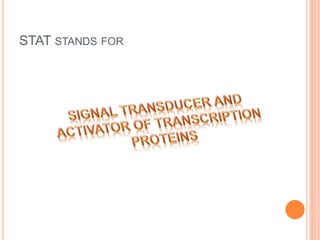
STAT STANDS FOR
INTRODUCTION
 The JAK-STAT signaling pathway is a chain of
interactions between proteins in a cell, and is involved in
processes such as immunity, cell division, cell
death and tumour formation.
 The pathway communicates information from chemical
signals outside of a cell to the cell nucleus, resulting in
the activation of genes through a process
called transcription.
 There are three key parts of JAK-STAT signalling: Janus
kinases (JAKs), signal transducer and activator of
transcription proteins (STATs), and receptors (which bind
the chemical signals).
 Disrupted JAK-STAT signaling may lead to a variety of
diseases, such as skin conditions, cancers, and
disorders affecting the immune system.
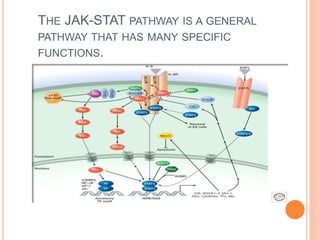
THE JAK-STAT PATHWAY IS A GENERAL
PATHWAY THAT HAS MANY SPECIFIC
FUNCTIONS.
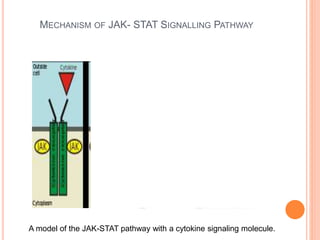
MECHANISM OF JAK- STAT SIGNALLING PATHWAY
A model of the JAK-STAT pathway with a cytokine signaling molecule.
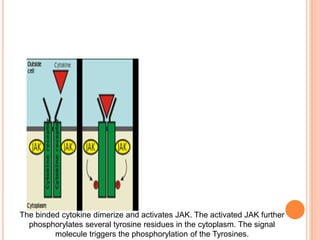
The binded cytokine dimerize and activates JAK. The activated JAK further
phosphorylates several tyrosine residues in the cytoplasm. The signal
molecule triggers the phosphorylation of the Tyrosines.
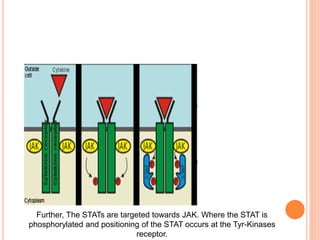
Further, The STATs are targeted towards JAK. Where the STAT is
phosphorylated and positioning of the STAT occurs at the Tyr-Kinases
receptor.
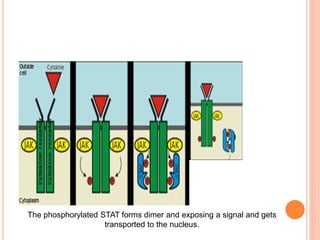
The phosphorylated STAT forms dimer and exposing a signal and gets
transported to the nucleus.
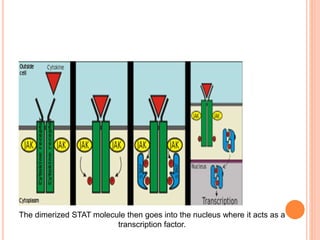
The dimerized STAT molecule then goes into the nucleus where it acts as a
transcription factor.
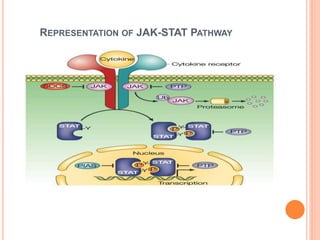
REPRESENTATION OF JAK-STAT PATHWAY
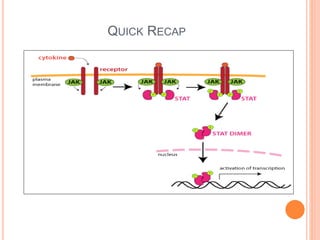
QUICK RECAP
 If the Protein Tyrosine Phosphotases
dephosphorylates the tyrosine kinase receptor and
STAT.
 SOCS(Suppressors of Cytokine Signaling) inhibit
STAT phosphorylation by binding and inhibiting JAK
or competing with STAT for phosphorylated
tyrosine.
 PIAS(Protein Inhibitor of Activated STAT) are in the
nucleus and different type correspond with different
STATs to inhibit Transcription.
CLINICAL SIGNIFICANCES
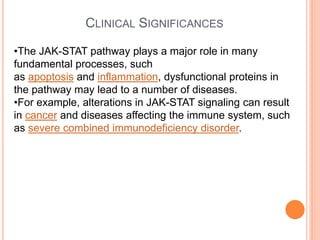
•The JAK-STAT pathway plays a major role in many
fundamental processes, such
as apoptosis and inflammation, dysfunctional proteins in
the pathway may lead to a number of diseases.
•For example, alterations in JAK-STAT signaling can result
in cancer and diseases affecting the immune system, such
as severe combined immunodeficiency disorder.
REFERENCES
1. Lehninger-Principles of Biochemistry,6th-Edition
(Pg. No. 457-458)
2. Harper’s Illustrated Biochemistry, 26th- Edition (Pg.
No. 467)
Jak  stat signaling pathway

Jak stat signaling pathway

  • 2.
    JAK-STAT SIGNALING PATHWAY PresentedBy – Deepak Chawhan M.Sc. (Semeter II) Sardar Patel Mahavidyalaya, Chandrapur Department of Microbiology (Session 2020-2021)
  • 3.
    CONTENT 1. Introduction 2. Mechanismof JAK-STAT Signaling Pathway 3. Representation of the JAK-STAT Pathway 4. Quick Recap of the JAK-STAT Pathway 5. Regulation of JAK-STAT Pathway 6. Clinical Significances 7. References
  • 4.
  • 5.
  • 6.
    INTRODUCTION  The JAK-STATsignaling pathway is a chain of interactions between proteins in a cell, and is involved in processes such as immunity, cell division, cell death and tumour formation.  The pathway communicates information from chemical signals outside of a cell to the cell nucleus, resulting in the activation of genes through a process called transcription.  There are three key parts of JAK-STAT signalling: Janus kinases (JAKs), signal transducer and activator of transcription proteins (STATs), and receptors (which bind the chemical signals).  Disrupted JAK-STAT signaling may lead to a variety of diseases, such as skin conditions, cancers, and disorders affecting the immune system.
  • 7.
    THE JAK-STAT PATHWAYIS A GENERAL PATHWAY THAT HAS MANY SPECIFIC FUNCTIONS.
  • 8.
    MECHANISM OF JAK-STAT SIGNALLING PATHWAY A model of the JAK-STAT pathway with a cytokine signaling molecule.
  • 9.
    The binded cytokinedimerize and activates JAK. The activated JAK further phosphorylates several tyrosine residues in the cytoplasm. The signal molecule triggers the phosphorylation of the Tyrosines.
  • 10.
    Further, The STATsare targeted towards JAK. Where the STAT is phosphorylated and positioning of the STAT occurs at the Tyr-Kinases receptor.
  • 11.
    The phosphorylated STATforms dimer and exposing a signal and gets transported to the nucleus.
  • 12.
    The dimerized STATmolecule then goes into the nucleus where it acts as a transcription factor.
  • 13.
  • 14.
  • 15.
     If theProtein Tyrosine Phosphotases dephosphorylates the tyrosine kinase receptor and STAT.  SOCS(Suppressors of Cytokine Signaling) inhibit STAT phosphorylation by binding and inhibiting JAK or competing with STAT for phosphorylated tyrosine.  PIAS(Protein Inhibitor of Activated STAT) are in the nucleus and different type correspond with different STATs to inhibit Transcription.
  • 16.
    CLINICAL SIGNIFICANCES •The JAK-STATpathway plays a major role in many fundamental processes, such as apoptosis and inflammation, dysfunctional proteins in the pathway may lead to a number of diseases. •For example, alterations in JAK-STAT signaling can result in cancer and diseases affecting the immune system, such as severe combined immunodeficiency disorder.
  • 17.
    REFERENCES 1. Lehninger-Principles ofBiochemistry,6th-Edition (Pg. No. 457-458) 2. Harper’s Illustrated Biochemistry, 26th- Edition (Pg. No. 467)