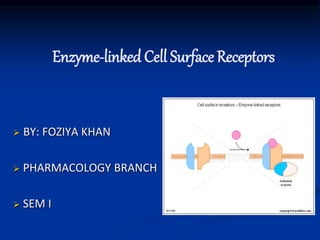
Enzyme-linked Cell Surface Receptors
 BY: FOZIYA KHAN
 PHARMACOLOGY BRANCH
 SEM I
CONTENTS
 Introduction
 Classification
 Receptor Tyrosine Kinases (RTKs)
 Tyrosine Protein Phosphorylation
 Subfamilies of RTKs
 Protein Tyrosine Kinases
 Signaling from Tyrosine Kinase Receptors
 Ras
INTRODUCTION
Also known as a catalytic receptors
 transmembrane receptor, where the binding of an
extracellular ligand causes enzymatic activity on the
intracellular side.
 integral membrane protein possessing both
enzymatic catalytic and receptor functions.
 Upon ligand binding a conformational change is
transmitted which activates the enzyme, initiating
signaling cascades.
Enzyme-linked Cell Surface Receptors
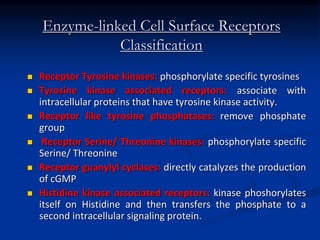
Classification
 Receptor Tyrosine kinases: phosphorylate specific tyrosines
 Tyrosine kinase associated receptors: associate with
intracellular proteins that have tyrosine kinase activity.
 Receptor like tyrosine phosphatases: remove phosphate
group
 Receptor Serine/ Threonine kinases: phosphorylate specific
Serine/ Threonine
 Receptor guanylyl cyclases: directly catalyzes the production
of cGMP
 Histidine kinase associated receptors: kinase phoshorylates
itself on Histidine and then transfers the phosphate to a
second intracellular signaling protein.
Receptor Tyrosine Kinases (RTKs)
 Intrinsic tyrosine kinase activity
 Soluble or membrane-bound ligands:
 Nerve growth factor, NGF
 Platelet-derived growth factor, PDGF
 Fibroblast growth factor, EGF
 Epidermal growth factor, EGF
 Insulin
 Downstream pathway activation:
 Ras-MAP kinase pathway
TYROSINE KINASE RECEPTORS
• these receptors traverse the membrane only
once
• respond exclusively to protein stimuli
– cytokines
– mitogenic growth factors:
• platelet derived growth factor
• epidermal growth factor
 Functions include:
 Cell proliferation, differentiation
 Cell survival
 Cellular metabolism
 Some RTKs have been discovered in cancer
research
 Her2, constitutively active form in breast cancer
 EGF-R overexpression in breast cancer
 Other RTKs have been covered in studies of
developmental mutations that block
differentiation
Outline
 Activated RTKs transmit signal to Ras protein
 Ras transduces signal to downstream serine-
threonine kinases
 Ultimate activation of MAP kinase
 Activation of transcription factors
Ligand binding to RTKs
 Most RTKs are monomeric
 ligand binding to EC domain induces
dimerization
 FGF binds to heparan sulfate enhancing its
binding to receptor: dimeric receptor-ligand
complex
 Some ligands are dimeric: direct dimerization of
receptors
 Insulin receptors occur naturally as a dimer
 Activation is due to the conformational change of the
receptor upon ligand binding
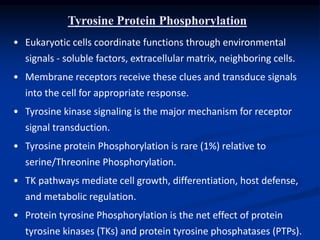
Tyrosine Protein Phosphorylation
• Eukaryotic cells coordinate functions through environmental
signals - soluble factors, extracellular matrix, neighboring cells.
• Membrane receptors receive these clues and transduce signals
into the cell for appropriate response.
• Tyrosine kinase signaling is the major mechanism for receptor
signal transduction.
• Tyrosine protein Phosphorylation is rare (1%) relative to
serine/Threonine Phosphorylation.
• TK pathways mediate cell growth, differentiation, host defense,
and metabolic regulation.
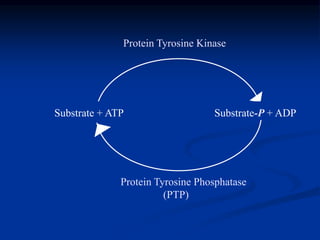
• Protein tyrosine Phosphorylation is the net effect of protein
tyrosine kinases (TKs) and protein tyrosine phosphatases (PTPs).
Substrate + ATP Substrate-P + ADP
Protein Tyrosine Kinase
Protein Tyrosine Phosphatase
(PTP)
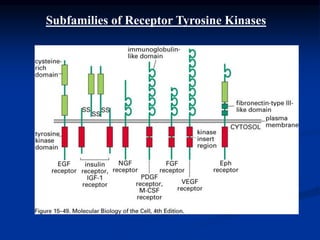
Subfamilies of Receptor Tyrosine Kinases
Protein Tyrosine Kinases (TKs)
Receptor tyrosine kinases (RTK)
– insulin receptor
– EGF receptor
– PDGF receptor
– TrkA
Non-receptor tyrosine kinases (NRTK)
– c-Src
– Janus kinases (Jak)
– Csk (C-terminal src kinase)
– Focal adhesion kinase (FAK)
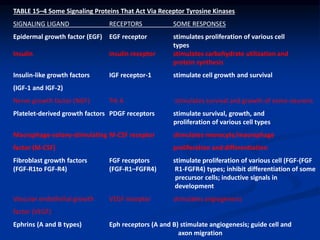
TABLE 15–4 Some Signaling Proteins That Act Via Receptor Tyrosine Kinases
SIGNALING LIGAND RECEPTORS SOME RESPONSES
Epidermal growth factor (EGF) EGF receptor stimulates proliferation of various cell
types
Insulin insulin receptor stimulates carbohydrate utilization and
protein synthesis
Insulin-like growth factors IGF receptor-1 stimulate cell growth and survival
(IGF-1 and IGF-2)
Nerve growth factor (NGF) Trk A stimulates survival and growth of some neurons
Platelet-derived growth factors PDGF receptors stimulate survival, growth, and
proliferation of various cell types
Macrophage-colony-stimulating M-CSF receptor stimulates monocyte/macrophage
factor (M-CSF) proliferation and differentiation
Fibroblast growth factors FGF receptors stimulate proliferation of various cell (FGF-(FGF
(FGF-R1to FGF-R4) (FGF-R1–FGFR4) R1-FGFR4) types; inhibit differentiation of some
precursor cells; inductive signals in
development
Vascular endothelial growth VEGF receptor stimulates angiogenesis
factor (VEGF)
Ephrins (A and B types) Eph receptors (A and B) stimulate angiogenesis; guide cell and
axon migration
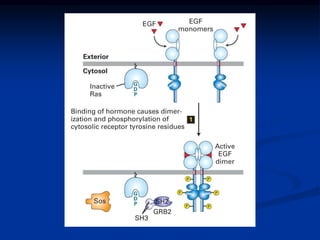
Signaling from tyrosine kinase receptors
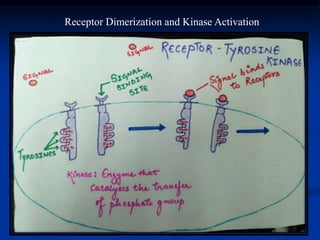
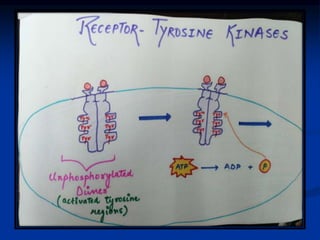
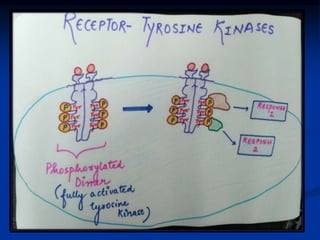
• Ligand induced dimerization
• Autophosphorylation
• Phosphorylation in the catalytic domain increase
the kinase activity
• Phosphorylation outside the catalytic domain
creates specific binding for other proteins.
• Autophosphorylated receptors bind to
signaling proteins that have SH2
(phosphotyrosine residues) domains
Receptor Dimerization and Kinase Activation
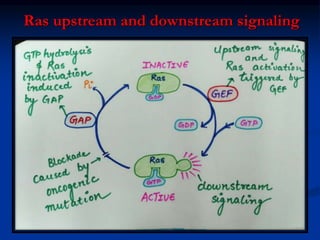
Ras
 Monomeric GTPase switch protein
 Its activation is enhanced by GEF
 GDP-GTP exchange
 Deactivation of Ras-GTP complex requires
GAP, which increases intrinsic GTPase activity
100 fold
 Lifetime of Ras-GTP is higher than that of G
 Ras is a small protein (170 aa. Vs 300 aa of G)
 G has a domain that functions like GAP
 Mutant ras proteins are associated with many
cancers
 Mutant ras can bind GTP but can not
hydrolyze it, and thus remain constitutively in
“on” state
 Most oncogenic ras proteins contain a
mutation in codon 12 (Gly)
 This blocks the binding of GAP to ras, and
prevents GTP hydrolysis.
Ras upstream and downstream signaling
Linking ras to RTKs
 Experimental evidences
 Fibroblasts were induced to proliferate with FGF
and EGF
 Anti-ras antibody microinjected: cell proliferation
arrest
 Injection of mutant ras proteins allows cell to
proliferate in the absence of growth factors.
 Ligand-bound RTKs activate ras! How?
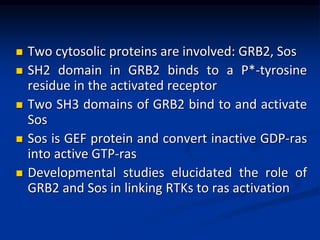
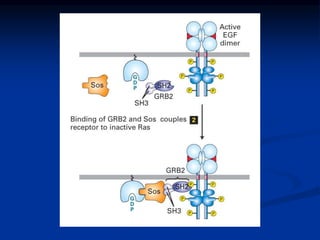
 Two cytosolic proteins are involved: GRB2, Sos
 SH2 domain in GRB2 binds to a P*-tyrosine
residue in the activated receptor
 Two SH3 domains of GRB2 bind to and activate
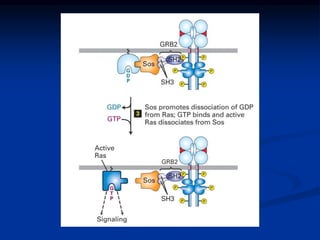
Sos
 Sos is GEF protein and convert inactive GDP-ras
into active GTP-ras
 Developmental studies elucidated the role of
GRB2 and Sos in linking RTKs to ras activation
Enzyme linked cell surface receptors

Enzyme linked cell surface receptors

  • 1.
    Enzyme-linked Cell SurfaceReceptors  BY: FOZIYA KHAN  PHARMACOLOGY BRANCH  SEM I
  • 2.
    CONTENTS  Introduction  Classification Receptor Tyrosine Kinases (RTKs)  Tyrosine Protein Phosphorylation  Subfamilies of RTKs  Protein Tyrosine Kinases  Signaling from Tyrosine Kinase Receptors  Ras
  • 3.
    INTRODUCTION Also known asa catalytic receptors  transmembrane receptor, where the binding of an extracellular ligand causes enzymatic activity on the intracellular side.  integral membrane protein possessing both enzymatic catalytic and receptor functions.  Upon ligand binding a conformational change is transmitted which activates the enzyme, initiating signaling cascades.
  • 4.
    Enzyme-linked Cell SurfaceReceptors Classification  Receptor Tyrosine kinases: phosphorylate specific tyrosines  Tyrosine kinase associated receptors: associate with intracellular proteins that have tyrosine kinase activity.  Receptor like tyrosine phosphatases: remove phosphate group  Receptor Serine/ Threonine kinases: phosphorylate specific Serine/ Threonine  Receptor guanylyl cyclases: directly catalyzes the production of cGMP  Histidine kinase associated receptors: kinase phoshorylates itself on Histidine and then transfers the phosphate to a second intracellular signaling protein.
  • 5.
    Receptor Tyrosine Kinases(RTKs)  Intrinsic tyrosine kinase activity  Soluble or membrane-bound ligands:  Nerve growth factor, NGF  Platelet-derived growth factor, PDGF  Fibroblast growth factor, EGF  Epidermal growth factor, EGF  Insulin  Downstream pathway activation:  Ras-MAP kinase pathway
  • 6.
    TYROSINE KINASE RECEPTORS •these receptors traverse the membrane only once • respond exclusively to protein stimuli – cytokines – mitogenic growth factors: • platelet derived growth factor • epidermal growth factor
  • 7.
     Functions include: Cell proliferation, differentiation  Cell survival  Cellular metabolism  Some RTKs have been discovered in cancer research  Her2, constitutively active form in breast cancer  EGF-R overexpression in breast cancer  Other RTKs have been covered in studies of developmental mutations that block differentiation
  • 8.
    Outline  Activated RTKstransmit signal to Ras protein  Ras transduces signal to downstream serine- threonine kinases  Ultimate activation of MAP kinase  Activation of transcription factors
  • 9.
    Ligand binding toRTKs  Most RTKs are monomeric  ligand binding to EC domain induces dimerization  FGF binds to heparan sulfate enhancing its binding to receptor: dimeric receptor-ligand complex  Some ligands are dimeric: direct dimerization of receptors  Insulin receptors occur naturally as a dimer  Activation is due to the conformational change of the receptor upon ligand binding
  • 10.
    Tyrosine Protein Phosphorylation •Eukaryotic cells coordinate functions through environmental signals - soluble factors, extracellular matrix, neighboring cells. • Membrane receptors receive these clues and transduce signals into the cell for appropriate response. • Tyrosine kinase signaling is the major mechanism for receptor signal transduction. • Tyrosine protein Phosphorylation is rare (1%) relative to serine/Threonine Phosphorylation. • TK pathways mediate cell growth, differentiation, host defense, and metabolic regulation. • Protein tyrosine Phosphorylation is the net effect of protein tyrosine kinases (TKs) and protein tyrosine phosphatases (PTPs).
  • 11.
    Substrate + ATPSubstrate-P + ADP Protein Tyrosine Kinase Protein Tyrosine Phosphatase (PTP)
  • 12.
    Subfamilies of ReceptorTyrosine Kinases
  • 13.
    Protein Tyrosine Kinases(TKs) Receptor tyrosine kinases (RTK) – insulin receptor – EGF receptor – PDGF receptor – TrkA Non-receptor tyrosine kinases (NRTK) – c-Src – Janus kinases (Jak) – Csk (C-terminal src kinase) – Focal adhesion kinase (FAK)
  • 14.
    TABLE 15–4 SomeSignaling Proteins That Act Via Receptor Tyrosine Kinases SIGNALING LIGAND RECEPTORS SOME RESPONSES Epidermal growth factor (EGF) EGF receptor stimulates proliferation of various cell types Insulin insulin receptor stimulates carbohydrate utilization and protein synthesis Insulin-like growth factors IGF receptor-1 stimulate cell growth and survival (IGF-1 and IGF-2) Nerve growth factor (NGF) Trk A stimulates survival and growth of some neurons Platelet-derived growth factors PDGF receptors stimulate survival, growth, and proliferation of various cell types Macrophage-colony-stimulating M-CSF receptor stimulates monocyte/macrophage factor (M-CSF) proliferation and differentiation Fibroblast growth factors FGF receptors stimulate proliferation of various cell (FGF-(FGF (FGF-R1to FGF-R4) (FGF-R1–FGFR4) R1-FGFR4) types; inhibit differentiation of some precursor cells; inductive signals in development Vascular endothelial growth VEGF receptor stimulates angiogenesis factor (VEGF) Ephrins (A and B types) Eph receptors (A and B) stimulate angiogenesis; guide cell and axon migration
  • 15.
    Signaling from tyrosinekinase receptors • Ligand induced dimerization • Autophosphorylation • Phosphorylation in the catalytic domain increase the kinase activity • Phosphorylation outside the catalytic domain creates specific binding for other proteins. • Autophosphorylated receptors bind to signaling proteins that have SH2 (phosphotyrosine residues) domains
  • 16.
    Receptor Dimerization andKinase Activation
  • 19.
    Ras  Monomeric GTPaseswitch protein  Its activation is enhanced by GEF  GDP-GTP exchange  Deactivation of Ras-GTP complex requires GAP, which increases intrinsic GTPase activity 100 fold  Lifetime of Ras-GTP is higher than that of G  Ras is a small protein (170 aa. Vs 300 aa of G)  G has a domain that functions like GAP
  • 20.
     Mutant rasproteins are associated with many cancers  Mutant ras can bind GTP but can not hydrolyze it, and thus remain constitutively in “on” state  Most oncogenic ras proteins contain a mutation in codon 12 (Gly)  This blocks the binding of GAP to ras, and prevents GTP hydrolysis.
  • 21.
    Ras upstream anddownstream signaling
  • 22.
    Linking ras toRTKs  Experimental evidences  Fibroblasts were induced to proliferate with FGF and EGF  Anti-ras antibody microinjected: cell proliferation arrest  Injection of mutant ras proteins allows cell to proliferate in the absence of growth factors.  Ligand-bound RTKs activate ras! How?
  • 23.
     Two cytosolicproteins are involved: GRB2, Sos  SH2 domain in GRB2 binds to a P*-tyrosine residue in the activated receptor  Two SH3 domains of GRB2 bind to and activate Sos  Sos is GEF protein and convert inactive GDP-ras into active GTP-ras  Developmental studies elucidated the role of GRB2 and Sos in linking RTKs to ras activation