Catalysis
Definition of Catalyst
 A substance that alters the reaction rate of a
particular chemical reaction
 chemically unchanged at the end of the
reaction
 2 classes : I) positive catalyst
==> increase the rate
II) negative catalyst (inhibitor)
==> decrease the rate
 How to change the rate of reaction???
Catalysis
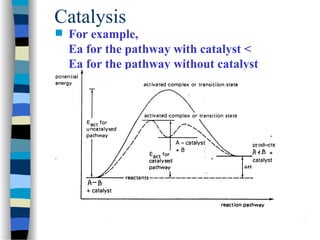
 By providing an alternative pathway (or
mechanism) with lower/ higher activation
energy.
Characteristics of catalysts
 The catalyst remains unchanged (in mass and
chemical composition ) in the reaction
(Activity of catalyst.)
 A small quantity of the catalyst is required.
e.g. One mole of colloid Pt catalyses
 The catalyst does not change the equilibrium
constant. But the equilibrium approaches
earlier.
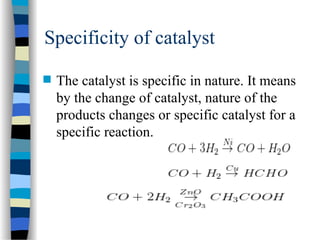
Specificity of catalyst
 The catalyst is specific in nature. It means
by the change of catalyst, nature of the
products changes or specific catalyst for a
specific reaction.
Characteristics of catalysts
 The catalyst can not make impossible reaction to
occur and does not intiate a reaction.
 Catalyst Poison: There are certain substances
which decrease or destroy the activity of the
catalyst. Such substances are known as catalytic
poisons. E.g. arsenic destroys the catalytic activity
of the platinum catalyst in the manufacture of
sulphuric acid.
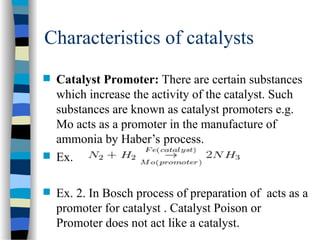
Characteristics of catalysts
 Catalyst Promoter: There are certain substances
which increase the activity of the catalyst. Such
substances are known as catalyst promoters e.g.
Mo acts as a promoter in the manufacture of
ammonia by Haber’s process.
 Ex.
 Ex. 2. In Bosch process of preparation of acts as a
promoter for catalyst . Catalyst Poison or
Promoter does not act like a catalyst.
Characteristics of catalysts
 The catalyst exhibits maximum activity at a
particular temperature which is known
as optimum temperature.
Catalysis
 For example,
Ea for the pathway with catalyst <
Ea for the pathway without catalyst
Catalysis
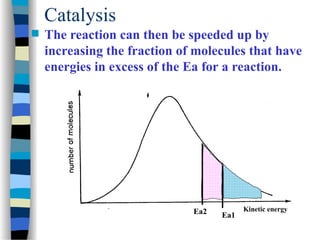
 The reaction can then be speeded up by
increasing the fraction of molecules that have
energies in excess of the Ea for a reaction.
Ea1
Ea2 Kinetic energy
Theory of catalysis
 (1) Intermediate compound theory of
catalysis
 adsorption theory of catalysis
Intermediate compound theory
of catalysis
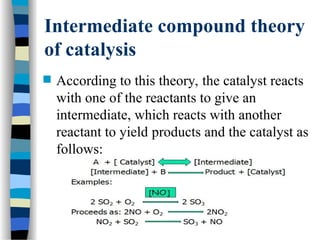
 According to this theory, the catalyst reacts
with one of the reactants to give an
intermediate, which reacts with another
reactant to yield products and the catalyst as
follows:
adsorption theory of catalysis
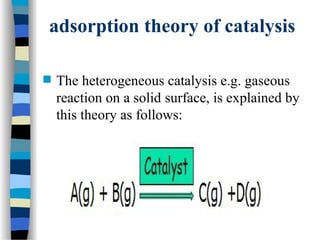
 The heterogeneous catalysis e.g. gaseous
reaction on a solid surface, is explained by
this theory as follows:
Adsorption theory
 Following four steps are involved in the
heterogeneous catalysis:
 (i)Diffusion of reactants at the surface of
the catalyst.
 (ii)Adsorption of reactants at the surface.
 (iii)Reaction of reactants at the surface.
 (iv)Desorption of products from the surface.
Type of catalysis
 Homogenous catalysis
 Heterogeneous catalysis
 Positive catalysis
 Negative catalysis
 Acid Catalysis
 Base catalysis
 Autocatalysis
 Enzyme catalysis
Types of Catalyst
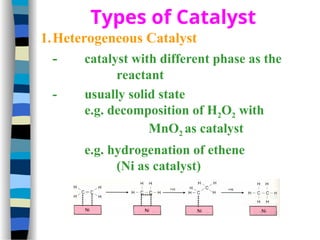
1.Heterogeneous Catalyst
- catalyst with different phase as the
reactant
- usually solid state
e.g. decomposition of H2O2 with
MnO2 as catalyst
e.g. hydrogenation of ethene
(Ni as catalyst)
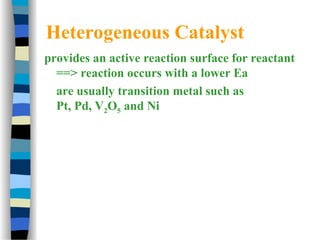
Heterogeneous Catalyst
provides an active reaction surface for reactant
==> reaction occurs with a lower Ea
are usually transition metal such as
Pt, Pd, V2O5 and Ni
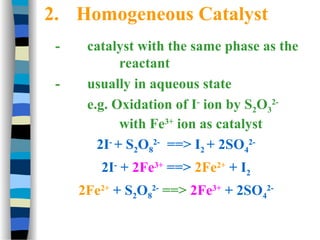
2. Homogeneous Catalyst
- catalyst with the same phase as the
reactant
- usually in aqueous state
e.g. Oxidation of I-
ion by S2O3
2-
with Fe3+
ion as catalyst
2I-
+ S2O8
2-
==> I2 + 2SO4
2-
2I-
+ 2Fe3+
==> 2Fe2+
+ I2
2Fe2+
+ S2O8
2-
==> 2Fe3+
+ 2SO4
2-
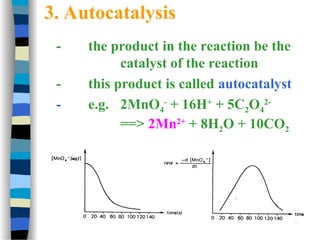
3. Autocatalysis
- the product in the reaction be the
catalyst of the reaction
- this product is called autocatalyst
- e.g. 2MnO4
-
+ 16H+
+ 5C2O4
2-
==> 2Mn2+
+ 8H2O + 10CO2
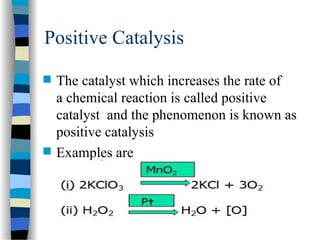
Positive Catalysis
 The catalyst which increases the rate of
a chemical reaction is called positive
catalyst and the phenomenon is known as
positive catalysis
 Examples are
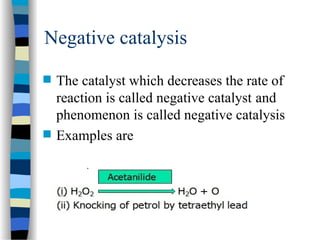
Negative catalysis
 The catalyst which decreases the rate of
reaction is called negative catalyst and
phenomenon is called negative catalysis
 Examples are
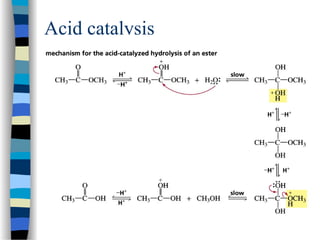
Acid catalysis
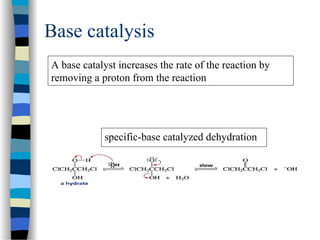
Base catalysis
A base catalyst increases the rate of the reaction by
removing a proton from the reaction
specific-base catalyzed dehydration
Enzyme catalysis
 Enzymes are Biological catalysts
 Enzymes control chemical reactions that
take place in the cytoplasm.
 Catalase in an example of an enzyme
made by living cells
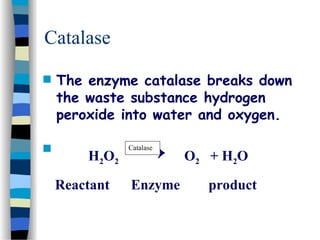
Catalase
 The enzyme catalase breaks down
the waste substance hydrogen
peroxide into water and oxygen.

H2O2 → O2 + H2O
Reactant Enzyme product
Catalase
Properties of enzymes
 Speed up reactions.
 Made of protein.
 Are specific
 Not used up during the reaction
 Require optimum conditions at which
they work best
 At high temperature they become
denatured
Mechanism and kinetics of
enzyme catalysed reactions
The Michaelis-Menten Equation
[E] + [S] [ES] [P] + [E]
k2
k-1
k1
Assumption: k-1 >> k2 i.e. the equilibrium of [E], [S] and [ES] is not
affected by k2:
KS = =
k-1
k1
[E] [S]
[ES]
KS = dissociation constant
[ES] = „Michaelis-Menten“ complex
Since we assume equilibrium it follows:
[E] [S] k1 = [ES] k-1 solving for [E] =
k-1
k1
[ES]
[S]
(1)
In addition we know that: [E]total = [E] + [ES] (2)
This relationship is called the „enzyme conservation equation“
The Michaelis-Menten approach
[E] =
k-1
k1
[ES]
[S]
(1)
[E]total = [E] + [ES] (2)
Solving equation (2) for [E] and substituting [E] in equation (1):
[E]total = [ES] (1 + )
k-1
k1 [S]
We also know that the velocity of the reaction equals:
v = k2 [ES]
(3)
(4)
Solving equation (3) and (4) for [ES] and then substituting [ES] in
equation (3) with [ES] = v / k2 then yields:
k2
(1 + )
k-1
k1 [S]
v = =
[E]total k2 [E]total
[S]
k-1
k1
[S]
We define k-1/ k1 as KM, the Michaelis-Menten constant and the
maximal velocity as vmax = k2 [E]total
This simplifies the above equation to:
v =
k2
vmax [S]
[S] + KM
if [S] >> KM then v = vmax
if [S] = KM then v =
vmax
2
Therefore KM can be viewed as the substrate concentration with half-
maximal velocity (dimension M, typically mM to nM)
+
Michaelis-Menten plot
v
[S]
vmax
KM
vmax
2
1st order zero order
Linear plot of substrate concentration versus velocity
yields a hyperbolic relationship:
Industrial Application of
Catalysts
A) Usage of Catalysts in Chemical
Industries
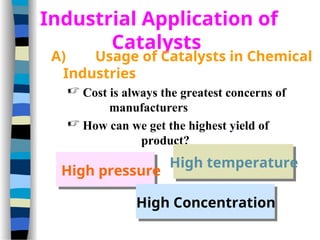
 Cost is always the greatest concerns of
manufacturers
 How can we get the highest yield of
product?
High pressure
High temperature
High Concentration
Industrial Application of
Catalysts
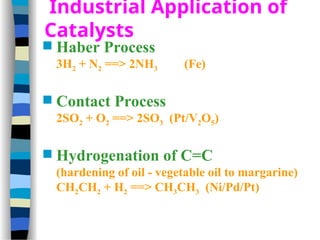
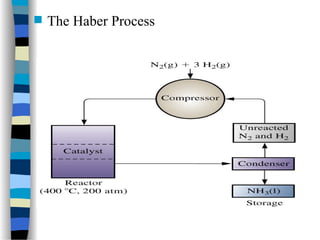
 Haber Process
3H2 + N2 ==> 2NH3 (Fe)
 Contact Process
2SO2 + O2 ==> 2SO3 (Pt/V2O5)
 Hydrogenation of C=C
(hardening of oil - vegetable oil to margarine)
CH2CH2 + H2 ==> CH3CH3 (Ni/Pd/Pt)
The Haber Process
An essential industrial process
The Haber Process
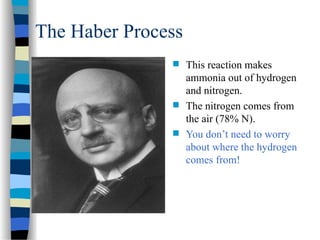
 This reaction makes
ammonia out of hydrogen
and nitrogen.
 The nitrogen comes from
the air (78% N).
 You don’t need to worry
about where the hydrogen
comes from!
The Haber Process
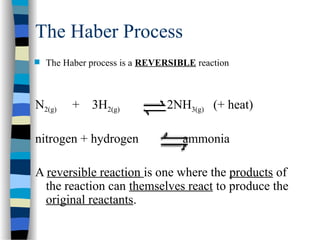
 The Haber process is a REVERSIBLE reaction
N2(g) + 3H2(g) 2NH3(g) (+ heat)
nitrogen + hydrogen ammonia
A reversible reaction is one where the products of
the reaction can themselves react to produce the
original reactants.
 The Haber Process
The Haber Process
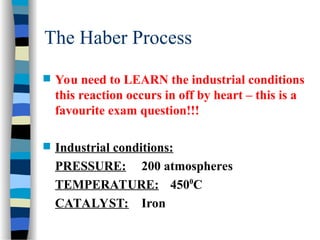
 You need to LEARN the industrial conditions
this reaction occurs in off by heart – this is a
favourite exam question!!!
 Industrial conditions:
PRESSURE: 200 atmospheres
TEMPERATURE: 4500
C
CATALYST: Iron
The Haber
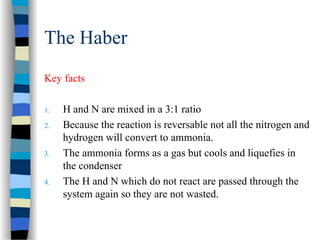
Key facts
1. H and N are mixed in a 3:1 ratio
2. Because the reaction is reversable not all the nitrogen and
hydrogen will convert to ammonia.
3. The ammonia forms as a gas but cools and liquefies in
the condenser
4. The H and N which do not react are passed through the
system again so they are not wasted.
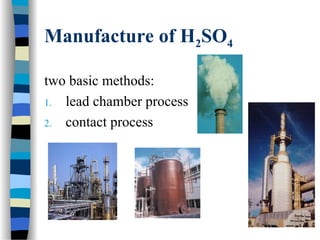
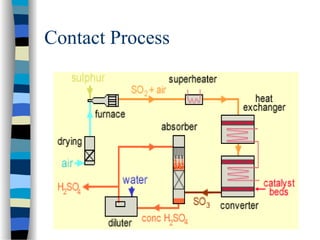
Manufacture of H2SO4
two basic methods:
1. lead chamber process
2. contact process
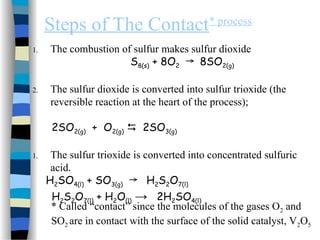
Steps of The Contact* process
1. The combustion of sulfur makes sulfur dioxide
S8(s) + 8O2 8SO
→ 2(g)
2. The sulfur dioxide is converted into sulfur trioxide (the
reversible reaction at the heart of the process);
2SO2(g) + O2(g)  2SO3(g)
1. The sulfur trioxide is converted into concentrated sulfuric
acid.
H2SO4(l) + SO3(g) H
→ 2S2O7(l)
H2S2O7(l) + H2O(l) → 2H2SO4(l)
* Called “contact” since the molecules of the gases O2 and
SO2 are in contact with the surface of the solid catalyst, V2O5
Contact Process
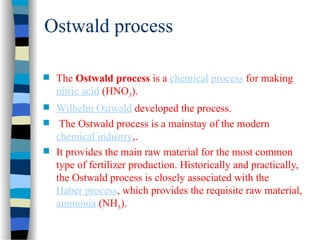
Ostwald process
 The Ostwald process is a chemical process for making
nitric acid (HNO3).
 Wilhelm Ostwald developed the process.
 The Ostwald process is a mainstay of the modern
chemical industry,.
 It provides the main raw material for the most common
type of fertilizer production. Historically and practically,
the Ostwald process is closely associated with the
Haber process, which provides the requisite raw material,
ammonia (NH3).
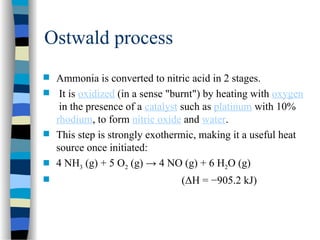
Ostwald process
 Ammonia is converted to nitric acid in 2 stages.
 It is oxidized (in a sense "burnt") by heating with oxygen
in the presence of a catalyst such as platinum with 10%
rhodium, to form nitric oxide and water.
 This step is strongly exothermic, making it a useful heat
source once initiated:
 4 NH3 (g) + 5 O2 (g) → 4 NO (g) + 6 H2O (g)
 (ΔH = −905.2 kJ)
Ostwald process
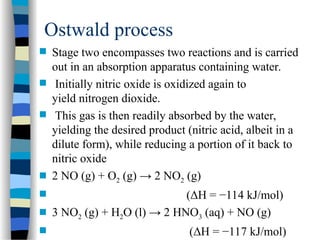
 Stage two encompasses two reactions and is carried
out in an absorption apparatus containing water.
 Initially nitric oxide is oxidized again to
yield nitrogen dioxide.
 This gas is then readily absorbed by the water,
yielding the desired product (nitric acid, albeit in a
dilute form), while reducing a portion of it back to
nitric oxide
 2 NO (g) + O2 (g) → 2 NO2 (g)
 (ΔH = −114 kJ/mol)
 3 NO2 (g) + H2O (l) → 2 HNO3 (aq) + NO (g)
 (ΔH = −117 kJ/mol)
Ostwald process
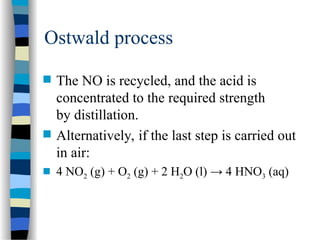
 The NO is recycled, and the acid is
concentrated to the required strength
by distillation.
 Alternatively, if the last step is carried out
in air:
 4 NO2 (g) + O2 (g) + 2 H2O (l) → 4 HNO3 (aq)
Ostwald process
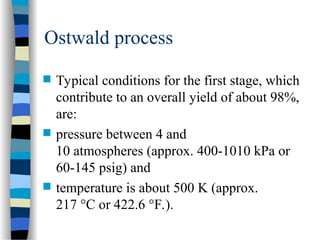
 Typical conditions for the first stage, which
contribute to an overall yield of about 98%,
are:
 pressure between 4 and
10 atmospheres (approx. 400-1010 kPa or
60-145 psig) and
 temperature is about 500 K (approx.
217 °C or 422.6 °F.).
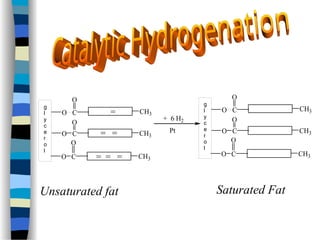
Hydrogenation of oils
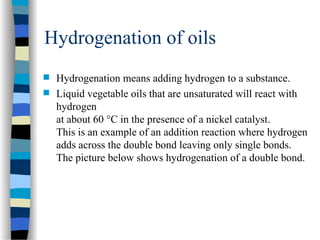
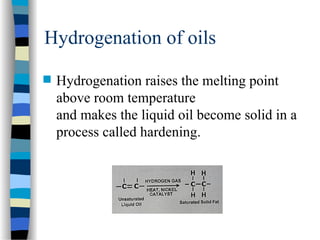
 Hydrogenation means adding hydrogen to a substance.
 Liquid vegetable oils that are unsaturated will react with
hydrogen
at about 60 °C in the presence of a nickel catalyst.
This is an example of an addition reaction where hydrogen
adds across the double bond leaving only single bonds.
The picture below shows hydrogenation of a double bond.
Hydrogenation of oils
 Hydrogenation raises the melting point
above room temperature
and makes the liquid oil become solid in a
process called hardening.
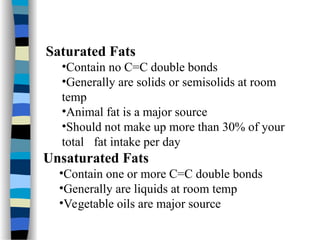
Saturated Fats
•Contain no C=C double bonds
•Generally are solids or semisolids at room
temp
•Animal fat is a major source
•Should not make up more than 30% of your
total fat intake per day
Unsaturated Fats
•Contain one or more C=C double bonds
•Generally are liquids at room temp
•Vegetable oils are major source
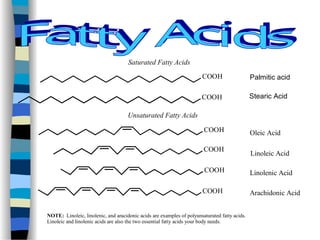
COOH
COOH
COOH
COOH
COOH
COOH
Palmitic acid
Stearic Acid
Saturated Fatty Acids
Unsaturated Fatty Acids
Oleic Acid
Linoleic Acid
Linolenic Acid
Arachidonic Acid
NOTE: Linoleic, linolenic, and aracidonic acids are examples of polyunsaturated fatty acids.
Linoleic and linolenic acids are also the two essential fatty acids your body needs.
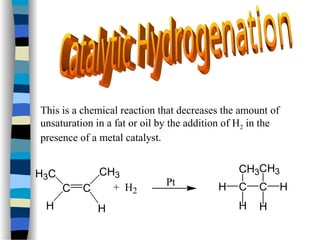
This is a chemical reaction that decreases the amount of
unsaturation in a fat or oil by the addition of H2 in the
presence of a metal catalyst.
C C
H3C
H
CH3
H
+ H2
Pt C C
CH3
H
CH3
H
H H
Unsaturated fat Saturated Fat
O C
O C
O C
CH3
=
CH3
= =
CH3
= = =
g
l
y
c
e
r
o
l
O
O
O
+ 6 H2
Pt
O C
O C
O C
CH3
CH3
CH3
g
l
y
c
e
r
o
l
O
O
O
• If no oxygen is available, cells can obtain energy
through the process of anaerobic respiration.
• A common anaerobic process is fermentation.
• Fermentation is not an efficient process and
results in the formation of far fewer ATP
molecules than aerobic respiration.
There are two primary fermentation processes:
1. Lactic Acid Fermentation
2. Alcohol Fermentation
Fermentation
Alcoholic fermentation
 Alcoholic fermentation, also referred to as
ethanol fermentation, is a biological
process in which molecules such as glucose,
fructose, and sucrose are converted into
cellular energy and thereby produce
ethanol and carbon dioxide as metabolic
waste products
Thank You

catyalisis.presentation in engineering ppt

  • 1.
  • 2.
    Definition of Catalyst A substance that alters the reaction rate of a particular chemical reaction  chemically unchanged at the end of the reaction  2 classes : I) positive catalyst ==> increase the rate II) negative catalyst (inhibitor) ==> decrease the rate  How to change the rate of reaction???
  • 3.
    Catalysis  By providingan alternative pathway (or mechanism) with lower/ higher activation energy.
  • 4.
    Characteristics of catalysts The catalyst remains unchanged (in mass and chemical composition ) in the reaction (Activity of catalyst.)  A small quantity of the catalyst is required. e.g. One mole of colloid Pt catalyses  The catalyst does not change the equilibrium constant. But the equilibrium approaches earlier.
  • 5.
    Specificity of catalyst The catalyst is specific in nature. It means by the change of catalyst, nature of the products changes or specific catalyst for a specific reaction.
  • 6.
    Characteristics of catalysts The catalyst can not make impossible reaction to occur and does not intiate a reaction.  Catalyst Poison: There are certain substances which decrease or destroy the activity of the catalyst. Such substances are known as catalytic poisons. E.g. arsenic destroys the catalytic activity of the platinum catalyst in the manufacture of sulphuric acid.
  • 7.
    Characteristics of catalysts Catalyst Promoter: There are certain substances which increase the activity of the catalyst. Such substances are known as catalyst promoters e.g. Mo acts as a promoter in the manufacture of ammonia by Haber’s process.  Ex.  Ex. 2. In Bosch process of preparation of acts as a promoter for catalyst . Catalyst Poison or Promoter does not act like a catalyst.
  • 8.
    Characteristics of catalysts The catalyst exhibits maximum activity at a particular temperature which is known as optimum temperature.
  • 9.
    Catalysis  For example, Eafor the pathway with catalyst < Ea for the pathway without catalyst
  • 10.
    Catalysis  The reactioncan then be speeded up by increasing the fraction of molecules that have energies in excess of the Ea for a reaction. Ea1 Ea2 Kinetic energy
  • 11.
    Theory of catalysis (1) Intermediate compound theory of catalysis  adsorption theory of catalysis
  • 12.
    Intermediate compound theory ofcatalysis  According to this theory, the catalyst reacts with one of the reactants to give an intermediate, which reacts with another reactant to yield products and the catalyst as follows:
  • 13.
    adsorption theory ofcatalysis  The heterogeneous catalysis e.g. gaseous reaction on a solid surface, is explained by this theory as follows:
  • 14.
    Adsorption theory  Followingfour steps are involved in the heterogeneous catalysis:  (i)Diffusion of reactants at the surface of the catalyst.  (ii)Adsorption of reactants at the surface.  (iii)Reaction of reactants at the surface.  (iv)Desorption of products from the surface.
  • 15.
    Type of catalysis Homogenous catalysis  Heterogeneous catalysis  Positive catalysis  Negative catalysis  Acid Catalysis  Base catalysis  Autocatalysis  Enzyme catalysis
  • 16.
    Types of Catalyst 1.HeterogeneousCatalyst - catalyst with different phase as the reactant - usually solid state e.g. decomposition of H2O2 with MnO2 as catalyst e.g. hydrogenation of ethene (Ni as catalyst)
  • 17.
    Heterogeneous Catalyst provides anactive reaction surface for reactant ==> reaction occurs with a lower Ea are usually transition metal such as Pt, Pd, V2O5 and Ni
  • 18.
    2. Homogeneous Catalyst -catalyst with the same phase as the reactant - usually in aqueous state e.g. Oxidation of I- ion by S2O3 2- with Fe3+ ion as catalyst 2I- + S2O8 2- ==> I2 + 2SO4 2- 2I- + 2Fe3+ ==> 2Fe2+ + I2 2Fe2+ + S2O8 2- ==> 2Fe3+ + 2SO4 2-
  • 19.
    3. Autocatalysis - theproduct in the reaction be the catalyst of the reaction - this product is called autocatalyst - e.g. 2MnO4 - + 16H+ + 5C2O4 2- ==> 2Mn2+ + 8H2O + 10CO2
  • 20.
    Positive Catalysis  Thecatalyst which increases the rate of a chemical reaction is called positive catalyst and the phenomenon is known as positive catalysis  Examples are
  • 21.
    Negative catalysis  Thecatalyst which decreases the rate of reaction is called negative catalyst and phenomenon is called negative catalysis  Examples are
  • 22.
  • 23.
    Base catalysis A basecatalyst increases the rate of the reaction by removing a proton from the reaction specific-base catalyzed dehydration
  • 24.
    Enzyme catalysis  Enzymesare Biological catalysts  Enzymes control chemical reactions that take place in the cytoplasm.  Catalase in an example of an enzyme made by living cells
  • 25.
    Catalase  The enzymecatalase breaks down the waste substance hydrogen peroxide into water and oxygen.  H2O2 → O2 + H2O Reactant Enzyme product Catalase
  • 26.
    Properties of enzymes Speed up reactions.  Made of protein.  Are specific  Not used up during the reaction  Require optimum conditions at which they work best  At high temperature they become denatured
  • 27.
    Mechanism and kineticsof enzyme catalysed reactions
  • 28.
    The Michaelis-Menten Equation [E]+ [S] [ES] [P] + [E] k2 k-1 k1 Assumption: k-1 >> k2 i.e. the equilibrium of [E], [S] and [ES] is not affected by k2: KS = = k-1 k1 [E] [S] [ES] KS = dissociation constant [ES] = „Michaelis-Menten“ complex Since we assume equilibrium it follows: [E] [S] k1 = [ES] k-1 solving for [E] = k-1 k1 [ES] [S] (1) In addition we know that: [E]total = [E] + [ES] (2) This relationship is called the „enzyme conservation equation“
  • 29.
    The Michaelis-Menten approach [E]= k-1 k1 [ES] [S] (1) [E]total = [E] + [ES] (2) Solving equation (2) for [E] and substituting [E] in equation (1): [E]total = [ES] (1 + ) k-1 k1 [S] We also know that the velocity of the reaction equals: v = k2 [ES] (3) (4) Solving equation (3) and (4) for [ES] and then substituting [ES] in equation (3) with [ES] = v / k2 then yields:
  • 30.
    k2 (1 + ) k-1 k1[S] v = = [E]total k2 [E]total [S] k-1 k1 [S] We define k-1/ k1 as KM, the Michaelis-Menten constant and the maximal velocity as vmax = k2 [E]total This simplifies the above equation to: v = k2 vmax [S] [S] + KM if [S] >> KM then v = vmax if [S] = KM then v = vmax 2 Therefore KM can be viewed as the substrate concentration with half- maximal velocity (dimension M, typically mM to nM) +
  • 31.
    Michaelis-Menten plot v [S] vmax KM vmax 2 1st orderzero order Linear plot of substrate concentration versus velocity yields a hyperbolic relationship:
  • 32.
    Industrial Application of Catalysts A)Usage of Catalysts in Chemical Industries  Cost is always the greatest concerns of manufacturers  How can we get the highest yield of product? High pressure High temperature High Concentration
  • 33.
    Industrial Application of Catalysts Haber Process 3H2 + N2 ==> 2NH3 (Fe)  Contact Process 2SO2 + O2 ==> 2SO3 (Pt/V2O5)  Hydrogenation of C=C (hardening of oil - vegetable oil to margarine) CH2CH2 + H2 ==> CH3CH3 (Ni/Pd/Pt)
  • 34.
    The Haber Process Anessential industrial process
  • 35.
    The Haber Process This reaction makes ammonia out of hydrogen and nitrogen.  The nitrogen comes from the air (78% N).  You don’t need to worry about where the hydrogen comes from!
  • 36.
    The Haber Process The Haber process is a REVERSIBLE reaction N2(g) + 3H2(g) 2NH3(g) (+ heat) nitrogen + hydrogen ammonia A reversible reaction is one where the products of the reaction can themselves react to produce the original reactants.
  • 37.
  • 38.
    The Haber Process You need to LEARN the industrial conditions this reaction occurs in off by heart – this is a favourite exam question!!!  Industrial conditions: PRESSURE: 200 atmospheres TEMPERATURE: 4500 C CATALYST: Iron
  • 39.
    The Haber Key facts 1.H and N are mixed in a 3:1 ratio 2. Because the reaction is reversable not all the nitrogen and hydrogen will convert to ammonia. 3. The ammonia forms as a gas but cools and liquefies in the condenser 4. The H and N which do not react are passed through the system again so they are not wasted.
  • 40.
    Manufacture of H2SO4 twobasic methods: 1. lead chamber process 2. contact process
  • 41.
    Steps of TheContact* process 1. The combustion of sulfur makes sulfur dioxide S8(s) + 8O2 8SO → 2(g) 2. The sulfur dioxide is converted into sulfur trioxide (the reversible reaction at the heart of the process); 2SO2(g) + O2(g)  2SO3(g) 1. The sulfur trioxide is converted into concentrated sulfuric acid. H2SO4(l) + SO3(g) H → 2S2O7(l) H2S2O7(l) + H2O(l) → 2H2SO4(l) * Called “contact” since the molecules of the gases O2 and SO2 are in contact with the surface of the solid catalyst, V2O5
  • 42.
  • 43.
    Ostwald process  TheOstwald process is a chemical process for making nitric acid (HNO3).  Wilhelm Ostwald developed the process.  The Ostwald process is a mainstay of the modern chemical industry,.  It provides the main raw material for the most common type of fertilizer production. Historically and practically, the Ostwald process is closely associated with the Haber process, which provides the requisite raw material, ammonia (NH3).
  • 44.
    Ostwald process  Ammoniais converted to nitric acid in 2 stages.  It is oxidized (in a sense "burnt") by heating with oxygen in the presence of a catalyst such as platinum with 10% rhodium, to form nitric oxide and water.  This step is strongly exothermic, making it a useful heat source once initiated:  4 NH3 (g) + 5 O2 (g) → 4 NO (g) + 6 H2O (g)  (ΔH = −905.2 kJ)
  • 45.
    Ostwald process  Stagetwo encompasses two reactions and is carried out in an absorption apparatus containing water.  Initially nitric oxide is oxidized again to yield nitrogen dioxide.  This gas is then readily absorbed by the water, yielding the desired product (nitric acid, albeit in a dilute form), while reducing a portion of it back to nitric oxide  2 NO (g) + O2 (g) → 2 NO2 (g)  (ΔH = −114 kJ/mol)  3 NO2 (g) + H2O (l) → 2 HNO3 (aq) + NO (g)  (ΔH = −117 kJ/mol)
  • 46.
    Ostwald process  TheNO is recycled, and the acid is concentrated to the required strength by distillation.  Alternatively, if the last step is carried out in air:  4 NO2 (g) + O2 (g) + 2 H2O (l) → 4 HNO3 (aq)
  • 47.
    Ostwald process  Typicalconditions for the first stage, which contribute to an overall yield of about 98%, are:  pressure between 4 and 10 atmospheres (approx. 400-1010 kPa or 60-145 psig) and  temperature is about 500 K (approx. 217 °C or 422.6 °F.).
  • 48.
    Hydrogenation of oils Hydrogenation means adding hydrogen to a substance.  Liquid vegetable oils that are unsaturated will react with hydrogen at about 60 °C in the presence of a nickel catalyst. This is an example of an addition reaction where hydrogen adds across the double bond leaving only single bonds. The picture below shows hydrogenation of a double bond.
  • 49.
    Hydrogenation of oils Hydrogenation raises the melting point above room temperature and makes the liquid oil become solid in a process called hardening.
  • 50.
    Saturated Fats •Contain noC=C double bonds •Generally are solids or semisolids at room temp •Animal fat is a major source •Should not make up more than 30% of your total fat intake per day Unsaturated Fats •Contain one or more C=C double bonds •Generally are liquids at room temp •Vegetable oils are major source
  • 51.
    COOH COOH COOH COOH COOH COOH Palmitic acid Stearic Acid SaturatedFatty Acids Unsaturated Fatty Acids Oleic Acid Linoleic Acid Linolenic Acid Arachidonic Acid NOTE: Linoleic, linolenic, and aracidonic acids are examples of polyunsaturated fatty acids. Linoleic and linolenic acids are also the two essential fatty acids your body needs.
  • 52.
    This is achemical reaction that decreases the amount of unsaturation in a fat or oil by the addition of H2 in the presence of a metal catalyst. C C H3C H CH3 H + H2 Pt C C CH3 H CH3 H H H
  • 53.
    Unsaturated fat SaturatedFat O C O C O C CH3 = CH3 = = CH3 = = = g l y c e r o l O O O + 6 H2 Pt O C O C O C CH3 CH3 CH3 g l y c e r o l O O O
  • 54.
    • If nooxygen is available, cells can obtain energy through the process of anaerobic respiration. • A common anaerobic process is fermentation. • Fermentation is not an efficient process and results in the formation of far fewer ATP molecules than aerobic respiration. There are two primary fermentation processes: 1. Lactic Acid Fermentation 2. Alcohol Fermentation Fermentation
  • 55.
    Alcoholic fermentation  Alcoholicfermentation, also referred to as ethanol fermentation, is a biological process in which molecules such as glucose, fructose, and sucrose are converted into cellular energy and thereby produce ethanol and carbon dioxide as metabolic waste products
  • 56.