NITROGEN
BY:-
Department of CHEMISTRY
IR CHEM 2
Course Content
Reason for inertness of nitrogen and active nitrogen
Manufacture of Ammonia by Haber’s process
Chemical properties of ammonia [Action with water, Conc. HCl, O2,
CuSO4 solution, FeCl3 solution, Mercurous nitrate paper ]
Applications of ammonia, Harmful effects of ammonia
 Oxy-acids of nitrogen (name and formula)
 Manufacture of nitric acid by Ostwald's process
Chemical properties of nitric acid [HNO3 as an acid and oxidizing agent
(action with zinc, magnesium, iron, copper, sulphur, carbon, SO2 and
H2S)
 Ring test for nitrate ion.
IR CHEM 3
Nitrogen
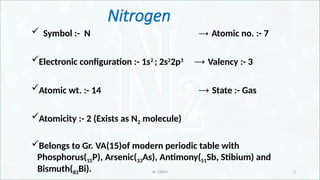
 Symbol :- N → Atomic no. :- 7
Electronic configuration :- 1s2
; 2s2
2p3
→ Valency :- 3
Atomic wt. :- 14 → State :- Gas
Atomicity :- 2 (Exists as N2 molecule)
Belongs to Gr. VA(15)of modern periodic table with
Phosphorus(15P), Arsenic(33As), Antimony(51Sb, Stibium) and
Bismuth(83Bi).
IR CHEM 4
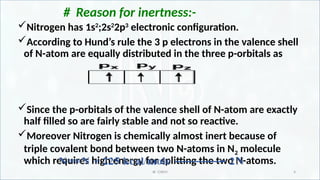
# Reason for inertness:-
Nitrogen has 1s2
;2s2
2p3
electronic configuration.
According to Hund’s rule the 3 p electrons in the valence shell
of N-atom are equally distributed in the three p-orbitals as
Since the p-orbitals of the valence shell of N-atom are exactly
half filled so are fairly stable and not so reactive.
Moreover Nitrogen is chemically almost inert because of
triple covalent bond between two N-atoms in N2 molecule
which requires high energy for splitting the two N-atoms.
IR CHEM 5
Contd……
# Active nitrogen:-
 The nitrogen atom produced by the action of electric discharge on
nitrogen gas at low pressure is called active nitrogen.
 In this process, a characteristic yellow-orange glow is produced which
persists for several hours even after the discharge is shut off.
 It indicates the slow release of energy which was first observed by
Warberg in 1884.
 The presence of N-atoms in the afterglow categorizes active nitrogen
as a free radical phenomenon, perhaps the first free radical system
studied in gas phase.
IR CHEM 6
# Ammonia(NH3)
Manufacture by Haber’s Process:-
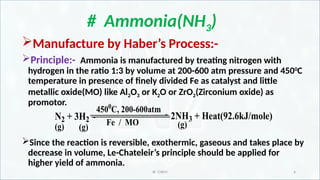
Principle:- Ammonia is manufactured by treating nitrogen with
hydrogen in the ratio 1:3 by volume at 200-600 atm pressure and 4500
C
temperature in presence of finely divided Fe as catalyst and little
metallic oxide(MO) like Al2O3 or K2O or ZrO2(Zirconium oxide) as
promotor.
Since the reaction is reversible, exothermic, gaseous and takes place by
decrease in volume, Le-Chateleir’s principle should be applied for
higher yield of ammonia.
N2 + 3H2
4500
C, 200-600atm
Fe / MO
2NH3 + Heat(92.6kJ/mole)
(g) (g) (g)
IR CHEM 7
Contd…...
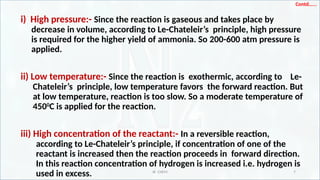
i) High pressure:- Since the reaction is gaseous and takes place by
decrease in volume, according to Le-Chateleir’s principle, high pressure
is required for the higher yield of ammonia. So 200-600 atm pressure is
applied.
ii) Low temperature:- Since the reaction is exothermic, according to Le-
Chateleir’s principle, low temperature favors the forward reaction. But
at low temperature, reaction is too slow. So a moderate temperature of
4500
C is applied for the reaction.
iii) High concentration of the reactant:- In a reversible reaction,
according to Le-Chateleir’s principle, if concentration of one of the
reactant is increased then the reaction proceeds in forward direction.
In this reaction concentration of hydrogen is increased i.e. hydrogen is
used in excess.
IR CHEM 8
Contd…..
iv) Presence of Catalyst:- In this reaction finely divided iron is used as
catalyst with little metallic oxide(MO) like Al2O3 or K2O or
ZrO2(Zirconium oxide) as promotor.
v) Purity of gases:- In a gaseous reaction, if the reacting gases are
pure then the reaction becomes faster.
So nitrogen and hydrogen
should be used in pure and
dry state.
IR CHEM 9
Contd……
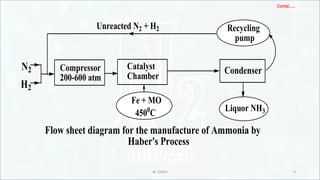
H2
N2
Unreacted N2 + H2 Recycling
pump
Condenser
Catalyst
Chamber
Compressor
200-600 atm
Fe + MO
4500
C Liquor NH3
Flow sheet diagram for the manufacture of Ammonia by
Haber's Process
IR CHEM 10
# Properties of Ammonia:-
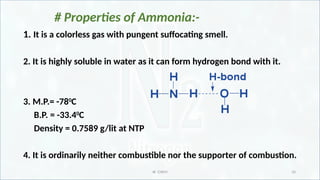
1. It is a colorless gas with pungent suffocating smell.
2. It is highly soluble in water as it can form hydrogen bond with it.
3. M.P.= -780
C
B.P. = -33.40
C
Density = 0.7589 g/lit at NTP
4. It is ordinarily neither combustible nor the supporter of combustion.
IR CHEM 11
Contd…..
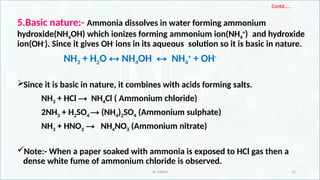
5.Basic nature:- Ammonia dissolves in water forming ammonium
hydroxide(NH4OH) which ionizes forming ammonium ion(NH4
+
) and hydroxide
ion(OH-
). Since it gives OH-
ions in its aqueous solution so it is basic in nature.
NH3 + H2O ↔ NH4OH ↔ NH4
+
+ OH-
Since it is basic in nature, it combines with acids forming salts.
NH3 + HCl → NH4Cl ( Ammonium chloride)
2NH3 + H2SO4 → (NH4)2SO4 (Ammonium sulphate)
NH3 + HNO3 → NH4NO3 (Ammonium nitrate)
Note:- When a paper soaked with ammonia is exposed to HCl gas then a
dense white fume of ammonium chloride is observed.
IR CHEM 12
Contd……
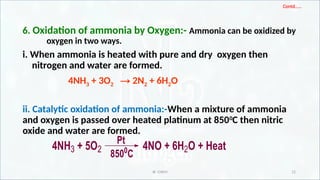
6. Oxidation of ammonia by Oxygen:- Ammonia can be oxidized by
oxygen in two ways.
i. When ammonia is heated with pure and dry oxygen then
nitrogen and water are formed.
4NH3 + 3O2 → 2N2 + 6H2O
ii. Catalytic oxidation of ammonia:-When a mixture of ammonia
and oxygen is passed over heated platinum at 8500
C then nitric
oxide and water are formed.
4NH3 + 5O2 4NO + 6H2O + Heat
Pt
8500
C
IR CHEM 13
Contd…...
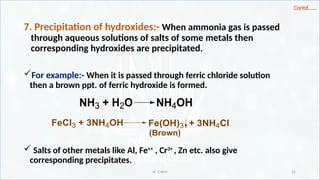
7. Precipitation of hydroxides:- When ammonia gas is passed
through aqueous solutions of salts of some metals then
corresponding hydroxides are precipitated.
For example:- When it is passed through ferric chloride solution
then a brown ppt. of ferric hydroxide is formed.
 Salts of other metals like Al, Fe++
, Cr3+
, Zn etc. also give
corresponding precipitates.
NH3 + H2O NH4OH
FeCl3 + 3NH4OH Fe(OH)3 + 3NH4Cl
(Brown)
IR CHEM 14
Contd……
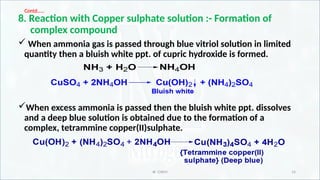
8. Reaction with Copper sulphate solution :- Formation of
complex compound
 When ammonia gas is passed through blue vitriol solution in limited
quantity then a bluish white ppt. of cupric hydroxide is formed.
When excess ammonia is passed then the bluish white ppt. dissolves
and a deep blue solution is obtained due to the formation of a
complex, tetrammine copper(II)sulphate.
IR CHEM 15
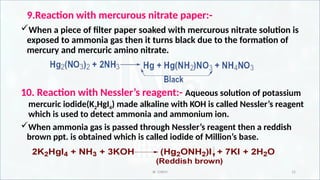
9.Reaction with mercurous nitrate paper:-
When a piece of filter paper soaked with mercurous nitrate solution is
exposed to ammonia gas then it turns black due to the formation of
mercury and mercuric amino nitrate.
10. Reaction with Nessler’s reagent:- Aqueous solution of potassium
mercuric iodide(K2HgI4) made alkaline with KOH is called Nessler’s reagent
which is used to detect ammonia and ammonium ion.
When ammonia gas is passed through Nessler’s reagent then a reddish
brown ppt. is obtained which is called iodide of Million’s base.
IR CHEM 16
Contd.…..
@ Uses:-
1. It is used as refrigerating agent in refrigeration plants of ice making machines.
2. It is used in the manufacture of washing soda by Solvay ammonia soda
process.
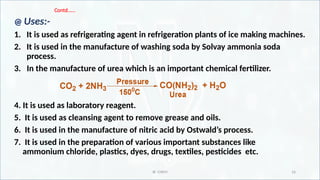
3. In the manufacture of urea which is an important chemical fertilizer.
4. It is used as laboratory reagent.
5. It is used as cleansing agent to remove grease and oils.
6. It is used in the manufacture of nitric acid by Ostwald’s process.
7. It is used in the preparation of various important substances like
ammonium chloride, plastics, dyes, drugs, textiles, pesticides etc.
IR CHEM 17
# Harmful effects of ammonia:-
Ammonia is a harmful chemical to human health. The severity of
health effects depends upon the route of exposure, the dose and
the duration of exposure.
Exposure to high concentration of ammonia in air causes burning
of eyes, nose, throat and respiratory tract.
It may result in blindness, lung damage or death.
Inhalation of low concentration of ammonia can cause coughing,
nose and throat irritation.
IR CHEM 18
Contd.…..
Ammonia vapours are toxic to livestock like dairy, swine and poultry.
Ammonia emitted by rotting agricultural slurry and fertilizer factories
and burning coal mines cause air pollution.
In the atmosphere, ammonia reacts with acid pollutants like SO2, NO2
etc. and produce ammonium(NH4
+
) containing aerosol which affects
human breathing.
 A large release of ammonia vapours may burn the leaves of vegetation.
IR CHEM 19
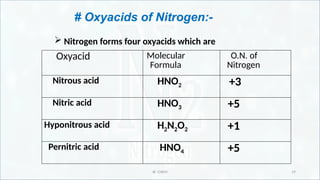
# Oxyacids of Nitrogen:-
 Nitrogen forms four oxyacids which are
Oxyacid Molecular
Formula
O.N. of
Nitrogen
Nitrous acid HNO2 +3
Nitric acid HNO3 +5
Hyponitrous acid H2N2O2 +1
Pernitric acid HNO4 +5
IR CHEM 20
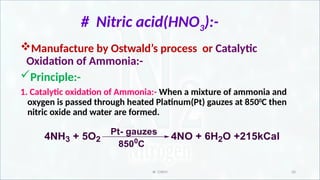
# Nitric acid(HNO3):-
Manufacture by Ostwald’s process or Catalytic
Oxidation of Ammonia:-
Principle:-
1. Catalytic oxidation of Ammonia:- When a mixture of ammonia and
oxygen is passed through heated Platinum(Pt) gauzes at 8500
C then
nitric oxide and water are formed.
4NH3 + 5O2
Pt- gauzes
8500
C
4NO + 6H2O +215kCal
IR CHEM 21
Contd…..
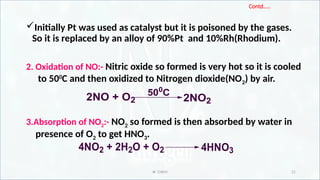
Initially Pt was used as catalyst but it is poisoned by the gases.
So it is replaced by an alloy of 90%Pt and 10%Rh(Rhodium).
2. Oxidation of NO:- Nitric oxide so formed is very hot so it is cooled
to 500
C and then oxidized to Nitrogen dioxide(NO2) by air.
3.Absorption of NO2:- NO2 so formed is then absorbed by water in
presence of O2 to get HNO3.
2NO + O2
500
C
2NO2
4NO2 + 2H2O + O2 4HNO3
IR CHEM 22
Contd……
q
Catalytic Convertor
90%Pt + 10%Rh
8500
C
NH3
NO + H2O
+ O2
Cooler
500
C
NO + O2
Oxidation
chamber
2NO + O2
2NO2
NO2 + O2
Absorption
tower
dil.HNO3
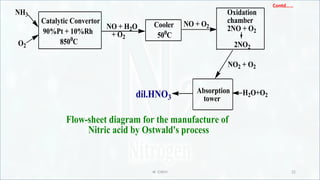
Flow-sheet diagram for the manufacture of
Nitric acid by Ostwald's process
O2
H2O+O2
IR CHEM 23
Contd…..
# Properties:-
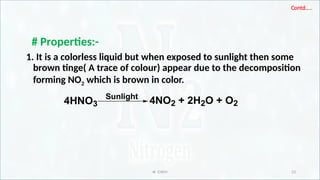
1. It is a colorless liquid but when exposed to sunlight then some
brown tinge( A trace of colour) appear due to the decomposition
forming NO2 which is brown in color.
4HNO3
Sunlight
4NO2 + 2H2O + O2
IR CHEM 24
Contd……
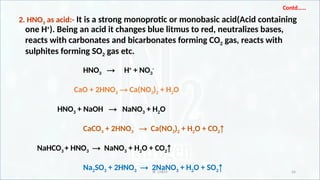
2. HNO3 as acid:- It is a strong monoprotic or monobasic acid(Acid containing
one H+
). Being an acid it changes blue litmus to red, neutralizes bases,
reacts with carbonates and bicarbonates forming CO2 gas, reacts with
sulphites forming SO2 gas etc.
HNO3 → H+
+ NO3
-
CaO + 2HNO3 → Ca(NO3)2 + H2O
HNO3 + NaOH → NaNO3 + H2O
CaCO3 + 2HNO3 → Ca(NO3)2 + H2O + CO2↑
NaHCO3 + HNO3 → NaNO3 + H2O + CO2↑
Na2SO3 + 2HNO3 → 2NaNO3 + H2O + SO2↑
IR CHEM 25
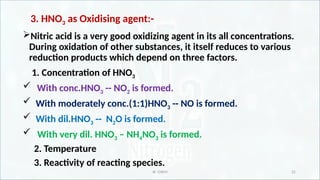
3. HNO3 as Oxidising agent:-
Nitric acid is a very good oxidizing agent in its all concentrations.
During oxidation of other substances, it itself reduces to various
reduction products which depend on three factors.
1. Concentration of HNO3
 With conc.HNO3 -- NO2 is formed.
 With moderately conc.(1:1)HNO3 -- NO is formed.
 With dil.HNO3 -- N2O is formed.
 With very dil. HNO3 – NH4NO3 is formed.
2. Temperature
3. Reactivity of reacting species.
IR CHEM 26
Contd…...
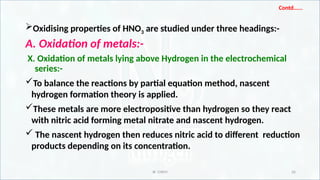
Oxidising properties of HNO3 are studied under three headings:-
A. Oxidation of metals:-
X. Oxidation of metals lying above Hydrogen in the electrochemical
series:-
To balance the reactions by partial equation method, nascent
hydrogen formation theory is applied.
These metals are more electropositive than hydrogen so they react
with nitric acid forming metal nitrate and nascent hydrogen.
 The nascent hydrogen then reduces nitric acid to different reduction
products depending on its concentration.
IR CHEM 27
Contd…...
a. Oxidation of Zinc:-
i. With conc.HNO3:- Zinc nitrate, water and NO2 gas are formed.
ii. With 1:1 HNO3:- Zinc nitrate, water and NO gas are formed.
Zn + 2HNO3 Zn(NO3)2 +2[H]
HNO3 + [H] H2O + NO2 ] x 2
Zn + 4HNO3 Zn(NO3)2 + 2H2O + 2NO2
IR CHEM 28
Contd…...
iii. With dil. HNO3:- Zinc nitrate, water and N2O gas are formed.
iv. With very dil.HNO3:- Zinc nitrate, ammonium nitrate and water
are formed.
Zn + 2HNO3 Zn(NO3)2 + 2[H] ] x 4
2HNO3 +8[H] 5H2O + N2O
4Zn + 10HNO3 4Zn(NO3)2 + 5H2O + N2O
IR CHEM 29
Contd…...
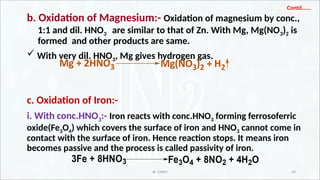
b. Oxidation of Magnesium:- Oxidation of magnesium by conc.,
1:1 and dil. HNO3 are similar to that of Zn. With Mg, Mg(NO3)2 is
formed and other products are same.
 With very dil. HNO3, Mg gives hydrogen gas.
c. Oxidation of Iron:-
i. With conc.HNO3:- Iron reacts with conc.HNO3 forming ferrosoferric
oxide(Fe3O4) which covers the surface of iron and HNO3 cannot come in
contact with the surface of iron. Hence reaction stops. It means iron
becomes passive and the process is called passivity of iron.
IR CHEM 30
Contd…...
ii. With 1:1 HNO3:- Iron reacts with 1:1 HNO3 forming ferric nitrate,
NO2 gas and water.
iii. With dil. HNO3:- Iron reacts with dil HNO3 forming ferrous nitrate,
N2O gas and water.
Fe+ 3HNO3 Fe(NO3)3 +3[H]
HNO3 + [H] H2O + NO2 ] x 3
Fe + 6HNO3 Fe(NO3)3 + 3H2O + 3NO2
Fe+ 2HNO3 Fe(NO3)2 +2[H] x 4
2HNO3 + 8[H] 5H2O + N2O
4Fe + 10HNO3 4Fe(NO3)2 + 5H2O + N2O
IR CHEM 31
Contd…...
iv. With very dil.HNO3:- Iron reacts with very dil HNO3 forming ferrous
nitrate, ammonium nitrate and water.
Y. Oxidation of metals lying below Hydrogen in the
electrochemical series:-
Only conc. and 1:1 HNO3 can oxidize the metals lying below
hydrogen in the electrochemical series.
Fe + 2HNO3 Fe(NO3)2 + 2[H] ] x 4
HNO3 +8[H] 3H2O + NH3
4Fe + 10HNO3 4Fe(NO3)2 +
NH3 + HNO3 NH4NO3
NH4NO3+ 3H2O
IR CHEM 32
Contd…...
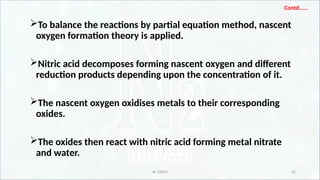
To balance the reactions by partial equation method, nascent
oxygen formation theory is applied.
Nitric acid decomposes forming nascent oxygen and different
reduction products depending upon the concentration of it.
The nascent oxygen oxidises metals to their corresponding
oxides.
The oxides then react with nitric acid forming metal nitrate
and water.
IR CHEM 33
a. Oxidation of Copper
i. With conc. HNO3:- Cupric nitrate, water and NO2 gas are formed.
ii. With 1:1 HNO3:- Cupric nitrate, water and NO gas are formed.
H2O + 2NO2 + [O]
Cu + [O] CuO
CuO + 2HNO3 Cu(NO3)2 + H2O
Cu + 4HNO3 Cu(NO3)2 + 2H2O + 2NO2
2HNO3
H2O + 2NO + 3[O]
Cu + [O] CuO] x 3
CuO + 2HNO3 Cu(NO3)2 + H2O ]x 3
3Cu + 8HNO3 3Cu(NO3)2 + 4H2O + 2NO
2HNO3
IR CHEM 34
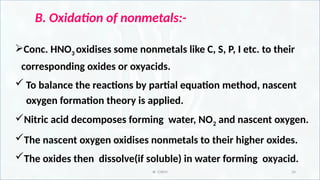
B. Oxidation of nonmetals:-
Conc. HNO3 oxidises some nonmetals like C, S, P, I etc. to their
corresponding oxides or oxyacids.
 To balance the reactions by partial equation method, nascent
oxygen formation theory is applied.
Nitric acid decomposes forming water, NO2 and nascent oxygen.
The nascent oxygen oxidises nonmetals to their higher oxides.
The oxides then dissolve(if soluble) in water forming oxyacid.
IR CHEM 35
Contd…...
a. Oxidation of Carbon:- Carbon is oxidised to carbon dioxide by
conc. HNO3.
b. Oxidation of Sulphur:- Sulphur is oxidised to sulphuric acid by
conc. HNO3.
2HNO3 H2O + 2NO2 + [O] ]x 2
C + 2[O] CO2
C + 4HNO3 2H2O + 4NO2 + CO2
2HNO3 H2O + 2NO2 + [O] ]x 3
S + 3[O] SO3
S + 6HNO3 H2SO4 + 2H2O + 6NO2
SO3 + H2O H2SO4
IR CHEM 36
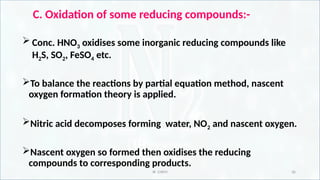
C. Oxidation of some reducing compounds:-
 Conc. HNO3 oxidises some inorganic reducing compounds like
H2S, SO2, FeSO4 etc.
To balance the reactions by partial equation method, nascent
oxygen formation theory is applied.
Nitric acid decomposes forming water, NO2 and nascent oxygen.
Nascent oxygen so formed then oxidises the reducing
compounds to corresponding products.
IR CHEM 37
Contd…...
a. Oxidation of hydrogen sulphide(H2S):- H2S is oxidised to sulphur
by conc.HNO3.
b. Oxidation of Sulphur dioxide(SO2):- SO2 is oxidised to sulphuric
acid by conc.HNO3.
2HNO3 H2O + 2NO2 + [O]
H2S + [O] H2O + S
H2S + 2HNO3 2H2O + 2NO2 + S
2HNO3 H2O + 2NO2 + [O]
SO2 + H2O + [O]
SO2 + 2HNO3 H2SO4 + 2NO2
H2SO4
IR CHEM 38
Contd.…..
c. Oxidation of Ferrous sulphate(FeSO4):- FeSO4 is oxidised to
ferric sulphate by conc.HNO3 in presence of dil. H2SO4.
2HNO3 H2O + 2NO2 + [O]
2FeSO4 + H2SO4 + [O]
2FeSO4 + 2HNO3 + H2SO4
Fe2(SO4)3 + H2O
Fe2(SO4)3 + 2H2O + 2NO2
IR CHEM 39
# Ring test for nitrate(NO3
-
):-
Nitrate ion is tested in the lab by Ring test.
For the test, dil.HNO3 or solution of any nitrate salt is taken in a
clean test tube, double volume conc.H2SO4 is added, cooled and
freshly prepared ferrous sulphate solution is added slowly by
inclining the test tube.
Formation of brown ring at the junction of two liquids indicate the
presence of NO3
-
ion.
IR CHEM 40
Contd…..
NO3
-
+ H2SO4 → HNO3 + HSO4
-
2HNO3 → H2O + 2NO + 3[O]
2FeSO4 + H2SO4 + [O] → Fe2(SO4)3 + H2O
FeSO4 +5H2O + NO → [Fe(H2O)5NO]SO4
(Pentaaquanitrosyl iron(II)sulphate)
(Brown ring)
# Uses:-
1. Widely used in the manufacture of chemical fertilizers like
ammonium nitrate, calcium ammonium nitrate(CAN) etc.
2. Used in the manufacture of artificial silk.
IR CHEM 41
Contd…...
3. Used in the manufacture of explosives like dynamite,
trinitrotoluene(TNT), nitroglycerine etc.
4. Used in the manufacture of various dyes, drugs, polymers like
nylon etc.
5. Used as nitrating agent in organic reactions.
6. Used as lab reagent.
IR CHEM 42
Some MCQs
1. Which one of the following is the proper condition for the manufacture of
ammonia by Haber’s process?
a. Low pressure and high temperature b. High pressure and temperature
c. High pressure and low temperature d. Low pressure and temperature
2. When excess aq. ammonia is added to blue vitriol solution then
a. Brown ppt. is formed b. Bluish white ppt. is formed
c. White ppt. is formed d. Deep blue colored complex is formed.
3. Ammonia is dried using …..
a. conc. H2SO4 b. CaO c. P2O5 d. Fused CaCl2
4. Ammonia is not used ……
a. as lab reagent. b. in the manufacture of nitric acid.
c. as refrigerating agent. d. in the manufacture of explosives.
IR CHEM 43
Contd……
5. Which of the following substance is oxidized during the manufacture of
nitric acid?
a. H2O b. NO2 c. NH3 d. O2
6. Light decomposes nitric acid forming gases which are …..
a. NO and O2 b. NO2 and NO c. NO2 and O2 d. NO, NO2 and O2
7. Which of the following metal displaces H2 from very dil. Nitric acid?
a. Mn b. Fe c. Zn d. Cu
8. Which of the following metal becomes passive on treatment with
conc. nitric acid?
a. Zn b. Sn c. Cu d. Fe
9. Which of the following gas has color?
a. NO b. N2O c. NO2 d. N2O5

3 Nitrogen.pptxsssssssssddddddddddddddddd

  • 1.
  • 2.
    IR CHEM 2 CourseContent Reason for inertness of nitrogen and active nitrogen Manufacture of Ammonia by Haber’s process Chemical properties of ammonia [Action with water, Conc. HCl, O2, CuSO4 solution, FeCl3 solution, Mercurous nitrate paper ] Applications of ammonia, Harmful effects of ammonia  Oxy-acids of nitrogen (name and formula)  Manufacture of nitric acid by Ostwald's process Chemical properties of nitric acid [HNO3 as an acid and oxidizing agent (action with zinc, magnesium, iron, copper, sulphur, carbon, SO2 and H2S)  Ring test for nitrate ion.
  • 3.
    IR CHEM 3 Nitrogen Symbol :- N → Atomic no. :- 7 Electronic configuration :- 1s2 ; 2s2 2p3 → Valency :- 3 Atomic wt. :- 14 → State :- Gas Atomicity :- 2 (Exists as N2 molecule) Belongs to Gr. VA(15)of modern periodic table with Phosphorus(15P), Arsenic(33As), Antimony(51Sb, Stibium) and Bismuth(83Bi).
  • 4.
    IR CHEM 4 #Reason for inertness:- Nitrogen has 1s2 ;2s2 2p3 electronic configuration. According to Hund’s rule the 3 p electrons in the valence shell of N-atom are equally distributed in the three p-orbitals as Since the p-orbitals of the valence shell of N-atom are exactly half filled so are fairly stable and not so reactive. Moreover Nitrogen is chemically almost inert because of triple covalent bond between two N-atoms in N2 molecule which requires high energy for splitting the two N-atoms.
  • 5.
    IR CHEM 5 Contd…… #Active nitrogen:-  The nitrogen atom produced by the action of electric discharge on nitrogen gas at low pressure is called active nitrogen.  In this process, a characteristic yellow-orange glow is produced which persists for several hours even after the discharge is shut off.  It indicates the slow release of energy which was first observed by Warberg in 1884.  The presence of N-atoms in the afterglow categorizes active nitrogen as a free radical phenomenon, perhaps the first free radical system studied in gas phase.
  • 6.
    IR CHEM 6 #Ammonia(NH3) Manufacture by Haber’s Process:- Principle:- Ammonia is manufactured by treating nitrogen with hydrogen in the ratio 1:3 by volume at 200-600 atm pressure and 4500 C temperature in presence of finely divided Fe as catalyst and little metallic oxide(MO) like Al2O3 or K2O or ZrO2(Zirconium oxide) as promotor. Since the reaction is reversible, exothermic, gaseous and takes place by decrease in volume, Le-Chateleir’s principle should be applied for higher yield of ammonia. N2 + 3H2 4500 C, 200-600atm Fe / MO 2NH3 + Heat(92.6kJ/mole) (g) (g) (g)
  • 7.
    IR CHEM 7 Contd…... i)High pressure:- Since the reaction is gaseous and takes place by decrease in volume, according to Le-Chateleir’s principle, high pressure is required for the higher yield of ammonia. So 200-600 atm pressure is applied. ii) Low temperature:- Since the reaction is exothermic, according to Le- Chateleir’s principle, low temperature favors the forward reaction. But at low temperature, reaction is too slow. So a moderate temperature of 4500 C is applied for the reaction. iii) High concentration of the reactant:- In a reversible reaction, according to Le-Chateleir’s principle, if concentration of one of the reactant is increased then the reaction proceeds in forward direction. In this reaction concentration of hydrogen is increased i.e. hydrogen is used in excess.
  • 8.
    IR CHEM 8 Contd….. iv)Presence of Catalyst:- In this reaction finely divided iron is used as catalyst with little metallic oxide(MO) like Al2O3 or K2O or ZrO2(Zirconium oxide) as promotor. v) Purity of gases:- In a gaseous reaction, if the reacting gases are pure then the reaction becomes faster. So nitrogen and hydrogen should be used in pure and dry state.
  • 9.
    IR CHEM 9 Contd…… H2 N2 UnreactedN2 + H2 Recycling pump Condenser Catalyst Chamber Compressor 200-600 atm Fe + MO 4500 C Liquor NH3 Flow sheet diagram for the manufacture of Ammonia by Haber's Process
  • 10.
    IR CHEM 10 #Properties of Ammonia:- 1. It is a colorless gas with pungent suffocating smell. 2. It is highly soluble in water as it can form hydrogen bond with it. 3. M.P.= -780 C B.P. = -33.40 C Density = 0.7589 g/lit at NTP 4. It is ordinarily neither combustible nor the supporter of combustion.
  • 11.
    IR CHEM 11 Contd….. 5.Basicnature:- Ammonia dissolves in water forming ammonium hydroxide(NH4OH) which ionizes forming ammonium ion(NH4 + ) and hydroxide ion(OH- ). Since it gives OH- ions in its aqueous solution so it is basic in nature. NH3 + H2O ↔ NH4OH ↔ NH4 + + OH- Since it is basic in nature, it combines with acids forming salts. NH3 + HCl → NH4Cl ( Ammonium chloride) 2NH3 + H2SO4 → (NH4)2SO4 (Ammonium sulphate) NH3 + HNO3 → NH4NO3 (Ammonium nitrate) Note:- When a paper soaked with ammonia is exposed to HCl gas then a dense white fume of ammonium chloride is observed.
  • 12.
    IR CHEM 12 Contd…… 6.Oxidation of ammonia by Oxygen:- Ammonia can be oxidized by oxygen in two ways. i. When ammonia is heated with pure and dry oxygen then nitrogen and water are formed. 4NH3 + 3O2 → 2N2 + 6H2O ii. Catalytic oxidation of ammonia:-When a mixture of ammonia and oxygen is passed over heated platinum at 8500 C then nitric oxide and water are formed. 4NH3 + 5O2 4NO + 6H2O + Heat Pt 8500 C
  • 13.
    IR CHEM 13 Contd…... 7.Precipitation of hydroxides:- When ammonia gas is passed through aqueous solutions of salts of some metals then corresponding hydroxides are precipitated. For example:- When it is passed through ferric chloride solution then a brown ppt. of ferric hydroxide is formed.  Salts of other metals like Al, Fe++ , Cr3+ , Zn etc. also give corresponding precipitates. NH3 + H2O NH4OH FeCl3 + 3NH4OH Fe(OH)3 + 3NH4Cl (Brown)
  • 14.
    IR CHEM 14 Contd…… 8.Reaction with Copper sulphate solution :- Formation of complex compound  When ammonia gas is passed through blue vitriol solution in limited quantity then a bluish white ppt. of cupric hydroxide is formed. When excess ammonia is passed then the bluish white ppt. dissolves and a deep blue solution is obtained due to the formation of a complex, tetrammine copper(II)sulphate.
  • 15.
    IR CHEM 15 9.Reactionwith mercurous nitrate paper:- When a piece of filter paper soaked with mercurous nitrate solution is exposed to ammonia gas then it turns black due to the formation of mercury and mercuric amino nitrate. 10. Reaction with Nessler’s reagent:- Aqueous solution of potassium mercuric iodide(K2HgI4) made alkaline with KOH is called Nessler’s reagent which is used to detect ammonia and ammonium ion. When ammonia gas is passed through Nessler’s reagent then a reddish brown ppt. is obtained which is called iodide of Million’s base.
  • 16.
    IR CHEM 16 Contd.….. @Uses:- 1. It is used as refrigerating agent in refrigeration plants of ice making machines. 2. It is used in the manufacture of washing soda by Solvay ammonia soda process. 3. In the manufacture of urea which is an important chemical fertilizer. 4. It is used as laboratory reagent. 5. It is used as cleansing agent to remove grease and oils. 6. It is used in the manufacture of nitric acid by Ostwald’s process. 7. It is used in the preparation of various important substances like ammonium chloride, plastics, dyes, drugs, textiles, pesticides etc.
  • 17.
    IR CHEM 17 #Harmful effects of ammonia:- Ammonia is a harmful chemical to human health. The severity of health effects depends upon the route of exposure, the dose and the duration of exposure. Exposure to high concentration of ammonia in air causes burning of eyes, nose, throat and respiratory tract. It may result in blindness, lung damage or death. Inhalation of low concentration of ammonia can cause coughing, nose and throat irritation.
  • 18.
    IR CHEM 18 Contd.….. Ammoniavapours are toxic to livestock like dairy, swine and poultry. Ammonia emitted by rotting agricultural slurry and fertilizer factories and burning coal mines cause air pollution. In the atmosphere, ammonia reacts with acid pollutants like SO2, NO2 etc. and produce ammonium(NH4 + ) containing aerosol which affects human breathing.  A large release of ammonia vapours may burn the leaves of vegetation.
  • 19.
    IR CHEM 19 #Oxyacids of Nitrogen:-  Nitrogen forms four oxyacids which are Oxyacid Molecular Formula O.N. of Nitrogen Nitrous acid HNO2 +3 Nitric acid HNO3 +5 Hyponitrous acid H2N2O2 +1 Pernitric acid HNO4 +5
  • 20.
    IR CHEM 20 #Nitric acid(HNO3):- Manufacture by Ostwald’s process or Catalytic Oxidation of Ammonia:- Principle:- 1. Catalytic oxidation of Ammonia:- When a mixture of ammonia and oxygen is passed through heated Platinum(Pt) gauzes at 8500 C then nitric oxide and water are formed. 4NH3 + 5O2 Pt- gauzes 8500 C 4NO + 6H2O +215kCal
  • 21.
    IR CHEM 21 Contd….. InitiallyPt was used as catalyst but it is poisoned by the gases. So it is replaced by an alloy of 90%Pt and 10%Rh(Rhodium). 2. Oxidation of NO:- Nitric oxide so formed is very hot so it is cooled to 500 C and then oxidized to Nitrogen dioxide(NO2) by air. 3.Absorption of NO2:- NO2 so formed is then absorbed by water in presence of O2 to get HNO3. 2NO + O2 500 C 2NO2 4NO2 + 2H2O + O2 4HNO3
  • 22.
    IR CHEM 22 Contd…… q CatalyticConvertor 90%Pt + 10%Rh 8500 C NH3 NO + H2O + O2 Cooler 500 C NO + O2 Oxidation chamber 2NO + O2 2NO2 NO2 + O2 Absorption tower dil.HNO3 Flow-sheet diagram for the manufacture of Nitric acid by Ostwald's process O2 H2O+O2
  • 23.
    IR CHEM 23 Contd….. #Properties:- 1. It is a colorless liquid but when exposed to sunlight then some brown tinge( A trace of colour) appear due to the decomposition forming NO2 which is brown in color. 4HNO3 Sunlight 4NO2 + 2H2O + O2
  • 24.
    IR CHEM 24 Contd…… 2.HNO3 as acid:- It is a strong monoprotic or monobasic acid(Acid containing one H+ ). Being an acid it changes blue litmus to red, neutralizes bases, reacts with carbonates and bicarbonates forming CO2 gas, reacts with sulphites forming SO2 gas etc. HNO3 → H+ + NO3 - CaO + 2HNO3 → Ca(NO3)2 + H2O HNO3 + NaOH → NaNO3 + H2O CaCO3 + 2HNO3 → Ca(NO3)2 + H2O + CO2↑ NaHCO3 + HNO3 → NaNO3 + H2O + CO2↑ Na2SO3 + 2HNO3 → 2NaNO3 + H2O + SO2↑
  • 25.
    IR CHEM 25 3.HNO3 as Oxidising agent:- Nitric acid is a very good oxidizing agent in its all concentrations. During oxidation of other substances, it itself reduces to various reduction products which depend on three factors. 1. Concentration of HNO3  With conc.HNO3 -- NO2 is formed.  With moderately conc.(1:1)HNO3 -- NO is formed.  With dil.HNO3 -- N2O is formed.  With very dil. HNO3 – NH4NO3 is formed. 2. Temperature 3. Reactivity of reacting species.
  • 26.
    IR CHEM 26 Contd…... Oxidisingproperties of HNO3 are studied under three headings:- A. Oxidation of metals:- X. Oxidation of metals lying above Hydrogen in the electrochemical series:- To balance the reactions by partial equation method, nascent hydrogen formation theory is applied. These metals are more electropositive than hydrogen so they react with nitric acid forming metal nitrate and nascent hydrogen.  The nascent hydrogen then reduces nitric acid to different reduction products depending on its concentration.
  • 27.
    IR CHEM 27 Contd…... a.Oxidation of Zinc:- i. With conc.HNO3:- Zinc nitrate, water and NO2 gas are formed. ii. With 1:1 HNO3:- Zinc nitrate, water and NO gas are formed. Zn + 2HNO3 Zn(NO3)2 +2[H] HNO3 + [H] H2O + NO2 ] x 2 Zn + 4HNO3 Zn(NO3)2 + 2H2O + 2NO2
  • 28.
    IR CHEM 28 Contd…... iii.With dil. HNO3:- Zinc nitrate, water and N2O gas are formed. iv. With very dil.HNO3:- Zinc nitrate, ammonium nitrate and water are formed. Zn + 2HNO3 Zn(NO3)2 + 2[H] ] x 4 2HNO3 +8[H] 5H2O + N2O 4Zn + 10HNO3 4Zn(NO3)2 + 5H2O + N2O
  • 29.
    IR CHEM 29 Contd…... b.Oxidation of Magnesium:- Oxidation of magnesium by conc., 1:1 and dil. HNO3 are similar to that of Zn. With Mg, Mg(NO3)2 is formed and other products are same.  With very dil. HNO3, Mg gives hydrogen gas. c. Oxidation of Iron:- i. With conc.HNO3:- Iron reacts with conc.HNO3 forming ferrosoferric oxide(Fe3O4) which covers the surface of iron and HNO3 cannot come in contact with the surface of iron. Hence reaction stops. It means iron becomes passive and the process is called passivity of iron.
  • 30.
    IR CHEM 30 Contd…... ii.With 1:1 HNO3:- Iron reacts with 1:1 HNO3 forming ferric nitrate, NO2 gas and water. iii. With dil. HNO3:- Iron reacts with dil HNO3 forming ferrous nitrate, N2O gas and water. Fe+ 3HNO3 Fe(NO3)3 +3[H] HNO3 + [H] H2O + NO2 ] x 3 Fe + 6HNO3 Fe(NO3)3 + 3H2O + 3NO2 Fe+ 2HNO3 Fe(NO3)2 +2[H] x 4 2HNO3 + 8[H] 5H2O + N2O 4Fe + 10HNO3 4Fe(NO3)2 + 5H2O + N2O
  • 31.
    IR CHEM 31 Contd…... iv.With very dil.HNO3:- Iron reacts with very dil HNO3 forming ferrous nitrate, ammonium nitrate and water. Y. Oxidation of metals lying below Hydrogen in the electrochemical series:- Only conc. and 1:1 HNO3 can oxidize the metals lying below hydrogen in the electrochemical series. Fe + 2HNO3 Fe(NO3)2 + 2[H] ] x 4 HNO3 +8[H] 3H2O + NH3 4Fe + 10HNO3 4Fe(NO3)2 + NH3 + HNO3 NH4NO3 NH4NO3+ 3H2O
  • 32.
    IR CHEM 32 Contd…... Tobalance the reactions by partial equation method, nascent oxygen formation theory is applied. Nitric acid decomposes forming nascent oxygen and different reduction products depending upon the concentration of it. The nascent oxygen oxidises metals to their corresponding oxides. The oxides then react with nitric acid forming metal nitrate and water.
  • 33.
    IR CHEM 33 a.Oxidation of Copper i. With conc. HNO3:- Cupric nitrate, water and NO2 gas are formed. ii. With 1:1 HNO3:- Cupric nitrate, water and NO gas are formed. H2O + 2NO2 + [O] Cu + [O] CuO CuO + 2HNO3 Cu(NO3)2 + H2O Cu + 4HNO3 Cu(NO3)2 + 2H2O + 2NO2 2HNO3 H2O + 2NO + 3[O] Cu + [O] CuO] x 3 CuO + 2HNO3 Cu(NO3)2 + H2O ]x 3 3Cu + 8HNO3 3Cu(NO3)2 + 4H2O + 2NO 2HNO3
  • 34.
    IR CHEM 34 B.Oxidation of nonmetals:- Conc. HNO3 oxidises some nonmetals like C, S, P, I etc. to their corresponding oxides or oxyacids.  To balance the reactions by partial equation method, nascent oxygen formation theory is applied. Nitric acid decomposes forming water, NO2 and nascent oxygen. The nascent oxygen oxidises nonmetals to their higher oxides. The oxides then dissolve(if soluble) in water forming oxyacid.
  • 35.
    IR CHEM 35 Contd…... a.Oxidation of Carbon:- Carbon is oxidised to carbon dioxide by conc. HNO3. b. Oxidation of Sulphur:- Sulphur is oxidised to sulphuric acid by conc. HNO3. 2HNO3 H2O + 2NO2 + [O] ]x 2 C + 2[O] CO2 C + 4HNO3 2H2O + 4NO2 + CO2 2HNO3 H2O + 2NO2 + [O] ]x 3 S + 3[O] SO3 S + 6HNO3 H2SO4 + 2H2O + 6NO2 SO3 + H2O H2SO4
  • 36.
    IR CHEM 36 C.Oxidation of some reducing compounds:-  Conc. HNO3 oxidises some inorganic reducing compounds like H2S, SO2, FeSO4 etc. To balance the reactions by partial equation method, nascent oxygen formation theory is applied. Nitric acid decomposes forming water, NO2 and nascent oxygen. Nascent oxygen so formed then oxidises the reducing compounds to corresponding products.
  • 37.
    IR CHEM 37 Contd…... a.Oxidation of hydrogen sulphide(H2S):- H2S is oxidised to sulphur by conc.HNO3. b. Oxidation of Sulphur dioxide(SO2):- SO2 is oxidised to sulphuric acid by conc.HNO3. 2HNO3 H2O + 2NO2 + [O] H2S + [O] H2O + S H2S + 2HNO3 2H2O + 2NO2 + S 2HNO3 H2O + 2NO2 + [O] SO2 + H2O + [O] SO2 + 2HNO3 H2SO4 + 2NO2 H2SO4
  • 38.
    IR CHEM 38 Contd.….. c.Oxidation of Ferrous sulphate(FeSO4):- FeSO4 is oxidised to ferric sulphate by conc.HNO3 in presence of dil. H2SO4. 2HNO3 H2O + 2NO2 + [O] 2FeSO4 + H2SO4 + [O] 2FeSO4 + 2HNO3 + H2SO4 Fe2(SO4)3 + H2O Fe2(SO4)3 + 2H2O + 2NO2
  • 39.
    IR CHEM 39 #Ring test for nitrate(NO3 - ):- Nitrate ion is tested in the lab by Ring test. For the test, dil.HNO3 or solution of any nitrate salt is taken in a clean test tube, double volume conc.H2SO4 is added, cooled and freshly prepared ferrous sulphate solution is added slowly by inclining the test tube. Formation of brown ring at the junction of two liquids indicate the presence of NO3 - ion.
  • 40.
    IR CHEM 40 Contd….. NO3 - +H2SO4 → HNO3 + HSO4 - 2HNO3 → H2O + 2NO + 3[O] 2FeSO4 + H2SO4 + [O] → Fe2(SO4)3 + H2O FeSO4 +5H2O + NO → [Fe(H2O)5NO]SO4 (Pentaaquanitrosyl iron(II)sulphate) (Brown ring) # Uses:- 1. Widely used in the manufacture of chemical fertilizers like ammonium nitrate, calcium ammonium nitrate(CAN) etc. 2. Used in the manufacture of artificial silk.
  • 41.
    IR CHEM 41 Contd…... 3.Used in the manufacture of explosives like dynamite, trinitrotoluene(TNT), nitroglycerine etc. 4. Used in the manufacture of various dyes, drugs, polymers like nylon etc. 5. Used as nitrating agent in organic reactions. 6. Used as lab reagent.
  • 42.
    IR CHEM 42 SomeMCQs 1. Which one of the following is the proper condition for the manufacture of ammonia by Haber’s process? a. Low pressure and high temperature b. High pressure and temperature c. High pressure and low temperature d. Low pressure and temperature 2. When excess aq. ammonia is added to blue vitriol solution then a. Brown ppt. is formed b. Bluish white ppt. is formed c. White ppt. is formed d. Deep blue colored complex is formed. 3. Ammonia is dried using ….. a. conc. H2SO4 b. CaO c. P2O5 d. Fused CaCl2 4. Ammonia is not used …… a. as lab reagent. b. in the manufacture of nitric acid. c. as refrigerating agent. d. in the manufacture of explosives.
  • 43.
    IR CHEM 43 Contd…… 5.Which of the following substance is oxidized during the manufacture of nitric acid? a. H2O b. NO2 c. NH3 d. O2 6. Light decomposes nitric acid forming gases which are ….. a. NO and O2 b. NO2 and NO c. NO2 and O2 d. NO, NO2 and O2 7. Which of the following metal displaces H2 from very dil. Nitric acid? a. Mn b. Fe c. Zn d. Cu 8. Which of the following metal becomes passive on treatment with conc. nitric acid? a. Zn b. Sn c. Cu d. Fe 9. Which of the following gas has color? a. NO b. N2O c. NO2 d. N2O5