1Chapter One
CHAPTER1
The Science of Macroeconomics
®
A PowerPoint™Tutorial
To Accompany
MACROECONOMICS, 6th. ed.
N. Gregory Mankiw
By
Mannig J. Simidian
2Chapter One
I would like to thank Greg Mankiw for creating another macroeconomics masterpiece! It is none
other than an honor to be a part of his prolific work.
To Mike McElroy (North Carolina State University), I express eternal gratitude for his continued
interest in my endeavors. For almost 10 years, he has been reading and contributing to my
macroeconomics modules. I also want to thank Mark Rush (University of Florida), David
Denslow (University of Florida) and “the director” for making my earliest experiences in
economics so entertaining. Jeffrey Frankel (Harvard University), Ed Tower (Duke University),
and Roberto Rigobon (M.I.T) also encouraged my love for economics.
I thank Peter Max, America’s painter-laureate, for all he has taught me through his wisdom and
art. Lawrence Brockman, D.M.D, an economist in spirit, has been my teacher and great friend
throughout the years.
Thanks go to my former colleagues at the Massachusetts Institute of Technology (MIT), Michele
Rubino, Guido Meardi and Stewart Brazil. I also thank Franco Modigliani (MIT) and Rudi
Dornbusch (MIT) posthumously, for their courageous tutelage until the very end.
I also want to thank my sweet two year old daughter Elle (perhaps a future economist) for being
my beautiful inspiration in teaching macroeconomics. Of course, I thank my Dad for his best
friendship and unending love and support. Through the thousand hours of discussing economics
and business, he showed me how love and learning are inextricably linked.
Mannig J. Simidian
January 2006
Acknowledgements
3Chapter One
Everyone has reason to think critically about macroeconomic
issues. It is imperative that we seek to understand why some
countries are growing faster or slower than others or
why some have greater fluctuations in inflation or
unemployment. The state of the macroeconomy
affects everyone in many ways. It plays a significant
role in the political sphere while also affecting public
policy and societal well-being, at the national and global levels.
Some of the most important variables macroeconomists use
to measure the performance of the economy are real GDP, the
inflation rate, and the unemployment rate. Macroeconomists are also
concerned with matters such as monetary and fiscal policy—both of
which, will be discussed at length in Macroeconomics, 6th ed.,
Mankiw’s Macroeconomics Modules, and in your macroeconomics
course. Good luck!
Welcome to Macroeconomics!Welcome to Macroeconomics!
4Chapter One
Economists use models to understand what goes on in the economy.
Here are two important points about models: endogenous variables
and exogenous variables. Endogenous variables are those which the
model tries to explain. Exogenous variables are those variables that a
model takes as given. In short, endogenous are variables within a
model, and exogenous are the variables outside the model.
Price
Demand
QQ*
PP
Supply
QuantityQuantity
*
This is the most famous
economic model. It describes
the ubiquitous relationship
between buyers and sellers in
the market. The point of
intersection is called an
equilibrium.
5Chapter One
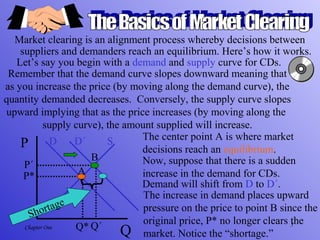
Market clearing is an alignment process whereby decisions between
suppliers and demanders reach an equilibrium. Here’s how it works.
Remember that the demand curve slopes downward meaning that
as you increase the price (by moving along the demand curve), the
quantity demanded decreases. Conversely, the supply curve slopes
upward implying that as the price increases (by moving along the
supply curve), the amount supplied will increase.
Let’s say you begin with a demand and supply curve for CDs.
P
Q
D S
Now, suppose that there is a sudden
increase in the demand for CDs.
Demand will shift from D to D´.
The center point A is where market
decisions reach an equilibrium.
Q*
P* A
D´
Q´
P´
B
The increase in demand places upward
pressure on the price to point B since the
original price, P* no longer clears the
market. Notice the “shortage.”
Shortage
6Chapter One
SHIFTS IN DEMAND: Suppose your income
rises? Your demand for a given product, for
example, pizza, will also increase.
This translates into a rightward shift in the
demand curve from D to D''. Result:
both price and quantity are higher.
PP
DD
SS
QQ
DD''
SHIFTS IN SUPPLY: A fall in the price
of materials increases the supply of pizza; at
any given price, pizzerias find that the sale
of pizza is more profitable, and thus the
supply of pizza rises.
This translates into a rightward shift in supply
from S to S'' ..Result: price falls, quantity rises.Result: price falls, quantity rises.
PP
DD
SS
QQ
SS''
7Chapter One
Economists typically assume that the market will go into an
equilibrium of supply and demand, which is called the
market clearing process. This assumption is central to the
pizza example on the previous slide. But, assuming that
markets clear continuously, is unrealistic. For markets to
clear continuously, prices would have to adjust instantly to
changes in supply and demand. But, evidence suggests that
prices and wages often adjust slowly.
So, remember that although market clearing models assume
that wages and prices are flexible, in actuality, some wages
and prices are sticky. Market clearing models may not
describe every instant in an economy, but they do depict the
equilibrium toward which the economy gravitates.
8Chapter One
Microeconomics is the study of how households and firms
make decisions and how these decision makers interact in the
broader marketplace. In microeconomics, an individual chooses to
maximize his or her utility subject to his or her budget constraint.
Macroeconomic events arise from the interaction of many
individuals trying to maximize their own welfare. Because
aggregate variables are the sum of the variables describing
individuals’ decisions, the study of macroeconomics
is based on microeconomic foundations.
9Chapter One
The modules mirror the sequencing of the text, Macroeconomics, 6th
ed.
There are six parts and a total of nineteen chapters with a module
written for each chapter. Enjoy!
Introduction
Classical Theory, The Economy in the Long Run
Growth Theory, The Economy in the Very Long Run
Business Cycle Theory: The Economy in the Short Run
Macroeconomic Policy Debates
More on the Microeconomics Behind Macroeconomics
®
10Chapter One
•Macroeconomics
•Real GDP
•Inflation and Deflation
•Unemployment
•Recession
•Depression
•Models
•Endogenous variables
•Exogenous variables
•Market clearing
•Flexible and sticky prices
•Microeconomics
•Macroeconomics
•Real GDP
•Inflation and Deflation
•Unemployment
•Recession
•Depression
•Models
•Endogenous variables
•Exogenous variables
•Market clearing
•Flexible and sticky prices
•Microeconomics

Mankiw's Macroeconomics Modules Chapter 1

  • 1.
    1Chapter One CHAPTER1 The Scienceof Macroeconomics ® A PowerPoint™Tutorial To Accompany MACROECONOMICS, 6th. ed. N. Gregory Mankiw By Mannig J. Simidian
  • 2.
    2Chapter One I wouldlike to thank Greg Mankiw for creating another macroeconomics masterpiece! It is none other than an honor to be a part of his prolific work. To Mike McElroy (North Carolina State University), I express eternal gratitude for his continued interest in my endeavors. For almost 10 years, he has been reading and contributing to my macroeconomics modules. I also want to thank Mark Rush (University of Florida), David Denslow (University of Florida) and “the director” for making my earliest experiences in economics so entertaining. Jeffrey Frankel (Harvard University), Ed Tower (Duke University), and Roberto Rigobon (M.I.T) also encouraged my love for economics. I thank Peter Max, America’s painter-laureate, for all he has taught me through his wisdom and art. Lawrence Brockman, D.M.D, an economist in spirit, has been my teacher and great friend throughout the years. Thanks go to my former colleagues at the Massachusetts Institute of Technology (MIT), Michele Rubino, Guido Meardi and Stewart Brazil. I also thank Franco Modigliani (MIT) and Rudi Dornbusch (MIT) posthumously, for their courageous tutelage until the very end. I also want to thank my sweet two year old daughter Elle (perhaps a future economist) for being my beautiful inspiration in teaching macroeconomics. Of course, I thank my Dad for his best friendship and unending love and support. Through the thousand hours of discussing economics and business, he showed me how love and learning are inextricably linked. Mannig J. Simidian January 2006 Acknowledgements
  • 3.
    3Chapter One Everyone hasreason to think critically about macroeconomic issues. It is imperative that we seek to understand why some countries are growing faster or slower than others or why some have greater fluctuations in inflation or unemployment. The state of the macroeconomy affects everyone in many ways. It plays a significant role in the political sphere while also affecting public policy and societal well-being, at the national and global levels. Some of the most important variables macroeconomists use to measure the performance of the economy are real GDP, the inflation rate, and the unemployment rate. Macroeconomists are also concerned with matters such as monetary and fiscal policy—both of which, will be discussed at length in Macroeconomics, 6th ed., Mankiw’s Macroeconomics Modules, and in your macroeconomics course. Good luck! Welcome to Macroeconomics!Welcome to Macroeconomics!
  • 4.
    4Chapter One Economists usemodels to understand what goes on in the economy. Here are two important points about models: endogenous variables and exogenous variables. Endogenous variables are those which the model tries to explain. Exogenous variables are those variables that a model takes as given. In short, endogenous are variables within a model, and exogenous are the variables outside the model. Price Demand QQ* PP Supply QuantityQuantity * This is the most famous economic model. It describes the ubiquitous relationship between buyers and sellers in the market. The point of intersection is called an equilibrium.
  • 5.
    5Chapter One Market clearingis an alignment process whereby decisions between suppliers and demanders reach an equilibrium. Here’s how it works. Remember that the demand curve slopes downward meaning that as you increase the price (by moving along the demand curve), the quantity demanded decreases. Conversely, the supply curve slopes upward implying that as the price increases (by moving along the supply curve), the amount supplied will increase. Let’s say you begin with a demand and supply curve for CDs. P Q D S Now, suppose that there is a sudden increase in the demand for CDs. Demand will shift from D to D´. The center point A is where market decisions reach an equilibrium. Q* P* A D´ Q´ P´ B The increase in demand places upward pressure on the price to point B since the original price, P* no longer clears the market. Notice the “shortage.” Shortage
  • 6.
    6Chapter One SHIFTS INDEMAND: Suppose your income rises? Your demand for a given product, for example, pizza, will also increase. This translates into a rightward shift in the demand curve from D to D''. Result: both price and quantity are higher. PP DD SS QQ DD'' SHIFTS IN SUPPLY: A fall in the price of materials increases the supply of pizza; at any given price, pizzerias find that the sale of pizza is more profitable, and thus the supply of pizza rises. This translates into a rightward shift in supply from S to S'' ..Result: price falls, quantity rises.Result: price falls, quantity rises. PP DD SS QQ SS''
  • 7.
    7Chapter One Economists typicallyassume that the market will go into an equilibrium of supply and demand, which is called the market clearing process. This assumption is central to the pizza example on the previous slide. But, assuming that markets clear continuously, is unrealistic. For markets to clear continuously, prices would have to adjust instantly to changes in supply and demand. But, evidence suggests that prices and wages often adjust slowly. So, remember that although market clearing models assume that wages and prices are flexible, in actuality, some wages and prices are sticky. Market clearing models may not describe every instant in an economy, but they do depict the equilibrium toward which the economy gravitates.
  • 8.
    8Chapter One Microeconomics isthe study of how households and firms make decisions and how these decision makers interact in the broader marketplace. In microeconomics, an individual chooses to maximize his or her utility subject to his or her budget constraint. Macroeconomic events arise from the interaction of many individuals trying to maximize their own welfare. Because aggregate variables are the sum of the variables describing individuals’ decisions, the study of macroeconomics is based on microeconomic foundations.
  • 9.
    9Chapter One The modulesmirror the sequencing of the text, Macroeconomics, 6th ed. There are six parts and a total of nineteen chapters with a module written for each chapter. Enjoy! Introduction Classical Theory, The Economy in the Long Run Growth Theory, The Economy in the Very Long Run Business Cycle Theory: The Economy in the Short Run Macroeconomic Policy Debates More on the Microeconomics Behind Macroeconomics ®
  • 10.
    10Chapter One •Macroeconomics •Real GDP •Inflationand Deflation •Unemployment •Recession •Depression •Models •Endogenous variables •Exogenous variables •Market clearing •Flexible and sticky prices •Microeconomics •Macroeconomics •Real GDP •Inflation and Deflation •Unemployment •Recession •Depression •Models •Endogenous variables •Exogenous variables •Market clearing •Flexible and sticky prices •Microeconomics