CHAPTER 1 The Science of Macroeconomics slide 0
About the Class
The objective of the course is to:
 Develop an analytical framework to
 explain growth, unemployment and
inflation,
 and see how government policies
(monetary and fiscal) affect these
things.
CHAPTER 1 The Science of Macroeconomics slide 1
Important issues in macroeconomics
 Why does the cost of living keep rising?
 Why are millions of people unemployed,
even when the economy is recovering?
 Why are there recessions?
Can the government do anything to combat
recessions? Should it??
macroeconomics
fifth edition
N. Gregory Mankiw
PowerPoint®
Slides
by Ron Cronovich
CHAPTER ONE
The Science of
Macroeconomics
macro
© 2002 Worth Publishers, all rights reserved
Topic 1:
(ch. 1)
Topic 1:
Introduction
(chapter 1)
CHAPTER 1 The Science of Macroeconomics slide 3
Learning objectives
This chapter introduces you to
 the issues macroeconomists study
 the tools macroeconomists use
 some important concepts in
macroeconomic analysis
CHAPTER 1 The Science of Macroeconomics slide 4
Three main variables we will study:
1) Gross domestic output (GDP)
2) Inflation in the cost of living (CPI)
3) Unemployment rate
We will begin by looking at trends in the data
for these, and make initial observations.
CHAPTER 1 The Science of Macroeconomics slide 5
CHAPTER 1 The Science of Macroeconomics slide 6
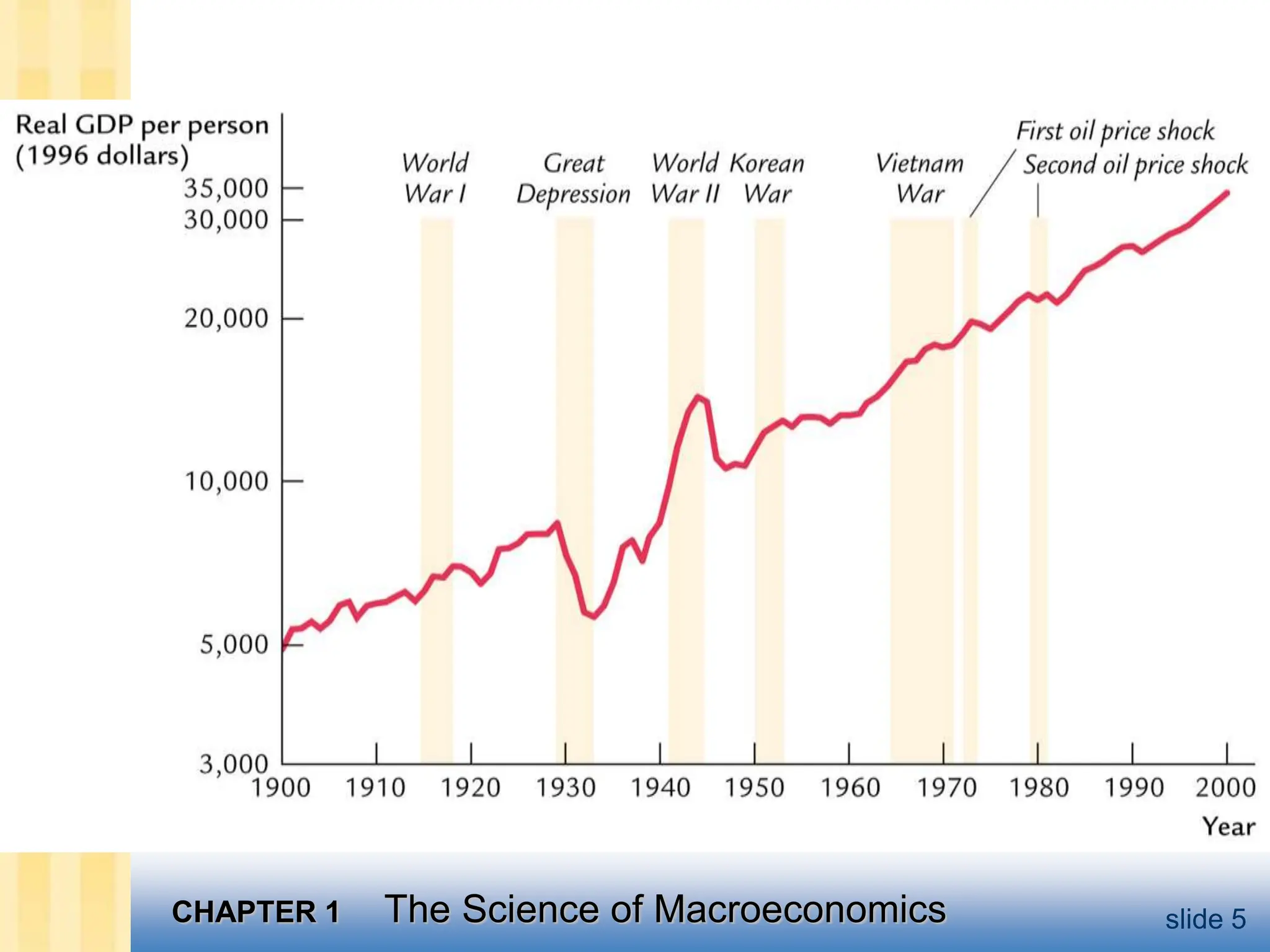
GDP: Observations
1. Long-term upward trend. Income more than doubled
over last 30 years.
2. Short-run disruptions in the trend: recessions.
CHAPTER 1 The Science of Macroeconomics slide 7
CHAPTER 1 The Science of Macroeconomics slide 8
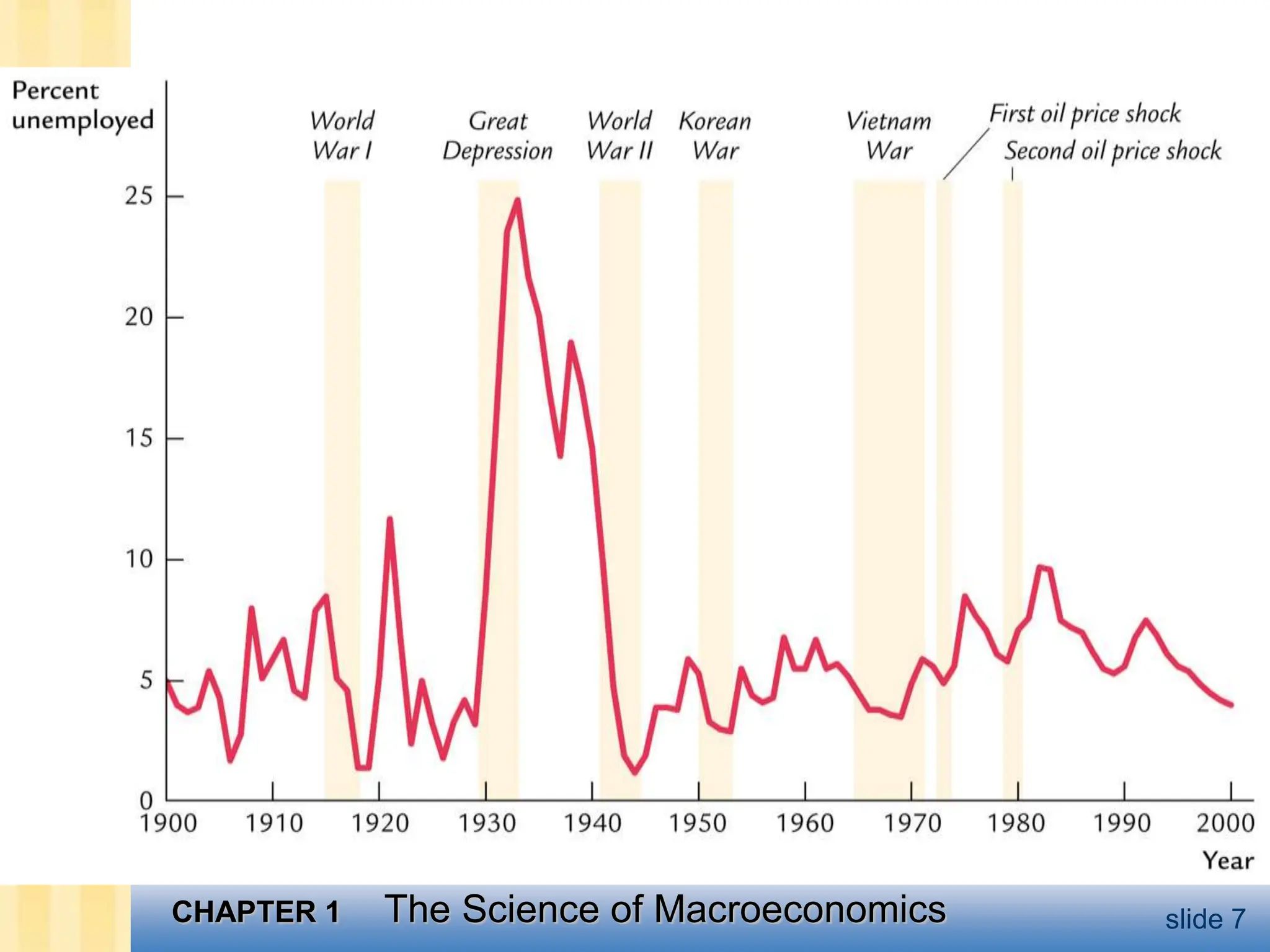
Unemployment: Observations
1. Unemployment always positive.
2. Fluctuations related to GDP: unemployment higher
during recessions.
CHAPTER 1 The Science of Macroeconomics slide 9
CHAPTER 1 The Science of Macroeconomics slide 10
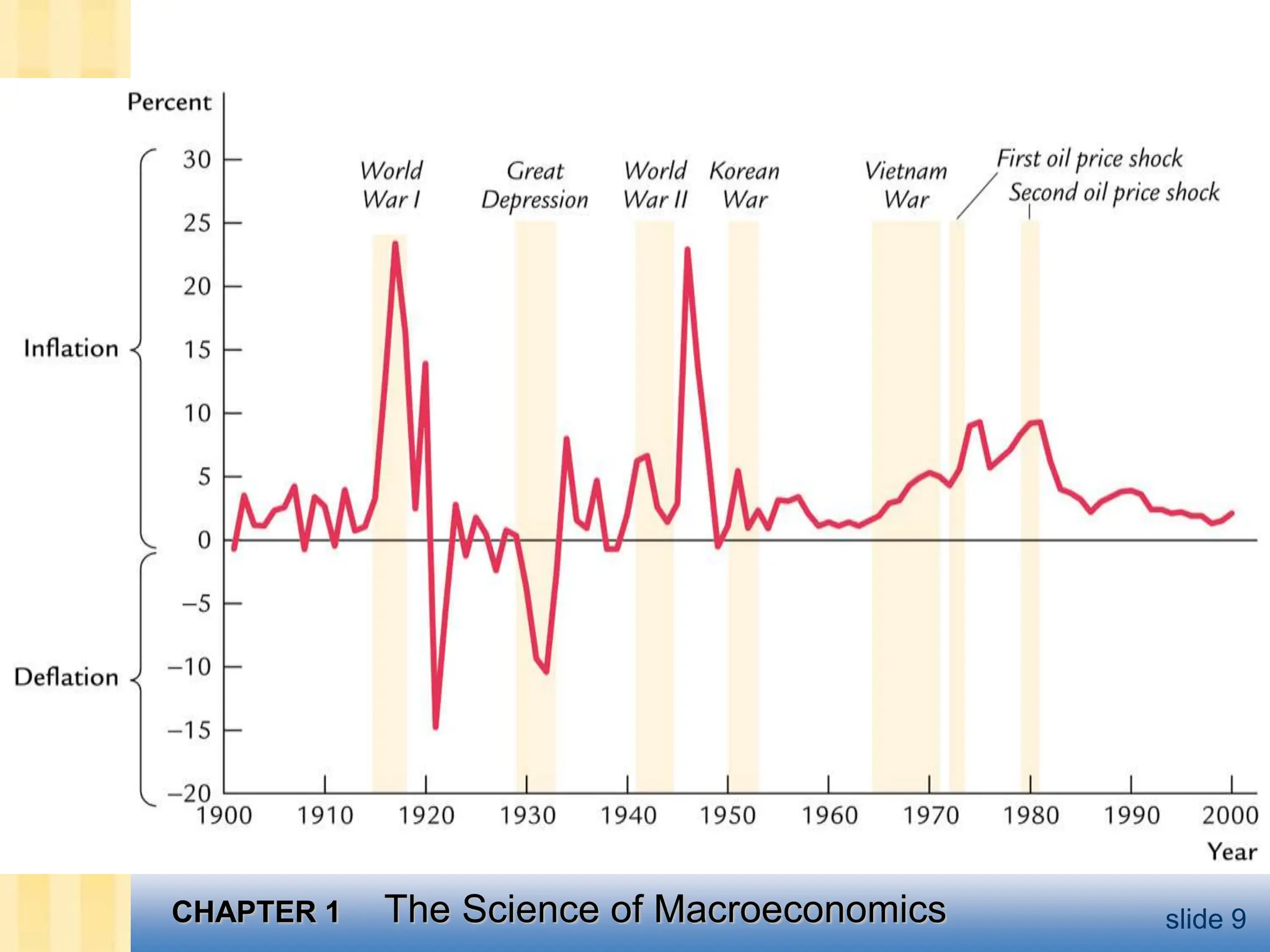
Inflation: Observations
1. Inflation can be negative.
2. Often high when GDP high, but not always (see
1970s).
CHAPTER 1 The Science of Macroeconomics slide 11
Why learn macroeconomics?
1. The macroeconomy affects society’s well-being.
 Crime and suicides tend to be higher during spells
of high unemployment
2. The macroeconomy affects your well-being.
 Will it be hard to find a job when you graduate?
3. The macroeconomy affects politics and current
events.
 Incumbents tend to lose elections during
recessions or bad inflation.
CHAPTER 1 The Science of Macroeconomics slide 12
How we learn Economics: Models
…are simplied versions of a more complex reality
• irrelevant details are stripped away
Used to
• show the relationships between economic
variables
• explain the economy’s behavior
• devise policies to improve economic
performance
CHAPTER 1 The Science of Macroeconomics slide 13
Example of a model:
The supply & demand for new cars
 explains the factors that determine the price of
cars and the quantity sold.
 assumes the market is competitive: each buyer
and seller is too small to affect the market price
 Variables:
Qd = quantity of cars that buyers demand
Qs = quantity that producers supply
P = price of new cars
Y = aggregate income
Ps = price of steel (an input)
CHAPTER 1 The Science of Macroeconomics slide 14
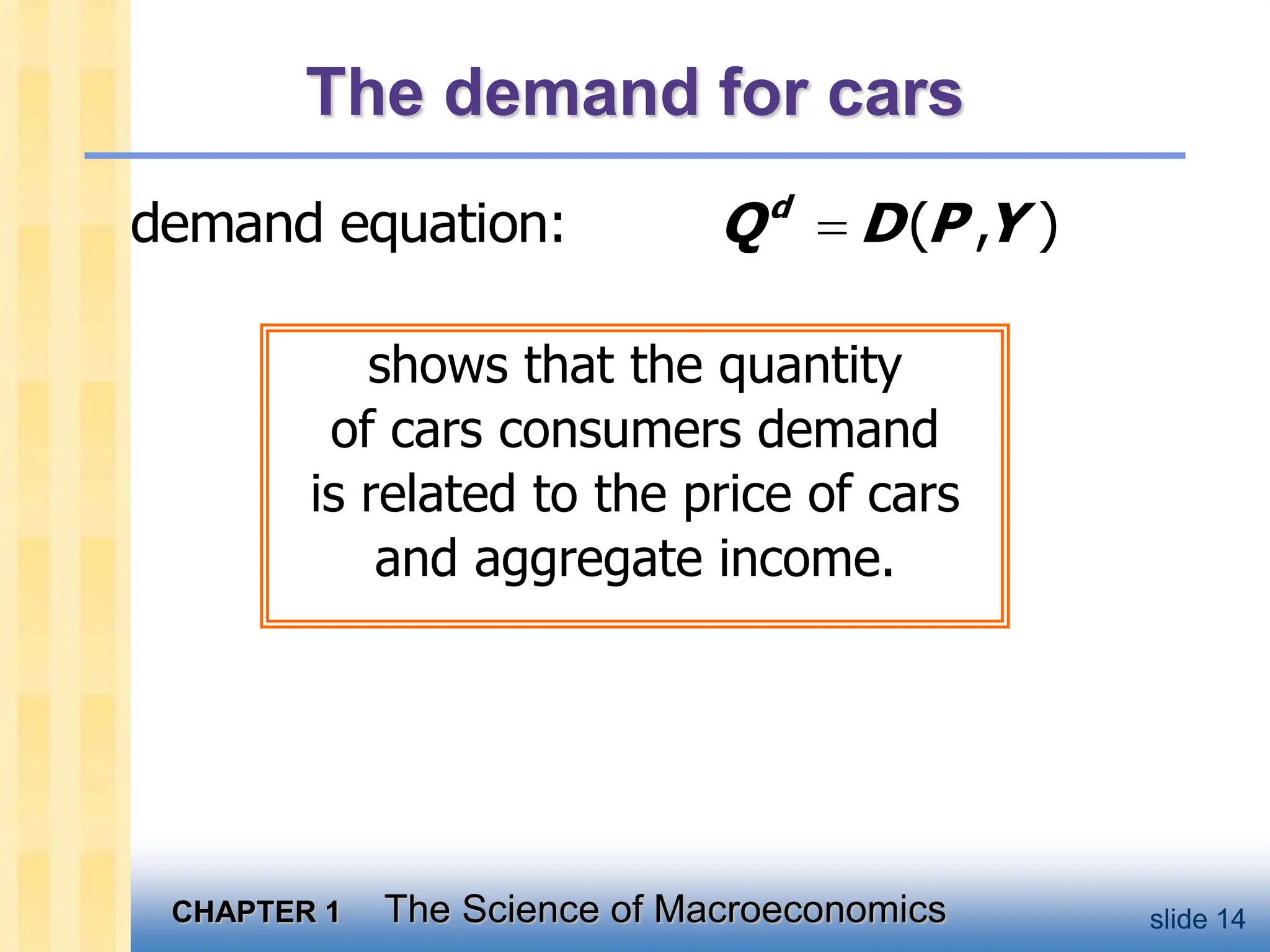
The demand for cars
shows that the quantity
of cars consumers demand
is related to the price of cars
and aggregate income.
demand equation: ( , )
d
Q D P Y

CHAPTER 1 The Science of Macroeconomics slide 15
Digression: Functional notation
 General functional notation shows only
that the variables are related:
( , )
d
Q D P Y

A list of the
variables
that affect Qd
CHAPTER 1 The Science of Macroeconomics slide 16
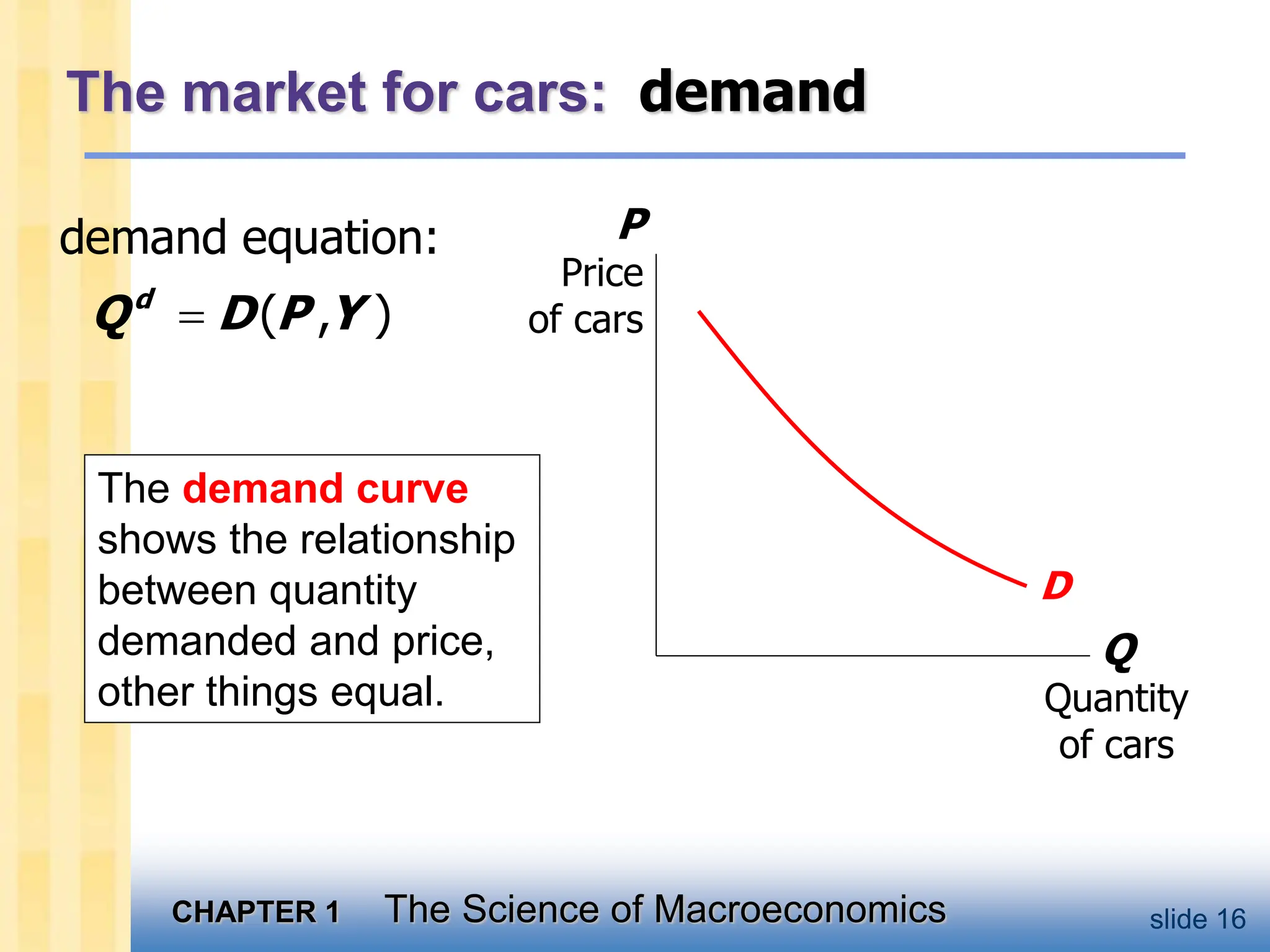
The market for cars: demand
Q
Quantity
of cars
P
Price
of cars
D
The demand curve
shows the relationship
between quantity
demanded and price,
other things equal.
demand equation:
( , )

d
Q D P Y
CHAPTER 1 The Science of Macroeconomics slide 17
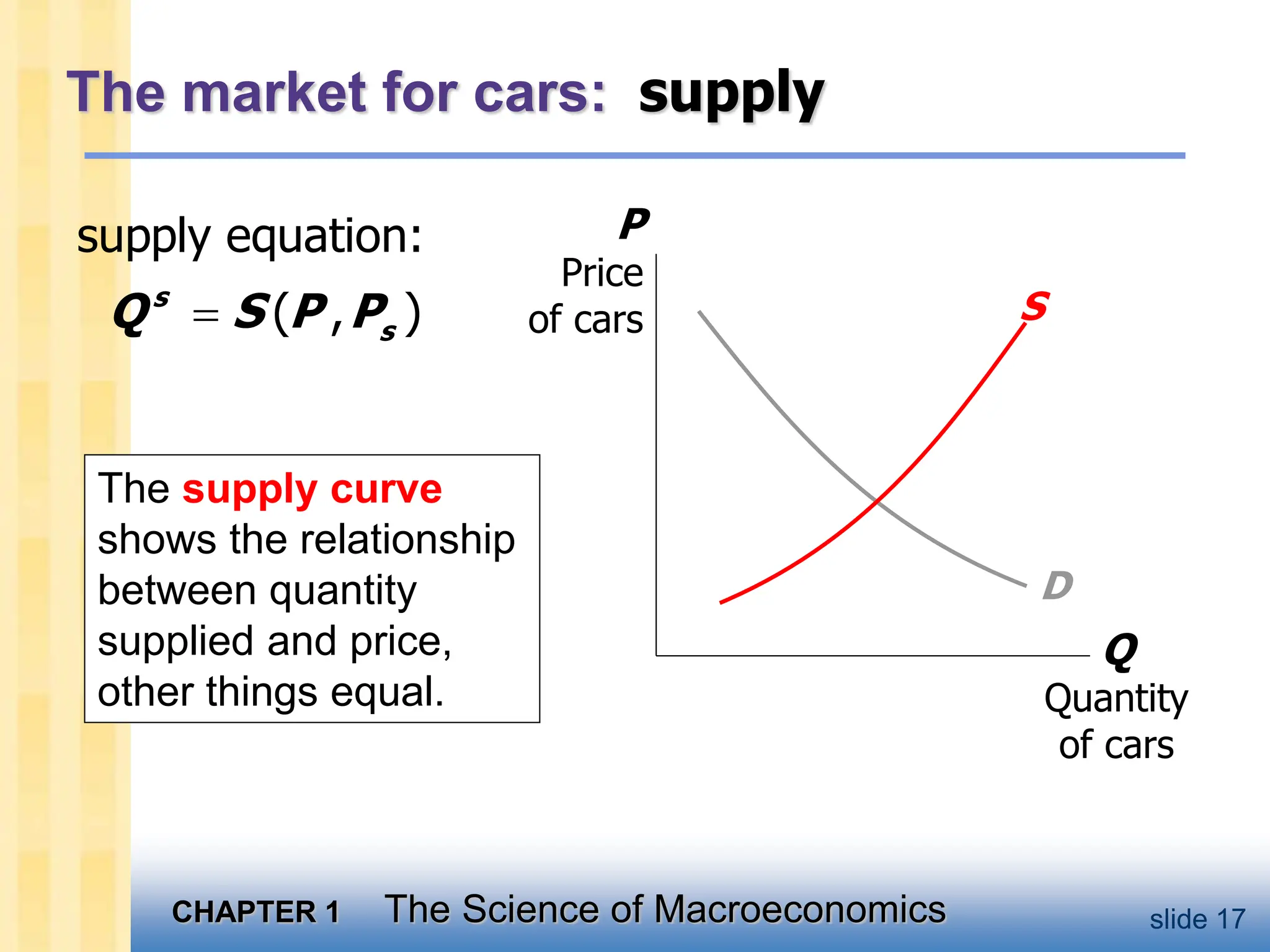
The market for cars: supply
Q
Quantity
of cars
P
Price
of cars
D
supply equation:
( , )

s
s
Q S P P S
The supply curve
shows the relationship
between quantity
supplied and price,
other things equal.
CHAPTER 1 The Science of Macroeconomics slide 18
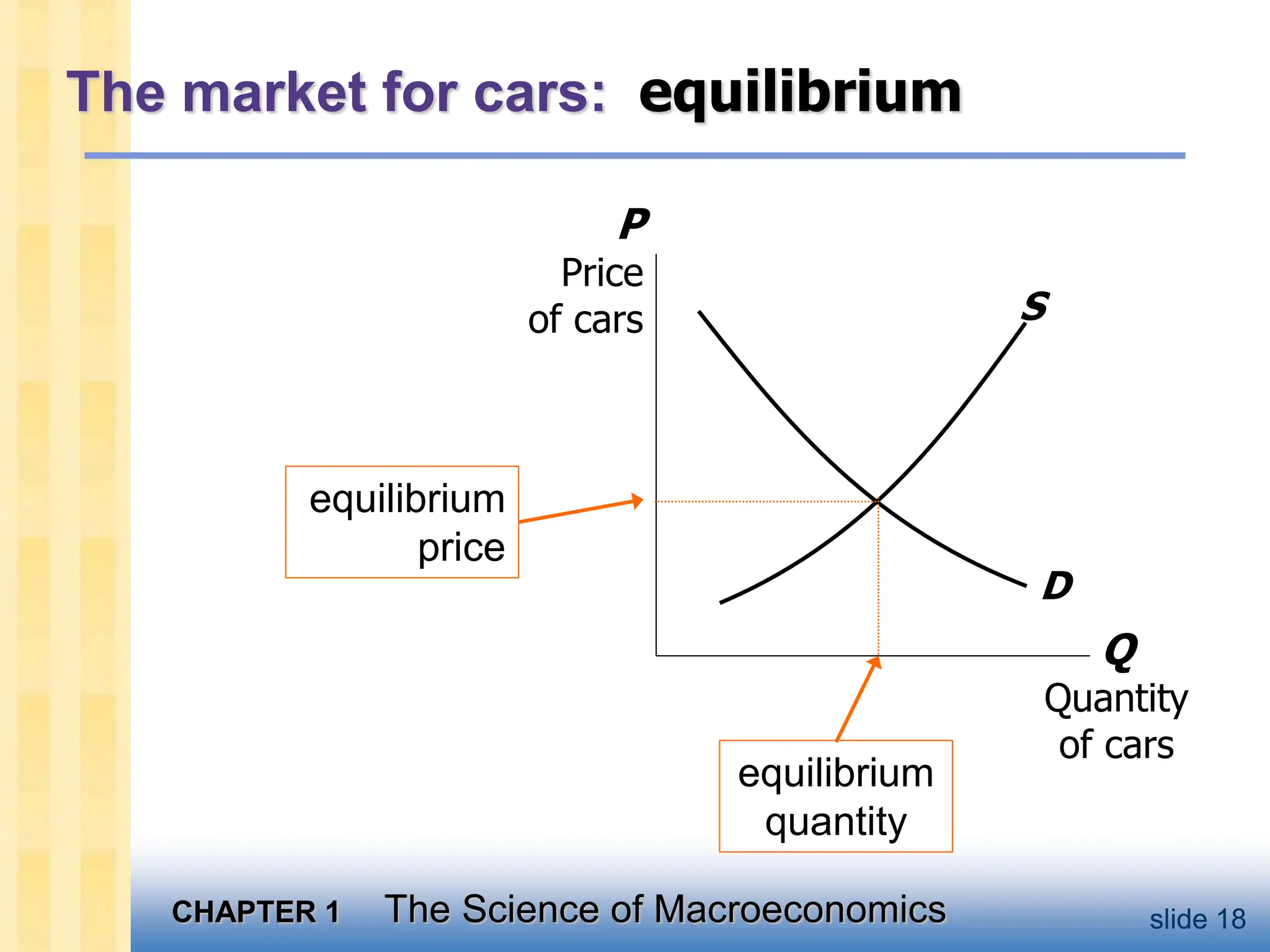
The market for cars: equilibrium
Q
Quantity
of cars
P
Price
of cars S
D
equilibrium
price
equilibrium
quantity
CHAPTER 1 The Science of Macroeconomics slide 19
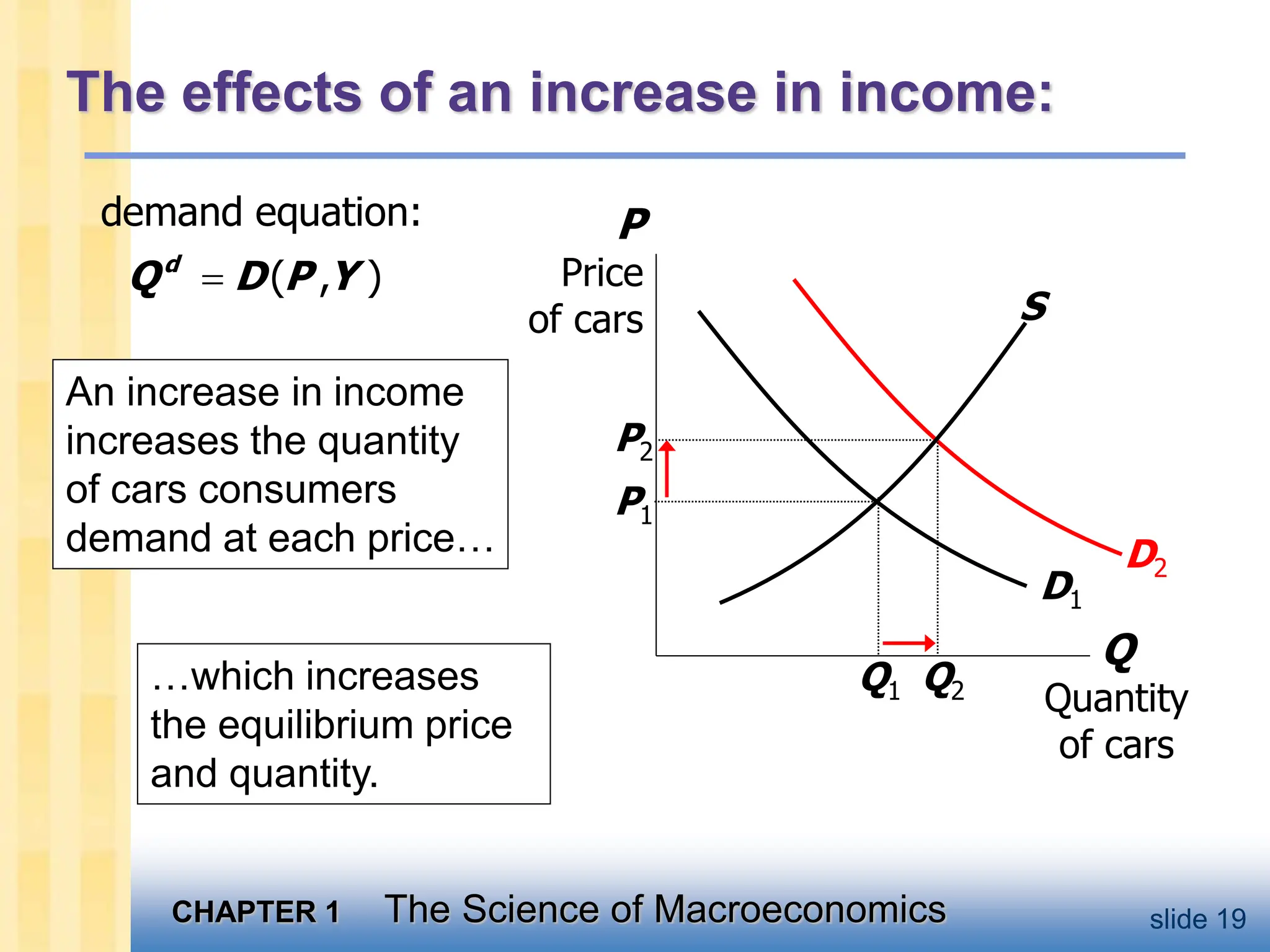
The effects of an increase in income:
D2
Q
Quantity
of cars
P
Price
of cars S
D1
Q1
P1
An increase in income
increases the quantity
of cars consumers
demand at each price…
…which increases
the equilibrium price
and quantity.
P2
Q2
demand equation:
( , )

d
Q D P Y
CHAPTER 1 The Science of Macroeconomics slide 20
The effects of a steel price increase:
Q
Quantity
of cars
P
Price
of cars S1
D
Q1
P1
An increase in Ps
reduces the quantity of
cars producers supply
at each price…
…which increases the
market price and
reduces the quantity.
P2
Q2
S2
supply equation:
( , )

s
s
Q S P P
CHAPTER 1 The Science of Macroeconomics slide 21
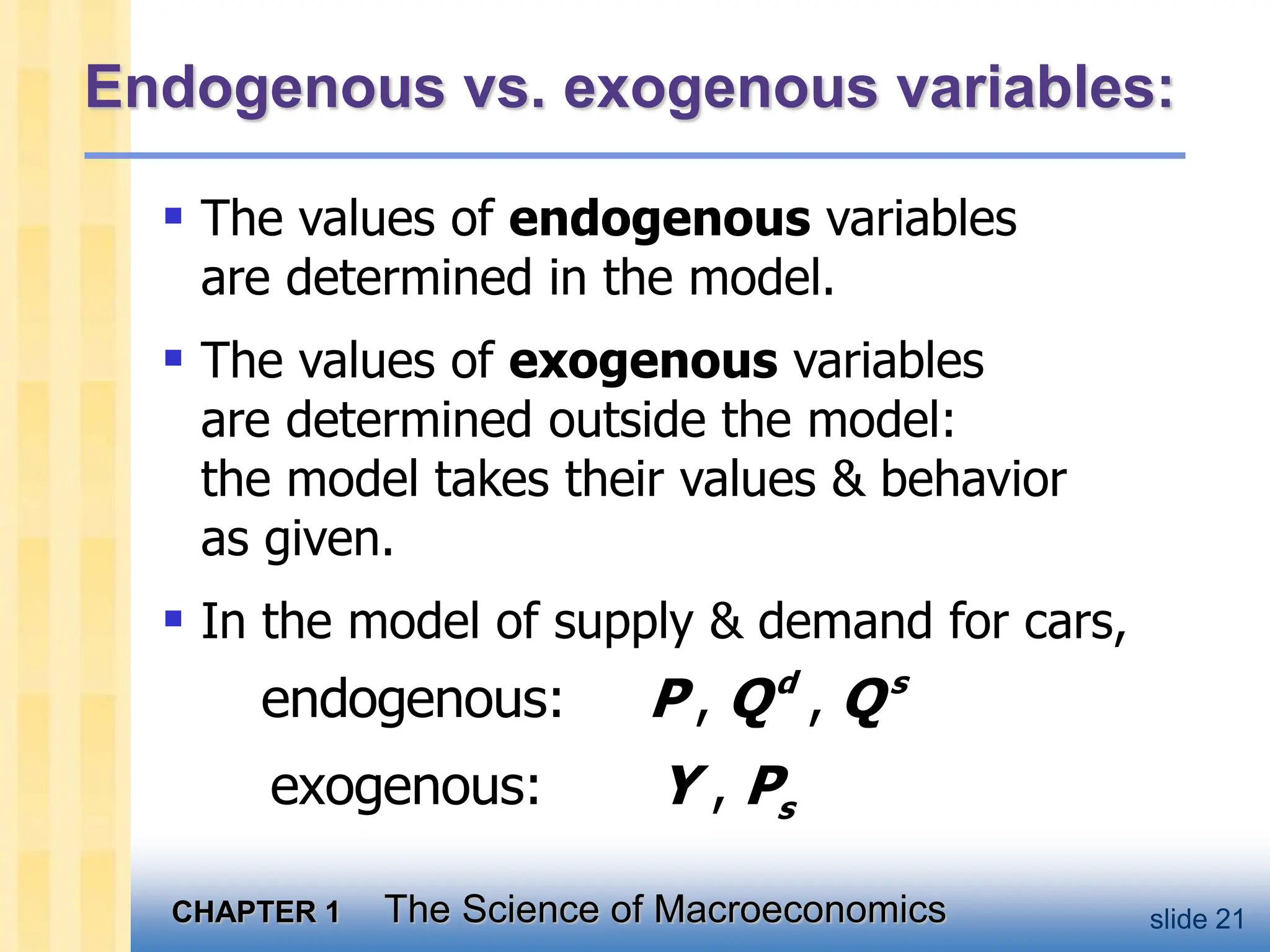
Endogenous vs. exogenous variables:
 The values of endogenous variables
are determined in the model.
 The values of exogenous variables
are determined outside the model:
the model takes their values & behavior
as given.
 In the model of supply & demand for cars,
endogenous: , ,
d s
P Q Q
exogenous: , s
Y P
CHAPTER 1 The Science of Macroeconomics slide 22
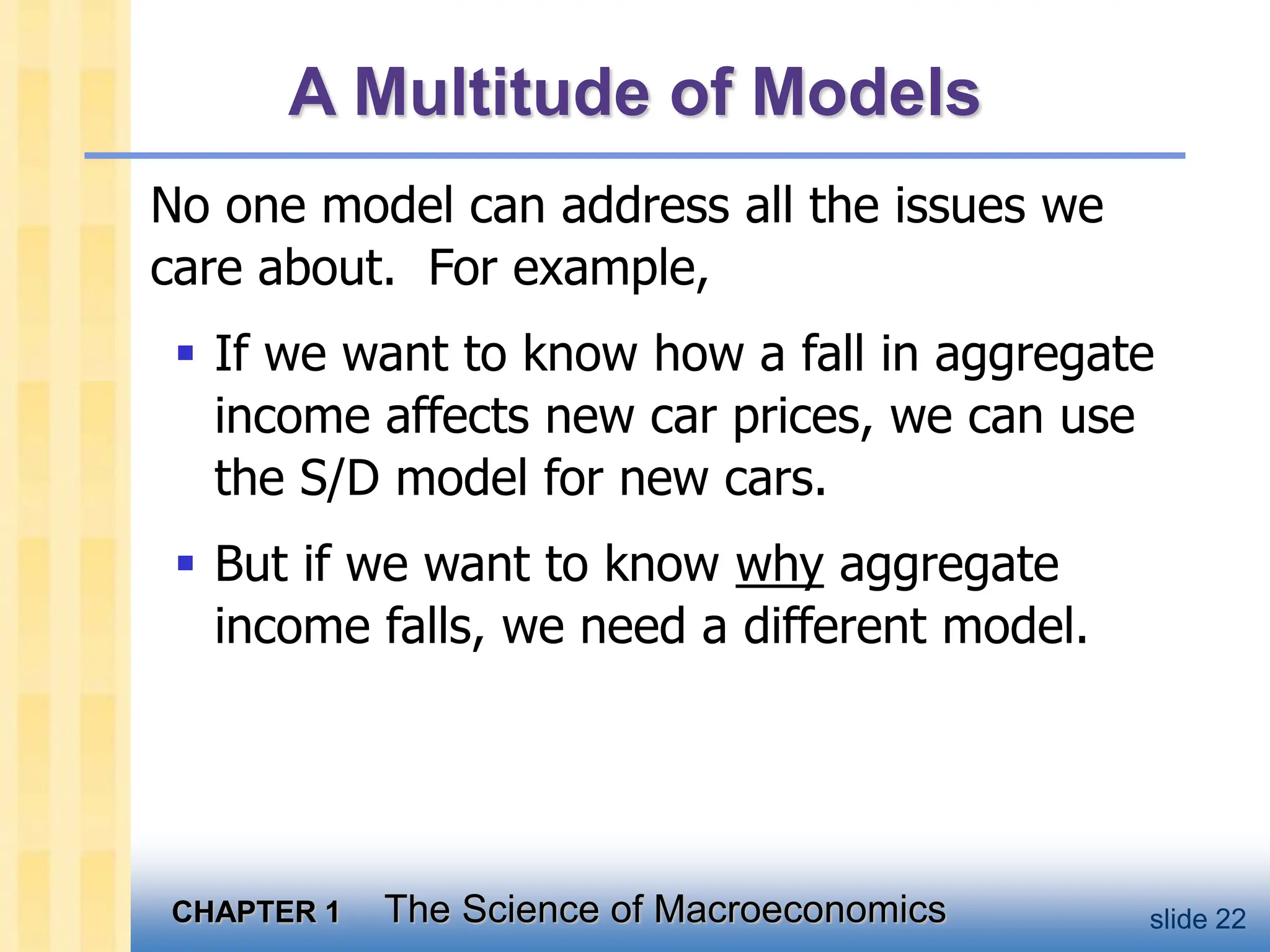
A Multitude of Models
No one model can address all the issues we
care about. For example,
 If we want to know how a fall in aggregate
income affects new car prices, we can use
the S/D model for new cars.
 But if we want to know why aggregate
income falls, we need a different model.
CHAPTER 1 The Science of Macroeconomics slide 23
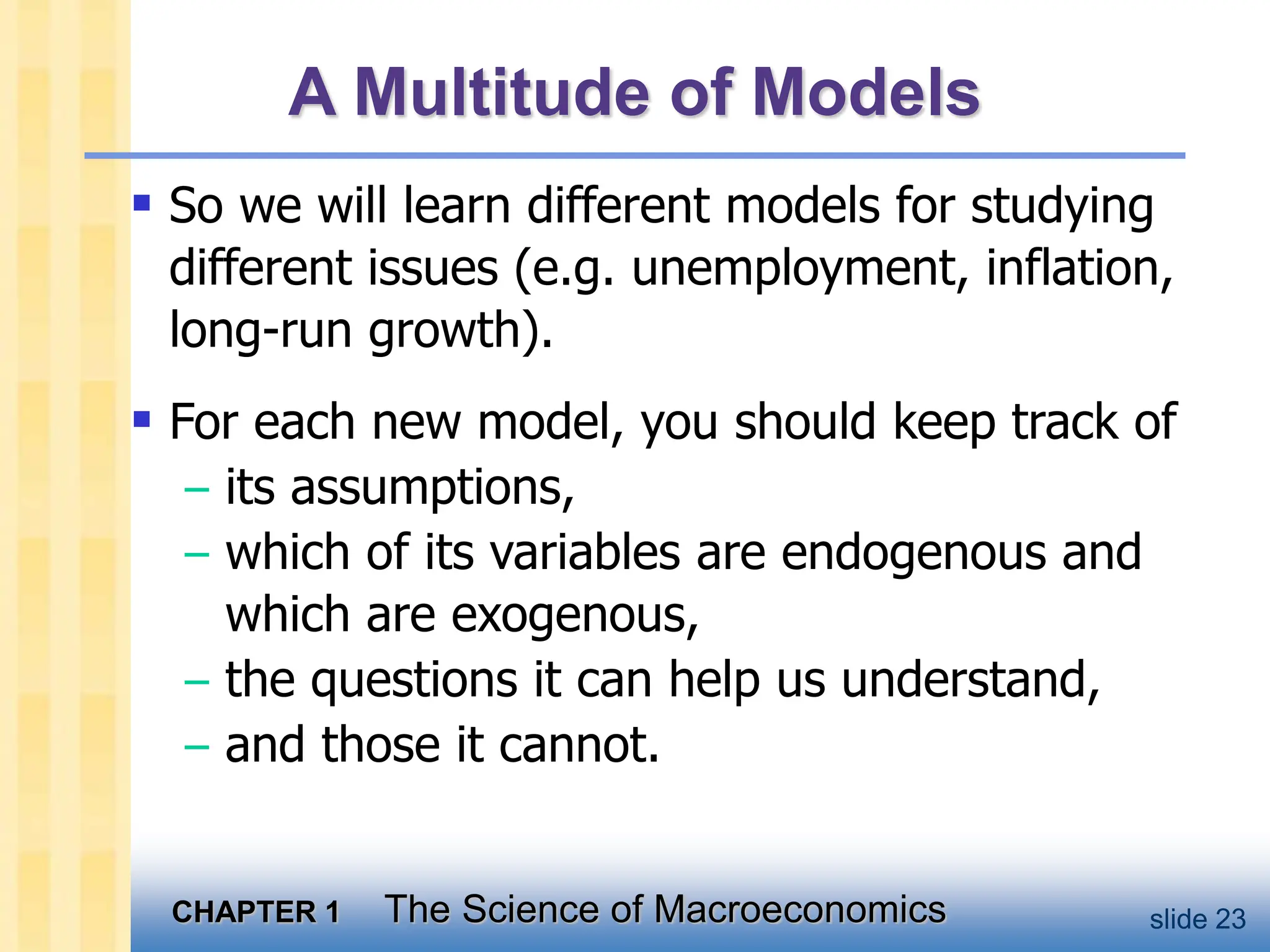
A Multitude of Models
 So we will learn different models for studying
different issues (e.g. unemployment, inflation,
long-run growth).
 For each new model, you should keep track of
– its assumptions,
– which of its variables are endogenous and
which are exogenous,
– the questions it can help us understand,
– and those it cannot.
CHAPTER 1 The Science of Macroeconomics slide 24
Prices: Flexible Versus Sticky
 Market clearing: an assumption that prices
are flexible and adjust to equate supply and
demand.(A market-clearing price is
the price of a good or service at which
quantity supplied is equal to quantity
demanded, also called the equilibrium
price. The theory claims that markets tend
to move toward this price.)
 In the short run, many prices are sticky---
they adjust only sluggishly in response to
supply/demand imbalances.
CHAPTER 1 The Science of Macroeconomics slide 25
Prices: Flexible Versus Sticky
 The economy’s behavior depends partly on
whether prices are sticky or flexible:
 If prices are sticky, then demand won’t
always equal supply. This helps explain
– unemployment (excess supply of labor)
– the occasional inability of firms to sell what
they produce
 Long run: prices flexible, markets clear,
economy behaves very differently.

chap 1.Economic model and macro iindicators Mankiw.ppt

  • 1.
    CHAPTER 1 TheScience of Macroeconomics slide 0 About the Class The objective of the course is to:  Develop an analytical framework to  explain growth, unemployment and inflation,  and see how government policies (monetary and fiscal) affect these things.
  • 2.
    CHAPTER 1 TheScience of Macroeconomics slide 1 Important issues in macroeconomics  Why does the cost of living keep rising?  Why are millions of people unemployed, even when the economy is recovering?  Why are there recessions? Can the government do anything to combat recessions? Should it??
  • 3.
    macroeconomics fifth edition N. GregoryMankiw PowerPoint® Slides by Ron Cronovich CHAPTER ONE The Science of Macroeconomics macro © 2002 Worth Publishers, all rights reserved Topic 1: (ch. 1) Topic 1: Introduction (chapter 1)
  • 4.
    CHAPTER 1 TheScience of Macroeconomics slide 3 Learning objectives This chapter introduces you to  the issues macroeconomists study  the tools macroeconomists use  some important concepts in macroeconomic analysis
  • 5.
    CHAPTER 1 TheScience of Macroeconomics slide 4 Three main variables we will study: 1) Gross domestic output (GDP) 2) Inflation in the cost of living (CPI) 3) Unemployment rate We will begin by looking at trends in the data for these, and make initial observations.
  • 6.
    CHAPTER 1 TheScience of Macroeconomics slide 5
  • 7.
    CHAPTER 1 TheScience of Macroeconomics slide 6 GDP: Observations 1. Long-term upward trend. Income more than doubled over last 30 years. 2. Short-run disruptions in the trend: recessions.
  • 8.
    CHAPTER 1 TheScience of Macroeconomics slide 7
  • 9.
    CHAPTER 1 TheScience of Macroeconomics slide 8 Unemployment: Observations 1. Unemployment always positive. 2. Fluctuations related to GDP: unemployment higher during recessions.
  • 10.
    CHAPTER 1 TheScience of Macroeconomics slide 9
  • 11.
    CHAPTER 1 TheScience of Macroeconomics slide 10 Inflation: Observations 1. Inflation can be negative. 2. Often high when GDP high, but not always (see 1970s).
  • 12.
    CHAPTER 1 TheScience of Macroeconomics slide 11 Why learn macroeconomics? 1. The macroeconomy affects society’s well-being.  Crime and suicides tend to be higher during spells of high unemployment 2. The macroeconomy affects your well-being.  Will it be hard to find a job when you graduate? 3. The macroeconomy affects politics and current events.  Incumbents tend to lose elections during recessions or bad inflation.
  • 13.
    CHAPTER 1 TheScience of Macroeconomics slide 12 How we learn Economics: Models …are simplied versions of a more complex reality • irrelevant details are stripped away Used to • show the relationships between economic variables • explain the economy’s behavior • devise policies to improve economic performance
  • 14.
    CHAPTER 1 TheScience of Macroeconomics slide 13 Example of a model: The supply & demand for new cars  explains the factors that determine the price of cars and the quantity sold.  assumes the market is competitive: each buyer and seller is too small to affect the market price  Variables: Qd = quantity of cars that buyers demand Qs = quantity that producers supply P = price of new cars Y = aggregate income Ps = price of steel (an input)
  • 15.
    CHAPTER 1 TheScience of Macroeconomics slide 14 The demand for cars shows that the quantity of cars consumers demand is related to the price of cars and aggregate income. demand equation: ( , ) d Q D P Y 
  • 16.
    CHAPTER 1 TheScience of Macroeconomics slide 15 Digression: Functional notation  General functional notation shows only that the variables are related: ( , ) d Q D P Y  A list of the variables that affect Qd
  • 17.
    CHAPTER 1 TheScience of Macroeconomics slide 16 The market for cars: demand Q Quantity of cars P Price of cars D The demand curve shows the relationship between quantity demanded and price, other things equal. demand equation: ( , )  d Q D P Y
  • 18.
    CHAPTER 1 TheScience of Macroeconomics slide 17 The market for cars: supply Q Quantity of cars P Price of cars D supply equation: ( , )  s s Q S P P S The supply curve shows the relationship between quantity supplied and price, other things equal.
  • 19.
    CHAPTER 1 TheScience of Macroeconomics slide 18 The market for cars: equilibrium Q Quantity of cars P Price of cars S D equilibrium price equilibrium quantity
  • 20.
    CHAPTER 1 TheScience of Macroeconomics slide 19 The effects of an increase in income: D2 Q Quantity of cars P Price of cars S D1 Q1 P1 An increase in income increases the quantity of cars consumers demand at each price… …which increases the equilibrium price and quantity. P2 Q2 demand equation: ( , )  d Q D P Y
  • 21.
    CHAPTER 1 TheScience of Macroeconomics slide 20 The effects of a steel price increase: Q Quantity of cars P Price of cars S1 D Q1 P1 An increase in Ps reduces the quantity of cars producers supply at each price… …which increases the market price and reduces the quantity. P2 Q2 S2 supply equation: ( , )  s s Q S P P
  • 22.
    CHAPTER 1 TheScience of Macroeconomics slide 21 Endogenous vs. exogenous variables:  The values of endogenous variables are determined in the model.  The values of exogenous variables are determined outside the model: the model takes their values & behavior as given.  In the model of supply & demand for cars, endogenous: , , d s P Q Q exogenous: , s Y P
  • 23.
    CHAPTER 1 TheScience of Macroeconomics slide 22 A Multitude of Models No one model can address all the issues we care about. For example,  If we want to know how a fall in aggregate income affects new car prices, we can use the S/D model for new cars.  But if we want to know why aggregate income falls, we need a different model.
  • 24.
    CHAPTER 1 TheScience of Macroeconomics slide 23 A Multitude of Models  So we will learn different models for studying different issues (e.g. unemployment, inflation, long-run growth).  For each new model, you should keep track of – its assumptions, – which of its variables are endogenous and which are exogenous, – the questions it can help us understand, – and those it cannot.
  • 25.
    CHAPTER 1 TheScience of Macroeconomics slide 24 Prices: Flexible Versus Sticky  Market clearing: an assumption that prices are flexible and adjust to equate supply and demand.(A market-clearing price is the price of a good or service at which quantity supplied is equal to quantity demanded, also called the equilibrium price. The theory claims that markets tend to move toward this price.)  In the short run, many prices are sticky--- they adjust only sluggishly in response to supply/demand imbalances.
  • 26.
    CHAPTER 1 TheScience of Macroeconomics slide 25 Prices: Flexible Versus Sticky  The economy’s behavior depends partly on whether prices are sticky or flexible:  If prices are sticky, then demand won’t always equal supply. This helps explain – unemployment (excess supply of labor) – the occasional inability of firms to sell what they produce  Long run: prices flexible, markets clear, economy behaves very differently.