Economics 3030
Intermediate Microeconomic Theory
Topic 2: Consumer Theory (ii)
1. Introduction
 We have seen how demand curves may be used to
represent consumer behaviour.
 But we said very little about the nature of the
demand curve; why it slopes down for example.
 Now we go ‘behind’ the demand curve
 i.e. we investigate how buyers reconcile what they
want with what they can get
1. Introduction
 N.B. We can use this theory in many ways - not
simply as household consumer buying goods.
 For example:
 Modelling decision of worker as regards his supply
of labour (i.e. demand for leisure)
 Allocation of income across time (saving and
investment)
2. Theory of Consumer Choice
 Four elements:
(i) Consumer’s income
(ii) Prices of goods
(iii) Consumer’s tastes
(iv) Rational Maximisation
3. The Budget Constraint
 The first two elements define the budget constraint
 The feasibility of the consumer’s desired
consumption bundle depends upon two factors:
(i) Income
(ii) Prices
 Note: We assume, for the time being, that both are
exogenous (i.e. beyond consumer's control)
3. The Budget Constraint
 Example (N.B two goods)
 Two goods - films and meals
 Student grant = $50 per week (p.w.)
 Price of meal = $5
 Price of film = $10
3. The Budget Constraint
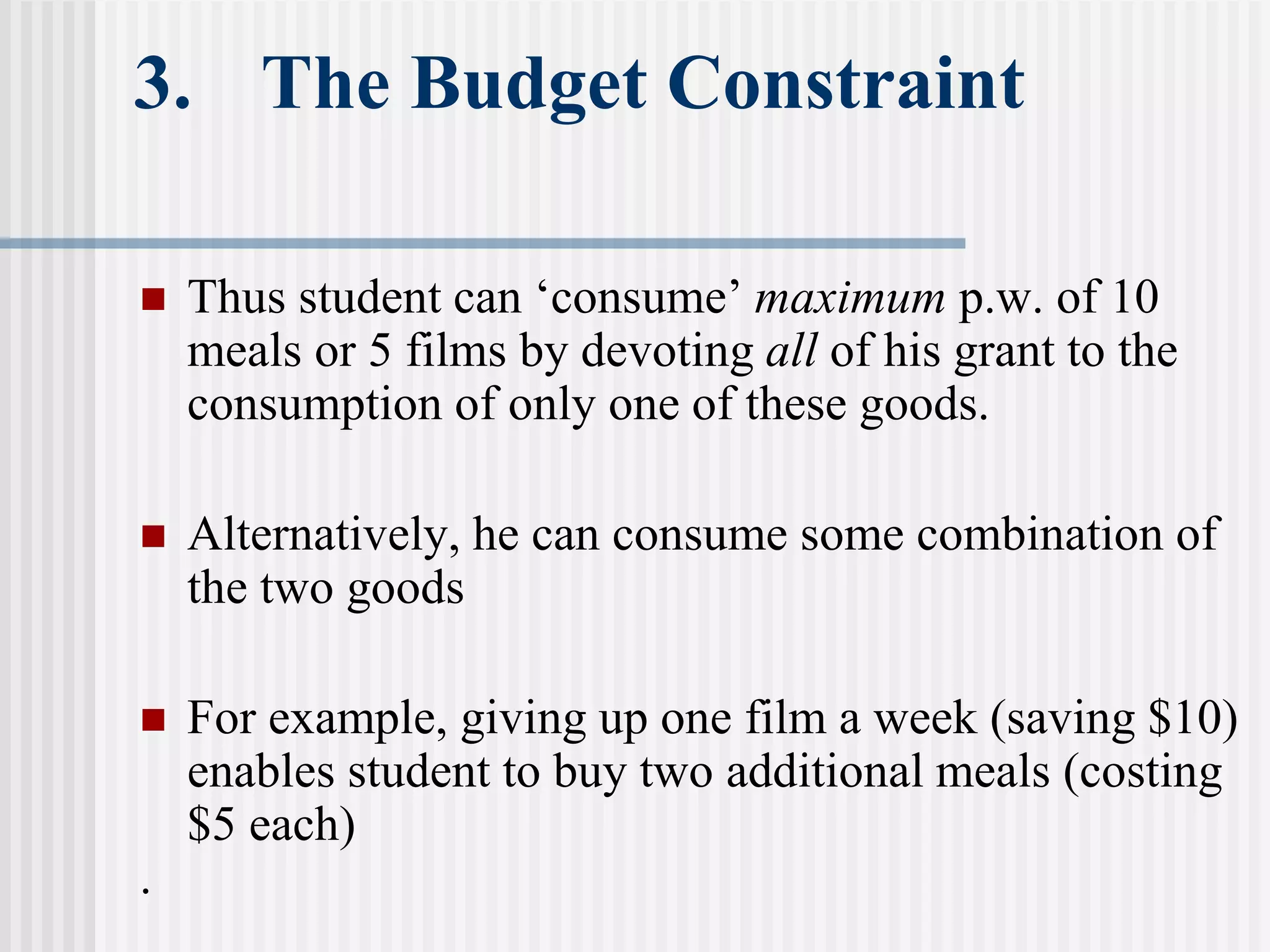
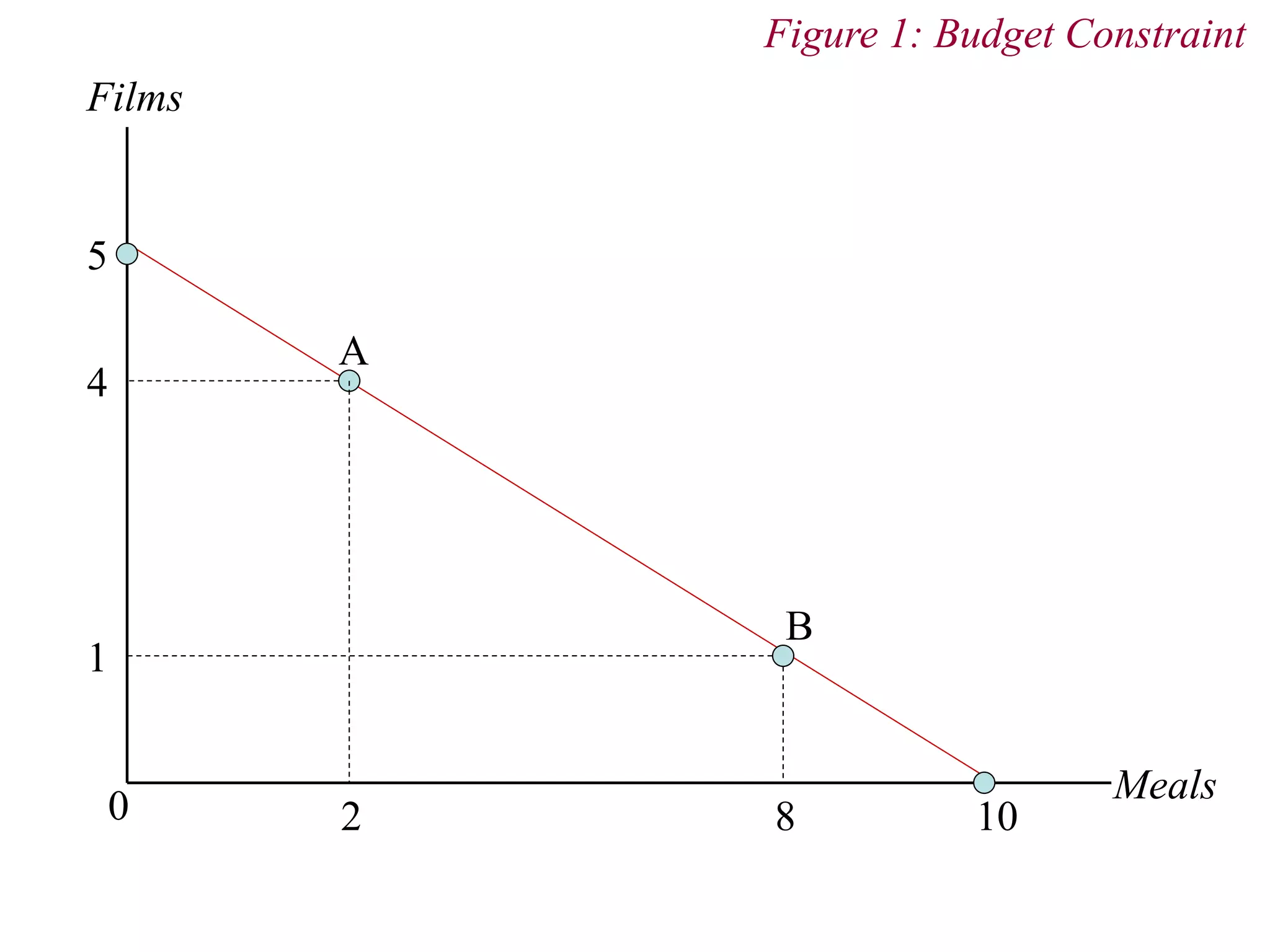
 Thus student can ‘consume’ maximum p.w. of 10
meals or 5 films by devoting all of his grant to the
consumption of only one of these goods.
 Alternatively, he can consume some combination of
the two goods
 For example, giving up one film a week (saving $10)
enables student to buy two additional meals (costing
$5 each)
.
3. The Budget Constraint
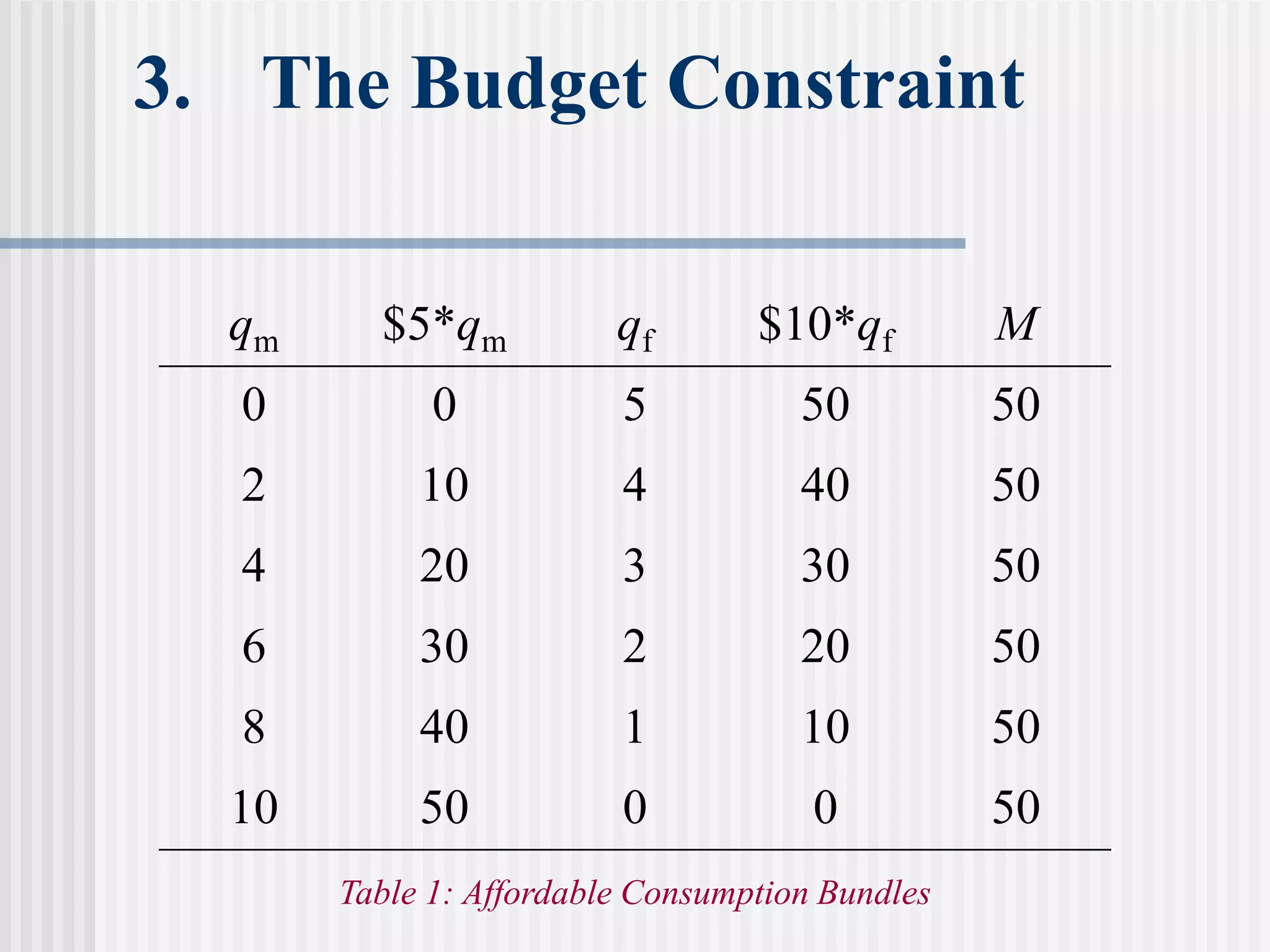
qm $5*qm qf $10*qf M
0 0 5 50 50
2 10 4 40 50
4 20 3 30 50
6 30 2 20 50
8 40 1 10 50
10 50 0 0 50
Table 1: Affordable Consumption Bundles
Films
0
Meals
A
B
Figure 1: Budget Constraint
2 8 10
1
4
5
Films
0
Meals
Figure 1: Budget Constraint
Budget Line
Budget (Feasible) Set
3. The Budget Constraint
 The budget constraint defines the maximum
affordable quantity of one good available to the
consumer given the quantity of the other good that
is being consumed.
 N.B. Trade-off!
 Trade-off is represented slope of budget
constraint.
3. The Budget Constraint
 Intercepts
Determined by income divided by the appropriate
price of the good
Define maximum quantity of a particular good
available to an individual
 Slope
Independent of income
Determined only by relative prices
• .
3. The Budget Constraint
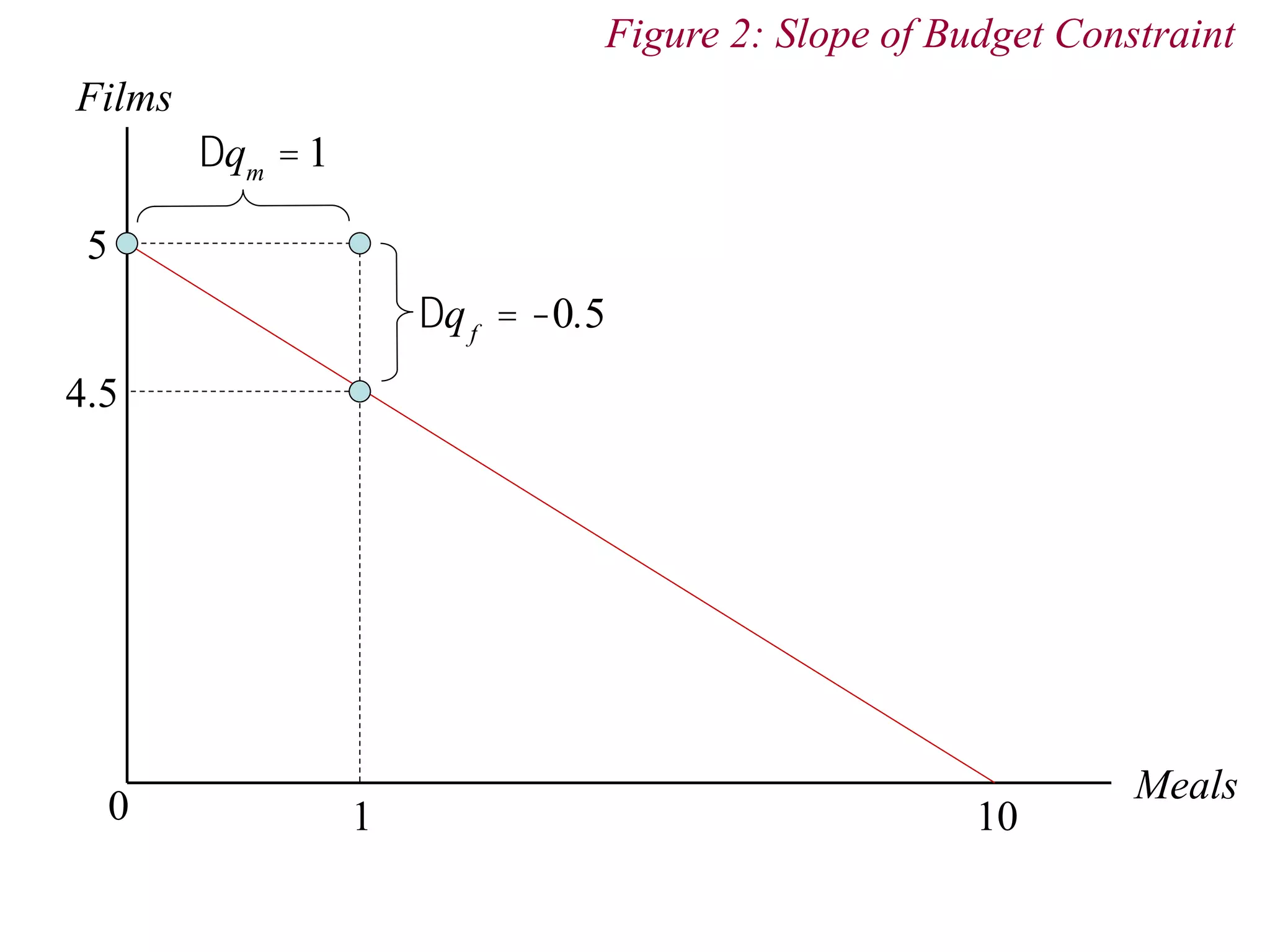
 If consumer is devoting all income to films (qf =
$50/$10 = 5), then 1 meal can only be obtained by
sacrificing consumption of some films.
 How many films must consumer give up?
 pm = $5; thus to obtain that $5, the consumer must
give up 1/2 a film
3. The Budget Constraint
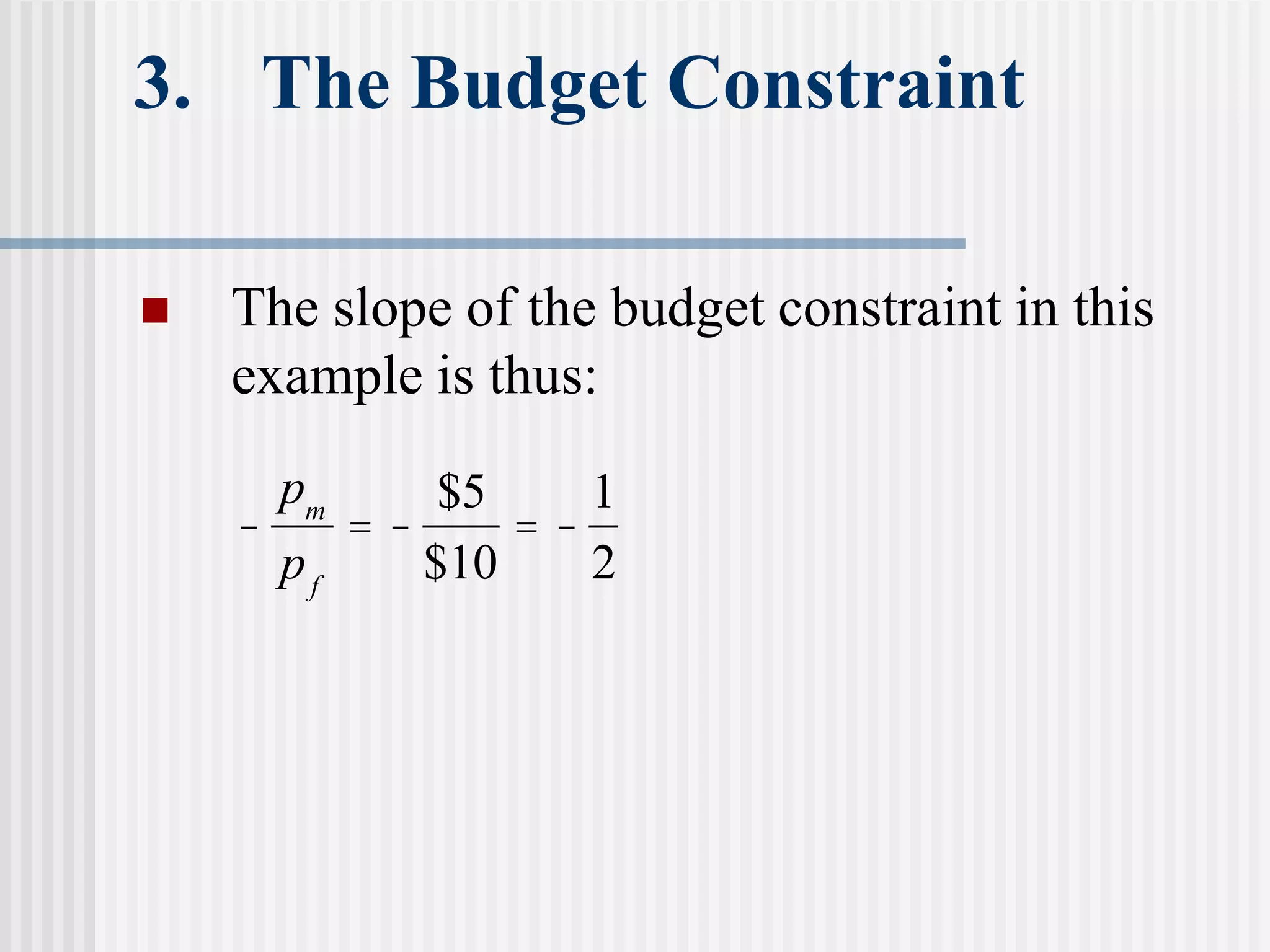
 The slope of the budget constraint in this
example is thus:
-
pm
pf
= -
$5
$10
= -
1
2
Films
0
Meals
Figure 2: Slope of Budget Constraint
1 10
4.5
5
Dqm
=1
Dqf
= -0.5
3. The Budget Constraint
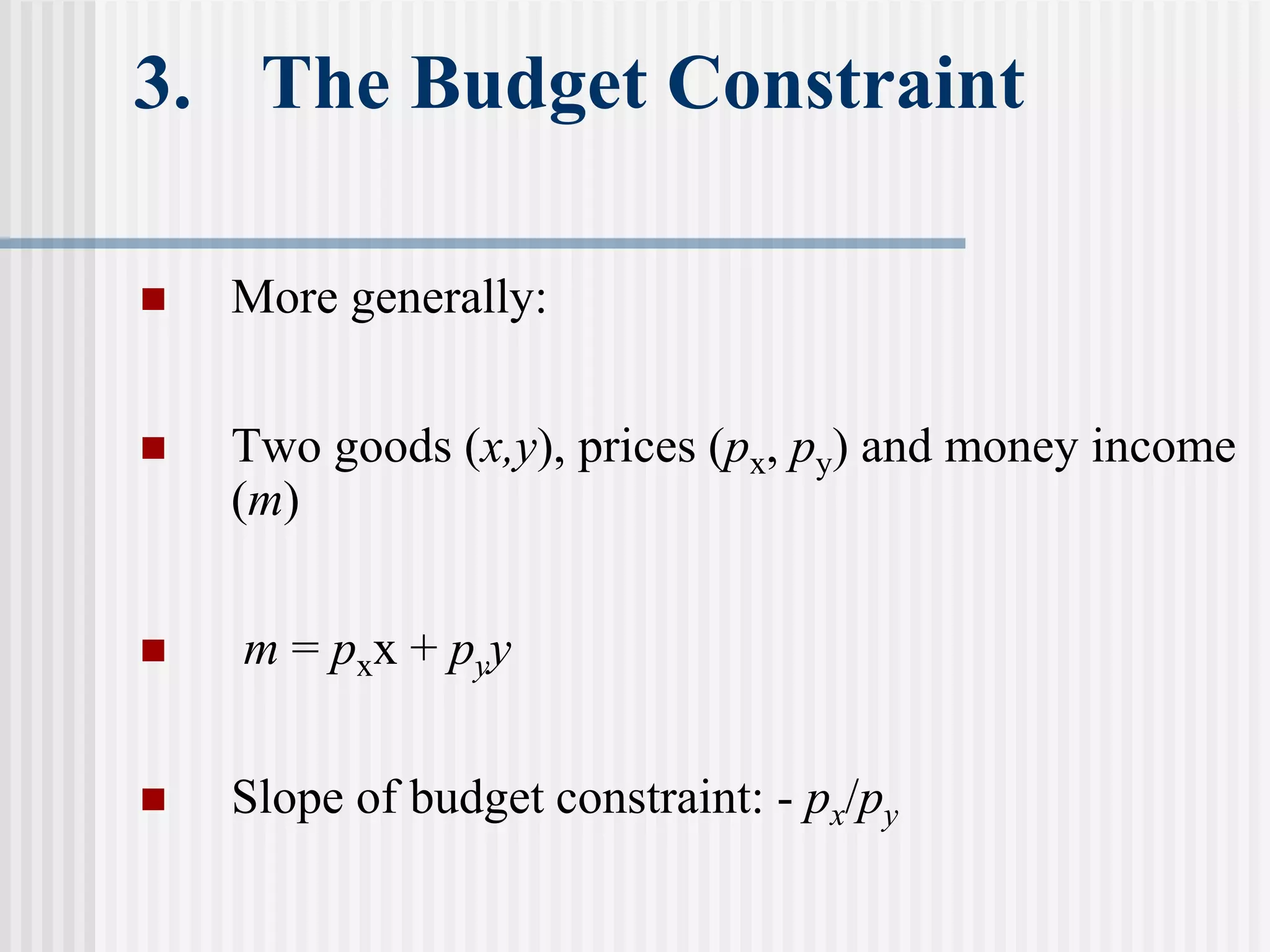
 More generally:
 Two goods (x,y), prices (px, py) and money income
(m)
 m = pxx + pyy
 Slope of budget constraint: - px/py
3. The Budget Constraint
 Proof:
m = px
x + py
y
Þ
py
y = m - px
x
Þ
y =
m
py
-
px
py
x
3. The Budget Constraint
 Thus:
 Such that
y =
m
py
æ
è
ç
ö
ø
÷
a
-
px
py
æ
è
ç
ö
ø
÷
b
x
Þ
y = a - bx
Dy = -bDx = -
px
py
æ
è
ç
ö
ø
÷ Dx
y
0
x
A
B
Figure 3: Budget Constraint
y = m/py - (px/py)x
m/px
m/py
Dx
Dy = -
px
py
æ
è
ç
ö
ø
÷ Dx
3. The Budget Constraint
 Intuition:
 If additional units of x costs px
 Then their purchase requires a change in
consumption of y of –(px/py) (i.e. a sacrifice of y)
in order to maintain the budget constraint.
3. The Budget Constraint
 Economic Rate of Substitution (ERS)
Amount of y the consumer is obliged to
sacrifice for one extra unit of x
 ERS = –(px/py)
 Slope of budget line
3. Budget Constraint
 Taxes and Subsidies
Taxes can be imposed per unit (i.e. p + t) or ad
valorem [i.e. p(1+ t)]
 Subsidies are ‘negative’ taxes
 Rationing causes budget constraint to become
vertical or horizontal
y
0 m/px
Figure 4: Budget Constraint and Rationing
m/py
x
x
y
0 xt m/px
Figure 5: Budget Constraint and Taxation
m/py
x
Slope = -(px/py)
Slope = -[(px+t)/py]
x
4. Preferences
 Consider now the consumer’s preferences; given
what consumer can do, what would he like to do?
 Four assumptions:
(i) Completeness
(ii) Consistency
(iii) Non-satiation
(iv) Diminishing Marginal Rate of Substitution
4. Preferences
 Completeness
Consumers can rank alternative bundles according
to the satisfaction or utility they provide
Thus, given two bundles a and b, then ,
or
Preferences assumed only to be ordinal, not
cardinal; i.e. consumer simply has to be able to say
he prefers a to b, not to say by how much.
a ≻ b a ≻ b
a ≻ b
4. Preferences
 Consistency
Preferences are also assumed to be consistent
Thus if and , then we would infer that
We assume consumer is logically consistent
a ≻ b a ≻ c
a ≻ c
4. Preferences
 Non-satiation
Consumers assumed to always prefer more
‘goods’ to less.
We can accommodate economics ‘bads’ (e.g.
pollution) in this assumption by interpreting then
as ‘negative’ goods
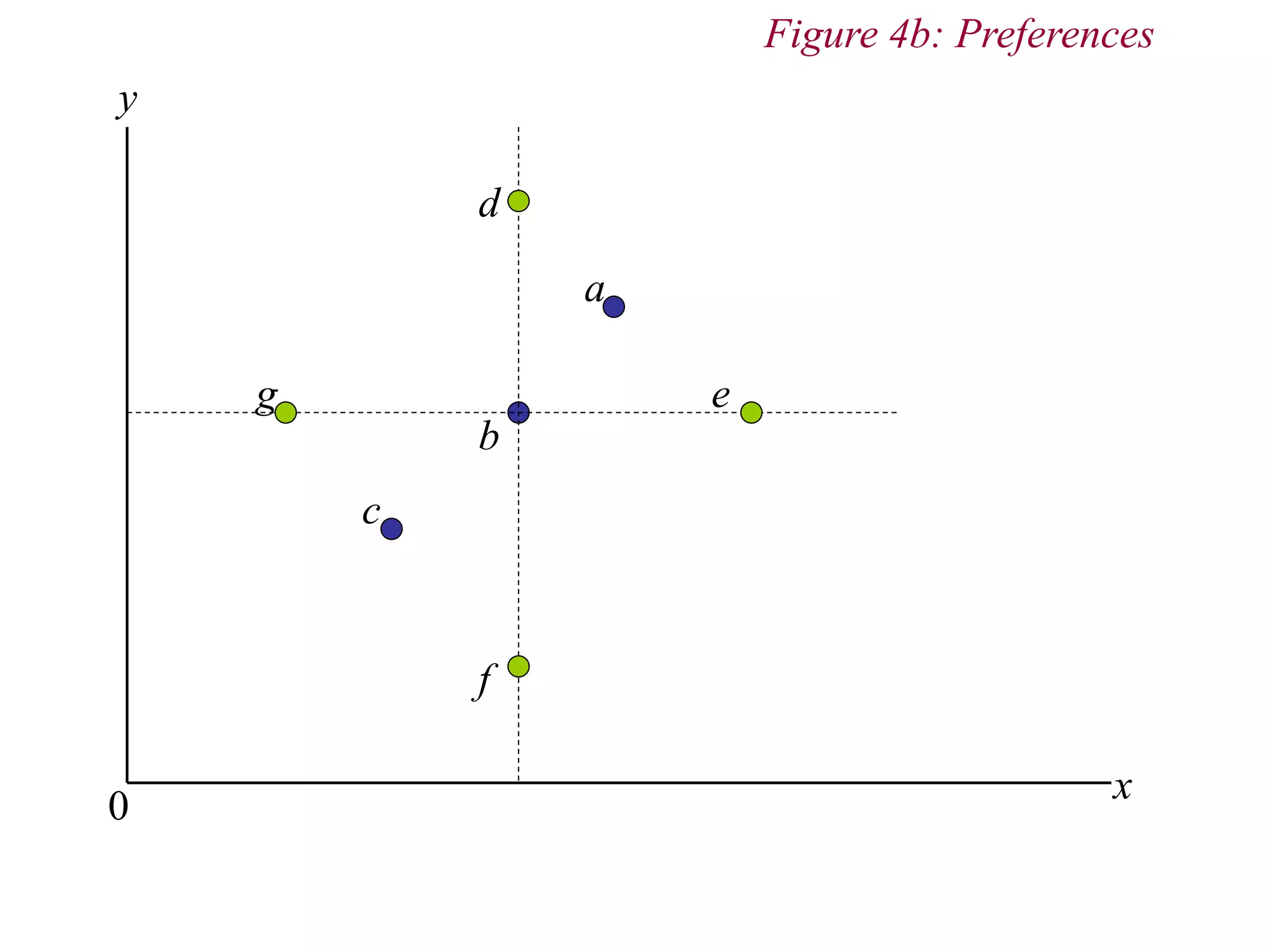
 We can illustrate the first three assumptions
graphically as follows
y
0
x
a
Figure 4a: Preferences
c
b
y
0
x
a
Figure 4b: Preferences
c
f
d
e
g
b
y
0
x
a
Figure 4c: Preferences
b
c
f
d
e
g
h
i
y
0
x
a
Figure 4d: Preferences
b
c
f
d
e
g
h
i
Indifference Curve
4. Preferences
 Marginal Rate of Substitution (MRS)
The quantity of y (i.e. the ‘vertical’ good) the consumer
must sacrifice to increase the quantity of x (i.e. ‘the
horizontal’ good) by one unit without changing total utility.
 We generally assume (smooth) diminishing MRS
 To hold utility constant, diminishing quantities of
one good must be sacrificed to obtain successive
equal increases in the quantity of the other good.
4. Preferences
 Diminishing MRS derives from underlying
assumption of diminishing marginal utility
 Marginal utility of a good is defined as the change
in a consumer’s total utility from consuming the
good divided by the change in his consumption of
the good
 Diminishing MRS assumes that the increase in
utility from consuming additional units of a good
is declining
4. Preferences
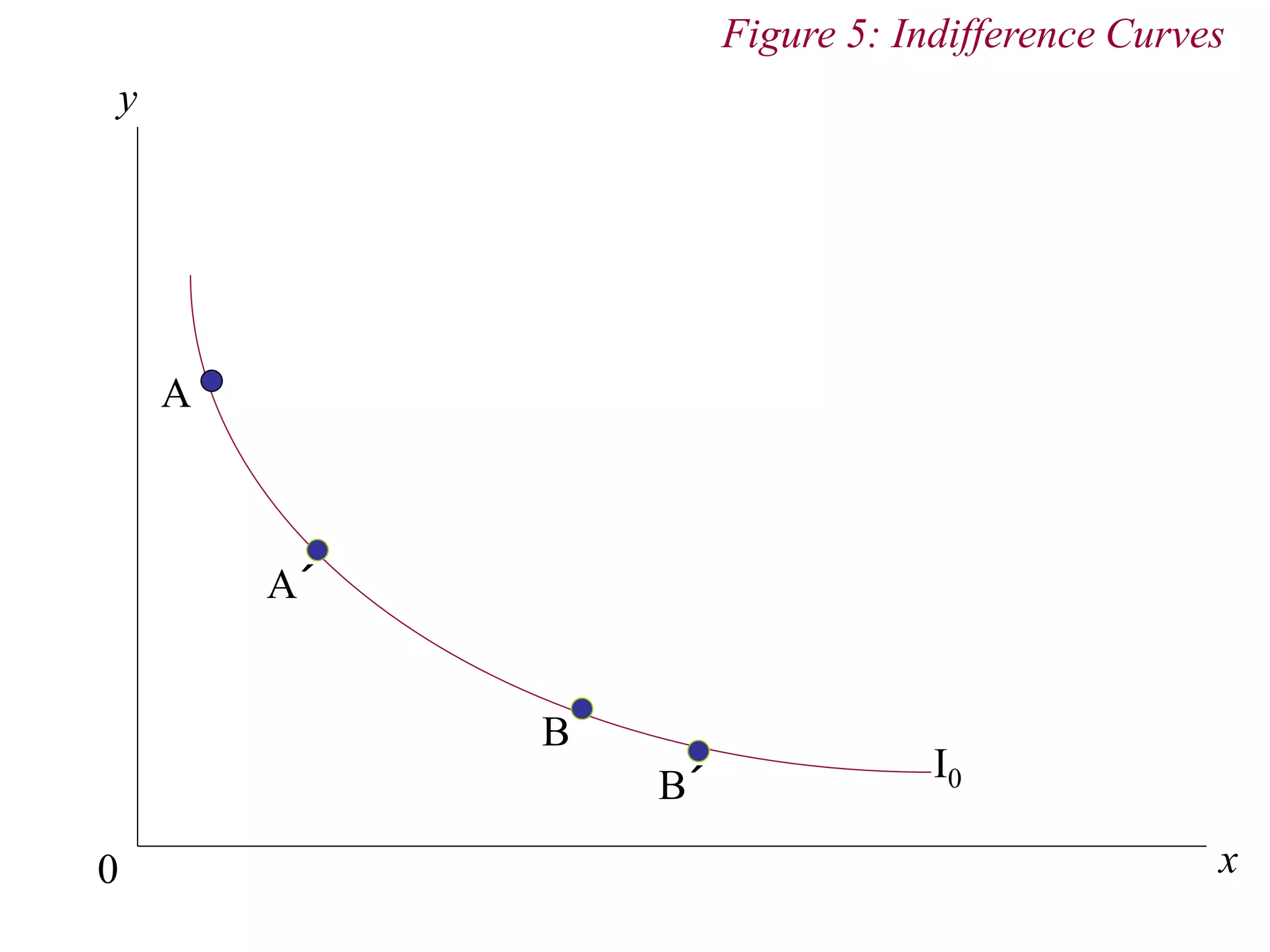
 Non-satiation implies downward sloping
indifference curves; increases in one good require
sacrifices in the other good to hold total utility
constant.
 However, we can go further; diminishing MRS
implies that indifference curves are convex to
origin, becoming flatter as we move to the right.
 Indeed, the MRS of x for y is simply the slope of
the indifference curve
y
x
0
I0
Figure 5: Indifference Curves
y
x
0
Figure 5: Indifference Curves
A
B
I0
y
x
0
I0
Figure 5: Indifference Curves
A
B
A´
B´
y
x
0
I0
Figure 5: Indifference Curves
A
B
A´
B´
Dy
Dy
Dx =1
Dx =1
4. Preferences
 Diminishing MRS implies consumers prefer
consumption bundles containing mixtures of
goods rather than extremes
 For example, Bundle C = (5, 5) preferred to both
Bundle A = (2, 8) and Bundle B = (8, 2)
 Diminishing MRS (i.e. diminishing marginal
utility)
y
x
0
I0
Figure 6: Indifference Curves
A
B
y
x
0
I0
Figure 6: Indifference Curves
A
B
8
2
2 8
y
x
0
I0
Figure 6: Indifference Curves
A
B
8
2
2 5 8
5
C
I1
4. Preferences
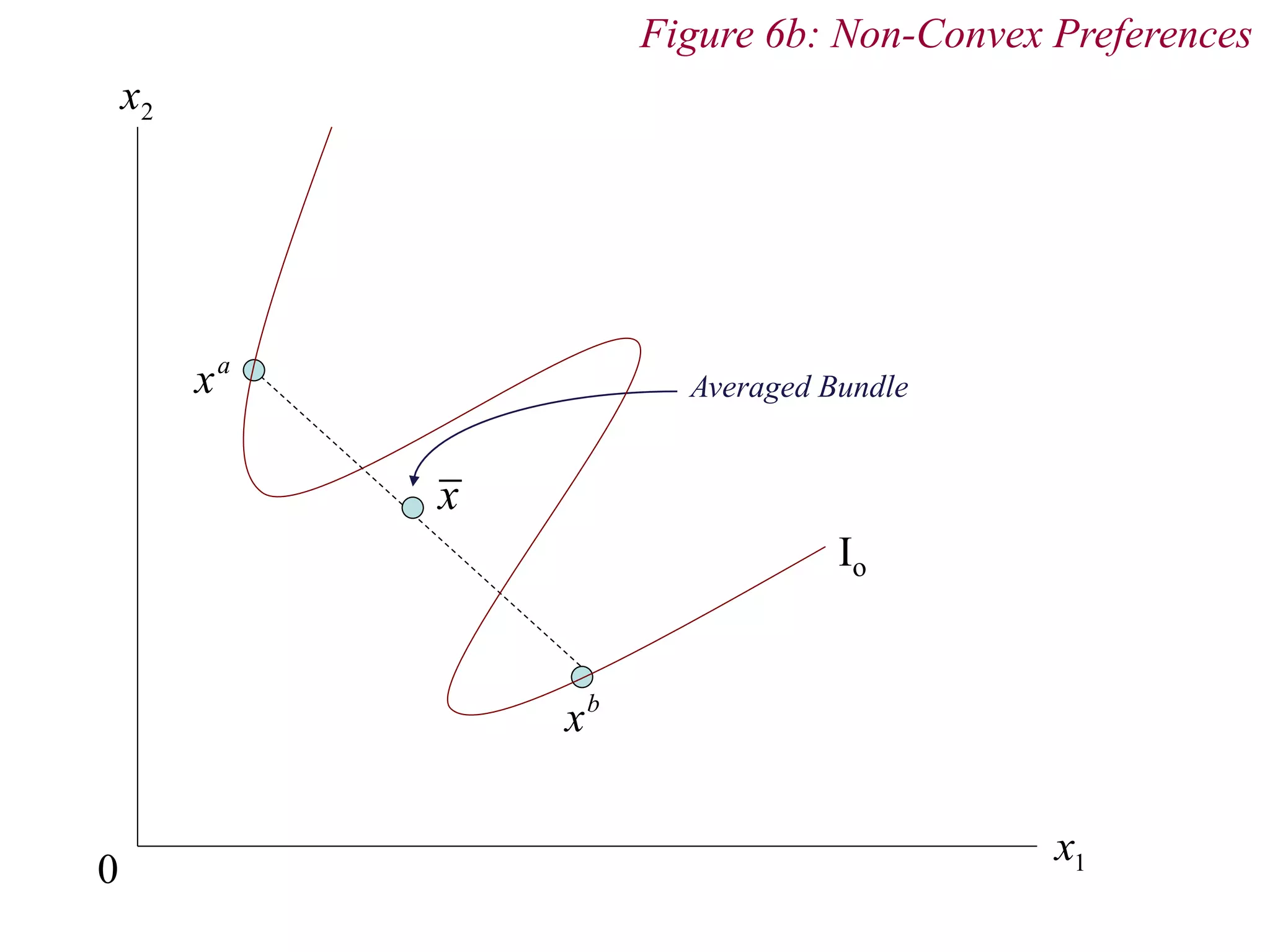
 Formally, such preferences are said to be convex
 Note also:
 Non-convex preferences
 Concave preferences
0
xa
xb
x2
x1
Io
Averaged Bundle
x
Figure 6a: Convex Preferences
0
xa
xb
x2
x1
Io
Averaged Bundle
x
Figure 6b: Non-Convex Preferences
0
xa
xb
x2
x1
Io
Averaged Bundle
x
Figure 6c: Concave Preferences
4. Preferences
 Note:
(i) Any point on the indifference map must lay on
an indifference curve;
and
(ii) indifference curves cannot cross
 Thus every point on the indifference map must lay
on one and only one indifference curve
y
x
0
I0
I1
I2
Figure 7: Indifference Curves
y
x
0
I1
I0
Figure 8: Indifference Curves Cannot Cross
a
b
c
4. Preferences
 Non-Standard Preferences
 Perfect Substitutes
 Perfect Complements
 Neutral Goods
 Satiation and Bliss Points
0
x2
x1
I0
I1
I2
Figure 8a: Perfect Substitutes
0
x2
x1
I0
I1
I2
b = x2 x1
Figure 8b: Perfect Complements
4. Preferences
 Comparing preferences
 Slope of indifference curve (MRS) measures
relative intensity of consumer’s demand
 Steeper (flatter) indifference curves implies
relatively higher (lower) demand for horizontal
good (x)

Consumer Theory 1.ppt

  • 1.
    Economics 3030 Intermediate MicroeconomicTheory Topic 2: Consumer Theory (ii)
  • 2.
    1. Introduction  Wehave seen how demand curves may be used to represent consumer behaviour.  But we said very little about the nature of the demand curve; why it slopes down for example.  Now we go ‘behind’ the demand curve  i.e. we investigate how buyers reconcile what they want with what they can get
  • 3.
    1. Introduction  N.B.We can use this theory in many ways - not simply as household consumer buying goods.  For example:  Modelling decision of worker as regards his supply of labour (i.e. demand for leisure)  Allocation of income across time (saving and investment)
  • 4.
    2. Theory ofConsumer Choice  Four elements: (i) Consumer’s income (ii) Prices of goods (iii) Consumer’s tastes (iv) Rational Maximisation
  • 5.
    3. The BudgetConstraint  The first two elements define the budget constraint  The feasibility of the consumer’s desired consumption bundle depends upon two factors: (i) Income (ii) Prices  Note: We assume, for the time being, that both are exogenous (i.e. beyond consumer's control)
  • 6.
    3. The BudgetConstraint  Example (N.B two goods)  Two goods - films and meals  Student grant = $50 per week (p.w.)  Price of meal = $5  Price of film = $10
  • 7.
    3. The BudgetConstraint  Thus student can ‘consume’ maximum p.w. of 10 meals or 5 films by devoting all of his grant to the consumption of only one of these goods.  Alternatively, he can consume some combination of the two goods  For example, giving up one film a week (saving $10) enables student to buy two additional meals (costing $5 each) .
  • 8.
    3. The BudgetConstraint qm $5*qm qf $10*qf M 0 0 5 50 50 2 10 4 40 50 4 20 3 30 50 6 30 2 20 50 8 40 1 10 50 10 50 0 0 50 Table 1: Affordable Consumption Bundles
  • 9.
    Films 0 Meals A B Figure 1: BudgetConstraint 2 8 10 1 4 5
  • 10.
    Films 0 Meals Figure 1: BudgetConstraint Budget Line Budget (Feasible) Set
  • 11.
    3. The BudgetConstraint  The budget constraint defines the maximum affordable quantity of one good available to the consumer given the quantity of the other good that is being consumed.  N.B. Trade-off!  Trade-off is represented slope of budget constraint.
  • 12.
    3. The BudgetConstraint  Intercepts Determined by income divided by the appropriate price of the good Define maximum quantity of a particular good available to an individual  Slope Independent of income Determined only by relative prices • .
  • 13.
    3. The BudgetConstraint  If consumer is devoting all income to films (qf = $50/$10 = 5), then 1 meal can only be obtained by sacrificing consumption of some films.  How many films must consumer give up?  pm = $5; thus to obtain that $5, the consumer must give up 1/2 a film
  • 14.
    3. The BudgetConstraint  The slope of the budget constraint in this example is thus: - pm pf = - $5 $10 = - 1 2
  • 15.
    Films 0 Meals Figure 2: Slopeof Budget Constraint 1 10 4.5 5 Dqm =1 Dqf = -0.5
  • 16.
    3. The BudgetConstraint  More generally:  Two goods (x,y), prices (px, py) and money income (m)  m = pxx + pyy  Slope of budget constraint: - px/py
  • 17.
    3. The BudgetConstraint  Proof: m = px x + py y Þ py y = m - px x Þ y = m py - px py x
  • 18.
    3. The BudgetConstraint  Thus:  Such that y = m py æ è ç ö ø ÷ a - px py æ è ç ö ø ÷ b x Þ y = a - bx Dy = -bDx = - px py æ è ç ö ø ÷ Dx
  • 19.
    y 0 x A B Figure 3: BudgetConstraint y = m/py - (px/py)x m/px m/py Dx Dy = - px py æ è ç ö ø ÷ Dx
  • 20.
    3. The BudgetConstraint  Intuition:  If additional units of x costs px  Then their purchase requires a change in consumption of y of –(px/py) (i.e. a sacrifice of y) in order to maintain the budget constraint.
  • 21.
    3. The BudgetConstraint  Economic Rate of Substitution (ERS) Amount of y the consumer is obliged to sacrifice for one extra unit of x  ERS = –(px/py)  Slope of budget line
  • 22.
    3. Budget Constraint Taxes and Subsidies Taxes can be imposed per unit (i.e. p + t) or ad valorem [i.e. p(1+ t)]  Subsidies are ‘negative’ taxes  Rationing causes budget constraint to become vertical or horizontal
  • 23.
    y 0 m/px Figure 4:Budget Constraint and Rationing m/py x x
  • 24.
    y 0 xt m/px Figure5: Budget Constraint and Taxation m/py x Slope = -(px/py) Slope = -[(px+t)/py] x
  • 25.
    4. Preferences  Considernow the consumer’s preferences; given what consumer can do, what would he like to do?  Four assumptions: (i) Completeness (ii) Consistency (iii) Non-satiation (iv) Diminishing Marginal Rate of Substitution
  • 26.
    4. Preferences  Completeness Consumerscan rank alternative bundles according to the satisfaction or utility they provide Thus, given two bundles a and b, then , or Preferences assumed only to be ordinal, not cardinal; i.e. consumer simply has to be able to say he prefers a to b, not to say by how much. a ≻ b a ≻ b a ≻ b
  • 27.
    4. Preferences  Consistency Preferencesare also assumed to be consistent Thus if and , then we would infer that We assume consumer is logically consistent a ≻ b a ≻ c a ≻ c
  • 28.
    4. Preferences  Non-satiation Consumersassumed to always prefer more ‘goods’ to less. We can accommodate economics ‘bads’ (e.g. pollution) in this assumption by interpreting then as ‘negative’ goods  We can illustrate the first three assumptions graphically as follows
  • 29.
  • 30.
  • 31.
  • 32.
  • 33.
    4. Preferences  MarginalRate of Substitution (MRS) The quantity of y (i.e. the ‘vertical’ good) the consumer must sacrifice to increase the quantity of x (i.e. ‘the horizontal’ good) by one unit without changing total utility.  We generally assume (smooth) diminishing MRS  To hold utility constant, diminishing quantities of one good must be sacrificed to obtain successive equal increases in the quantity of the other good.
  • 34.
    4. Preferences  DiminishingMRS derives from underlying assumption of diminishing marginal utility  Marginal utility of a good is defined as the change in a consumer’s total utility from consuming the good divided by the change in his consumption of the good  Diminishing MRS assumes that the increase in utility from consuming additional units of a good is declining
  • 35.
    4. Preferences  Non-satiationimplies downward sloping indifference curves; increases in one good require sacrifices in the other good to hold total utility constant.  However, we can go further; diminishing MRS implies that indifference curves are convex to origin, becoming flatter as we move to the right.  Indeed, the MRS of x for y is simply the slope of the indifference curve
  • 36.
  • 37.
  • 38.
  • 39.
    y x 0 I0 Figure 5: IndifferenceCurves A B A´ B´ Dy Dy Dx =1 Dx =1
  • 40.
    4. Preferences  DiminishingMRS implies consumers prefer consumption bundles containing mixtures of goods rather than extremes  For example, Bundle C = (5, 5) preferred to both Bundle A = (2, 8) and Bundle B = (8, 2)  Diminishing MRS (i.e. diminishing marginal utility)
  • 41.
  • 42.
  • 43.
    y x 0 I0 Figure 6: IndifferenceCurves A B 8 2 2 5 8 5 C I1
  • 44.
    4. Preferences  Formally,such preferences are said to be convex  Note also:  Non-convex preferences  Concave preferences
  • 45.
  • 46.
  • 47.
  • 48.
    4. Preferences  Note: (i)Any point on the indifference map must lay on an indifference curve; and (ii) indifference curves cannot cross  Thus every point on the indifference map must lay on one and only one indifference curve
  • 49.
  • 50.
    y x 0 I1 I0 Figure 8: IndifferenceCurves Cannot Cross a b c
  • 51.
    4. Preferences  Non-StandardPreferences  Perfect Substitutes  Perfect Complements  Neutral Goods  Satiation and Bliss Points
  • 52.
  • 53.
    0 x2 x1 I0 I1 I2 b = x2x1 Figure 8b: Perfect Complements
  • 54.
    4. Preferences  Comparingpreferences  Slope of indifference curve (MRS) measures relative intensity of consumer’s demand  Steeper (flatter) indifference curves implies relatively higher (lower) demand for horizontal good (x)