The modern theory of factor pricing, developed by Karan Verma, explains the determination of factor prices through the demand and supply of production factors, emphasizing derived demand. It operates under assumptions of profit motive, perfect knowledge, and competition in factor markets, ultimately seeking equilibrium price. Criticisms highlight its limited applicability to real-life scenarios and challenges in correlating marginal revenue product with factor pricing.
Introduction to the modern theory of factor pricing and its content structure covering definitions, theory assumptions, demand/supply, price determination, and criticisms.
Explanation of factor pricing through demand and supply theory, highlighting its equilibrium in price determination according to Robert Lipsey.
Key assumptions of factor pricing theory including profit motive, perfect knowledge, competition in factor markets, and perfect competition.
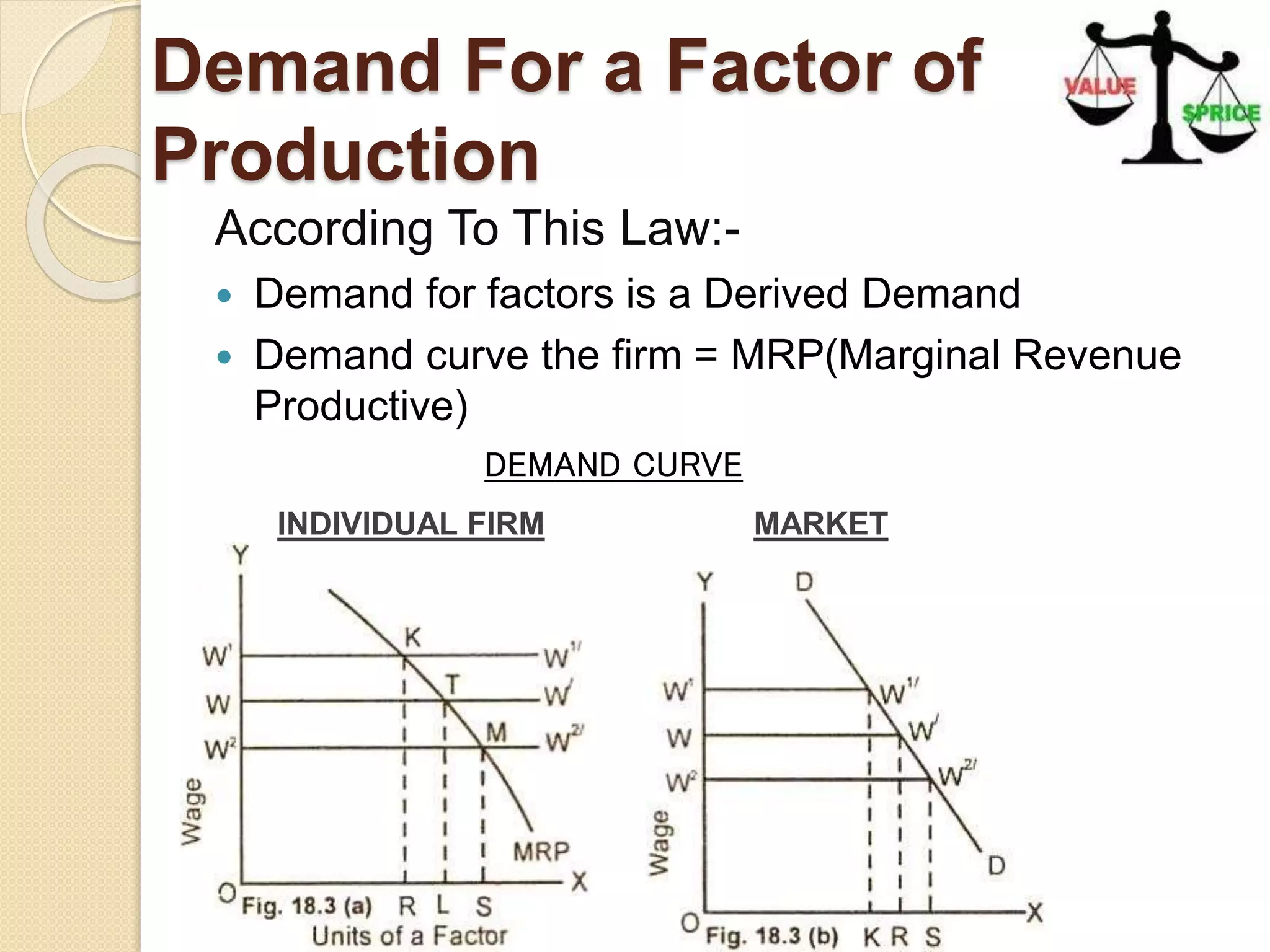
Derived demand for factors of production and its representation through the marginal revenue productivity curve in a market.
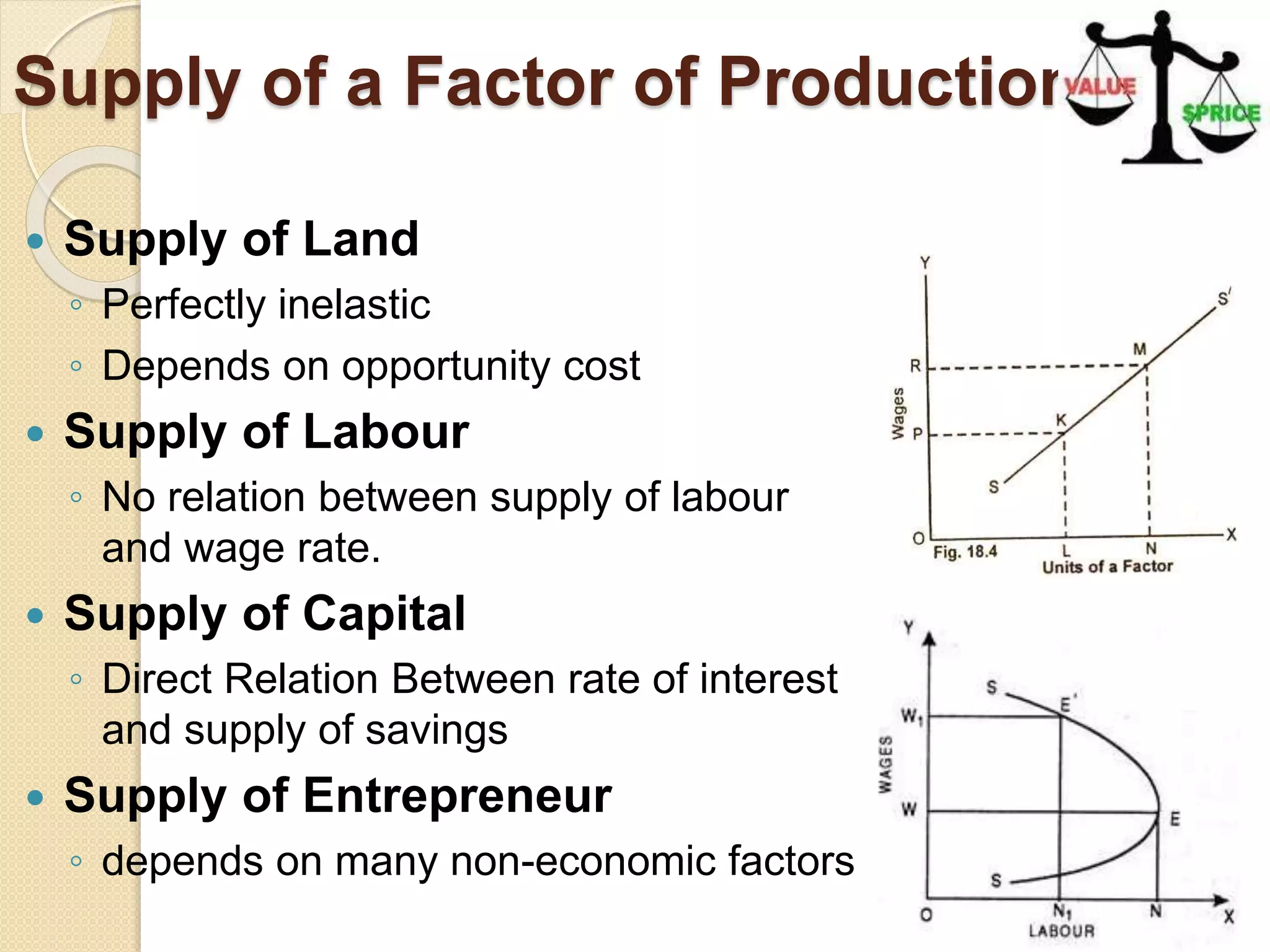
Discussions on the supply characteristics of land, labor, capital, and entrepreneurship emphasizing their unique supply dynamics.
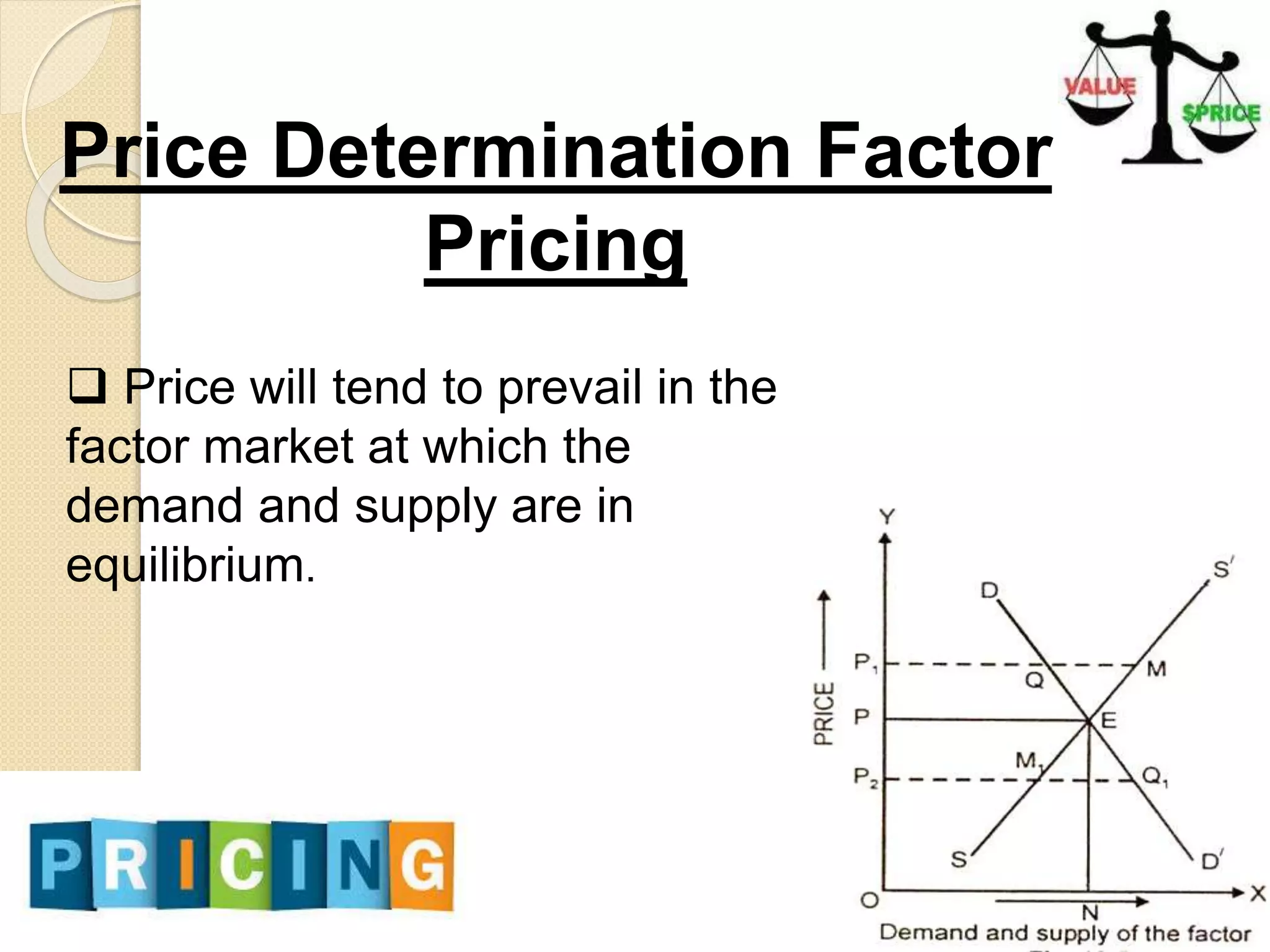
Description of how equilibrium price and quantity in the factor market are determined through demand and supply interactions.
Critiques of the theory including its real-life applicability, neglect of increasing returns, and challenges in coordination of MRP and factor pricing.
List of references used for the presentation including websites and books related to the modern theory of factor pricing.
Content
Meaning
Assumptionof theory
Demand For a Factor of Production
Supply For a Factor of Production
Price Determination Factor Pricing
Criticism
3.
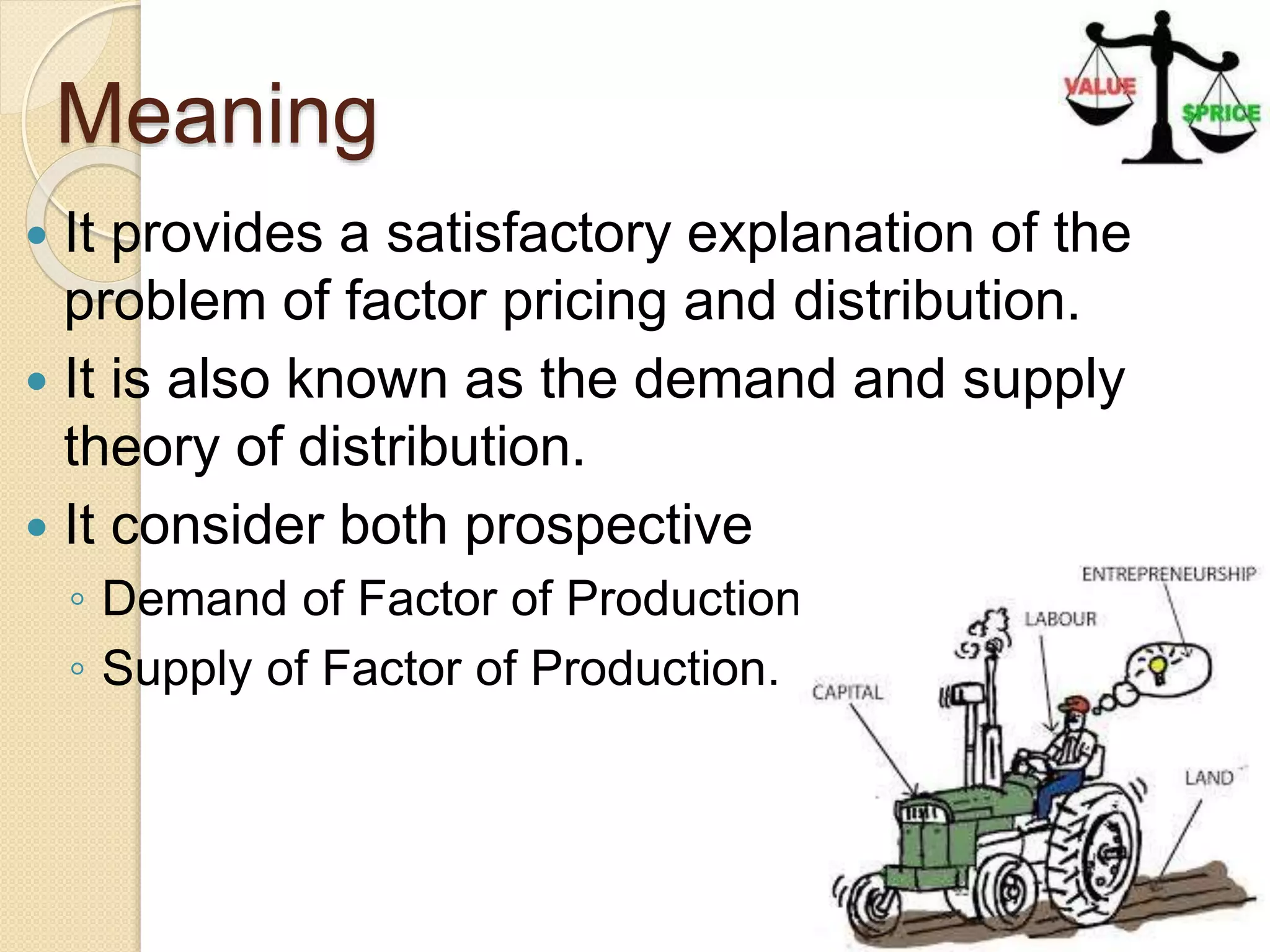
Meaning
It providesa satisfactory explanation of the
problem of factor pricing and distribution.
It is also known as the demand and supply
theory of distribution.
It consider both prospective
◦ Demand of Factor of Production.
◦ Supply of Factor of Production.
4.
Contd….
According to RobertLipsey
“The theory of factor prices is just a
special case of the theory of
pricing. We first develop a theory
of the demand for factors, then a
theory of the supply of factors
and finally combine them into a
theory of determination of
equilibrium price and quantities.”
5.
Assumptions
Profit Motive.
Perfect knowledge of
MRP.
Competition exists:-
◦ In the Factor Market.
◦ Different units of factors.
Prefect Competition
6.
Demand For aFactor of
Production
According To This Law:-
Demand for factors is a Derived Demand
Demand curve the firm = MRP(Marginal Revenue
Productive)
INDIVIDUAL FIRM MARKET
DEMAND CURVE
7.
Supply of aFactor of Production
Supply of Land
◦ Perfectly inelastic
◦ Depends on opportunity cost
Supply of Labour
◦ No relation between supply of labour
and wage rate.
Supply of Capital
◦ Direct Relation Between rate of interest
and supply of savings
Supply of Entrepreneur
◦ depends on many non-economic factors
Criticism
Theory doesn’tapplicable in Real life.
Theory ignores the increasing returns
in factor pricing.
Very difficult to coordinate MRP with
Factor pricing.
Assumption of Prefect substitution.