PROTECTING SUNDARBAN A REAL
CHALLANGE
SUNDARBAN -THE LOWER
GANGATIC DELTA
Sundarban extends from India to Bangladesh with
14,300 sq km area of which the major part lies in
Bangladesh. North 24 pargana has 6 blocks &
South 24 pargana has13 blocks. Indian part of
Sundarban have 4,267 sqkm area of which only
2,347 sq km is covered by forest .21 th August is
celebrated as the sundarban day for it is our
national heritage.
BIODIVERSITY OF SUNDARBAN
(FLORA)
D.Prain (1903)- 1.Southern coastal strip & south western part
mainly mangrove species
Rhizophora sp. , Arthrocnemum sp. Sonneratia sp.,
Phoenix sp.
2.Central zone of Heritiera
Heritiera fomes , Pandanus sp. ,
3.North- eastern part of Savannah type
vegetation. Saccharum sp. Andropogon sp.
Oberonia sp. , Cirrhopetalum roxburghii (Endamic)
Halophytic fern - Acrostichum aureum , Drymoglossum
pilosselloides
BIODIVERSITY OF SUNDARBAN
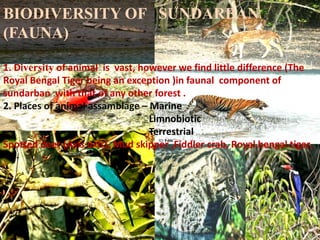
(FAUNA)
1. Diversity of animal is vast, however we find little difference (The
Royal Bengal Tiger being an exception )in faunal component of
sundarban with that of any other forest .
2. Places of animal assamblage – Marine
Limnobiotic
Terrestrial
Spotted deer (Axis axis), Mud skipper ,Fiddler crab, Royal bengal tiger,
THREATS AND CONSERVATION OF
BIODIVERSITY
HUNTING
OF
TIGERS
DESTRUCTION OF
OTHER ORGANISM
DURING
PRAWN SEEDLING
, FISHING
TRAPING
OF BIRDS
AS PETS
POACHING
OF
DEER,WILD
PIG,
REPTILES
ETC.
MERCILESS
KILLING OF
CROCODILE
TIGER
PROGECT
AWARENESS &
PRIMARY
EDUCATION
MODIFICATION IN
THE SIZE OF FISHING
NET & GENERAL
AWARENESS
CROCODILE
FARMING
GENERAL
AWARENESS
HAZARDS & DISASTERS
(1948-2009)
YEAR CALAMITES YEAR CALAMITES
1948 Cyclone 1973 Cyclone ,Flood
1956 Cyclone 1976 Flood
1960 Cyclone 1978 Flood
1961 Cyclone 1979 Famine
1962 Cyclone 1981 Cyclone
1965 Cyclone 1991 Chattagram
1966 Flood 2007 Sidr
1968 Super
cyclone
2008 Nargis
1970 Bhola 2009 Ayla
EFFECT OF CLIMATE CHANGE
ON SUNDARBAN ECOSYSTEM &
SOCIAL LIFE
IMPACT OF CLIMATE CHANGE
ON ECOSYSTEM ON SOCIAL LIFE
1. ANNUAL TEMPERATURE RISE BY 0.4
DEGREE CELSIUS. LEADING TO CYCLONIC
STORM & FLOOD.
2. RISE IN SEE LAVEL BY 4 mm EVERY
YEAR. LEADING TO INCREASED SALINITY
& DECREASED SWEET WATER FLOW.
• TOP DRYING DISEASE
• ALTERATION IN SPECIES COMBINATION
• AFFECTED PLANT SUCCESSION
• LOSS OF VALUEABLE WILD LIFE
3. INCREASE IN SURFACE WATER TEMPERATURE BY 0.5
DEGREE CELSIUS.
4. VARIATION IN DISSOLVED OXYGEN, PH LEVEL,
TRANSPIRANCY ,WATER QUALITY.
1.REDUCTION IN AGRICULTURAL LAND.
2. CHANGE IN LIVELI HOOD
3. LOSS OF HABITAT.
4.LOSS OF HUMAN LIVES.
EXPERIMENTAL PROJECTS IN
SOCIO-ECONOMIC IMPROVEMENT……
EXISTING ECONOMIC PRACTICES :-
1.SUSTAINABLE AGRICULTURE
2.FISHERIES ,
3. APICULTURE
4. TIMBER FROM Casuarina sp.
WAYS TO IMPROVE ECONOMY OF
SUNDARBAN :-
1.SOCIOECONOMIC IMPROVEMENT PROGRAMME.
2. DEVELOPMENT OF VARIOUS INDUSTRIES USING SEA WATER RESOURCES, SEA
WATER HYDROELECTRIC POWER PROJECT.
3. MORE FISHERIES , APICULTURE,PEARL CULTURE, SERICULTURE, SILVICULTURE.
4. ENCOURAGEMENT OF WILDLIFE, SEMI AQUATIC & SALINE BELT FLORA & FAUNA .
EXPERIMENTAL PROJECTS IN
DEVELOPMENTAL PLANNING
1. Monitoring Soil and Water Quality Within Sundarban Reserve Forests - conducted
by Institute of Environmental Studies & Wetland Management.
2. Software Development for Tiger Pugmark Analysis - conducted by Indian
Statistical Institute.
3. Preparation of Classified Mangrove Vegetation Map using Remote Sensing or
Geographical Information System - conducted by National Remote Sensing
Agency.
4. Status of Avifauna within Sundarban Reserve Forest and Non-Forest Areas of
Sundarban Biosphere Reserve - conducted by Prakriti Samsad, a Non-
Government Organisation.
5. Environment Awareness & Education Programme Among Teachers, Students
and Villagers of Sundarban - conducted by World Wildlife Fund - India, a Non-
Government Organisation.
6. Establishment of Sundarban Biosphere Resource Information Centre -
conducted Jointly by Indian Institute of Social Welfare and Business Management
and Botanical Survey of India.
Presentation1.pptx  save sundarbon

Presentation1.pptx save sundarbon

  • 1.
    PROTECTING SUNDARBAN AREAL CHALLANGE
  • 2.
    SUNDARBAN -THE LOWER GANGATICDELTA Sundarban extends from India to Bangladesh with 14,300 sq km area of which the major part lies in Bangladesh. North 24 pargana has 6 blocks & South 24 pargana has13 blocks. Indian part of Sundarban have 4,267 sqkm area of which only 2,347 sq km is covered by forest .21 th August is celebrated as the sundarban day for it is our national heritage.
  • 3.
    BIODIVERSITY OF SUNDARBAN (FLORA) D.Prain(1903)- 1.Southern coastal strip & south western part mainly mangrove species Rhizophora sp. , Arthrocnemum sp. Sonneratia sp., Phoenix sp. 2.Central zone of Heritiera Heritiera fomes , Pandanus sp. , 3.North- eastern part of Savannah type vegetation. Saccharum sp. Andropogon sp. Oberonia sp. , Cirrhopetalum roxburghii (Endamic) Halophytic fern - Acrostichum aureum , Drymoglossum pilosselloides
  • 4.
    BIODIVERSITY OF SUNDARBAN (FAUNA) 1.Diversity of animal is vast, however we find little difference (The Royal Bengal Tiger being an exception )in faunal component of sundarban with that of any other forest . 2. Places of animal assamblage – Marine Limnobiotic Terrestrial Spotted deer (Axis axis), Mud skipper ,Fiddler crab, Royal bengal tiger,
  • 5.
    THREATS AND CONSERVATIONOF BIODIVERSITY HUNTING OF TIGERS DESTRUCTION OF OTHER ORGANISM DURING PRAWN SEEDLING , FISHING TRAPING OF BIRDS AS PETS POACHING OF DEER,WILD PIG, REPTILES ETC. MERCILESS KILLING OF CROCODILE TIGER PROGECT AWARENESS & PRIMARY EDUCATION MODIFICATION IN THE SIZE OF FISHING NET & GENERAL AWARENESS CROCODILE FARMING GENERAL AWARENESS
  • 6.
    HAZARDS & DISASTERS (1948-2009) YEARCALAMITES YEAR CALAMITES 1948 Cyclone 1973 Cyclone ,Flood 1956 Cyclone 1976 Flood 1960 Cyclone 1978 Flood 1961 Cyclone 1979 Famine 1962 Cyclone 1981 Cyclone 1965 Cyclone 1991 Chattagram 1966 Flood 2007 Sidr 1968 Super cyclone 2008 Nargis 1970 Bhola 2009 Ayla
  • 7.
    EFFECT OF CLIMATECHANGE ON SUNDARBAN ECOSYSTEM & SOCIAL LIFE IMPACT OF CLIMATE CHANGE ON ECOSYSTEM ON SOCIAL LIFE 1. ANNUAL TEMPERATURE RISE BY 0.4 DEGREE CELSIUS. LEADING TO CYCLONIC STORM & FLOOD. 2. RISE IN SEE LAVEL BY 4 mm EVERY YEAR. LEADING TO INCREASED SALINITY & DECREASED SWEET WATER FLOW. • TOP DRYING DISEASE • ALTERATION IN SPECIES COMBINATION • AFFECTED PLANT SUCCESSION • LOSS OF VALUEABLE WILD LIFE 3. INCREASE IN SURFACE WATER TEMPERATURE BY 0.5 DEGREE CELSIUS. 4. VARIATION IN DISSOLVED OXYGEN, PH LEVEL, TRANSPIRANCY ,WATER QUALITY. 1.REDUCTION IN AGRICULTURAL LAND. 2. CHANGE IN LIVELI HOOD 3. LOSS OF HABITAT. 4.LOSS OF HUMAN LIVES.
  • 8.
    EXPERIMENTAL PROJECTS IN SOCIO-ECONOMICIMPROVEMENT…… EXISTING ECONOMIC PRACTICES :- 1.SUSTAINABLE AGRICULTURE 2.FISHERIES , 3. APICULTURE 4. TIMBER FROM Casuarina sp. WAYS TO IMPROVE ECONOMY OF SUNDARBAN :- 1.SOCIOECONOMIC IMPROVEMENT PROGRAMME. 2. DEVELOPMENT OF VARIOUS INDUSTRIES USING SEA WATER RESOURCES, SEA WATER HYDROELECTRIC POWER PROJECT. 3. MORE FISHERIES , APICULTURE,PEARL CULTURE, SERICULTURE, SILVICULTURE. 4. ENCOURAGEMENT OF WILDLIFE, SEMI AQUATIC & SALINE BELT FLORA & FAUNA .
  • 9.
    EXPERIMENTAL PROJECTS IN DEVELOPMENTALPLANNING 1. Monitoring Soil and Water Quality Within Sundarban Reserve Forests - conducted by Institute of Environmental Studies & Wetland Management. 2. Software Development for Tiger Pugmark Analysis - conducted by Indian Statistical Institute. 3. Preparation of Classified Mangrove Vegetation Map using Remote Sensing or Geographical Information System - conducted by National Remote Sensing Agency. 4. Status of Avifauna within Sundarban Reserve Forest and Non-Forest Areas of Sundarban Biosphere Reserve - conducted by Prakriti Samsad, a Non- Government Organisation. 5. Environment Awareness & Education Programme Among Teachers, Students and Villagers of Sundarban - conducted by World Wildlife Fund - India, a Non- Government Organisation. 6. Establishment of Sundarban Biosphere Resource Information Centre - conducted Jointly by Indian Institute of Social Welfare and Business Management and Botanical Survey of India.