Department of Dentistry
Seminar presentation on
Anesthesia considerations in Dentistry
Year III medical students
Moderator:Dr Dani(MD,orthodontist)
Presenters:Group 5(IDNo 031/19-036/19)
Tikimt 23,2015E.C
Dilla,Ethiopia
contents
Overview on maxillary and maxillary innervation
Definition
Methods
Advantages
Limitations
Advances
objectives
At the end of this seminar you are expected to:
 Define anesthesia
 Know the role of anesthesia in dentistry
 Identify different methods
 Limitations of anesthesia
 Identify advances in anesthesia
Definition
11/1/2022 4
 Local Anesthesia is the loss of sensation in circumscribed area
of body caused by depression of excitation in nerve engines or
inhibition of conduction process in peripheral nerves.
 Produces loss of sensation with out loss of consciousness
Role of Local Anesthetics
• Decrease intraoperative and postoperative pain
• Decrease amount of general anesthetics used in the
OR
• Increase patients cooperation
• Diagnostic testing/examination
11/1/2022 5
Techniques of Local Anesthesia or methods
1. Topical anesthesia
Spray
Ointment
Solution form
Gel
2. Parentral anesthesia
Infiltration
Block anesthesia
11/1/2022 6
Desirable characteristics of ideal
anesthesia
1. Low toxicity
2. Reduction of blood flow
3. Long duration of action
4. Rapid speed of onset
5. Good anesthetic efficacy
11/1/2022 7
Precaution to be considered during
injection inside the mouth
11/1/2022 8
 Do not inject local anesthetic into an area that is swollen.
 If the person has heart disease or hypertension not
use an anesthetic with epinephrine(vasoconstrictor).
 Use lidocaine without epinephrine.
 Before the needle enter the mucosa, be sure its
bevel is facing the mucosa.
Cont…
 Before the local anesthetic is injected, aspirat with the
syringe to prevent an intravascular injection.
 If this happens pull the needle part way out and
gently move it over to a different place.
 Use a sharp needle and inject the solution very
slowly.
 Be sure the syringe is clean and sterile.
11/1/2022 9
types:
11/1/2022 10
1. amide
lidocaine, mepivacaine, prilocaine, articaine,
bupivacaine and etidocaine.
2. Ester
procaine propoxycaine, chlorprocain and
tetracaine are some common esther anesthetics.
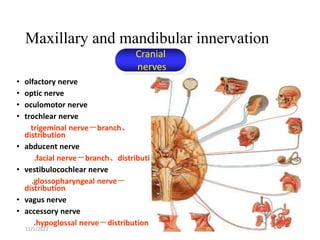
Maxillary and mandibular innervation
11/1/2022 11
• olfactory nerve
• optic nerve
• oculomotor nerve
• trochlear nerve
• V.trigeminal nerve-branch、
distribution
• abducent nerve
• VII.facial nerve-branch、distribution
• vestibulocochlear nerve
• IX.glossopharyngeal nerve-
distribution
• vagus nerve
• accessory nerve
• XII.hypoglossal nerve-distribution
Cranial
nerves
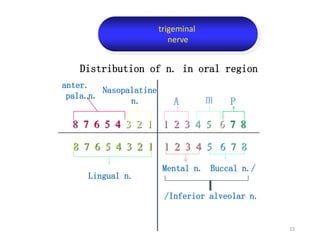
8 7 6 5 4 3 2 1 1 2 3 4 5 6 7 8
8 7 6 5 4 3 2 1 1 2 3 4 5 6 7 8
trigeminal
nerve
P
m
A
Lingual n.
Buccal n./
Mental n.
/Inferior alveolar n.
Nasopalatine
n.
anter.
pala.n.
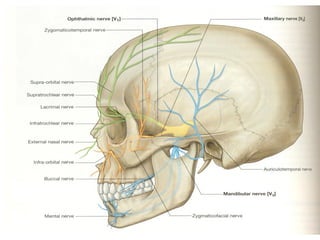
Distribution of n. in oral region
13
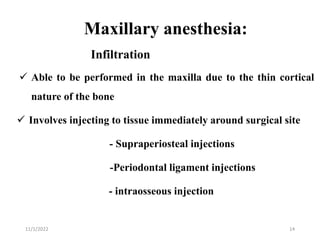
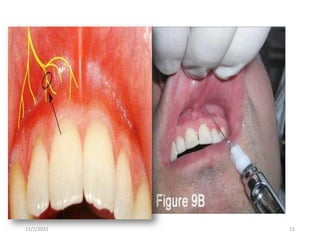
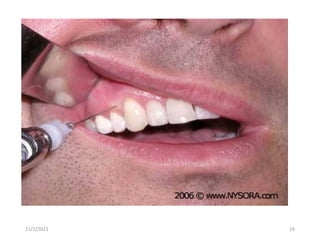
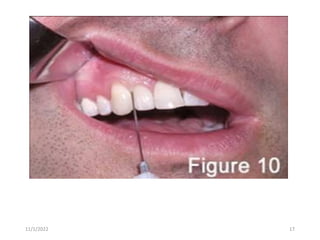
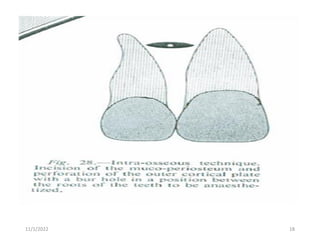
Maxillary anesthesia:
Infiltration
 Able to be performed in the maxilla due to the thin cortical
nature of the bone
 Involves injecting to tissue immediately around surgical site
- Supraperiosteal injections
-Periodontal ligament injections
- intraosseous injection
11/1/2022 14
11/1/2022 15
11/1/2022 16
11/1/2022 17
11/1/2022 18
Cont…
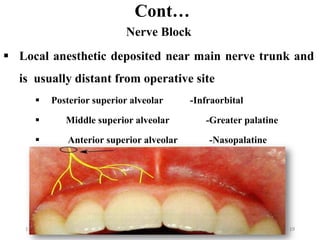
Nerve Block
 Local anesthetic deposited near main nerve trunk and
is usually distant from operative site
 Posterior superior alveolar -Infraorbital
 Middle superior alveolar -Greater palatine
 Anterior superior alveolar -Nasopalatine
11/1/2022 19
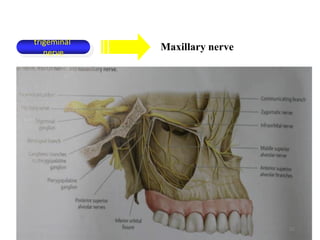
Maxillary nerve
trigeminal
nerve
20
Cont………
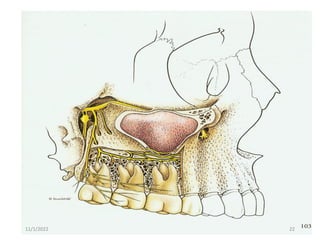
Posterior superior alveolar nerve block:
– Used to anesthetize the pulpal tissue, corresponding
alveolar bone, and buccal gingival tissue to the maxillary
1st, 2nd and 3rd molars.
11/1/2022 21
11/1/2022 22
Cont…
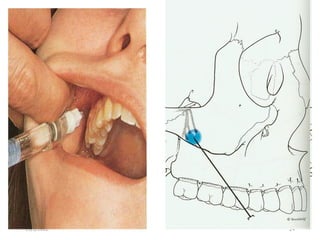
– Technique:
• Area of insertion - height of mucobuccal fold
between1st and 2nd molar
• Angle at 45° superiorly and medially
• No resistance should be felt (if bony contact angle
it to medial, reposition laterally)
• Insert about 15-20mm
• Aspirate then inject if negative
11/1/2022 23
11/1/2022 24
Cont…
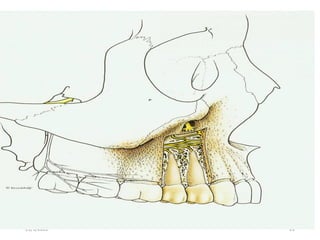
Middle superior alveolar nerve block:
- Used to anesthetize the maxillary premolars,
corresponding alveolus, and buccal gingival tissue
- Used if the infraorbital block fails to anesthetize
premolars
11/1/2022 25
11/1/2022 26
Cont…
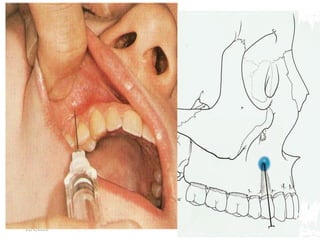
– Technique:
• Area of insertion is height of mucobuccal fold in area of 1st &
2nd premolars
• Insert around 10-15mm
• Inject around 0.9-1.2cc
11/1/2022 27
11/1/2022 28
Cont…
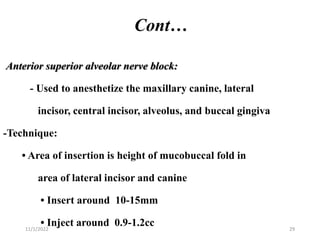
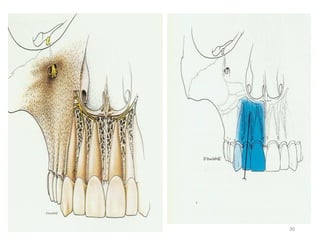
Anterior superior alveolar nerve block:
- Used to anesthetize the maxillary canine, lateral
incisor, central incisor, alveolus, and buccal gingiva
-Technique:
• Area of insertion is height of mucobuccal fold in
area of lateral incisor and canine
• Insert around 10-15mm
• Inject around 0.9-1.2cc
11/1/2022 29
11/1/2022 30
Cont..
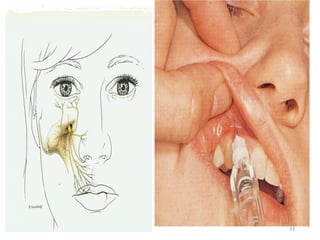
Infraorbital nerve block:
– Used to anesthetize the maxillary1st and 2nd
premolars, canine, lateral incisor, central incisor,
corresponding alveolar bone, and buccal gingiva
– Combines MSA and ASA blocks
– Will also cause anesthesia to the lower eyelid, lateral
aspect of nasal skin tissue, and skin of infraorbital region
11/1/2022 31
Cont…
Technique:
• Palpate infraorbital foramen extra-orally and place
thumb or index finger on region
• Retract the upper lip and buccal mucosa
• Area of insertion is the mucobuccal fold of the1st
premolar/canine area
• Contact bone in infraorbital region
• Inject 0.9-1.2cc of local anesthetic
11/1/2022 32
11/1/2022 33
Cont…
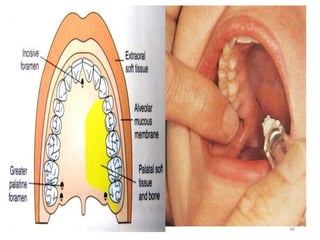
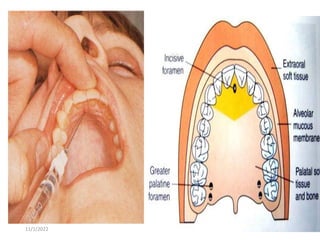
Greater palatine nerve block:
- Can be used to anesthetize the palatal soft tissue of
the teeth posterior to the maxillary canine and corresponding
alveolus/hard palate
11/1/2022 34
Cont……
Technique:
• Area of insertion is ~1cm medial from 2nd maxillary molar
on the hard palate
• Palpate with needle to find greater palatine foramen
• Depth is usually less than 10mm
• Utilize pressure with elevator/mirror handle to
desensitize region at time of injection
• Inject 0.3-0.5cc of local anesthetic
11/1/2022 35
11/1/2022 36
Cont…
Nasopalatine nerve block:
- Can be used to anesthetize the soft and hard tissue of
the maxillary anterior palate from canine to canine
– Technique:
• Area of insertion is incisive papilla into incisive foramen
• Depth of penetration is less than 10mm
• Inject 0.3-0.5cc of local anesthetic
• Can use pressure over area at time of injection to
decrease pain
11/1/2022 37
11/1/2022 38
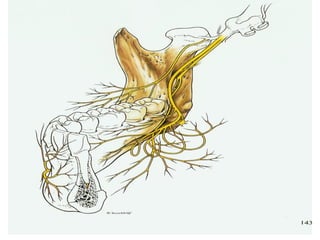
Mandibular anesthesia
• Infiltration techniques do not work in the adult mandible
due to the dense cortical bone
• Nerve blocks are utilized to anesthetize the inferior
alveolar, lingual, and buccal nerves
• Provides anesthesia to the pulpal, alveolar, lingual and
buccal gingival tissue, and skin of lower lip and medial
aspect of chin on side injected
11/1/2022 39
11/1/2022 40
Cont…
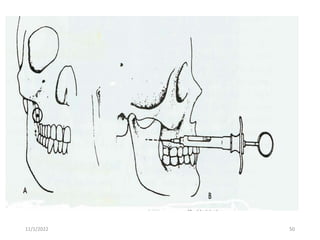
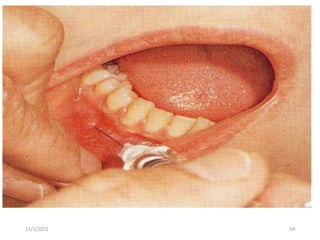
Inferior alveolar nerve block (IAN):
– Technique involves blocking the inferior alveolar nerve
prior to entry into the mandibular lingula on the medial
aspect of the mandibular ramus
– Multiple techniques can be used for the IAN nerve block
• IAN
• Akinosi
11/1/2022 41
Cont….
Technique:
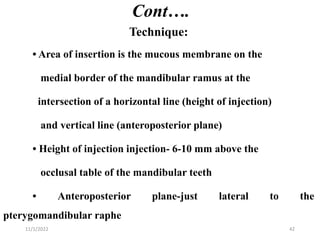
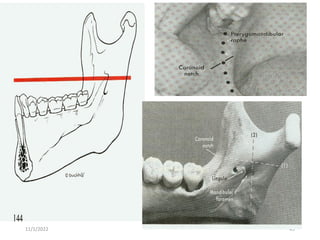
• Area of insertion is the mucous membrane on the
medial border of the mandibular ramus at the
intersection of a horizontal line (height of injection)
and vertical line (anteroposterior plane)
• Height of injection injection- 6-10 mm above the
occlusal table of the mandibular teeth
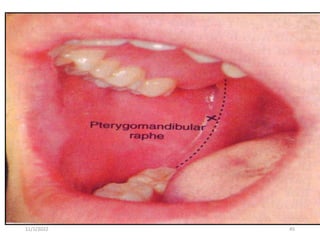
• Anteroposterior plane-just lateral to the
pterygomandibular raphe
11/1/2022 42
11/1/2022 43
cont…
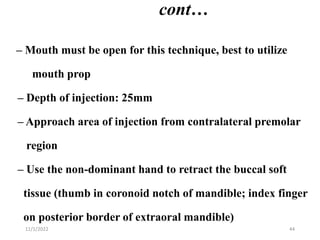
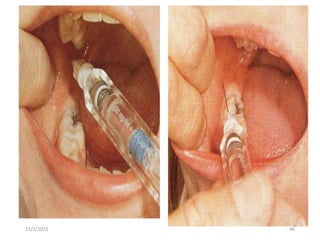
– Mouth must be open for this technique, best to utilize
mouth prop
– Depth of injection: 25mm
– Approach area of injection from contralateral premolar
region
– Use the non-dominant hand to retract the buccal soft
tissue (thumb in coronoid notch of mandible; index finger
on posterior border of extraoral mandible)
11/1/2022 44
11/1/2022 45
11/1/2022 46
cont…
– Inject ~0.5-1.0cc of local anesthetic
– Continue to inject ~0.5cc on removal from injection site
to anesthetize the lingual branch
– Inject remaining anesthetic into coronoid notch region of
the mandible in the mucous membrane distal and buccal
to most distal molar to perform a long buccal nerve block
11/1/2022 47
cont…
Akinosi closed-mouth mandibular block:
– Useful technique for infected patients with trismus,
fractured mandibles, mentally handicapped individuals,
children
– Provides same areas of anesthesia as the IAN nerve block
11/1/2022 48
Cont…
Area of insertion
 soft tissue overlying the medial border of the mandibular
ramus directly adjacent to maxillary tuberosity
 Inject to depth of 25mm
 Inject ~1.0-1.5cc of local anesthetic as in the IAN
 Inject remaining anesthetic in area of long buccal nerve
11/1/2022 49
11/1/2022 50
Cont….
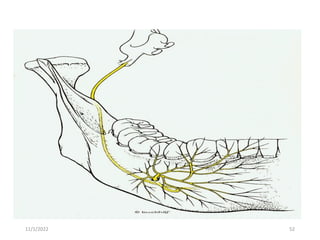
Mental nerve block:
- Mental and incisive nerves are the terminal branches for
the inferior alveolar nerve
- Provides sensory input for the lower lip skin, mucous
membrane, pulpal/alveolar tissue for the premolars,
canine, and incisors on side blocked
11/1/2022 51
11/1/2022 52
cont…
– Technique:
• Area of injection mucobuccal fold at or anterior to the
mental foramen. This lies between the mandibular
premolars
• Depth of injection ~5 5-6mm
• Inject 0.5 0.5-1.0cc of local anesthesia
• Message local anesthesia into tissue to manipulate into
mental foramen to anesthetize the incisive branch
11/1/2022 53
11/1/2022 54
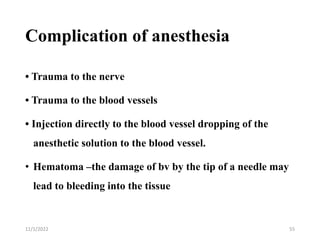
Complication of anesthesia
• Trauma to the nerve
• Trauma to the blood vessels
• Injection directly to the blood vessel dropping of the
anesthetic solution to the blood vessel.
• Hematoma –the damage of bv by the tip of a needle may
lead to bleeding into the tissue
11/1/2022 55
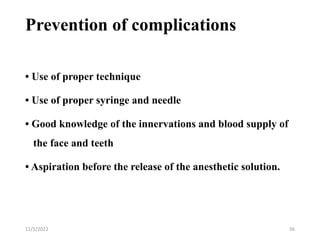
Prevention of complications
• Use of proper technique
• Use of proper syringe and needle
• Good knowledge of the innervations and blood supply of
the face and teeth
• Aspiration before the release of the anesthetic solution.
11/1/2022 56
References
11/1/2022 57
Thank you!
11/1/2022 58

Finalized.pdf

  • 1.
    Department of Dentistry Seminarpresentation on Anesthesia considerations in Dentistry Year III medical students Moderator:Dr Dani(MD,orthodontist) Presenters:Group 5(IDNo 031/19-036/19) Tikimt 23,2015E.C Dilla,Ethiopia
  • 2.
    contents Overview on maxillaryand maxillary innervation Definition Methods Advantages Limitations Advances
  • 3.
    objectives At the endof this seminar you are expected to:  Define anesthesia  Know the role of anesthesia in dentistry  Identify different methods  Limitations of anesthesia  Identify advances in anesthesia
  • 4.
    Definition 11/1/2022 4  LocalAnesthesia is the loss of sensation in circumscribed area of body caused by depression of excitation in nerve engines or inhibition of conduction process in peripheral nerves.  Produces loss of sensation with out loss of consciousness
  • 5.
    Role of LocalAnesthetics • Decrease intraoperative and postoperative pain • Decrease amount of general anesthetics used in the OR • Increase patients cooperation • Diagnostic testing/examination 11/1/2022 5
  • 6.
    Techniques of LocalAnesthesia or methods 1. Topical anesthesia Spray Ointment Solution form Gel 2. Parentral anesthesia Infiltration Block anesthesia 11/1/2022 6
  • 7.
    Desirable characteristics ofideal anesthesia 1. Low toxicity 2. Reduction of blood flow 3. Long duration of action 4. Rapid speed of onset 5. Good anesthetic efficacy 11/1/2022 7
  • 8.
    Precaution to beconsidered during injection inside the mouth 11/1/2022 8  Do not inject local anesthetic into an area that is swollen.  If the person has heart disease or hypertension not use an anesthetic with epinephrine(vasoconstrictor).  Use lidocaine without epinephrine.  Before the needle enter the mucosa, be sure its bevel is facing the mucosa.
  • 9.
    Cont…  Before thelocal anesthetic is injected, aspirat with the syringe to prevent an intravascular injection.  If this happens pull the needle part way out and gently move it over to a different place.  Use a sharp needle and inject the solution very slowly.  Be sure the syringe is clean and sterile. 11/1/2022 9
  • 10.
    types: 11/1/2022 10 1. amide lidocaine,mepivacaine, prilocaine, articaine, bupivacaine and etidocaine. 2. Ester procaine propoxycaine, chlorprocain and tetracaine are some common esther anesthetics.
  • 11.
    Maxillary and mandibularinnervation 11/1/2022 11 • olfactory nerve • optic nerve • oculomotor nerve • trochlear nerve • V.trigeminal nerve-branch、 distribution • abducent nerve • VII.facial nerve-branch、distribution • vestibulocochlear nerve • IX.glossopharyngeal nerve- distribution • vagus nerve • accessory nerve • XII.hypoglossal nerve-distribution Cranial nerves
  • 13.
    8 7 65 4 3 2 1 1 2 3 4 5 6 7 8 8 7 6 5 4 3 2 1 1 2 3 4 5 6 7 8 trigeminal nerve P m A Lingual n. Buccal n./ Mental n. /Inferior alveolar n. Nasopalatine n. anter. pala.n. Distribution of n. in oral region 13
  • 14.
    Maxillary anesthesia: Infiltration  Ableto be performed in the maxilla due to the thin cortical nature of the bone  Involves injecting to tissue immediately around surgical site - Supraperiosteal injections -Periodontal ligament injections - intraosseous injection 11/1/2022 14
  • 15.
  • 16.
  • 17.
  • 18.
  • 19.
    Cont… Nerve Block  Localanesthetic deposited near main nerve trunk and is usually distant from operative site  Posterior superior alveolar -Infraorbital  Middle superior alveolar -Greater palatine  Anterior superior alveolar -Nasopalatine 11/1/2022 19
  • 20.
  • 21.
    Cont……… Posterior superior alveolarnerve block: – Used to anesthetize the pulpal tissue, corresponding alveolar bone, and buccal gingival tissue to the maxillary 1st, 2nd and 3rd molars. 11/1/2022 21
  • 22.
  • 23.
    Cont… – Technique: • Areaof insertion - height of mucobuccal fold between1st and 2nd molar • Angle at 45° superiorly and medially • No resistance should be felt (if bony contact angle it to medial, reposition laterally) • Insert about 15-20mm • Aspirate then inject if negative 11/1/2022 23
  • 24.
  • 25.
    Cont… Middle superior alveolarnerve block: - Used to anesthetize the maxillary premolars, corresponding alveolus, and buccal gingival tissue - Used if the infraorbital block fails to anesthetize premolars 11/1/2022 25
  • 26.
  • 27.
    Cont… – Technique: • Areaof insertion is height of mucobuccal fold in area of 1st & 2nd premolars • Insert around 10-15mm • Inject around 0.9-1.2cc 11/1/2022 27
  • 28.
  • 29.
    Cont… Anterior superior alveolarnerve block: - Used to anesthetize the maxillary canine, lateral incisor, central incisor, alveolus, and buccal gingiva -Technique: • Area of insertion is height of mucobuccal fold in area of lateral incisor and canine • Insert around 10-15mm • Inject around 0.9-1.2cc 11/1/2022 29
  • 30.
  • 31.
    Cont.. Infraorbital nerve block: –Used to anesthetize the maxillary1st and 2nd premolars, canine, lateral incisor, central incisor, corresponding alveolar bone, and buccal gingiva – Combines MSA and ASA blocks – Will also cause anesthesia to the lower eyelid, lateral aspect of nasal skin tissue, and skin of infraorbital region 11/1/2022 31
  • 32.
    Cont… Technique: • Palpate infraorbitalforamen extra-orally and place thumb or index finger on region • Retract the upper lip and buccal mucosa • Area of insertion is the mucobuccal fold of the1st premolar/canine area • Contact bone in infraorbital region • Inject 0.9-1.2cc of local anesthetic 11/1/2022 32
  • 33.
  • 34.
    Cont… Greater palatine nerveblock: - Can be used to anesthetize the palatal soft tissue of the teeth posterior to the maxillary canine and corresponding alveolus/hard palate 11/1/2022 34
  • 35.
    Cont…… Technique: • Area ofinsertion is ~1cm medial from 2nd maxillary molar on the hard palate • Palpate with needle to find greater palatine foramen • Depth is usually less than 10mm • Utilize pressure with elevator/mirror handle to desensitize region at time of injection • Inject 0.3-0.5cc of local anesthetic 11/1/2022 35
  • 36.
  • 37.
    Cont… Nasopalatine nerve block: -Can be used to anesthetize the soft and hard tissue of the maxillary anterior palate from canine to canine – Technique: • Area of insertion is incisive papilla into incisive foramen • Depth of penetration is less than 10mm • Inject 0.3-0.5cc of local anesthetic • Can use pressure over area at time of injection to decrease pain 11/1/2022 37
  • 38.
  • 39.
    Mandibular anesthesia • Infiltrationtechniques do not work in the adult mandible due to the dense cortical bone • Nerve blocks are utilized to anesthetize the inferior alveolar, lingual, and buccal nerves • Provides anesthesia to the pulpal, alveolar, lingual and buccal gingival tissue, and skin of lower lip and medial aspect of chin on side injected 11/1/2022 39
  • 40.
  • 41.
    Cont… Inferior alveolar nerveblock (IAN): – Technique involves blocking the inferior alveolar nerve prior to entry into the mandibular lingula on the medial aspect of the mandibular ramus – Multiple techniques can be used for the IAN nerve block • IAN • Akinosi 11/1/2022 41
  • 42.
    Cont…. Technique: • Area ofinsertion is the mucous membrane on the medial border of the mandibular ramus at the intersection of a horizontal line (height of injection) and vertical line (anteroposterior plane) • Height of injection injection- 6-10 mm above the occlusal table of the mandibular teeth • Anteroposterior plane-just lateral to the pterygomandibular raphe 11/1/2022 42
  • 43.
  • 44.
    cont… – Mouth mustbe open for this technique, best to utilize mouth prop – Depth of injection: 25mm – Approach area of injection from contralateral premolar region – Use the non-dominant hand to retract the buccal soft tissue (thumb in coronoid notch of mandible; index finger on posterior border of extraoral mandible) 11/1/2022 44
  • 45.
  • 46.
  • 47.
    cont… – Inject ~0.5-1.0ccof local anesthetic – Continue to inject ~0.5cc on removal from injection site to anesthetize the lingual branch – Inject remaining anesthetic into coronoid notch region of the mandible in the mucous membrane distal and buccal to most distal molar to perform a long buccal nerve block 11/1/2022 47
  • 48.
    cont… Akinosi closed-mouth mandibularblock: – Useful technique for infected patients with trismus, fractured mandibles, mentally handicapped individuals, children – Provides same areas of anesthesia as the IAN nerve block 11/1/2022 48
  • 49.
    Cont… Area of insertion soft tissue overlying the medial border of the mandibular ramus directly adjacent to maxillary tuberosity  Inject to depth of 25mm  Inject ~1.0-1.5cc of local anesthetic as in the IAN  Inject remaining anesthetic in area of long buccal nerve 11/1/2022 49
  • 50.
  • 51.
    Cont…. Mental nerve block: -Mental and incisive nerves are the terminal branches for the inferior alveolar nerve - Provides sensory input for the lower lip skin, mucous membrane, pulpal/alveolar tissue for the premolars, canine, and incisors on side blocked 11/1/2022 51
  • 52.
  • 53.
    cont… – Technique: • Areaof injection mucobuccal fold at or anterior to the mental foramen. This lies between the mandibular premolars • Depth of injection ~5 5-6mm • Inject 0.5 0.5-1.0cc of local anesthesia • Message local anesthesia into tissue to manipulate into mental foramen to anesthetize the incisive branch 11/1/2022 53
  • 54.
  • 55.
    Complication of anesthesia •Trauma to the nerve • Trauma to the blood vessels • Injection directly to the blood vessel dropping of the anesthetic solution to the blood vessel. • Hematoma –the damage of bv by the tip of a needle may lead to bleeding into the tissue 11/1/2022 55
  • 56.
    Prevention of complications •Use of proper technique • Use of proper syringe and needle • Good knowledge of the innervations and blood supply of the face and teeth • Aspiration before the release of the anesthetic solution. 11/1/2022 56
  • 57.
  • 58.