IMPACTION
IMPACTION
BY
DR. VIGNESH PRABHU.t
Introduction
Theories for impaction of teeth.
Causes of impaction.
Order of frequency for impaction of teeth.
Complications arising from the retained impacted
teeth.
Indications & contraindications for removal of
impacted teeth.
CONTENTS
“Third molar tooth has been the most widely discussed tooth in
the dental literature, and the debatable question,to extract or
not to extract” seems set to run into the next century-
Faiez N hattab;joms 57:389-391 ( 1999)
Got their name” wisdom teeth” from the age during which
they erupt:17-25
This is the age at which men and women become adults and
presumably wiser.
INTRODUCTION
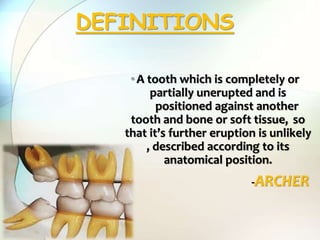
•A tooth which is completely or
partially unerupted and is
positioned against another
tooth and bone or soft tissue, so
that it’s further eruption is unlikely
, described according to its
anatomical position.
-ARCHER
DEFINITIONS
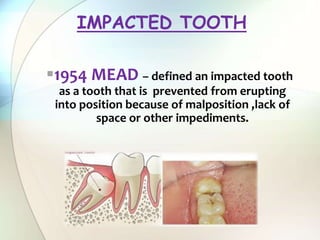
1954 MEAD – defined an impacted tooth
as a tooth that is prevented from erupting
into position because of malposition ,lack of
space or other impediments.
IMPACTED TOOTH
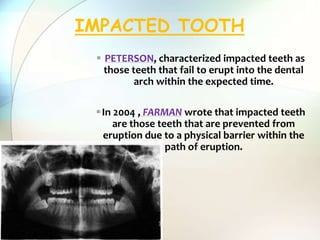
 PETERSON, characterized impacted teeth as
those teeth that fail to erupt into the dental
arch within the expected time.
In 2004 , FARMAN wrote that impacted teeth
are those teeth that are prevented from
eruption due to a physical barrier within the
path of eruption.
IMPACTED TOOTH
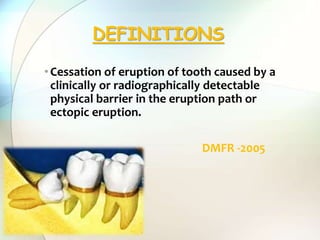
•Cessation of eruption of tooth caused by a
clinically or radiographically detectable
physical barrier in the eruption path or
ectopic eruption.
DMFR -2005
DEFINITIONS
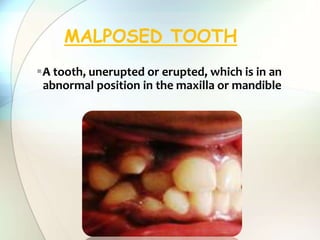
A tooth, unerupted or erupted, which is in an
abnormal position in the maxilla or mandible
MALPOSED TOOTH
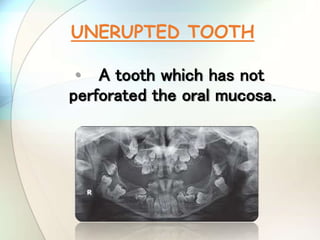
• A tooth which has not
perforated the oral mucosa.
UNERUPTED TOOTH
Cessation of
eruption of tooth
after emergence
without a physical
barrier in the path
of eruption or result
of abnormal position
.
Secondary
If no physical barrier
can be identified as a
explanation for the
cessation of a
normally placed &
developed tooth
germ before
emergence
Primary
RETENTIONS
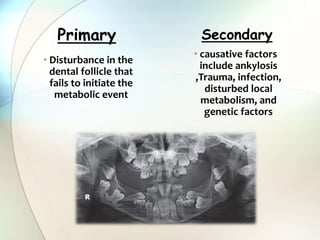
• causative factors
include ankylosis
,Trauma, infection,
disturbed local
metabolism, and
genetic factors
Secondary
• Disturbance in the
dental follicle that
fails to initiate the
metabolic event
Primary
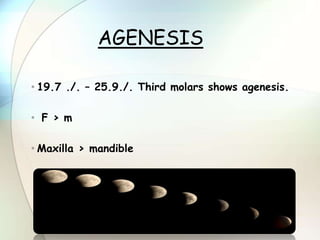
• 19.7 ./. – 25.9./. Third molars shows agenesis.
• F > m
• Maxilla > mandible
AGENESIS
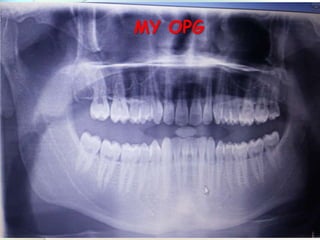
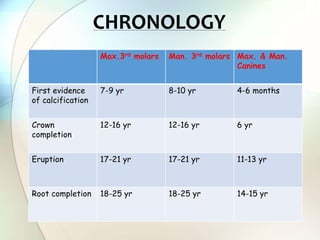
MY OPG
Max.3rd molars Man. 3rd molars Max. & Man.
Canines
First evidence
of calcification
7-9 yr 8-10 yr 4-6 months
Crown
completion
12-16 yr 12-16 yr 6 yr
Eruption 17-21 yr 17-21 yr 11-13 yr
Root completion 18-25 yr 18-25 yr 14-15 yr
CHRONOLOGY
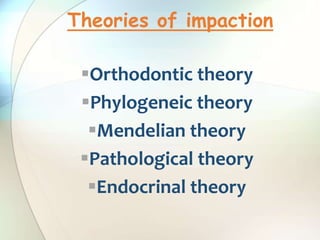
Orthodontic theory
Phylogeneic theory
Mendelian theory
Pathological theory
Endocrinal theory
Theories of impaction
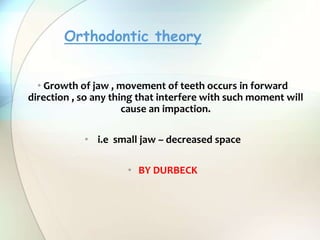
• Growth of jaw , movement of teeth occurs in forward
direction , so any thing that interfere with such moment will
cause an impaction.
• i.e small jaw – decreased space
• BY DURBECK
Orthodontic theory
• Due to changing nutritional habits of our civilization ,
use of large powerful jaws have been practically
eliminated.
Phylogenic theory
•Genetic variations play a major role.
•Hereditary transmission of small jaw & large teeth
from parents to siblings , it may be important
etiological factor for impaction.
Mendelian theory
• Increase or decrease
in growth hormone
Endocrinal
• Chronic infection may
bring the condensation
of osseous tissue .
Pathological
OTHERS
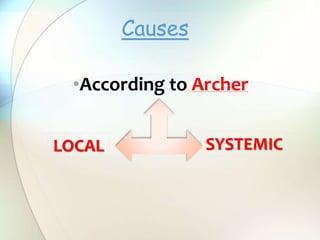
•According to Archer
Causes
LOCAL SYSTEMIC
• Inadequate space
• Inclination
• Obstruction
• Ankylosis
• Ectopic eruption
• Dilaceration of roots
LOCAL CAUSES
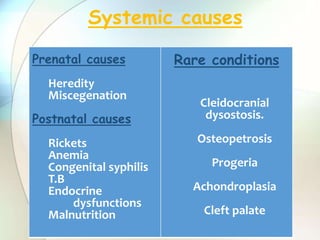
Systemic causes
Prenatal causes
Heredity
Miscegenation
Postnatal causes
Rickets
Anemia
Congenital syphilis
T.B
Endocrine
dysfunctions
Malnutrition
Rare conditions
Cleidocranial
dysostosis.
Osteopetrosis
Progeria
Achondroplasia
Cleft palate
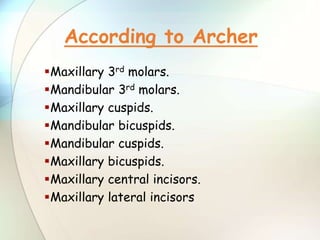
Maxillary 3rd molars.
Mandibular 3rd molars.
Maxillary cuspids.
Mandibular bicuspids.
Mandibular cuspids.
Maxillary bicuspids.
Maxillary central incisors.
Maxillary lateral incisors
According to Archer
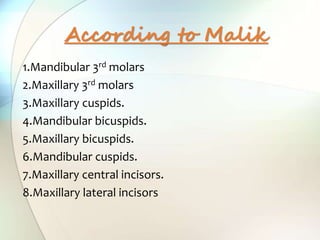
1.Mandibular 3rd molars
2.Maxillary 3rd molars
3.Maxillary cuspids.
4.Mandibular bicuspids.
5.Maxillary bicuspids.
6.Mandibular cuspids.
7.Maxillary central incisors.
8.Maxillary lateral incisors
According to Malik
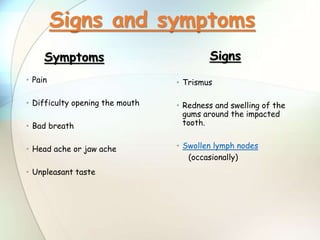
• Trismus
• Redness and swelling of the
gums around the impacted
tooth.
• Swollen lymph nodes
(occasionally)
Signs
• Pain
• Difficulty opening the mouth
• Bad breath
• Head ache or jaw ache
• Unpleasant taste
Symptoms
Signs and symptoms
•“A strong indication for removal of impacted tooth
should be complemented with a strong
contraindication to its retention”
INDICATION
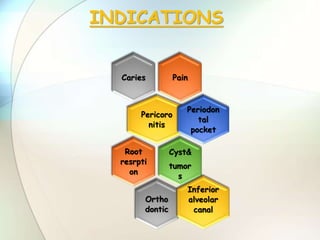
PainCaries
Pericoro
nitis
Periodon
tal
pocket
Cyst&
tumor
s
Root
resrpti
on
Ortho
dontic
Inferior
alveolar
canal
INDICATIONS
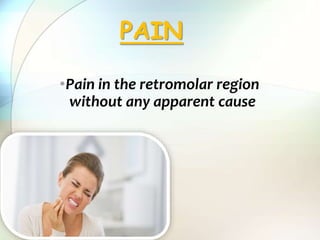
•Pain in the retromolar region
without any apparent cause
PAIN
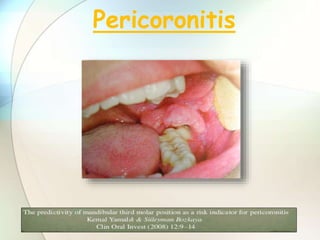
Pericoronitis
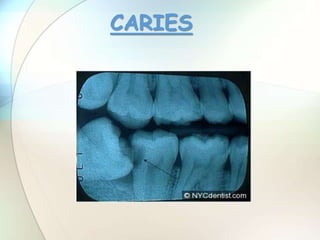
CARIES
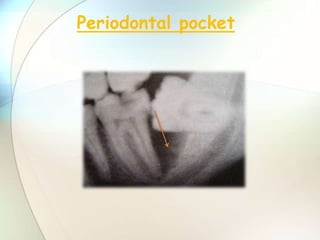
Periodontal pocket
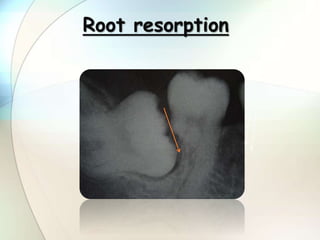
Root resorption
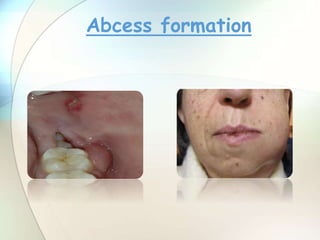
Abcess formation
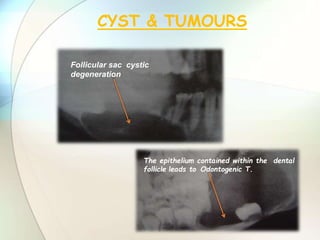
CYST & TUMOURS
Follicular sac cystic
degeneration
The epithelium contained within the dental
follicle leads to Odontogenic T.
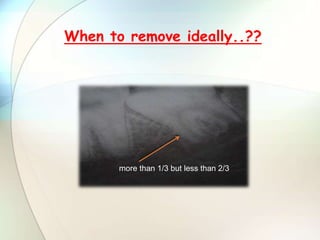
When to remove ideally..??
more than 1/3 but less than 2/3
• Extremes of age
• compromised medical status
• Excessive risk of damage of adjacent structure
• Uncontrolled active pericoronal infection
• Prosthetic considerations
• Socioeconomic status
CONTRA INDICATIONS
•Intervention …????
•Non – intervention…????
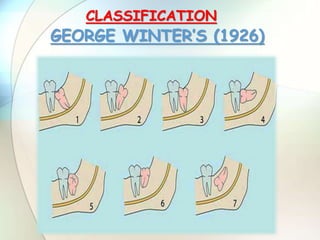
CLASSIFICATION
GEORGE WINTER’S (1926)
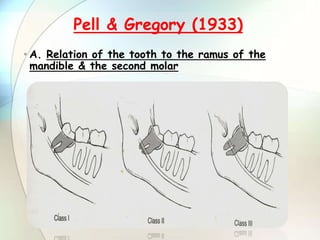
• A. Relation of the tooth to the ramus of the
mandible & the second molar
Pell & Gregory (1933)
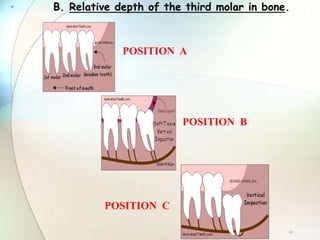
• B. Relative depth of the third molar in bone.
42
POSITION B
POSITION C
POSITION A
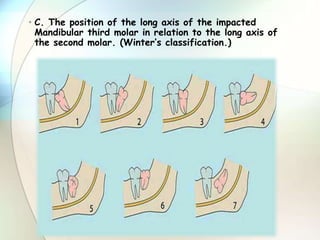
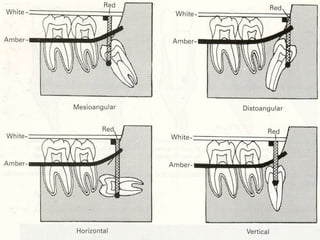
• C. The position of the long axis of the impacted
Mandibular third molar in relation to the long axis of
the second molar. (Winter’s classification.)
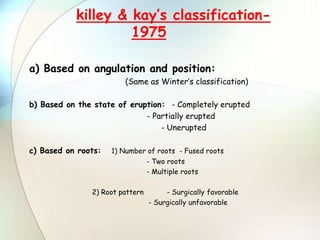
a) Based on angulation and position:
(Same as Winter’s classification)
b) Based on the state of eruption: - Completely erupted
- Partially erupted
- Unerupted
c) Based on roots: 1) Number of roots - Fused roots
- Two roots
- Multiple roots
2) Root pattern - Surgically favorable
- Surgically unfavorable
killey & kay’s classification-
1975
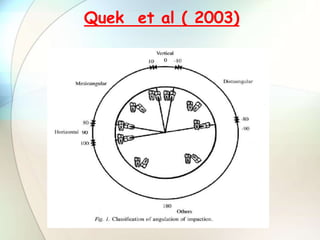
Quek et al ( 2003)
46
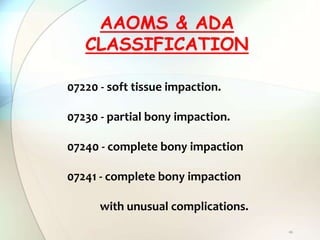
AAOMS & ADA
CLASSIFICATION
07220 - soft tissue impaction.
07230 - partial bony impaction.
07240 - complete bony impaction
07241 - complete bony impaction
with unusual complications.
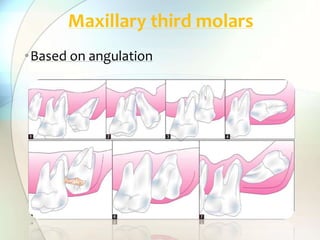
•Based on angulation
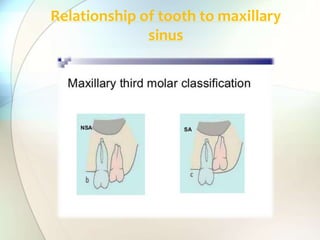
Maxillary third molars
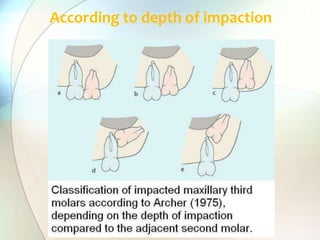
According to depth of impaction
Relationship of tooth to maxillary
sinus
•Clinical
•Radiographical
•Psycological
Assessment
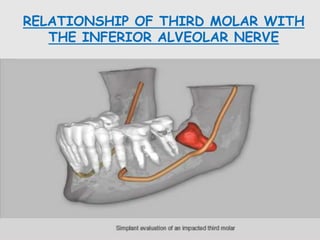
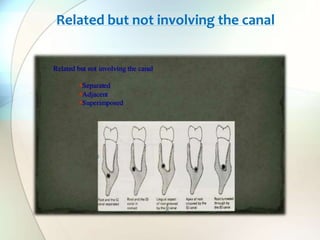
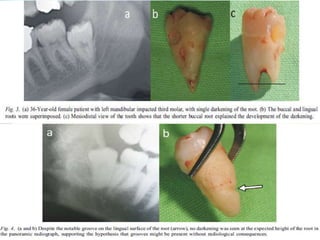
RELATIONSHIP OF THIRD MOLAR WITH
THE INFERIOR ALVEOLAR NERVE
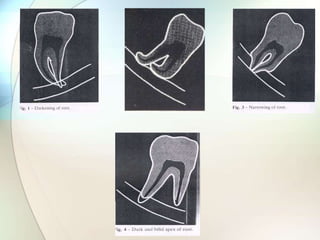
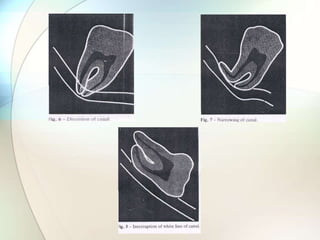
Related but not involving the canal
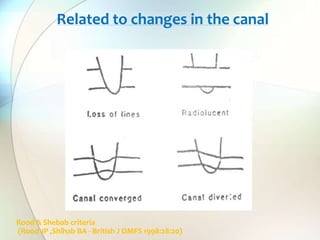
Related to changes in the canal
Rood & Shebab criteria
(Rood JP ,Shihab BA - British J OMFS 1998:28:20)
57
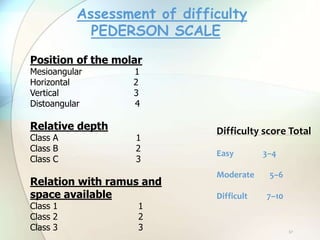
Position of the molar
Mesioangular 1
Horizontal 2
Vertical 3
Distoangular 4
Relative depth
Class A 1
Class B 2
Class C 3
Relation with ramus and
space available
Class 1 1
Class 2 2
Class 3 3
Assessment of difficulty
PEDERSON SCALE
Difficulty score Total
Easy 3–4
Moderate 5–6
Difficult 7–10
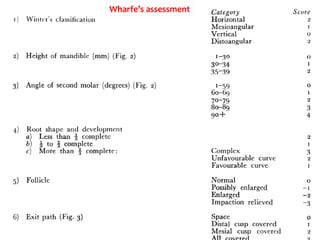
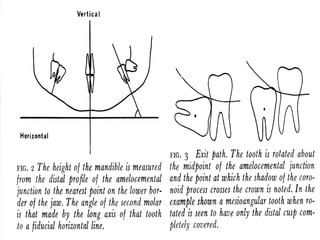
Wharfe’s assessment
60
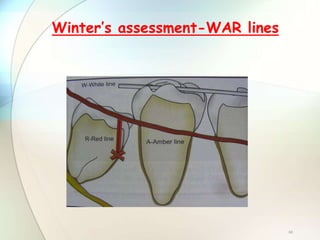
Winter’s assessment-WAR lines
Surgical anatomy
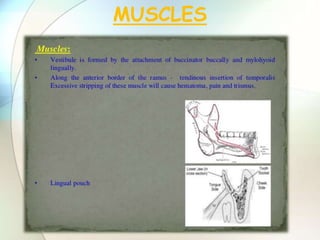
MUSCLES
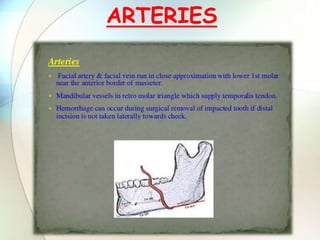
ARTERIES
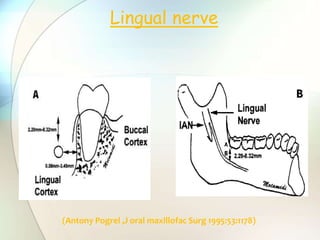
Lingual nerve
(Antony Pogrel ,J oral maxillofac Surg 1995:53:1178)
66
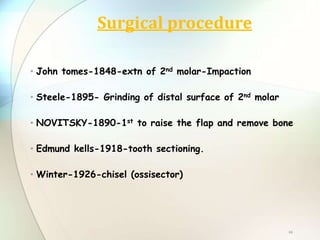
Surgical procedure
• John tomes-1848-extn of 2nd molar-Impaction
• Steele-1895- Grinding of distal surface of 2nd molar
• NOVITSKY-1890-1st to raise the flap and remove bone
• Edmund kells-1918-tooth sectioning.
• Winter-1926-chisel (ossisector)
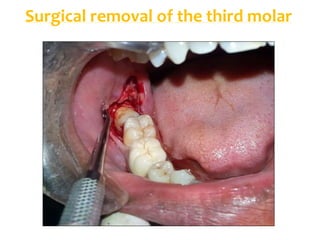
Surgical removal of the third molar
STEPS TO BE FOLLOWED
Premedication
Armamentarium and patient preparation
Local anesthesia+ sedation/general anesthesia
Incision
Reflection of mucoperiosteal flap
osteotomy
odontectomy
Elevation
Extraction
Debridement and smoothening of bone
Control of bleeding
Closure
Medications
Follow up
69
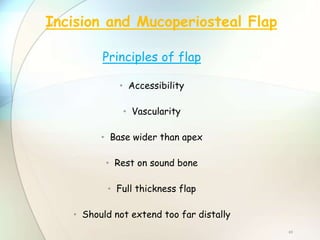
Incision and Mucoperiosteal Flap
Principles of flap
• Accessibility
• Vascularity
• Base wider than apex
• Rest on sound bone
• Full thickness flap
• Should not extend too far distally
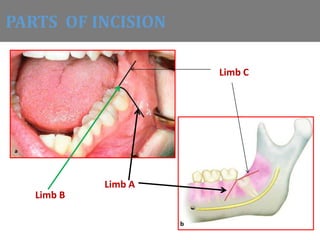
PARTS OF INCISION
Limb A
Limb B
Limb C
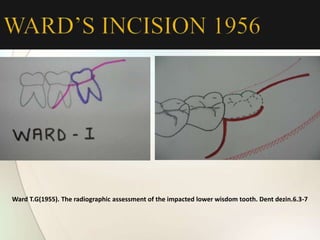
Ward T.G(1955). The radiographic assessment of the impacted lower wisdom tooth. Dent dezin.6.3-7
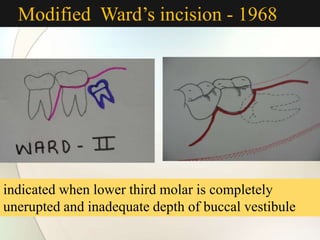
Modified Ward’s incision - 1968
indicated when lower third molar is completely
unerupted and inadequate depth of buccal vestibule
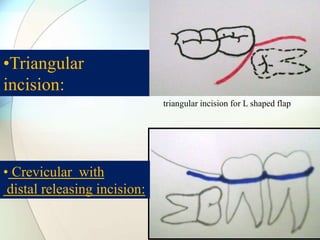
•Triangular
incision:
triangular incision for L shaped flap
• Crevicular with
distal releasing incision:
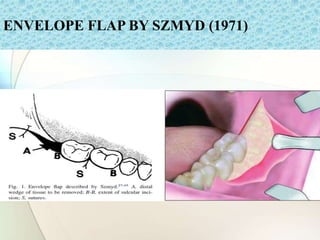
ENVELOPE FLAP BY SZMYD (1971)
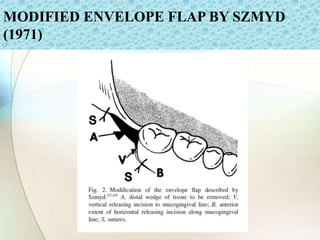
MODIFIED ENVELOPE FLAP BY SZMYD
(1971)
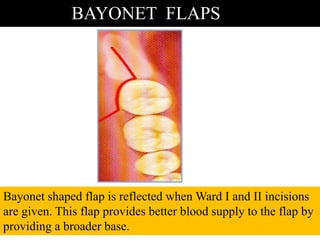
BAYONET FLAPS
Bayonet shaped flap is reflected when Ward I and II incisions
are given. This flap provides better blood supply to the flap by
providing a broader base.
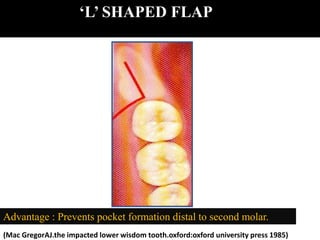
‘L’ SHAPED FLAP
Advantage : Prevents pocket formation distal to second molar.
(Mac GregorAJ.the impacted lower wisdom tooth.oxford:oxford university press 1985)
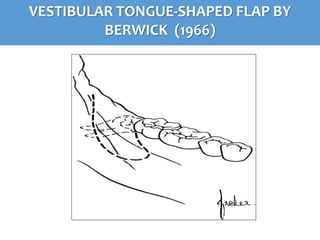
VESTIBULAR TONGUE-SHAPED FLAP BY
BERWICK (1966)
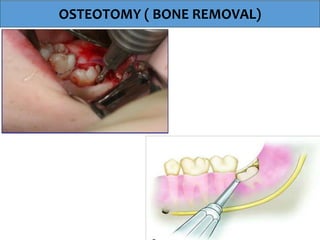
OSTEOTOMY ( BONE REMOVAL)
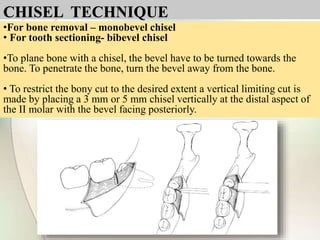
CHISEL TECHNIQUE
•For bone removal – monobevel chisel
• For tooth sectioning- bibevel chisel
•To plane bone with a chisel, the bevel have to be turned towards the
bone. To penetrate the bone, turn the bevel away from the bone.
• To restrict the bony cut to the desired extent a vertical limiting cut is
made by placing a 3 mm or 5 mm chisel vertically at the distal aspect of
the II molar with the bevel facing posteriorly.
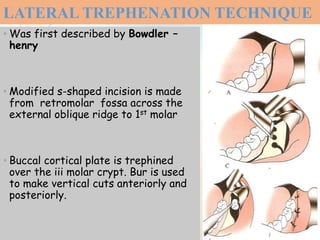
LATERAL TREPHENATION TECHNIQUE
• Was first described by Bowdler –
henry
• Modified s-shaped incision is made
from retromolar fossa across the
external oblique ridge to 1st molar
• Buccal cortical plate is trephined
over the iii molar crypt. Bur is used
to make vertical cuts anteriorly and
posteriorly.
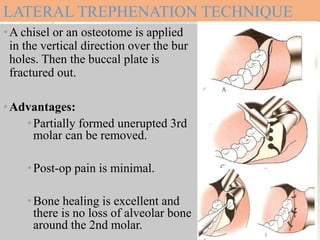
LATERAL TREPHENATION TECHNIQUE
•A chisel or an osteotome is applied
in the vertical direction over the bur
holes. Then the buccal plate is
fractured out.
•Advantages:
•Partially formed unerupted 3rd
molar can be removed.
•Post-op pain is minimal.
•Bone healing is excellent and
there is no loss of alveolar bone
around the 2nd molar.
DIFFERENCES BETWEEN BUR & CHISEL TECHNIQUE
Sl.No Criteria. Chisel&Mallett Bur
1. Technique Difficult Easy.
2. Control over bone cutting Uncontrolled &
chances of
fracture is more.
Controlled.
3. Patient acceptance. Not tolerated in
L.A.
Well tolerated in
L.A.
4. Healing of bone. Good Delayed Healing
5. Postoperative edema Less More.
6. Dry socket. Less. More.
7. Postoperative Infection. Less. More.
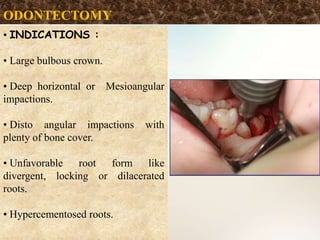
ODONTECTOMY
• INDICATIONS :
• Large bulbous crown.
• Deep horizontal or Mesioangular
impactions.
• Disto angular impactions with
plenty of bone cover.
• Unfavorable root form like
divergent, locking or dilacerated
roots.
• Hypercementosed roots.
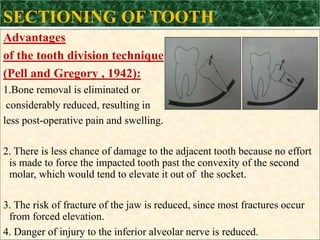
SECTIONING OF TOOTH
Advantages
of the tooth division technique
(Pell and Gregory , 1942):
1.Bone removal is eliminated or
considerably reduced, resulting in
less post-operative pain and swelling.
2. There is less chance of damage to the adjacent tooth because no effort
is made to force the impacted tooth past the convexity of the second
molar, which would tend to elevate it out of the socket.
3. The risk of fracture of the jaw is reduced, since most fractures occur
from forced elevation.
4. Danger of injury to the inferior alveolar nerve is reduced.
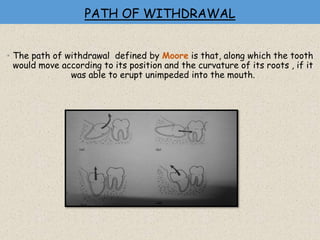
PATH OF WITHDRAWAL
• The path of withdrawal defined by Moore is that, along which the tooth
would move according to its position and the curvature of its roots , if it
was able to erupt unimpeded into the mouth.
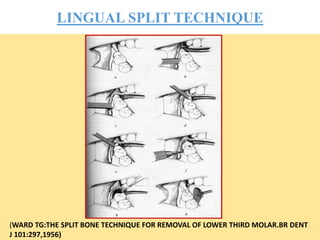
LINGUAL SPLIT TECHNIQUE
(WARD TG:THE SPLIT BONE TECHNIQUE FOR REMOVAL OF LOWER THIRD MOLAR.BR DENT
J 101:297,1956)
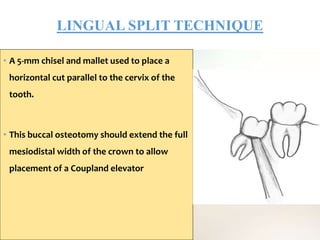
LINGUAL SPLIT TECHNIQUE
• A 5-mm chisel and mallet used to place a
horizontal cut parallel to the cervix of the
tooth.
• This buccal osteotomy should extend the full
mesiodistal width of the crown to allow
placement of a Coupland elevator
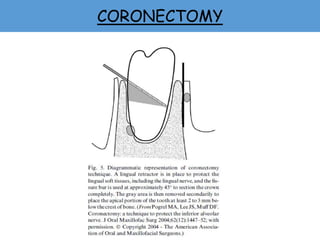
CORONECTOMY
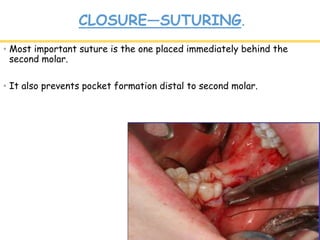
CLOSURE—SUTURING.
• Most important suture is the one placed immediately behind the
second molar.
• It also prevents pocket formation distal to second molar.
Recent advances
IMPACTION IN ORAL SURGERY

IMPACTION IN ORAL SURGERY

  • 1.
  • 2.
    Introduction Theories for impactionof teeth. Causes of impaction. Order of frequency for impaction of teeth. Complications arising from the retained impacted teeth. Indications & contraindications for removal of impacted teeth. CONTENTS
  • 3.
    “Third molar toothhas been the most widely discussed tooth in the dental literature, and the debatable question,to extract or not to extract” seems set to run into the next century- Faiez N hattab;joms 57:389-391 ( 1999) Got their name” wisdom teeth” from the age during which they erupt:17-25 This is the age at which men and women become adults and presumably wiser. INTRODUCTION
  • 4.
    •A tooth whichis completely or partially unerupted and is positioned against another tooth and bone or soft tissue, so that it’s further eruption is unlikely , described according to its anatomical position. -ARCHER DEFINITIONS
  • 5.
    1954 MEAD –defined an impacted tooth as a tooth that is prevented from erupting into position because of malposition ,lack of space or other impediments. IMPACTED TOOTH
  • 6.
     PETERSON, characterizedimpacted teeth as those teeth that fail to erupt into the dental arch within the expected time. In 2004 , FARMAN wrote that impacted teeth are those teeth that are prevented from eruption due to a physical barrier within the path of eruption. IMPACTED TOOTH
  • 7.
    •Cessation of eruptionof tooth caused by a clinically or radiographically detectable physical barrier in the eruption path or ectopic eruption. DMFR -2005 DEFINITIONS
  • 8.
    A tooth, uneruptedor erupted, which is in an abnormal position in the maxilla or mandible MALPOSED TOOTH
  • 9.
    • A toothwhich has not perforated the oral mucosa. UNERUPTED TOOTH
  • 10.
    Cessation of eruption oftooth after emergence without a physical barrier in the path of eruption or result of abnormal position . Secondary If no physical barrier can be identified as a explanation for the cessation of a normally placed & developed tooth germ before emergence Primary RETENTIONS
  • 11.
    • causative factors includeankylosis ,Trauma, infection, disturbed local metabolism, and genetic factors Secondary • Disturbance in the dental follicle that fails to initiate the metabolic event Primary
  • 12.
    • 19.7 ./.– 25.9./. Third molars shows agenesis. • F > m • Maxilla > mandible AGENESIS
  • 13.
  • 14.
    Max.3rd molars Man.3rd molars Max. & Man. Canines First evidence of calcification 7-9 yr 8-10 yr 4-6 months Crown completion 12-16 yr 12-16 yr 6 yr Eruption 17-21 yr 17-21 yr 11-13 yr Root completion 18-25 yr 18-25 yr 14-15 yr CHRONOLOGY
  • 15.
    Orthodontic theory Phylogeneic theory Mendeliantheory Pathological theory Endocrinal theory Theories of impaction
  • 16.
    • Growth ofjaw , movement of teeth occurs in forward direction , so any thing that interfere with such moment will cause an impaction. • i.e small jaw – decreased space • BY DURBECK Orthodontic theory
  • 17.
    • Due tochanging nutritional habits of our civilization , use of large powerful jaws have been practically eliminated. Phylogenic theory
  • 18.
    •Genetic variations playa major role. •Hereditary transmission of small jaw & large teeth from parents to siblings , it may be important etiological factor for impaction. Mendelian theory
  • 19.
    • Increase ordecrease in growth hormone Endocrinal • Chronic infection may bring the condensation of osseous tissue . Pathological OTHERS
  • 20.
  • 21.
    • Inadequate space •Inclination • Obstruction • Ankylosis • Ectopic eruption • Dilaceration of roots LOCAL CAUSES
  • 22.
    Systemic causes Prenatal causes Heredity Miscegenation Postnatalcauses Rickets Anemia Congenital syphilis T.B Endocrine dysfunctions Malnutrition Rare conditions Cleidocranial dysostosis. Osteopetrosis Progeria Achondroplasia Cleft palate
  • 23.
    Maxillary 3rd molars. Mandibular3rd molars. Maxillary cuspids. Mandibular bicuspids. Mandibular cuspids. Maxillary bicuspids. Maxillary central incisors. Maxillary lateral incisors According to Archer
  • 24.
    1.Mandibular 3rd molars 2.Maxillary3rd molars 3.Maxillary cuspids. 4.Mandibular bicuspids. 5.Maxillary bicuspids. 6.Mandibular cuspids. 7.Maxillary central incisors. 8.Maxillary lateral incisors According to Malik
  • 25.
    • Trismus • Rednessand swelling of the gums around the impacted tooth. • Swollen lymph nodes (occasionally) Signs • Pain • Difficulty opening the mouth • Bad breath • Head ache or jaw ache • Unpleasant taste Symptoms Signs and symptoms
  • 26.
    •“A strong indicationfor removal of impacted tooth should be complemented with a strong contraindication to its retention” INDICATION
  • 27.
  • 28.
    •Pain in theretromolar region without any apparent cause PAIN
  • 29.
  • 30.
  • 31.
  • 32.
  • 33.
  • 34.
    CYST & TUMOURS Follicularsac cystic degeneration The epithelium contained within the dental follicle leads to Odontogenic T.
  • 35.
    When to removeideally..?? more than 1/3 but less than 2/3
  • 37.
    • Extremes ofage • compromised medical status • Excessive risk of damage of adjacent structure • Uncontrolled active pericoronal infection • Prosthetic considerations • Socioeconomic status CONTRA INDICATIONS
  • 39.
  • 40.
  • 41.
    • A. Relationof the tooth to the ramus of the mandible & the second molar Pell & Gregory (1933)
  • 42.
    • B. Relativedepth of the third molar in bone. 42 POSITION B POSITION C POSITION A
  • 43.
    • C. Theposition of the long axis of the impacted Mandibular third molar in relation to the long axis of the second molar. (Winter’s classification.)
  • 44.
    a) Based onangulation and position: (Same as Winter’s classification) b) Based on the state of eruption: - Completely erupted - Partially erupted - Unerupted c) Based on roots: 1) Number of roots - Fused roots - Two roots - Multiple roots 2) Root pattern - Surgically favorable - Surgically unfavorable killey & kay’s classification- 1975
  • 45.
    Quek et al( 2003)
  • 46.
    46 AAOMS & ADA CLASSIFICATION 07220- soft tissue impaction. 07230 - partial bony impaction. 07240 - complete bony impaction 07241 - complete bony impaction with unusual complications.
  • 47.
  • 48.
    According to depthof impaction
  • 49.
    Relationship of toothto maxillary sinus
  • 50.
  • 51.
    RELATIONSHIP OF THIRDMOLAR WITH THE INFERIOR ALVEOLAR NERVE
  • 54.
    Related but notinvolving the canal
  • 55.
    Related to changesin the canal Rood & Shebab criteria (Rood JP ,Shihab BA - British J OMFS 1998:28:20)
  • 57.
    57 Position of themolar Mesioangular 1 Horizontal 2 Vertical 3 Distoangular 4 Relative depth Class A 1 Class B 2 Class C 3 Relation with ramus and space available Class 1 1 Class 2 2 Class 3 3 Assessment of difficulty PEDERSON SCALE Difficulty score Total Easy 3–4 Moderate 5–6 Difficult 7–10
  • 58.
  • 60.
  • 62.
  • 63.
  • 64.
  • 65.
    Lingual nerve (Antony Pogrel,J oral maxillofac Surg 1995:53:1178)
  • 66.
    66 Surgical procedure • Johntomes-1848-extn of 2nd molar-Impaction • Steele-1895- Grinding of distal surface of 2nd molar • NOVITSKY-1890-1st to raise the flap and remove bone • Edmund kells-1918-tooth sectioning. • Winter-1926-chisel (ossisector)
  • 67.
    Surgical removal ofthe third molar
  • 68.
    STEPS TO BEFOLLOWED Premedication Armamentarium and patient preparation Local anesthesia+ sedation/general anesthesia Incision Reflection of mucoperiosteal flap osteotomy odontectomy Elevation Extraction Debridement and smoothening of bone Control of bleeding Closure Medications Follow up
  • 69.
    69 Incision and MucoperiostealFlap Principles of flap • Accessibility • Vascularity • Base wider than apex • Rest on sound bone • Full thickness flap • Should not extend too far distally
  • 70.
    PARTS OF INCISION LimbA Limb B Limb C
  • 71.
    Ward T.G(1955). Theradiographic assessment of the impacted lower wisdom tooth. Dent dezin.6.3-7
  • 72.
    Modified Ward’s incision- 1968 indicated when lower third molar is completely unerupted and inadequate depth of buccal vestibule
  • 73.
    •Triangular incision: triangular incision forL shaped flap • Crevicular with distal releasing incision:
  • 74.
    ENVELOPE FLAP BYSZMYD (1971)
  • 75.
    MODIFIED ENVELOPE FLAPBY SZMYD (1971)
  • 76.
    BAYONET FLAPS Bayonet shapedflap is reflected when Ward I and II incisions are given. This flap provides better blood supply to the flap by providing a broader base.
  • 77.
    ‘L’ SHAPED FLAP Advantage: Prevents pocket formation distal to second molar. (Mac GregorAJ.the impacted lower wisdom tooth.oxford:oxford university press 1985)
  • 78.
  • 79.
  • 80.
    CHISEL TECHNIQUE •For boneremoval – monobevel chisel • For tooth sectioning- bibevel chisel •To plane bone with a chisel, the bevel have to be turned towards the bone. To penetrate the bone, turn the bevel away from the bone. • To restrict the bony cut to the desired extent a vertical limiting cut is made by placing a 3 mm or 5 mm chisel vertically at the distal aspect of the II molar with the bevel facing posteriorly.
  • 81.
    LATERAL TREPHENATION TECHNIQUE •Was first described by Bowdler – henry • Modified s-shaped incision is made from retromolar fossa across the external oblique ridge to 1st molar • Buccal cortical plate is trephined over the iii molar crypt. Bur is used to make vertical cuts anteriorly and posteriorly.
  • 82.
    LATERAL TREPHENATION TECHNIQUE •Achisel or an osteotome is applied in the vertical direction over the bur holes. Then the buccal plate is fractured out. •Advantages: •Partially formed unerupted 3rd molar can be removed. •Post-op pain is minimal. •Bone healing is excellent and there is no loss of alveolar bone around the 2nd molar.
  • 83.
    DIFFERENCES BETWEEN BUR& CHISEL TECHNIQUE Sl.No Criteria. Chisel&Mallett Bur 1. Technique Difficult Easy. 2. Control over bone cutting Uncontrolled & chances of fracture is more. Controlled. 3. Patient acceptance. Not tolerated in L.A. Well tolerated in L.A. 4. Healing of bone. Good Delayed Healing 5. Postoperative edema Less More. 6. Dry socket. Less. More. 7. Postoperative Infection. Less. More.
  • 84.
    ODONTECTOMY • INDICATIONS : •Large bulbous crown. • Deep horizontal or Mesioangular impactions. • Disto angular impactions with plenty of bone cover. • Unfavorable root form like divergent, locking or dilacerated roots. • Hypercementosed roots.
  • 85.
    SECTIONING OF TOOTH Advantages ofthe tooth division technique (Pell and Gregory , 1942): 1.Bone removal is eliminated or considerably reduced, resulting in less post-operative pain and swelling. 2. There is less chance of damage to the adjacent tooth because no effort is made to force the impacted tooth past the convexity of the second molar, which would tend to elevate it out of the socket. 3. The risk of fracture of the jaw is reduced, since most fractures occur from forced elevation. 4. Danger of injury to the inferior alveolar nerve is reduced.
  • 86.
    PATH OF WITHDRAWAL •The path of withdrawal defined by Moore is that, along which the tooth would move according to its position and the curvature of its roots , if it was able to erupt unimpeded into the mouth.
  • 87.
    LINGUAL SPLIT TECHNIQUE (WARDTG:THE SPLIT BONE TECHNIQUE FOR REMOVAL OF LOWER THIRD MOLAR.BR DENT J 101:297,1956)
  • 88.
    LINGUAL SPLIT TECHNIQUE •A 5-mm chisel and mallet used to place a horizontal cut parallel to the cervix of the tooth. • This buccal osteotomy should extend the full mesiodistal width of the crown to allow placement of a Coupland elevator
  • 89.
  • 90.
    CLOSURE—SUTURING. • Most importantsuture is the one placed immediately behind the second molar. • It also prevents pocket formation distal to second molar.
  • 91.

Editor's Notes

  • #75 The first was an envelope flap with the incision beginning just medial to the external oblique ridge and extending to the middle of the distal line angle of the second molar. From there, a sulcular incision was made from the distofacial line angle of the second molar to the mesiofacial line angle of the first molar.
  • #76 In the second flap designed by Szmyd, the first part of the incision was similar to the first. It was continued by a vertical incision line from the distofacial line angle of the second molar apically to the mucogingival line approximately 2 to 3 mm
  • #77 This incision has three parts: distal or posterior, intermediate or gingival, and an anterior part. The posterior part of the incision goes round the gingival margin of the second and even the first molar, before turning into the sulcus.
  • #78 L- shaped flap: suits only the buccal approach since it is difficult to raise a lingual flap from this approach.this is given at a 45 degrees to the long axis of 2nd molar and runs straight anteriorly and downwards without having the smooth curvature as in the wards incision.
  • #79 Berwick, in1966, designed a vestibular tongue-shaped flap that extended onto the buccal shelf of the mandible with an incision line that did not lie over the bony defect created by the removal of the impacted tooth, and had its base at the distolingual aspect of the second molar to spare the periodontal ligament of the adjacent molar
  • #84 Most surgeons prefer to use a hand piece with adequate speed and high torque to remove the overlying bone. A variety of 45° angle hand pieces are available which are conveniently used by the surgeons.