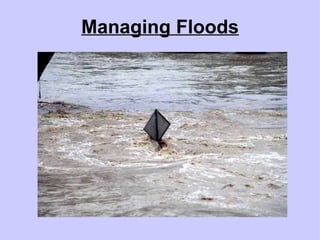
Managing Floods
Effects of flooding What are the effects of flooding? Why do we need to  manage  rivers?
Managing floods There are two ways of managing floods to reduce their impact Soft engineering and hard engineering (same as with coasts) It is a balance of how valuable the land is, how many people will be affected, how costly the management scheme is, and how effective + sustainable the management scheme will be
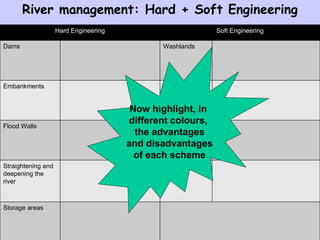
River management: Hard + Soft Engineering Now highlight, in  different colours,  the advantages and disadvantages  of each scheme Hard Engineering Soft Engineering Dams Washlands Embankments Land-use zoning Flood Walls Afforestation Straightening and deepening the river Warning systems Storage areas
Hard Engineering These are traditional methods of stopping floods and require complicated engineering.  The Environment Agency has three options available:   1. build flood defences like dams, embankments and flood walls 2. straighten and deepen the river and cut off meanders 3. make storage areas for extra water.
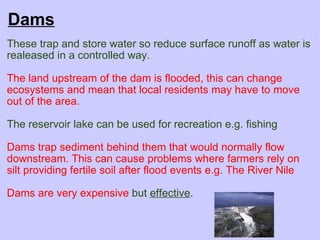
Dams These trap and store water so reduce surface runoff as water is realeased in a controlled way.   The land upstream of the dam is flooded, this can change ecosystems and mean that local residents may have to move out of the area.    The reservoir lake can be used for recreation e.g. fishing   Dams trap sediment behind them that would normally flow downstream. This can cause problems where farmers rely on silt providing fertile soil after flood events e.g. The River Nile   Dams are very expensive   but  effective .
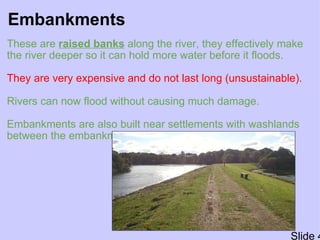
Embankments These are  raised banks  along the river, they effectively make the river deeper so it can hold more water before it floods.   They are very expensive and do not last long (unsustainable).    Rivers can now flood without causing much damage. Embankments are also built near settlements with washlands between the embankments and the river.   Slide 4
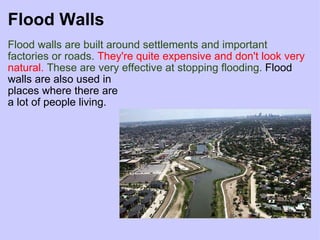
Flood Walls Flood walls are built around settlements and important   factories or roads.   They're quite expensive and don't look very natural.  These are very effective at stopping flooding.  Flood walls are also used in  places where there are a lot of people living.
Straightening and deepening the river This is when the  river is made straighter  to make the river flow and channel flow faster so there is less chance of river flooding. It keeps the water levels to a minimum so it is less likely to flood. We can use it to make high levels of electricity. It is very expensive to dig out and straighten the whole river, especially if it is a very long river. The result is often not natural looking. Slide 6
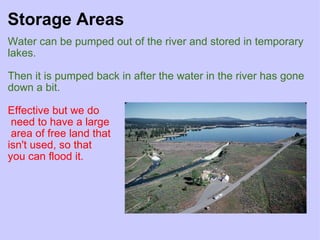
Storage Areas Water can be pumped out of the river and stored in temporary lakes.   Then it is pumped back in after the water in the river has gone down a bit.     Effective but we do   need to have a large   area of free land that  isn't used, so that  you can flood it.   
Soft Engineering Soft engineering techniques work with the river and use natural processes.
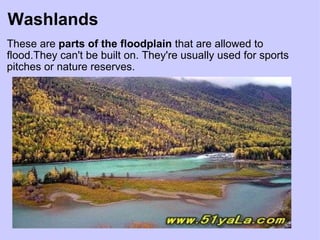
Washlands These are  parts of the floodplain  that are allowed to flood.They can't be built on. They're usually used for sports pitches or nature reserves.
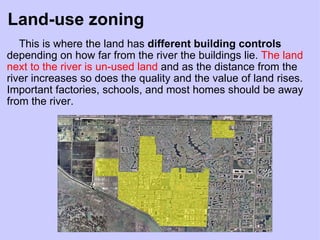
Land-use zoning      This is where the land has  different building controls  depending on how far from the river the buildings lie.  The land next to the river is un-used land   and as the distance from the river increases so does the quality and the value of land rises. Important factories, schools, and most homes should be away from the river.

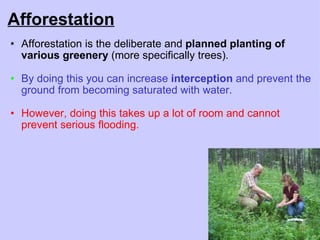
Afforestation Afforestation is the deliberate and  planned planting of various greenery  (more specifically trees).     By doing this you can increase  interception  and prevent the ground from becoming saturated with water. However, doing this takes up a lot of room and cannot prevent serious flooding.      
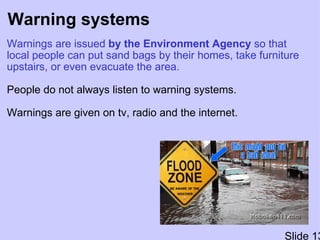
Warning systems Warnings are issued  by the Environment Agency  so that local people can put sand bags by their homes, take furniture upstairs, or even evacuate the area.   People do not always listen to warning systems. Warnings are given on tv, radio and the internet. Slide 13
River flood example Example video of the Mozambique floods If you want that higher grade, take notes….it is your case study after all
Geog. GCSE P84-85 Read through the information on the choices of management schemes You need two different colours of paper. On one piece, make notes on the River Derwent – the hard and soft engineering here. On the other colour, make notes on how the River Limpopo/Zambesi in Mozambique is managed. This has now created a revision sheet for you.
Comparing Flood control in  MEDC's  and  LEDCs MEDC - North Yorkshire, River Derwent   MEDC river = has money to build defences (e.g. embankments, sluice gates,, washlands, land-use zoning)    Since the flood, £7.5 million has been spent on protecting towns    Sluice gates upstream can hold back water and let it out in a controlled way.   LEDC – Mozambique, Limpopo / Zambezi River   LEDC river = does not have the money to build defences       Money has been given to Mozambique by other countries to help recover in the short term Cannot afford to have flood defences / prediction
Homework over holidays Make sure you have caught up on everything. Rivers + Coasts are now  finished You need to make sure you have got your case studies completed, that you understand the keywords, that you know + can explain landforms/changes in coasts+rivers, and flood hydrographs Make a log/journal over the holiday to show what work you have done (e.g. 17 th  Feb, completed Mozambique case study). Please start using the blog.  It is not there just for fun, it is your reference point. Every lesson is on there plus links to the exam board. There is a checklist of all you should know.
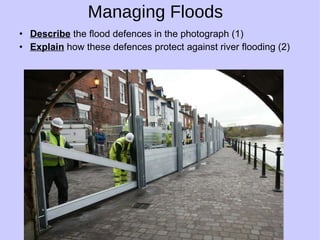
Managing Floods Describe  the flood defences in the photograph (1) Explain  how these defences protect against river flooding (2)
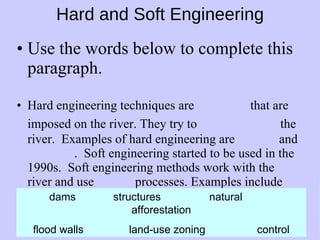
Hard and Soft Engineering Use the words below to complete this paragraph. Hard engineering techniques are   that are imposed on the river. They try to     the river.  Examples of hard engineering are   and  .  Soft engineering started to be used in the 1990s.  Soft engineering methods work with the river and use   processes. Examples include   and  . dams  structures natural afforestation flood walls land-use zoning control
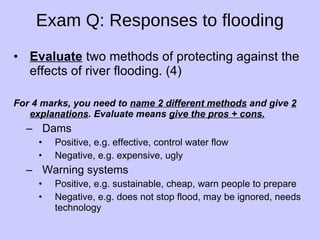
Exam Q: Responses to flooding Evaluate  two methods of protecting against the effects of river flooding. (4) For 4 marks, you need to  name 2 different methods  and give  2 explanations . Evaluate means  give the pros + cons. Dams Positive, e.g. effective, control water flow Negative, e.g. expensive, ugly Warning systems Positive, e.g. sustainable, cheap, warn people to prepare Negative, e.g. does not stop flood, may be ignored, needs technology
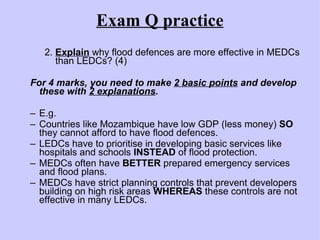
Exam Q practice 2.  Explain  why flood defences are more effective in MEDCs    than LEDCs? (4) For 4 marks, you need to make  2 basic points  and develop these with  2 explanations .  E.g. Countries like Mozambique have low GDP (less money)  SO  they cannot afford to have flood defences. LEDCs have to prioritise in developing basic services like hospitals and schools  INSTEAD  of flood protection. MEDCs often have  BETTER  prepared emergency services and flood plans. MEDCs have strict planning controls that prevent developers building on high risk areas  WHEREAS  these controls are not effective in many LEDCs.
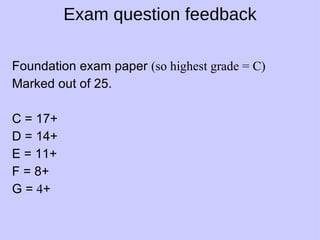
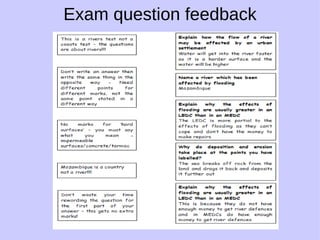
Foundation exam paper  (so highest grade = C) Marked out of 25. C = 17+ D = 14+ E = 11+ F = 8+ G =  4 + Exam question feedback
Exam question feedback
River Terminology Test You are going to be shown 10 words. For each one, write the correct definition.
1. Abrasion
2. Afforestation
3. Delta
4. Floodplain
5. Groundwater flow
6. Impermeable
7. Infiltration
8. Interception
9. Transpiration
10. River basin
 
Abrasion The scratching and scraping of the river bed and banks by the stones and sand in the river
2. Afforestation The replanting of trees
3. Delta A flat area at the mouth of a river made of sediment deposited by the river
4. Floodplain Flat land around a river that gets flooded when the river overflows
5. Groundwater flow The flow of water through underground rock
6. Impermeable  Doesn’t let water through e.g. tarmac
7. Infiltration The soaking of water into the ground
8. Interception The capture of rainwater by leaves
9. Transpiration The evaporation of water from leaves
10. River basin The area drained by a river, the edge of which is marked by its watershed
Knowledge check Update your checklist sheet in your book Make a note of the areas you feel you still need to learn more about (e.g. I’m a bit unsure about the hydrological cycle)
 

Managing Floods

  • 1.
  • 2.
    Effects of floodingWhat are the effects of flooding? Why do we need to manage rivers?
  • 3.
    Managing floods Thereare two ways of managing floods to reduce their impact Soft engineering and hard engineering (same as with coasts) It is a balance of how valuable the land is, how many people will be affected, how costly the management scheme is, and how effective + sustainable the management scheme will be
  • 4.
    River management: Hard+ Soft Engineering Now highlight, in different colours, the advantages and disadvantages of each scheme Hard Engineering Soft Engineering Dams Washlands Embankments Land-use zoning Flood Walls Afforestation Straightening and deepening the river Warning systems Storage areas
  • 5.
    Hard Engineering Theseare traditional methods of stopping floods and require complicated engineering. The Environment Agency has three options available:   1. build flood defences like dams, embankments and flood walls 2. straighten and deepen the river and cut off meanders 3. make storage areas for extra water.
  • 6.
    Dams These trapand store water so reduce surface runoff as water is realeased in a controlled way.   The land upstream of the dam is flooded, this can change ecosystems and mean that local residents may have to move out of the area.   The reservoir lake can be used for recreation e.g. fishing   Dams trap sediment behind them that would normally flow downstream. This can cause problems where farmers rely on silt providing fertile soil after flood events e.g. The River Nile   Dams are very expensive but effective .
  • 7.
    Embankments These are raised banks along the river, they effectively make the river deeper so it can hold more water before it floods.   They are very expensive and do not last long (unsustainable).    Rivers can now flood without causing much damage. Embankments are also built near settlements with washlands between the embankments and the river.   Slide 4
  • 8.
    Flood Walls Floodwalls are built around settlements and important factories or roads. They're quite expensive and don't look very natural. These are very effective at stopping flooding. Flood walls are also used in places where there are a lot of people living.
  • 9.
    Straightening and deepeningthe river This is when the river is made straighter to make the river flow and channel flow faster so there is less chance of river flooding. It keeps the water levels to a minimum so it is less likely to flood. We can use it to make high levels of electricity. It is very expensive to dig out and straighten the whole river, especially if it is a very long river. The result is often not natural looking. Slide 6
  • 10.
    Storage Areas Watercan be pumped out of the river and stored in temporary lakes.   Then it is pumped back in after the water in the river has gone down a bit.   Effective but we do   need to have a large   area of free land that isn't used, so that you can flood it.  
  • 11.
    Soft Engineering Softengineering techniques work with the river and use natural processes.
  • 12.
    Washlands These are parts of the floodplain that are allowed to flood.They can't be built on. They're usually used for sports pitches or nature reserves.
  • 13.
    Land-use zoning     This is where the land has different building controls depending on how far from the river the buildings lie.  The land next to the river is un-used land   and as the distance from the river increases so does the quality and the value of land rises. Important factories, schools, and most homes should be away from the river.
  • 14.
    Afforestation Afforestation isthe deliberate and planned planting of various greenery (more specifically trees).     By doing this you can increase interception and prevent the ground from becoming saturated with water. However, doing this takes up a lot of room and cannot prevent serious flooding.      
  • 15.
    Warning systems Warningsare issued by the Environment Agency so that local people can put sand bags by their homes, take furniture upstairs, or even evacuate the area.   People do not always listen to warning systems. Warnings are given on tv, radio and the internet. Slide 13
  • 16.
    River flood exampleExample video of the Mozambique floods If you want that higher grade, take notes….it is your case study after all
  • 17.
    Geog. GCSE P84-85Read through the information on the choices of management schemes You need two different colours of paper. On one piece, make notes on the River Derwent – the hard and soft engineering here. On the other colour, make notes on how the River Limpopo/Zambesi in Mozambique is managed. This has now created a revision sheet for you.
  • 18.
    Comparing Flood controlin MEDC's and LEDCs MEDC - North Yorkshire, River Derwent   MEDC river = has money to build defences (e.g. embankments, sluice gates,, washlands, land-use zoning)    Since the flood, £7.5 million has been spent on protecting towns   Sluice gates upstream can hold back water and let it out in a controlled way.   LEDC – Mozambique, Limpopo / Zambezi River   LEDC river = does not have the money to build defences      Money has been given to Mozambique by other countries to help recover in the short term Cannot afford to have flood defences / prediction
  • 19.
    Homework over holidaysMake sure you have caught up on everything. Rivers + Coasts are now finished You need to make sure you have got your case studies completed, that you understand the keywords, that you know + can explain landforms/changes in coasts+rivers, and flood hydrographs Make a log/journal over the holiday to show what work you have done (e.g. 17 th Feb, completed Mozambique case study). Please start using the blog. It is not there just for fun, it is your reference point. Every lesson is on there plus links to the exam board. There is a checklist of all you should know.
  • 20.
    Managing Floods Describe the flood defences in the photograph (1) Explain how these defences protect against river flooding (2)
  • 21.
    Hard and SoftEngineering Use the words below to complete this paragraph. Hard engineering techniques are that are imposed on the river. They try to the river. Examples of hard engineering are and . Soft engineering started to be used in the 1990s. Soft engineering methods work with the river and use processes. Examples include and . dams structures natural afforestation flood walls land-use zoning control
  • 22.
    Exam Q: Responsesto flooding Evaluate two methods of protecting against the effects of river flooding. (4) For 4 marks, you need to name 2 different methods and give 2 explanations . Evaluate means give the pros + cons. Dams Positive, e.g. effective, control water flow Negative, e.g. expensive, ugly Warning systems Positive, e.g. sustainable, cheap, warn people to prepare Negative, e.g. does not stop flood, may be ignored, needs technology
  • 23.
    Exam Q practice2. Explain why flood defences are more effective in MEDCs than LEDCs? (4) For 4 marks, you need to make 2 basic points and develop these with 2 explanations . E.g. Countries like Mozambique have low GDP (less money) SO they cannot afford to have flood defences. LEDCs have to prioritise in developing basic services like hospitals and schools INSTEAD of flood protection. MEDCs often have BETTER prepared emergency services and flood plans. MEDCs have strict planning controls that prevent developers building on high risk areas WHEREAS these controls are not effective in many LEDCs.
  • 24.
    Foundation exam paper (so highest grade = C) Marked out of 25. C = 17+ D = 14+ E = 11+ F = 8+ G = 4 + Exam question feedback
  • 25.
  • 26.
    River Terminology TestYou are going to be shown 10 words. For each one, write the correct definition.
  • 27.
  • 28.
  • 29.
  • 30.
  • 31.
  • 32.
  • 33.
  • 34.
  • 35.
  • 36.
  • 37.
  • 38.
    Abrasion The scratchingand scraping of the river bed and banks by the stones and sand in the river
  • 39.
    2. Afforestation Thereplanting of trees
  • 40.
    3. Delta Aflat area at the mouth of a river made of sediment deposited by the river
  • 41.
    4. Floodplain Flatland around a river that gets flooded when the river overflows
  • 42.
    5. Groundwater flowThe flow of water through underground rock
  • 43.
    6. Impermeable Doesn’t let water through e.g. tarmac
  • 44.
    7. Infiltration Thesoaking of water into the ground
  • 45.
    8. Interception Thecapture of rainwater by leaves
  • 46.
    9. Transpiration Theevaporation of water from leaves
  • 47.
    10. River basinThe area drained by a river, the edge of which is marked by its watershed
  • 48.
    Knowledge check Updateyour checklist sheet in your book Make a note of the areas you feel you still need to learn more about (e.g. I’m a bit unsure about the hydrological cycle)
  • 49.

Editor's Notes