Rivers, floods and management


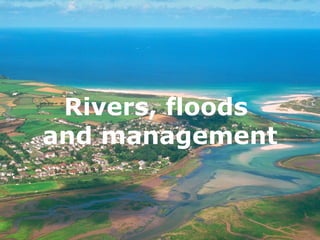
      Rivers, floods
     and management
Rivers, floods and management


     The drainage basin hydrological cycle
Rivers, floods and management
River discharge

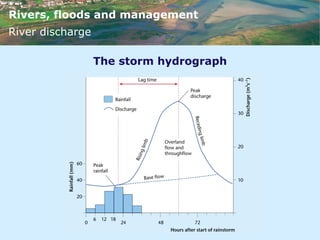
                  The storm hydrograph
Rivers, floods and management
River discharge

What factors might result in a ‘flashy’ hydrograph?
                          • short-lived but intense rainfall
                          • impermeable underlying rock such
                            as granite
                          • steep relief
                          • urban area, where water is
                            channelled through drains to the
                            stream
                          • small round drainage basin
Rivers, floods and management
River discharge

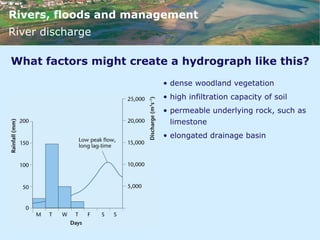
What factors might create a hydrograph like this?
                         • dense woodland vegetation
                         • high infiltration capacity of soil
                         • permeable underlying rock, such as
                           limestone
                         • elongated drainage basin
Rivers, floods and management


               The long profile
Rivers, floods and management


             The Hjülstrom curve
Rivers, floods and management


           An upper course channel


                                Amanda Barker
Rivers, floods and management


           A middle course channel


                                     Amanda Barker
Rivers, floods and management


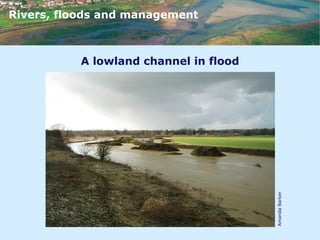
           A lowland channel in flood


                                        Amanda Barker
Rivers, floods and management


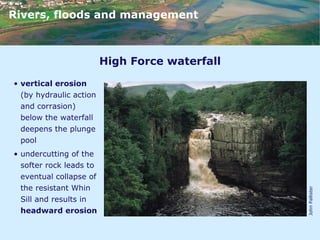
                         High Force waterfall
• vertical erosion
  (by hydraulic action
  and corrasion)
  below the waterfall
 deepens the plunge
 pool
• undercutting of the
  softer rock leads to
  eventual collapse of
 the resistant Whin


                                                John Pallister
 Sill and results in
 headward erosion
Rivers, floods and management


       The development of an oxbow lake
Rivers, floods and management


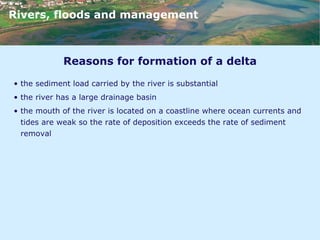
             Reasons for formation of a delta
• the sediment load carried by the river is substantial
• the river has a large drainage basin
• the mouth of the river is located on a coastline where ocean currents and
  tides are weak so the rate of deposition exceeds the rate of sediment
  removal
Rivers, floods and management


             Features related to rejuvenation
• knick points, rapids and
  waterfalls
• river terraces
• incised meanders, both
  entrenched and ingrown


                                                Aerofilms
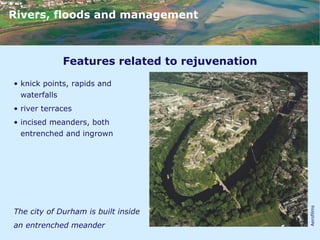
The city of Durham is built inside
an entrenched meander
Rivers, floods and management
Flooding

                 Physical causes of flooding
• excessive precipitation over   • the nature of the drainage
  a long period of time            basin
• intensive precipitation over   • relief
  a short period of time         • rock and soil type
• snowmelt                       • natural vegetation
• climatic hazards such as
  hurricanes
Rivers, floods and management
Flooding

      Influence of human activities on flooding
• Urbanisation creates impermeable surfaces so reducing infiltration.
  Surface water is therefore transported more rapidly through drains to
  the river.
• Deforestation reduces interception and increases runoff.
• Some methods of river management, such as channelisation, increase
  flood risk downstream.
• Global warming leads to more extreme rainfall events.
Rivers, floods and management
Flooding

  Areas of high flood risk in England and Wales
Rivers, floods and management
Flooding

                     Responses to flooding

Short-term responses:                  Long-term responses:
• media broadcasts of information      • government and/or foreign aid
• emergency relief, rescue, shelter,   • disaster planning for the future
  food                                 • flood management programmes
• armed services for evacuation and
  building emergency defences
Rivers, floods and management
Flooding

                Examples of hard engineering
• channelisation, to raise, straighten or strengthen banks
• dams and weirs
• diversion channels
• dredging
• retention basins and balancing lakes
• artificially raising the height of the floodplain
Rivers, floods and management
Flooding

                  Examples of soft engineering
• afforestation
• floodplain zoning
• land-use management, e.g. contour ploughing
• wetland and riverbank conservation
• river restoration
• improved forecasting and warning

Rivers

  • 1.
    Rivers, floods andmanagement Rivers, floods and management
  • 2.
    Rivers, floods andmanagement The drainage basin hydrological cycle
  • 3.
    Rivers, floods andmanagement River discharge The storm hydrograph
  • 4.
    Rivers, floods andmanagement River discharge What factors might result in a ‘flashy’ hydrograph? • short-lived but intense rainfall • impermeable underlying rock such as granite • steep relief • urban area, where water is channelled through drains to the stream • small round drainage basin
  • 5.
    Rivers, floods andmanagement River discharge What factors might create a hydrograph like this? • dense woodland vegetation • high infiltration capacity of soil • permeable underlying rock, such as limestone • elongated drainage basin
  • 6.
    Rivers, floods andmanagement The long profile
  • 7.
    Rivers, floods andmanagement The Hjülstrom curve
  • 8.
    Rivers, floods andmanagement An upper course channel Amanda Barker
  • 9.
    Rivers, floods andmanagement A middle course channel Amanda Barker
  • 10.
    Rivers, floods andmanagement A lowland channel in flood Amanda Barker
  • 11.
    Rivers, floods andmanagement High Force waterfall • vertical erosion (by hydraulic action and corrasion) below the waterfall deepens the plunge pool • undercutting of the softer rock leads to eventual collapse of the resistant Whin John Pallister Sill and results in headward erosion
  • 12.
    Rivers, floods andmanagement The development of an oxbow lake
  • 13.
    Rivers, floods andmanagement Reasons for formation of a delta • the sediment load carried by the river is substantial • the river has a large drainage basin • the mouth of the river is located on a coastline where ocean currents and tides are weak so the rate of deposition exceeds the rate of sediment removal
  • 14.
    Rivers, floods andmanagement Features related to rejuvenation • knick points, rapids and waterfalls • river terraces • incised meanders, both entrenched and ingrown Aerofilms The city of Durham is built inside an entrenched meander
  • 15.
    Rivers, floods andmanagement Flooding Physical causes of flooding • excessive precipitation over • the nature of the drainage a long period of time basin • intensive precipitation over • relief a short period of time • rock and soil type • snowmelt • natural vegetation • climatic hazards such as hurricanes
  • 16.
    Rivers, floods andmanagement Flooding Influence of human activities on flooding • Urbanisation creates impermeable surfaces so reducing infiltration. Surface water is therefore transported more rapidly through drains to the river. • Deforestation reduces interception and increases runoff. • Some methods of river management, such as channelisation, increase flood risk downstream. • Global warming leads to more extreme rainfall events.
  • 17.
    Rivers, floods andmanagement Flooding Areas of high flood risk in England and Wales
  • 18.
    Rivers, floods andmanagement Flooding Responses to flooding Short-term responses: Long-term responses: • media broadcasts of information • government and/or foreign aid • emergency relief, rescue, shelter, • disaster planning for the future food • flood management programmes • armed services for evacuation and building emergency defences
  • 19.
    Rivers, floods andmanagement Flooding Examples of hard engineering • channelisation, to raise, straighten or strengthen banks • dams and weirs • diversion channels • dredging • retention basins and balancing lakes • artificially raising the height of the floodplain
  • 20.
    Rivers, floods andmanagement Flooding Examples of soft engineering • afforestation • floodplain zoning • land-use management, e.g. contour ploughing • wetland and riverbank conservation • river restoration • improved forecasting and warning