
Government Engineering College
Subject: Disaster Management
Topic : Hydro Metrological Disaster
“Hydro Metrological Disaster”
Contents
 Introduction
 Flood
 Cyclone
 Avalanches
 Lightning
 Heat wave
 Cold wave
 Drought
 Thunder storm
Introduction :
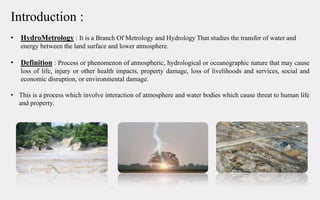
• HydroMetrology : It is a Branch Of Metrology and Hydrology That studies the transfer of water and
energy between the land surface and lower atmosphere.
• Definition : Process or phenomenon of atmospheric, hydrological or oceanographic nature that may cause
loss of life, injury or other health impacts, property damage, loss of livelihoods and services, social and
economic disruption, or environmental damage.
• This is a process which involve interaction of atmosphere and water bodies which cause threat to human life
and property.
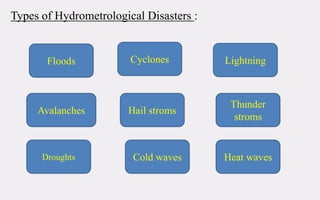
Types of Hydrometrological Disasters :
Droughts
Floods
Avalanches Hail stroms
Thunder
stroms
LightningCyclones
Cold waves Heat waves
Flood
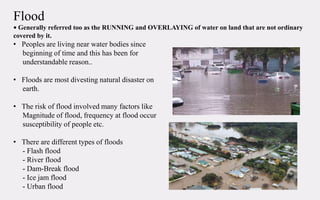
• Generally referred too as the RUNNING and OVERLAYING of water on land that are not ordinary
covered by it.
• Peoples are living near water bodies since
beginning of time and this has been for
understandable reason..
• Floods are most divesting natural disaster on
earth.
• The risk of flood involved many factors like
Magnitude of flood, frequency at flood occur
susceptibility of people etc.
• There are different types of floods
- Flash flood
- River flood
- Dam-Break flood
- Ice jam flood
- Urban flood
Causes & Effects of flood:
C1) River over flows on it’s bank and
water spreads surrounding land.
C2) Excessive run off from land.
C3) Triggered heavy Rain.
C4) Un desired drainage network.
C5) Backing up of flood waters at river
mouth
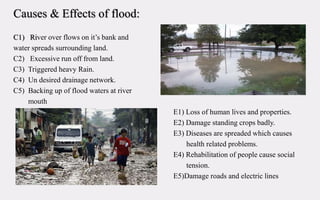
E1) Loss of human lives and properties.
E2) Damage standing crops badly.
E3) Diseases are spreaded which causes
health related problems.
E4) Rehabilitation of people cause social
tension.
E5)Damage roads and electric lines
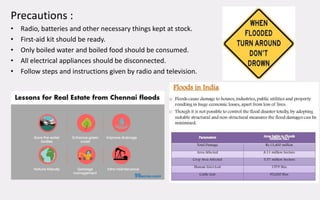
Precautions :
• Radio, batteries and other necessary things kept at stock.
• First-aid kit should be ready.
• Only boiled water and boiled food should be consumed.
• All electrical appliances should be disconnected.
• Follow steps and instructions given by radio and television.
Cyclones :
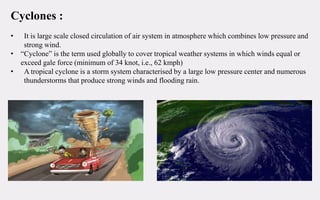
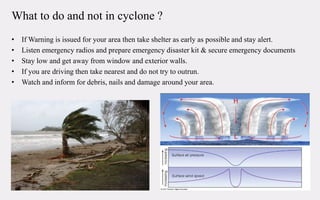
• It is large scale closed circulation of air system in atmosphere which combines low pressure and
strong wind.
• “Cyclone” is the term used globally to cover tropical weather systems in which winds equal or
exceed gale force (minimum of 34 knot, i.e., 62 kmph)
• A tropical cyclone is a storm system characterised by a large low pressure center and numerous
thunderstorms that produce strong winds and flooding rain.
Cause and Effects :
Near the center, the pressure gradient and the force in hemisphere the fastest winds relative to the
surface of the earth therefore occur on eastern side of a moving cyclone and on the side of a moving
one, direction of cyclone in southern hemisphere is opposite than northern hemisphere.
Categories of cyclone:
- It categorized on saffir-simpson scale.
Cat.1 79-95 mph
Cat.2 96-110 mph
Cat.3 111-130 mph
Cat.4 131-155 mph
Cat.5 >155 mph
- Cyclones are monitored by remote sensing imagery
To monitor track, and forecast activity.
What to do and not in cyclone ?
• If Warning is issued for your area then take shelter as early as possible and stay alert.
• Listen emergency radios and prepare emergency disaster kit & secure emergency documents
• Stay low and get away from window and exterior walls.
• If you are driving then take nearest and do not try to outrun.
• Watch and inform for debris, nails and damage around your area.
Avalanches :
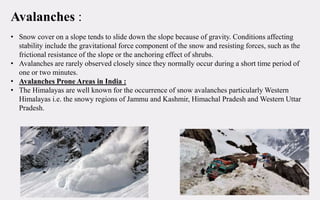
• Snow cover on a slope tends to slide down the slope because of gravity. Conditions affecting
stability include the gravitational force component of the snow and resisting forces, such as the
frictional resistance of the slope or the anchoring effect of shrubs.
• Avalanches are rarely observed closely since they normally occur during a short time period of
one or two minutes.
• Avalanches Prone Areas in India :
• The Himalayas are well known for the occurrence of snow avalanches particularly Western
Himalayas i.e. the snowy regions of Jammu and Kashmir, Himachal Pradesh and Western Uttar
Pradesh.
Causes of Avalanche :
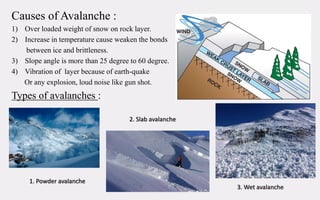
1) Over loaded weight of snow on rock layer.
2) Increase in temperature cause weaken the bonds
between ice and brittleness.
3) Slope angle is more than 25 degree to 60 degree.
4) Vibration of layer because of earth-quake
Or any explosion, loud noise like gun shot.
Types of avalanches :
1. Powder avalanche
2. Slab avalanche
3. Wet avalanche
Lightning :
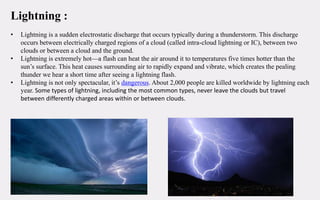
• Lightning is a sudden electrostatic discharge that occurs typically during a thunderstorm. This discharge
occurs between electrically charged regions of a cloud (called intra-cloud lightning or IC), between two
clouds or between a cloud and the ground.
• Lightning is extremely hot—a flash can heat the air around it to temperatures five times hotter than the
sun’s surface. This heat causes surrounding air to rapidly expand and vibrate, which creates the pealing
thunder we hear a short time after seeing a lightning flash.
• Lightning is not only spectacular, it’s dangerous. About 2,000 people are killed worldwide by lightning each
year. Some types of lightning, including the most common types, never leave the clouds but travel
between differently charged areas within or between clouds.
Causes and Effects :
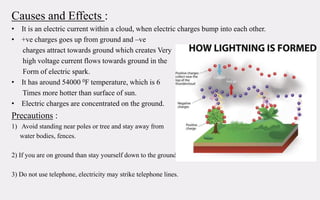
• It is an electric current within a cloud, when electric charges bump into each other.
• +ve charges goes up from ground and –ve
charges attract towards ground which creates Very
high voltage current flows towards ground in the
Form of electric spark.
• It has around 54000 0F temperature, which is 6
Times more hotter than surface of sun.
• Electric charges are concentrated on the ground.
Precautions :
1) Avoid standing near poles or tree and stay away from
water bodies, fences.
2) If you are on ground than stay yourself down to the ground..
3) Do not use telephone, electricity may strike telephone lines.
Heat wave :
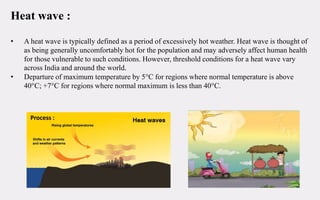
• A heat wave is typically defined as a period of excessively hot weather. Heat wave is thought of
as being generally uncomfortably hot for the population and may adversely affect human health
for those vulnerable to such conditions. However, threshold conditions for a heat wave vary
across India and around the world.
• Departure of maximum temperature by 5°C for regions where normal temperature is above
40°C; +7°C for regions where normal maximum is less than 40°C.
Process :
Facts about heat wave :
• It is an prolonged period of excessive heat, often
Combined with external humidity.
• Urban areas experience higher temperature
During heat wave because of roads and
constructions.
• Extreme heat can cause cramps, swelling
or even a temporary epilepsy attack..
• Stay hydrated during the heat wave, drink plenty
Of water and eat salty food.
• Avoid to go outside on afternoon time, use hat
or umbrella.
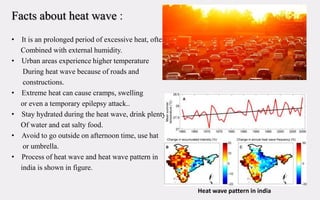
• Process of heat wave and heat wave pattern in
india is shown in figure.
Heat wave pattern in india
Cold wave :
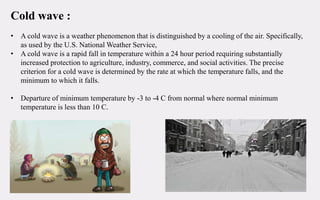
• A cold wave is a weather phenomenon that is distinguished by a cooling of the air. Specifically,
as used by the U.S. National Weather Service,
• A cold wave is a rapid fall in temperature within a 24 hour period requiring substantially
increased protection to agriculture, industry, commerce, and social activities. The precise
criterion for a cold wave is determined by the rate at which the temperature falls, and the
minimum to which it falls.
• Departure of minimum temperature by -3 to -4 C from normal where normal minimum
temperature is less than 10 C.
Drought :
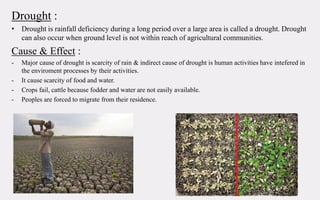
• Drought is rainfall deficiency during a long period over a large area is called a drought. Drought
can also occur when ground level is not within reach of agricultural communities.
Cause & Effect :
- Major cause of drought is scarcity of rain & indirect cause of drought is human activities have intefered in
the enviroment processes by their activities.
- It cause scarcity of food and water.
- Crops fail, cattle because fodder and water are not easily available.
- Peoples are forced to migrate from their residence.
Thunder storm :
• Thunder storm usually defined as a combination of Thunder, Lightning, heavy strong winds and
high rate of perspiration.
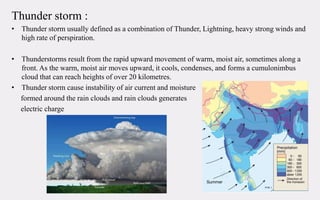
• Thunderstorms result from the rapid upward movement of warm, moist air, sometimes along a
front. As the warm, moist air moves upward, it cools, condenses, and forms a cumulonimbus
cloud that can reach heights of over 20 kilometres.
• Thunder storm cause instability of air current and moisture
formed around the rain clouds and rain clouds generates
electric charge
THANK YOU.!!

Hydro-Metrological Disasters (Disaster Management)

  • 1.
    Government Engineering College Subject:Disaster Management Topic : Hydro Metrological Disaster “Hydro Metrological Disaster”
  • 2.
    Contents  Introduction  Flood Cyclone  Avalanches  Lightning  Heat wave  Cold wave  Drought  Thunder storm
  • 3.
    Introduction : • HydroMetrology: It is a Branch Of Metrology and Hydrology That studies the transfer of water and energy between the land surface and lower atmosphere. • Definition : Process or phenomenon of atmospheric, hydrological or oceanographic nature that may cause loss of life, injury or other health impacts, property damage, loss of livelihoods and services, social and economic disruption, or environmental damage. • This is a process which involve interaction of atmosphere and water bodies which cause threat to human life and property.
  • 4.
    Types of HydrometrologicalDisasters : Droughts Floods Avalanches Hail stroms Thunder stroms LightningCyclones Cold waves Heat waves
  • 5.
    Flood • Generally referredtoo as the RUNNING and OVERLAYING of water on land that are not ordinary covered by it. • Peoples are living near water bodies since beginning of time and this has been for understandable reason.. • Floods are most divesting natural disaster on earth. • The risk of flood involved many factors like Magnitude of flood, frequency at flood occur susceptibility of people etc. • There are different types of floods - Flash flood - River flood - Dam-Break flood - Ice jam flood - Urban flood
  • 6.
    Causes & Effectsof flood: C1) River over flows on it’s bank and water spreads surrounding land. C2) Excessive run off from land. C3) Triggered heavy Rain. C4) Un desired drainage network. C5) Backing up of flood waters at river mouth E1) Loss of human lives and properties. E2) Damage standing crops badly. E3) Diseases are spreaded which causes health related problems. E4) Rehabilitation of people cause social tension. E5)Damage roads and electric lines
  • 7.
    Precautions : • Radio,batteries and other necessary things kept at stock. • First-aid kit should be ready. • Only boiled water and boiled food should be consumed. • All electrical appliances should be disconnected. • Follow steps and instructions given by radio and television.
  • 8.
    Cyclones : • Itis large scale closed circulation of air system in atmosphere which combines low pressure and strong wind. • “Cyclone” is the term used globally to cover tropical weather systems in which winds equal or exceed gale force (minimum of 34 knot, i.e., 62 kmph) • A tropical cyclone is a storm system characterised by a large low pressure center and numerous thunderstorms that produce strong winds and flooding rain.
  • 9.
    Cause and Effects: Near the center, the pressure gradient and the force in hemisphere the fastest winds relative to the surface of the earth therefore occur on eastern side of a moving cyclone and on the side of a moving one, direction of cyclone in southern hemisphere is opposite than northern hemisphere. Categories of cyclone: - It categorized on saffir-simpson scale. Cat.1 79-95 mph Cat.2 96-110 mph Cat.3 111-130 mph Cat.4 131-155 mph Cat.5 >155 mph - Cyclones are monitored by remote sensing imagery To monitor track, and forecast activity.
  • 10.
    What to doand not in cyclone ? • If Warning is issued for your area then take shelter as early as possible and stay alert. • Listen emergency radios and prepare emergency disaster kit & secure emergency documents • Stay low and get away from window and exterior walls. • If you are driving then take nearest and do not try to outrun. • Watch and inform for debris, nails and damage around your area.
  • 11.
    Avalanches : • Snowcover on a slope tends to slide down the slope because of gravity. Conditions affecting stability include the gravitational force component of the snow and resisting forces, such as the frictional resistance of the slope or the anchoring effect of shrubs. • Avalanches are rarely observed closely since they normally occur during a short time period of one or two minutes. • Avalanches Prone Areas in India : • The Himalayas are well known for the occurrence of snow avalanches particularly Western Himalayas i.e. the snowy regions of Jammu and Kashmir, Himachal Pradesh and Western Uttar Pradesh.
  • 12.
    Causes of Avalanche: 1) Over loaded weight of snow on rock layer. 2) Increase in temperature cause weaken the bonds between ice and brittleness. 3) Slope angle is more than 25 degree to 60 degree. 4) Vibration of layer because of earth-quake Or any explosion, loud noise like gun shot. Types of avalanches : 1. Powder avalanche 2. Slab avalanche 3. Wet avalanche
  • 13.
    Lightning : • Lightningis a sudden electrostatic discharge that occurs typically during a thunderstorm. This discharge occurs between electrically charged regions of a cloud (called intra-cloud lightning or IC), between two clouds or between a cloud and the ground. • Lightning is extremely hot—a flash can heat the air around it to temperatures five times hotter than the sun’s surface. This heat causes surrounding air to rapidly expand and vibrate, which creates the pealing thunder we hear a short time after seeing a lightning flash. • Lightning is not only spectacular, it’s dangerous. About 2,000 people are killed worldwide by lightning each year. Some types of lightning, including the most common types, never leave the clouds but travel between differently charged areas within or between clouds.
  • 14.
    Causes and Effects: • It is an electric current within a cloud, when electric charges bump into each other. • +ve charges goes up from ground and –ve charges attract towards ground which creates Very high voltage current flows towards ground in the Form of electric spark. • It has around 54000 0F temperature, which is 6 Times more hotter than surface of sun. • Electric charges are concentrated on the ground. Precautions : 1) Avoid standing near poles or tree and stay away from water bodies, fences. 2) If you are on ground than stay yourself down to the ground.. 3) Do not use telephone, electricity may strike telephone lines.
  • 15.
    Heat wave : •A heat wave is typically defined as a period of excessively hot weather. Heat wave is thought of as being generally uncomfortably hot for the population and may adversely affect human health for those vulnerable to such conditions. However, threshold conditions for a heat wave vary across India and around the world. • Departure of maximum temperature by 5°C for regions where normal temperature is above 40°C; +7°C for regions where normal maximum is less than 40°C. Process :
  • 16.
    Facts about heatwave : • It is an prolonged period of excessive heat, often Combined with external humidity. • Urban areas experience higher temperature During heat wave because of roads and constructions. • Extreme heat can cause cramps, swelling or even a temporary epilepsy attack.. • Stay hydrated during the heat wave, drink plenty Of water and eat salty food. • Avoid to go outside on afternoon time, use hat or umbrella. • Process of heat wave and heat wave pattern in india is shown in figure. Heat wave pattern in india
  • 17.
    Cold wave : •A cold wave is a weather phenomenon that is distinguished by a cooling of the air. Specifically, as used by the U.S. National Weather Service, • A cold wave is a rapid fall in temperature within a 24 hour period requiring substantially increased protection to agriculture, industry, commerce, and social activities. The precise criterion for a cold wave is determined by the rate at which the temperature falls, and the minimum to which it falls. • Departure of minimum temperature by -3 to -4 C from normal where normal minimum temperature is less than 10 C.
  • 18.
    Drought : • Droughtis rainfall deficiency during a long period over a large area is called a drought. Drought can also occur when ground level is not within reach of agricultural communities. Cause & Effect : - Major cause of drought is scarcity of rain & indirect cause of drought is human activities have intefered in the enviroment processes by their activities. - It cause scarcity of food and water. - Crops fail, cattle because fodder and water are not easily available. - Peoples are forced to migrate from their residence.
  • 19.
    Thunder storm : •Thunder storm usually defined as a combination of Thunder, Lightning, heavy strong winds and high rate of perspiration. • Thunderstorms result from the rapid upward movement of warm, moist air, sometimes along a front. As the warm, moist air moves upward, it cools, condenses, and forms a cumulonimbus cloud that can reach heights of over 20 kilometres. • Thunder storm cause instability of air current and moisture formed around the rain clouds and rain clouds generates electric charge
  • 20.