PRINCE2®,P3O®,MSP®,MoP®,M_o_R®,MoV®,ITIL®,P3M3®areregisteredtrademarksofAXELOSLtd.Theswirllogo™isatrademarkofAXELOSLtd
Course administration
Course introduction
Start and finish Course style
LunchCoffee and breaks
M00 - Course introduction 2/12 | 2/209
Course objectives
 Processes and techniques used within MoV and the reasons for
using them
 How MoV may be applied into organization activity
 The differences in applying MoV at different stages in
a project and the expected outputs from
a MoV Study at each stage
 The circumstances under which MoV should be used
 The concept of value and how value may be improved
 Approaches for implementing MoV
 How to respond to external and internal influences
 The principles of embedding MoV into an organisation
 The key topics in document check lists, the toolbox, health check,
organizational maturity and individual competence
Main goal
 Attempt Foundation exam with confidence
 Begin to apply the method, tailoring it to your own needs
Secondary goal
 Benefits and value of value management and MoV
Course introduction
M00 - Course introduction 3/12 | 3/209
Course introduction
Let’s Get to Know Each Other
 Please share with the class:
 Your name and surname
 Your organization
 Your profession
 Title, function, job responsibilities
 Your familiarity with the project and
programme management
 Your familiarity with the value
management
 Your familiarity with the value
engineering (VE)
 Your experience with MoV
 Your personal session expectations
M00 - Course introduction 4/12 | 4/209
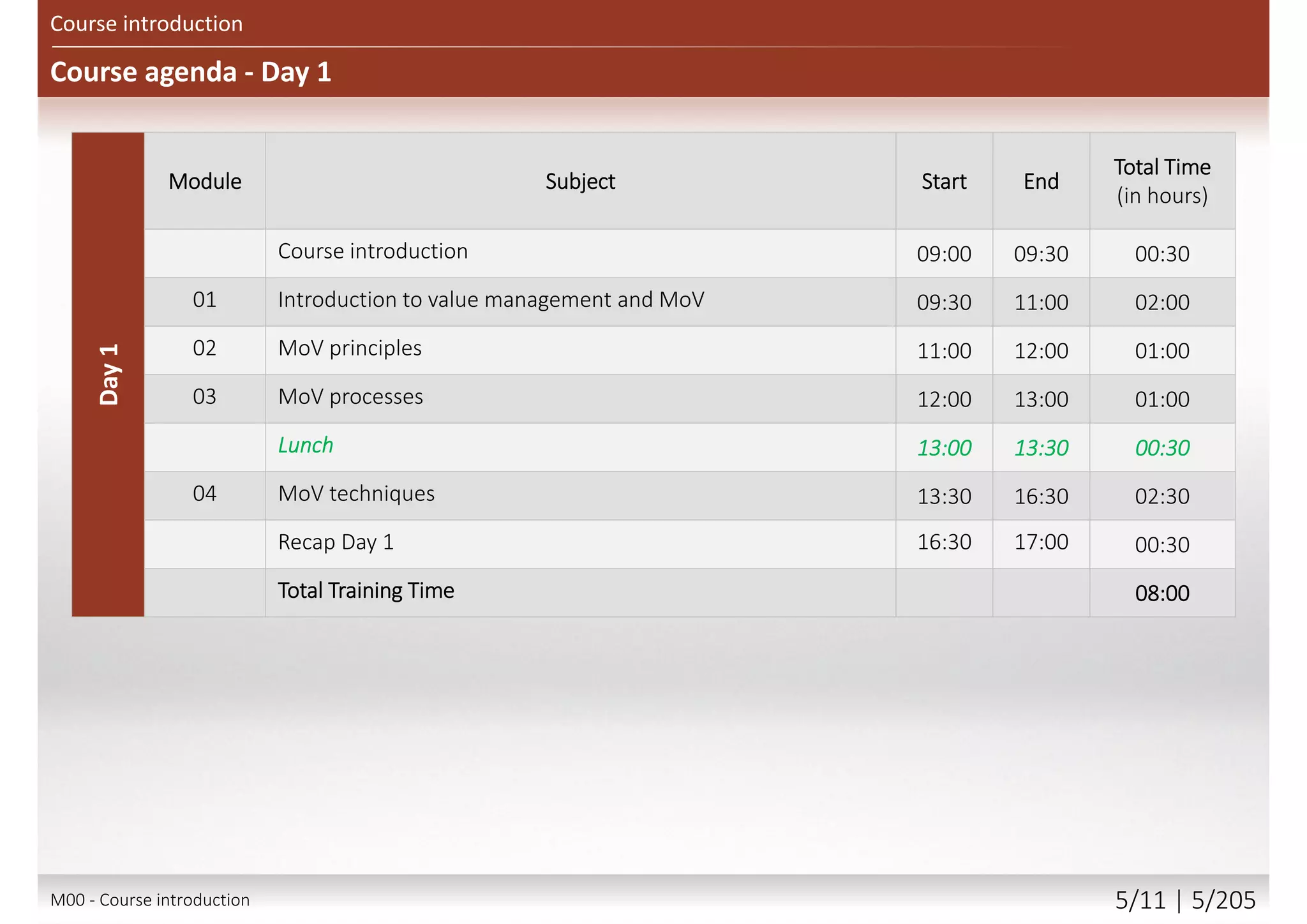
Day1
Module Subject Start End
Total Time
(in hours)
Course introduction 09:00 09:30 00:30
01 Introduction to value management and MoV 09:30 11:00 02:00
02 MoV principles 11:00 12:00 01:00
03 MoV processes 12:00 13:00 01:00
Lunch 13:00 13:30 00:30
04 MoV techniques 13:30 16:30 02:30
Recap Day 1 16:30 17:00 00:30
Total Training Time 08:00
Course agenda - Day 1
Course introduction
M00 - Course introduction 5/12 | 5/209
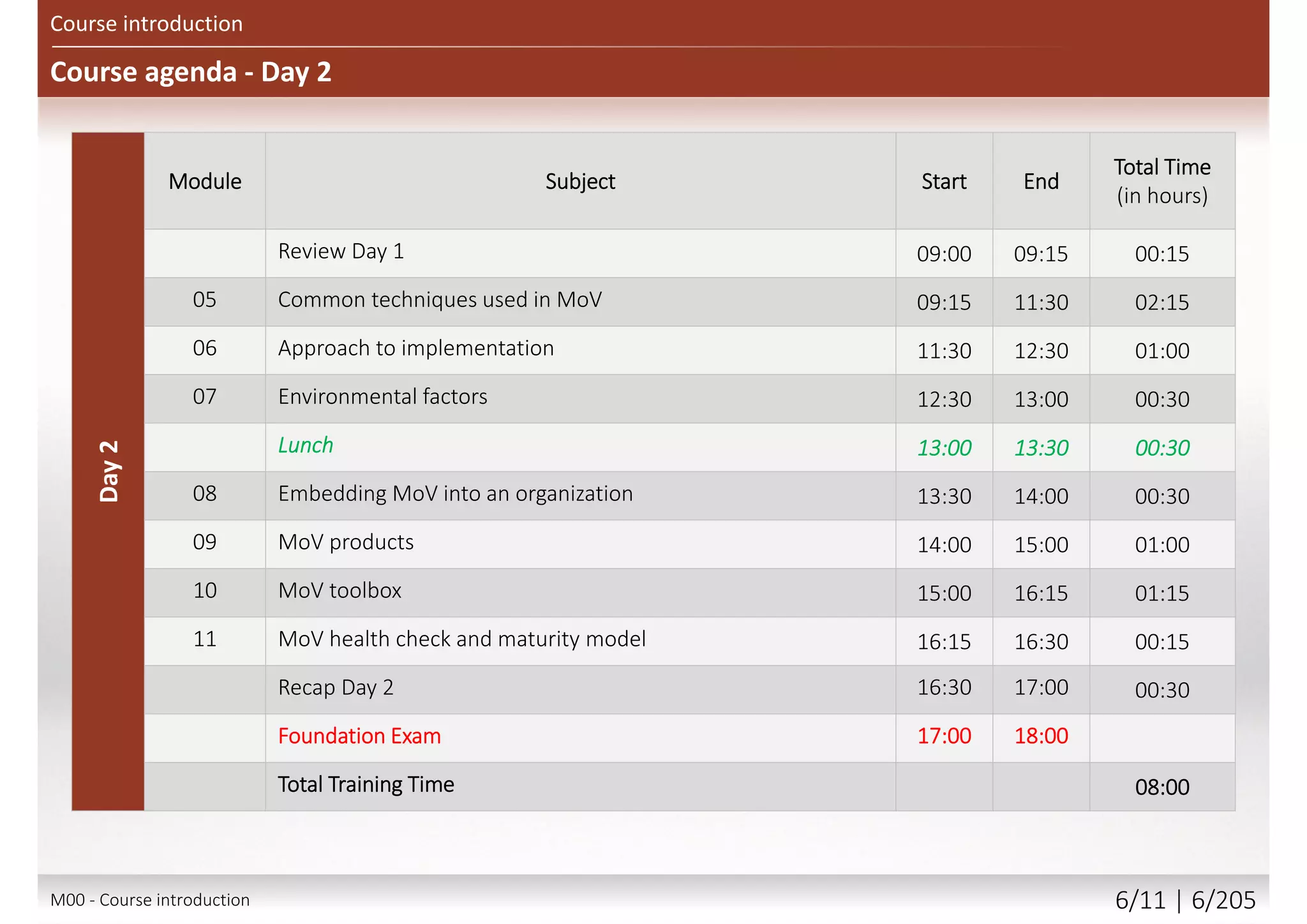
Day2
Module Subject Start End
Total Time
(in hours)
Review Day 1 09:00 09:15 00:15
05 Common techniques used in MoV 09:15 11:30 02:15
06 Approach to implementation 11:30 12:30 01:00
07 Environmental factors 12:30 13:00 00:30
Lunch 13:00 13:30 00:30
08 Embedding MoV into an organization 13:30 14:00 00:30
09 MoV products 14:00 15:00 01:00
10 MoV toolbox 15:00 16:15 01:15
11 MoV health check and maturity model 16:15 16:30 00:15
Recap Day 2 16:30 17:00 00:30
Foundation Exam 17:00 18:00
Total Training Time 08:00
Course agenda - Day 2
Course introduction
M00 - Course introduction 6/12 | 6/209
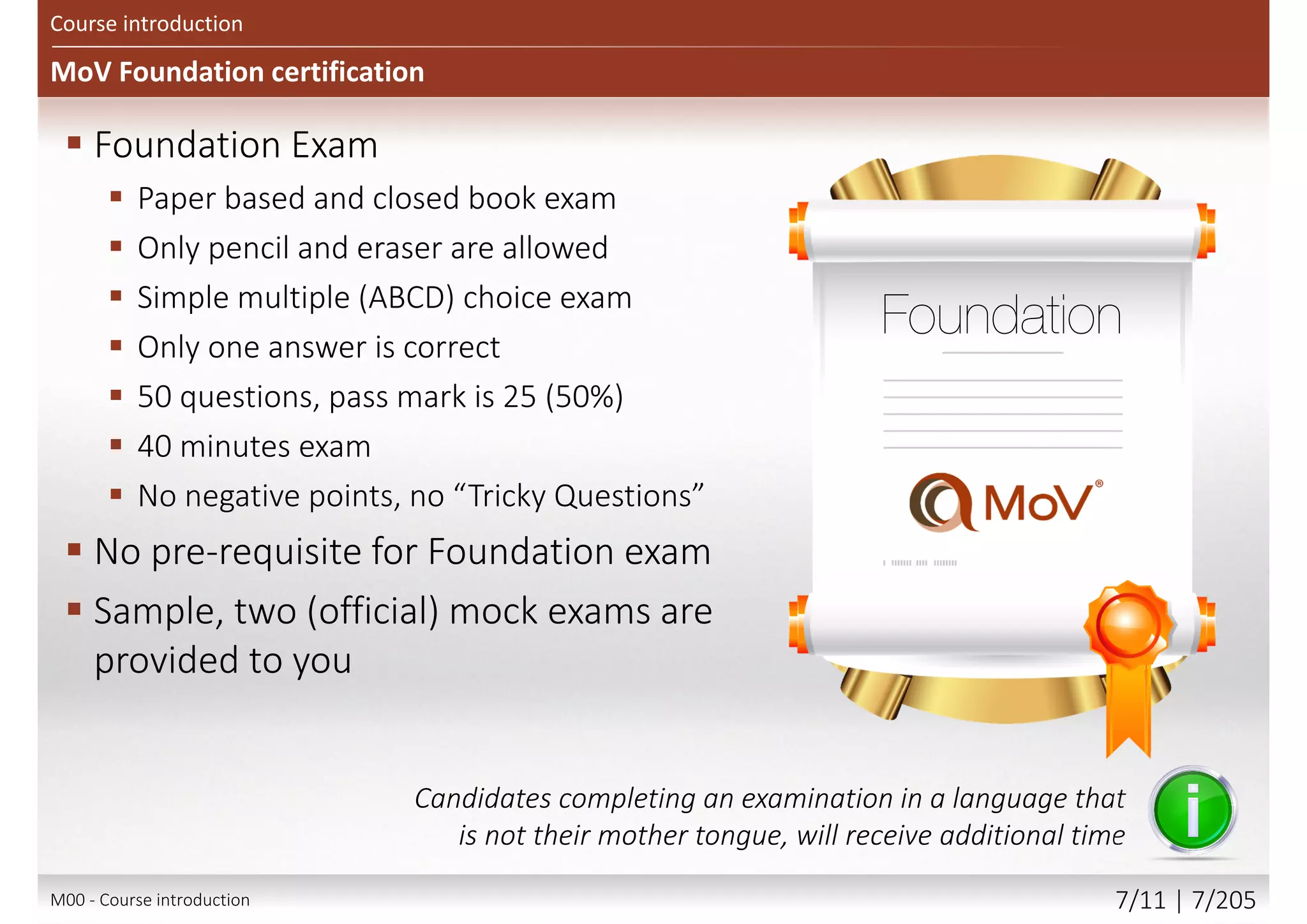
MoV Foundation certification
Course introduction
 Foundation Exam
 Paper based and closed book exam
 Only pencil and eraser are allowed
 Simple multiple (ABCD) choice exam
 Only one answer is correct
 50 questions, pass mark is 25 (50%)
 40 minutes exam
 No negative points, no “Tricky Questions”
 No pre-requisite for Foundation exam
 Sample, two (official) mock exams are
provided to you
Candidates completing an examination in a language that
is not their mother tongue, will receive additional time
M00 - Course introduction 7/12 | 7/209
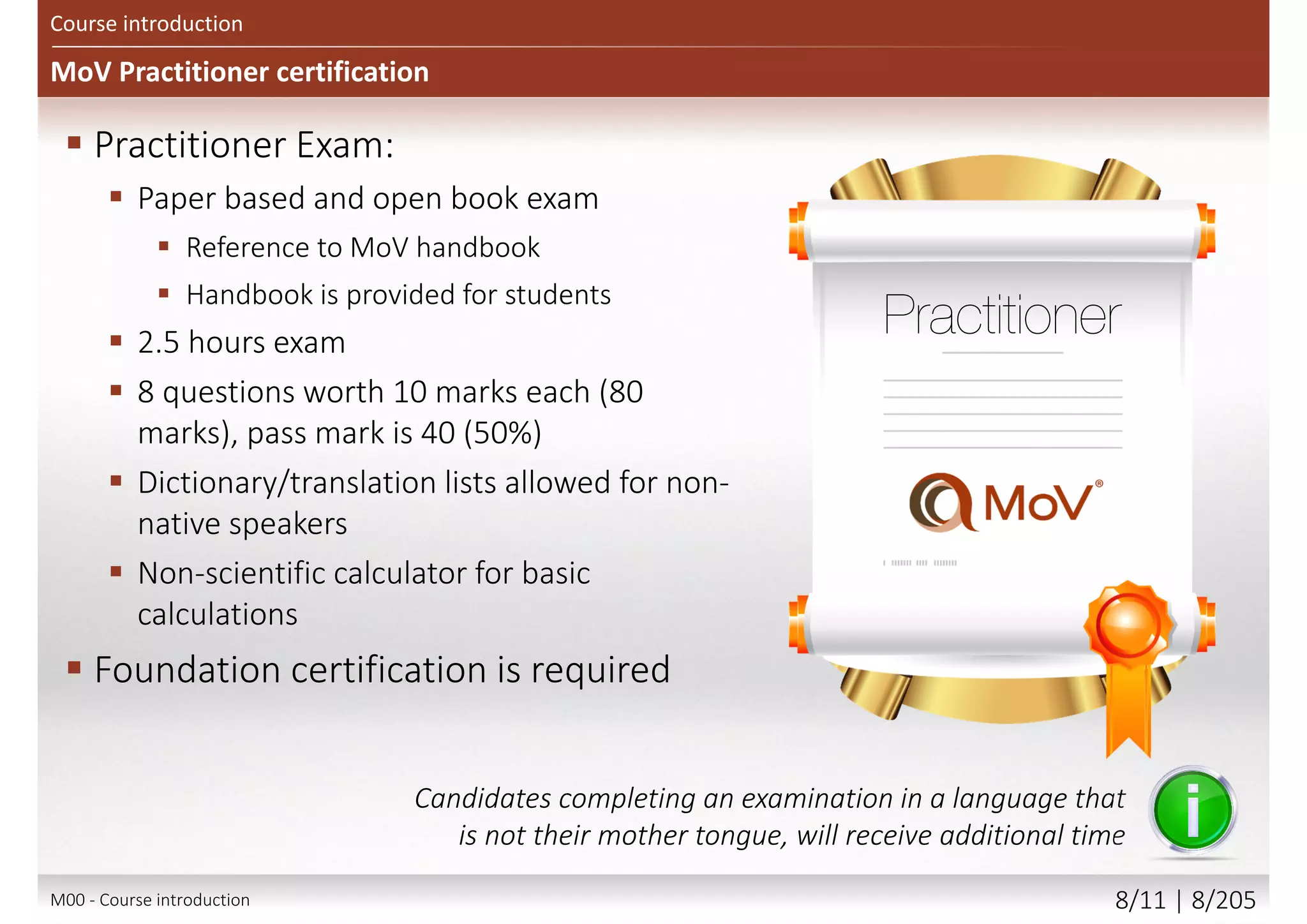
MoV Practitioner certification
Course introduction
 Practitioner Exam:
 Paper based and open book exam
 Reference to MoV handbook
 Handbook is provided for students
 2.5 hours exam
 8 questions worth 10 marks each (80
marks), pass mark is 40 (50%)
 Dictionary/translation lists allowed for non-
native speakers
 Non-scientific calculator for basic
calculations
 Foundation certification is required
Candidates completing an examination in a language that
is not their mother tongue, will receive additional time
M00 - Course introduction 8/12 | 8/209
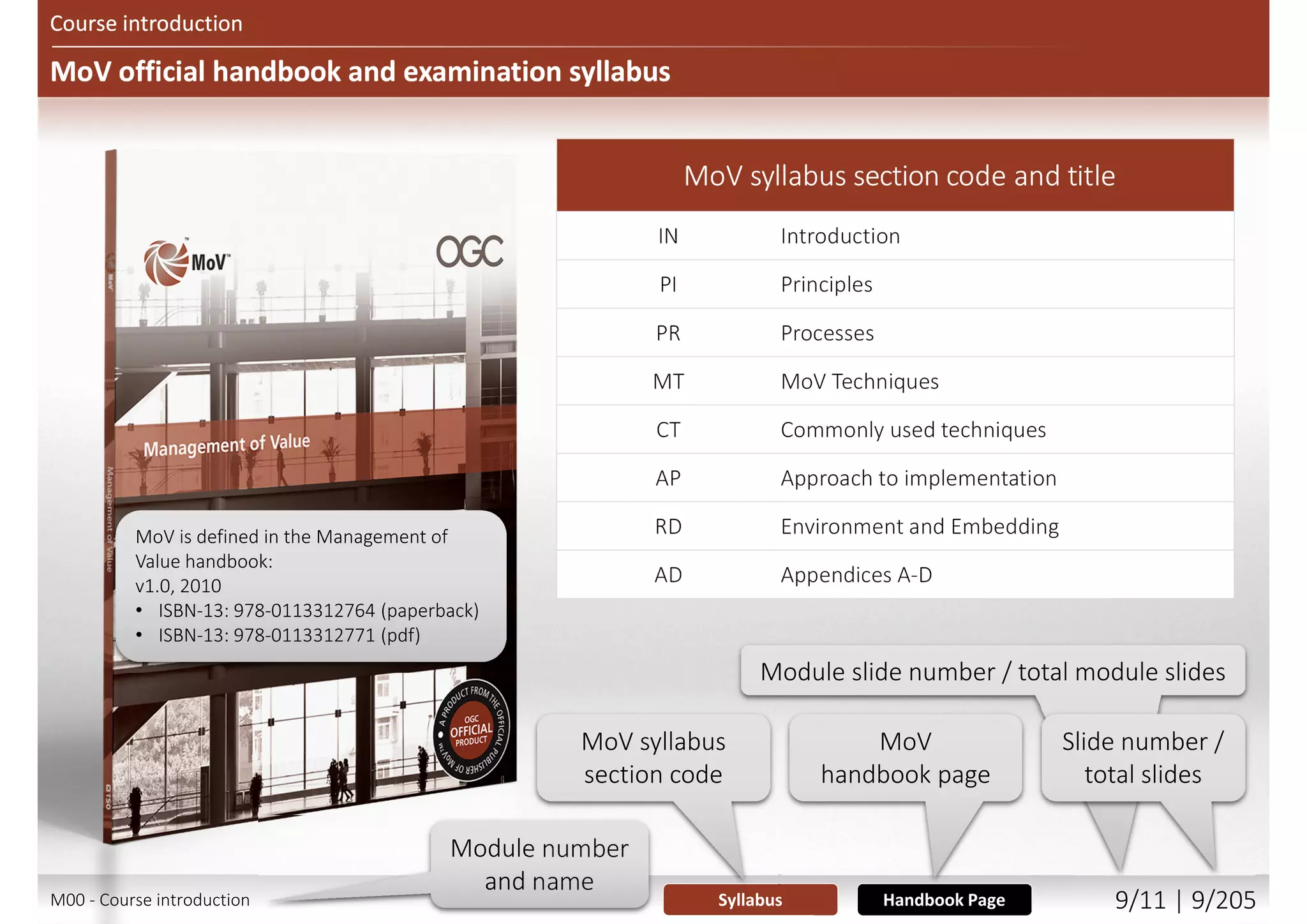
MoV official handbook and examination syllabus
Course introduction
MoV syllabus section code and title
IN Introduction
PI Principles
PR Processes
MT MoV Techniques
CT Commonly used techniques
AP Approach to implementation
RD Environment and Embedding
AD Appendices A-D
Module slide number / total module slides
Slide number /
total slides
Module number
and name
Syllabus Handbook Page
MoV
handbook page
MoV syllabus
section code
M00 - Course introduction 9/12 | 9/209
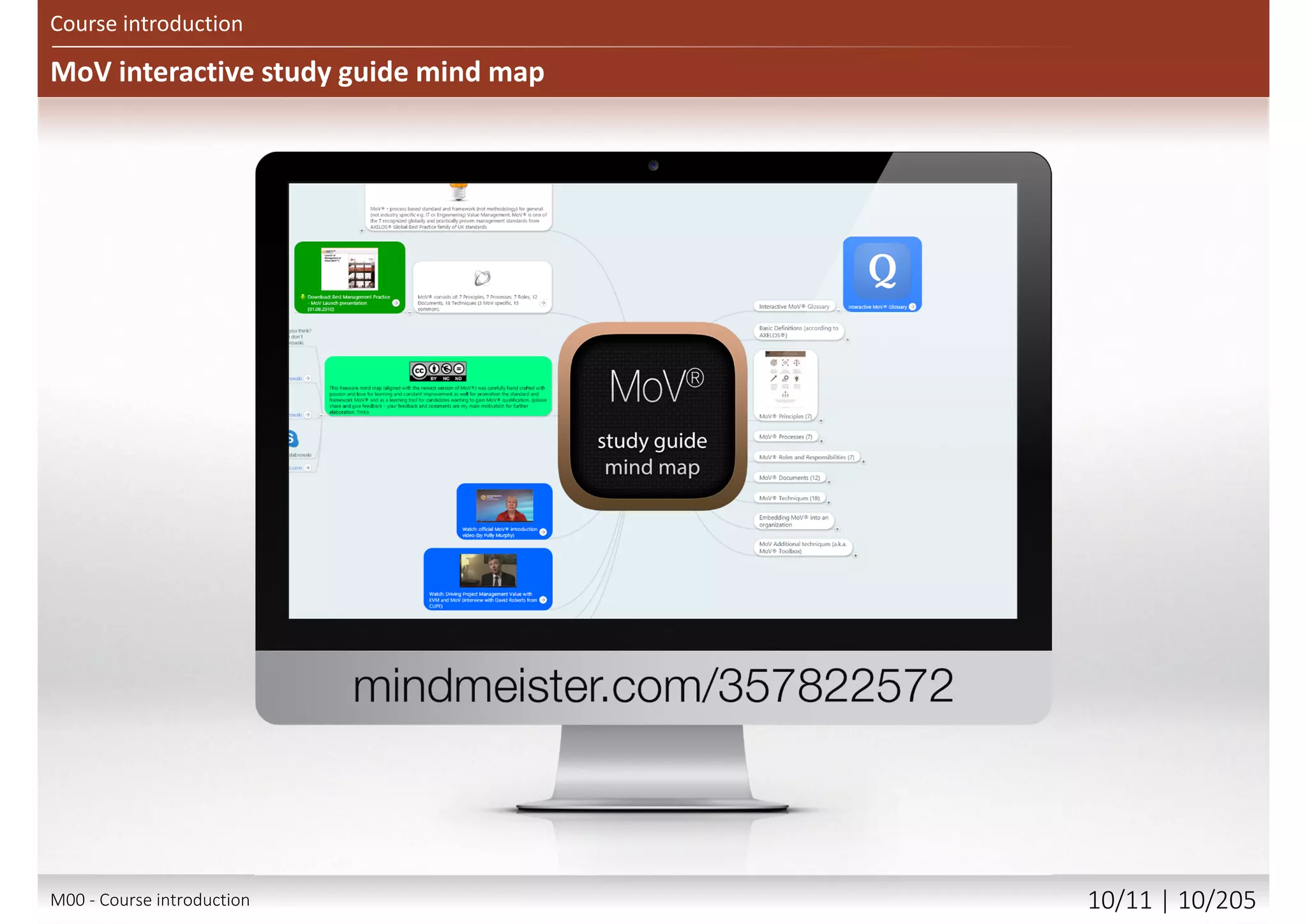
MoV interactive study guide mind map
Course introduction
See Appendix #2 more mind maps from AXELOS Global Best Practice
M00 - Course introduction 10/12 | 10/209
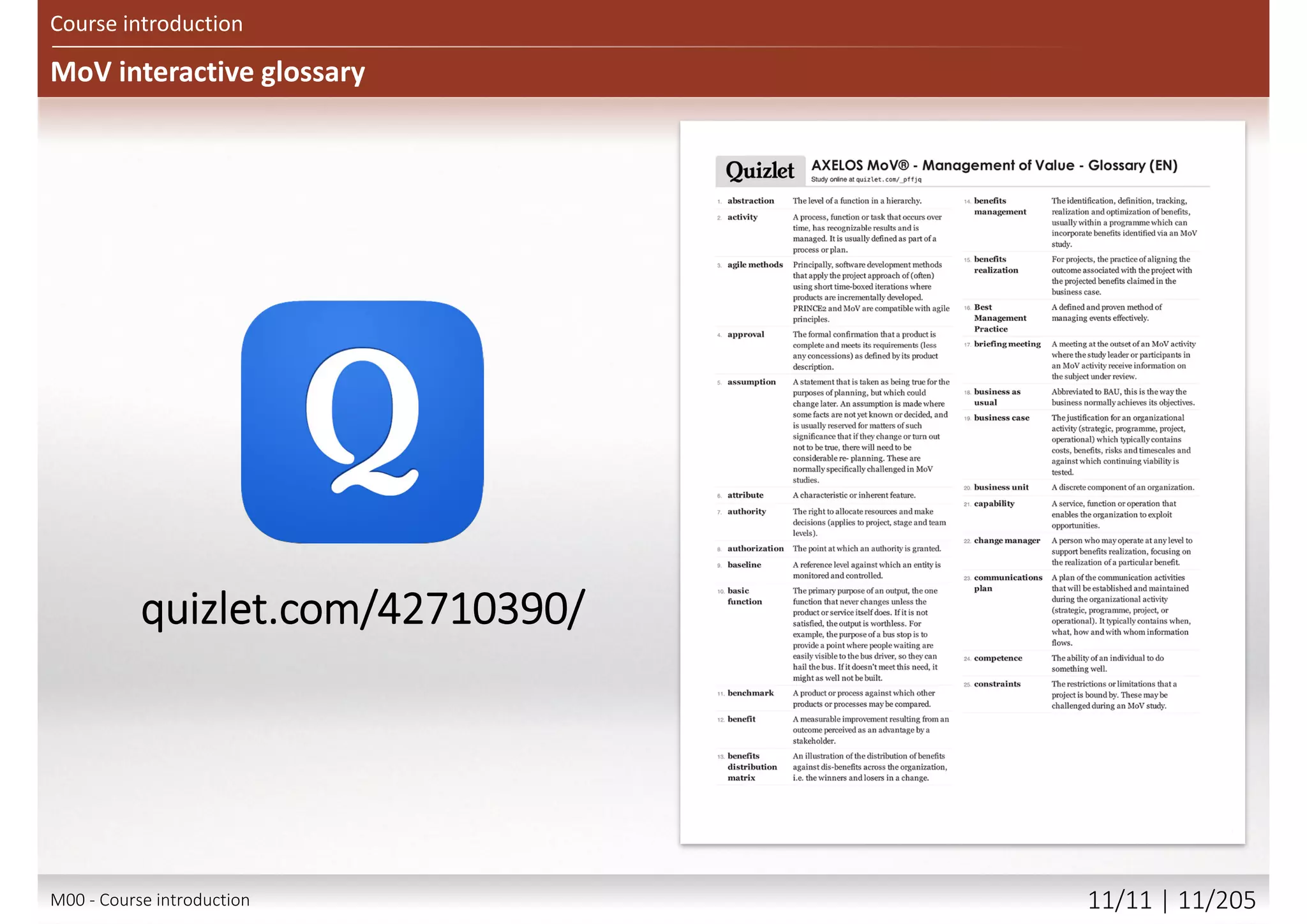
MoV interactive glossary
Course introduction
quizlet.com/42710390/
M00 - Course introduction 11/12 | 11/209
About course author - Mirosław Dąbrowski
Course introduction
twitter.com/mirodabrowski
linkedin.com/in/miroslawdabrowski
google.com/+miroslawdabrowski
miroslaw_dabrowski
www.miroslawdabrowski.com
Mirosław Dąbrowski
Agile Coach, Trainer, Consultant
(former JEE/PHP developer, UX/UI designer, BA/SA)
Creator Writer / Translator Trainer / Coach
• Creator of 50+ mind maps from PPM and related
topics (2mln views): miroslawdabrowski.com
• Lead author of more than 50+ accredited materials
from PRINCE2, PRINCE2 Agile, MSP, MoP, P3O, ITIL,
M_o_R, MoV, PMP, Scrum, AgilePM, DSDM, CISSP,
CISA, CISM, CRISC, CGEIT, TOGAF, COBIT5 etc.
• Creator of 50+ interactive mind maps from PPM
topics: mindmeister.com/users/channel/2757050
• Product Owner of biggest Polish project
management portal: 4PM: 4pm.pl (15.000+ views
each month)
• Editorial Board Member of Official PMI Poland
Chapter magazine: “Strefa PMI”: strefapmi.pl
• Official PRINCE2 Agile, AgilePM, ASL2, BiSL methods
translator for Polish language
• English speaking, international, independent
trainer and coach from multiple domains.
• Master Lead Trainer
• 11+ years in training and coaching / 15.000+ hours
• 100+ certifications
• 5000+ people trained and coached
• 25+ trainers trained and coached
linkedin.com/in/miroslawdabrowski
Agile Coach / Scrum Master PM / IT architect Notable clients
• 8+ years of experience with Agile projects as a
Scrum Master, Product Owner and Agile Coach
• Coached 25+ teams from Agile and Scrum
• Agile Coach coaching C-level executives
• Scrum Master facilitating multiple teams
experienced with UX/UI + Dev teams
• Experience multiple Agile methods
• Author of AgilePM/DSDM Project Health Check
Questionnaire (PHCQ) audit tool
• Dozens of mobile and ecommerce projects
• IT architect experienced in IT projects with budget
above 10mln PLN and timeline of 3+ years
• Experienced with (“traditional”) projects under high
security, audit and compliance requirements based
on ISO/EIC 27001
• 25+ web portal design and development and
mobile application projects with iterative,
incremental and adaptive approach
ABB, AGH, Aiton Caldwell, Asseco, Capgemini, Deutsche Bank,
Descom, Ericsson, Ericpol, Euler Hermes, General Electric,
Glencore, HP Global Business Center, Ideo, Infovide-Matrix,
Interia, Kemira, Lufthansa Systems, Media-Satrun Group,
Ministry of Defense (Poland), Ministry of Justice (Poland),
Nokia Siemens Networks, Oracle, Orange, Polish Air Force,
Proama, Roche, Sabre Holdings, Samsung Electronics, Sescom,
Scania, Sopra Steria, Sun Microsystems, Tauron Polish Energy,
Tieto, University of Wroclaw, UBS Service Centre, Volvo IT…
miroslawdabrowski.com/about-me/clients-and-references/
Accreditations/certifications (selected): CISA, CISM, CRISC, CASP, Security+, Project+, Network+, Server+, Approved Trainer:
(MoP, MSP, PRINCE2, PRINCE2 Agile, M_o_R, MoV, P3O, ITIL Expert, RESILIA), ASL2, BiSL, Change Management,
Facilitation, Managing Benefits, COBIT5, TOGAF 8/9L2, OBASHI, CAPM, PSM I, SDC, SMC, ESMC, SPOC, AEC, DSDM Atern,
DSDM Agile Professional, DSDM Agile Trainer-Coach, AgilePM, OCUP Advanced, SCWCD, SCBCD, SCDJWS, SCMAD, ZCE 5.0,
ZCE 5.3, MCT, MCP, MCITP, MCSE-S, MCSA-S, MCS, MCSA, ISTQB, IQBBA, REQB, CIW Web Design / Web Development /
Web Security Professional, Playing Lean Facilitator, DISC D3 Consultant, SDI Facilitator, Certified Trainer Apollo 13 ITSM
Simulation …
M00 - Course introduction 12/12 | 12/209
Agenda
Introduction to value management and MoV
1. Introduction to value management and MoV
2. MoV principles
3. MoV processes
4. MoV techniques
5. Common techniques used in MoV
6. Approach to MoV implementation
7. Environmental factors
8. Embedding MoV into an organization
9. MoV products
10. MoV toolbox
11. MoV health check and maturity model
M01 - Introduction to value management and MoV 2/21 | 14/209
Value and Value Management
Introduction to value management and MoV
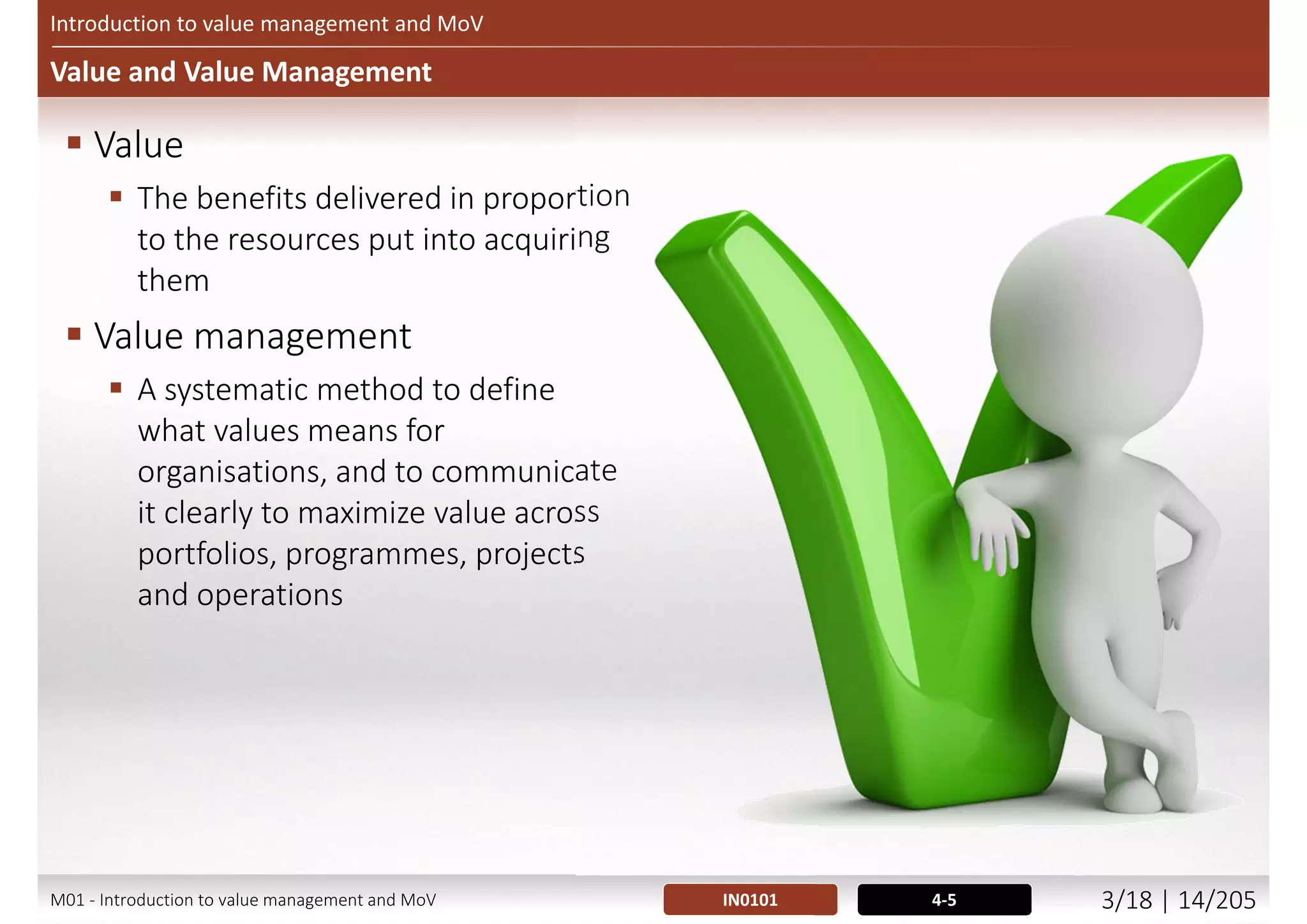
 Value
 The benefits delivered in proportion
to the resources put into acquiring
them
 Value management
 A systematic method (with several
techniques) to define what values
means for organisations, and to
communicate it clearly to maximize
value across portfolios,
programmes, projects and
operations
IN0101 4-5M01 - Introduction to value management and MoV 3/21 | 15/209
Capabilities, Outcomes, Benefits and Dis-benefits
Introduction to value management and MoV
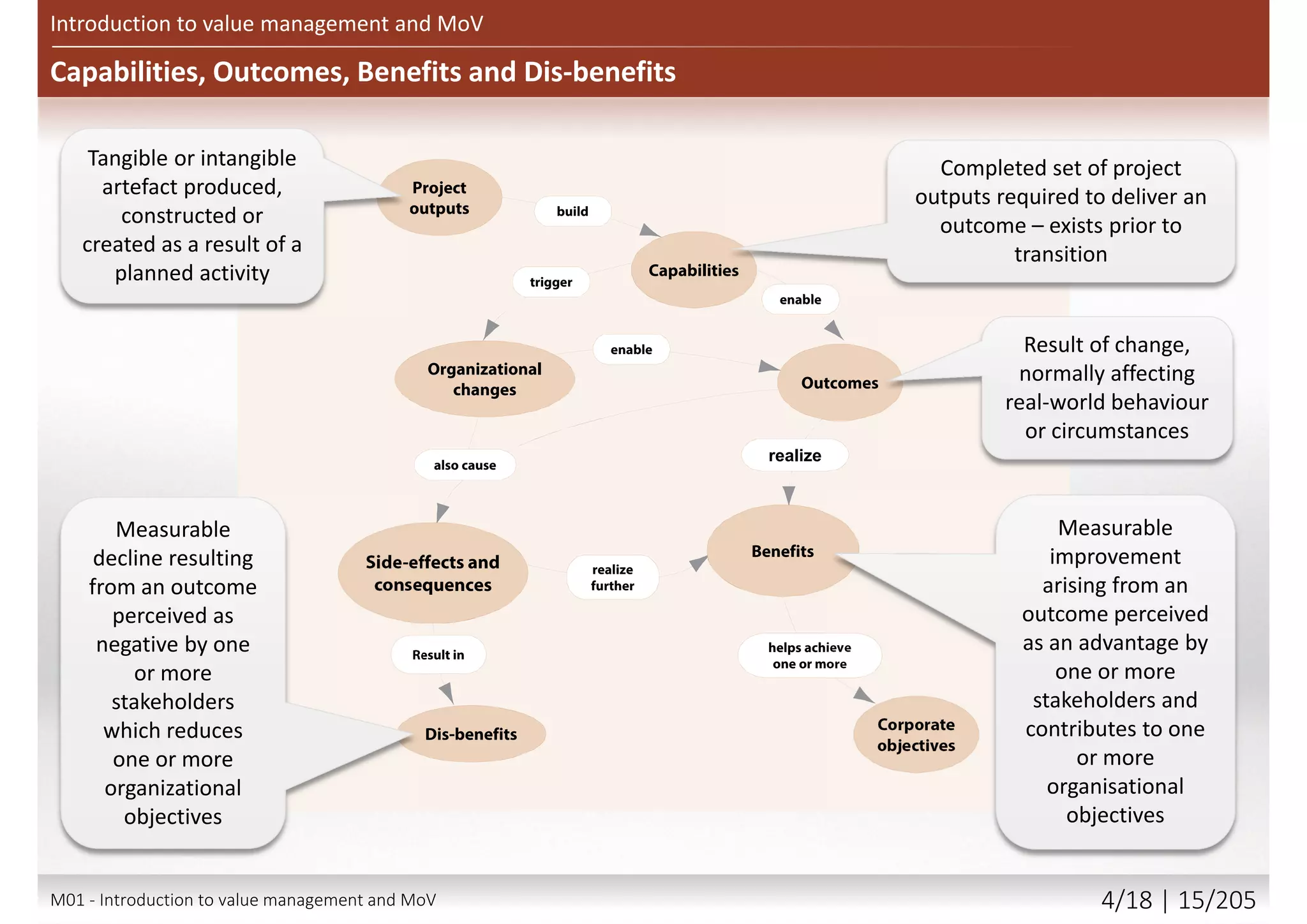
Side-effects and
consequences
Corporate
objectives
realize
further
also cause
Project
outputs
Organizational
changes
Dis-benefits
enable
realize
helps achieve
one or more
Outcomes
Benefits
trigger
Result in
Capabilities
build
enable
Measurable
improvement
arising from an
outcome perceived
as an advantage by
one or more
stakeholders and
contributes to one
or more
organisational
objectives
Measurable
decline resulting
from an outcome
perceived as
negative by one
or more
stakeholders
which reduces
one or more
organizational
objectives
Tangible or intangible
artefact produced,
constructed or created
as a result of a
planned activity
Completed set of project
outputs required to deliver an
outcome – exists prior to
transition
Result of change,
normally affecting
real-world behaviour
or circumstances
M01 - Introduction to value management and MoV 4/21 | 16/209
What is Value?
Introduction to value management and MoV
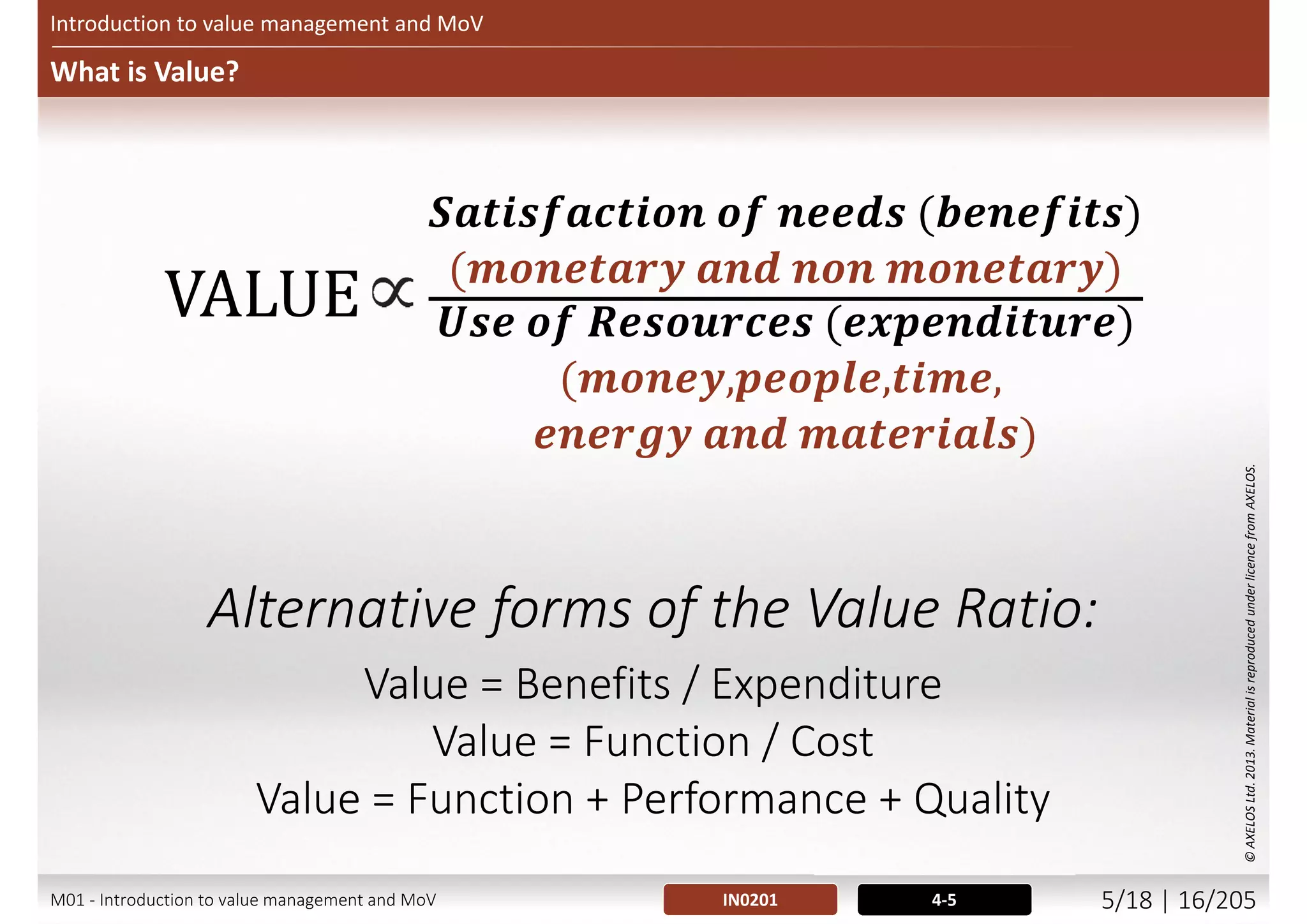
Alternative forms of the Value Ratio:
Value = Benefits / Expenditure
Value = Function / Cost
Value = Function + Performance + Quality
©AXELOSLtd.2013.MaterialisreproducedunderlicencefromAXELOS.
4-5IN0201M01 - Introduction to value management and MoV 5/21 | 17/209
Introduction to value management and MoV
What is Management of Value (MoV)? (1/2)
 Process based approach for defining and embracing value
 MoV focuses on function – what things DO, not strictly what they ARE
 PRINCE2 – what things ARE (acceptation criteria)
 MoV – what things DO (functions / value drivers)
 MoV Maximises value in line with Programme and Project objectives
and key stakeholder requirements:
 Not simply minimising costs
 Are we maximizing the value, are we getting optimal benefits?
 Collective term embracing many processes to maximise value:
 Value is subjective, MoV seek to achieve the optimum balance between all
stakeholder’s needs
 Supports decision making based on maximising value for money
 8 key benefits
5-6M01 - Introduction to value management and MoV 6/21 | 18/209
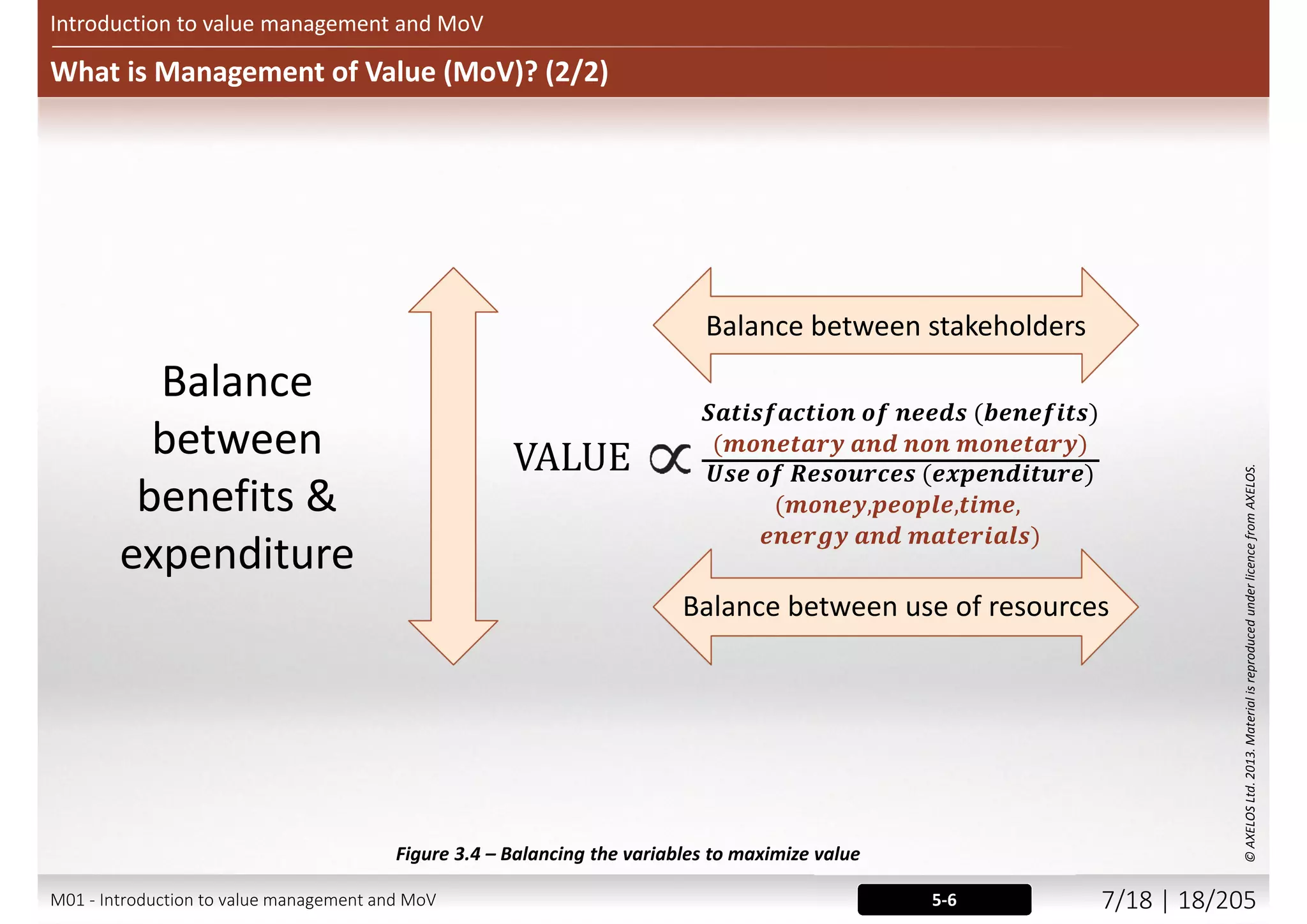
What is Management of Value (MoV)? (2/2)
Introduction to value management and MoV
, , ,
Balance
between
benefits &
expenditure
Balance between stakeholders
Balance between use of resources
©AXELOSLtd.2013.MaterialisreproducedunderlicencefromAXELOS.
5-6
Figure 3.4 – Balancing the variables to maximize value
M01 - Introduction to value management and MoV 7/21 | 19/209
Introduction to value management and MoV
Why use MoV?
 MoV enhances competitiveness, productivity and profitability:
 Maximising ROI
 Minimizing TCO/TCI
 Making optimum use of resources
 Improving customer satisfaction by providing value for money for customers
 Streamlining production and improving delivery of services
 Eliminating wasteful practices
 Deliver cost savings with minimum impact on essential quality of products and
services
 Cut non-essential projects or services
6-8IN0102; 0203M01 - Introduction to value management and MoV 8/21 | 20/209
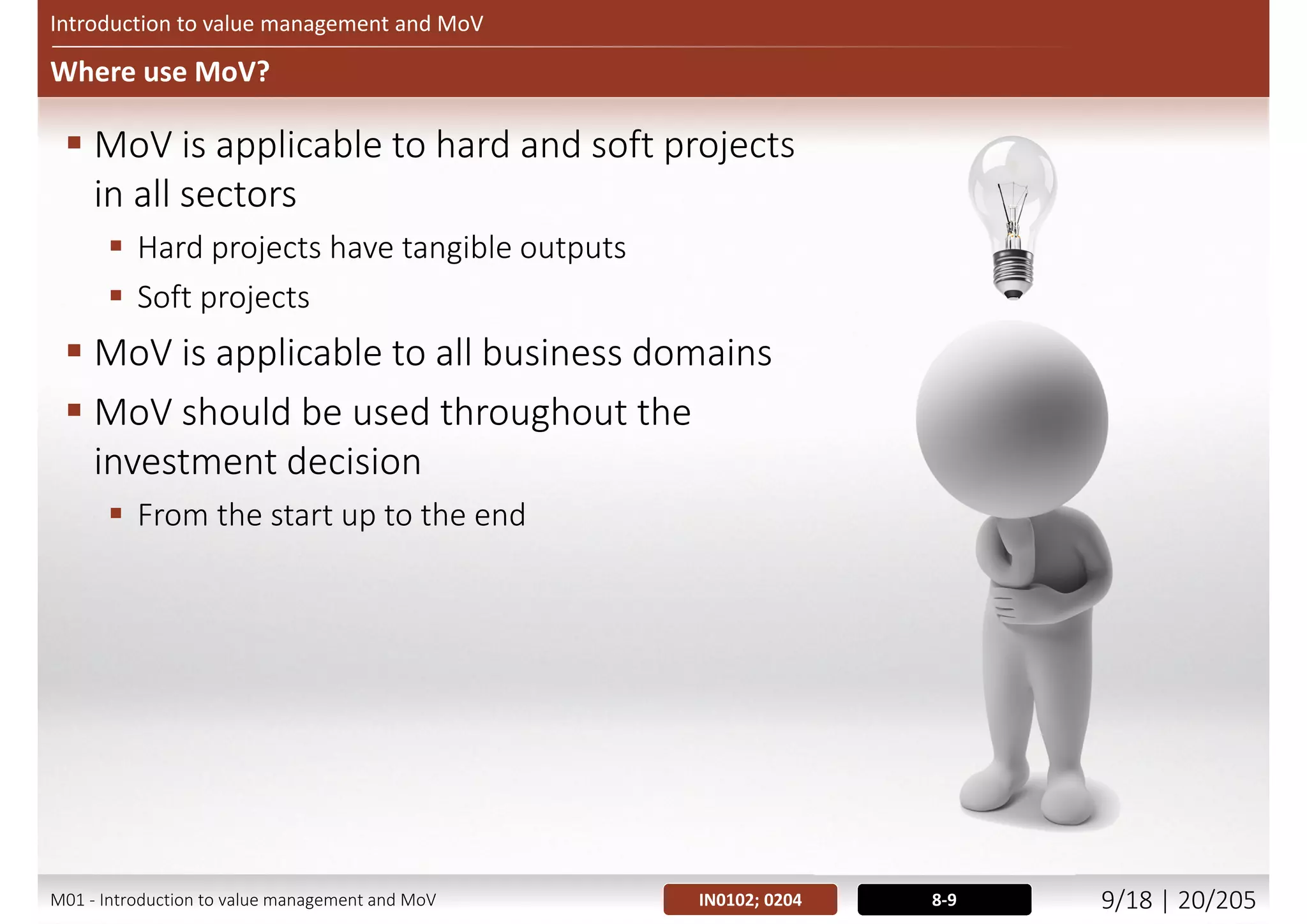
Where use MoV?
Introduction to value management and MoV
 MoV is applicable to hard and soft projects in all
sectors
 Hard projects have tangible outputs
 Soft projects
 MoV is applicable to all business domains
 MoV should be used throughout the investment
decision
 From the start up to the end
8-9IN0102; 0204M01 - Introduction to value management and MoV 9/21 | 21/209
Introduction to value management and MoV
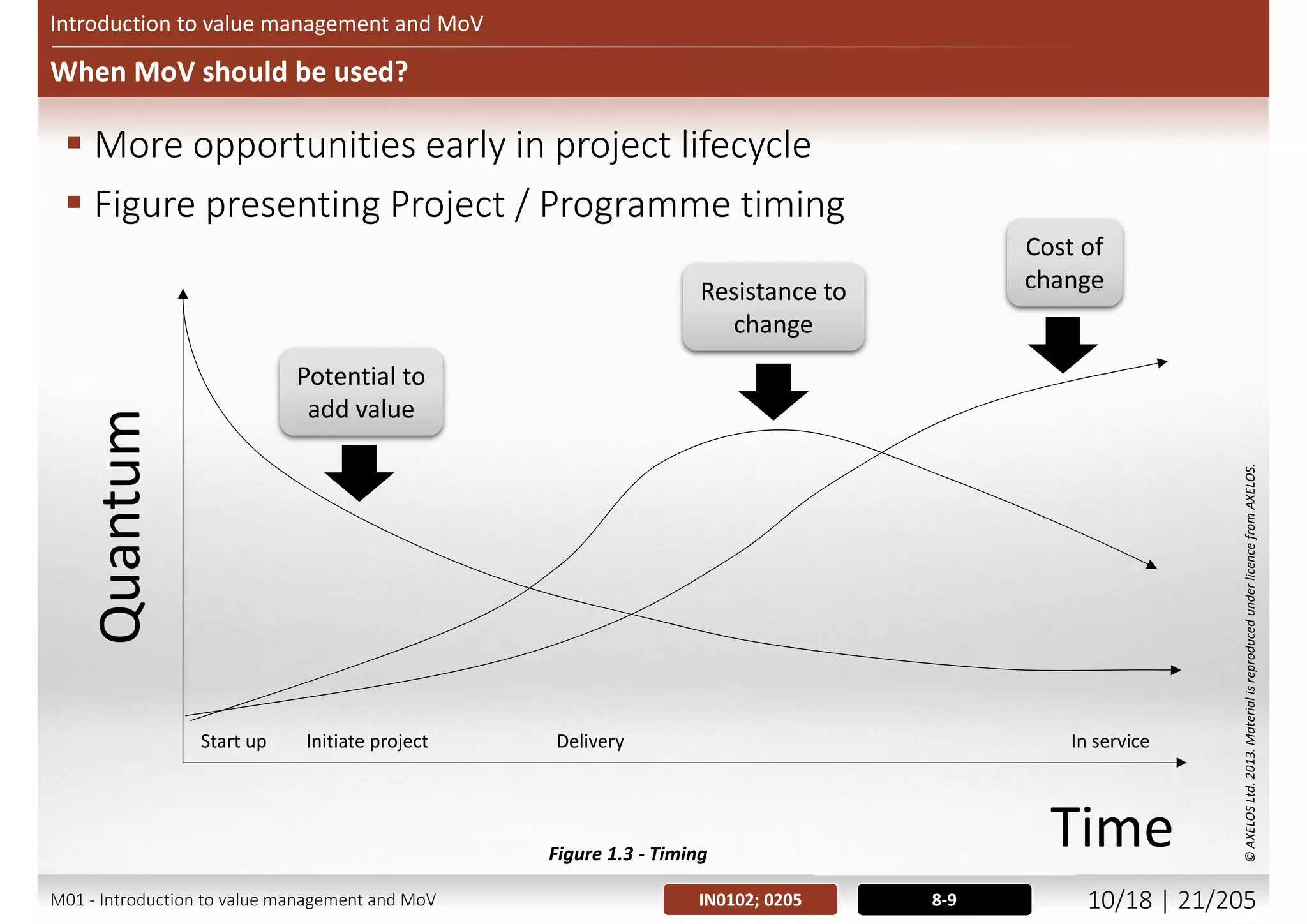
When MoV should be used?
 More opportunities early in project lifecycle
 Figure presenting Project / Programme timing
Quantum
Time
Start up Initiate project Delivery In service
Potential to
add value
Resistance to
change
Cost of
change
©AXELOSLtd.2013.MaterialisreproducedunderlicencefromAXELOS.
8-9
Figure 1.3 - Timing
IN0102; 0205M01 - Introduction to value management and MoV 10/21 | 22/209
Introduction to value management and MoV
What using MoV involve?
 Based on 7 principles
 Underpinned by 7 processes
 The use of some unique (specific for MoV) techniques
 And some commonly used (across other methodologies / methods)
techniques
 Applied in a structured manner
 Process based approach
 Supported by sound management and a supportive culture
 No blame culture
IN0103; 0206 12-14M01 - Introduction to value management and MoV 11/21 | 23/209
Selected MoV benefits (1/2)
Introduction to value management and MoV
1. Enables more efficient delivery by employing
fewer resources and using these resources to
better effect
2. Provides a means to define objectives and scope
clearly in terms of the organization’s and end
users’ short- and long-term needs
3. Supports decision-making based upon
maximizing value for money
4. Encourages innovation that is well-aligned to the
organization’s goals
5. Facilitates optimal balance between investment
and long-term operating expenditure
5-6IN0202M01 - Introduction to value management and MoV 12/21 | 24/209
Selected MoV benefits (2/2)
Introduction to value management and MoV
6. Provides a means of measuring and auditing
value, taking account of monetary and non-
monetary benefits and achieving optimal
balance between them, thus demonstrating that
optimal value has been achieved
7. Enables effective consultation and engagement
of stakeholders and end users and reconciles
their differing needs
8. Promotes sustainable decision-making, based on
adding value, by addressing both monetary and
non-monetary factors
5-6IN0202M01 - Introduction to value management and MoV 13/21 | 25/209
Relationship with other AXELOS Global Best Practices
Introduction to value management and MoV
6
Portfolio
management
Portfolio(s)
Office
Programme
management
Programme(s)
Office
Project(s)
Office
Project
management
Project
management
Project
management
ManagementofRisk(M_o_R)
ITIL
ManagementofValue(MoV)
RESILIA
M01 - Introduction to value management and MoV 14/21 | 26/209
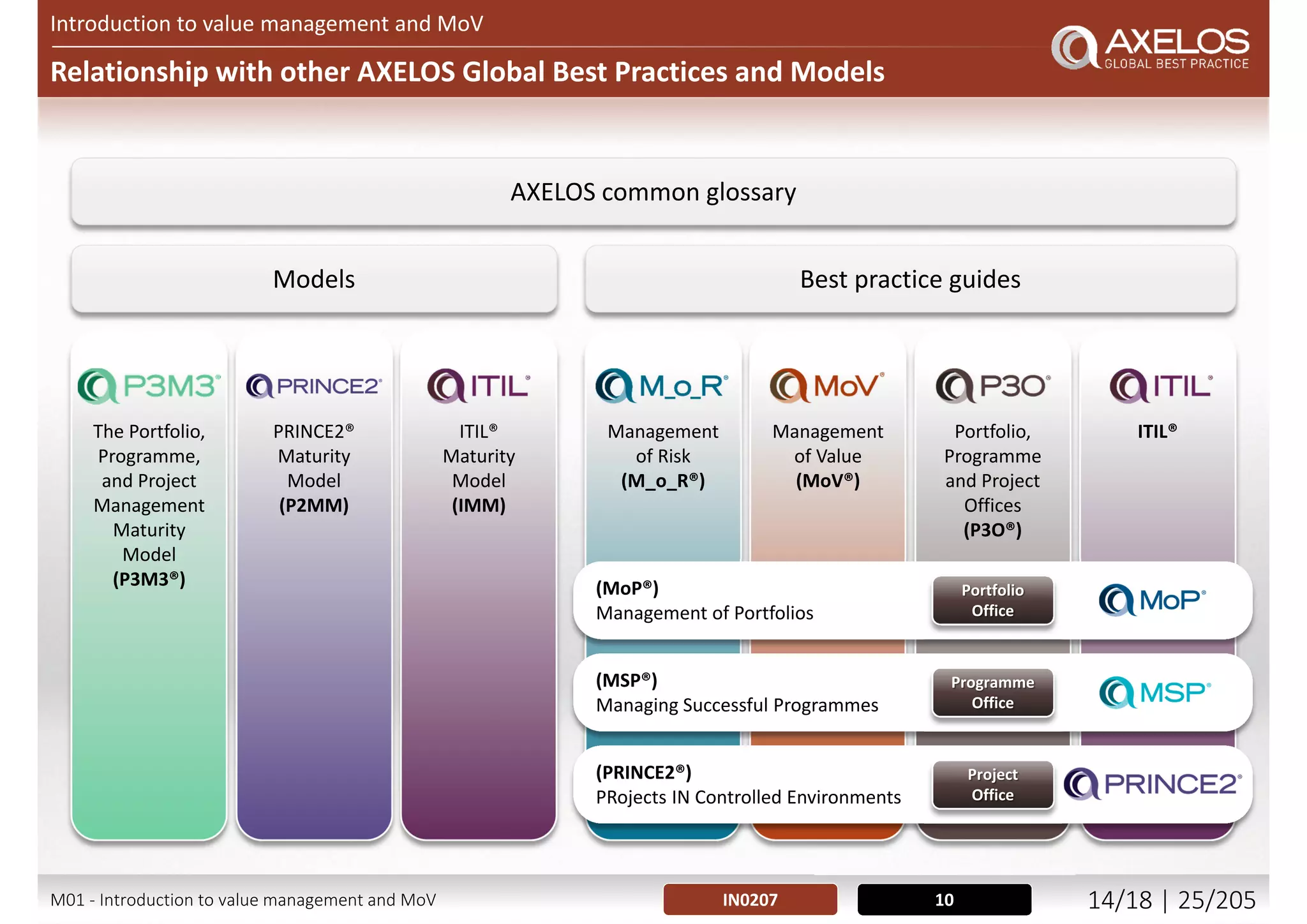
Relationship with other AXELOS Global Best Practices and Models
Introduction to value management and MoV
10IN0207
The Portfolio,
Programme,
and Project
Management
Maturity
Model
(P3M3)
ITIL
Maturity
Model
(IMM)
ITILPortfolio,
Programme
and Project
Offices
(P3O)
Management
of Value
(MoV)
Management
of Risk
(M_o_R)
Best practice guides
AXELOS common glossary
PRINCE2
Maturity
Model
(P2MM)
Models
(MoP)
Management of Portfolios
(MSP)
Managing Successful Programmes
(PRINCE2)
PRojects IN Controlled Environments
Portfolio
Office
Programme
Office
Project
Office
RESILIA
M01 - Introduction to value management and MoV 15/21 | 27/209
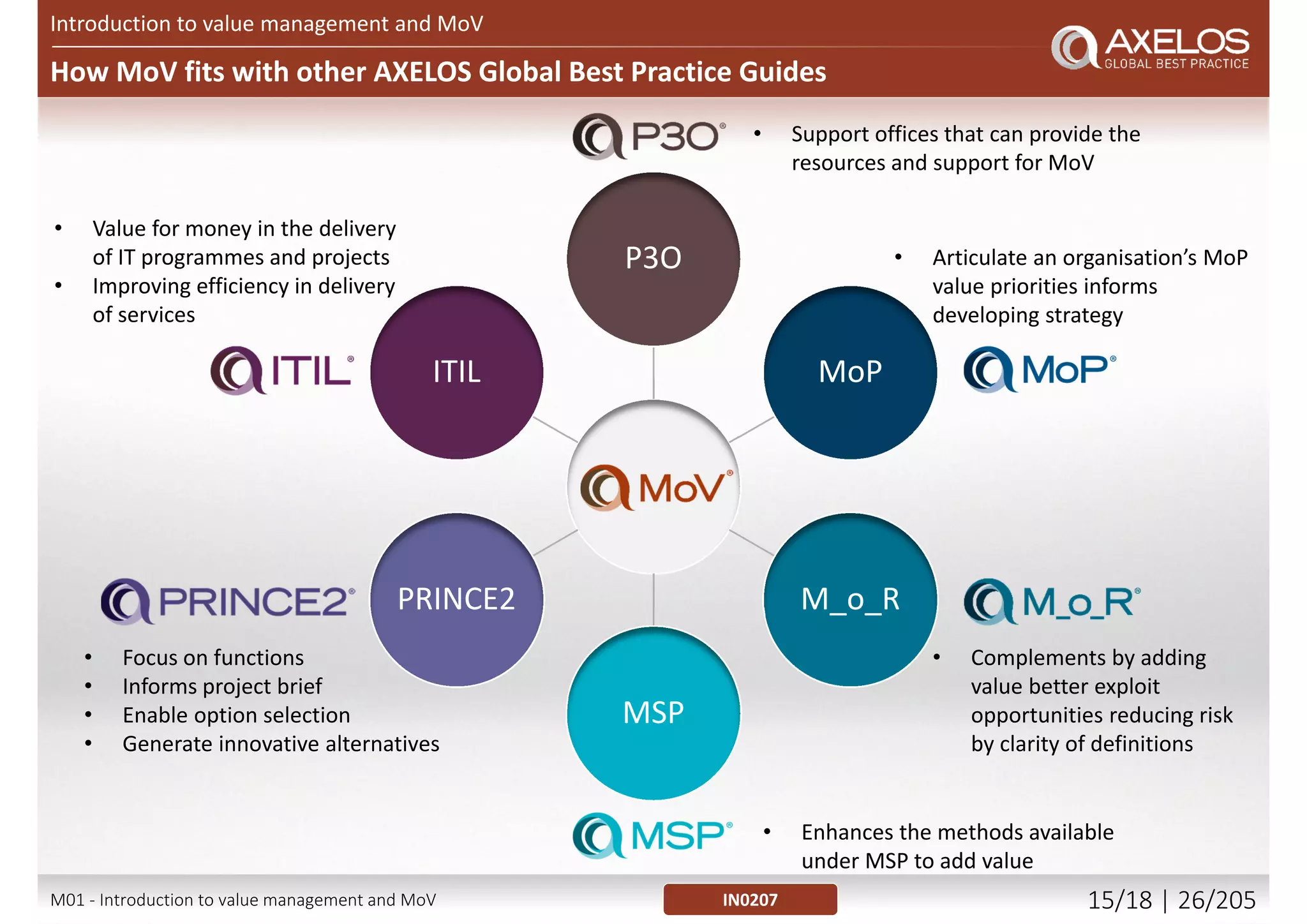
How MoV fits with other AXELOS Global Best Practice Guides
Introduction to value management and MoV
P3O
MoP
M_o_R
MSP
PRINCE2
ITIL
 Value for money in the
delivery of IT programmes
and projects
 Improving efficiency in
delivery of services
 Support offices that can provide the
resources and support for MoV
 Articulate an
organisation’s MoP value
priorities informs
developing strategy
 Complements by adding
value better exploit
opportunities reducing
risk by clarity of
definitions
 Enhances the methods available
under MSP to add value
 Focus on functions
 Informs project brief
 Enable option selection
 Generate innovative alternatives
IN0207M01 - Introduction to value management and MoV 16/21 | 28/209
M01 - Introduction to value management and MoV 17/21 | 29/209
MoV in numbers (version 2010)
Introduction to value management and MoV
7
7
7
12
18
1
1
Principles
Processes
Roles
Products
Techniques
Health Check
Maturity
Model
M01 - Introduction to value management and MoV 18/21 | 30/209
Introduction to value management and MoV
Module review and summary
 Value
 Value management
 Where MoV can be used?
 What using MoV involve?
 Why use MoV?
 Selected MoV benefits
 How MoV fits with other AXELOS Global
Best Practice Guides
M01 - Introduction to value management and MoV 19/21 | 31/209
Q&A
Introduction to value management and MoV
M01 - Introduction to value management and MoV 20/21 | 32/209
I hope you enjoyed
this presentation. If so,
please like, share and
leave a comment
below.
Endorsements on
LinkedIn are also
highly appreciated! 
(your feedback = more free stuff)

MIROSLAWDABROWSKI.COM/downloads
M01 - Introduction to value management and MoV 21/21 | 33/209

AXELOS - MoV® - Management of Value - Foundation

  • 1.
  • 2.
    Course administration Course introduction Startand finish Course style LunchCoffee and breaks M00 - Course introduction 2/12 | 2/209
  • 3.
    Course objectives  Processesand techniques used within MoV and the reasons for using them  How MoV may be applied into organization activity  The differences in applying MoV at different stages in a project and the expected outputs from a MoV Study at each stage  The circumstances under which MoV should be used  The concept of value and how value may be improved  Approaches for implementing MoV  How to respond to external and internal influences  The principles of embedding MoV into an organisation  The key topics in document check lists, the toolbox, health check, organizational maturity and individual competence Main goal  Attempt Foundation exam with confidence  Begin to apply the method, tailoring it to your own needs Secondary goal  Benefits and value of value management and MoV Course introduction M00 - Course introduction 3/12 | 3/209
  • 4.
    Course introduction Let’s Getto Know Each Other  Please share with the class:  Your name and surname  Your organization  Your profession  Title, function, job responsibilities  Your familiarity with the project and programme management  Your familiarity with the value management  Your familiarity with the value engineering (VE)  Your experience with MoV  Your personal session expectations M00 - Course introduction 4/12 | 4/209
  • 5.
    Day1 Module Subject StartEnd Total Time (in hours) Course introduction 09:00 09:30 00:30 01 Introduction to value management and MoV 09:30 11:00 02:00 02 MoV principles 11:00 12:00 01:00 03 MoV processes 12:00 13:00 01:00 Lunch 13:00 13:30 00:30 04 MoV techniques 13:30 16:30 02:30 Recap Day 1 16:30 17:00 00:30 Total Training Time 08:00 Course agenda - Day 1 Course introduction M00 - Course introduction 5/12 | 5/209
  • 6.
    Day2 Module Subject StartEnd Total Time (in hours) Review Day 1 09:00 09:15 00:15 05 Common techniques used in MoV 09:15 11:30 02:15 06 Approach to implementation 11:30 12:30 01:00 07 Environmental factors 12:30 13:00 00:30 Lunch 13:00 13:30 00:30 08 Embedding MoV into an organization 13:30 14:00 00:30 09 MoV products 14:00 15:00 01:00 10 MoV toolbox 15:00 16:15 01:15 11 MoV health check and maturity model 16:15 16:30 00:15 Recap Day 2 16:30 17:00 00:30 Foundation Exam 17:00 18:00 Total Training Time 08:00 Course agenda - Day 2 Course introduction M00 - Course introduction 6/12 | 6/209
  • 7.
    MoV Foundation certification Courseintroduction  Foundation Exam  Paper based and closed book exam  Only pencil and eraser are allowed  Simple multiple (ABCD) choice exam  Only one answer is correct  50 questions, pass mark is 25 (50%)  40 minutes exam  No negative points, no “Tricky Questions”  No pre-requisite for Foundation exam  Sample, two (official) mock exams are provided to you Candidates completing an examination in a language that is not their mother tongue, will receive additional time M00 - Course introduction 7/12 | 7/209
  • 8.
    MoV Practitioner certification Courseintroduction  Practitioner Exam:  Paper based and open book exam  Reference to MoV handbook  Handbook is provided for students  2.5 hours exam  8 questions worth 10 marks each (80 marks), pass mark is 40 (50%)  Dictionary/translation lists allowed for non- native speakers  Non-scientific calculator for basic calculations  Foundation certification is required Candidates completing an examination in a language that is not their mother tongue, will receive additional time M00 - Course introduction 8/12 | 8/209
  • 9.
    MoV official handbookand examination syllabus Course introduction MoV syllabus section code and title IN Introduction PI Principles PR Processes MT MoV Techniques CT Commonly used techniques AP Approach to implementation RD Environment and Embedding AD Appendices A-D Module slide number / total module slides Slide number / total slides Module number and name Syllabus Handbook Page MoV handbook page MoV syllabus section code M00 - Course introduction 9/12 | 9/209
  • 10.
    MoV interactive studyguide mind map Course introduction See Appendix #2 more mind maps from AXELOS Global Best Practice M00 - Course introduction 10/12 | 10/209
  • 11.
    MoV interactive glossary Courseintroduction quizlet.com/42710390/ M00 - Course introduction 11/12 | 11/209
  • 12.
    About course author- Mirosław Dąbrowski Course introduction twitter.com/mirodabrowski linkedin.com/in/miroslawdabrowski google.com/+miroslawdabrowski miroslaw_dabrowski www.miroslawdabrowski.com Mirosław Dąbrowski Agile Coach, Trainer, Consultant (former JEE/PHP developer, UX/UI designer, BA/SA) Creator Writer / Translator Trainer / Coach • Creator of 50+ mind maps from PPM and related topics (2mln views): miroslawdabrowski.com • Lead author of more than 50+ accredited materials from PRINCE2, PRINCE2 Agile, MSP, MoP, P3O, ITIL, M_o_R, MoV, PMP, Scrum, AgilePM, DSDM, CISSP, CISA, CISM, CRISC, CGEIT, TOGAF, COBIT5 etc. • Creator of 50+ interactive mind maps from PPM topics: mindmeister.com/users/channel/2757050 • Product Owner of biggest Polish project management portal: 4PM: 4pm.pl (15.000+ views each month) • Editorial Board Member of Official PMI Poland Chapter magazine: “Strefa PMI”: strefapmi.pl • Official PRINCE2 Agile, AgilePM, ASL2, BiSL methods translator for Polish language • English speaking, international, independent trainer and coach from multiple domains. • Master Lead Trainer • 11+ years in training and coaching / 15.000+ hours • 100+ certifications • 5000+ people trained and coached • 25+ trainers trained and coached linkedin.com/in/miroslawdabrowski Agile Coach / Scrum Master PM / IT architect Notable clients • 8+ years of experience with Agile projects as a Scrum Master, Product Owner and Agile Coach • Coached 25+ teams from Agile and Scrum • Agile Coach coaching C-level executives • Scrum Master facilitating multiple teams experienced with UX/UI + Dev teams • Experience multiple Agile methods • Author of AgilePM/DSDM Project Health Check Questionnaire (PHCQ) audit tool • Dozens of mobile and ecommerce projects • IT architect experienced in IT projects with budget above 10mln PLN and timeline of 3+ years • Experienced with (“traditional”) projects under high security, audit and compliance requirements based on ISO/EIC 27001 • 25+ web portal design and development and mobile application projects with iterative, incremental and adaptive approach ABB, AGH, Aiton Caldwell, Asseco, Capgemini, Deutsche Bank, Descom, Ericsson, Ericpol, Euler Hermes, General Electric, Glencore, HP Global Business Center, Ideo, Infovide-Matrix, Interia, Kemira, Lufthansa Systems, Media-Satrun Group, Ministry of Defense (Poland), Ministry of Justice (Poland), Nokia Siemens Networks, Oracle, Orange, Polish Air Force, Proama, Roche, Sabre Holdings, Samsung Electronics, Sescom, Scania, Sopra Steria, Sun Microsystems, Tauron Polish Energy, Tieto, University of Wroclaw, UBS Service Centre, Volvo IT… miroslawdabrowski.com/about-me/clients-and-references/ Accreditations/certifications (selected): CISA, CISM, CRISC, CASP, Security+, Project+, Network+, Server+, Approved Trainer: (MoP, MSP, PRINCE2, PRINCE2 Agile, M_o_R, MoV, P3O, ITIL Expert, RESILIA), ASL2, BiSL, Change Management, Facilitation, Managing Benefits, COBIT5, TOGAF 8/9L2, OBASHI, CAPM, PSM I, SDC, SMC, ESMC, SPOC, AEC, DSDM Atern, DSDM Agile Professional, DSDM Agile Trainer-Coach, AgilePM, OCUP Advanced, SCWCD, SCBCD, SCDJWS, SCMAD, ZCE 5.0, ZCE 5.3, MCT, MCP, MCITP, MCSE-S, MCSA-S, MCS, MCSA, ISTQB, IQBBA, REQB, CIW Web Design / Web Development / Web Security Professional, Playing Lean Facilitator, DISC D3 Consultant, SDI Facilitator, Certified Trainer Apollo 13 ITSM Simulation … M00 - Course introduction 12/12 | 12/209
  • 14.
    Agenda Introduction to valuemanagement and MoV 1. Introduction to value management and MoV 2. MoV principles 3. MoV processes 4. MoV techniques 5. Common techniques used in MoV 6. Approach to MoV implementation 7. Environmental factors 8. Embedding MoV into an organization 9. MoV products 10. MoV toolbox 11. MoV health check and maturity model M01 - Introduction to value management and MoV 2/21 | 14/209
  • 15.
    Value and ValueManagement Introduction to value management and MoV  Value  The benefits delivered in proportion to the resources put into acquiring them  Value management  A systematic method (with several techniques) to define what values means for organisations, and to communicate it clearly to maximize value across portfolios, programmes, projects and operations IN0101 4-5M01 - Introduction to value management and MoV 3/21 | 15/209
  • 16.
    Capabilities, Outcomes, Benefitsand Dis-benefits Introduction to value management and MoV Side-effects and consequences Corporate objectives realize further also cause Project outputs Organizational changes Dis-benefits enable realize helps achieve one or more Outcomes Benefits trigger Result in Capabilities build enable Measurable improvement arising from an outcome perceived as an advantage by one or more stakeholders and contributes to one or more organisational objectives Measurable decline resulting from an outcome perceived as negative by one or more stakeholders which reduces one or more organizational objectives Tangible or intangible artefact produced, constructed or created as a result of a planned activity Completed set of project outputs required to deliver an outcome – exists prior to transition Result of change, normally affecting real-world behaviour or circumstances M01 - Introduction to value management and MoV 4/21 | 16/209
  • 17.
    What is Value? Introductionto value management and MoV Alternative forms of the Value Ratio: Value = Benefits / Expenditure Value = Function / Cost Value = Function + Performance + Quality ©AXELOSLtd.2013.MaterialisreproducedunderlicencefromAXELOS. 4-5IN0201M01 - Introduction to value management and MoV 5/21 | 17/209
  • 18.
    Introduction to valuemanagement and MoV What is Management of Value (MoV)? (1/2)  Process based approach for defining and embracing value  MoV focuses on function – what things DO, not strictly what they ARE  PRINCE2 – what things ARE (acceptation criteria)  MoV – what things DO (functions / value drivers)  MoV Maximises value in line with Programme and Project objectives and key stakeholder requirements:  Not simply minimising costs  Are we maximizing the value, are we getting optimal benefits?  Collective term embracing many processes to maximise value:  Value is subjective, MoV seek to achieve the optimum balance between all stakeholder’s needs  Supports decision making based on maximising value for money  8 key benefits 5-6M01 - Introduction to value management and MoV 6/21 | 18/209
  • 19.
    What is Managementof Value (MoV)? (2/2) Introduction to value management and MoV , , , Balance between benefits & expenditure Balance between stakeholders Balance between use of resources ©AXELOSLtd.2013.MaterialisreproducedunderlicencefromAXELOS. 5-6 Figure 3.4 – Balancing the variables to maximize value M01 - Introduction to value management and MoV 7/21 | 19/209
  • 20.
    Introduction to valuemanagement and MoV Why use MoV?  MoV enhances competitiveness, productivity and profitability:  Maximising ROI  Minimizing TCO/TCI  Making optimum use of resources  Improving customer satisfaction by providing value for money for customers  Streamlining production and improving delivery of services  Eliminating wasteful practices  Deliver cost savings with minimum impact on essential quality of products and services  Cut non-essential projects or services 6-8IN0102; 0203M01 - Introduction to value management and MoV 8/21 | 20/209
  • 21.
    Where use MoV? Introductionto value management and MoV  MoV is applicable to hard and soft projects in all sectors  Hard projects have tangible outputs  Soft projects  MoV is applicable to all business domains  MoV should be used throughout the investment decision  From the start up to the end 8-9IN0102; 0204M01 - Introduction to value management and MoV 9/21 | 21/209
  • 22.
    Introduction to valuemanagement and MoV When MoV should be used?  More opportunities early in project lifecycle  Figure presenting Project / Programme timing Quantum Time Start up Initiate project Delivery In service Potential to add value Resistance to change Cost of change ©AXELOSLtd.2013.MaterialisreproducedunderlicencefromAXELOS. 8-9 Figure 1.3 - Timing IN0102; 0205M01 - Introduction to value management and MoV 10/21 | 22/209
  • 23.
    Introduction to valuemanagement and MoV What using MoV involve?  Based on 7 principles  Underpinned by 7 processes  The use of some unique (specific for MoV) techniques  And some commonly used (across other methodologies / methods) techniques  Applied in a structured manner  Process based approach  Supported by sound management and a supportive culture  No blame culture IN0103; 0206 12-14M01 - Introduction to value management and MoV 11/21 | 23/209
  • 24.
    Selected MoV benefits(1/2) Introduction to value management and MoV 1. Enables more efficient delivery by employing fewer resources and using these resources to better effect 2. Provides a means to define objectives and scope clearly in terms of the organization’s and end users’ short- and long-term needs 3. Supports decision-making based upon maximizing value for money 4. Encourages innovation that is well-aligned to the organization’s goals 5. Facilitates optimal balance between investment and long-term operating expenditure 5-6IN0202M01 - Introduction to value management and MoV 12/21 | 24/209
  • 25.
    Selected MoV benefits(2/2) Introduction to value management and MoV 6. Provides a means of measuring and auditing value, taking account of monetary and non- monetary benefits and achieving optimal balance between them, thus demonstrating that optimal value has been achieved 7. Enables effective consultation and engagement of stakeholders and end users and reconciles their differing needs 8. Promotes sustainable decision-making, based on adding value, by addressing both monetary and non-monetary factors 5-6IN0202M01 - Introduction to value management and MoV 13/21 | 25/209
  • 26.
    Relationship with otherAXELOS Global Best Practices Introduction to value management and MoV 6 Portfolio management Portfolio(s) Office Programme management Programme(s) Office Project(s) Office Project management Project management Project management ManagementofRisk(M_o_R) ITIL ManagementofValue(MoV) RESILIA M01 - Introduction to value management and MoV 14/21 | 26/209
  • 27.
    Relationship with otherAXELOS Global Best Practices and Models Introduction to value management and MoV 10IN0207 The Portfolio, Programme, and Project Management Maturity Model (P3M3) ITIL Maturity Model (IMM) ITILPortfolio, Programme and Project Offices (P3O) Management of Value (MoV) Management of Risk (M_o_R) Best practice guides AXELOS common glossary PRINCE2 Maturity Model (P2MM) Models (MoP) Management of Portfolios (MSP) Managing Successful Programmes (PRINCE2) PRojects IN Controlled Environments Portfolio Office Programme Office Project Office RESILIA M01 - Introduction to value management and MoV 15/21 | 27/209
  • 28.
    How MoV fitswith other AXELOS Global Best Practice Guides Introduction to value management and MoV P3O MoP M_o_R MSP PRINCE2 ITIL  Value for money in the delivery of IT programmes and projects  Improving efficiency in delivery of services  Support offices that can provide the resources and support for MoV  Articulate an organisation’s MoP value priorities informs developing strategy  Complements by adding value better exploit opportunities reducing risk by clarity of definitions  Enhances the methods available under MSP to add value  Focus on functions  Informs project brief  Enable option selection  Generate innovative alternatives IN0207M01 - Introduction to value management and MoV 16/21 | 28/209
  • 29.
    M01 - Introductionto value management and MoV 17/21 | 29/209
  • 30.
    MoV in numbers(version 2010) Introduction to value management and MoV 7 7 7 12 18 1 1 Principles Processes Roles Products Techniques Health Check Maturity Model M01 - Introduction to value management and MoV 18/21 | 30/209
  • 31.
    Introduction to valuemanagement and MoV Module review and summary  Value  Value management  Where MoV can be used?  What using MoV involve?  Why use MoV?  Selected MoV benefits  How MoV fits with other AXELOS Global Best Practice Guides M01 - Introduction to value management and MoV 19/21 | 31/209
  • 32.
    Q&A Introduction to valuemanagement and MoV M01 - Introduction to value management and MoV 20/21 | 32/209
  • 33.
    I hope youenjoyed this presentation. If so, please like, share and leave a comment below. Endorsements on LinkedIn are also highly appreciated!  (your feedback = more free stuff)  MIROSLAWDABROWSKI.COM/downloads M01 - Introduction to value management and MoV 21/21 | 33/209