PMO 
Project Management Office 
DILAWAR ABBAS
PMO MODEL
PMO MODEL 
There are two (2) standard Project Management Office (PMO) models: 
Administrative and Functional. 
The key difference between the two is “ownership” in terms of Accountability. 
The Administrative PMO is responsible for maintaining the approved policies, processes, and 
procedures commonly applied across all programs/projects, as well as the centralized Project 
Administration support necessary to ensure consistent implementation. 
A Functional PMO, on the other hand, is an organizational activity that assigns the Project 
Manager (PM) resources responsible for program/project cost, schedule, and 
technical/quality performance. It is important to note that a Functional PMO also performs all 
of the functions of an Administrative PMO, including assignment of a Project Administrator
PRIMARY REASON FOR IMPLEMENTING PMO 
Efficiency – making optimal use of available resources; 
Effectiveness – ensuring Project Management processes are delivered in a correct, 
consistent, and timely manner; and 
IT Governance – providing the leadership, organizational structure, regulations, 
standards and processes that ensure projects comply with best practices in accordance 
with the enterprise charter/mission, strategies, and business objectives 
Regardless of whether it follows an Administrative or Functional model, the PMO serves as a 
mechanism for satisfying six (6) standard process control objectives:
SIX STANDARD PROCESS CONTROL OBJECTIVES 
Process Owner – designates an “owner” for each Project Management process so that 
performance responsibility is clear 
Process Repeatability – Project Management processes are defined and yield consistent 
process results/outcomes 
Clear Goals and Objectives – establishes clear goals and objectives for effective 
execution of each Project Management process 
Assigned Roles and Responsibilities – defines unambiguous roles, activities, and 
responsibilities for each Project Management process to ensure efficient execution 
Process Performance Evaluation – objectively measures the performance of each 
Project Management process against defined goals and objectives 
Approved Policy, Plans, and Procedures – documents, reviews, approves, and 
communicates to all stakeholders the applicable policy, plan, and procedure/work 
instructions that drive each Project Management process
HOW PMO CAN BE SUCCESSFUL
PROJECT PLANNING 
For the PMO and PM to be successful, all activities, 
goals, milestones, and schedules must be 
documented in a Project Plan. 
Project Plans are based on the Work Breakdown 
Structure (WBS), which identifies the activities 
necessary to deliver the highest value project 
work products and performance. The WBS defines 
the total project work scope, and each 
descending level of the WBS represents an 
increasingly detailed definition of the work to be 
performed. 
The WBS provides the project scope definition 
foundation for resource and performance 
planning, time and cost estimating, budget 
formation, and progress/performance tracking 
and reporting. 
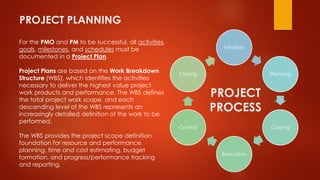
Initiation 
Planning 
Costing 
Execution 
Closing 
Control 
PROJECT 
PROCESS
COMMUNICATION MANAGEMENT 
Effective communications are a key 
factor in Project success. Project 
communications best 
practices include periodic Project 
Team meetings, regularly 
scheduled Client meetings and 
formal reviews and audits, and 
submission of regular (e.g., monthly) 
Cost and Schedule Status 
Reports (CSSRs). 
To facilitate communication among 
the Project Team members and 
timely service delivery to Clients, a 
PMO can employ a variety of 
collaboration tools. 
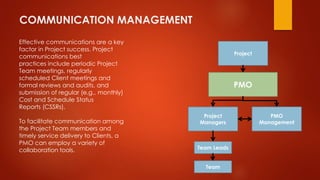
Project 
PMO 
Project 
Managers 
PMO 
Management 
Team Leads 
Team
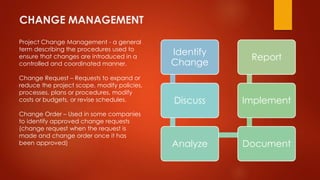
CHANGE MANAGEMENT 
Project Change Management - a general 
term describing the procedures used to 
ensure that changes are introduced in a 
controlled and coordinated manner. 
Change Request – Requests to expand or 
reduce the project scope, modify policies, 
processes, plans or procedures, modify 
costs or budgets, or revise schedules. 
Change Order – Used in some companies 
to identify approved change requests 
(change request when the request is 
made and change order once it has 
been approved) 
Identify 
Change 
Discuss 
Report 
Implement 
Analyze Document
QUALITY MANAGEMENT 
Quality Management is a less-emphasized function of the PMO. In large IT organizations, 
primary Quality guidance is provided by a centralized Quality function and actual 
implementation guidance by the PMO. For smaller IT organizations, the PMO. 
However, it is important that the PMO incorporate the Quality Management aspects into its 
guidance and governance systems, since process-orientation can bring in discipline and 
streamline all activities in the Programs/projects.
QUALITY MANAGEMENT 
The key responsibilities of a PMO for Quality Management include: 
• Setting up quality standards if none exists or tailoring organizational standards. 
• Provide guidance on defining acceptance criteria to measure successful completion of 
the project. 
• Provide guidance on setting up Program and project specific metrics for monitoring, 
tracking progress and quality. 
• Schedule, conduct and review Program and project audits to ensure they are following 
the guidance provided by the PMO. 
• These aspects can be detailed out in a Quality Management Plan. A well-structured QM 
Plan can help the Program/Project adhere to the accepted practices in their projects. In 
addition, the PMO may also provide. 
• Quality management support to projects through a dedicated team of people.
QUALITY MANAGEMENT 
A typical QM Plan will have the following Table of contents (sections): 
• Reference to organizational processes (if available) 
• List and reference to any adaptations to the organizational processes, templates and 
checklists 
• List and reference to program/project specific processes, templates and checklists 
• List and reference to all standards/guidelines (including technical, industry-specific 
regulations, domain etc.) 
• Release Reviews performed by the Quality function before any customer/production 
release. 
• Program/Project specific metrics and tolerances 
• Work product reviews that will be performed by people in the Quality function 
• Tools and techniques used for Quality activities 
• Defect prevention, causal analysis activities and techniques 
• Reports and Dashboards 
• Frequency and timing of project reviews and audits by the Quality function
QUALITY MANAGEMENT 
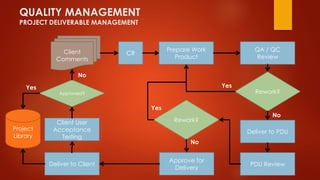
PROJECT DELIVERABLE MANAGEMENT 
Prepare Work 
Product 
QA / QC 
Review 
Rework? 
Deliver to PDU 
PDU Review 
Rework? 
Yes 
No 
Yes 
No 
Approve for 
Delivery 
Client 
Comments 
Approved? 
Client User 
Acceptance 
Testing 
Deliver to Client 
Project 
Library 
CR 
Yes 
No
RISK MANAGEMENT 
A risk is a possible future event that may affect 
your project either positively or negatively. 
Risk management is the systematic process of managing an 
organization's risk exposures to achieve its objectives in a manner 
consistent with public interest, human safety, environmental factors, 
and the law. It consists of the planning, organizing, leading, 
coordinating, and controlling activities undertaken with the intent of 
providing an efficient pre-loss plan that minimizes the adverse impact 
of risk on the organization's resources, earnings, and cash flows.
RISK MANAGEMENT 
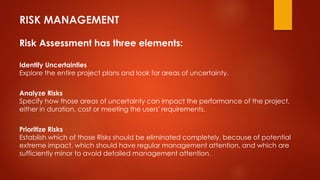
Risk Assessment has three elements: 
Identify Uncertainties 
Explore the entire project plans and look for areas of uncertainty. 
Analyze Risks 
Specify how those areas of uncertainty can impact the performance of the project, 
either in duration, cost or meeting the users' requirements. 
Prioritize Risks 
Establish which of those Risks should be eliminated completely, because of potential 
extreme impact, which should have regular management attention, and which are 
sufficiently minor to avoid detailed management attention.
RISK MANAGEMENT 
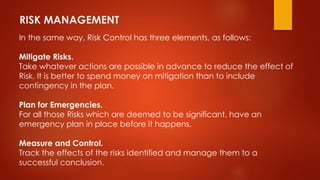
In the same way, Risk Control has three elements, as follows: 
Mitigate Risks. 
Take whatever actions are possible in advance to reduce the effect of 
Risk. It is better to spend money on mitigation than to include 
contingency in the plan. 
Plan for Emergencies. 
For all those Risks which are deemed to be significant, have an 
emergency plan in place before it happens. 
Measure and Control. 
Track the effects of the risks identified and manage them to a 
successful conclusion.
EARNED VALUE MANAGEMENT 
Earned Value Management (EVM) is a project management technique that objectively tracks 
physical accomplishment of work 
More Elaborately: 
• Earn Value Management (EVM) technique used to track the Progress and Status of a 
Project & Forecast the likely future performance of the Project. 
• EVM technique integrates the scope , schedule and cost of a project. 
• EVM technique answers a lot of questions to the stakeholders in a project related to the 
performance of the project. 
• EVM technique can be used to show past performance of the project, current 
performance of the project and predict the future performance of the project by use of 
statistical techniques. 
• Good planning coupled with effective use of the EVM technique will reduce a large 
amount of issues arising out of schedule and cost overruns.
. . . follow process and progress will follow.
DETERMINING 
THE PMO 
MATURITY LEVEL
LEVEL 1 
REACTIVE PROJECT MANAGEMENT – AD HOC 
Level 1 is the Reactive Project Management stage where methods are undocumented 
and delivery, budgets and schedules are uncontrolled. 
At this basic level, PMO need to establish methods for project scheduling, time tracking, 
resource assignments, project tracking, oversight & support and perhaps use an 
automated 
project dashboard to track project success. 
Key Identifications: 
• No formal Project Management Process exist across the organization.
LEVEL 2 
REPEATABLE PROCESS – CONSISTENT 
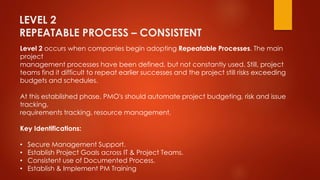
Level 2 occurs when companies begin adopting Repeatable Processes. The main 
project 
management processes have been defined, but not constantly used. Still, project 
teams find it difficult to repeat earlier successes and the project still risks exceeding 
budgets and schedules. 
At this established phase, PMO's should automate project budgeting, risk and issue 
tracking, 
requirements tracking, resource management. 
Key Identifications: 
• Secure Management Support. 
• Establish Project Goals across IT & Project Teams. 
• Consistent use of Documented Process. 
• Establish & Implement PM Training
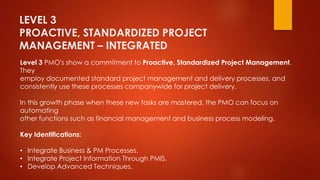
LEVEL 3 
PROACTIVE, STANDARDIZED PROJECT 
MANAGEMENT – INTEGRATED 
Level 3 PMO's show a commitment to Proactive, Standardized Project Management. 
They 
employ documented standard project management and delivery processes, and 
consistently use these processes companywide for project delivery. 
In this growth phase when these new tasks are mastered, the PMO can focus on 
automating 
other functions such as financial management and business process modeling. 
Key Identifications: 
• Integrate Business & PM Processes. 
• Integrate Project Information Through PMIS. 
• Develop Advanced Techniques.
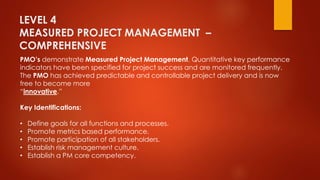
LEVEL 4 
MEASURED PROJECT MANAGEMENT – 
COMPREHENSIVE 
PMO’s demonstrate Measured Project Management. Quantitative key performance 
indicators have been specified for project success and are monitored frequently. 
The PMO has achieved predictable and controllable project delivery and is now 
free to become more 
“innovative.” 
Key Identifications: 
• Define goals for all functions and processes. 
• Promote metrics based performance. 
• Promote participation of all stakeholders. 
• Establish risk management culture. 
• Establish a PM core competency.
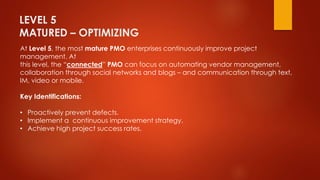
LEVEL 5 
MATURED – OPTIMIZING 
At Level 5, the most mature PMO enterprises continuously improve project 
management. At 
this level, the “connected” PMO can focus on automating vendor management, 
collaboration through social networks and blogs – and communication through text, 
IM, video or mobile. 
Key Identifications: 
• Proactively prevent defects. 
• Implement a continuous improvement strategy. 
• Achieve high project success rates.
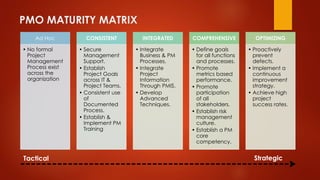
PMO MATURITY MATRIX 
Ad Hoc 
• No formal 
Project 
Management 
Process exist 
across the 
organization 
CONSISTENT 
• Secure 
Management 
Support. 
• Establish 
Project Goals 
across IT & 
Project Teams. 
• Consistent use 
of 
Documented 
Process. 
• Establish & 
Implement PM 
Training 
INTEGRATED 
• Integrate 
Business & PM 
Processes. 
• Integrate 
Project 
Information 
Through PMIS. 
• Develop 
Advanced 
Techniques. 
COMPREHENSIVE 
• Define goals 
for all functions 
and processes. 
• Promote 
metrics based 
performance. 
• Promote 
participation 
of all 
stakeholders. 
• Establish risk 
management 
culture. 
• Establish a PM 
core 
competency. 
OPTIMIZING 
• Proactively 
prevent 
defects. 
• Implement a 
continuous 
improvement 
strategy. 
• Achieve high 
project 
success rates. 
Tactical Strategic
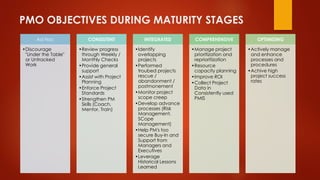
PMO OBJECTIVES DURING MATURITY STAGES 
Ad Hoc 
•Discourage 
"Under the Table" 
or Untracked 
Work 
CONSISTENT 
•Review progress 
through Weekly / 
Monthly Checks 
•Provide general 
support 
•Assist with Project 
Planning 
•Enforce Project 
Standards 
•Strengthen PM 
Skills (Coach, 
Mentor, Train) 
INTEGRATED 
•Identify 
overlapping 
projects 
•Performed 
troubed projects 
rescue / 
abandonment / 
postmonement 
•Monitor project 
scope creep 
•Develop advance 
processes (Risk 
Management, 
SCope 
Management) 
•Help PM's too 
secure Buy-In and 
Support from 
Managers and 
Executives 
•Leverage 
Historical Lessons 
Learned 
COMPREHENSIVE 
•Manage project 
prioritization and 
reprioritization 
•Resource 
capacity planning 
•Improve ROI 
•Collect Project 
Data in 
Consistently used 
PMIS 
OPTIMIZING 
•Actively manage 
and enhance 
processes and 
procedures 
•Achive high 
project success 
rates
We are what we repeatedly do. 
Excellence then, is not an act, but a habit.
Thank You

PMO (Project Management Office)

  • 1.
    PMO Project ManagementOffice DILAWAR ABBAS
  • 2.
  • 3.
    PMO MODEL Thereare two (2) standard Project Management Office (PMO) models: Administrative and Functional. The key difference between the two is “ownership” in terms of Accountability. The Administrative PMO is responsible for maintaining the approved policies, processes, and procedures commonly applied across all programs/projects, as well as the centralized Project Administration support necessary to ensure consistent implementation. A Functional PMO, on the other hand, is an organizational activity that assigns the Project Manager (PM) resources responsible for program/project cost, schedule, and technical/quality performance. It is important to note that a Functional PMO also performs all of the functions of an Administrative PMO, including assignment of a Project Administrator
  • 4.
    PRIMARY REASON FORIMPLEMENTING PMO Efficiency – making optimal use of available resources; Effectiveness – ensuring Project Management processes are delivered in a correct, consistent, and timely manner; and IT Governance – providing the leadership, organizational structure, regulations, standards and processes that ensure projects comply with best practices in accordance with the enterprise charter/mission, strategies, and business objectives Regardless of whether it follows an Administrative or Functional model, the PMO serves as a mechanism for satisfying six (6) standard process control objectives:
  • 5.
    SIX STANDARD PROCESSCONTROL OBJECTIVES Process Owner – designates an “owner” for each Project Management process so that performance responsibility is clear Process Repeatability – Project Management processes are defined and yield consistent process results/outcomes Clear Goals and Objectives – establishes clear goals and objectives for effective execution of each Project Management process Assigned Roles and Responsibilities – defines unambiguous roles, activities, and responsibilities for each Project Management process to ensure efficient execution Process Performance Evaluation – objectively measures the performance of each Project Management process against defined goals and objectives Approved Policy, Plans, and Procedures – documents, reviews, approves, and communicates to all stakeholders the applicable policy, plan, and procedure/work instructions that drive each Project Management process
  • 6.
    HOW PMO CANBE SUCCESSFUL
  • 7.
    PROJECT PLANNING Forthe PMO and PM to be successful, all activities, goals, milestones, and schedules must be documented in a Project Plan. Project Plans are based on the Work Breakdown Structure (WBS), which identifies the activities necessary to deliver the highest value project work products and performance. The WBS defines the total project work scope, and each descending level of the WBS represents an increasingly detailed definition of the work to be performed. The WBS provides the project scope definition foundation for resource and performance planning, time and cost estimating, budget formation, and progress/performance tracking and reporting. Initiation Planning Costing Execution Closing Control PROJECT PROCESS
  • 8.
    COMMUNICATION MANAGEMENT Effectivecommunications are a key factor in Project success. Project communications best practices include periodic Project Team meetings, regularly scheduled Client meetings and formal reviews and audits, and submission of regular (e.g., monthly) Cost and Schedule Status Reports (CSSRs). To facilitate communication among the Project Team members and timely service delivery to Clients, a PMO can employ a variety of collaboration tools. Project PMO Project Managers PMO Management Team Leads Team
  • 9.
    CHANGE MANAGEMENT ProjectChange Management - a general term describing the procedures used to ensure that changes are introduced in a controlled and coordinated manner. Change Request – Requests to expand or reduce the project scope, modify policies, processes, plans or procedures, modify costs or budgets, or revise schedules. Change Order – Used in some companies to identify approved change requests (change request when the request is made and change order once it has been approved) Identify Change Discuss Report Implement Analyze Document
  • 10.
    QUALITY MANAGEMENT QualityManagement is a less-emphasized function of the PMO. In large IT organizations, primary Quality guidance is provided by a centralized Quality function and actual implementation guidance by the PMO. For smaller IT organizations, the PMO. However, it is important that the PMO incorporate the Quality Management aspects into its guidance and governance systems, since process-orientation can bring in discipline and streamline all activities in the Programs/projects.
  • 11.
    QUALITY MANAGEMENT Thekey responsibilities of a PMO for Quality Management include: • Setting up quality standards if none exists or tailoring organizational standards. • Provide guidance on defining acceptance criteria to measure successful completion of the project. • Provide guidance on setting up Program and project specific metrics for monitoring, tracking progress and quality. • Schedule, conduct and review Program and project audits to ensure they are following the guidance provided by the PMO. • These aspects can be detailed out in a Quality Management Plan. A well-structured QM Plan can help the Program/Project adhere to the accepted practices in their projects. In addition, the PMO may also provide. • Quality management support to projects through a dedicated team of people.
  • 12.
    QUALITY MANAGEMENT Atypical QM Plan will have the following Table of contents (sections): • Reference to organizational processes (if available) • List and reference to any adaptations to the organizational processes, templates and checklists • List and reference to program/project specific processes, templates and checklists • List and reference to all standards/guidelines (including technical, industry-specific regulations, domain etc.) • Release Reviews performed by the Quality function before any customer/production release. • Program/Project specific metrics and tolerances • Work product reviews that will be performed by people in the Quality function • Tools and techniques used for Quality activities • Defect prevention, causal analysis activities and techniques • Reports and Dashboards • Frequency and timing of project reviews and audits by the Quality function
  • 13.
    QUALITY MANAGEMENT PROJECTDELIVERABLE MANAGEMENT Prepare Work Product QA / QC Review Rework? Deliver to PDU PDU Review Rework? Yes No Yes No Approve for Delivery Client Comments Approved? Client User Acceptance Testing Deliver to Client Project Library CR Yes No
  • 14.
    RISK MANAGEMENT Arisk is a possible future event that may affect your project either positively or negatively. Risk management is the systematic process of managing an organization's risk exposures to achieve its objectives in a manner consistent with public interest, human safety, environmental factors, and the law. It consists of the planning, organizing, leading, coordinating, and controlling activities undertaken with the intent of providing an efficient pre-loss plan that minimizes the adverse impact of risk on the organization's resources, earnings, and cash flows.
  • 15.
    RISK MANAGEMENT RiskAssessment has three elements: Identify Uncertainties Explore the entire project plans and look for areas of uncertainty. Analyze Risks Specify how those areas of uncertainty can impact the performance of the project, either in duration, cost or meeting the users' requirements. Prioritize Risks Establish which of those Risks should be eliminated completely, because of potential extreme impact, which should have regular management attention, and which are sufficiently minor to avoid detailed management attention.
  • 16.
    RISK MANAGEMENT Inthe same way, Risk Control has three elements, as follows: Mitigate Risks. Take whatever actions are possible in advance to reduce the effect of Risk. It is better to spend money on mitigation than to include contingency in the plan. Plan for Emergencies. For all those Risks which are deemed to be significant, have an emergency plan in place before it happens. Measure and Control. Track the effects of the risks identified and manage them to a successful conclusion.
  • 17.
    EARNED VALUE MANAGEMENT Earned Value Management (EVM) is a project management technique that objectively tracks physical accomplishment of work More Elaborately: • Earn Value Management (EVM) technique used to track the Progress and Status of a Project & Forecast the likely future performance of the Project. • EVM technique integrates the scope , schedule and cost of a project. • EVM technique answers a lot of questions to the stakeholders in a project related to the performance of the project. • EVM technique can be used to show past performance of the project, current performance of the project and predict the future performance of the project by use of statistical techniques. • Good planning coupled with effective use of the EVM technique will reduce a large amount of issues arising out of schedule and cost overruns.
  • 18.
    . . .follow process and progress will follow.
  • 19.
    DETERMINING THE PMO MATURITY LEVEL
  • 20.
    LEVEL 1 REACTIVEPROJECT MANAGEMENT – AD HOC Level 1 is the Reactive Project Management stage where methods are undocumented and delivery, budgets and schedules are uncontrolled. At this basic level, PMO need to establish methods for project scheduling, time tracking, resource assignments, project tracking, oversight & support and perhaps use an automated project dashboard to track project success. Key Identifications: • No formal Project Management Process exist across the organization.
  • 21.
    LEVEL 2 REPEATABLEPROCESS – CONSISTENT Level 2 occurs when companies begin adopting Repeatable Processes. The main project management processes have been defined, but not constantly used. Still, project teams find it difficult to repeat earlier successes and the project still risks exceeding budgets and schedules. At this established phase, PMO's should automate project budgeting, risk and issue tracking, requirements tracking, resource management. Key Identifications: • Secure Management Support. • Establish Project Goals across IT & Project Teams. • Consistent use of Documented Process. • Establish & Implement PM Training
  • 22.
    LEVEL 3 PROACTIVE,STANDARDIZED PROJECT MANAGEMENT – INTEGRATED Level 3 PMO's show a commitment to Proactive, Standardized Project Management. They employ documented standard project management and delivery processes, and consistently use these processes companywide for project delivery. In this growth phase when these new tasks are mastered, the PMO can focus on automating other functions such as financial management and business process modeling. Key Identifications: • Integrate Business & PM Processes. • Integrate Project Information Through PMIS. • Develop Advanced Techniques.
  • 23.
    LEVEL 4 MEASUREDPROJECT MANAGEMENT – COMPREHENSIVE PMO’s demonstrate Measured Project Management. Quantitative key performance indicators have been specified for project success and are monitored frequently. The PMO has achieved predictable and controllable project delivery and is now free to become more “innovative.” Key Identifications: • Define goals for all functions and processes. • Promote metrics based performance. • Promote participation of all stakeholders. • Establish risk management culture. • Establish a PM core competency.
  • 24.
    LEVEL 5 MATURED– OPTIMIZING At Level 5, the most mature PMO enterprises continuously improve project management. At this level, the “connected” PMO can focus on automating vendor management, collaboration through social networks and blogs – and communication through text, IM, video or mobile. Key Identifications: • Proactively prevent defects. • Implement a continuous improvement strategy. • Achieve high project success rates.
  • 25.
    PMO MATURITY MATRIX Ad Hoc • No formal Project Management Process exist across the organization CONSISTENT • Secure Management Support. • Establish Project Goals across IT & Project Teams. • Consistent use of Documented Process. • Establish & Implement PM Training INTEGRATED • Integrate Business & PM Processes. • Integrate Project Information Through PMIS. • Develop Advanced Techniques. COMPREHENSIVE • Define goals for all functions and processes. • Promote metrics based performance. • Promote participation of all stakeholders. • Establish risk management culture. • Establish a PM core competency. OPTIMIZING • Proactively prevent defects. • Implement a continuous improvement strategy. • Achieve high project success rates. Tactical Strategic
  • 26.
    PMO OBJECTIVES DURINGMATURITY STAGES Ad Hoc •Discourage "Under the Table" or Untracked Work CONSISTENT •Review progress through Weekly / Monthly Checks •Provide general support •Assist with Project Planning •Enforce Project Standards •Strengthen PM Skills (Coach, Mentor, Train) INTEGRATED •Identify overlapping projects •Performed troubed projects rescue / abandonment / postmonement •Monitor project scope creep •Develop advance processes (Risk Management, SCope Management) •Help PM's too secure Buy-In and Support from Managers and Executives •Leverage Historical Lessons Learned COMPREHENSIVE •Manage project prioritization and reprioritization •Resource capacity planning •Improve ROI •Collect Project Data in Consistently used PMIS OPTIMIZING •Actively manage and enhance processes and procedures •Achive high project success rates
  • 27.
    We are whatwe repeatedly do. Excellence then, is not an act, but a habit.
  • 28.