Project Server 2010 Demand Management (Part 3of 4)Tim Cermak, PMPManmeet Chaudhari, MVPAdvisicon, Inc.www.Advisicon.com
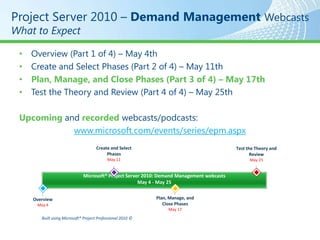
Create and Select PhasesMay 11Test the Theory and ReviewMay 25May 9, '10May 16, '10May 23, '10Microsoft® Project Server 2010: Demand Management webcastsMay 4 - May 25Plan, Manage, and Close PhasesMay 17OverviewMay 4Project Server 2010 – Demand Management WebcastsWhat to ExpectOverview (Part 1 of 4) – May 4thCreate and Select Phases (Part 2 of 4) – May 11thPlan, Manage, and Close Phases (Part 3 of 4) – May 17thTest the Theory and Review (Part 4 of 4) – May 25thUpcomingand recorded webcasts/podcasts:www.microsoft.com/events/series/epm.aspxBuilt using Microsoft® Project Professional 2010 ©
AgendaShort Recap
Introduction
Demand Management Plan
Demand Management Manage
Demand Management Close
Recap and Questions3
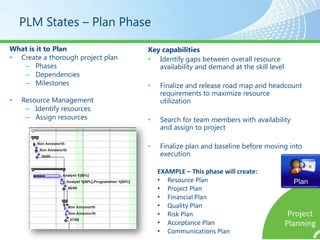
RecapProgram Management Lifecycle Demand Management Create Phase Demand Management Select Phase
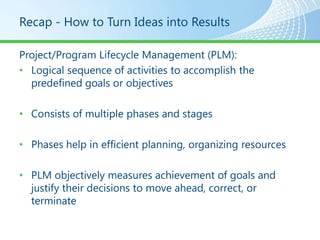
Recap - How to Turn Ideas into ResultsProject/Program Lifecycle Management (PLM):Logical sequence of activities to accomplish the predefined goals or objectivesConsists of multiple phases and stagesPhases help in efficient planning, organizing resources PLM objectively measures achievement of goals and justify their decisions to move ahead, correct, or terminate
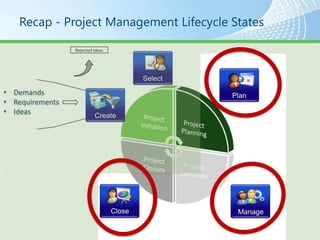
Recap - Project Management Lifecycle States Rejected IdeasDemands
Requirements
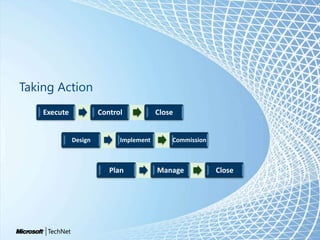
IdeasSelectManageCloseCreatePlan
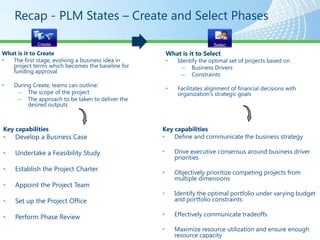
Recap - PLM States – Create and Select PhasesWhat is it to CreateThe first stage, evolving a business idea in project terms which becomes the baseline for funding approvalDuring Create, teams can outline:The scope of the project The approach to be taken to deliver the desired outputsWhat is it to SelectIdentify the optimal set of projects based onBusiness DriversConstraints Facilitates alignment of financial decisions with organization’s strategic goalsKey capabilitiesDevelop a Business Case Undertake a Feasibility Study Establish the Project Charter Appoint the Project Team Set up the Project Office Perform Phase Review Key capabilitiesDefine and communicate the business strategyDrive executive consensus around business driver prioritiesObjectively prioritize competing projects from multiple dimensionsIdentify the optimal portfolio under varying budget and portfolio constraintsEffectively communicate tradeoffs Maximize resource utilization and ensure enough resource capacitySelectCreate
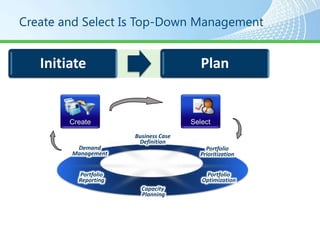
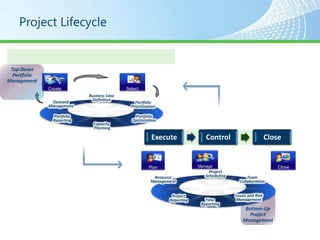
Create and Select Is Top-Down ManagementCreateSelectBusiness Case DefinitionDemand ManagementPortfolio PrioritizationPortfolio OptimizationPortfolio ReportingCapacity  Planning
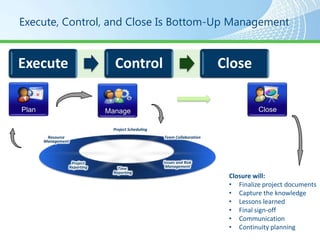
Execute, Control, and Close Is Bottom-Up ManagementCloseManagePlanProject SchedulingClosure will:Finalize project documents
Capture the knowledge
Lessons learned
Final sign-off
Communication
Continuity planningTeam CollaborationResource ManagementIssues and Risk ManagementProject ReportingTime Reporting
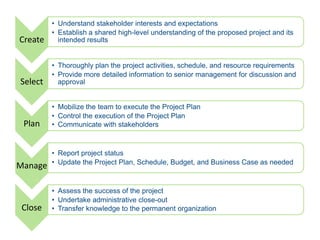
Project LifecycleTop-DownPortfolio ManagementBottom-Up Project ManagementCreateSelectManageClosePlanBusiness Case DefinitionProject SchedulingDemand ManagementTeam CollaborationResource ManagementPortfolio PrioritizationPortfolio OptimizationPortfolio ReportingIssues and Risk ManagementProject ReportingTime ReportingCapacity  Planning

Tn 100517 T Cermak Rev2

  • 1.
    Project Server 2010Demand Management (Part 3of 4)Tim Cermak, PMPManmeet Chaudhari, MVPAdvisicon, Inc.www.Advisicon.com
  • 2.
    Create and SelectPhasesMay 11Test the Theory and ReviewMay 25May 9, '10May 16, '10May 23, '10Microsoft® Project Server 2010: Demand Management webcastsMay 4 - May 25Plan, Manage, and Close PhasesMay 17OverviewMay 4Project Server 2010 – Demand Management WebcastsWhat to ExpectOverview (Part 1 of 4) – May 4thCreate and Select Phases (Part 2 of 4) – May 11thPlan, Manage, and Close Phases (Part 3 of 4) – May 17thTest the Theory and Review (Part 4 of 4) – May 25thUpcomingand recorded webcasts/podcasts:www.microsoft.com/events/series/epm.aspxBuilt using Microsoft® Project Professional 2010 ©
  • 3.
  • 4.
  • 5.
  • 6.
  • 7.
  • 8.
  • 9.
    RecapProgram Management LifecycleDemand Management Create Phase Demand Management Select Phase
  • 10.
    Recap - Howto Turn Ideas into ResultsProject/Program Lifecycle Management (PLM):Logical sequence of activities to accomplish the predefined goals or objectivesConsists of multiple phases and stagesPhases help in efficient planning, organizing resources PLM objectively measures achievement of goals and justify their decisions to move ahead, correct, or terminate
  • 11.
    Recap - ProjectManagement Lifecycle States Rejected IdeasDemands
  • 12.
  • 13.
  • 14.
    Recap - PLMStates – Create and Select PhasesWhat is it to CreateThe first stage, evolving a business idea in project terms which becomes the baseline for funding approvalDuring Create, teams can outline:The scope of the project The approach to be taken to deliver the desired outputsWhat is it to SelectIdentify the optimal set of projects based onBusiness DriversConstraints Facilitates alignment of financial decisions with organization’s strategic goalsKey capabilitiesDevelop a Business Case Undertake a Feasibility Study Establish the Project Charter Appoint the Project Team Set up the Project Office Perform Phase Review Key capabilitiesDefine and communicate the business strategyDrive executive consensus around business driver prioritiesObjectively prioritize competing projects from multiple dimensionsIdentify the optimal portfolio under varying budget and portfolio constraintsEffectively communicate tradeoffs Maximize resource utilization and ensure enough resource capacitySelectCreate
  • 15.
    Create and SelectIs Top-Down ManagementCreateSelectBusiness Case DefinitionDemand ManagementPortfolio PrioritizationPortfolio OptimizationPortfolio ReportingCapacity Planning
  • 16.
    Execute, Control, andClose Is Bottom-Up ManagementCloseManagePlanProject SchedulingClosure will:Finalize project documents
  • 17.
  • 18.
  • 19.
  • 20.
  • 21.
    Continuity planningTeam CollaborationResourceManagementIssues and Risk ManagementProject ReportingTime Reporting
  • 22.
    Project LifecycleTop-DownPortfolio ManagementBottom-UpProject ManagementCreateSelectManageClosePlanBusiness Case DefinitionProject SchedulingDemand ManagementTeam CollaborationResource ManagementPortfolio PrioritizationPortfolio OptimizationPortfolio ReportingIssues and Risk ManagementProject ReportingTime ReportingCapacity Planning

Editor's Notes

  • #8 Capture all requests, from work orders to discretionary projects Standardize metrics, valuation criteria and templates Control investment through governance workflow
  • #14 Create the caseAnalyses and determine best scenarioEnsures project/initiative aligns with the strategic objectivesFeasibility of support (Sponsor/Stakeholders)Financial and organizational benefitsPresent business caseThe proposal and supporting justification for doing a project, delivered to upper management in the form of a presentation and supporting written report. The complete Business Case is made up of the following 2 deliverables:· Business Case Report · Business Case Presentation See the definitions of these two deliverables for the detailed content description of the Business Case.Tips and TricksWhen you are developing the business case, the first step is to make sure that the deliverables of the initiative are actually aligned to the strategic business objectives.  If they aren’t, then your business case will be dead in the water before you even start to build it.  Use the following questions as a high-level guide to help to determine if there is alignment between the initiative and the business objectives.  Define the Initiative What is it you actually want to create or accomplish?  Is it a project? A program? An operational upgrade?  Evaluate the problemWhat is the objective?  What are the requirements? What is the strategy of how the business case will be developed? Define the Scope and Boundaries What is the time period for it? Who will be affected? What are the included and excluded costs? What is the scope of the analysis? At this early stage, if you are unable to answer any of these questions at the high level, you may need to take more time to research the initiative.  The more clearly and simply you are able to answer these questions, the greater the likelihood of the success of the business case.  
  • #16 Create the caseAnalyses and determine best scenarioEnsures project/initiative aligns with the strategic objectivesFeasibility of support (Sponsor/Stakeholders)Financial and organizational benefitsPresent business caseThe proposal and supporting justification for doing a project, delivered to upper management in the form of a presentation and supporting written report. The complete Business Case is made up of the following 2 deliverables:· Business Case Report · Business Case Presentation See the definitions of these two deliverables for the detailed content description of the Business Case.Tips and TricksWhen you are developing the business case, the first step is to make sure that the deliverables of the initiative are actually aligned to the strategic business objectives.  If they aren’t, then your business case will be dead in the water before you even start to build it.  Use the following questions as a high-level guide to help to determine if there is alignment between the initiative and the business objectives.  Define the Initiative What is it you actually want to create or accomplish?  Is it a project? A program? An operational upgrade?  Evaluate the problemWhat is the objective?  What are the requirements? What is the strategy of how the business case will be developed? Define the Scope and Boundaries What is the time period for it? Who will be affected? What are the included and excluded costs? What is the scope of the analysis? At this early stage, if you are unable to answer any of these questions at the high level, you may need to take more time to research the initiative.  The more clearly and simply you are able to answer these questions, the greater the likelihood of the success of the business case.