Business Case for eLearning Michael Gwyther
Do you use eLearning currently? A  No B  Yes – self paced learning C  Yes – Blended Learning D  Yes – Fully online and facilitated
Do you have a vision of how  eLearnng  can work at your organisation? A  No –  eLearnng  is a mystery to me B  Yes
Critical issues Determining your “brand” of  eLearnng Identity opportunities from existing/proposed training Demonstrate value  Aligning to strategic plan, vision, goals Audit current capacity and staff commitment to change Champions Management commitment
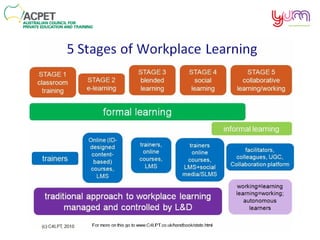
State of Play Totally online courses Blended solutions with a mix of face-to-face and online elements  Learning management systems that manage students' learning Web conferencing systems, which support the delivery of scheduled online sessions  Informal learning using social networking Skills recognition portals to shape individual learning plans and training
 
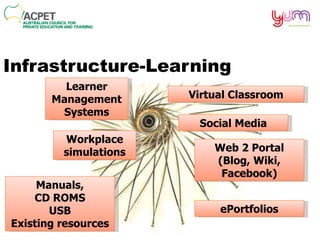
Infrastructure-Learning Learner Management Systems Virtual Classroom Web 2 Portal (Blog, Wiki, Facebook) Manuals, CD ROMS USB Existing resources ePortfolios Workplace simulations Social Media
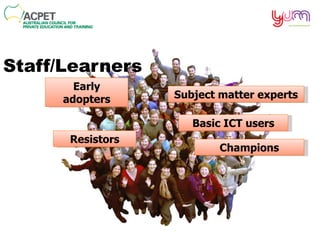
Staff/Learners Early adopters Subject matter experts Champions Resistors Basic ICT users
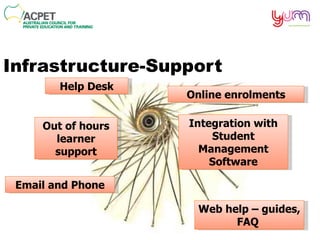
Infrastructure-Support Help Desk Online enrolments Email and Phone Web help – guides, FAQ  Out of hours learner support Integration with Student Management Software
Maturity Studies (UK) identified where learning technologies were adding business value and reports findings in 8 themes: 1. Time Saving 2. Productivity Gains 3. Staff Benefit 4. Business Impact 5. Tangible quality improvement for learning 6. Impact of Social Learning 7. Green Issues 8. Cost Savings http://www.towardsmaturity.org /
Maturity Six strands of implementation behavior are more likely to be seen in organisations that are more mature in their use of learning technologies.
Maturity 6 strands which collectively entwine to help deliver a successful e-learning implementation.  Defining Need Learner context Work context Building capability Ensuring engagement Demonstrating value
Failure 33 reasons why eLearnng fails No Defined Business Purpose Lack of Hybrid Skills for Learning Professionals Poor Project Management and Planning Poor Stakeholder Management Failure to understand the Learner’s environment Failure to demonstrate value  http://www.towardsmaturity.org/article/2010/03/30/33-reasons-why-elearning-projects-fail/
Preventing Failure Before embarking on an eLearning-learning project: 1. learn from other projects (both successes and failures;) 2. audit their own and their organisation’s capabilities; and 3. challenge your organisation/clients to document as to why eLearning-learning is required http://www.towardsmaturity.org/article/2010/03/30/33-reasons-why-elearning-projects-fail/
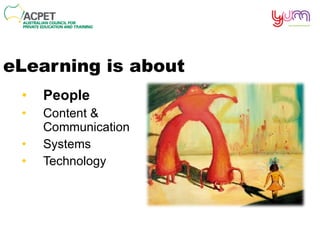
eLearning is about People Content &  Communication Systems Technology
Task – Business Case E Learning Strategic Plan Executive Summary Description of Initiative What will be developed Options, Risks & Budget Implementation Staffing and Responsibilities
What will be developed? Content Facilitation Communication and support Assessment Group based Industry
BC – Executive Summary Summarise the overall business case : What are you planning to do & Why are you doing it? How business /training  need is  currently  met Why the proposed eLearning solution will be a good alternative A dvantages of the recommended strategy. Identify links between benefits, what you will deliver and benchmarks used to measure success
Why good alternative? Advantages of  the recommended strategy
BC – Description of Initiative Clearly define your initiative Reason for Initiative – Business Reason Ensure proposal has some fit with your organisations strategic planning Intended market and target audience (capabilities) What eLearning in sector – Why more? Staff involved
BC – Options and Benefits What are the benefits How can they be measured Can you achieve/sustain within a budget SWOT Stakeholders – Capabilities Competitors – what are they doing? Repercussions
BC – Costs Staff Marketing Delivery Travel Consultants Content Infrastructure * Training
BC – Risk Strategy Document Risks Document likelihood of occurring Document impact on project if occurs Document how contain risk should it occur
BC – Implementation Define Roles Define Tasks Define Milestones  (Tasks, Dates, Accountability)
BC – Implementation Define Project & Team Roles Define Training Outcomes Outline Content Storyboarding Development of learning content Usability Testing/Sign Off/Approval Pilot Edits Implement
Questions Michael Gwyther [email_address]

Business Case for eLearning

  • 1.
    Business Case foreLearning Michael Gwyther
  • 2.
    Do you useeLearning currently? A No B Yes – self paced learning C Yes – Blended Learning D Yes – Fully online and facilitated
  • 3.
    Do you havea vision of how eLearnng can work at your organisation? A No – eLearnng is a mystery to me B Yes
  • 4.
    Critical issues Determiningyour “brand” of eLearnng Identity opportunities from existing/proposed training Demonstrate value Aligning to strategic plan, vision, goals Audit current capacity and staff commitment to change Champions Management commitment
  • 5.
    State of PlayTotally online courses Blended solutions with a mix of face-to-face and online elements Learning management systems that manage students' learning Web conferencing systems, which support the delivery of scheduled online sessions Informal learning using social networking Skills recognition portals to shape individual learning plans and training
  • 6.
  • 7.
    Infrastructure-Learning Learner ManagementSystems Virtual Classroom Web 2 Portal (Blog, Wiki, Facebook) Manuals, CD ROMS USB Existing resources ePortfolios Workplace simulations Social Media
  • 8.
    Staff/Learners Early adoptersSubject matter experts Champions Resistors Basic ICT users
  • 9.
    Infrastructure-Support Help DeskOnline enrolments Email and Phone Web help – guides, FAQ Out of hours learner support Integration with Student Management Software
  • 10.
    Maturity Studies (UK)identified where learning technologies were adding business value and reports findings in 8 themes: 1. Time Saving 2. Productivity Gains 3. Staff Benefit 4. Business Impact 5. Tangible quality improvement for learning 6. Impact of Social Learning 7. Green Issues 8. Cost Savings http://www.towardsmaturity.org /
  • 11.
    Maturity Six strandsof implementation behavior are more likely to be seen in organisations that are more mature in their use of learning technologies.
  • 12.
    Maturity 6 strandswhich collectively entwine to help deliver a successful e-learning implementation. Defining Need Learner context Work context Building capability Ensuring engagement Demonstrating value
  • 13.
    Failure 33 reasonswhy eLearnng fails No Defined Business Purpose Lack of Hybrid Skills for Learning Professionals Poor Project Management and Planning Poor Stakeholder Management Failure to understand the Learner’s environment Failure to demonstrate value http://www.towardsmaturity.org/article/2010/03/30/33-reasons-why-elearning-projects-fail/
  • 14.
    Preventing Failure Beforeembarking on an eLearning-learning project: 1. learn from other projects (both successes and failures;) 2. audit their own and their organisation’s capabilities; and 3. challenge your organisation/clients to document as to why eLearning-learning is required http://www.towardsmaturity.org/article/2010/03/30/33-reasons-why-elearning-projects-fail/
  • 15.
    eLearning is aboutPeople Content & Communication Systems Technology
  • 16.
    Task – BusinessCase E Learning Strategic Plan Executive Summary Description of Initiative What will be developed Options, Risks & Budget Implementation Staffing and Responsibilities
  • 17.
    What will bedeveloped? Content Facilitation Communication and support Assessment Group based Industry
  • 18.
    BC – ExecutiveSummary Summarise the overall business case : What are you planning to do & Why are you doing it? How business /training need is currently met Why the proposed eLearning solution will be a good alternative A dvantages of the recommended strategy. Identify links between benefits, what you will deliver and benchmarks used to measure success
  • 19.
    Why good alternative?Advantages of the recommended strategy
  • 20.
    BC – Descriptionof Initiative Clearly define your initiative Reason for Initiative – Business Reason Ensure proposal has some fit with your organisations strategic planning Intended market and target audience (capabilities) What eLearning in sector – Why more? Staff involved
  • 21.
    BC – Optionsand Benefits What are the benefits How can they be measured Can you achieve/sustain within a budget SWOT Stakeholders – Capabilities Competitors – what are they doing? Repercussions
  • 22.
    BC – CostsStaff Marketing Delivery Travel Consultants Content Infrastructure * Training
  • 23.
    BC – RiskStrategy Document Risks Document likelihood of occurring Document impact on project if occurs Document how contain risk should it occur
  • 24.
    BC – ImplementationDefine Roles Define Tasks Define Milestones (Tasks, Dates, Accountability)
  • 25.
    BC – ImplementationDefine Project & Team Roles Define Training Outcomes Outline Content Storyboarding Development of learning content Usability Testing/Sign Off/Approval Pilot Edits Implement
  • 26.

Editor's Notes