Fayol’s General Principles of
Management
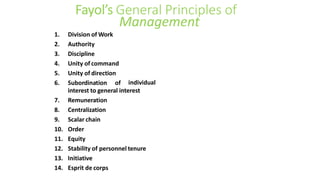
1. Division of Work
2. Authority
3. Discipline
4. Unity of command
5. Unity of direction
6. Subordination of individual
interest to general interest
7. Remuneration
8. Centralization
9. Scalar chain
10. Order
11. Equity
12. Stability of personnel tenure
13. Initiative
14. Esprit de corps
Production Planning and
Control
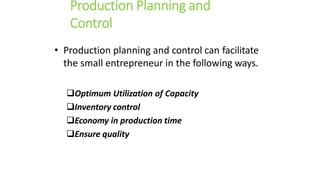
• Production planning and control can facilitate
the small entrepreneur in the following ways.
Optimum Utilization of Capacity
Inventory control
Economy in production time
Ensure quality
Steps of Production Planning and Control
Production Planning and Control
Production Control
ProductionPlanning
Dispatching
Followingup
Inspection
Corrective
Measures
Planning
Routing
Scheduling
Loading
• Aggregate Planning: The objective of aggregate
planning is to find out the most economical
method of using production resources to meet
fluctuating demands of production output
• Routing: Routing procedure involves following
different activities.
1.The operations to be carried out on a job.
2. The machine or work centre to be used.
3. The details of operations to be performed.
4.The sequence of operations from raw
material to finished product.
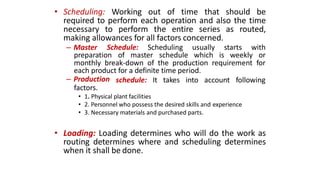
• Scheduling: Working out of time that should be
required to perform each operation and also the time
necessary to perform the entire series as routed,
making allowances for all factors concerned.
– Master Schedule: Scheduling usually starts with
preparation of master schedule which is weekly or
monthly break-down of the production requirement for
each product for a definite time period.
schedule: It takes into account following– Production
factors.
• 1. Physical plant facilities
• 2. Personnel who possess the desired skills and experience
• 3. Necessary materials and purchased parts.
• Loading: Loading determines who will do the work as
routing determines where and scheduling determines
when it shall be done.
Production Control
Dispatching: Dispatching involves issue of
production orders for starting the operations.
Necessary authority and conformation is given
for:
1.Movement of materials to different workstations.
2. Movement of tools and fixtures necessary for each
operation.
3. Beginning of work on each operation.
4.Recording of time and cost involved in each operation.
5.Movement of work from one operation to another in
accordance with the route sheet.
6. Inspecting or supervision of work.
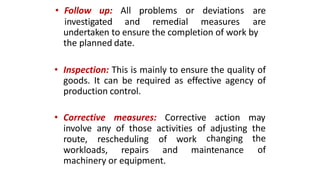
• Follow up: All problems or deviations are
investigated and remedial measures are
undertaken to ensure the completion of work by
the planned date.
• Inspection: This is mainly to ensure the quality of
goods. It can be required as effective agency of
production control.
• Corrective measures: Corrective action may
involve any of those activities of adjusting the
route, rescheduling of work
maintenance
changing the
ofworkloads, repairs and
machinery or equipment.
SPECIFICATION OF PRODUCTION
REQUIREMENT1.Part Drawing
(Production
Drawing)
2.Machining Detailed
and Sequences
3.Materials &
components
4.Quality level
required
ction Quantity514-0.3-2P01r0o0:4d4:0u0
WORK STUDY
• Work Study implies the study of human work.
Work study investigates the work done in
organization and it aims at finding the best
and most efficient way of using available
resources men, material, machine and money.
Work Study & ProductivWORK STUDY
METHOD STUDY WORK MEASUREMENT
Choose & evaluate
one best standard
Method
Choose and evaluate
one best standard
time
Standard Time & Standard Method
Rise in Productivity
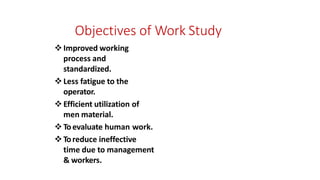
Objectives of Work Study
Improved working
process and
standardized.
Less fatigue to the
operator.
Efficient utilization of
men material.
Toevaluate human work.
Toreduce ineffective
time due to management
& workers.
Benefits of Work Study Improved Productivity.
 Higher efficiency in
productivity.
 Manufacturing cost is
reduced.
 Quicker and accurate
delivery dates.
 Good employee-
employer relationship.
 Job satisfaction to
workers.
 Higher wages and
incentives to workers.
Method Study or (Motion Study)
• Method study is systematic recording and
critical examination of existing and proposed
ways of doing work, as a means of developing
and applying easier and more effective
methods and reducing costs.
Objectives of Method StudyThe improvement of process
and procedures.
The improvement of factory,
shop and workplace layout
and of the design of plant and
equipment.
Economy in human efforts
and reduction of unnecessary
fatigue.
in use of
machines &
Improvement
materials,
manpower
To find out the best way of
doing a job.
To standardize the best
method.
Effective material handling
MethodStudy
Select the subject to be studied
Record facts relating to existing method
Examine all relevant facts critically
Develop alternative to existing methods
Install the newmethod
Plan-arrange-implement
Maintain new method
Verify its implications at regular intervals
Diagram Charts Model
Purpose Place Sequence Person Means
HigherProductivity
Work Measurement
• Work measurement is concerned with
andelimination of ineffective time
establishment of time standards for a job.
• “Work measurement is a technique to
establish the time for a qualified worker to
carryout a specified job at a definite level of
performance.”
Uses of Work Measurement1. Toreveal the existence of ineffective time.
2. To compare the efficiency of alternative
method.
3. To determine with the help of man machine
chart the number of machine an operator
can run.
4. To set the time standard for carrying out the
work.
5. As a basis for realistic and fair incentive
scheme.
Time Study
• Time study is a work measurement technique
for recording the times performing a certain
specific job or its elements carried out under
specified conditions, and for analyzing the
data so as to obtain the time necessary for an
operator to carry it out at a defined rate of
performance.
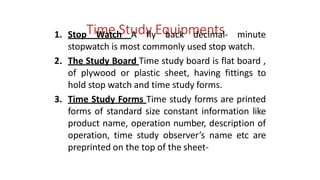
Time Study Equipments1. Stop Watch A fly back decimal- minute
stopwatch is most commonly used stop watch.
2. The Study Board Time study board is flat board ,
of plywood or plastic sheet, having fittings to
hold stop watch and time study forms.
3. Time Study Forms Time study forms are printed
forms of standard size constant information like
product name, operation number, description of
operation, time study observer’s name etc are
preprinted on the top of the sheet-
Time Study Form
Time Study Form
Product-------- Time Study -------------
Operation No----------- Observer
Description of Operation -------------------- Date-------------------
No. of Cycles 5(say)
Standard time found------
Element Description Observed time Average
observed Time
Rating
factor
Normal
Time
All Std.
Time
1 2 3 4 5
Procedure for Collecting Time Study Data
• The following are the procedural steps in stop Watch time study:-
1. Identify the operation to be studied
1. Obtain the improved procedure from method study departments.
2. Collect and check necessary equipment
3. Select the worker to be observed for Time Study
4. Explain the worker the objective of Time Study
5. Explain the worker the improved procedure.
6. Break the operation into small elements.
7. Determine the number of observations to be timed for each element.
8. Conduct the observation and record them on time study form
9. Rate also the performance of the worker during step.
10. Calculate normal time from observed time by using performance
rating factor Observed time X Rating factor
Normal time=
100
13. Add process allowance, rest and personal allowance and special allowances to normal time
in order to obtain standard time.
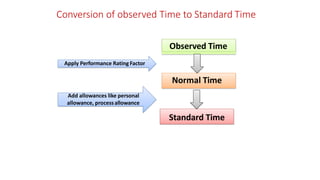
Conversion of observed Time to Standard Time
Observed Time
Normal Time
Standard Time
Apply Performance Rating Factor
Add allowances like personal
allowance, processallowance
Advantages of Time Study
1.Standard labour cost per unit of product can
be calculated.
2.Comparisons of actual and standard
production.
3.Enable further improvement in work
methods, training necessity and better
workplace layout.
Limitations of Time Study
1.Not suitable for non- repetitive jobs.
2.Not suitable for highly automated work place
3.May affect operator’s morale if output
standard is not attained.
4. While rating a worker error may come due to
subjectivity involved in it.
Thank You

Management tools

  • 1.
    Fayol’s General Principlesof Management 1. Division of Work 2. Authority 3. Discipline 4. Unity of command 5. Unity of direction 6. Subordination of individual interest to general interest 7. Remuneration 8. Centralization 9. Scalar chain 10. Order 11. Equity 12. Stability of personnel tenure 13. Initiative 14. Esprit de corps
  • 2.
    Production Planning and Control •Production planning and control can facilitate the small entrepreneur in the following ways. Optimum Utilization of Capacity Inventory control Economy in production time Ensure quality
  • 3.
    Steps of ProductionPlanning and Control Production Planning and Control Production Control ProductionPlanning Dispatching Followingup Inspection Corrective Measures Planning Routing Scheduling Loading
  • 4.
    • Aggregate Planning:The objective of aggregate planning is to find out the most economical method of using production resources to meet fluctuating demands of production output • Routing: Routing procedure involves following different activities. 1.The operations to be carried out on a job. 2. The machine or work centre to be used. 3. The details of operations to be performed. 4.The sequence of operations from raw material to finished product.
  • 5.
    • Scheduling: Workingout of time that should be required to perform each operation and also the time necessary to perform the entire series as routed, making allowances for all factors concerned. – Master Schedule: Scheduling usually starts with preparation of master schedule which is weekly or monthly break-down of the production requirement for each product for a definite time period. schedule: It takes into account following– Production factors. • 1. Physical plant facilities • 2. Personnel who possess the desired skills and experience • 3. Necessary materials and purchased parts. • Loading: Loading determines who will do the work as routing determines where and scheduling determines when it shall be done.
  • 6.
    Production Control Dispatching: Dispatchinginvolves issue of production orders for starting the operations. Necessary authority and conformation is given for: 1.Movement of materials to different workstations. 2. Movement of tools and fixtures necessary for each operation. 3. Beginning of work on each operation. 4.Recording of time and cost involved in each operation. 5.Movement of work from one operation to another in accordance with the route sheet. 6. Inspecting or supervision of work.
  • 7.
    • Follow up:All problems or deviations are investigated and remedial measures are undertaken to ensure the completion of work by the planned date. • Inspection: This is mainly to ensure the quality of goods. It can be required as effective agency of production control. • Corrective measures: Corrective action may involve any of those activities of adjusting the route, rescheduling of work maintenance changing the ofworkloads, repairs and machinery or equipment.
  • 8.
    SPECIFICATION OF PRODUCTION REQUIREMENT1.PartDrawing (Production Drawing) 2.Machining Detailed and Sequences 3.Materials & components 4.Quality level required ction Quantity514-0.3-2P01r0o0:4d4:0u0
  • 9.
    WORK STUDY • WorkStudy implies the study of human work. Work study investigates the work done in organization and it aims at finding the best and most efficient way of using available resources men, material, machine and money.
  • 10.
    Work Study &ProductivWORK STUDY METHOD STUDY WORK MEASUREMENT Choose & evaluate one best standard Method Choose and evaluate one best standard time Standard Time & Standard Method Rise in Productivity
  • 11.
    Objectives of WorkStudy Improved working process and standardized. Less fatigue to the operator. Efficient utilization of men material. Toevaluate human work. Toreduce ineffective time due to management & workers.
  • 12.
    Benefits of WorkStudy Improved Productivity.  Higher efficiency in productivity.  Manufacturing cost is reduced.  Quicker and accurate delivery dates.  Good employee- employer relationship.  Job satisfaction to workers.  Higher wages and incentives to workers.
  • 13.
    Method Study or(Motion Study) • Method study is systematic recording and critical examination of existing and proposed ways of doing work, as a means of developing and applying easier and more effective methods and reducing costs.
  • 14.
    Objectives of MethodStudyThe improvement of process and procedures. The improvement of factory, shop and workplace layout and of the design of plant and equipment. Economy in human efforts and reduction of unnecessary fatigue. in use of machines & Improvement materials, manpower To find out the best way of doing a job. To standardize the best method. Effective material handling
  • 15.
    MethodStudy Select the subjectto be studied Record facts relating to existing method Examine all relevant facts critically Develop alternative to existing methods Install the newmethod Plan-arrange-implement Maintain new method Verify its implications at regular intervals Diagram Charts Model Purpose Place Sequence Person Means HigherProductivity
  • 16.
    Work Measurement • Workmeasurement is concerned with andelimination of ineffective time establishment of time standards for a job. • “Work measurement is a technique to establish the time for a qualified worker to carryout a specified job at a definite level of performance.”
  • 17.
    Uses of WorkMeasurement1. Toreveal the existence of ineffective time. 2. To compare the efficiency of alternative method. 3. To determine with the help of man machine chart the number of machine an operator can run. 4. To set the time standard for carrying out the work. 5. As a basis for realistic and fair incentive scheme.
  • 18.
    Time Study • Timestudy is a work measurement technique for recording the times performing a certain specific job or its elements carried out under specified conditions, and for analyzing the data so as to obtain the time necessary for an operator to carry it out at a defined rate of performance.
  • 19.
    Time Study Equipments1.Stop Watch A fly back decimal- minute stopwatch is most commonly used stop watch. 2. The Study Board Time study board is flat board , of plywood or plastic sheet, having fittings to hold stop watch and time study forms. 3. Time Study Forms Time study forms are printed forms of standard size constant information like product name, operation number, description of operation, time study observer’s name etc are preprinted on the top of the sheet-
  • 20.
    Time Study Form TimeStudy Form Product-------- Time Study ------------- Operation No----------- Observer Description of Operation -------------------- Date------------------- No. of Cycles 5(say) Standard time found------ Element Description Observed time Average observed Time Rating factor Normal Time All Std. Time 1 2 3 4 5
  • 21.
    Procedure for CollectingTime Study Data • The following are the procedural steps in stop Watch time study:- 1. Identify the operation to be studied 1. Obtain the improved procedure from method study departments. 2. Collect and check necessary equipment 3. Select the worker to be observed for Time Study 4. Explain the worker the objective of Time Study 5. Explain the worker the improved procedure. 6. Break the operation into small elements. 7. Determine the number of observations to be timed for each element. 8. Conduct the observation and record them on time study form 9. Rate also the performance of the worker during step. 10. Calculate normal time from observed time by using performance rating factor Observed time X Rating factor Normal time= 100 13. Add process allowance, rest and personal allowance and special allowances to normal time in order to obtain standard time.
  • 22.
    Conversion of observedTime to Standard Time Observed Time Normal Time Standard Time Apply Performance Rating Factor Add allowances like personal allowance, processallowance
  • 23.
    Advantages of TimeStudy 1.Standard labour cost per unit of product can be calculated. 2.Comparisons of actual and standard production. 3.Enable further improvement in work methods, training necessity and better workplace layout.
  • 24.
    Limitations of TimeStudy 1.Not suitable for non- repetitive jobs. 2.Not suitable for highly automated work place 3.May affect operator’s morale if output standard is not attained. 4. While rating a worker error may come due to subjectivity involved in it.
  • 25.