Inventory
Control
Production,
Planning & Control
Plant Layout&
Material Handling
Work Study
CPM&PERT
System Engg.
Value Engg.
Operation Research
Cybermatics
Industrial
Engineering
◦ ILO defines: A Generic term for those techniques
particularly ‘Method Study’ and ‘Work Measurement’
which are used in examination of human work in all
its context and which lead systematically to the
investigation of all the factors which affect the
efficiency and economy of the situation being
reviewed in order to effect improvement.
Method Study
To simplify the job and
develop more
economical methods
of doing it
Work Measurement
To determine how long
It should take to carry out
Work
Study
J
O
B
J
O
B
With
Higher
Productivity
Emerged in 1881
Detailed Analysis for use and cost of the
resources of Organization.
Concerned with Productivity.
Productivity is Measure of Performance.
Applies W.S. for increased Productivity.
Frederick W.Taylor – Father of modern
industrial Engineering
Scientific Management and Work Measurement
(1881)
Work of each person should be planned one
day in advance
Definite work to be allotted.
Pre-explained method to be adopted.
Time to be fixed to complete the job
Training is required.
Branch of Industrial engineering
Combination of 2 Techniques
Method study, Work measurement
Generic term for -Method Study and work
measurement, which are used in the
examination of human work in all its
contexts, and which leads systematically to
the investigation of all the factors which
affect the efficiency and economy of the
situation being reviewed, in order to effect
improvement.
Uniform ,improved production flow
Higher productive efficiency
Reduced manufacturing costs
Fast , accurate delivery dates
Better employee-employer relations
Better service to customers
Job security and satisfaction
Better working conditions
Higher wagews
Systematic Recording and Critical
Examination of Existing and Proposed ways of
doing a work, as a means of developing and
applying easier and more effective methods
and reducing costs.
Improved working processes
Better work place layout
Less fatigue to workers
Better product quality
Effective utilization of resources
Efficient, fast material handling
Reduced health hazards
Efficient planning of section
Streamlined working proceedures.
Application of Techniques Designed to
establish the Time for a Qualified Worker
to carry out a specified job at a defined level
of performance.
Determines time required, establishes fastest
method;
Determines man power required for a job;
Decides equipments;
Provides information for effective production
planning;
Aids in calculating exact delivery dates;
Decides realistic labour budgeting;
Provides a basis for sound incentive scheme;
Results in effective labour control.
METHOD STUDY
METHOD STUDY
METHOD STUDY
METHOD STUDY
1. Select.
2. Record.
3. Examine Critically.
4. Develop.
5. Install.
6. Maintain.
Economic factor.
Technical factor.
Human Reactions
Charts
Charts
Charts
Charts a) out line process b) flow process
charts (man, material, equipment) c) two
handed d) multiple activity e) travel
Diagrams
Diagrams
Diagrams
Diagrams a) flow b) string
Motion and film analysis
Motion and film analysis a) simo chart
b)P.M.T.S
Lay out models
Lay out models
Lay out models
Lay out models.
Governing Considerations:
◦ Purpose
◦ Place
◦ Sequence
◦ Person
◦ Means
Primary Questions - Facts, reasons
Secondary Questions – Possible alternative,
Selected alternative (proposed)
Selected alternative
Selected for development
Technical feasibility & desirability
Economics such as cost of implementations
and expected savigs
Human factors
Practicability
Accessibility to management under
limitations imposed
Training if needed
◦ Preparation
Plan
Arrange
Rehearsal
◦ Installation
Systematic ad periodic checks
Deviations to be observed
Modify or elimination of deviations
Alterations improvements
Suggestions and innovations
Transformation of raw materials into finished
goods
Can be increased by increased input.
Not a measure of performance
Not much effort required to achieve increased
production
Ratio of output to input
Output=final goods
Input=resources
Measure of performance
To study performance of a system
To attain a relative comparison of different
systems for a given level.
To compare actual to planned productivity
Aggregate productivity
a) total productivity
b) total factor productivity
c) return on investment.
Partial productivity
a) Labor
b) Capital
c) material
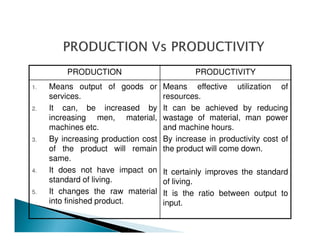
PRODUCTION PRODUCTIVITY
1. Means output of goods or
services.
2. It can, be increased by
increasing men, material,
machines etc.
3. By increasing production cost
of the product will remain
same.
4. It does not have impact on
standard of living.
5. It changes the raw material
into finished product.
Means effective utilization of
resources.
It can be achieved by reducing
wastage of material, man power
and machine hours.
By increase in productivity cost of
the product will come down.
It certainly improves the standard
of living.
It is the ratio between output to
input.
It is the application of techniques designed
to establish the time for a qualified worker
to carry out a specified job at a defined
level of performance.
Method Study
To simplify the job and
develop more
economical methods
of doing it
Work Measurement
To determine how long
It should take to carry out
Work
Study
J
O
B
J
O
B
With
Higher
Productivity
Areas to cover:
◦ Marketing policy
◦ Standardisation
◦ Product development
◦ Production Planning and Control
◦ Material Control
◦ Planned Maintenance
◦ Personnel Policy
◦ Improved Working conditions
◦ Operator Training
◦ Incentive Schemes
Cost: Low/Moderate
How quickly can results be achieved?:May
start slowly but effect grows quickly
Extent of improvement in Productivity:
Limited, but often of a high order
The role of Work study: Work measurement:
to investigate existing practice, locate
ineffective time and set standards of
performance as a basis for-
◦ a) Planning and control
◦ b) Utilisation of Plant
◦ c) Labour cost control
◦ d) Incentive Schemes
Good human relations
◦ Management
◦ Supervisor
◦ Worker
◦ Work study man
working conditions
◦ Occupational Safety and Health
◦ Fire prevention and Protection
◦ Layout and House keeping
◦ Lighting and Ventilation
◦ Noise and vibration
◦ Ergonomics
◦ Arrangement of working time
To evaluate Worker’s performance
To plan work-face needs
To determine available capacity
To determine price or cost of a product
To compare work methods
To facilitate operations
It is the application of techniques designed
to establish the time for a qualified worker
to carry out a specified job at a defined level
of performance.
To evaluate the existence of ineffective time
To evaluate a worker’s performance
To plan work-face needs
To determine the available capacity
To determine price and cost of a product
To compare work methods
To facilitate operations scheduling
To establish wage incentive schemes
SELECT
RECORD
EXAMINE
MEASURE
COMPILE
DEFINE
1. Time study technique.
2. Production study technique.
3 Analytical estimating techniques.
4. Activity/ work sampling.
5. Pre-determined time standard systems
(PTS)
It is a technique for determining as accurately
as possible, the time required to carry out a
specified task by a qualified worker at a
defined level of performance.
1. Identify the job to be time studied and the
operation to be timed.
2. Obtain the improved procedure of doing the job
from the method study department.
3. Select the worker for study.
4. Take the worker as well as shop supervisor into
confidence and explain the objectives.
5. Collect the equipments and arrange machinery,
jigs and fixtures, etc, required to conduct the
time study and ensure their accuracy.
6. Explain to the worker the improved working
procedure and use of tools to do the job.
7. Break the job into operations and operations into
elements and record. Separate constant elements
from variable elements.
8. Determine number of observations to be timed for
each elements.
9. Conduct observations and record time.
10. Rate the performance of worker.
11. Repeat the steps above two for number of
observations as determined in earlier steps.
12. Compute observed time from the measure central
tendency.
13. Calculate the “normal time” from the observed time by
using performance rating factor.
14. Add process allowance, rest and personal allowances
to obtain “standard time”.
It is defined as a continuous study of a
relatively lengthy duration extending over a
period of one or more shifts.
It is undertaken with an object of checking
the existing or proposed standard time on
obtaining other information affecting the rate
of output.
◦ When the job is performed by a group of persons.
◦ Where awarding of rating is not possible.
◦ When the process takes more than one shift.
◦ Where effective and ineffective are to be separated.
◦ Where ineffective time required to be segregated
into avoidable and unavoidable.
◦ Where time can be converted into man minutes or
man hours.
To obtain a general picture of pre-incentive
performance.
To check output limit on specified item on section
or machines.
To check the corrective ness of standard or allowed
time.
To obtain data for contingency allowance etc.
To check waiting time and bottlenecks in
production.
To obtain information about various allowances
required.
To evaluate the operating efficiency.
To locate the causes of loss of efficiency.
To reduce the idle time of men and machine.
Classify the strength of activity design in a chart
for recording information.
Make a pilot study.
From the pilot study made, compute
delay/inefficiency percentage.
Determine accuracy and confidence limit.
Calculate the number of observations required for
fixing the time.
Plan the schedule of observations.
Proceed with sampling of observations making
note of unusual point if any
Analyse the data obtained.
Generally no equipment is required for gathering
data.
Trained persons are not required to collect the
data.
Study of the number of activities can be done
simultaneously.
Work sampling techniques are not expensive to
undertake.
When it is compared to production study, it is
generally liked by workers as an observer does not
confront the worker through the day.
Study can be interrupted at any time without
affecting the result.
Operations which are difficult and expensive to be
measured by time study can be subjected to the
work sampling techniques.
It is not capable of giving elemental data.
It is not economical for study of single
operation or operator.
When compared to stop watch study the
statistical approval of work sampling is
difficult to be understood by the worker as
well as the management.
Analytical Estimating
Technique
(Standard Data)
One the work measurement techniques even the
time required to carryout the element of the job at
defined level of performance is established from
the knowledge and practical experience of the
observer as far as elements are concerned .
Almost similar to ‘time study technique’.
The difference - the time for each element is
estimated by an observer who is an expert having
the knowledge and practical experience of the
element concerned.
Most useful in engineering , construction
work, erection work and Inspection.
1. Collect the full details of job.
2. Analyze the job into its constituents- elements,
activity, grouping to enable synthetic data to be
applied if relevant.
3. Apply systematic data and estimate basic time for
the remaining elements and contingencies.
4. Apply appropriate relaxation allowance.
5. Verify the details of elemental data for job, its
method and conditions.
6. Sum up total time and relaxation allowance, etc.
to establish standard time form the job.
It possess almost the same advantages as
enjoyed by synthesis of work measurement.
It aids in planning and scheduling.
It provides a basis for rate fixing for non-
repetitive works in industries.
It improves labour control.
Since analytical estimating relies upon the
judgment of estimator, the time values obtained
are not as accurate and reliable as estimated by
other work measurement techniques.
PTS -Pre-determined Time Study.
Does not measure elements time by a stop watch
and thus avoids the inaccuracies being
introduced owing to the element of human
Judgment.
It is assumed that all manual tasks in industries
are made up of certain basic human movements
which one common to almost all jobs.
The average time taken by the average qualified
worker to perform a basic movement to
practically constant.
A work measurement technique whereby
the time is established for basic human
motions (Classified according to the nature
of the motion and the conditions under
which it is made) are used to build up the
time for a job at a defined level of
performance.
1. Select large number of workers doing variety of
jobs under normal working conditions in the
workshop.
2. The jobs selected are such that they involve most
of the common basic motions and are worked
under different set of conditions by workers
having different ages and other characteristics.
3. Record the job operations on a movie film (Micro
motion study).
4. Analyze the film, note down the time taken to
complete each element and compile the data in the
form of a table or chart.
Eliminates in-accuracies associated with stop watch time
study.
Superior to stop watch time study when applied to short cycle
highly repetitive operations.
Time standard for a job can be arrived at without going to the
pace of work.
Unlike stop watch study, no rating factor is employed.
PTS data is more reliable and accurate as compared to stop
watch time study data.
The time and cost associated with finding the standard time
for a job is considerably reduced.
*
Scope:
◦ Meaning, Need
◦ CPM, PERT
◦ Practical problems
◦ Finding out critical path/slack work sampling
“A project is a series of activities directed to
accomplishment of a desired objective.”
A project is composed of jobs, activities,
functions or tasks that are related to the other
in some manner, and all of these should be
completed in order to complete the project.
Every project has one specific purpose:-it
starts at some specific moment and it is
finished when its objectives have been
fulfilled.
For completion of a project, two basic
things are required:
◦ Material resources
◦ Man power resources
Availability, quality and use of human
resources is a single determinant factor in
accomplishing project objectives.
Management:
Management:
Management:
Management:
◦ While technology deals with material things,
Management deals with both material things as well
as human beings.
◦ Management increases the productivity through
technological innovation taking into account human
factors involved in these advances.
1. The project should be completed with a
completed with a
completed with a
completed with a
minimum elapsed time.
2. It should be available more power and other
more power and other
resources as sparingly
resources as sparingly as possible, without
delay.
3. It should be completed with a minimum of
a minimum of
a minimum of
a minimum of
capital investment
capital investment
capital investment
capital investment without delay.
1. Project Planning
2. Project Scheduling
3. Project Controlling
Manager at all levels need improved
techniques at all stages in a project to:
i. Define the work to be performed.
ii. Develop more realistic schedule and cost
estimates based on resources planned to
perform the work.
iii. Determine where the resources should be
applied to achieve best time, cost and
technical performance.
iv. Identify those areas developing potential
delays or cost over runs, in time to permit
corrective action.
Bar charts or Milestone Charts
Network diagrams or techniques.
Bar charts are introduced by Henry Gannt
Around 1900 AD.
Bar charts represents pictorial
representation in two dimensions of a
project by breaking it down into a number
of manageable units or activities for
planning and control shown on one
dimension or axis and the durations
assigned to these activities on the other
dimensions or axes.
While a bar chart represents the activities, a
mile stone chart represents the events
which mark either the beginning or the end
of an activity.
Network diagram is an outcome of the
improvements in the milestone charts.
This technique is based on the basic
characteristics of all projects, that all work
must be completed in well defined steps.
The network technique exploits this
characteristics by representing the steps of
the project objective graphically in the form
of a ‘network’ or ‘arrow’ diagram.
PERT – P
P
P
Programmed E
E
E
Evaluation and
R
R
R
Review T
T
T
Technique.
CPM – C
C
C
Critical P
P
P
Path M
M
M
Method.
PERT was developed by the US Navy for the
planning and control of the Polaris missile program
and the emphasis was on completing the program
in the shortest possible time.
In addition, PERT had the ability to cope with
uncertain activity completion times (e.g. for a
particular activity the most likely completion time
is 4 weeks but it could be anywhere between 3
weeks and 8 weeks).
USED
USED
USED
USED IN
IN
IN
IN :
:
:
: Project
Project
Project
Project management
management
management
management -
-
-
- for non-repetitive
jobs (research and development work), where the
time and cost estimates tend to be quite uncertain.
This technique uses probabilistic time estimates.
CPM was developed by Du Pont and the
emphasis was on the trade-off between the
cost of the project and its overall completion
time.
e
e
e
e.
.
.
.g
g
g
g.
.
.
. for certain activities it may be possible
to decrease their completion times by
spending more money - how does this affect
the overall completion time of the project?.
USED
USED
USED
USED IN
IN
IN
IN :
:
:
: Production management - for the
jobs of repetitive in nature where the activity
time estimates can be predicted with
considerable certainty due to the existence
of past experience.
PERT uses a network diagram consisting of
events which must be established to reach
project objectives.
An event is that particular instant of time at
which some specific part of a plan is to be
achieved.
PERT uses event oriented network diagrams
in which successive events are joined by
arrows (→).
PERT system is preferred for those projects or
operations which are non
non
non
non-
-
-
-repetitive
repetitive
repetitive
repetitive nature
nature
nature
nature or
those projects in which precise time
determination for various activities cannot be
made.
In such projects, managements cannot be
guided by the past experience. They are
referred to as ‘once through’ operations or
projects.
In this, the whole project consists of a number of
clearly recognizable jobs or operations, called
activities.
Activities are usually operations which take time to
carry out, and on which resources are expanded.
Functions of two activities are termed as ‘Events’.
The CPM networks are often referred to as ‘activity
oriented diagrams in which each activity is
represented by an arrow, and the sequence in
which the activities are performed is shown by the
sequence of the arrows.
CPM network are generally used for repetitive
repetitive
repetitive
repetitive type
type
type
type
projects,
projects,
projects,
projects, or for those projects for which fairly
accurate estimate of time for completion of each
activity can be made; and for which cost
estimations can be made with fair degree of
accuracy.
Network technique is one of the most
modern tools of project management. It is
always possible to break up the entire
project into a number of distinct, well
defined jobs or tasks (called activities).
The beginning or end of each such activity
constitutes an event of the project. A
network is a flow of diagram consisting of
activities and events, connected logically
and sequentially. In the network diagram,
an activity
activity
activity
activity is represented by
by
by
by arrow
arrow
arrow
arrow (→
→
→
→) while
events
events
events
events are represented by
by
by
by circles
circles
circles
circles (O)
(O)
(O)
(O).
.
.
.
An activity is the actual performance of a
task.
It is the work required to complete a specific
event.
An activity is a recognisable part of a work
project that requires time and resources for
its completion.
A project may consist of a number of
activities or jobs.
Depending upon the interdependency, we
can categorise activities as:
◦ Parallel activities
◦ Serial Activities
Further activities can be classified as
◦ Proceeding activity
◦ Succeeding activity
◦ Dummy Activity
Those activities which can be performed
simultaneously and independently to each
other are known as parallel activities
12
Serial activities are those which are to be
performed one after other in succession.
These activities cannot be performed
independently to each other.
22
Excavate Foundation Concrete Foundation
Activity or activities that are required to be
performed before another job or activity can
begin are called Predecessor activities to that
activity.
Activity or activities that can be performed
after the performance of other activity are
known as Successor activities.
Activity Predecessor Successor
A - C*; E
B - D*; E
C A* E*
D B* E*
E A; C*; B; D* -
7
6
5 8 9
A
B
C
D
E
A dummy activity is a type of operation in the
network which neither requires any time nor
any resources, but is merely a device to
identify a dependence among operations.
A dummy is a connecting link for control
purposes or for maintaining uniqueness of
activity.
1 2 3
4 5 6
Dummy (2,5)
The commencement of completion of an
activity is called an event.
An event is that particular instant of time at
which some specific part of a plan has been
or is to be achieved.
Initial Event:
Initial Event:
Initial Event:
Initial Event:
◦ Initial event is the event which indicates the
commencement of project.
1
Activity ‘A’
Initial Event
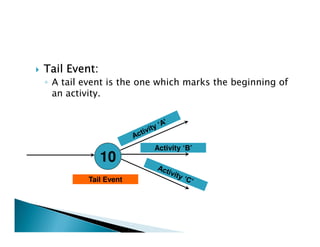
Tail Event:
Tail Event:
Tail Event:
Tail Event:
◦ A tail event is the one which marks the beginning of
an activity.
10
Activity ‘B’
Tail Event
WORK STUDY -method study & time study all in one.pdf

WORK STUDY -method study & time study all in one.pdf

  • 2.
    Inventory Control Production, Planning & Control PlantLayout& Material Handling Work Study CPM&PERT System Engg. Value Engg. Operation Research Cybermatics Industrial Engineering
  • 3.
    ◦ ILO defines:A Generic term for those techniques particularly ‘Method Study’ and ‘Work Measurement’ which are used in examination of human work in all its context and which lead systematically to the investigation of all the factors which affect the efficiency and economy of the situation being reviewed in order to effect improvement.
  • 4.
    Method Study To simplifythe job and develop more economical methods of doing it Work Measurement To determine how long It should take to carry out Work Study J O B J O B With Higher Productivity
  • 5.
    Emerged in 1881 DetailedAnalysis for use and cost of the resources of Organization. Concerned with Productivity. Productivity is Measure of Performance. Applies W.S. for increased Productivity.
  • 6.
    Frederick W.Taylor –Father of modern industrial Engineering Scientific Management and Work Measurement (1881) Work of each person should be planned one day in advance Definite work to be allotted. Pre-explained method to be adopted. Time to be fixed to complete the job Training is required.
  • 7.
    Branch of Industrialengineering Combination of 2 Techniques Method study, Work measurement
  • 8.
    Generic term for-Method Study and work measurement, which are used in the examination of human work in all its contexts, and which leads systematically to the investigation of all the factors which affect the efficiency and economy of the situation being reviewed, in order to effect improvement.
  • 9.
    Uniform ,improved productionflow Higher productive efficiency Reduced manufacturing costs Fast , accurate delivery dates Better employee-employer relations Better service to customers Job security and satisfaction Better working conditions Higher wagews
  • 10.
    Systematic Recording andCritical Examination of Existing and Proposed ways of doing a work, as a means of developing and applying easier and more effective methods and reducing costs.
  • 11.
    Improved working processes Betterwork place layout Less fatigue to workers Better product quality Effective utilization of resources Efficient, fast material handling Reduced health hazards Efficient planning of section Streamlined working proceedures.
  • 12.
    Application of TechniquesDesigned to establish the Time for a Qualified Worker to carry out a specified job at a defined level of performance.
  • 13.
    Determines time required,establishes fastest method; Determines man power required for a job; Decides equipments; Provides information for effective production planning; Aids in calculating exact delivery dates; Decides realistic labour budgeting; Provides a basis for sound incentive scheme; Results in effective labour control.
  • 14.
  • 15.
    1. Select. 2. Record. 3.Examine Critically. 4. Develop. 5. Install. 6. Maintain.
  • 16.
  • 17.
    Charts Charts Charts Charts a) outline process b) flow process charts (man, material, equipment) c) two handed d) multiple activity e) travel Diagrams Diagrams Diagrams Diagrams a) flow b) string Motion and film analysis Motion and film analysis Motion and film analysis Motion and film analysis a) simo chart b)P.M.T.S Lay out models Lay out models Lay out models Lay out models.
  • 18.
    Governing Considerations: ◦ Purpose ◦Place ◦ Sequence ◦ Person ◦ Means
  • 19.
    Primary Questions -Facts, reasons Secondary Questions – Possible alternative, Selected alternative (proposed) Selected alternative Selected for development
  • 20.
    Technical feasibility &desirability Economics such as cost of implementations and expected savigs Human factors Practicability Accessibility to management under limitations imposed Training if needed
  • 21.
  • 22.
    Systematic ad periodicchecks Deviations to be observed Modify or elimination of deviations Alterations improvements Suggestions and innovations
  • 23.
    Transformation of rawmaterials into finished goods Can be increased by increased input. Not a measure of performance Not much effort required to achieve increased production
  • 24.
    Ratio of outputto input Output=final goods Input=resources Measure of performance
  • 25.
    To study performanceof a system To attain a relative comparison of different systems for a given level. To compare actual to planned productivity
  • 26.
    Aggregate productivity Aggregate productivity Aggregateproductivity Aggregate productivity a) total productivity b) total factor productivity c) return on investment. Partial productivity Partial productivity Partial productivity Partial productivity a) Labor b) Capital c) material
  • 27.
    PRODUCTION PRODUCTIVITY 1. Meansoutput of goods or services. 2. It can, be increased by increasing men, material, machines etc. 3. By increasing production cost of the product will remain same. 4. It does not have impact on standard of living. 5. It changes the raw material into finished product. Means effective utilization of resources. It can be achieved by reducing wastage of material, man power and machine hours. By increase in productivity cost of the product will come down. It certainly improves the standard of living. It is the ratio between output to input.
  • 29.
    It is theapplication of techniques designed to establish the time for a qualified worker to carry out a specified job at a defined level of performance.
  • 30.
    Method Study To simplifythe job and develop more economical methods of doing it Work Measurement To determine how long It should take to carry out Work Study J O B J O B With Higher Productivity
  • 31.
    Areas to cover: ◦Marketing policy ◦ Standardisation ◦ Product development ◦ Production Planning and Control ◦ Material Control ◦ Planned Maintenance ◦ Personnel Policy ◦ Improved Working conditions ◦ Operator Training ◦ Incentive Schemes
  • 32.
    Cost: Low/Moderate How quicklycan results be achieved?:May start slowly but effect grows quickly Extent of improvement in Productivity: Limited, but often of a high order
  • 33.
    The role ofWork study: Work measurement: to investigate existing practice, locate ineffective time and set standards of performance as a basis for- ◦ a) Planning and control ◦ b) Utilisation of Plant ◦ c) Labour cost control ◦ d) Incentive Schemes
  • 34.
    Good human relations ◦Management ◦ Supervisor ◦ Worker ◦ Work study man working conditions ◦ Occupational Safety and Health ◦ Fire prevention and Protection ◦ Layout and House keeping ◦ Lighting and Ventilation ◦ Noise and vibration ◦ Ergonomics ◦ Arrangement of working time
  • 35.
    To evaluate Worker’sperformance To plan work-face needs To determine available capacity To determine price or cost of a product To compare work methods To facilitate operations
  • 36.
    It is theapplication of techniques designed to establish the time for a qualified worker to carry out a specified job at a defined level of performance.
  • 37.
    To evaluate theexistence of ineffective time To evaluate a worker’s performance To plan work-face needs To determine the available capacity To determine price and cost of a product To compare work methods To facilitate operations scheduling To establish wage incentive schemes
  • 38.
  • 39.
    1. Time studytechnique. 2. Production study technique. 3 Analytical estimating techniques. 4. Activity/ work sampling. 5. Pre-determined time standard systems (PTS)
  • 41.
    It is atechnique for determining as accurately as possible, the time required to carry out a specified task by a qualified worker at a defined level of performance.
  • 42.
    1. Identify thejob to be time studied and the operation to be timed. 2. Obtain the improved procedure of doing the job from the method study department. 3. Select the worker for study. 4. Take the worker as well as shop supervisor into confidence and explain the objectives. 5. Collect the equipments and arrange machinery, jigs and fixtures, etc, required to conduct the time study and ensure their accuracy. 6. Explain to the worker the improved working procedure and use of tools to do the job.
  • 43.
    7. Break thejob into operations and operations into elements and record. Separate constant elements from variable elements. 8. Determine number of observations to be timed for each elements. 9. Conduct observations and record time. 10. Rate the performance of worker. 11. Repeat the steps above two for number of observations as determined in earlier steps. 12. Compute observed time from the measure central tendency. 13. Calculate the “normal time” from the observed time by using performance rating factor. 14. Add process allowance, rest and personal allowances to obtain “standard time”.
  • 45.
    It is definedas a continuous study of a relatively lengthy duration extending over a period of one or more shifts. It is undertaken with an object of checking the existing or proposed standard time on obtaining other information affecting the rate of output.
  • 46.
    ◦ When thejob is performed by a group of persons. ◦ Where awarding of rating is not possible. ◦ When the process takes more than one shift. ◦ Where effective and ineffective are to be separated. ◦ Where ineffective time required to be segregated into avoidable and unavoidable. ◦ Where time can be converted into man minutes or man hours.
  • 47.
    To obtain ageneral picture of pre-incentive performance. To check output limit on specified item on section or machines. To check the corrective ness of standard or allowed time. To obtain data for contingency allowance etc. To check waiting time and bottlenecks in production. To obtain information about various allowances required.
  • 49.
    To evaluate theoperating efficiency. To locate the causes of loss of efficiency. To reduce the idle time of men and machine.
  • 50.
    Classify the strengthof activity design in a chart for recording information. Make a pilot study. From the pilot study made, compute delay/inefficiency percentage. Determine accuracy and confidence limit. Calculate the number of observations required for fixing the time. Plan the schedule of observations. Proceed with sampling of observations making note of unusual point if any Analyse the data obtained.
  • 51.
    Generally no equipmentis required for gathering data. Trained persons are not required to collect the data. Study of the number of activities can be done simultaneously. Work sampling techniques are not expensive to undertake. When it is compared to production study, it is generally liked by workers as an observer does not confront the worker through the day. Study can be interrupted at any time without affecting the result. Operations which are difficult and expensive to be measured by time study can be subjected to the work sampling techniques.
  • 52.
    It is notcapable of giving elemental data. It is not economical for study of single operation or operator. When compared to stop watch study the statistical approval of work sampling is difficult to be understood by the worker as well as the management.
  • 53.
  • 54.
    One the workmeasurement techniques even the time required to carryout the element of the job at defined level of performance is established from the knowledge and practical experience of the observer as far as elements are concerned . Almost similar to ‘time study technique’. The difference - the time for each element is estimated by an observer who is an expert having the knowledge and practical experience of the element concerned.
  • 55.
    Most useful inengineering , construction work, erection work and Inspection.
  • 56.
    1. Collect thefull details of job. 2. Analyze the job into its constituents- elements, activity, grouping to enable synthetic data to be applied if relevant. 3. Apply systematic data and estimate basic time for the remaining elements and contingencies. 4. Apply appropriate relaxation allowance. 5. Verify the details of elemental data for job, its method and conditions. 6. Sum up total time and relaxation allowance, etc. to establish standard time form the job.
  • 57.
    It possess almostthe same advantages as enjoyed by synthesis of work measurement. It aids in planning and scheduling. It provides a basis for rate fixing for non- repetitive works in industries. It improves labour control.
  • 58.
    Since analytical estimatingrelies upon the judgment of estimator, the time values obtained are not as accurate and reliable as estimated by other work measurement techniques.
  • 60.
    PTS -Pre-determined TimeStudy. Does not measure elements time by a stop watch and thus avoids the inaccuracies being introduced owing to the element of human Judgment. It is assumed that all manual tasks in industries are made up of certain basic human movements which one common to almost all jobs. The average time taken by the average qualified worker to perform a basic movement to practically constant.
  • 61.
    A work measurementtechnique whereby the time is established for basic human motions (Classified according to the nature of the motion and the conditions under which it is made) are used to build up the time for a job at a defined level of performance.
  • 62.
    1. Select largenumber of workers doing variety of jobs under normal working conditions in the workshop. 2. The jobs selected are such that they involve most of the common basic motions and are worked under different set of conditions by workers having different ages and other characteristics. 3. Record the job operations on a movie film (Micro motion study). 4. Analyze the film, note down the time taken to complete each element and compile the data in the form of a table or chart.
  • 63.
    Eliminates in-accuracies associatedwith stop watch time study. Superior to stop watch time study when applied to short cycle highly repetitive operations. Time standard for a job can be arrived at without going to the pace of work. Unlike stop watch study, no rating factor is employed. PTS data is more reliable and accurate as compared to stop watch time study data. The time and cost associated with finding the standard time for a job is considerably reduced. *
  • 65.
    Scope: ◦ Meaning, Need ◦CPM, PERT ◦ Practical problems ◦ Finding out critical path/slack work sampling
  • 66.
    “A project isa series of activities directed to accomplishment of a desired objective.” A project is composed of jobs, activities, functions or tasks that are related to the other in some manner, and all of these should be completed in order to complete the project.
  • 67.
    Every project hasone specific purpose:-it starts at some specific moment and it is finished when its objectives have been fulfilled. For completion of a project, two basic things are required: ◦ Material resources ◦ Man power resources Availability, quality and use of human resources is a single determinant factor in accomplishing project objectives.
  • 68.
    Management: Management: Management: Management: ◦ While technologydeals with material things, Management deals with both material things as well as human beings. ◦ Management increases the productivity through technological innovation taking into account human factors involved in these advances.
  • 69.
    1. The projectshould be completed with a completed with a completed with a completed with a minimum elapsed time. minimum elapsed time. minimum elapsed time. minimum elapsed time. 2. It should be available more power and other more power and other more power and other more power and other resources as sparingly resources as sparingly resources as sparingly resources as sparingly as possible, without delay. 3. It should be completed with a minimum of a minimum of a minimum of a minimum of capital investment capital investment capital investment capital investment without delay.
  • 70.
    1. Project Planning 2.Project Scheduling 3. Project Controlling
  • 71.
    Manager at alllevels need improved techniques at all stages in a project to: i. Define the work to be performed. ii. Develop more realistic schedule and cost estimates based on resources planned to perform the work. iii. Determine where the resources should be applied to achieve best time, cost and technical performance. iv. Identify those areas developing potential delays or cost over runs, in time to permit corrective action.
  • 72.
    Bar charts orMilestone Charts Network diagrams or techniques.
  • 73.
    Bar charts areintroduced by Henry Gannt Around 1900 AD. Bar charts represents pictorial representation in two dimensions of a project by breaking it down into a number of manageable units or activities for planning and control shown on one dimension or axis and the durations assigned to these activities on the other dimensions or axes. While a bar chart represents the activities, a mile stone chart represents the events which mark either the beginning or the end of an activity.
  • 75.
    Network diagram isan outcome of the improvements in the milestone charts. This technique is based on the basic characteristics of all projects, that all work must be completed in well defined steps. The network technique exploits this characteristics by representing the steps of the project objective graphically in the form of a ‘network’ or ‘arrow’ diagram.
  • 76.
    PERT – P P P ProgrammedE E E Evaluation and R R R Review T T T Technique. CPM – C C C Critical P P P Path M M M Method.
  • 77.
    PERT was developedby the US Navy for the planning and control of the Polaris missile program and the emphasis was on completing the program in the shortest possible time. In addition, PERT had the ability to cope with uncertain activity completion times (e.g. for a particular activity the most likely completion time is 4 weeks but it could be anywhere between 3 weeks and 8 weeks). USED USED USED USED IN IN IN IN : : : : Project Project Project Project management management management management - - - - for non-repetitive jobs (research and development work), where the time and cost estimates tend to be quite uncertain. This technique uses probabilistic time estimates.
  • 78.
    CPM was developedby Du Pont and the emphasis was on the trade-off between the cost of the project and its overall completion time. e e e e. . . .g g g g. . . . for certain activities it may be possible to decrease their completion times by spending more money - how does this affect the overall completion time of the project?. USED USED USED USED IN IN IN IN : : : : Production management - for the jobs of repetitive in nature where the activity time estimates can be predicted with considerable certainty due to the existence of past experience.
  • 79.
    PERT uses anetwork diagram consisting of events which must be established to reach project objectives. An event is that particular instant of time at which some specific part of a plan is to be achieved. PERT uses event oriented network diagrams in which successive events are joined by arrows (→).
  • 80.
    PERT system ispreferred for those projects or operations which are non non non non- - - -repetitive repetitive repetitive repetitive nature nature nature nature or those projects in which precise time determination for various activities cannot be made. In such projects, managements cannot be guided by the past experience. They are referred to as ‘once through’ operations or projects.
  • 81.
    In this, thewhole project consists of a number of clearly recognizable jobs or operations, called activities. Activities are usually operations which take time to carry out, and on which resources are expanded. Functions of two activities are termed as ‘Events’. The CPM networks are often referred to as ‘activity oriented diagrams in which each activity is represented by an arrow, and the sequence in which the activities are performed is shown by the sequence of the arrows. CPM network are generally used for repetitive repetitive repetitive repetitive type type type type projects, projects, projects, projects, or for those projects for which fairly accurate estimate of time for completion of each activity can be made; and for which cost estimations can be made with fair degree of accuracy.
  • 82.
    Network technique isone of the most modern tools of project management. It is always possible to break up the entire project into a number of distinct, well defined jobs or tasks (called activities). The beginning or end of each such activity constitutes an event of the project. A network is a flow of diagram consisting of activities and events, connected logically and sequentially. In the network diagram, an activity activity activity activity is represented by by by by arrow arrow arrow arrow (→ → → →) while events events events events are represented by by by by circles circles circles circles (O) (O) (O) (O). . . .
  • 83.
    An activity isthe actual performance of a task. It is the work required to complete a specific event. An activity is a recognisable part of a work project that requires time and resources for its completion.
  • 84.
    A project mayconsist of a number of activities or jobs. Depending upon the interdependency, we can categorise activities as: ◦ Parallel activities ◦ Serial Activities Further activities can be classified as ◦ Proceeding activity ◦ Succeeding activity ◦ Dummy Activity
  • 85.
    Those activities whichcan be performed simultaneously and independently to each other are known as parallel activities 12
  • 86.
    Serial activities arethose which are to be performed one after other in succession. These activities cannot be performed independently to each other. 22 Excavate Foundation Concrete Foundation
  • 87.
    Activity or activitiesthat are required to be performed before another job or activity can begin are called Predecessor activities to that activity.
  • 88.
    Activity or activitiesthat can be performed after the performance of other activity are known as Successor activities.
  • 89.
    Activity Predecessor Successor A- C*; E B - D*; E C A* E* D B* E* E A; C*; B; D* - 7 6 5 8 9 A B C D E
  • 90.
    A dummy activityis a type of operation in the network which neither requires any time nor any resources, but is merely a device to identify a dependence among operations. A dummy is a connecting link for control purposes or for maintaining uniqueness of activity.
  • 91.
    1 2 3 45 6 Dummy (2,5)
  • 92.
    The commencement ofcompletion of an activity is called an event. An event is that particular instant of time at which some specific part of a plan has been or is to be achieved.
  • 93.
    Initial Event: Initial Event: InitialEvent: Initial Event: ◦ Initial event is the event which indicates the commencement of project. 1 Activity ‘A’ Initial Event
  • 94.
    Tail Event: Tail Event: TailEvent: Tail Event: ◦ A tail event is the one which marks the beginning of an activity. 10 Activity ‘B’ Tail Event