METHOD STUDY
METHOD STUDY
Method study is the systematic
recording and critical examination of
existing and proposed ways of doing
work, as a means of developing and
applying easier and more effective
methods and reducing costs.

Overview of Management
OBJECTIVES OF METHOD STUDY
1.
2.

Improvement of processes and procedures
Improvement in the design of plant and
equipment
3. Improvement of layout
4. Improvement in the use of men, materials
and
machines
5. Economy in human effort and reduction of
unnecessary fatigue
6. Improvement in safety standards
7. Development of better working environment.
Overview of Management
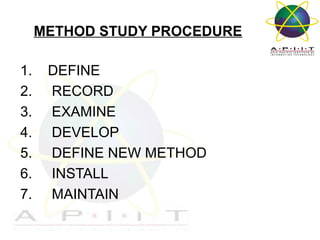
METHOD STUDY PROCEDURE
1.
2.
3.
4.
5.
6.
7.

DEFINE
RECORD
EXAMINE
DEVELOP
DEFINE NEW METHOD
INSTALL
MAINTAIN
Overview of Management
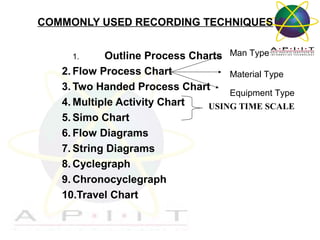
COMMONLY USED RECORDING TECHNIQUES
Outline Process Charts Man Type
2. Flow Process Chart
Material Type
3. Two Handed Process Chart
Equipment Type
4. Multiple Activity Chart
USING TIME SCALE
5. Simo Chart
6. Flow Diagrams
7. String Diagrams
8. Cyclegraph
9. Chronocyclegraph
10.Travel Chart
1.

Overview of Management
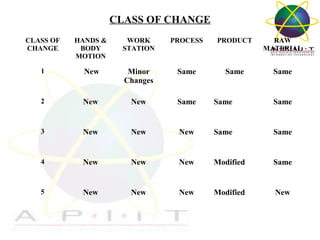
CLASS OF CHANGE
CLASS OF
CHANGE

HANDS &
BODY
MOTION

WORK
STATION

PROCESS

PRODUCT

RAW
MATERIAL

1

New

Minor
Changes

Same

Same

Same

2

New

New

Same

Same

Same

3

New

New

New

Same

Same

4

New

New

New

Modified

Same

5

New

New

New

Modified

New

Overview of Management
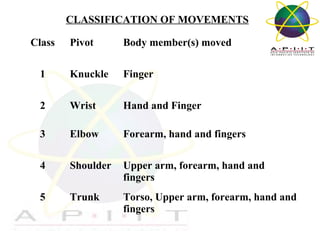
CLASSIFICATION OF MOVEMENTS
Class

Pivot

Body member(s) moved

1

Knuckle

Finger

2

Wrist

Hand and Finger

3

Elbow

Forearm, hand and fingers

4

Shoulder

Upper arm, forearm, hand and
fingers

5

Trunk

Torso, Upper arm, forearm, hand and
fingers
Overview of Management
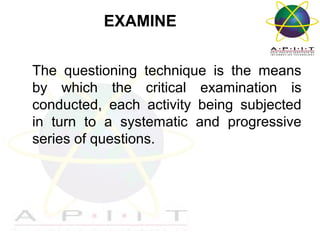
EXAMINE
The questioning technique is the means
by which the critical examination is
conducted, each activity being subjected
in turn to a systematic and progressive
series of questions.

Overview of Management
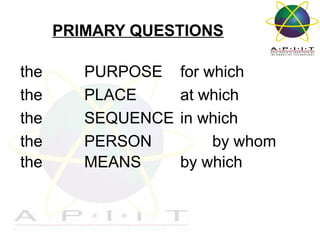
PRIMARY QUESTIONS
the
the
the
the
the

PURPOSE
PLACE
SEQUENCE
PERSON
MEANS

Overview of Management

for which
at which
in which
by whom
by which
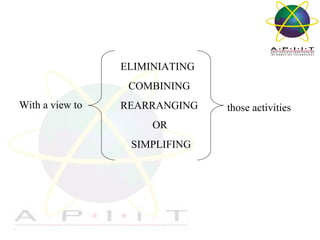
ELIMINIATING
COMBINING
With a view to

REARRANGING
OR
SIMPLIFING

Overview of Management

those activities
SECONDARY QUESTIONS
The secondary questions cover the
second stage of the questioning
technique, during which the answers to
the primary questions are subjected to
further query to determine whether
possible alternatives of place, sequence,
persons and means are practicable and
preferred as a means of improvement
upon the existing method.
Overview of Management
PURPOSE:

what is done?
why is it done?
what else might be done?
what should be done?

PLACE:

where is it done?
Why is it done there?
Where else might it is done?
Where should it be done?
Overview of Management
SEQUENCE:

When is it done?
Why is it done?
When might it be done?
When should it be done?

PERSON:

who does it?
Why does that person do it?
Who else might do it?
Who should do it?

MEANS:

How is it done?
Why is it done that way?
How else might it be done?
How should it be done ?
Overview of Management
DEFINING THE IMPROVED METHOD
• The report should show:
Relative costs in material, labour and overheads
of the
two methods, and savings expected.
2. The cost of installing the new method, including
the cost of new equipment and of re-laying out
shops
or working areas
3. Executive actions required to implement the new
method.
1.

• It should also give details regarding :
1.

2.
3.
etc

The tools and equipment to be used
A description of the method
A diagram of the work place layout, jigs/fixtures

Overview of Management
INSTALLING THE IMPROVED METHOD

1. Gaining acceptance of the change by
the
Management
2. Gaining acceptance of the change by
the
workers
3. Maintaining close contact with the
progress of the job until satisfied that it
is running as intended

Overview of Management
THE PRINCIPLES OF MOTION ECONOMY
A. Use of the human body
1. The two hands should begin and complete their
movements at the same time
2. Motion of the arms shall be symmetrical and in
opposite directions and should be made
simultaneously
3. Hands and body motions should be made at the
lowest
classification at which it is possible to do
the work satisfactorily
4. Rhythm is essential to the smooth and automatic
performance of a repetitive operation.
5. Work should be arranged so that eye movements
are confined to a comfortable area, without the need
for frequent changes of focus.
Overview of Management
 B.

Arrangement of the work place

1. 
Definite and fixed stations should be provided for all 
tools  and materials.
2.     Gravity  feed,  bins  and  containers  should  be  used  to 
deliver 
the materials as close to the point of use as possible.
the 

3.     Tools,  materials  and  controls  should  be  located  within 
maximum working area.

best 

4.     Materials  and  tools  should  be  arranged  to  permit  the 
sequence of motion.
5.         Provision should be made for adequate lighting.

6.       The colour of the workplace should contrast with that 
of the  workplace to reduce eye fatigue.
Overview of Management
C. Design of tools and equipment
1. The hands should be relieved of all work of
'holding' the workpiece where this can be done by
fixture etc.
2. Two or more tools should be combined wherever
possible
3. Levers, cross bars and handwheels should be so
placed that the operative can use them with the
least
change in body position and the greatest
mechanical
advantage.

Overview of Management
PURPOSE OF WORK MEASUREMENT
1.
2.
3.
4.
5.
6.
7.
8.

To find ineffective time in a process
To set standard for output level
To evaluate worker's performance
To plan work force needs.
To determine available capacity
To compare work methods
To facilitate operations scheduling
To establish wage incentive schemes
Overview of Management
THE TECHNIQUES OF
WORK MEASUREMENT
1. Stop-watch time study
2. Work sampling
3. Predetermined
standards(PTS)
4. Standard Data

Overview of Management

time
A FAIR DAY'S WORK
Amount of work that can be produced by a
qualified employee when working at normal
pace and effectively utilizing his time where
work is not restricted by process limitations.
Work Measurement
Work measurement is the application of
techniques designed to establish the time for
a qualified worker to carry out a specific job at
a defined level of performance.

Overview of Management
THE QUALIFIED WORKER
A qualified worker is one who is
accepted as having the necessary
physical attributes, who possess the
required intelligence and education and
who has acquired the necessary skill
and knowledge to carry out the work in
hand to satisfactory standards of safety,
quantity and quality
STANDARD RATING
Rating is the assessment of the
worker's rate of working relative to the
observers' concept of the rate
Overview of Management
STANDARD PERFORMANCE
It is the rate of output which qualified
workers will naturally achieve without
over-exertion as an average over the
working day or shift, provided that they
know and adhere to the specified method
and provided that they are motivated to
apply themselves to their work.

Overview of Management
TIME STUDY
Basic Steps

a. Obtaining and recording all available information about
the job, operator and the surrounding conditions likely to
affect
the execution of the work
b. Recording the complete description of the method,
breaking down the operation into 'elements'
c.
Measuring with a stopwatch and recording the time
taken by
the operator to perform each 'element' of the
operation.
d.
Assessing the rating
e.
Extending observed time to 'basic times'
f. Determining the allowances to be made over and above
the basic time for
the operation
g. Determining the 'standard time' for the operation.
Overview of Management
FACTORS AFFECTING RATE OF WORKING
(outside the control of worker)
1. Variation in the quality of materials used
2. Changes in the operating efficiency of the equipment
3. Changes in climatic and surrounding conditions of operation.
FACTORS WITHING THE CONTROL OF WORKER
a. Acceptable variations in the quality of the product
b. Variations due to his ability
c. Variations due to his attitude
SCALES OF RATING
100-133
60-80
75-100
0-100

Overview of Management

method study

  • 1.
  • 2.
    METHOD STUDY Method studyis the systematic recording and critical examination of existing and proposed ways of doing work, as a means of developing and applying easier and more effective methods and reducing costs. Overview of Management
  • 3.
    OBJECTIVES OF METHODSTUDY 1. 2. Improvement of processes and procedures Improvement in the design of plant and equipment 3. Improvement of layout 4. Improvement in the use of men, materials and machines 5. Economy in human effort and reduction of unnecessary fatigue 6. Improvement in safety standards 7. Development of better working environment. Overview of Management
  • 4.
  • 5.
    COMMONLY USED RECORDINGTECHNIQUES Outline Process Charts Man Type 2. Flow Process Chart Material Type 3. Two Handed Process Chart Equipment Type 4. Multiple Activity Chart USING TIME SCALE 5. Simo Chart 6. Flow Diagrams 7. String Diagrams 8. Cyclegraph 9. Chronocyclegraph 10.Travel Chart 1. Overview of Management
  • 6.
    CLASS OF CHANGE CLASSOF CHANGE HANDS & BODY MOTION WORK STATION PROCESS PRODUCT RAW MATERIAL 1 New Minor Changes Same Same Same 2 New New Same Same Same 3 New New New Same Same 4 New New New Modified Same 5 New New New Modified New Overview of Management
  • 7.
    CLASSIFICATION OF MOVEMENTS Class Pivot Bodymember(s) moved 1 Knuckle Finger 2 Wrist Hand and Finger 3 Elbow Forearm, hand and fingers 4 Shoulder Upper arm, forearm, hand and fingers 5 Trunk Torso, Upper arm, forearm, hand and fingers Overview of Management
  • 8.
    EXAMINE The questioning techniqueis the means by which the critical examination is conducted, each activity being subjected in turn to a systematic and progressive series of questions. Overview of Management
  • 9.
  • 10.
    ELIMINIATING COMBINING With a viewto REARRANGING OR SIMPLIFING Overview of Management those activities
  • 11.
    SECONDARY QUESTIONS The secondaryquestions cover the second stage of the questioning technique, during which the answers to the primary questions are subjected to further query to determine whether possible alternatives of place, sequence, persons and means are practicable and preferred as a means of improvement upon the existing method. Overview of Management
  • 12.
    PURPOSE: what is done? whyis it done? what else might be done? what should be done? PLACE: where is it done? Why is it done there? Where else might it is done? Where should it be done? Overview of Management
  • 13.
    SEQUENCE: When is itdone? Why is it done? When might it be done? When should it be done? PERSON: who does it? Why does that person do it? Who else might do it? Who should do it? MEANS: How is it done? Why is it done that way? How else might it be done? How should it be done ? Overview of Management
  • 14.
    DEFINING THE IMPROVEDMETHOD • The report should show: Relative costs in material, labour and overheads of the two methods, and savings expected. 2. The cost of installing the new method, including the cost of new equipment and of re-laying out shops or working areas 3. Executive actions required to implement the new method. 1. • It should also give details regarding : 1. 2. 3. etc The tools and equipment to be used A description of the method A diagram of the work place layout, jigs/fixtures Overview of Management
  • 15.
    INSTALLING THE IMPROVEDMETHOD 1. Gaining acceptance of the change by the Management 2. Gaining acceptance of the change by the workers 3. Maintaining close contact with the progress of the job until satisfied that it is running as intended Overview of Management
  • 16.
    THE PRINCIPLES OFMOTION ECONOMY A. Use of the human body 1. The two hands should begin and complete their movements at the same time 2. Motion of the arms shall be symmetrical and in opposite directions and should be made simultaneously 3. Hands and body motions should be made at the lowest classification at which it is possible to do the work satisfactorily 4. Rhythm is essential to the smooth and automatic performance of a repetitive operation. 5. Work should be arranged so that eye movements are confined to a comfortable area, without the need for frequent changes of focus. Overview of Management
  • 17.
     B. Arrangement of thework place 1.  Definite and fixed stations should be provided for all  tools  and materials. 2.     Gravity  feed,  bins  and  containers  should  be  used  to  deliver  the materials as close to the point of use as possible. the  3.     Tools,  materials  and  controls  should  be  located  within  maximum working area. best  4.     Materials  and  tools  should  be  arranged  to  permit  the  sequence of motion. 5.         Provision should be made for adequate lighting. 6.       The colour of the workplace should contrast with that  of the  workplace to reduce eye fatigue. Overview of Management
  • 18.
    C. Design oftools and equipment 1. The hands should be relieved of all work of 'holding' the workpiece where this can be done by fixture etc. 2. Two or more tools should be combined wherever possible 3. Levers, cross bars and handwheels should be so placed that the operative can use them with the least change in body position and the greatest mechanical advantage. Overview of Management
  • 19.
    PURPOSE OF WORKMEASUREMENT 1. 2. 3. 4. 5. 6. 7. 8. To find ineffective time in a process To set standard for output level To evaluate worker's performance To plan work force needs. To determine available capacity To compare work methods To facilitate operations scheduling To establish wage incentive schemes Overview of Management
  • 20.
    THE TECHNIQUES OF WORKMEASUREMENT 1. Stop-watch time study 2. Work sampling 3. Predetermined standards(PTS) 4. Standard Data Overview of Management time
  • 21.
    A FAIR DAY'SWORK Amount of work that can be produced by a qualified employee when working at normal pace and effectively utilizing his time where work is not restricted by process limitations. Work Measurement Work measurement is the application of techniques designed to establish the time for a qualified worker to carry out a specific job at a defined level of performance. Overview of Management
  • 22.
    THE QUALIFIED WORKER Aqualified worker is one who is accepted as having the necessary physical attributes, who possess the required intelligence and education and who has acquired the necessary skill and knowledge to carry out the work in hand to satisfactory standards of safety, quantity and quality STANDARD RATING Rating is the assessment of the worker's rate of working relative to the observers' concept of the rate Overview of Management
  • 23.
    STANDARD PERFORMANCE It isthe rate of output which qualified workers will naturally achieve without over-exertion as an average over the working day or shift, provided that they know and adhere to the specified method and provided that they are motivated to apply themselves to their work. Overview of Management
  • 24.
    TIME STUDY Basic Steps a.Obtaining and recording all available information about the job, operator and the surrounding conditions likely to affect the execution of the work b. Recording the complete description of the method, breaking down the operation into 'elements' c. Measuring with a stopwatch and recording the time taken by the operator to perform each 'element' of the operation. d. Assessing the rating e. Extending observed time to 'basic times' f. Determining the allowances to be made over and above the basic time for the operation g. Determining the 'standard time' for the operation. Overview of Management
  • 25.
    FACTORS AFFECTING RATEOF WORKING (outside the control of worker) 1. Variation in the quality of materials used 2. Changes in the operating efficiency of the equipment 3. Changes in climatic and surrounding conditions of operation. FACTORS WITHING THE CONTROL OF WORKER a. Acceptable variations in the quality of the product b. Variations due to his ability c. Variations due to his attitude SCALES OF RATING 100-133 60-80 75-100 0-100 Overview of Management