Arooj Zaidi
 Organizing is a function by which the concern is
able to define the role positions, the jobs related
and the coordination between authority and
responsibility.
 structuring of resources and activities
 accomplish objectives efficiently and effectively
 Plan implementation
 Assignment of authority, responsibility, and
accountability
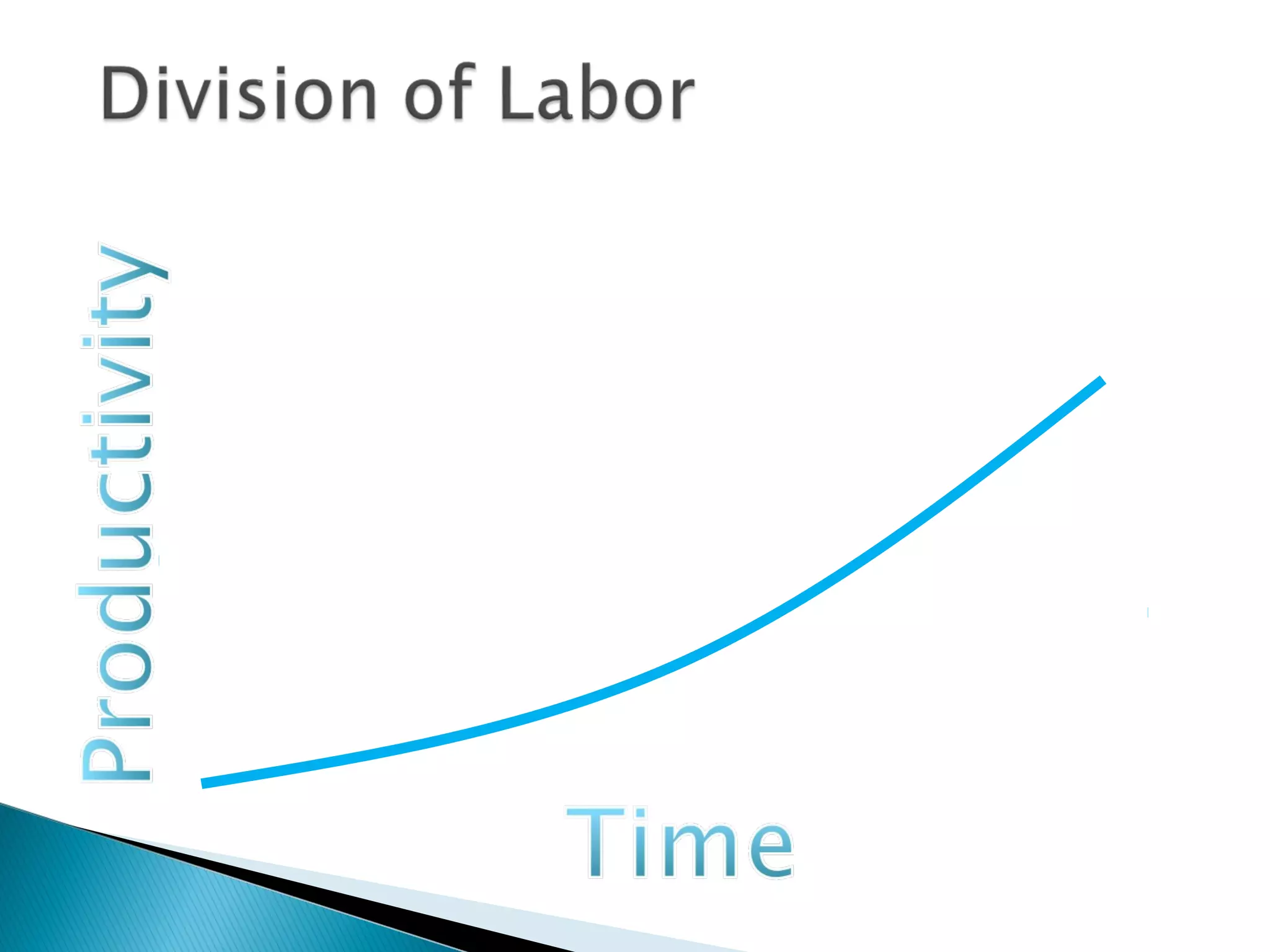
 Division of work
 Coordinates diverse organizational tasks
 Establish relationship among individuals, groups and
departments
 Establish formal lines of authority
 Allocation and deployment of organizational resources
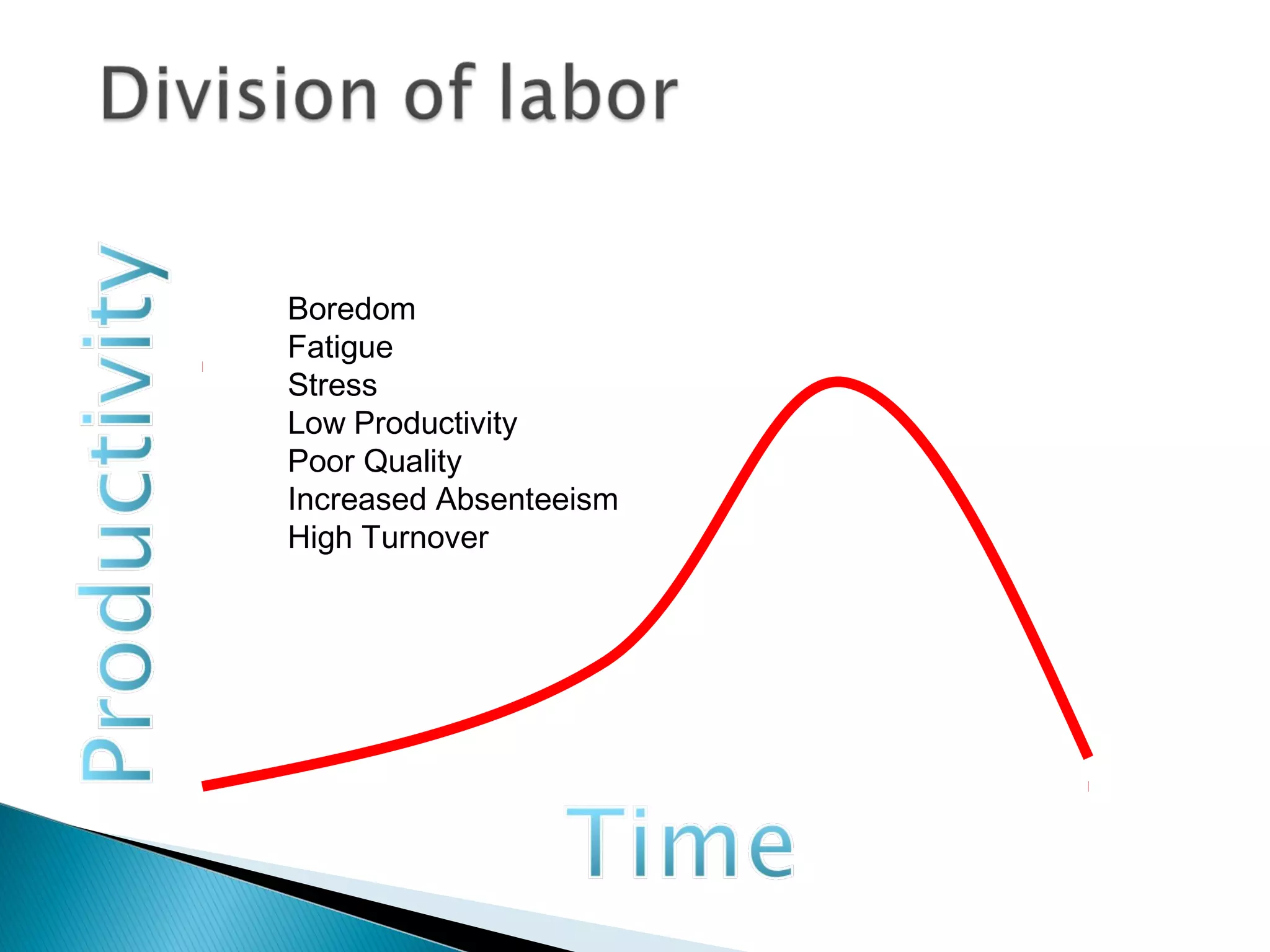
Boredom
Fatigue
Stress
Low Productivity
Poor Quality
Increased Absenteeism
High Turnover
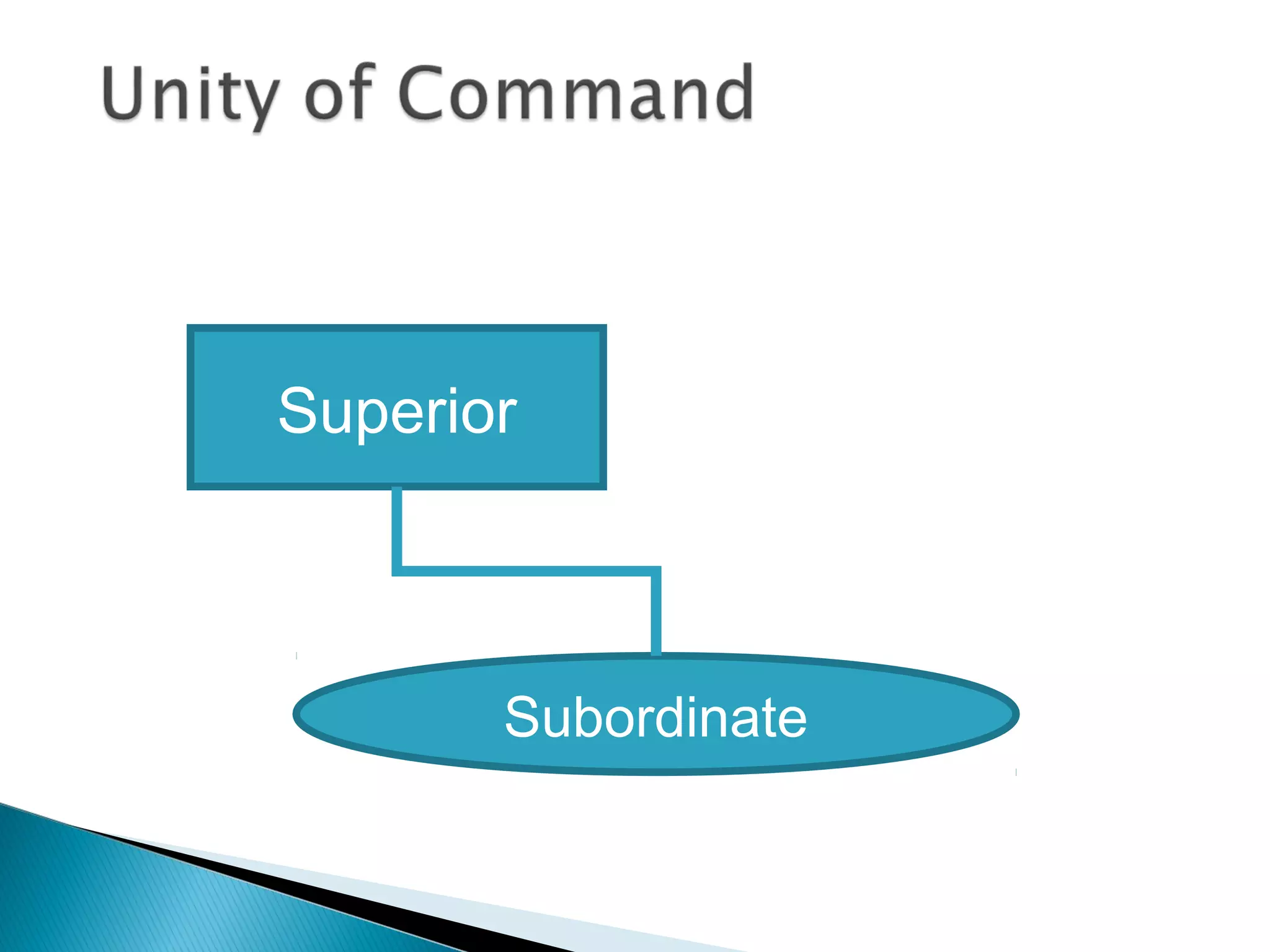
 The chain of command is an unbroken line of
authority that links all persons in an organization
and defines who reports to whom. This chain has
two underlying principles: unity of command and
scalar principle.
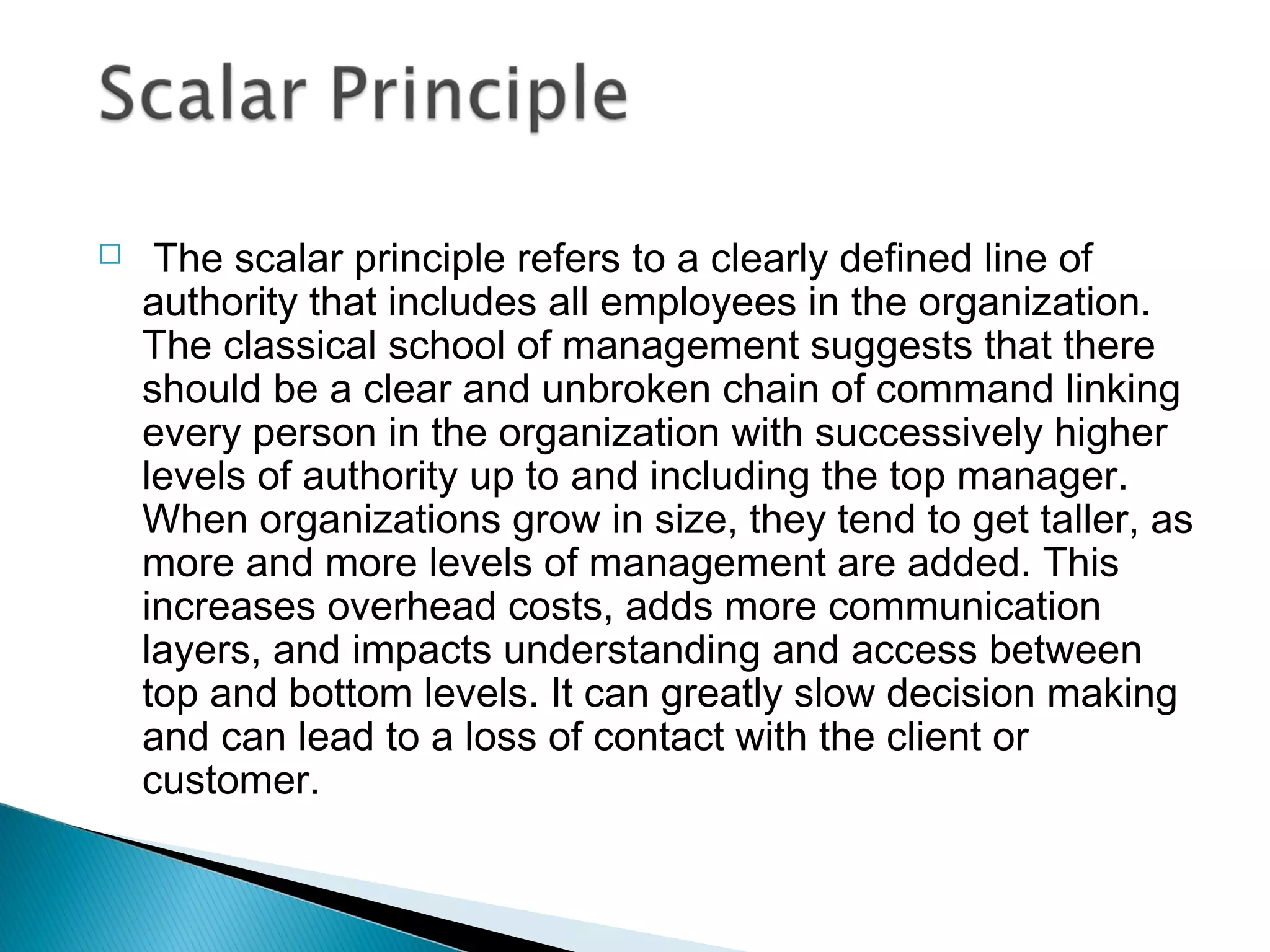
Superior
Subordinate
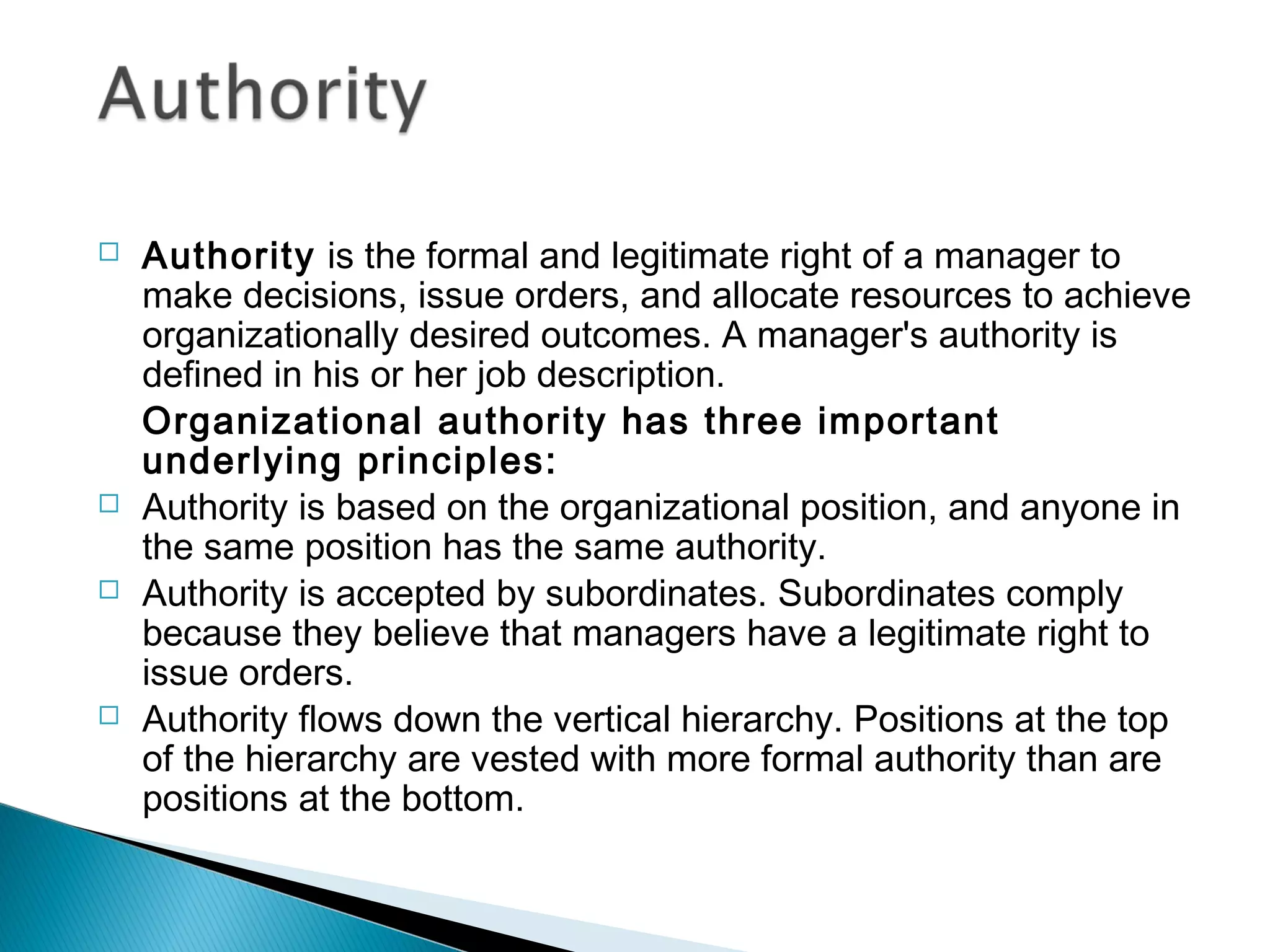
  The scalar principle refers to a clearly defined line of
authority that includes all employees in the organization.
The classical school of management suggests that there
should be a clear and unbroken chain of command linking
every person in the organization with successively higher
levels of authority up to and including the top manager.
When organizations grow in size, they tend to get taller, as
more and more levels of management are added. This
increases overhead costs, adds more communication
layers, and impacts understanding and access between
top and bottom levels. It can greatly slow decision making
and can lead to a loss of contact with the client or
customer.
 Authority is the formal and legitimate right of a manager to
make decisions, issue orders, and allocate resources to achieve
organizationally desired outcomes. A manager's authority is
defined in his or her job description.
Organizational authority has three important
underlying principles:
 Authority is based on the organizational position, and anyone in
the same position has the same authority.
 Authority is accepted by subordinates. Subordinates comply
because they believe that managers have a legitimate right to
issue orders.
 Authority flows down the vertical hierarchy. Positions at the top
of the hierarchy are vested with more formal authority than are
positions at the bottom.
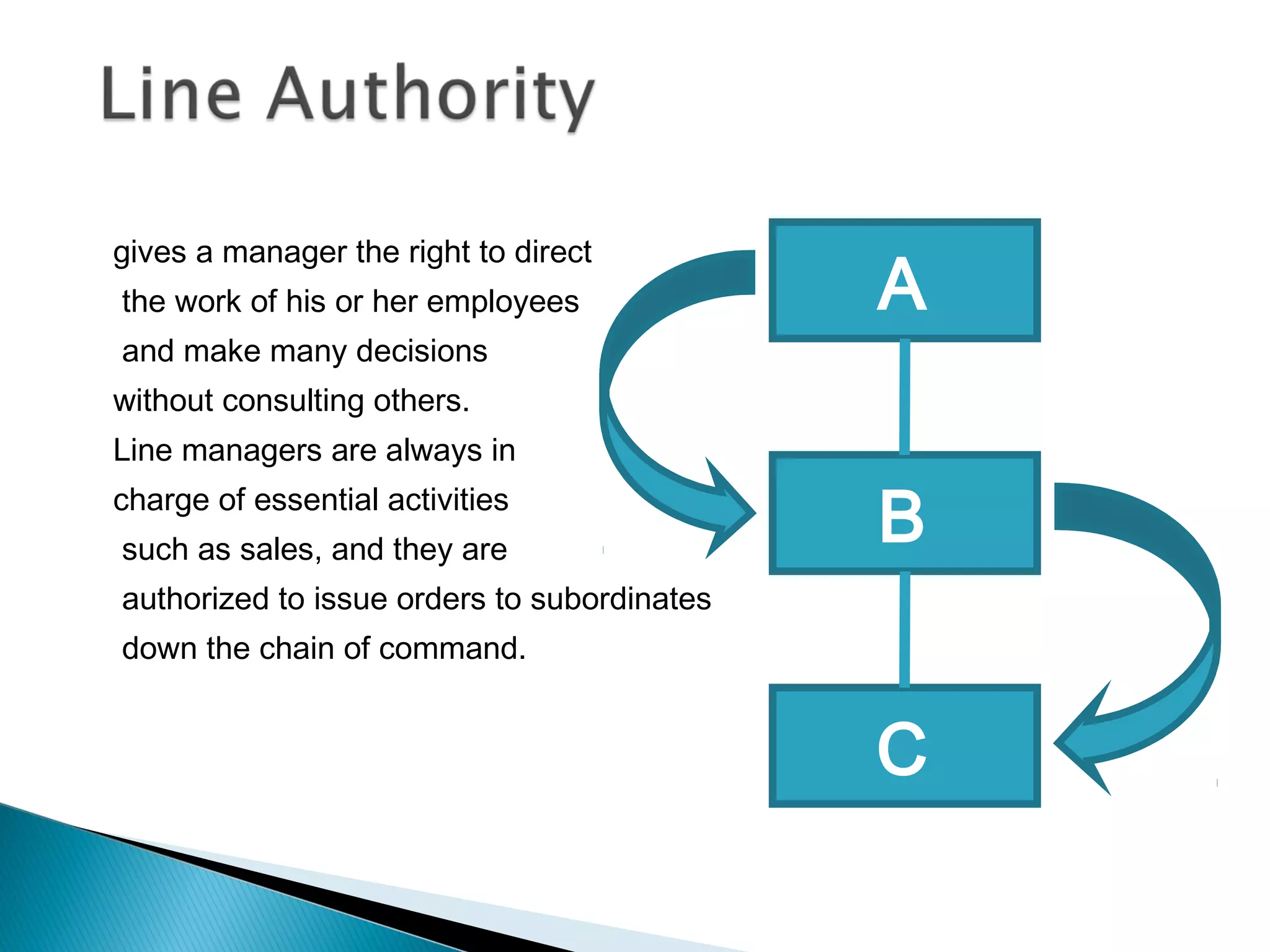
gives a manager the right to direct
the work of his or her employees
and make many decisions
without consulting others.
Line managers are always in
charge of essential activities
such as sales, and they are
authorized to issue orders to subordinates
down the chain of command.
A
B
C
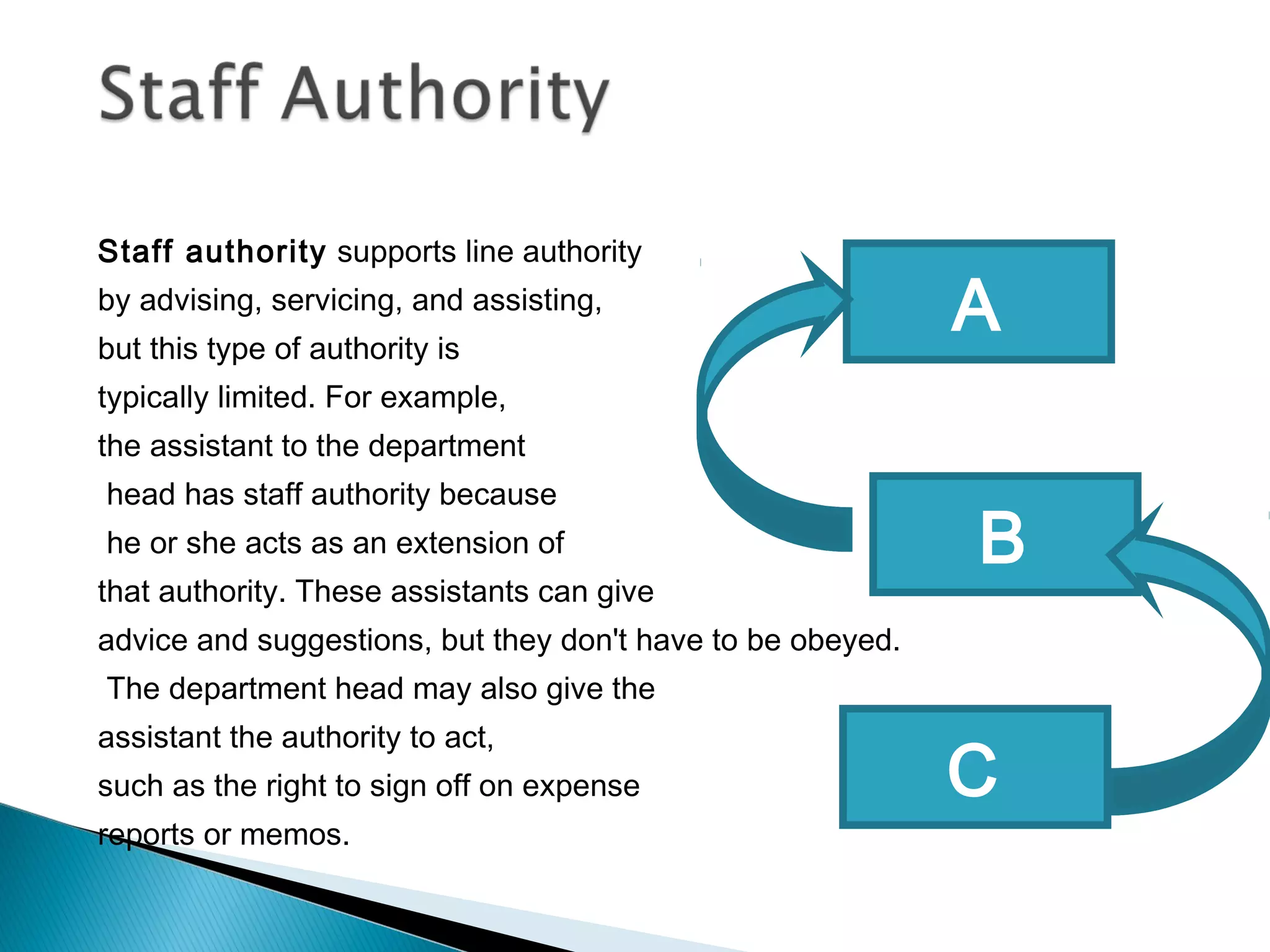
Staff authority supports line authority
by advising, servicing, and assisting,
but this type of authority is
typically limited. For example,
the assistant to the department
head has staff authority because
he or she acts as an extension of
that authority. These assistants can give
advice and suggestions, but they don't have to be obeyed.
The department head may also give the
assistant the authority to act,
such as the right to sign off on expense
reports or memos.
A
B
C
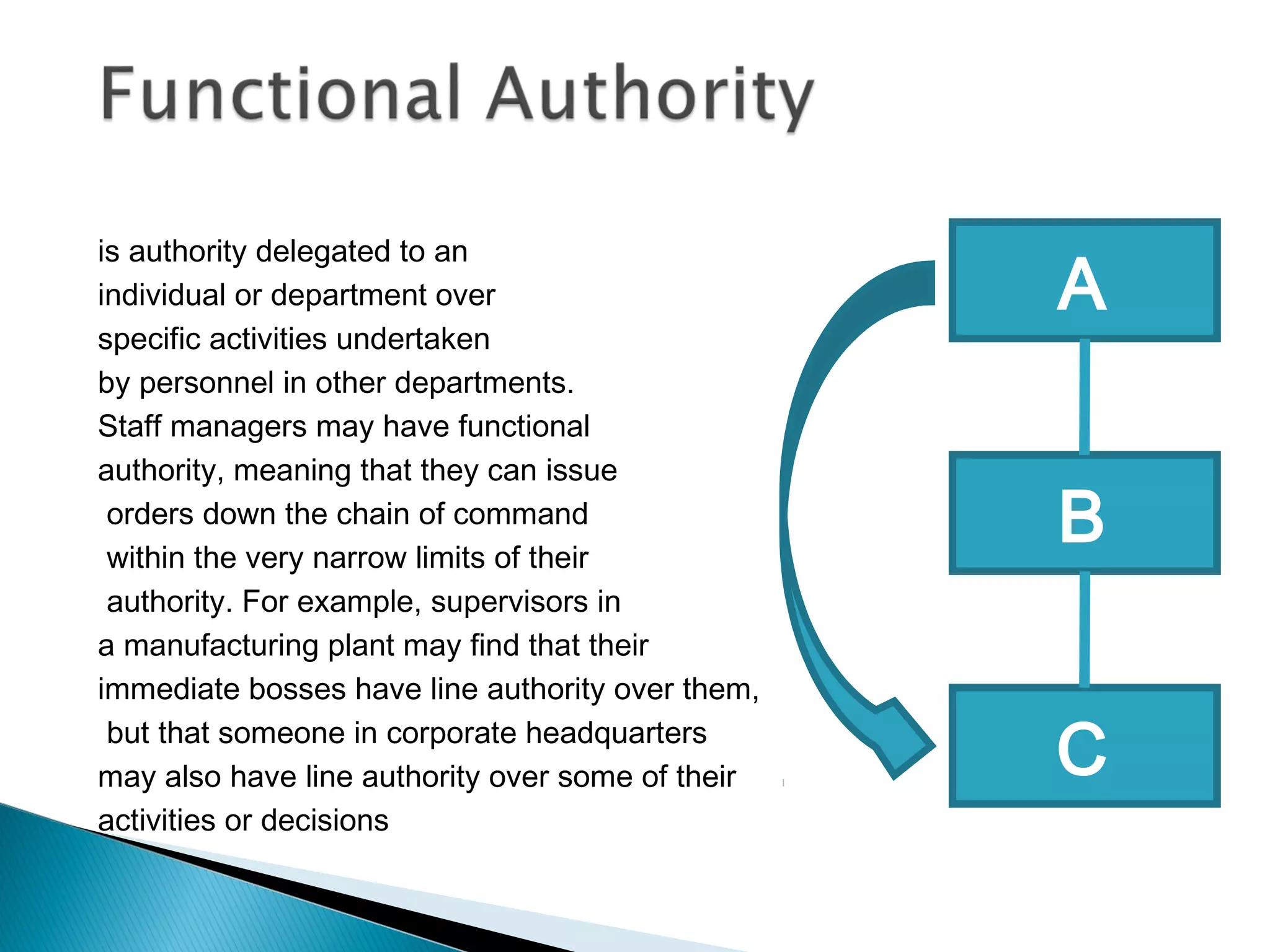
is authority delegated to an
individual or department over
specific activities undertaken
by personnel in other departments.
Staff managers may have functional
authority, meaning that they can issue
orders down the chain of command
within the very narrow limits of their
authority. For example, supervisors in
a manufacturing plant may find that their
immediate bosses have line authority over them,
but that someone in corporate headquarters
may also have line authority over some of their
activities or decisions
A
B
C
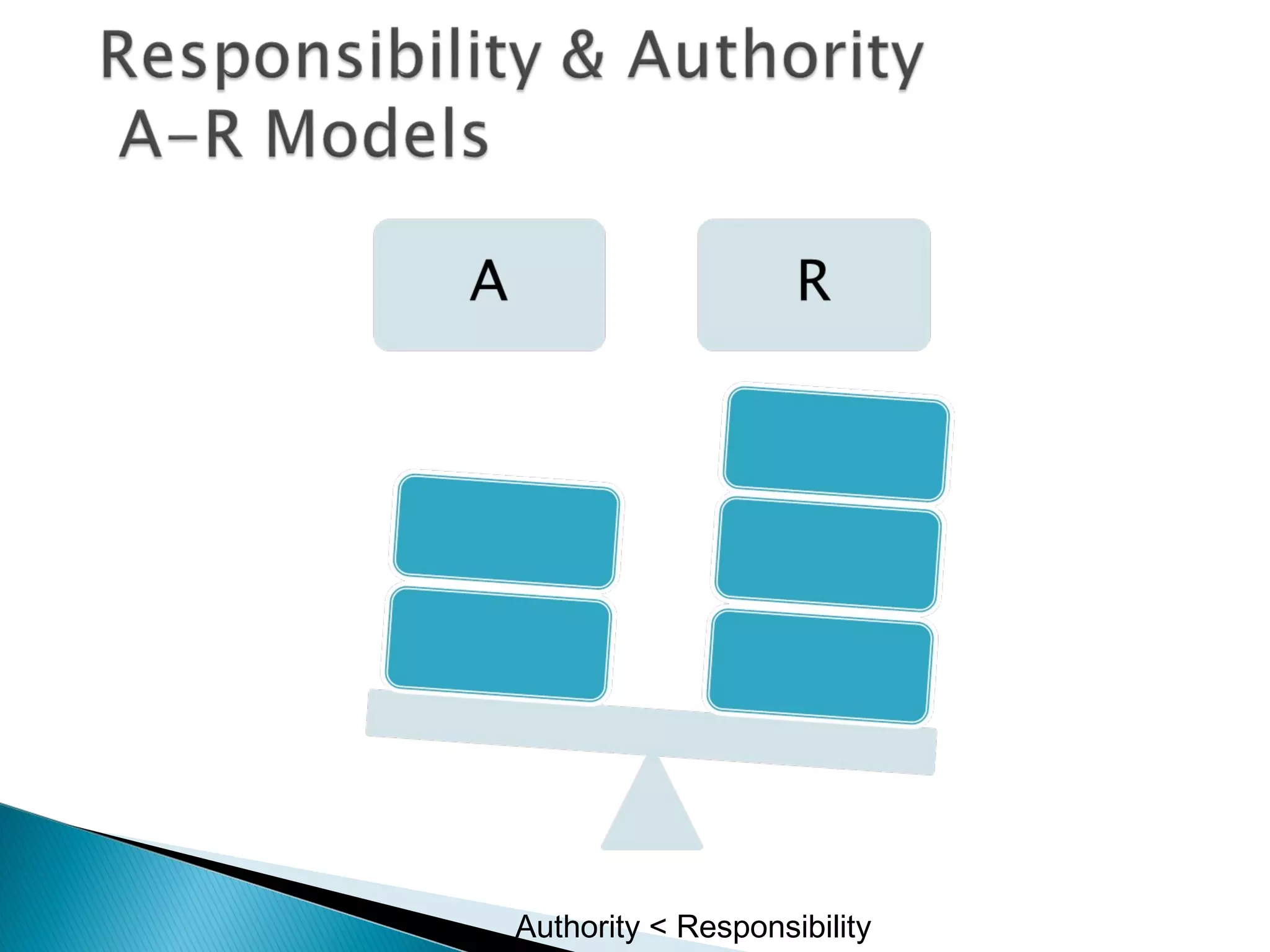
Authority < Responsibility
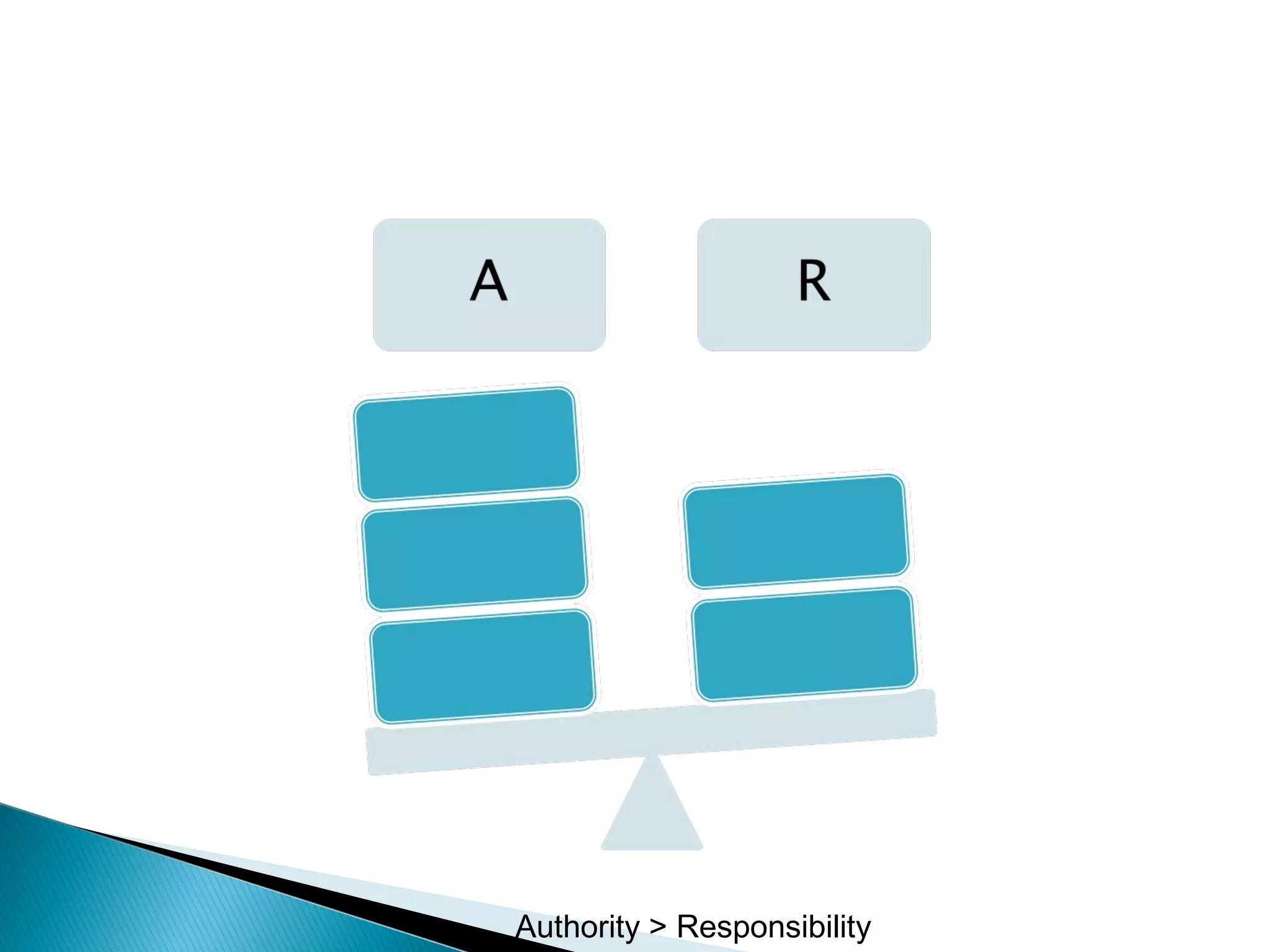
Authority > Responsibility
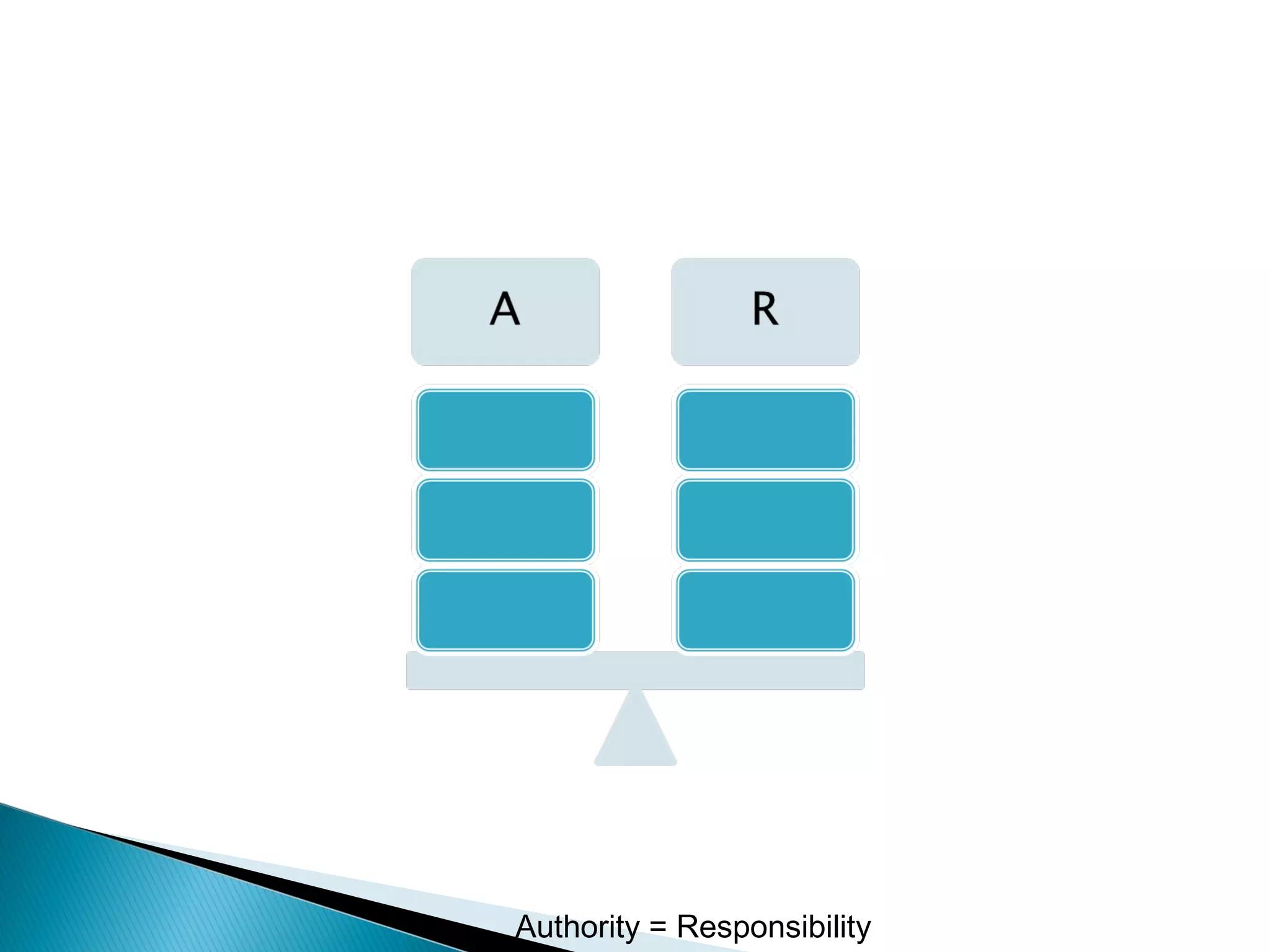
Authority = Responsibility
LECTURE-2
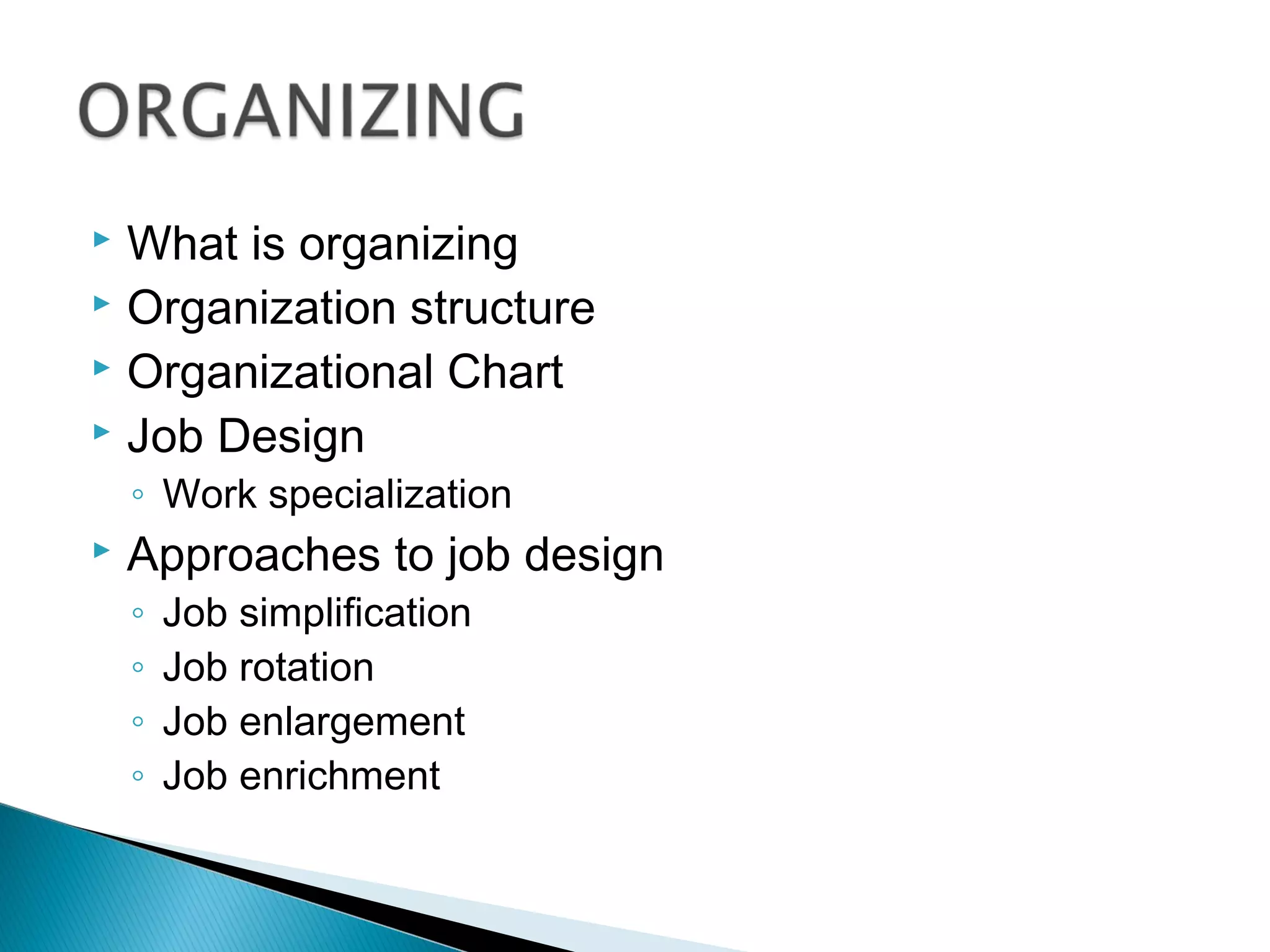
 What is organizing
 Organization structure
 Organizational Chart
 Job Design
◦ Work specialization
 Approaches to job design
◦ Job simplification
◦ Job rotation
◦ Job enlargement
◦ Job enrichment
 The linking of activities at the top of the
organization with those at the middle and lower
levels in order to achieve organizational goals.
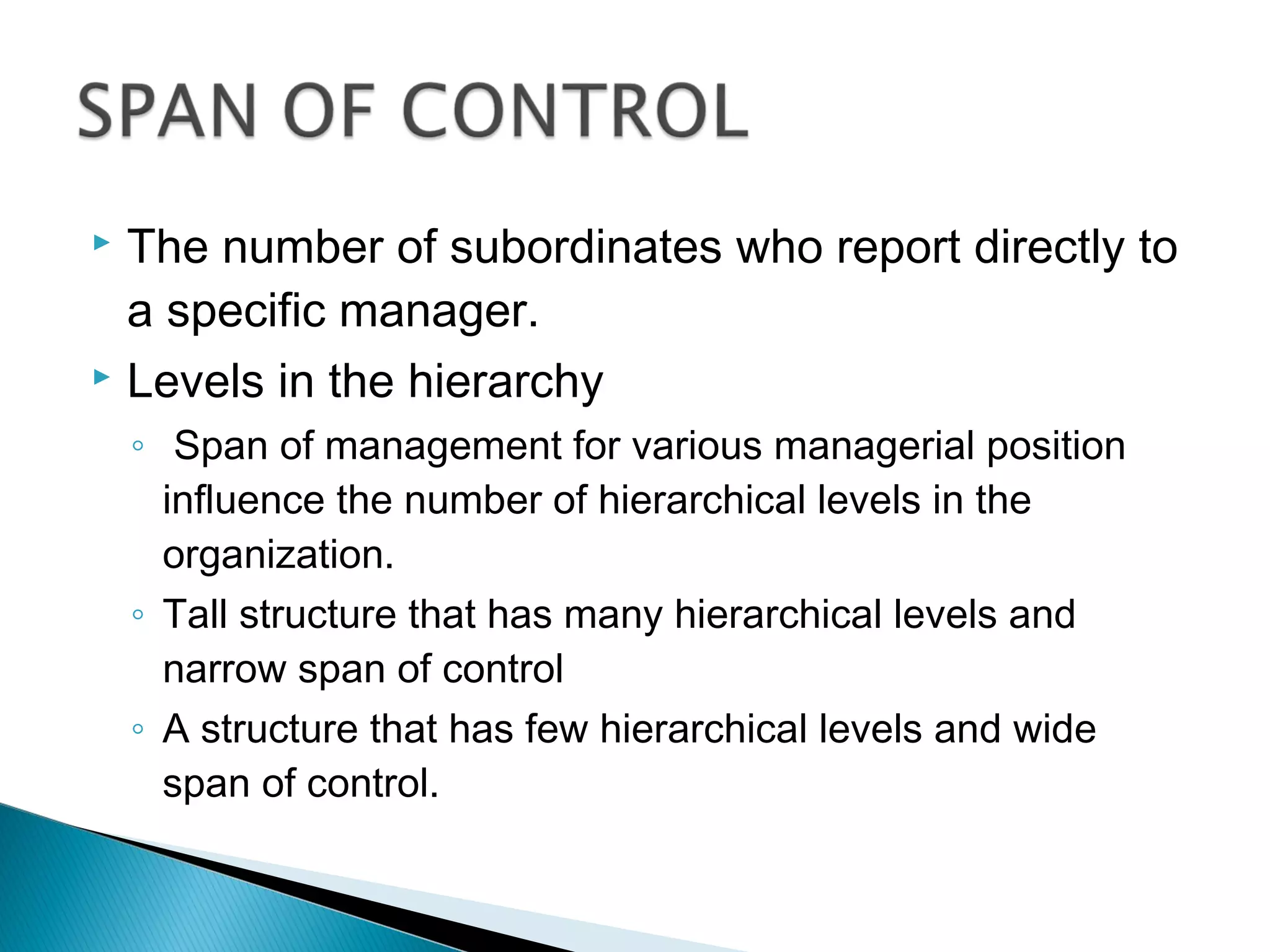
 The number of subordinates who report directly to
a specific manager.
 Levels in the hierarchy
◦ Span of management for various managerial position
influence the number of hierarchical levels in the
organization.
◦ Tall structure that has many hierarchical levels and
narrow span of control
◦ A structure that has few hierarchical levels and wide
span of control.
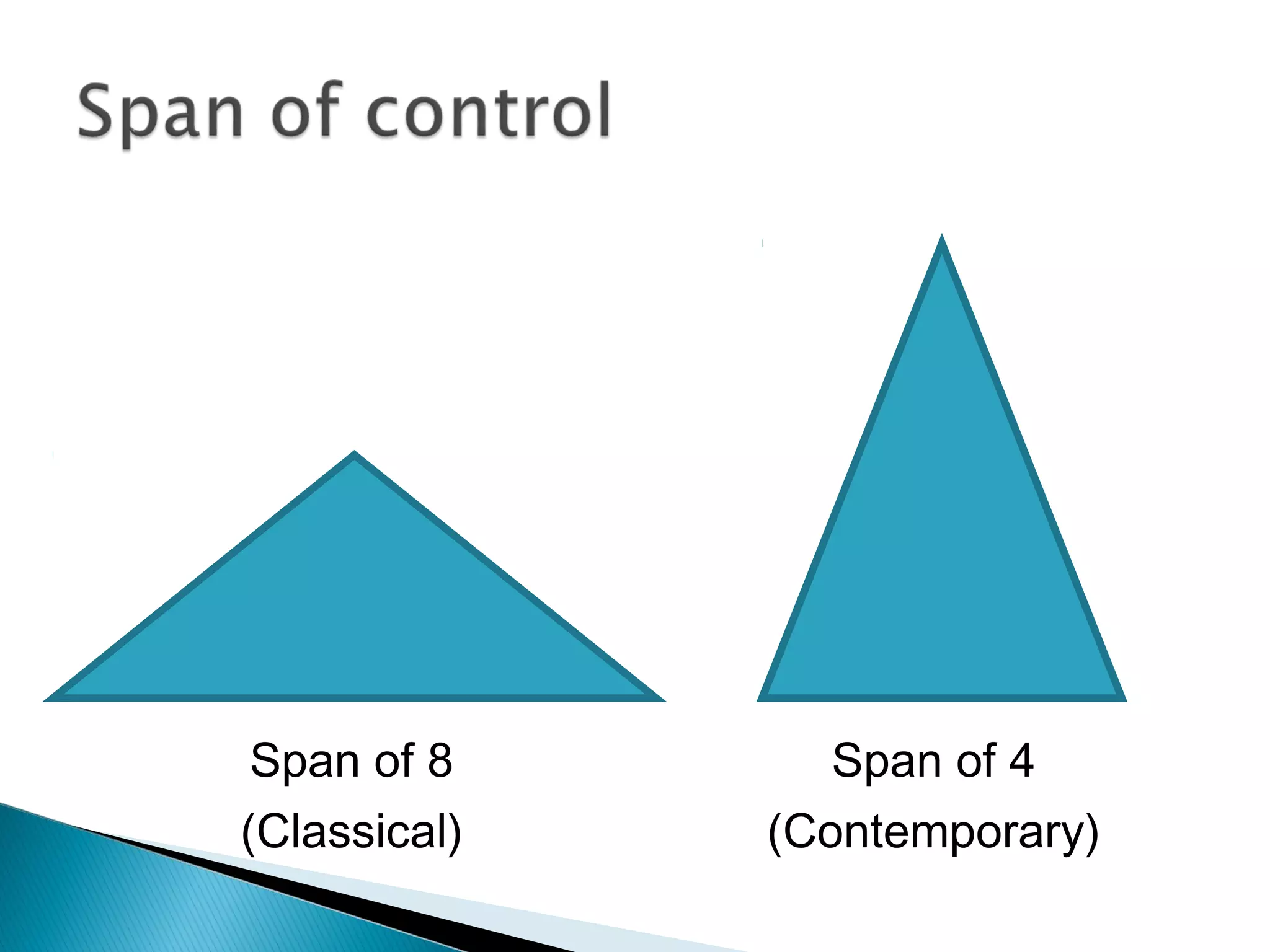
Span of 8
(Classical)
Span of 4
(Contemporary)
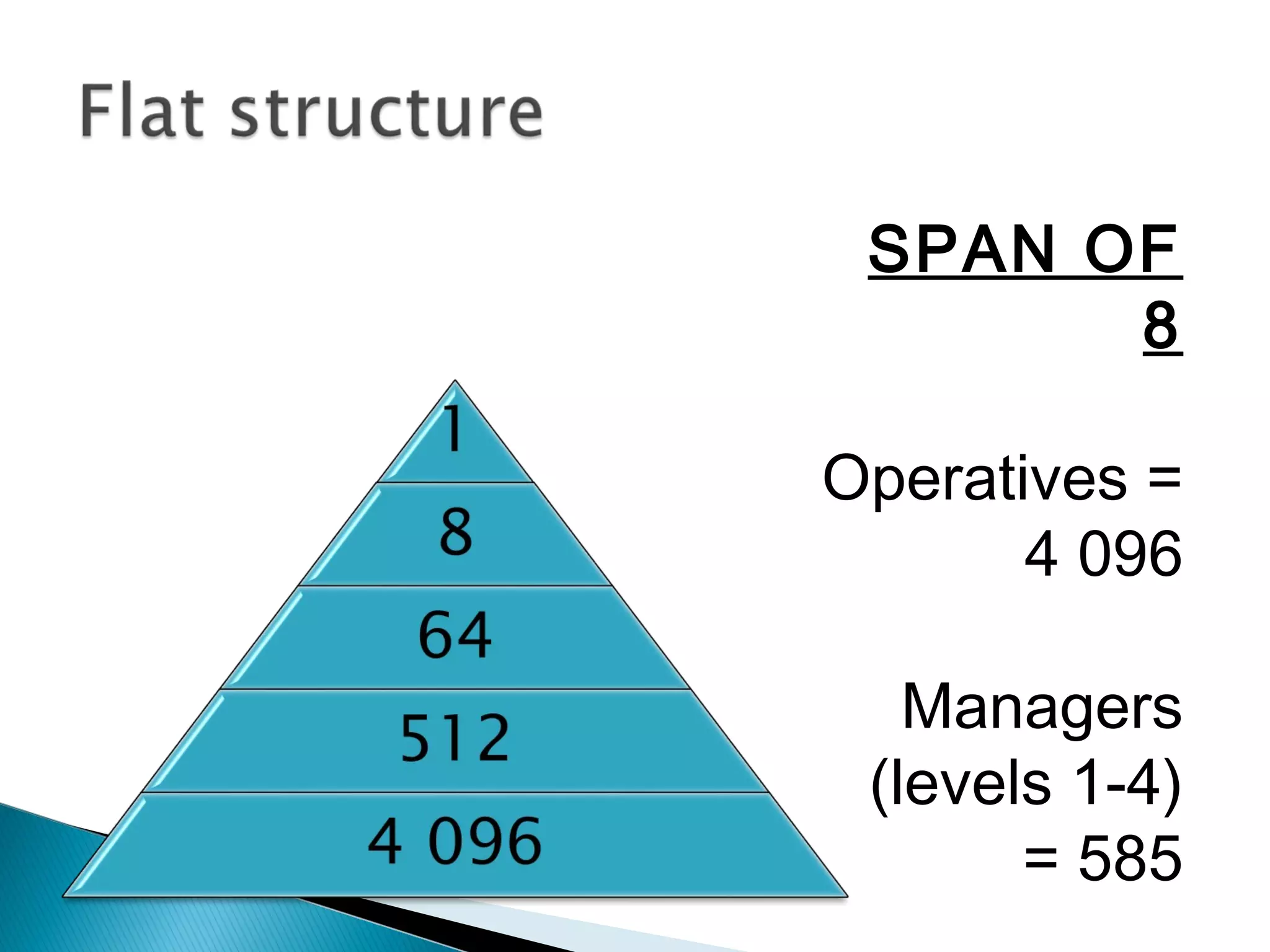
SPAN OF
8
Operatives =
4 096
Managers
(levels 1-4)
= 585
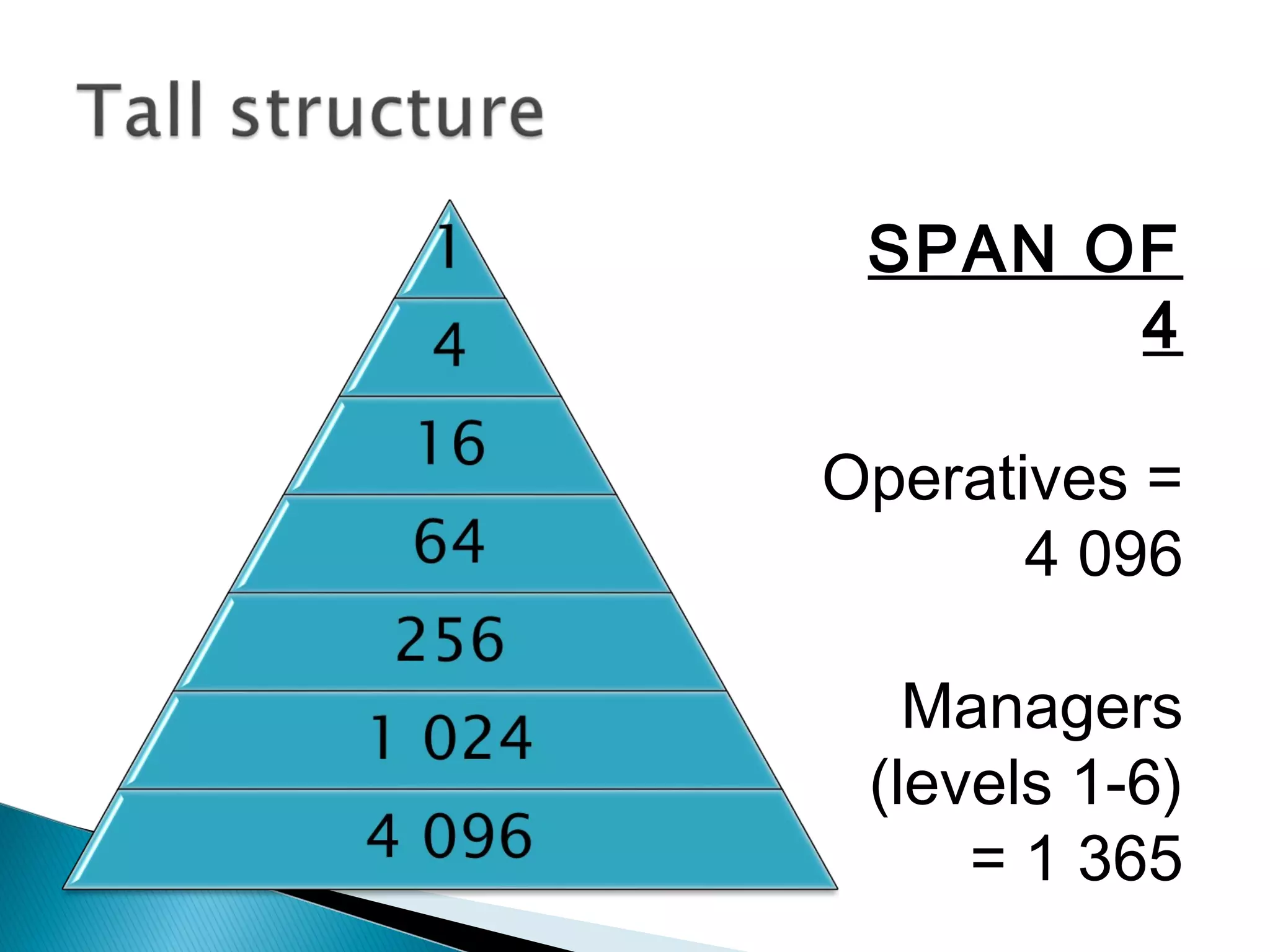
SPAN OF
4
Operatives =
4 096
Managers
(levels 1-6)
= 1 365
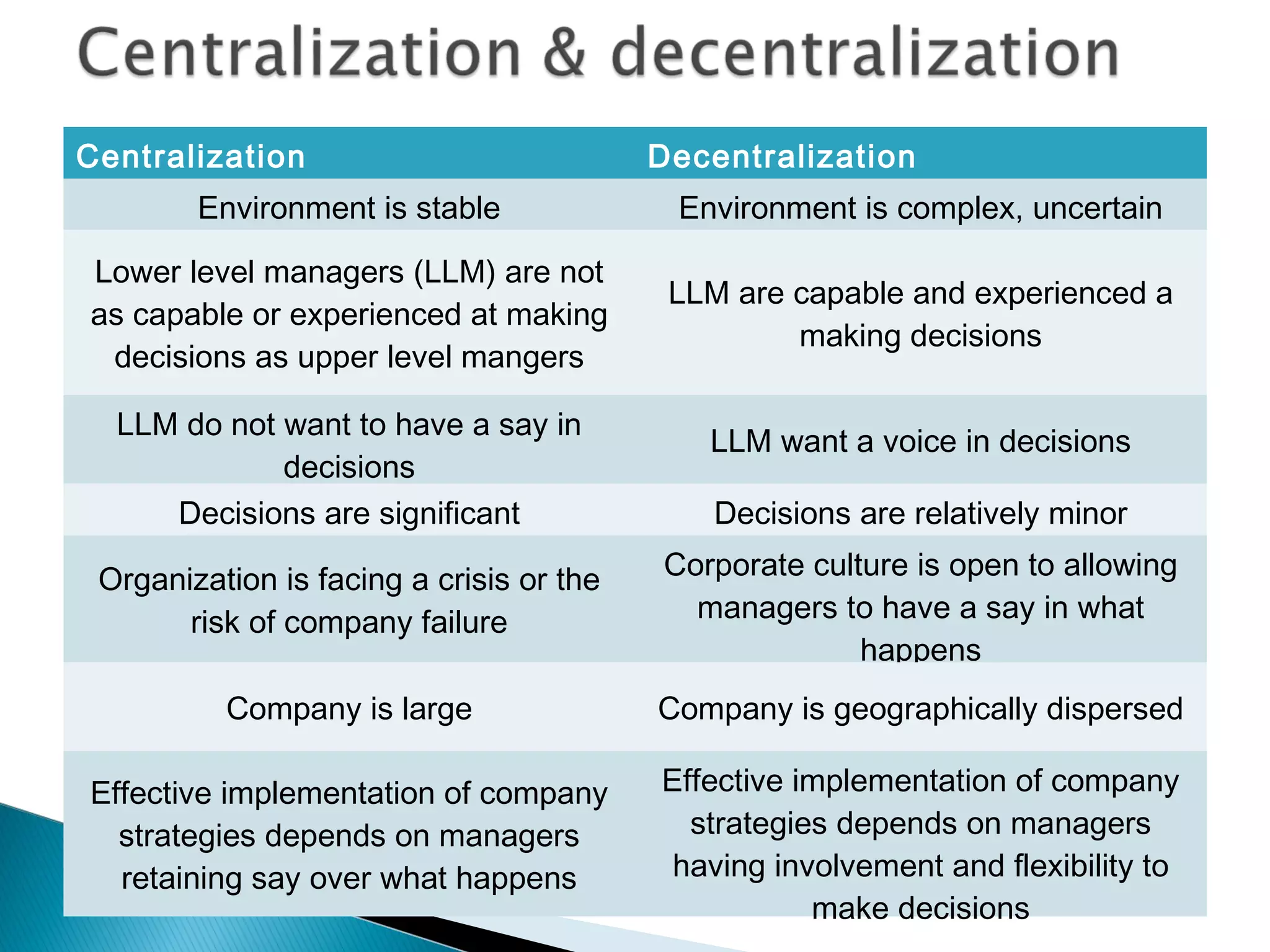
Centralization Decentralization
Environment is stable Environment is complex, uncertain
Lower level managers (LLM) are not
as capable or experienced at making
decisions as upper level mangers
LLM are capable and experienced a
making decisions
LLM do not want to have a say in
decisions
LLM want a voice in decisions
Decisions are significant Decisions are relatively minor
Organization is facing a crisis or the
risk of company failure
Corporate culture is open to allowing
managers to have a say in what
happens
Company is large Company is geographically dispersed
Effective implementation of company
strategies depends on managers
retaining say over what happens
Effective implementation of company
strategies depends on managers
having involvement and flexibility to
make decisions
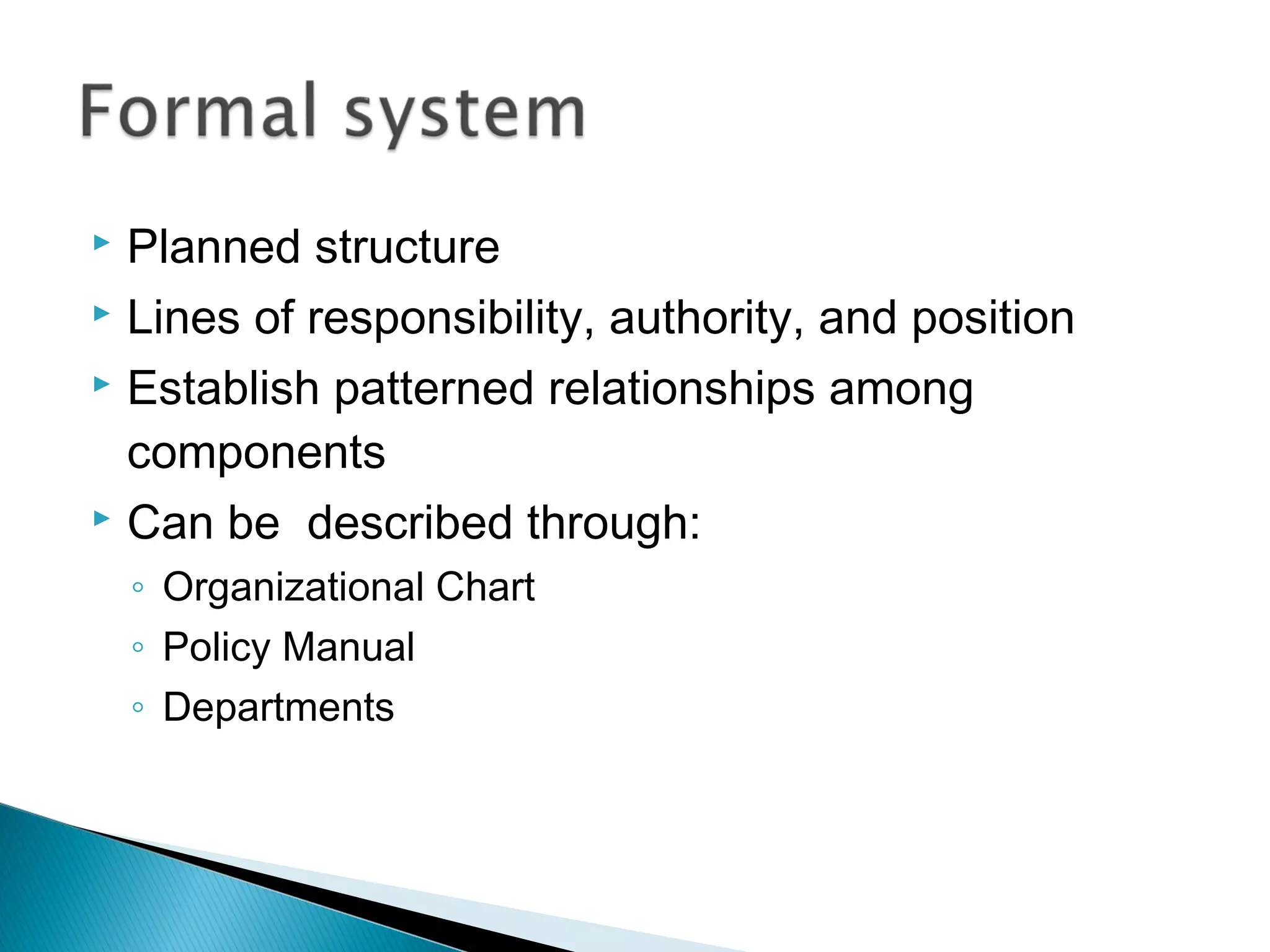
 Planned structure
 Lines of responsibility, authority, and position
 Establish patterned relationships among
components
 Can be described through:
◦ Organizational Chart
◦ Policy Manual
◦ Departments
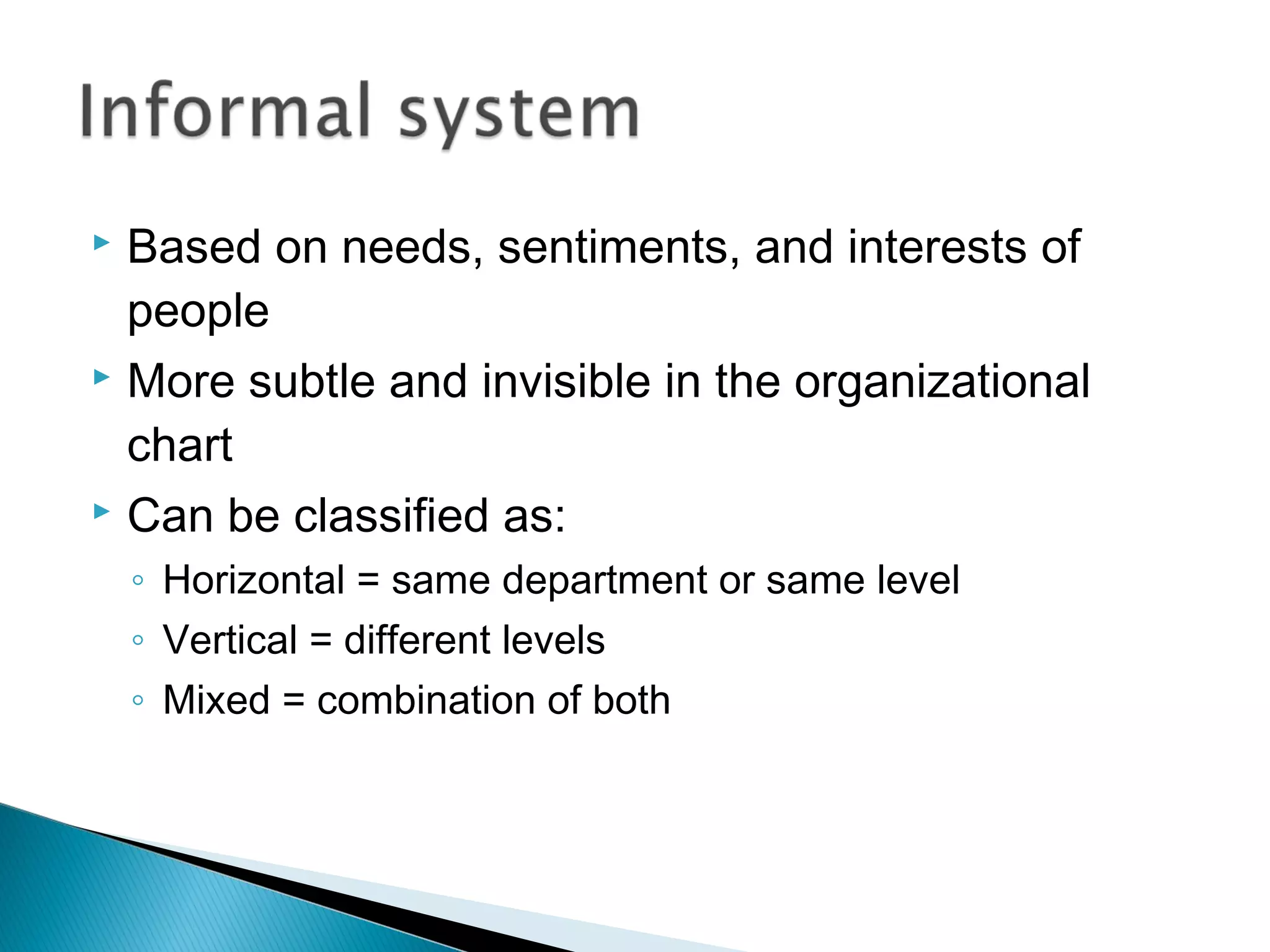
 Based on needs, sentiments, and interests of
people
 More subtle and invisible in the organizational
chart
 Can be classified as:
◦ Horizontal = same department or same level
◦ Vertical = different levels
◦ Mixed = combination of both

Management functions in organization

  • 1.
  • 3.
     Organizing isa function by which the concern is able to define the role positions, the jobs related and the coordination between authority and responsibility.
  • 4.
     structuring ofresources and activities  accomplish objectives efficiently and effectively
  • 6.
     Plan implementation Assignment of authority, responsibility, and accountability  Division of work  Coordinates diverse organizational tasks  Establish relationship among individuals, groups and departments  Establish formal lines of authority  Allocation and deployment of organizational resources
  • 9.
  • 10.
     The chain ofcommand is an unbroken line of authority that links all persons in an organization and defines who reports to whom. This chain has two underlying principles: unity of command and scalar principle.
  • 11.
  • 12.
      The scalarprinciple refers to a clearly defined line of authority that includes all employees in the organization. The classical school of management suggests that there should be a clear and unbroken chain of command linking every person in the organization with successively higher levels of authority up to and including the top manager. When organizations grow in size, they tend to get taller, as more and more levels of management are added. This increases overhead costs, adds more communication layers, and impacts understanding and access between top and bottom levels. It can greatly slow decision making and can lead to a loss of contact with the client or customer.
  • 13.
     Authority is theformal and legitimate right of a manager to make decisions, issue orders, and allocate resources to achieve organizationally desired outcomes. A manager's authority is defined in his or her job description. Organizational authority has three important underlying principles:  Authority is based on the organizational position, and anyone in the same position has the same authority.  Authority is accepted by subordinates. Subordinates comply because they believe that managers have a legitimate right to issue orders.  Authority flows down the vertical hierarchy. Positions at the top of the hierarchy are vested with more formal authority than are positions at the bottom.
  • 14.
    gives a managerthe right to direct the work of his or her employees and make many decisions without consulting others. Line managers are always in charge of essential activities such as sales, and they are authorized to issue orders to subordinates down the chain of command. A B C
  • 15.
    Staff authority supports lineauthority by advising, servicing, and assisting, but this type of authority is typically limited. For example, the assistant to the department head has staff authority because he or she acts as an extension of that authority. These assistants can give advice and suggestions, but they don't have to be obeyed. The department head may also give the assistant the authority to act, such as the right to sign off on expense reports or memos. A B C
  • 16.
    is authority delegatedto an individual or department over specific activities undertaken by personnel in other departments. Staff managers may have functional authority, meaning that they can issue orders down the chain of command within the very narrow limits of their authority. For example, supervisors in a manufacturing plant may find that their immediate bosses have line authority over them, but that someone in corporate headquarters may also have line authority over some of their activities or decisions A B C
  • 17.
  • 18.
  • 19.
  • 20.
  • 21.
     What isorganizing  Organization structure  Organizational Chart  Job Design ◦ Work specialization  Approaches to job design ◦ Job simplification ◦ Job rotation ◦ Job enlargement ◦ Job enrichment
  • 22.
     The linkingof activities at the top of the organization with those at the middle and lower levels in order to achieve organizational goals.
  • 23.
     The numberof subordinates who report directly to a specific manager.  Levels in the hierarchy ◦ Span of management for various managerial position influence the number of hierarchical levels in the organization. ◦ Tall structure that has many hierarchical levels and narrow span of control ◦ A structure that has few hierarchical levels and wide span of control.
  • 24.
    Span of 8 (Classical) Spanof 4 (Contemporary)
  • 25.
    SPAN OF 8 Operatives = 4096 Managers (levels 1-4) = 585
  • 26.
    SPAN OF 4 Operatives = 4096 Managers (levels 1-6) = 1 365
  • 27.
    Centralization Decentralization Environment isstable Environment is complex, uncertain Lower level managers (LLM) are not as capable or experienced at making decisions as upper level mangers LLM are capable and experienced a making decisions LLM do not want to have a say in decisions LLM want a voice in decisions Decisions are significant Decisions are relatively minor Organization is facing a crisis or the risk of company failure Corporate culture is open to allowing managers to have a say in what happens Company is large Company is geographically dispersed Effective implementation of company strategies depends on managers retaining say over what happens Effective implementation of company strategies depends on managers having involvement and flexibility to make decisions
  • 28.
     Planned structure Lines of responsibility, authority, and position  Establish patterned relationships among components  Can be described through: ◦ Organizational Chart ◦ Policy Manual ◦ Departments
  • 29.
     Based onneeds, sentiments, and interests of people  More subtle and invisible in the organizational chart  Can be classified as: ◦ Horizontal = same department or same level ◦ Vertical = different levels ◦ Mixed = combination of both