







1
2
Meaning
 If the manager requires his subordinate to perform the
work, he must entrust him with part of the rights and
powers which he would have to exercise himself to get that
work done.
-Louis A. Allen
 Delegating of authority merely means the granting of
authority to subordinates to operate within prescribed
limits.
-Theo Haimman
3
Advantages
 It relieves the manager of his heavy workload.
 It leads to better decisions.
 It speeds up decision-making.
 It help rain subordinates and builds morale.
 It serves as compensation to those employees who
face the prospect of limited advancement.
 It helps create a formal organisation structure.
4
Disadvantages
 The central management is far removed from the actual operations
where the decisions are made.
 It may be difficult to perfectly match the task with the capability of
the subordinate.
 A manager may lack confidence and trust in his subordinates.
 Some managers feel very insecure in delegating authority, when he is
capable of doing the job better.
 Many subordinates are reluctant to accept authority and make
decision that they would be criticized.
 A subordinate may lack self-confidence in doing the job and may fear
that the supervisor will not guidance after delegation.
5
 Assignment of task.
 Delegation of decision making authority.
 Creating of obligation.
 Creating of accountability.
Process
6
Meaning
Decentralisation refers to systematic effort to delegate to
the lowest level all authority except that which can be
exercised at central points .
-Louis A. Allen
Everything which goes to increase the important of a
subordinate’s role is decentralisation, every thing that goes
to reduce it is centralisation.
-Henri Fayol
7
8
 Centralisation would imply concentration of decision making
functions at the apex of the management hierarchy.
The authority for most decisions is concentrated at the top
of the managerial hierarchy.
 It refers to the concentration of power of authority at
higher level only.
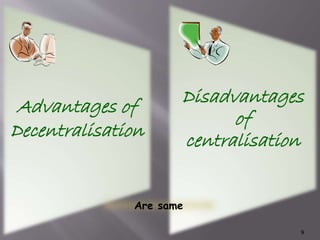
Advantages of
Decentralisation
Disadvantages
of
centralisation
Are same
9
Relieves top management of some burden of decision making.
Gives Managers more freedom and independence in decision
making.
Promotes establishment and use of board control which may
increase motivation.
Facilitates product diversification.
Promotes developments of general manager.
Aids in adaptation to fast changing environment.
Facilitates setting up of profit centre.
10
Disadvantages
of
Decentralisation
Advantages of
centralisation
Are same
11
It provides prestige and power which strengthens the self-
confidence.
It can be highly motivating and morale boosting for
executives.
The services of staff specialists in those area where they
are needed.
It is better equipped to handle any emergencies that might
affect all unit of the organization.
The optimal utilization of human and physical resources.
It is easier to achieve balance among the activities of
different departments and functional area.
12
Example
Way to go,wipro!
Wipro separated itself into several subsidiaries by product
line : Telecommunications, engineering, financial services etc.
Each subsidiary bring in about $ 300 millions in annual earnings
and is self-sufficient with their own accounting books
personnel and administrative functions. Wipro shifted from
centralised to decentralised management system. All
responsibilities for growth lay with the management of each
entity. “ We tried to de-layer the organisation and empower
our business leaders with much higher degree of growth
responsibilities “ said Premji, Chairman of Wipro.
13
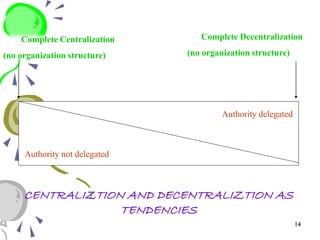
Complete Centralization
(no organization structure)
Complete Decentralization
(no organization structure)
Authority not delegated
Authority delegated
CENTRALIZTION AND DECENTRALIZTION AS
TENDENCIES
14
15
Differentiations
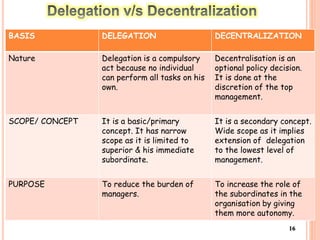
BASIS DELEGATION DECENTRALIZATION
Nature Delegation is a compulsory
act because no individual
can perform all tasks on his
own.
Decentralisation is an
optional policy decision.
It is done at the
discretion of the top
management.
SCOPE/ CONCEPT It is a basic/primary
concept. It has narrow
scope as it is limited to
superior & his immediate
subordinate.
It is a secondary concept.
Wide scope as it implies
extension of delegation
to the lowest level of
management.
PURPOSE To reduce the burden of
managers.
To increase the role of
the subordinates in the
organisation by giving
them more autonomy.
16
17
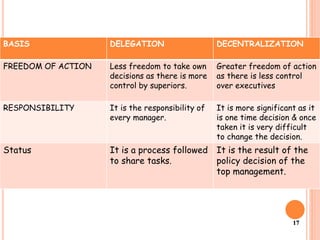
BASIS DELEGATION DECENTRALIZATION
FREEDOM OF ACTION Less freedom to take own
decisions as there is more
control by superiors.
Greater freedom of action
as there is less control
over executives
RESPONSIBILITY It is the responsibility of
every manager.
It is more significant as it
is one time decision & once
taken it is very difficult
to change the decision.
Status It is a process followed
to share tasks.
It is the result of the
policy decision of the
top management.
18
 Mission, goal and objective of the organization: Certain
types of organization such as universities and hospitals have a democratic
power sharing structure and hence a decentralized Form. On the other
hand, the goals and purposes of small Businesses such as a restaurant and
small scale industries would require a more centralized structure.
 Locations of target market: if the customers of an organization
are located far apart geographically, then the decentralization would be
more appropriate since in such a case, the appropriate management
resources would be placed closed to the customers allowing quicker
decisions and faster customer service
 Desirability of creativity in the organization: DONALD
HARPER suggests a decentralization if creativity with in the organization
is desirable and necessary. It gives the sub ordinates freedom to be
innovative and find better ways of doing things. This freedom is highly
motivational factor which encourages creativity.
Delegation, Decentralization and centrlization

Delegation, Decentralization and centrlization

  • 1.
  • 2.
  • 3.
    Meaning  If themanager requires his subordinate to perform the work, he must entrust him with part of the rights and powers which he would have to exercise himself to get that work done. -Louis A. Allen  Delegating of authority merely means the granting of authority to subordinates to operate within prescribed limits. -Theo Haimman 3
  • 4.
    Advantages  It relievesthe manager of his heavy workload.  It leads to better decisions.  It speeds up decision-making.  It help rain subordinates and builds morale.  It serves as compensation to those employees who face the prospect of limited advancement.  It helps create a formal organisation structure. 4
  • 5.
    Disadvantages  The centralmanagement is far removed from the actual operations where the decisions are made.  It may be difficult to perfectly match the task with the capability of the subordinate.  A manager may lack confidence and trust in his subordinates.  Some managers feel very insecure in delegating authority, when he is capable of doing the job better.  Many subordinates are reluctant to accept authority and make decision that they would be criticized.  A subordinate may lack self-confidence in doing the job and may fear that the supervisor will not guidance after delegation. 5
  • 6.
     Assignment oftask.  Delegation of decision making authority.  Creating of obligation.  Creating of accountability. Process 6
  • 7.
    Meaning Decentralisation refers tosystematic effort to delegate to the lowest level all authority except that which can be exercised at central points . -Louis A. Allen Everything which goes to increase the important of a subordinate’s role is decentralisation, every thing that goes to reduce it is centralisation. -Henri Fayol 7
  • 8.
    8  Centralisation wouldimply concentration of decision making functions at the apex of the management hierarchy. The authority for most decisions is concentrated at the top of the managerial hierarchy.  It refers to the concentration of power of authority at higher level only.
  • 9.
  • 10.
    Relieves top managementof some burden of decision making. Gives Managers more freedom and independence in decision making. Promotes establishment and use of board control which may increase motivation. Facilitates product diversification. Promotes developments of general manager. Aids in adaptation to fast changing environment. Facilitates setting up of profit centre. 10
  • 11.
  • 12.
    It provides prestigeand power which strengthens the self- confidence. It can be highly motivating and morale boosting for executives. The services of staff specialists in those area where they are needed. It is better equipped to handle any emergencies that might affect all unit of the organization. The optimal utilization of human and physical resources. It is easier to achieve balance among the activities of different departments and functional area. 12
  • 13.
    Example Way to go,wipro! Wiproseparated itself into several subsidiaries by product line : Telecommunications, engineering, financial services etc. Each subsidiary bring in about $ 300 millions in annual earnings and is self-sufficient with their own accounting books personnel and administrative functions. Wipro shifted from centralised to decentralised management system. All responsibilities for growth lay with the management of each entity. “ We tried to de-layer the organisation and empower our business leaders with much higher degree of growth responsibilities “ said Premji, Chairman of Wipro. 13
  • 14.
    Complete Centralization (no organizationstructure) Complete Decentralization (no organization structure) Authority not delegated Authority delegated CENTRALIZTION AND DECENTRALIZTION AS TENDENCIES 14
  • 15.
  • 16.
    BASIS DELEGATION DECENTRALIZATION NatureDelegation is a compulsory act because no individual can perform all tasks on his own. Decentralisation is an optional policy decision. It is done at the discretion of the top management. SCOPE/ CONCEPT It is a basic/primary concept. It has narrow scope as it is limited to superior & his immediate subordinate. It is a secondary concept. Wide scope as it implies extension of delegation to the lowest level of management. PURPOSE To reduce the burden of managers. To increase the role of the subordinates in the organisation by giving them more autonomy. 16
  • 17.
    17 BASIS DELEGATION DECENTRALIZATION FREEDOMOF ACTION Less freedom to take own decisions as there is more control by superiors. Greater freedom of action as there is less control over executives RESPONSIBILITY It is the responsibility of every manager. It is more significant as it is one time decision & once taken it is very difficult to change the decision. Status It is a process followed to share tasks. It is the result of the policy decision of the top management.
  • 18.
    18  Mission, goaland objective of the organization: Certain types of organization such as universities and hospitals have a democratic power sharing structure and hence a decentralized Form. On the other hand, the goals and purposes of small Businesses such as a restaurant and small scale industries would require a more centralized structure.  Locations of target market: if the customers of an organization are located far apart geographically, then the decentralization would be more appropriate since in such a case, the appropriate management resources would be placed closed to the customers allowing quicker decisions and faster customer service  Desirability of creativity in the organization: DONALD HARPER suggests a decentralization if creativity with in the organization is desirable and necessary. It gives the sub ordinates freedom to be innovative and find better ways of doing things. This freedom is highly motivational factor which encourages creativity.