Unit Three:
Organizing and Organization
1
Organizing
Session objectives
At the end of this session students will be able to :
 Define an organization and organizing function
 Understand organizational design and structure
 Contrast mechanistic and organic structural
designs
2
Organizing
Next step after planning.
 A key issue in accomplishing the goals identified in
the planning process.
structuring the work of the organization.
Is a process of deciding what work needs to be
done,
Is the process of arranging and allocating
work, authority and resources among
organization members to achieve goals.
3
The Importance of Organizing
• It is the primary mechanisms managers use to
activate plans
• It creates and maintains relationships between
all organizational resources by indicating which
resources are to be used for specified activities
and when, where, and how they are to be used.
• managers minimize costly weakness, such as
duplication of effort and idle organizational
resources.
4
The steps in the organizing process
include:
1. Review plans,
2. List all tasks to be accomplished,
3. Group related jobs together in a logical and efficient
manner,
4. Assign work to individuals,
5. Delegate authority
5
Organization
Two or more people who work together in a structured way to
to achieve a specific goal or set of goals.
Types of Organizations
- Many types: manufacturers, associations, political
parties, community associations, hospitals, etc.
 formal and informal
• In both people are kept together
 believing there is a benefit working together to achieve a
common goal
6
Characteristics of organizations:
Whatever their purpose, all organizations have four
characteristics:
1. Coordination of effort
2. Common goal or purpose
3. Division of labor, and
4. Hierarchy of authority.
7
Organizational Structure
• The way, in which an organization’s activities are
divided, organized and coordinated.
• Is the formal decision-making framework by which
job tasks are divided, grouped, and coordinated.
Why formal?
• It is the official organizational structure built by top
management.
• Formalization is an important aspect of structure.
8
Organizing….
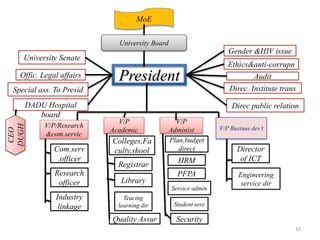
Organization charts/high level maps/
The formal organization can be seen and
represented in chart form.
The chart represents channels through which
authority, power and responsibilities flow.
Displays the organizational structure and
shows job titles, lines of authority, and
relationships between departments.
Is helpful for managers as it is an
organizational blue print for deploying
human resource. 9
MoE
University Board
President
Gender &HIV issue
Ethics&anti-corrupn
Audit
Direc. Institute trans
Direc public relation
DADU Hospital
board
Special ass. To Presid
Offic. Legal affairs
University Senate
V/P/Research
&com.servic
Colleges,Fa
culty,shool
Com.serv
.officer
Research
officer
Director
of ICT
V/P Businus dev’t
HRM
Plan,budget
direct
V/P
Academic
V/P
Administ
CEO
DUGH
Industry
linkage Student serv
Library
PFPA
Registrar
Service admin
Quality Assur
Teacing
learning dir
Security
Engineering
service dir
10
Organizing…
Why do we need an organizational
structure?
A clear organizational structure
• Clarifies the work environment,
• Creates a coordinated environment,
• Achieves a unity of direction, and
• Establishes a chain of command
11
Views(types) of organizational design
1) Mechanistic System (Tall structure )
• Traditional or classical design
– common in medium & large sized organizations.
• Organizational activities are broken down into separate,
separate, specialized tasks
• Objectives for each individual & units are precisely
defined by top level managers.
• It is best suited to a stable environment
12
Views on organizational design
2. Organic system (flat structure)
• More flexible, adaptable to a participative form of
management
• Open to the environment
• Less emphasis on taking orders from a manager or
giving orders to employees
• Organizational members must be skilled at solving a
a variety of problems
• Creative problem solving & decision making.
13
Organizing….
Functional Steps in Organizing
• The four building blocks of organizing are:
Division of work
Departmentalization
Hierarchy
Coordination
14
Organizing….
1. Division of work / Division of labour/ work
specialization
• Is the degree to which tasks in an organization are
divided into separate jobs.
• Is breaking of a complex task into components
Individuals are responsible for a limited set of
activities instead of the entire task.
• Placing capable people in each job ties directly with
with productivity improvement.
15
Organizing….
2. Departmentalization
• Once work activities are divided in to jobs or jobs
have been classified through work specialization,
they are grouped so those common tasks can be
coordinated and can be similarly and logically
connected.
• Departmentalization is the basis on which work or
individuals are grouped into manageable units.
 Each single box in an organizational chart
represents departments
16
Organizing…
3. Hierarchy
 A concept that shows how many could be
effectively handled
 A pattern of multiple levels of an organizational
structure
 At the top the senior-ranking manager
 Bottom - low-ranking managers located at
various levels
17
Hierarchy
Span of management or span of control
• The number of people/departments directly
reporting to a given manager.
 After work is divided, departments created and
span of control chosen decide on chain of
command.
Chain of command
• The plan that specifies who reports to whom
• Fundamental feature of an organization
The result of the two decisions lead to a pattern:
hierarchy
18
Hierarchy…..
• Unity of Command: Each employee must
instructions from only one person.
– If an employee reported to more than one manager,
conflicts in instructions and confusion of authority
would result.
• Unity of Direction: should be directed by only
manager using one plan.
19
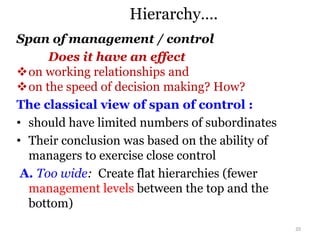
Hierarchy….
Span of management / control
Does it have an effect
on working relationships and
on the speed of decision making? How?
The classical view of span of control :
• should have limited numbers of subordinates
• Their conclusion was based on the ability of
managers to exercise close control
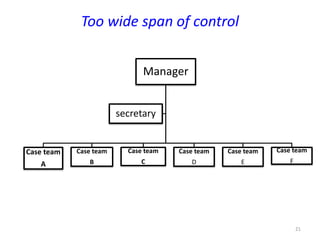
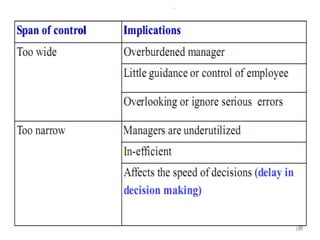
A. Too wide: Create flat hierarchies (fewer
management levels between the top and the
bottom)
20
Too wide span of control
Manager
Case team
A
Case team
B
Case team
C
Case team
D
Case team
E
Case team
F
secretary
21
Hierarchy…..
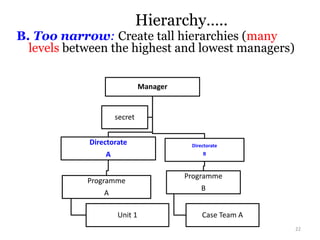
B. Too narrow: Create tall hierarchies (many
levels between the highest and lowest managers)
Manager
Directorate
A
Programme
A
Unit 1
Directorate
B
Programme
B
Case Team A
secret
22
Q
23
Factors affecting span of control
1. Level of profession & training of staff:
– Skilled staff require less close supervision
(Wider spans of control)
2. Level of uncertainty in the tasks to be done
:
– Complex & varied works require close
supervision (narrower spans of control )
24
Factors affecting span of control…
3. Degree of standardization of tasks :
– Standardized tasks require less frequent
supervision compared to less standardized ones
(wider spans of control )
4. Abilities & personal qualities of the
managers themselves
25
Organizing…
4. Coordination:
• The integration of activities of separate parts of an
an organization for accomplishing the
organizational goals
Integration: the degree to which various
departments work in a unified manner
The degree of coordination depends on:
• Nature of task
• Degree of interdependence of people in the
various units
• Eg. Clinical services
26
High degree of coordination is needed:
• When communication between units is important
• For non-routine & unpredictable works
• When organizations are challenged with unstable
environment
• When there is high interdependence between units
• When the organization has set high performance
objectives
• For highly specialized task such as coordination
among different organizations
27
Approaches to achieving effective
coordination
• Using basic management techniques
1. Specify relationships (managerial hierarchy or
chain of command)
2. Set rules and procedures
3. Management By Walking Around (MBWA)
28
Thank you!!
29

unit 3.pptx

  • 1.
  • 2.
    Organizing Session objectives At theend of this session students will be able to :  Define an organization and organizing function  Understand organizational design and structure  Contrast mechanistic and organic structural designs 2
  • 3.
    Organizing Next step afterplanning.  A key issue in accomplishing the goals identified in the planning process. structuring the work of the organization. Is a process of deciding what work needs to be done, Is the process of arranging and allocating work, authority and resources among organization members to achieve goals. 3
  • 4.
    The Importance ofOrganizing • It is the primary mechanisms managers use to activate plans • It creates and maintains relationships between all organizational resources by indicating which resources are to be used for specified activities and when, where, and how they are to be used. • managers minimize costly weakness, such as duplication of effort and idle organizational resources. 4
  • 5.
    The steps inthe organizing process include: 1. Review plans, 2. List all tasks to be accomplished, 3. Group related jobs together in a logical and efficient manner, 4. Assign work to individuals, 5. Delegate authority 5
  • 6.
    Organization Two or morepeople who work together in a structured way to to achieve a specific goal or set of goals. Types of Organizations - Many types: manufacturers, associations, political parties, community associations, hospitals, etc.  formal and informal • In both people are kept together  believing there is a benefit working together to achieve a common goal 6
  • 7.
    Characteristics of organizations: Whatevertheir purpose, all organizations have four characteristics: 1. Coordination of effort 2. Common goal or purpose 3. Division of labor, and 4. Hierarchy of authority. 7
  • 8.
    Organizational Structure • Theway, in which an organization’s activities are divided, organized and coordinated. • Is the formal decision-making framework by which job tasks are divided, grouped, and coordinated. Why formal? • It is the official organizational structure built by top management. • Formalization is an important aspect of structure. 8
  • 9.
    Organizing…. Organization charts/high levelmaps/ The formal organization can be seen and represented in chart form. The chart represents channels through which authority, power and responsibilities flow. Displays the organizational structure and shows job titles, lines of authority, and relationships between departments. Is helpful for managers as it is an organizational blue print for deploying human resource. 9
  • 10.
    MoE University Board President Gender &HIVissue Ethics&anti-corrupn Audit Direc. Institute trans Direc public relation DADU Hospital board Special ass. To Presid Offic. Legal affairs University Senate V/P/Research &com.servic Colleges,Fa culty,shool Com.serv .officer Research officer Director of ICT V/P Businus dev’t HRM Plan,budget direct V/P Academic V/P Administ CEO DUGH Industry linkage Student serv Library PFPA Registrar Service admin Quality Assur Teacing learning dir Security Engineering service dir 10
  • 11.
    Organizing… Why do weneed an organizational structure? A clear organizational structure • Clarifies the work environment, • Creates a coordinated environment, • Achieves a unity of direction, and • Establishes a chain of command 11
  • 12.
    Views(types) of organizationaldesign 1) Mechanistic System (Tall structure ) • Traditional or classical design – common in medium & large sized organizations. • Organizational activities are broken down into separate, separate, specialized tasks • Objectives for each individual & units are precisely defined by top level managers. • It is best suited to a stable environment 12
  • 13.
    Views on organizationaldesign 2. Organic system (flat structure) • More flexible, adaptable to a participative form of management • Open to the environment • Less emphasis on taking orders from a manager or giving orders to employees • Organizational members must be skilled at solving a a variety of problems • Creative problem solving & decision making. 13
  • 14.
    Organizing…. Functional Steps inOrganizing • The four building blocks of organizing are: Division of work Departmentalization Hierarchy Coordination 14
  • 15.
    Organizing…. 1. Division ofwork / Division of labour/ work specialization • Is the degree to which tasks in an organization are divided into separate jobs. • Is breaking of a complex task into components Individuals are responsible for a limited set of activities instead of the entire task. • Placing capable people in each job ties directly with with productivity improvement. 15
  • 16.
    Organizing…. 2. Departmentalization • Oncework activities are divided in to jobs or jobs have been classified through work specialization, they are grouped so those common tasks can be coordinated and can be similarly and logically connected. • Departmentalization is the basis on which work or individuals are grouped into manageable units.  Each single box in an organizational chart represents departments 16
  • 17.
    Organizing… 3. Hierarchy  Aconcept that shows how many could be effectively handled  A pattern of multiple levels of an organizational structure  At the top the senior-ranking manager  Bottom - low-ranking managers located at various levels 17
  • 18.
    Hierarchy Span of managementor span of control • The number of people/departments directly reporting to a given manager.  After work is divided, departments created and span of control chosen decide on chain of command. Chain of command • The plan that specifies who reports to whom • Fundamental feature of an organization The result of the two decisions lead to a pattern: hierarchy 18
  • 19.
    Hierarchy….. • Unity ofCommand: Each employee must instructions from only one person. – If an employee reported to more than one manager, conflicts in instructions and confusion of authority would result. • Unity of Direction: should be directed by only manager using one plan. 19
  • 20.
    Hierarchy…. Span of management/ control Does it have an effect on working relationships and on the speed of decision making? How? The classical view of span of control : • should have limited numbers of subordinates • Their conclusion was based on the ability of managers to exercise close control A. Too wide: Create flat hierarchies (fewer management levels between the top and the bottom) 20
  • 21.
    Too wide spanof control Manager Case team A Case team B Case team C Case team D Case team E Case team F secretary 21
  • 22.
    Hierarchy….. B. Too narrow:Create tall hierarchies (many levels between the highest and lowest managers) Manager Directorate A Programme A Unit 1 Directorate B Programme B Case Team A secret 22
  • 23.
  • 24.
    Factors affecting spanof control 1. Level of profession & training of staff: – Skilled staff require less close supervision (Wider spans of control) 2. Level of uncertainty in the tasks to be done : – Complex & varied works require close supervision (narrower spans of control ) 24
  • 25.
    Factors affecting spanof control… 3. Degree of standardization of tasks : – Standardized tasks require less frequent supervision compared to less standardized ones (wider spans of control ) 4. Abilities & personal qualities of the managers themselves 25
  • 26.
    Organizing… 4. Coordination: • Theintegration of activities of separate parts of an an organization for accomplishing the organizational goals Integration: the degree to which various departments work in a unified manner The degree of coordination depends on: • Nature of task • Degree of interdependence of people in the various units • Eg. Clinical services 26
  • 27.
    High degree ofcoordination is needed: • When communication between units is important • For non-routine & unpredictable works • When organizations are challenged with unstable environment • When there is high interdependence between units • When the organization has set high performance objectives • For highly specialized task such as coordination among different organizations 27
  • 28.
    Approaches to achievingeffective coordination • Using basic management techniques 1. Specify relationships (managerial hierarchy or chain of command) 2. Set rules and procedures 3. Management By Walking Around (MBWA) 28
  • 29.