AND ITS FUNCTION
BY
BIPUL NIRAULA
1.1 Meaning of organization
1.2 Process of Organization
1.3 Principles of Organization
2
 Activities:
 Identification of
activities
 Grouping of Activities
 Assignment of jobs to
formal groups
 Establishing a network
of authority and
responsibility
 Providing framework
for measurement,
evaluation and control
 Resources:
 Determining the
specific need of
resources
 Allocation of
resources into
specific groups
 Evaluation and
control of use of the
resources
3
4
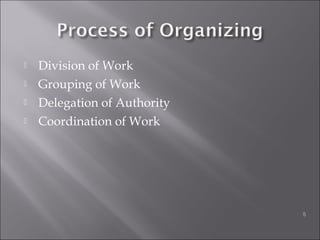
 Division of Work
 Grouping of Work
 Delegation of Authority
 Coordination of Work
5
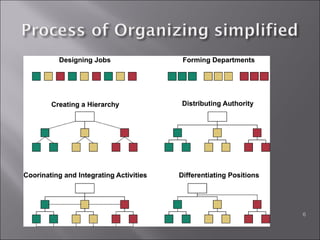
6
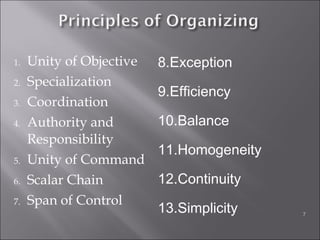
1. Unity of Objective
2. Specialization
3. Coordination
4. Authority and
Responsibility
5. Unity of Command
6. Scalar Chain
7. Span of Control
7
8.Exception
9.Efficiency
10.Balance
11.Homogeneity
12.Continuity
13.Simplicity
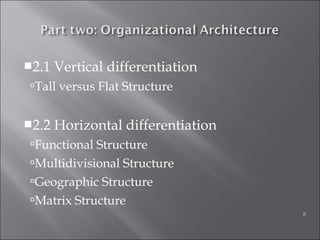
2.1 Vertical differentiation
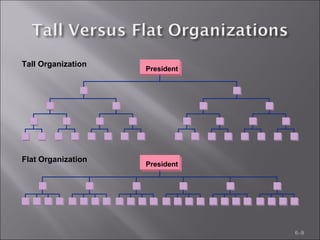
Tall versus Flat Structure
2.2 Horizontal differentiation
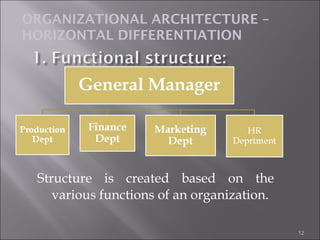
Functional Structure
Multidivisional Structure
Geographic Structure
Matrix Structure
8
6–9
President
President
Tall Organization
Flat Organization
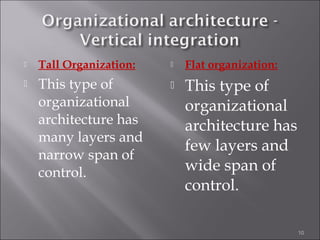
 Tall Organization:
 This type of
organizational
architecture has
many layers and
narrow span of
control.
 Flat organization:
 This type of
organizational
architecture has
few layers and
wide span of
control.
10
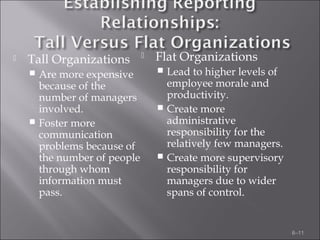
 Flat Organizations
 Lead to higher levels of
employee morale and
productivity.
 Create more
administrative
responsibility for the
relatively few managers.
 Create more supervisory
responsibility for
managers due to wider
spans of control.
 Tall Organizations
 Are more expensive
because of the
number of managers
involved.
 Foster more
communication
problems because of
the number of people
through whom
information must
pass.
6–11
Structure is created based on the
various functions of an organization.
12
ORGANIZATIONAL ARCHITECTURE –
HORIZONTAL DIFFERENTIATION
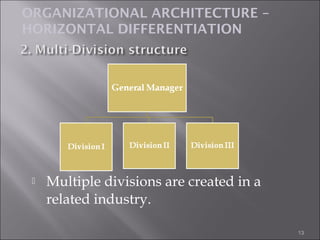
 Multiple divisions are created in a
related industry.
13
ORGANIZATIONAL ARCHITECTURE –
HORIZONTAL DIFFERENTIATION
 Divisional or M-form (Multidivisional) Design
 An organizational arrangement based on multiple
businesses in related areas operating within a larger
organizational framework; following a strategy of related
diversification.
 Activities are decentralized down to the divisional level;
others are centralized at the corporate level.
 The largest advantages of the M-form design are the
opportunities for coordination and sharing of resources.
14
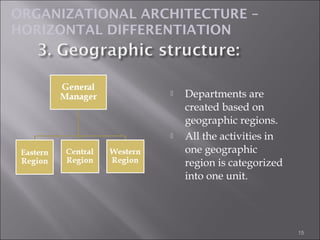
 Departments are
created based on
geographic regions.
 All the activities in
one geographic
region is categorized
into one unit.
15
ORGANIZATIONAL ARCHITECTURE –
HORIZONTAL DIFFERENTIATION
6–16
Employees
CEO
Project
manager B
Project
manager C
Vice president,
engineering
Vice president,
production
Vice president,
finance
Vice president,
marketing
Project
manager A
ORGANIZATIONAL ARCHITECTURE –
HORIZONTAL DIFFERENTIATION
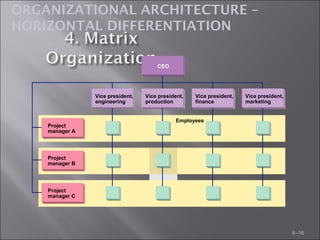
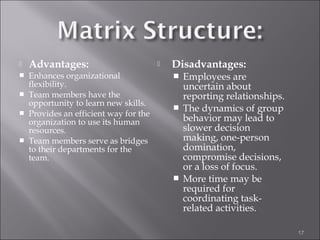
 Advantages:
 Enhances organizational
flexibility.
 Team members have the
opportunity to learn new skills.
 Provides an efficient way for the
organization to use its human
resources.
 Team members serve as bridges
to their departments for the
team.
 Disadvantages:
 Employees are
uncertain about
reporting relationships.
 The dynamics of group
behavior may lead to
slower decision
making, one-person
domination,
compromise decisions,
or a loss of focus.
 More time may be
required for
coordinating task-
related activities.
17
3.1 Meaning of Responsibility
3.2 Establishing Task and Reporting
Relationships
3.3 Creating Accountability
18
 Responsibility is the
obligation to perform
or
duty to carryout certain
activities
19
 Task Relationship:
 How activities related to each other in an
organization.
 How the basic units of an organization are formed.
 Establishment of job description and job specification
 Job Specification: Prerequisites of job. Various skills and
experiences needed to perform certain job.
 Job Description: The activities that have to be carried out at
certain position in a job. It describes the job.
20
Establishing Reporting Relationship:
It is finding out
 Chain of command
 Span of control or span of management
1. Who reports to whom?
2. How many subordinates will a supervisor have?
(Relate it to tall vs flat organizational architecture.)
21
 Accountability:
the state of being accountable
,  liable, or answerable
Requirement to report
It creates a mechanism of control.
22
4.1 Line and Staff Authority
4.2 Delegation of Authority
23
Right to take decisions that arises due to position
in organizational structure.
Authority is the right to perform or command. It
allows its holder to act in certain designated ways
and to directly influence the actions of others
through orders.
Types of Authority:
Line Authority
Staff Authority
24
 The chain of command in the
organizational structure that flows
major decision making power.
 The officially
sanctioned ability to issue orders to
subordinate employees within
an organization.
25
Staff authority consists of the right to advise
or assist those who possess line authority as
well as other staff personnel.
 The Advisory or Counseling Role :            
   
The Service Role               
The Control Role  26
 Assigning work to subordinates and
giving them necessary authority to
do the assigned work effectively.
Simple terms,
GRANTING AUTHORITY TO SUBORDINATES
27
 No delegation of total authority
 Delegation of only that authority a manager
has
 Representation of the superior
 Delegation for organizational purpose
 Restoration of delegated authority
 Balance of authority and responsibility
 No delegation of responsibility
28
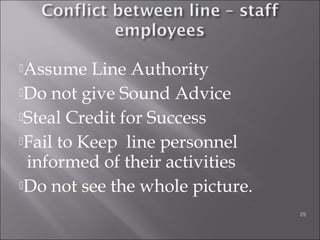
Assume Line Authority
Do not give Sound Advice
Steal Credit for Success
Fail to Keep  line personnel
 informed of their activities
Do not see the whole picture.
29
Meaning : Centralization and Decentralization
Reasons: In which case which is needed
Advantages and Disadvantages: of both
30
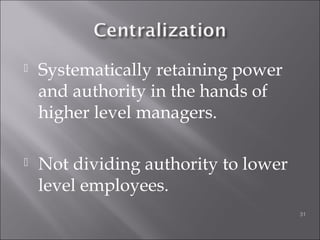
 Systematically retaining power
and authority in the hands of
higher level managers.
 Not dividing authority to lower
level employees.
31
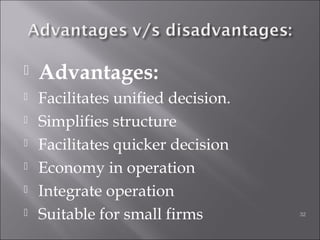
 Advantages:
 Facilitates unified decision.
 Simplifies structure
 Facilitates quicker decision
 Economy in operation
 Integrate operation
 Suitable for small firms 32
 Disadvantages:
 Unsuitable for large organization
 Manager is overburdened
 Possibility of power misuse
 Low morale and motivation
 Lack of environmental adaptation
 In appropriate for routine
decisions.
33
34
Advantages:
 Relief to top management
 Facilitates managers’ development
 Possibility if better decisions
 Effective control
 High morale and motivation
 Facilitates diversification
 Environment adaptation 35
Disadvantages:
 Increase in expenditure
 Conflict
 Unsuitable for emergency situations
 Maximizes risk
 Difficulty in communication
 Unsuitable for specialized services
36
 Re-engineering process
 Team work
 Network organization structure
 Downsizing organization
 Boundary-less organization
37
 It is the process of obtaining and maintaining
competent employees to fill all positions.
 Recruitment: Encouraging people to apply
 Selection: Finding the right person for the job
 Training: Teaching the employees certain skill
 Development: Progress/advancement of career
 Motivation: Encouraging the employees to
work harder.
38
 Managing effective staff
 Utilization of physical resources
 Increase in productivity
 Focus on goal achievement
 Helps to solve problems
 Job satisfaction
 Self-development of workers 39
LIKE SHARE AND
SUBSCRIBE
40

THE ORAGANIZING FUNCTION

  • 1.
  • 2.
    1.1 Meaning oforganization 1.2 Process of Organization 1.3 Principles of Organization 2
  • 3.
     Activities:  Identificationof activities  Grouping of Activities  Assignment of jobs to formal groups  Establishing a network of authority and responsibility  Providing framework for measurement, evaluation and control  Resources:  Determining the specific need of resources  Allocation of resources into specific groups  Evaluation and control of use of the resources 3
  • 4.
  • 5.
     Division ofWork  Grouping of Work  Delegation of Authority  Coordination of Work 5
  • 6.
  • 7.
    1. Unity ofObjective 2. Specialization 3. Coordination 4. Authority and Responsibility 5. Unity of Command 6. Scalar Chain 7. Span of Control 7 8.Exception 9.Efficiency 10.Balance 11.Homogeneity 12.Continuity 13.Simplicity
  • 8.
    2.1 Vertical differentiation Tallversus Flat Structure 2.2 Horizontal differentiation Functional Structure Multidivisional Structure Geographic Structure Matrix Structure 8
  • 9.
  • 10.
     Tall Organization: This type of organizational architecture has many layers and narrow span of control.  Flat organization:  This type of organizational architecture has few layers and wide span of control. 10
  • 11.
     Flat Organizations Lead to higher levels of employee morale and productivity.  Create more administrative responsibility for the relatively few managers.  Create more supervisory responsibility for managers due to wider spans of control.  Tall Organizations  Are more expensive because of the number of managers involved.  Foster more communication problems because of the number of people through whom information must pass. 6–11
  • 12.
    Structure is createdbased on the various functions of an organization. 12 ORGANIZATIONAL ARCHITECTURE – HORIZONTAL DIFFERENTIATION
  • 13.
     Multiple divisionsare created in a related industry. 13 ORGANIZATIONAL ARCHITECTURE – HORIZONTAL DIFFERENTIATION
  • 14.
     Divisional orM-form (Multidivisional) Design  An organizational arrangement based on multiple businesses in related areas operating within a larger organizational framework; following a strategy of related diversification.  Activities are decentralized down to the divisional level; others are centralized at the corporate level.  The largest advantages of the M-form design are the opportunities for coordination and sharing of resources. 14
  • 15.
     Departments are createdbased on geographic regions.  All the activities in one geographic region is categorized into one unit. 15 ORGANIZATIONAL ARCHITECTURE – HORIZONTAL DIFFERENTIATION
  • 16.
    6–16 Employees CEO Project manager B Project manager C Vicepresident, engineering Vice president, production Vice president, finance Vice president, marketing Project manager A ORGANIZATIONAL ARCHITECTURE – HORIZONTAL DIFFERENTIATION
  • 17.
     Advantages:  Enhancesorganizational flexibility.  Team members have the opportunity to learn new skills.  Provides an efficient way for the organization to use its human resources.  Team members serve as bridges to their departments for the team.  Disadvantages:  Employees are uncertain about reporting relationships.  The dynamics of group behavior may lead to slower decision making, one-person domination, compromise decisions, or a loss of focus.  More time may be required for coordinating task- related activities. 17
  • 18.
    3.1 Meaning ofResponsibility 3.2 Establishing Task and Reporting Relationships 3.3 Creating Accountability 18
  • 19.
     Responsibility isthe obligation to perform or duty to carryout certain activities 19
  • 20.
     Task Relationship: How activities related to each other in an organization.  How the basic units of an organization are formed.  Establishment of job description and job specification  Job Specification: Prerequisites of job. Various skills and experiences needed to perform certain job.  Job Description: The activities that have to be carried out at certain position in a job. It describes the job. 20
  • 21.
    Establishing Reporting Relationship: Itis finding out  Chain of command  Span of control or span of management 1. Who reports to whom? 2. How many subordinates will a supervisor have? (Relate it to tall vs flat organizational architecture.) 21
  • 22.
  • 23.
    4.1 Line andStaff Authority 4.2 Delegation of Authority 23
  • 24.
    Right to takedecisions that arises due to position in organizational structure. Authority is the right to perform or command. It allows its holder to act in certain designated ways and to directly influence the actions of others through orders. Types of Authority: Line Authority Staff Authority 24
  • 25.
     The chainof command in the organizational structure that flows major decision making power.  The officially sanctioned ability to issue orders to subordinate employees within an organization. 25
  • 26.
    Staff authority consistsof the right to advise or assist those who possess line authority as well as other staff personnel.  The Advisory or Counseling Role :                 The Service Role                The Control Role  26
  • 27.
     Assigning workto subordinates and giving them necessary authority to do the assigned work effectively. Simple terms, GRANTING AUTHORITY TO SUBORDINATES 27
  • 28.
     No delegationof total authority  Delegation of only that authority a manager has  Representation of the superior  Delegation for organizational purpose  Restoration of delegated authority  Balance of authority and responsibility  No delegation of responsibility 28
  • 29.
    Assume Line Authority Donot give Sound Advice Steal Credit for Success Fail to Keep  line personnel  informed of their activities Do not see the whole picture. 29
  • 30.
    Meaning : Centralizationand Decentralization Reasons: In which case which is needed Advantages and Disadvantages: of both 30
  • 31.
     Systematically retainingpower and authority in the hands of higher level managers.  Not dividing authority to lower level employees. 31
  • 32.
     Advantages:  Facilitatesunified decision.  Simplifies structure  Facilitates quicker decision  Economy in operation  Integrate operation  Suitable for small firms 32
  • 33.
     Disadvantages:  Unsuitablefor large organization  Manager is overburdened  Possibility of power misuse  Low morale and motivation  Lack of environmental adaptation  In appropriate for routine decisions. 33
  • 34.
  • 35.
    Advantages:  Relief totop management  Facilitates managers’ development  Possibility if better decisions  Effective control  High morale and motivation  Facilitates diversification  Environment adaptation 35
  • 36.
    Disadvantages:  Increase inexpenditure  Conflict  Unsuitable for emergency situations  Maximizes risk  Difficulty in communication  Unsuitable for specialized services 36
  • 37.
     Re-engineering process Team work  Network organization structure  Downsizing organization  Boundary-less organization 37
  • 38.
     It isthe process of obtaining and maintaining competent employees to fill all positions.  Recruitment: Encouraging people to apply  Selection: Finding the right person for the job  Training: Teaching the employees certain skill  Development: Progress/advancement of career  Motivation: Encouraging the employees to work harder. 38
  • 39.
     Managing effectivestaff  Utilization of physical resources  Increase in productivity  Focus on goal achievement  Helps to solve problems  Job satisfaction  Self-development of workers 39
  • 40.