Responsibility, Authority, Delegation,
and Power
Rey Lugtu
www.reylugtu.com
Responsibility
Responsibility is the obligation to perform
assigned activities.
4
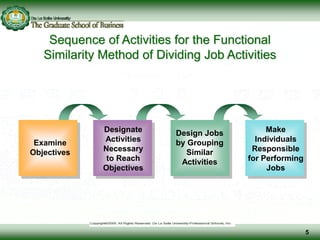
Sequence of Activities for the Functional
Similarity Method of Dividing Job Activities
Examine
Objectives
Designate
Activities
Necessary
to Reach
Objectives
Design Jobs
by Grouping
Similar
Activities
Make
Individuals
Responsible
for Performing
Jobs
5
Authority
Authority is the right to perform or command.
6
Acceptance of Authority
Barnard maintains that authority will be accepted only under the
following conditions:
1. The individual can understand the order being communicated.
2. The individual believes the order is consistent with the purpose
of the organization.
3. The individual sees the order as compatible with his or her
personal interests.
4. The individual is mentally and physically able to comply with
the order.
7
Delegation
Delegation is the process of assigning job
activities and related authority to specific
individuals in the organization.
8
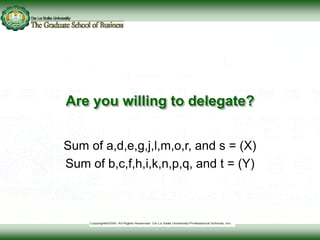
Are you willing to delegate?
Sum of a,d,e,g,j,l,m,o,r, and s = (X)
Sum of b,c,f,h,i,k,n,p,q, and t = (Y)
McGregor’s Theory X and Theory Y
• Leaders and managers who hold Theory X
assumptions believe that employees are
inherently lazy and lack ambition.
– A negative perspective on human behavior.
• Leaders and managers who hold Theory Y
assumptions believe that most employees do not
dislike work and want to make useful
contributions to the organization.
– A positive perspective on human behavior.
Obstacles to the Delegation
Process
Obstacles related to the supervisor.
Obstacles related to subordinates.
Obstacles related to organizations.
9
AUTHORITY and RESPONSIBILITY
• Authority
– right to take action or make decisions
– legitimises the exercise of power
– enables the issuance of instructions to others
• Responsibility
– obligation by the subordinate to perform certain duties and to accept reprimand
for unsatisfactory performance
– a corollary of authority
• Authority without responsibility gives rise to
possible abuse of delegation
AUTHORITY COMMENSURATE WITH RESPONSIBILITY
• Delegation, therefore, embraces both authority
and responsibility. It is not practical to delegate
one without the other
• Responsibility must be supported by authority
and by the power to influence the areas of
performance for which the subordinate is to be
held responsible
• To hold subordinates responsible for
performance without also conferring on them the
necessary authority to take action and make
decisions within the limits of that responsibility is
an abuse of delegation
• Sufficient responsibility to match the authority
which is delegated
• Sufficient responsibility to give subordinate
freedom of action within agreed terms of
reference and to avoid excessive supervision
• Development of subordinates who need the
feeling of responsibility to help in the
performance of their tasks
• Delegated duties are sometimes delegated
further down the line
AUTHORITY COMMENSURATE WITH RESPONSIBILITY
ACCOUTABILITY (Ultimate
Responsibility)
• Ultimate responsibility cannot be delegated
• Effective delegation of authority and responsibility is not
abdication of responsibility
• Dual responsibility of delegation: managers accept
responsibility for the control and performance of their
staff and are, in turn, responsible to higher management
• Accountability is ultimate responsibility: the subordinate
is responsible to the manager who is, in turn,
accountable to a superior for the actions of subordinates
• Managers should protect and support subordinate staff
and accept, personally, any reprimand for unsatisfactory
performance
Centralization, Decentralization
Centralization refers to the situation in
which a minimal number of job activities
and a minimal amount of authority are
delegated to subordinates.
Decentralization refers to the situation in
which a significant number of job activities
and a maximum amount of authority are
delegated to subordinates.
10
Centralized and Decentralized Organizations on
Delegation Continuum
Decentralized
organization
Maximum delegation
in organization
Centralized
organization
No delegation
in organization
VARIOUS DEGREES OF DELEGATION
VARIOUS DEGREES OF CENTRALIZATION
AND DECENTRALIZATION
11
The Decentralization of Coca-Cola
Coca-Cola decentralized its
organizational structure by cutting half
of the staff at its Atlanta headquarters
and moving the regional chieftains
closer to their local markets. In India,
decision making has been moved
further down to different areas of that
diverse country.
© AFP/CORBIS
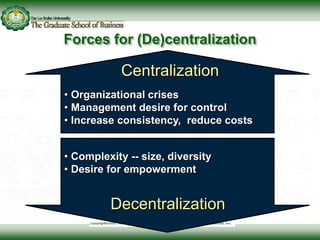
• Organizational crises
• Management desire for control
• Increase consistency, reduce costs
Centralization
• Complexity -- size, diversity
• Desire for empowerment
Decentralization
Forces for (De)centralization
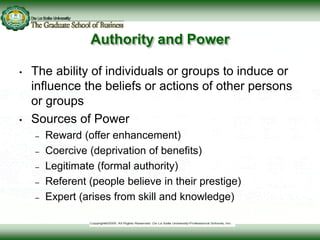
Authority and Power
• The ability of individuals or groups to induce or
influence the beliefs or actions of other persons
or groups
• Sources of Power
– Reward (offer enhancement)
– Coercive (deprivation of benefits)
– Legitimate (formal authority)
– Referent (people believe in their prestige)
– Expert (arises from skill and knowledge)
Authority and Power
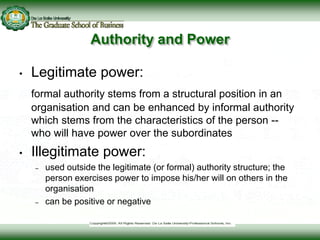
• Legitimate power:
formal authority stems from a structural position in an
organisation and can be enhanced by informal authority
which stems from the characteristics of the person --
who will have power over the subordinates
• Illegitimate power:
– used outside the legitimate (or formal) authority structure; the
person exercises power to impose his/her will on others in the
organisation
– can be positive or negative
Delegation and Empowerment
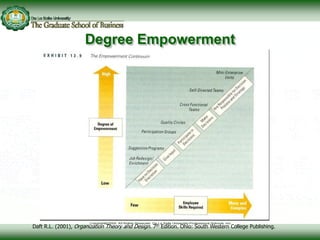
• ‘Empowerment is giving subordinates the
resources, both psychological and technical, to
discover the varieties of Power they themselves
have and/or accumulated, therefore which they
can use on another’s behalf.’
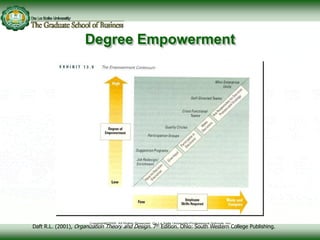
Degree Empowerment
Daft R.L. (2001), Organization Theory and Design. 7th Edition. Ohio: South Western College Publishing.
End
Back to Malard…
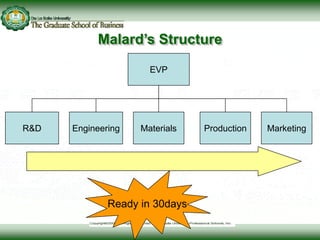
Malard’s Structure
EVP
R&D Engineering Materials Production Marketing
Ready in 30days
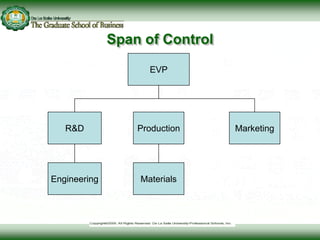
Span of Control
EVP
R&D
Engineering Materials
Production Marketing
Follett’s Guideline on Coordination
• Coordination can be attained with least difficulty
through direct horizontal relationships and
personal communications.
• Coordination should be a discussion topic during
the planning process
• Coordination is a continuing process
• Human element and communication process are
essential considerations to encourage
coordination.
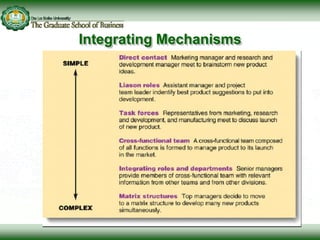
Integrating Mechanisms
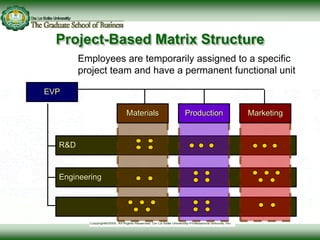
Engineering
R&D
Materials Production Marketing
Employees are temporarily assigned to a specific
project team and have a permanent functional unit
Project-Based Matrix Structure
EVP
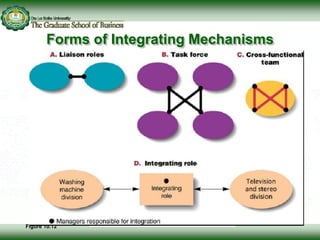
Forms of Integrating Mechanisms
Figure 10.12
Degree Empowerment
Daft R.L. (2001), Organization Theory and Design. 7th Edition. Ohio: South Western College Publishing.
End

Resposnibility and delegation

  • 1.
    Responsibility, Authority, Delegation, andPower Rey Lugtu www.reylugtu.com
  • 2.
    Responsibility Responsibility is theobligation to perform assigned activities. 4
  • 3.
    Sequence of Activitiesfor the Functional Similarity Method of Dividing Job Activities Examine Objectives Designate Activities Necessary to Reach Objectives Design Jobs by Grouping Similar Activities Make Individuals Responsible for Performing Jobs 5
  • 4.
    Authority Authority is theright to perform or command. 6
  • 5.
    Acceptance of Authority Barnardmaintains that authority will be accepted only under the following conditions: 1. The individual can understand the order being communicated. 2. The individual believes the order is consistent with the purpose of the organization. 3. The individual sees the order as compatible with his or her personal interests. 4. The individual is mentally and physically able to comply with the order. 7
  • 6.
    Delegation Delegation is theprocess of assigning job activities and related authority to specific individuals in the organization. 8
  • 7.
    Are you willingto delegate? Sum of a,d,e,g,j,l,m,o,r, and s = (X) Sum of b,c,f,h,i,k,n,p,q, and t = (Y)
  • 8.
    McGregor’s Theory Xand Theory Y • Leaders and managers who hold Theory X assumptions believe that employees are inherently lazy and lack ambition. – A negative perspective on human behavior. • Leaders and managers who hold Theory Y assumptions believe that most employees do not dislike work and want to make useful contributions to the organization. – A positive perspective on human behavior.
  • 9.
    Obstacles to theDelegation Process Obstacles related to the supervisor. Obstacles related to subordinates. Obstacles related to organizations. 9
  • 10.
    AUTHORITY and RESPONSIBILITY •Authority – right to take action or make decisions – legitimises the exercise of power – enables the issuance of instructions to others • Responsibility – obligation by the subordinate to perform certain duties and to accept reprimand for unsatisfactory performance – a corollary of authority • Authority without responsibility gives rise to possible abuse of delegation
  • 11.
    AUTHORITY COMMENSURATE WITHRESPONSIBILITY • Delegation, therefore, embraces both authority and responsibility. It is not practical to delegate one without the other • Responsibility must be supported by authority and by the power to influence the areas of performance for which the subordinate is to be held responsible • To hold subordinates responsible for performance without also conferring on them the necessary authority to take action and make decisions within the limits of that responsibility is an abuse of delegation
  • 12.
    • Sufficient responsibilityto match the authority which is delegated • Sufficient responsibility to give subordinate freedom of action within agreed terms of reference and to avoid excessive supervision • Development of subordinates who need the feeling of responsibility to help in the performance of their tasks • Delegated duties are sometimes delegated further down the line AUTHORITY COMMENSURATE WITH RESPONSIBILITY
  • 13.
    ACCOUTABILITY (Ultimate Responsibility) • Ultimateresponsibility cannot be delegated • Effective delegation of authority and responsibility is not abdication of responsibility • Dual responsibility of delegation: managers accept responsibility for the control and performance of their staff and are, in turn, responsible to higher management • Accountability is ultimate responsibility: the subordinate is responsible to the manager who is, in turn, accountable to a superior for the actions of subordinates • Managers should protect and support subordinate staff and accept, personally, any reprimand for unsatisfactory performance
  • 14.
    Centralization, Decentralization Centralization refersto the situation in which a minimal number of job activities and a minimal amount of authority are delegated to subordinates. Decentralization refers to the situation in which a significant number of job activities and a maximum amount of authority are delegated to subordinates. 10
  • 15.
    Centralized and DecentralizedOrganizations on Delegation Continuum Decentralized organization Maximum delegation in organization Centralized organization No delegation in organization VARIOUS DEGREES OF DELEGATION VARIOUS DEGREES OF CENTRALIZATION AND DECENTRALIZATION 11
  • 16.
    The Decentralization ofCoca-Cola Coca-Cola decentralized its organizational structure by cutting half of the staff at its Atlanta headquarters and moving the regional chieftains closer to their local markets. In India, decision making has been moved further down to different areas of that diverse country. © AFP/CORBIS
  • 17.
    • Organizational crises •Management desire for control • Increase consistency, reduce costs Centralization • Complexity -- size, diversity • Desire for empowerment Decentralization Forces for (De)centralization
  • 18.
    Authority and Power •The ability of individuals or groups to induce or influence the beliefs or actions of other persons or groups • Sources of Power – Reward (offer enhancement) – Coercive (deprivation of benefits) – Legitimate (formal authority) – Referent (people believe in their prestige) – Expert (arises from skill and knowledge)
  • 19.
    Authority and Power •Legitimate power: formal authority stems from a structural position in an organisation and can be enhanced by informal authority which stems from the characteristics of the person -- who will have power over the subordinates • Illegitimate power: – used outside the legitimate (or formal) authority structure; the person exercises power to impose his/her will on others in the organisation – can be positive or negative
  • 20.
    Delegation and Empowerment •‘Empowerment is giving subordinates the resources, both psychological and technical, to discover the varieties of Power they themselves have and/or accumulated, therefore which they can use on another’s behalf.’
  • 21.
    Degree Empowerment Daft R.L.(2001), Organization Theory and Design. 7th Edition. Ohio: South Western College Publishing.
  • 22.
  • 23.
  • 24.
    Malard’s Structure EVP R&D EngineeringMaterials Production Marketing Ready in 30days
  • 25.
    Span of Control EVP R&D EngineeringMaterials Production Marketing
  • 26.
    Follett’s Guideline onCoordination • Coordination can be attained with least difficulty through direct horizontal relationships and personal communications. • Coordination should be a discussion topic during the planning process • Coordination is a continuing process • Human element and communication process are essential considerations to encourage coordination.
  • 27.
  • 28.
    Engineering R&D Materials Production Marketing Employeesare temporarily assigned to a specific project team and have a permanent functional unit Project-Based Matrix Structure EVP
  • 29.
    Forms of IntegratingMechanisms Figure 10.12
  • 30.
    Degree Empowerment Daft R.L.(2001), Organization Theory and Design. 7th Edition. Ohio: South Western College Publishing.
  • 31.