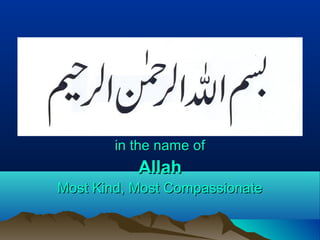



in the name ofin the name of
AllahAllah
Most Kind, Most CompassionateMost Kind, Most Compassionate
Chronograms
and Calendars
by
Shaukat Mahmood
HEC Professor
College of Art & Design
Punjab University, Lahore
The Time Factor
How the time was calculated
Chronogram
is a deviCe used for
measuring Time
and This has been in use
sinCe Time immemorial
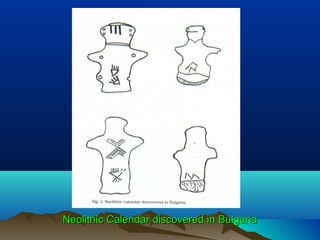
Neolithic Calendar discovered in BulgariaNeolithic Calendar discovered in Bulgaria
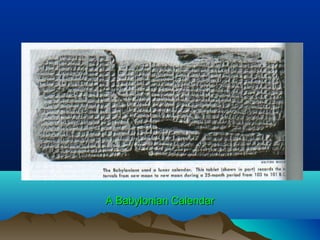
A Babylonian CalendarA Babylonian Calendar
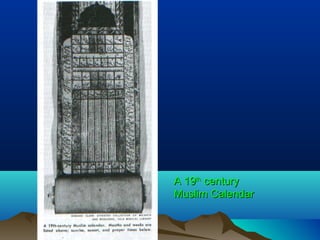
A 19A 19thth
centurycentury
Muslim CalendarMuslim Calendar
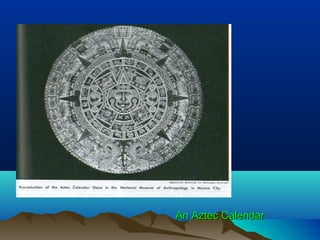
An Aztec CalendarAn Aztec Calendar
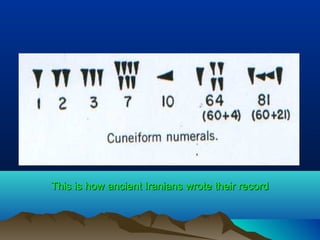
This is how ancient Iranians wrote their recordThis is how ancient Iranians wrote their record
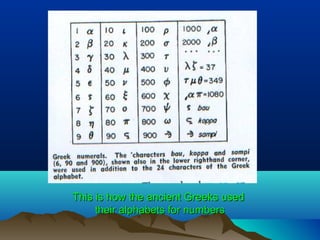
This is how the ancient Greeks usedThis is how the ancient Greeks used
their alphabets for numberstheir alphabets for numbers
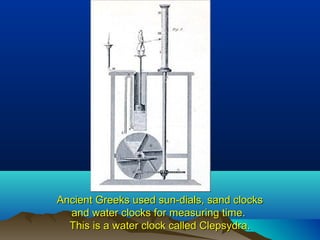
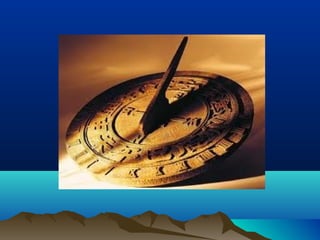
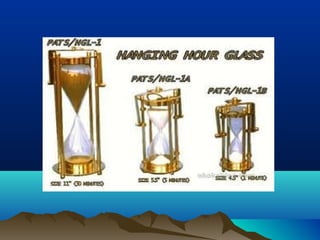
Ancient Greeks used sun-dials, sand clocksAncient Greeks used sun-dials, sand clocks
and water clocks for measuring time.and water clocks for measuring time.
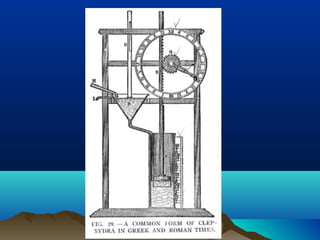
This is a water clock called ClepsydraThis is a water clock called Clepsydra..
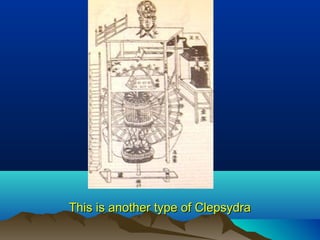
This is another type of ClepsydraThis is another type of Clepsydra
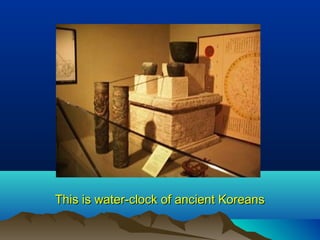
This is water-clock of ancient KoreansThis is water-clock of ancient Koreans
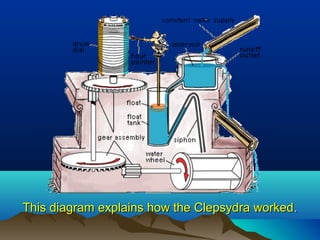
This diagram explains how the Clepsydra workedThis diagram explains how the Clepsydra worked..
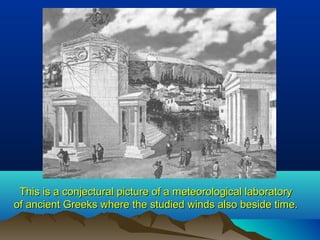
This is a conjectural picture of a meteorological laboratoryThis is a conjectural picture of a meteorological laboratory
of ancient Greeks where the studied winds also beside time.of ancient Greeks where the studied winds also beside time.
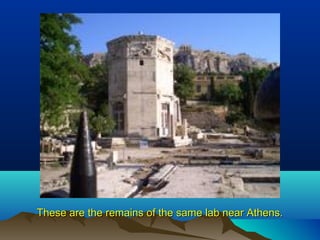
These are the remains of the same lab near Athens.These are the remains of the same lab near Athens.
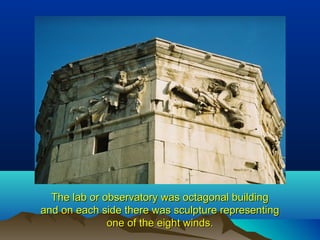
The lab or observatory was octagonal buildingThe lab or observatory was octagonal building
and on each side there was sculpture representingand on each side there was sculpture representing
one of the eight winds.one of the eight winds.
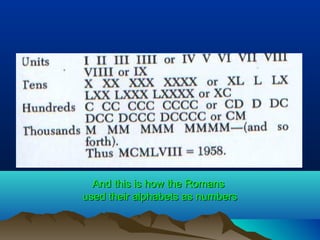
And this is how the RomansAnd this is how the Romans
used their alphabets as numbersused their alphabets as numbers
• To measure time
Little is known about the details of
timekeeping in prehistoric eras; however,
records and artefacts show that in every
culture people were preoccupied with
measuring and recording the passage of
time.
• Ice-age hunters in Europe over 20,000
years ago scratched lines and gouged
holes in sticks and bones, probably
counting the days between
phases of the moon.
Five thousand years ago, Sumerians in
the Tigris-Euphrates valley in today’s Iraq
had a calendar that divided the year into
thirty-day months, divided the day into 12
periods (each corresponding to two of our
hours), and divided these periods into 30
parts (each like four of our minutes).
The earliest Egyptian calendar was based
on the moon’s cycles, but later the
Egyptians realized that the “Dog Star” in
Canis Major, which is now called Sirius,
rose next to the sun every 365 days, about
when the annual inundation of the Nile
began. Based on this knowledge, they
devised a 365-day calendar that seems to
have begun in BC 4236, the earliest
recorded year in history.
the Dog Star, a common name for the star Sirius,
reflecting its prominence in its constellation, Canis
Major (Greater Dog).
Sirius is the brightest star in the night sky. It is almost
twice as bright as Canopus, the next brightest star. The
name "Sirius" is derived from the Ancient Greek
meaning "glowing" or "scorcher”. The star has
the Bayer designation Alpha Canis Majoris What the
naked eye perceives as a single star is actually
a binary star system.
In Babylonia, again in Iraq, a
year of 12 alternating 29-day and
30-day lunar months was
observed before BC 2000, giving
a 354-day year.
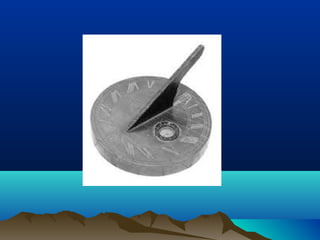
Sun Clocks
The Egyptians were the first to have formally
divided their day into parts something like our
hours. Obelisks (slender, tapering, foursided
monuments) were built as early as BC 3500
Their moving shadows formed a kind of sundial,
enabling citizens to partition the day into two
parts by indicating noon. They also showed the
year’s longest and shortest days when the
shadow at noon was the shortest or longest of
the year. Later, markers added around the base
of the monument would indicate further time
subdivisions.
Water Clocks
Water clocks were another form of early
timekeepers that did not depend on the
observation of celestial bodies. One of the
oldest was found in the tomb of Amenhotep I,
buried around BC 1500. Later named
clepsydras (“water thief”) by the Greeks, who
began using them about BC 325, these
timekeepers were stone vessels with sloping
sides that allowed water to drip at a nearly
constant rate from a small hole near the bottom.
More elaborate and impressive mechanized water
clocks were developed between BC 100
and AD 500 by Greek and Roman horologists and
astronomers. The added complexity was aimed at
making the flow more constant by regulating the
pressure, and at providing fancier displays of the
passage of time. Some water clocks rang bells
and gongs; others opened doors and windows to
show little figures of people, or moved pointers,
dials, and astrological models of the universe.
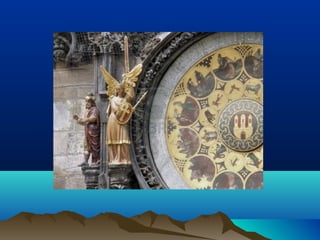
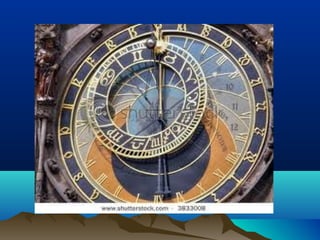
The first mechanical clocks: Early timepieces in
Europe
All modern clocks – down to the latest atomic clock,
accurate to one second every 30 million years – depend
on oscillation. An oscillator is a device which moves
backwards and forwards at a regular speed. This regular
movement chops time into segments, which can then be
counted. The best known example is the pendulum,
which is designed by the clockmaker to swing a precise
number of times per second. (For example, in most
pendulum wall clocks, it swings once every second.) The
time of the swing depends on the length of the pendulum.
In the early-to-mid-14th century, large mechanical
clocks, making use of oscillation, began to appear in the
towers of several large Italian cities. There is no
evidence or record of the working models preceding
these public clocks that were weight-driven and
regulated by a verge-and-foliot escapement. Verge-and-
foliot mechanisms reigned for more than 300 years with
variations in the shape of the foliot. All had the same
basic problem: the period of oscillation of this
escapement depended heavily on the amount of driving
force and the amount of friction in the drive. Like water
flow, the rate was difficult to regulate.
Portable time keeping
Peter Henlein of Nürnberg created the first pocket
watch in 1480. It was made of gilded brass and had
only one hand, giving the approximate time. Ball
shaped it was yet oddly named a “Nürnberg Egg”.
Religion was to have a strong influence on the watch
industry, however indirectly. When the Protestant
reformation took over Geneva in 1535 the city had no
watch making industry to speak of and was known
rather for its jewellery.
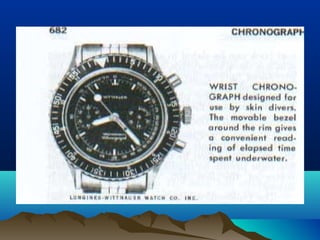
Quartz mechanism
A major change occurred in the 1930s and 1940s when
quartz crystal clocks replaced the pendulum, balance-
wheel escapements and the spring as standard
mechanisms, further improving timekeeping
performance. In a quartz watch the oscillator is a quartz
crystal, which has the property to vibrate in the
presence of an electric field, produced in watches by
miniature batteries. The high frequency of the vibrations
means that a quartz timekeeper is very accurate – to
within about one minute a year. In the 1960s it became
possible to manufacture integrated circuits small
enough to be used in wristwatches.
Atomic clocks
The atomic clock is the most recent development. It
uses the oscillations of atoms of caesium-133. Their
advantage is that they oscillate extremely fast and at
exactly the same rate. Unlike quartz crystals, for
example, they are unaffected by outside influences,
such as temperature changes. An example is the
FOCS-1, the most accurate clock ever developed in
Switzerland, which started operating in 2004. It
stands in a laboratory of the Swiss Federal Office of
Metrology METAS in Bern. Were you to come back
and look at it in 30 million years’ time, it would not
have deviated by more than one second.
Calligraphy
and inscriptions
are a fundamental component
of Islamic architecture
Both mosques and mausolea
are replete
with a variety of
religious and secular inscriptions
Qur’anic inscriptions
1. Complete suras and selected ayat.
2. Bismillah
3. Islamic confession of faith
(Kalima yi-Tayyibah and Shahadah)
4. The Takbir
5. Various attributes of Allah
Non-Qur’anic inscriptions
1. Name of the mosque
2. Name of the patron
3. The date of erection
4. Poetical eulogy in praise of Allah
and the Prophet (pbuh)
5. Ahatith concerning mosques, salat and
other fundamentals of Islam
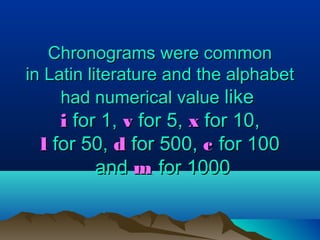
Chronograms were commonChronograms were common
in Latin literature and the alphabetin Latin literature and the alphabet
had numerical valuehad numerical value likelike
ii for 1,for 1, vv for 5,for 5, xx for 10,for 10,
ll for 50,for 50, dd for 500,for 500, cc for 100for 100
andand mm for 1000for 1000
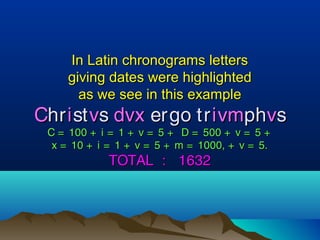
In Latin chronograms lettersIn Latin chronograms letters
giving dates were highlightedgiving dates were highlighted
as we see in this exampleas we see in this example
CChrhriiststvvss dvxdvx ergo trergo trivmivmphphvvss
C = 100 + i = 1 + v = 5 + D = 500 + v = 5 +C = 100 + i = 1 + v = 5 + D = 500 + v = 5 +
x = 10 + i = 1 + v = 5 + m = 1000, + v = 5.x = 10 + i = 1 + v = 5 + m = 1000, + v = 5.
TOTAL : 1632TOTAL : 1632
Persian chronograms in the Arabic alphabet are,Persian chronograms in the Arabic alphabet are,
it seems, of greater antiquity thanit seems, of greater antiquity than
European examples. It is not improbable indeed,European examples. It is not improbable indeed,
that chronograms originated in the East wherethat chronograms originated in the East where
poetic juggling of various kinds was common.poetic juggling of various kinds was common.
Chronograms became extremely popular for booksChronograms became extremely popular for books
and epitaphs. Authors,and epitaphs. Authors, katibskatibs and printers rivaledand printers rivaled
one another by hiding dates inone another by hiding dates in
intricate chronograms sometimesintricate chronograms sometimes
most difficult to decipher.most difficult to decipher.
Mir AmanMir Aman
translated a Persian romance of Amir Khusraw, calledtranslated a Persian romance of Amir Khusraw, called
Qissa-i Chahar DarvishQissa-i Chahar Darvish
(The story of four darvishes)(The story of four darvishes)
and he chose for his translation the nameand he chose for his translation the name
Bagh u baharBagh u bahar (“The garden and the spring”).(“The garden and the spring”).
According to the Arabic system ofAccording to the Arabic system of abjadabjad
these words give the date 1217 / 1802these words give the date 1217 / 1802
which was the date of translation’swhich was the date of translation’s
publicationpublication
In Persian datesIn Persian dates
are computed on the basisare computed on the basis
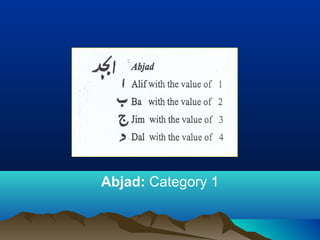
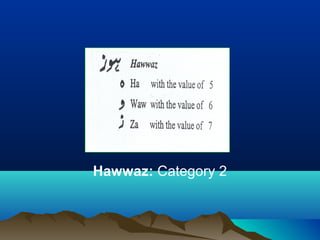
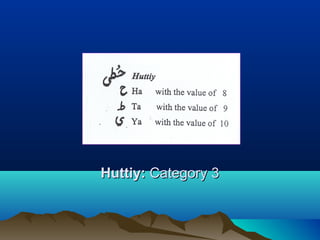
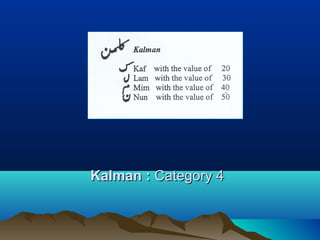
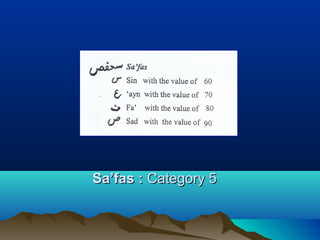
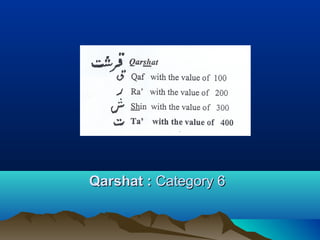
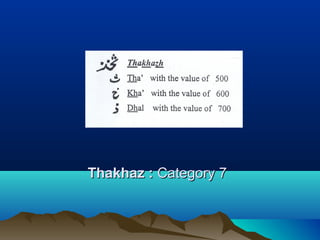
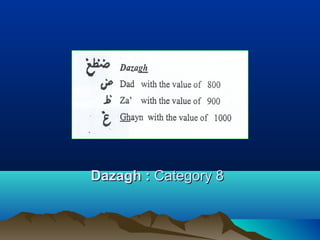
ofof AbjadAbjad
oror hisab al-jummal
Abjad: Category 1
Hawwaz: Category 2
Huttiy:Huttiy: Category 3Category 3
Kalman :Kalman : Category 4Category 4
Sa’fas :Sa’fas : Category 5Category 5
Qarshat :Qarshat : Category 6Category 6
Thakhaz :Thakhaz : Category 7Category 7
Dazagh :Dazagh : Category 8Category 8
Muslim all over the worldMuslim all over the world
often writeoften write
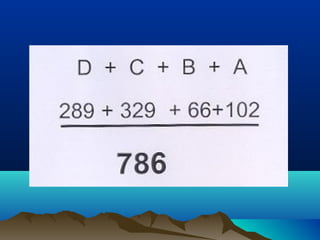
786786
at the top of their letters andat the top of their letters and
other documentsother documents
this has chronographic significancethis has chronographic significance
Let’s examine theLet’s examine the
significance ofsignificance of
786786
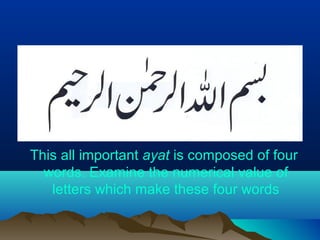
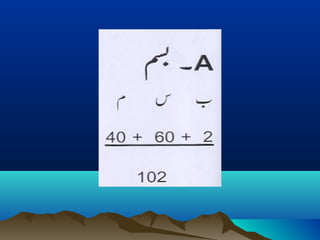
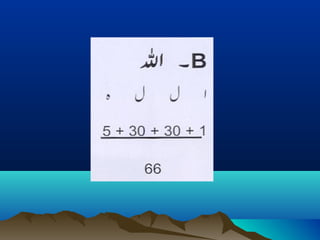
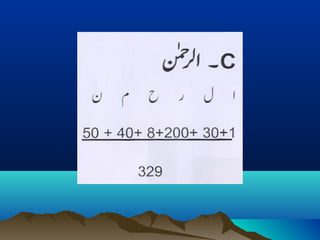
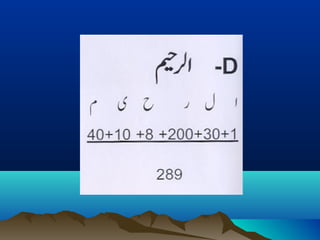
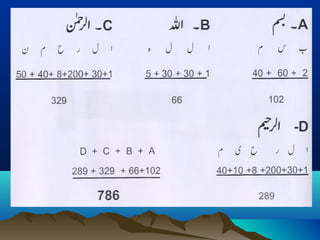
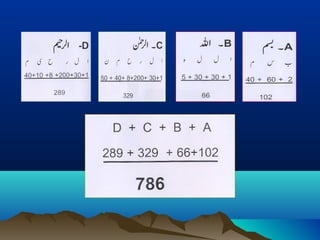
This all important ayat is composed of four
words. Examine the numerical value of
letters which make these four words
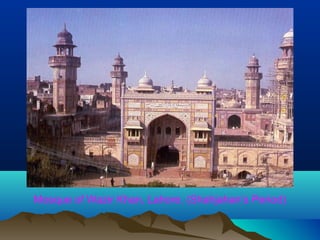
Mosque of Wazir Khan, Lahore. (Shahjahan’s Period)
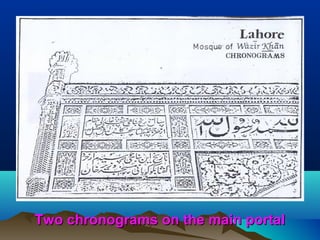
Two chronograms on the main portalTwo chronograms on the main portal
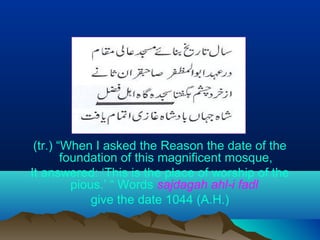
(tr.) “When I asked the Reason the date of the
foundation of this magnificent mosque,
It answered: ‘This is the place of worship of the
pious.’ “ Words sajdagah ahl-i fadl
give the date 1044 (A.H.)
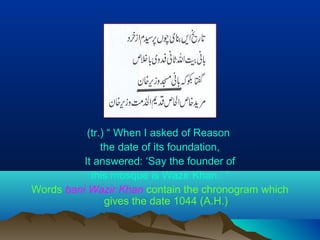
(tr.) “ When I asked of Reason
the date of its foundation,
It answered: ‘Say the founder of
this mosque is Wazir Khan.’ “
Words bani Wazir Khan contain the chronogram which
gives the date 1044 (A.H.)
Thatisallfortoday
Dr. Shaukat Mahmood
MA. Fine Arts, Gold Medalist, Punjab University
MSc. Architectural Conservation, Heriot-Watt University
PhD, Islamic Architecture, Edinburgh University
Academic Roll of Honour, Govt. College University, Lahore
Gold Medal for research in Islamic Calligraphy
President Medal for Pride of Performance 2001
Sitara-i Imtiaz 2010
HEC Professor & Coordinator Research & Ph.D. Programme
College of Art & Design, Punjab University, Lahore.

How Bismillah=786???

  • 1.
    in the nameofin the name of AllahAllah Most Kind, Most CompassionateMost Kind, Most Compassionate
  • 2.
  • 3.
    by Shaukat Mahmood HEC Professor Collegeof Art & Design Punjab University, Lahore
  • 4.
    The Time Factor Howthe time was calculated
  • 5.
    Chronogram is a deviCeused for measuring Time and This has been in use sinCe Time immemorial
  • 6.
    Neolithic Calendar discoveredin BulgariaNeolithic Calendar discovered in Bulgaria
  • 7.
    A Babylonian CalendarABabylonian Calendar
  • 8.
    A 19A 19thth centurycentury MuslimCalendarMuslim Calendar
  • 9.
    An Aztec CalendarAnAztec Calendar
  • 10.
    This is howancient Iranians wrote their recordThis is how ancient Iranians wrote their record
  • 11.
    This is howthe ancient Greeks usedThis is how the ancient Greeks used their alphabets for numberstheir alphabets for numbers
  • 12.
    Ancient Greeks usedsun-dials, sand clocksAncient Greeks used sun-dials, sand clocks and water clocks for measuring time.and water clocks for measuring time. This is a water clock called ClepsydraThis is a water clock called Clepsydra..
  • 13.
    This is anothertype of ClepsydraThis is another type of Clepsydra
  • 14.
    This is water-clockof ancient KoreansThis is water-clock of ancient Koreans
  • 16.
    This diagram explainshow the Clepsydra workedThis diagram explains how the Clepsydra worked..
  • 17.
    This is aconjectural picture of a meteorological laboratoryThis is a conjectural picture of a meteorological laboratory of ancient Greeks where the studied winds also beside time.of ancient Greeks where the studied winds also beside time.
  • 18.
    These are theremains of the same lab near Athens.These are the remains of the same lab near Athens.
  • 19.
    The lab orobservatory was octagonal buildingThe lab or observatory was octagonal building and on each side there was sculpture representingand on each side there was sculpture representing one of the eight winds.one of the eight winds.
  • 20.
    And this ishow the RomansAnd this is how the Romans used their alphabets as numbersused their alphabets as numbers
  • 22.
    • To measuretime Little is known about the details of timekeeping in prehistoric eras; however, records and artefacts show that in every culture people were preoccupied with measuring and recording the passage of time.
  • 23.
    • Ice-age huntersin Europe over 20,000 years ago scratched lines and gouged holes in sticks and bones, probably counting the days between phases of the moon.
  • 24.
    Five thousand yearsago, Sumerians in the Tigris-Euphrates valley in today’s Iraq had a calendar that divided the year into thirty-day months, divided the day into 12 periods (each corresponding to two of our hours), and divided these periods into 30 parts (each like four of our minutes).
  • 25.
    The earliest Egyptiancalendar was based on the moon’s cycles, but later the Egyptians realized that the “Dog Star” in Canis Major, which is now called Sirius, rose next to the sun every 365 days, about when the annual inundation of the Nile began. Based on this knowledge, they devised a 365-day calendar that seems to have begun in BC 4236, the earliest recorded year in history.
  • 26.
    the Dog Star,a common name for the star Sirius, reflecting its prominence in its constellation, Canis Major (Greater Dog). Sirius is the brightest star in the night sky. It is almost twice as bright as Canopus, the next brightest star. The name "Sirius" is derived from the Ancient Greek meaning "glowing" or "scorcher”. The star has the Bayer designation Alpha Canis Majoris What the naked eye perceives as a single star is actually a binary star system.
  • 27.
    In Babylonia, againin Iraq, a year of 12 alternating 29-day and 30-day lunar months was observed before BC 2000, giving a 354-day year.
  • 28.
    Sun Clocks The Egyptianswere the first to have formally divided their day into parts something like our hours. Obelisks (slender, tapering, foursided monuments) were built as early as BC 3500 Their moving shadows formed a kind of sundial, enabling citizens to partition the day into two parts by indicating noon. They also showed the year’s longest and shortest days when the shadow at noon was the shortest or longest of the year. Later, markers added around the base of the monument would indicate further time subdivisions.
  • 29.
    Water Clocks Water clockswere another form of early timekeepers that did not depend on the observation of celestial bodies. One of the oldest was found in the tomb of Amenhotep I, buried around BC 1500. Later named clepsydras (“water thief”) by the Greeks, who began using them about BC 325, these timekeepers were stone vessels with sloping sides that allowed water to drip at a nearly constant rate from a small hole near the bottom.
  • 30.
    More elaborate andimpressive mechanized water clocks were developed between BC 100 and AD 500 by Greek and Roman horologists and astronomers. The added complexity was aimed at making the flow more constant by regulating the pressure, and at providing fancier displays of the passage of time. Some water clocks rang bells and gongs; others opened doors and windows to show little figures of people, or moved pointers, dials, and astrological models of the universe.
  • 31.
    The first mechanicalclocks: Early timepieces in Europe All modern clocks – down to the latest atomic clock, accurate to one second every 30 million years – depend on oscillation. An oscillator is a device which moves backwards and forwards at a regular speed. This regular movement chops time into segments, which can then be counted. The best known example is the pendulum, which is designed by the clockmaker to swing a precise number of times per second. (For example, in most pendulum wall clocks, it swings once every second.) The time of the swing depends on the length of the pendulum.
  • 32.
    In the early-to-mid-14thcentury, large mechanical clocks, making use of oscillation, began to appear in the towers of several large Italian cities. There is no evidence or record of the working models preceding these public clocks that were weight-driven and regulated by a verge-and-foliot escapement. Verge-and- foliot mechanisms reigned for more than 300 years with variations in the shape of the foliot. All had the same basic problem: the period of oscillation of this escapement depended heavily on the amount of driving force and the amount of friction in the drive. Like water flow, the rate was difficult to regulate.
  • 33.
    Portable time keeping PeterHenlein of Nürnberg created the first pocket watch in 1480. It was made of gilded brass and had only one hand, giving the approximate time. Ball shaped it was yet oddly named a “Nürnberg Egg”. Religion was to have a strong influence on the watch industry, however indirectly. When the Protestant reformation took over Geneva in 1535 the city had no watch making industry to speak of and was known rather for its jewellery.
  • 34.
    Quartz mechanism A majorchange occurred in the 1930s and 1940s when quartz crystal clocks replaced the pendulum, balance- wheel escapements and the spring as standard mechanisms, further improving timekeeping performance. In a quartz watch the oscillator is a quartz crystal, which has the property to vibrate in the presence of an electric field, produced in watches by miniature batteries. The high frequency of the vibrations means that a quartz timekeeper is very accurate – to within about one minute a year. In the 1960s it became possible to manufacture integrated circuits small enough to be used in wristwatches.
  • 35.
    Atomic clocks The atomicclock is the most recent development. It uses the oscillations of atoms of caesium-133. Their advantage is that they oscillate extremely fast and at exactly the same rate. Unlike quartz crystals, for example, they are unaffected by outside influences, such as temperature changes. An example is the FOCS-1, the most accurate clock ever developed in Switzerland, which started operating in 2004. It stands in a laboratory of the Swiss Federal Office of Metrology METAS in Bern. Were you to come back and look at it in 30 million years’ time, it would not have deviated by more than one second.
  • 45.
    Calligraphy and inscriptions are afundamental component of Islamic architecture
  • 46.
    Both mosques andmausolea are replete with a variety of religious and secular inscriptions
  • 47.
    Qur’anic inscriptions 1. Completesuras and selected ayat. 2. Bismillah 3. Islamic confession of faith (Kalima yi-Tayyibah and Shahadah) 4. The Takbir 5. Various attributes of Allah
  • 48.
    Non-Qur’anic inscriptions 1. Nameof the mosque 2. Name of the patron 3. The date of erection 4. Poetical eulogy in praise of Allah and the Prophet (pbuh) 5. Ahatith concerning mosques, salat and other fundamentals of Islam
  • 49.
    Chronograms were commonChronogramswere common in Latin literature and the alphabetin Latin literature and the alphabet had numerical valuehad numerical value likelike ii for 1,for 1, vv for 5,for 5, xx for 10,for 10, ll for 50,for 50, dd for 500,for 500, cc for 100for 100 andand mm for 1000for 1000
  • 50.
    In Latin chronogramslettersIn Latin chronograms letters giving dates were highlightedgiving dates were highlighted as we see in this exampleas we see in this example CChrhriiststvvss dvxdvx ergo trergo trivmivmphphvvss C = 100 + i = 1 + v = 5 + D = 500 + v = 5 +C = 100 + i = 1 + v = 5 + D = 500 + v = 5 + x = 10 + i = 1 + v = 5 + m = 1000, + v = 5.x = 10 + i = 1 + v = 5 + m = 1000, + v = 5. TOTAL : 1632TOTAL : 1632
  • 51.
    Persian chronograms inthe Arabic alphabet are,Persian chronograms in the Arabic alphabet are, it seems, of greater antiquity thanit seems, of greater antiquity than European examples. It is not improbable indeed,European examples. It is not improbable indeed, that chronograms originated in the East wherethat chronograms originated in the East where poetic juggling of various kinds was common.poetic juggling of various kinds was common. Chronograms became extremely popular for booksChronograms became extremely popular for books and epitaphs. Authors,and epitaphs. Authors, katibskatibs and printers rivaledand printers rivaled one another by hiding dates inone another by hiding dates in intricate chronograms sometimesintricate chronograms sometimes most difficult to decipher.most difficult to decipher.
  • 52.
    Mir AmanMir Aman translateda Persian romance of Amir Khusraw, calledtranslated a Persian romance of Amir Khusraw, called Qissa-i Chahar DarvishQissa-i Chahar Darvish (The story of four darvishes)(The story of four darvishes) and he chose for his translation the nameand he chose for his translation the name Bagh u baharBagh u bahar (“The garden and the spring”).(“The garden and the spring”). According to the Arabic system ofAccording to the Arabic system of abjadabjad these words give the date 1217 / 1802these words give the date 1217 / 1802 which was the date of translation’swhich was the date of translation’s publicationpublication
  • 53.
    In Persian datesInPersian dates are computed on the basisare computed on the basis ofof AbjadAbjad oror hisab al-jummal
  • 54.
  • 55.
  • 56.
  • 57.
    Kalman :Kalman :Category 4Category 4
  • 58.
    Sa’fas :Sa’fas :Category 5Category 5
  • 59.
    Qarshat :Qarshat :Category 6Category 6
  • 60.
    Thakhaz :Thakhaz :Category 7Category 7
  • 61.
    Dazagh :Dazagh :Category 8Category 8
  • 62.
    Muslim all overthe worldMuslim all over the world often writeoften write 786786 at the top of their letters andat the top of their letters and other documentsother documents this has chronographic significancethis has chronographic significance
  • 63.
    Let’s examine theLet’sexamine the significance ofsignificance of 786786
  • 64.
    This all importantayat is composed of four words. Examine the numerical value of letters which make these four words
  • 72.
    Mosque of WazirKhan, Lahore. (Shahjahan’s Period)
  • 73.
    Two chronograms onthe main portalTwo chronograms on the main portal
  • 74.
    (tr.) “When Iasked the Reason the date of the foundation of this magnificent mosque, It answered: ‘This is the place of worship of the pious.’ “ Words sajdagah ahl-i fadl give the date 1044 (A.H.)
  • 75.
    (tr.) “ WhenI asked of Reason the date of its foundation, It answered: ‘Say the founder of this mosque is Wazir Khan.’ “ Words bani Wazir Khan contain the chronogram which gives the date 1044 (A.H.)
  • 77.
  • 78.
    Dr. Shaukat Mahmood MA.Fine Arts, Gold Medalist, Punjab University MSc. Architectural Conservation, Heriot-Watt University PhD, Islamic Architecture, Edinburgh University Academic Roll of Honour, Govt. College University, Lahore Gold Medal for research in Islamic Calligraphy President Medal for Pride of Performance 2001 Sitara-i Imtiaz 2010 HEC Professor & Coordinator Research & Ph.D. Programme College of Art & Design, Punjab University, Lahore.