Pectoral Region
Dr.Heta Patel(PT)
Assistant Professor
ARIP
cHARUSAT
What to learn?
• Introduction
• Surface landmarks
• Superficial fascia
• Deep fascia
• Muscles of pectoral region
Introduction
• Location: Front of chest
• Essential consist of structure which connects the upper
limb to the anterolateral chest wall
• i.e. bones and muscles
• Additionally Mammary gland
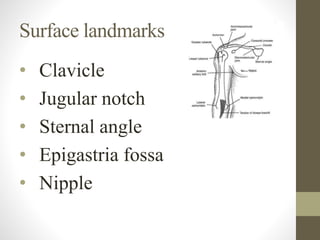
Surface landmarks
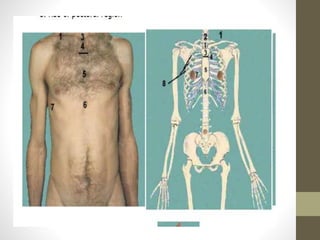
• Clavicle
• Jugular notch
• Sternal angle
• Epigastria fossa
• Nipple
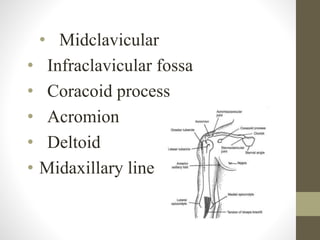
• Midclavicular
• Infraclavicular fossa
• Coracoid process
• Acromion
• Deltoid
• Midaxillary line
Superficial fascia
• Band
• Contains: moderate amount of fat, mammary
gland, fibrous septa
Contents
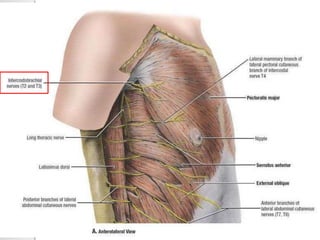
1) Cutaneous nerves
2) Cutaneous vessels
3) The platysma
4) The breast
Cutaneous Nerves
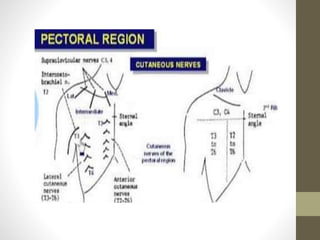
• Branches of the cervical plexus (C3, C4):(medial,
intermediate and lateral supraclavicular nerves)
• skin over the upper half of the deltoid and from the
clavicle down to the second rib.
• The anterior and lateral cutaneous branches of the second
to sixth intercostal nerves : skin below the level of the
second rib.
• The intercostobrachial nerve T2 : skin of the floor of the
axilla and the upper half of the medial side of the arm.
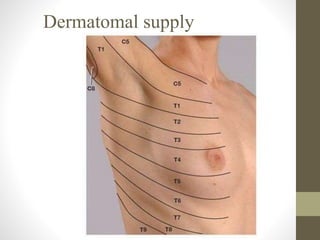
• Pulled away: The area supplied by spinal nerves
C3 and C4 directly meets the area supplied by
spinal nerves T2 and T3. This is because of the
fact that the intervening nerves (C5, C6, C7, C8
and T1) have been 'pulled away' to supply the
upper limb.
Cutaneous Vessels
• The cutaneous vessels are very small.
• The anterior cutaneous nerves are accompanied
by the perforating branches of the internal
thoracic artery.
• The second, third and fourth of these branches
are large in females for supplying the breast.
• The lateral cutaneous nerves are accompanied by
the lateral cutaneous branches of the posterior
intercostals arteries.
The Platysma
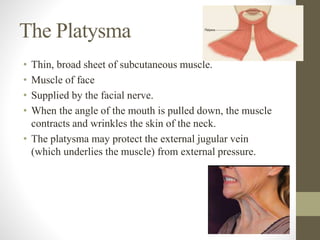
• Thin, broad sheet of subcutaneous muscle.
• Muscle of face
• Supplied by the facial nerve.
• When the angle of the mouth is pulled down, the muscle
contracts and wrinkles the skin of the neck.
• The platysma may protect the external jugular vein
(which underlies the muscle) from external pressure.
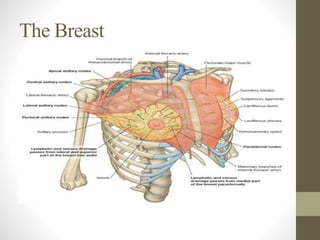
The Breast
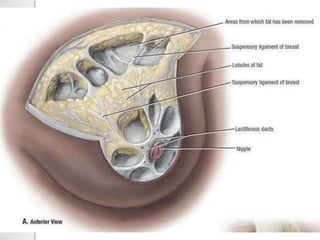
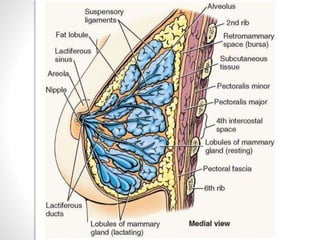
 Modified sweat gland- modified apocrine gland
 Made up of 15–20 lobules of glandular tissue
embedded in fat.
 Fat accounts for its smooth contour and most of its
bulk.
 These lobules are separated by fibrous septa
running from the subcutaneous tissues to the
fascia of the chest wall (the ligaments of
Cooper/ Astley Cooper fibers/ suspensory
ligaments)
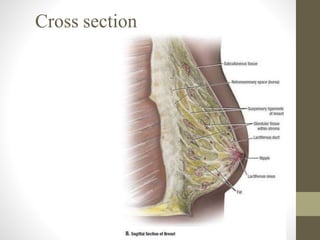
 Between the capsule and the fascia over pectoralis
major is the loose connective tissue of the
retromammary space.
 Each lobule drains by its lactiferous
duct on to the nipple, which is
surrounded by the pigmented areola.
 This area is lubricated by the areolar
glands of Montgomery
◦ large,
◦ modified sebaceous glands →may form
sebaceous cysts → may infected.
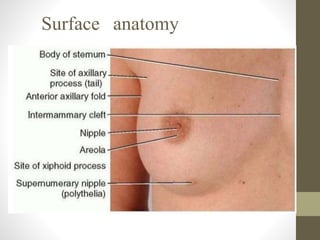
Surface anatomy
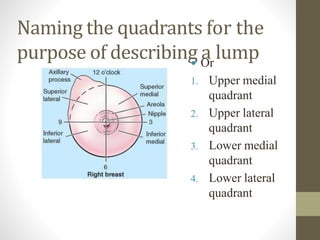
Naming the quadrants for the
purpose of describing a lump Or
1. Upper medial
quadrant
2. Upper lateral
quadrant
3. Lower medial
quadrant
4. Lower lateral
quadrant
Position & extent



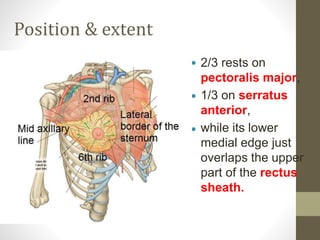
2/3 rests on
pectoralis major,
1/3 on serratus
anterior,
while its lower
medial edge just
overlaps the upper
part of the rectus
sheath.
Cross section
Blood supply
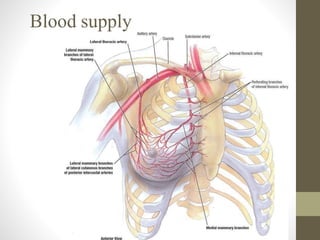
 Axillary artery →
◦ Lateral thoracic (mainly)
◦ Acromiothoracic branches.
 Internal thoracic (internal mammary) artery
→perforating branches; these pierce the 1st – 4th
intercostal spaces, then traverse pectoralis major
to reach the breast along its medial edge. The 1st
& 2nd perforators are the largest of these
branches.
 Intercostal arteries → lateral perforating
branches- relatively unimportant source.
Venous drainage
Venous drainage
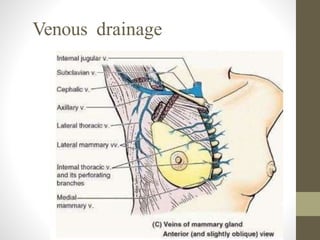
 Sub areolar venous plexus
 Posterior intercostal veins communicate
with internal vertebral venous plexus
veins - therefore cancers can spread to
vertebra- may cause back pain
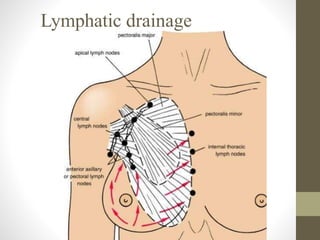
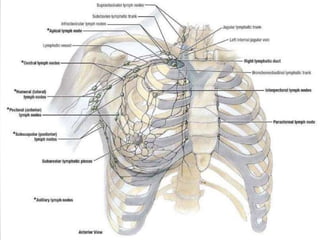
Lymphatic drainage
 Follows the pathway of its blood supply
 along tributaries of the
1. axillary vessels → axillary lymph
nodes;
2. internal thoracic vessels → piercing
pectoralis major → to traverse each
intercostal space → to lymph nodes along
the internal mammary chain; these also
receive lymphatics penetrating along the
lateral perforating branches of the
intercostal vessels.
 A subareolar plexus of lymphatics
below the nipple (the plexus of
Sappey)
 75% → axillary
 15% → internal mammary
 Upper → can go to supraclavicular
 Lower 2 quadrants can go to
subdiapragmatic or abdominal nodes
Dermatomal supply
Development and structure
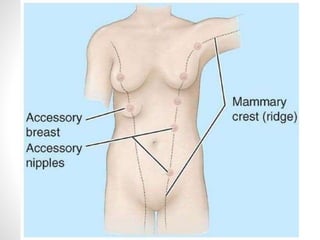
 Begins to develop as early as the 4th week as a
downgrowth from a thickened mammary ridge
(milk line) of ectoderm along a line from the
axilla to the inguinal region.
 Supernumerary nipples or even glands proper
may form at lower levels on this line.
 Lobule formation occurs only in the female
• breast & does so after puberty.
 Each lactiferous duct is connected to a tree- like system
of ducts and lobules, intermingled & enclosed by
connective tissue to form a lobe of the gland.
 The resting (non-lactating) breast, however
consists mostly of fibrous & fatty tissue;
variations in size are due to variations in fat
content, not glandular tissue which is very
sparse.
 During pregnancy alveoli bud off from the smaller ducts
& the organ usually enlarges significantly, & more so in
preparation for lactation.
 When lactation ceases there is involution of secretory
tissue.
 After menopause progressive atrophy of lobes & ducts
takes place.
The male breast
 Resembles the rudimentary female
breast
 has NO lobules or alveoli.
 The small nipple and areola lie over
the 4th intercostalspace.
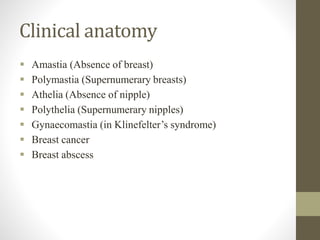
Clinical anatomy
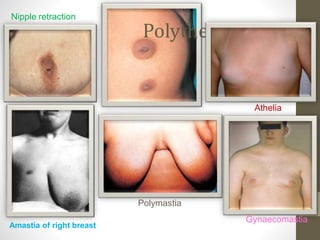
 Amastia (Absence of breast)
 Polymastia (Supernumerary breasts)
 Athelia (Absence of nipple)
 Polythelia (Supernumerary nipples)
 Gynaecomastia (in Klinefelter’s syndrome)
 Breast cancer
 Breast abscess
Amastia of right breast
Polymastia
Polythelia
Nipple retraction
Athelia
Gynaecomastia
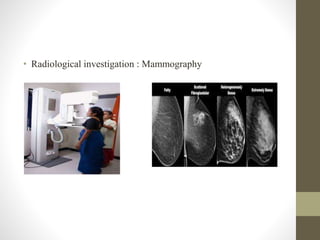
• Radiological investigation : Mammography
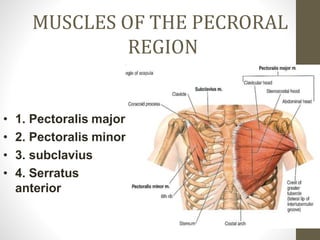
MUSCLES OF THE PECRORAL
REGION
• 1. Pectoralis major
• 2. Pectoralis minor
• 3. subclavius
• 4. Serratus
anterior
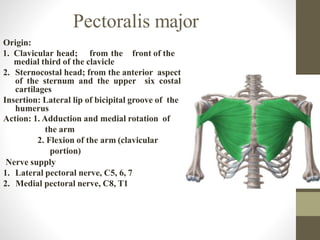
Pectoralis major
Origin:
1. Clavicular head; from the front of the
medial third of the clavicle
2. Sternocostal head; from the anterior aspect
of the sternum and the upper six costal
cartilages
Insertion: Lateral lip of bicipital groove of the
humerus
Action: 1. Adduction and medial rotation of
the arm
2. Flexion of the arm (clavicular
portion)
Nerve supply
1. Lateral pectoral nerve, C5, 6, 7
2. Medial pectoral nerve, C8, T1
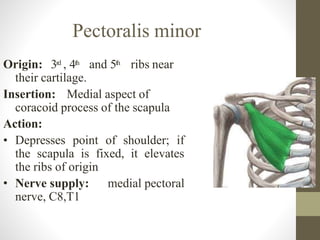
Pectoralis minor
Origin: 3rd , 4th and 5th ribs near
their cartilage.
Insertion: Medial aspect of
coracoid process of the scapula
Action:
• Depresses point of shoulder; if
the scapula is fixed, it elevates
the ribs of origin
• Nerve supply: medial pectoral
nerve, C8,T1
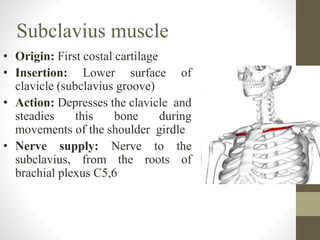
Subclavius muscle
• Origin: First costal cartilage
• Insertion: Lower surface of
clavicle (subclavius groove)
• Action: Depresses the clavicle and
steadies this bone during
movements of the shoulder girdle
• Nerve supply: Nerve to the
subclavius, from the roots of
brachial plexus C5,6
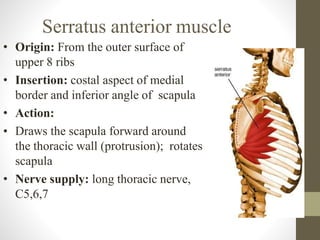
Serratus anterior muscle
• Origin: From the outer surface of
upper 8 ribs
• Insertion: costal aspect of medial
border and inferior angle of scapula
• Action:
• Draws the scapula forward around
the thoracic wall (protrusion); rotates
scapula
• Nerve supply: long thoracic nerve,
C5,6,7
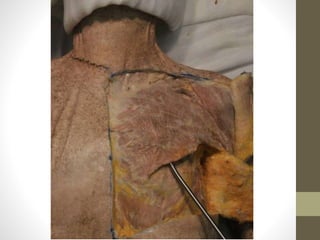
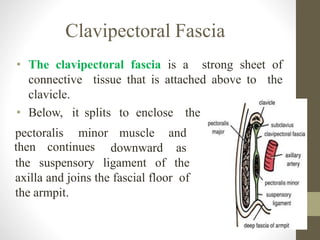
Clavipectoral Fascia
• The clavipectoral fascia is a strong sheet of
connective tissue that is attached above to the
clavicle.
• Below, it splits to enclose the
pectoralis minor
then continues
muscle and
downward as
the suspensory ligament of the
axilla and joins the fascial floor of
the armpit.
THANK YOU

Pectoral region

  • 1.
  • 2.
    What to learn? •Introduction • Surface landmarks • Superficial fascia • Deep fascia • Muscles of pectoral region
  • 3.
    Introduction • Location: Frontof chest • Essential consist of structure which connects the upper limb to the anterolateral chest wall • i.e. bones and muscles • Additionally Mammary gland
  • 4.
    Surface landmarks • Clavicle •Jugular notch • Sternal angle • Epigastria fossa • Nipple
  • 5.
    • Midclavicular • Infraclavicularfossa • Coracoid process • Acromion • Deltoid • Midaxillary line
  • 7.
    Superficial fascia • Band •Contains: moderate amount of fat, mammary gland, fibrous septa Contents 1) Cutaneous nerves 2) Cutaneous vessels 3) The platysma 4) The breast
  • 8.
    Cutaneous Nerves • Branchesof the cervical plexus (C3, C4):(medial, intermediate and lateral supraclavicular nerves) • skin over the upper half of the deltoid and from the clavicle down to the second rib. • The anterior and lateral cutaneous branches of the second to sixth intercostal nerves : skin below the level of the second rib. • The intercostobrachial nerve T2 : skin of the floor of the axilla and the upper half of the medial side of the arm.
  • 10.
    • Pulled away:The area supplied by spinal nerves C3 and C4 directly meets the area supplied by spinal nerves T2 and T3. This is because of the fact that the intervening nerves (C5, C6, C7, C8 and T1) have been 'pulled away' to supply the upper limb.
  • 11.
    Cutaneous Vessels • Thecutaneous vessels are very small. • The anterior cutaneous nerves are accompanied by the perforating branches of the internal thoracic artery. • The second, third and fourth of these branches are large in females for supplying the breast. • The lateral cutaneous nerves are accompanied by the lateral cutaneous branches of the posterior intercostals arteries.
  • 12.
    The Platysma • Thin,broad sheet of subcutaneous muscle. • Muscle of face • Supplied by the facial nerve. • When the angle of the mouth is pulled down, the muscle contracts and wrinkles the skin of the neck. • The platysma may protect the external jugular vein (which underlies the muscle) from external pressure.
  • 13.
  • 14.
     Modified sweatgland- modified apocrine gland  Made up of 15–20 lobules of glandular tissue embedded in fat.  Fat accounts for its smooth contour and most of its bulk.  These lobules are separated by fibrous septa running from the subcutaneous tissues to the fascia of the chest wall (the ligaments of Cooper/ Astley Cooper fibers/ suspensory ligaments)  Between the capsule and the fascia over pectoralis major is the loose connective tissue of the retromammary space.
  • 15.
     Each lobuledrains by its lactiferous duct on to the nipple, which is surrounded by the pigmented areola.  This area is lubricated by the areolar glands of Montgomery ◦ large, ◦ modified sebaceous glands →may form sebaceous cysts → may infected.
  • 16.
  • 17.
    Naming the quadrantsfor the purpose of describing a lump Or 1. Upper medial quadrant 2. Upper lateral quadrant 3. Lower medial quadrant 4. Lower lateral quadrant
  • 18.
    Position & extent    2/3rests on pectoralis major, 1/3 on serratus anterior, while its lower medial edge just overlaps the upper part of the rectus sheath.
  • 20.
  • 22.
  • 23.
     Axillary artery→ ◦ Lateral thoracic (mainly) ◦ Acromiothoracic branches.  Internal thoracic (internal mammary) artery →perforating branches; these pierce the 1st – 4th intercostal spaces, then traverse pectoralis major to reach the breast along its medial edge. The 1st & 2nd perforators are the largest of these branches.  Intercostal arteries → lateral perforating branches- relatively unimportant source.
  • 24.
  • 25.
    Venous drainage  Subareolar venous plexus  Posterior intercostal veins communicate with internal vertebral venous plexus veins - therefore cancers can spread to vertebra- may cause back pain
  • 26.
  • 28.
     Follows thepathway of its blood supply  along tributaries of the 1. axillary vessels → axillary lymph nodes; 2. internal thoracic vessels → piercing pectoralis major → to traverse each intercostal space → to lymph nodes along the internal mammary chain; these also receive lymphatics penetrating along the lateral perforating branches of the intercostal vessels.
  • 29.
     A subareolarplexus of lymphatics below the nipple (the plexus of Sappey)  75% → axillary  15% → internal mammary  Upper → can go to supraclavicular  Lower 2 quadrants can go to subdiapragmatic or abdominal nodes
  • 31.
  • 32.
    Development and structure Begins to develop as early as the 4th week as a downgrowth from a thickened mammary ridge (milk line) of ectoderm along a line from the axilla to the inguinal region.  Supernumerary nipples or even glands proper may form at lower levels on this line.
  • 33.
     Lobule formationoccurs only in the female • breast & does so after puberty.  Each lactiferous duct is connected to a tree- like system of ducts and lobules, intermingled & enclosed by connective tissue to form a lobe of the gland.
  • 35.
     The resting(non-lactating) breast, however consists mostly of fibrous & fatty tissue; variations in size are due to variations in fat content, not glandular tissue which is very sparse.
  • 36.
     During pregnancyalveoli bud off from the smaller ducts & the organ usually enlarges significantly, & more so in preparation for lactation.  When lactation ceases there is involution of secretory tissue.  After menopause progressive atrophy of lobes & ducts takes place.
  • 37.
    The male breast Resembles the rudimentary female breast  has NO lobules or alveoli.  The small nipple and areola lie over the 4th intercostalspace.
  • 38.
    Clinical anatomy  Amastia(Absence of breast)  Polymastia (Supernumerary breasts)  Athelia (Absence of nipple)  Polythelia (Supernumerary nipples)  Gynaecomastia (in Klinefelter’s syndrome)  Breast cancer  Breast abscess
  • 39.
    Amastia of rightbreast Polymastia Polythelia Nipple retraction Athelia Gynaecomastia
  • 40.
  • 41.
    MUSCLES OF THEPECRORAL REGION • 1. Pectoralis major • 2. Pectoralis minor • 3. subclavius • 4. Serratus anterior
  • 42.
    Pectoralis major Origin: 1. Clavicularhead; from the front of the medial third of the clavicle 2. Sternocostal head; from the anterior aspect of the sternum and the upper six costal cartilages Insertion: Lateral lip of bicipital groove of the humerus Action: 1. Adduction and medial rotation of the arm 2. Flexion of the arm (clavicular portion) Nerve supply 1. Lateral pectoral nerve, C5, 6, 7 2. Medial pectoral nerve, C8, T1
  • 44.
    Pectoralis minor Origin: 3rd, 4th and 5th ribs near their cartilage. Insertion: Medial aspect of coracoid process of the scapula Action: • Depresses point of shoulder; if the scapula is fixed, it elevates the ribs of origin • Nerve supply: medial pectoral nerve, C8,T1
  • 45.
    Subclavius muscle • Origin:First costal cartilage • Insertion: Lower surface of clavicle (subclavius groove) • Action: Depresses the clavicle and steadies this bone during movements of the shoulder girdle • Nerve supply: Nerve to the subclavius, from the roots of brachial plexus C5,6
  • 46.
    Serratus anterior muscle •Origin: From the outer surface of upper 8 ribs • Insertion: costal aspect of medial border and inferior angle of scapula • Action: • Draws the scapula forward around the thoracic wall (protrusion); rotates scapula • Nerve supply: long thoracic nerve, C5,6,7
  • 47.
    Clavipectoral Fascia • Theclavipectoral fascia is a strong sheet of connective tissue that is attached above to the clavicle. • Below, it splits to enclose the pectoralis minor then continues muscle and downward as the suspensory ligament of the axilla and joins the fascial floor of the armpit.
  • 48.