MAMMALIAN REPRODUCTION<br />Mammary glands<br />“Mammary glands are present in both sexes but normally produce milk only in females. Though not part of the reproductive system, the female mammary glands are important to reproduction. Within the glands, small sacs of epithelial tissue secrete milk, which drains into a series of ducts opening at the nipple. The breasts contain connective and fatty (adipose) tissue in addition to the mammary glands. Because the low level of estradiol in males limits the development of the fat deposits, male breasts usually remain small.”<br />Structure <-> Function
Female
StructureFunctionfolliclesStructure in the ovary that contains oocyte, a partially developed egg. It also releases a primary female sex hormone, estrogen, specifically estradiolCorpus luteumA tissue in the ovary that forms from the collapsed follicle after ovulation. It secretes additional estradiol and progesterone which helps maintain the uterine lining during pregnancyOviduct/fallopian tubeA tube connecting the ovary to the uterus. Using wavelike motions, the eggs released from the ovary is brought to the uterusOvaryproduces female gametes and reproductive hormones.Uterusa.k.a the womb. It is where eggs are fertilized and developendometriumInner lining of the uterus that is rich in blood vessels. The rich supply of blood vessels allow an optimal situation for implantation of blastocystcervixNeck of the uterus; leads to the vagina; mucus forms plug to prevent infection; allows the flow of blood from uterus to vagina; directs the sperm into uterusvaginaMuscular but elastic chamber; site for insertion of penis and deposition of sperm during copulation; serves as birth canal and opens to the vulva, the external female genitalia Labia majoraThick, fatty ridges that protect the rest of the vulvaLabia minoraSlender skin folds that borders the vaginal opening and the separate opening of the urethraHymenThin piece of tissue that partly covers the vagina; ruptured during sexual intercourseclitorisLocated at the upper intersection of the labia minora; consists of a short shaft, glans/head and prepuce(fold of skin covering the glans); richly supplied with nerve endings, making it one of the most sensitive points of sexual stimulation; becomes erect during arousalBartholin’s glandsLocated slightly below and to the left and right of the vaginal opening; secretes mucus to lubricate the vagina
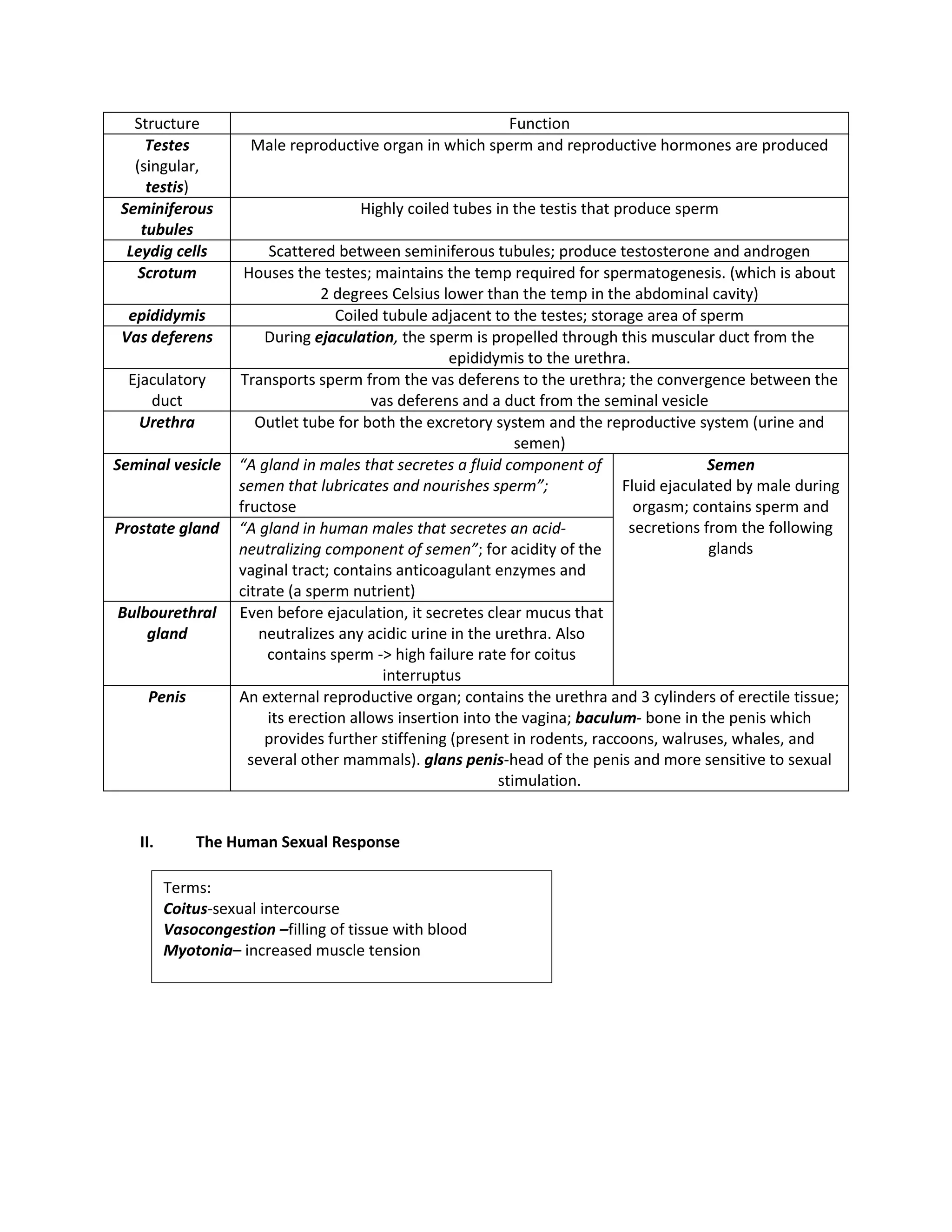
MaleStructureFunctionTestes (singular, testis)Male reproductive organ in which sperm and reproductive hormones are producedSeminiferous tubulesHighly coiled tubes in the testis that produce spermLeydig cellsScattered between seminiferous tubules; produce testosterone and androgenScrotum Houses the testes; maintains the temp required for spermatogenesis. (which is about 2 degrees Celsius lower than the temp in the abdominal cavity)epididymisCoiled tubule adjacent to the testes; storage area of spermVas deferensDuring ejaculation, the sperm is propelled through this muscular duct from the epididymis to the urethra.Ejaculatory ductTransports sperm from the vas deferens to the urethra; the convergence between the vas deferens and a duct from the seminal vesicleUrethra Outlet tube for both the excretory system and the reproductive system (urine and semen)Seminal vesicle“A gland in males that secretes a fluid component of semen that lubricates and nourishes sperm”; fructoseSemenFluid ejaculated by male during orgasm; contains sperm and secretions from the following glandsProstate gland“A gland in human males that secretes an acid-neutralizing component of semen”; for acidity of the vaginal tract; contains anticoagulant enzymes and citrate (a sperm nutrient)Bulbourethral glandEven before ejaculation, it secretes clear mucus that neutralizes any acidic urine in the urethra. Also contains sperm -> high failure rate for coitus interruptusPenis An external reproductive organ; contains the urethra and 3 cylinders of erectile tissue; its erection allows insertion into the vagina; baculum- bone in the penis which provides further stiffening (present in rodents, raccoons, walruses, whales, and several other mammals). glans penis-head of the penis and more sensitive to sexual stimulation.<br />323850325120Terms:Coitus-sexual intercourseVasocongestion –filling of tissue with bloodMyotonia– increased muscle tension00Terms:Coitus-sexual intercourseVasocongestion –filling of tissue with bloodMyotonia– increased muscle tensionThe Human Sexual Response
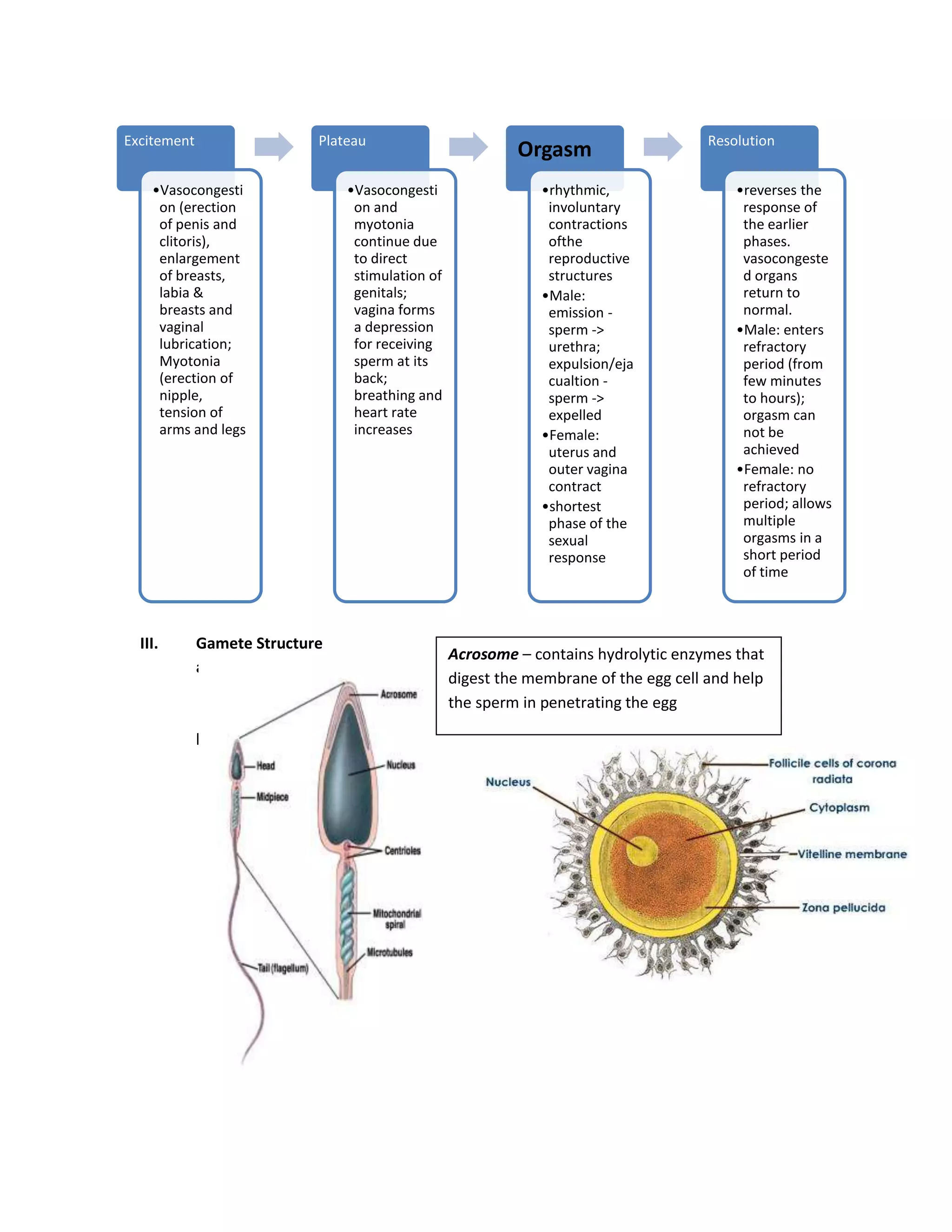
264795038735Acrosome – contains hydrolytic enzymes that digest the membrane of the egg cell and help the sperm in penetrating the egg00Acrosome – contains hydrolytic enzymes that digest the membrane of the egg cell and help the sperm in penetrating the eggGamete Structure
70612024765S
3032760531495
E
Regulation of Human Reproductive System by Sex Hormones

Mammalian Reproduction

  • 1.
    MAMMALIAN REPRODUCTION<br />Mammaryglands<br />“Mammary glands are present in both sexes but normally produce milk only in females. Though not part of the reproductive system, the female mammary glands are important to reproduction. Within the glands, small sacs of epithelial tissue secrete milk, which drains into a series of ducts opening at the nipple. The breasts contain connective and fatty (adipose) tissue in addition to the mammary glands. Because the low level of estradiol in males limits the development of the fat deposits, male breasts usually remain small.”<br />Structure <-> Function
  • 2.
  • 3.
    StructureFunctionfolliclesStructure in theovary that contains oocyte, a partially developed egg. It also releases a primary female sex hormone, estrogen, specifically estradiolCorpus luteumA tissue in the ovary that forms from the collapsed follicle after ovulation. It secretes additional estradiol and progesterone which helps maintain the uterine lining during pregnancyOviduct/fallopian tubeA tube connecting the ovary to the uterus. Using wavelike motions, the eggs released from the ovary is brought to the uterusOvaryproduces female gametes and reproductive hormones.Uterusa.k.a the womb. It is where eggs are fertilized and developendometriumInner lining of the uterus that is rich in blood vessels. The rich supply of blood vessels allow an optimal situation for implantation of blastocystcervixNeck of the uterus; leads to the vagina; mucus forms plug to prevent infection; allows the flow of blood from uterus to vagina; directs the sperm into uterusvaginaMuscular but elastic chamber; site for insertion of penis and deposition of sperm during copulation; serves as birth canal and opens to the vulva, the external female genitalia Labia majoraThick, fatty ridges that protect the rest of the vulvaLabia minoraSlender skin folds that borders the vaginal opening and the separate opening of the urethraHymenThin piece of tissue that partly covers the vagina; ruptured during sexual intercourseclitorisLocated at the upper intersection of the labia minora; consists of a short shaft, glans/head and prepuce(fold of skin covering the glans); richly supplied with nerve endings, making it one of the most sensitive points of sexual stimulation; becomes erect during arousalBartholin’s glandsLocated slightly below and to the left and right of the vaginal opening; secretes mucus to lubricate the vagina
  • 4.
    MaleStructureFunctionTestes (singular, testis)Malereproductive organ in which sperm and reproductive hormones are producedSeminiferous tubulesHighly coiled tubes in the testis that produce spermLeydig cellsScattered between seminiferous tubules; produce testosterone and androgenScrotum Houses the testes; maintains the temp required for spermatogenesis. (which is about 2 degrees Celsius lower than the temp in the abdominal cavity)epididymisCoiled tubule adjacent to the testes; storage area of spermVas deferensDuring ejaculation, the sperm is propelled through this muscular duct from the epididymis to the urethra.Ejaculatory ductTransports sperm from the vas deferens to the urethra; the convergence between the vas deferens and a duct from the seminal vesicleUrethra Outlet tube for both the excretory system and the reproductive system (urine and semen)Seminal vesicle“A gland in males that secretes a fluid component of semen that lubricates and nourishes sperm”; fructoseSemenFluid ejaculated by male during orgasm; contains sperm and secretions from the following glandsProstate gland“A gland in human males that secretes an acid-neutralizing component of semen”; for acidity of the vaginal tract; contains anticoagulant enzymes and citrate (a sperm nutrient)Bulbourethral glandEven before ejaculation, it secretes clear mucus that neutralizes any acidic urine in the urethra. Also contains sperm -> high failure rate for coitus interruptusPenis An external reproductive organ; contains the urethra and 3 cylinders of erectile tissue; its erection allows insertion into the vagina; baculum- bone in the penis which provides further stiffening (present in rodents, raccoons, walruses, whales, and several other mammals). glans penis-head of the penis and more sensitive to sexual stimulation.<br />323850325120Terms:Coitus-sexual intercourseVasocongestion –filling of tissue with bloodMyotonia– increased muscle tension00Terms:Coitus-sexual intercourseVasocongestion –filling of tissue with bloodMyotonia– increased muscle tensionThe Human Sexual Response
  • 5.
    264795038735Acrosome – containshydrolytic enzymes that digest the membrane of the egg cell and help the sperm in penetrating the egg00Acrosome – contains hydrolytic enzymes that digest the membrane of the egg cell and help the sperm in penetrating the eggGamete Structure
  • 6.
  • 7.
  • 8.
  • 9.
    Regulation of HumanReproductive System by Sex Hormones
  • 10.
    Hypothalamus, anterior pituitaryglands and gonads govern human reproduction
  • 11.
    Hypothalamus –secretes-> gonadotropinreleasing hormmones (GnRH).
  • 12.
    Anterior pituitary –GnRH->follicle-stimulating hormone (FSH) + lutenizing hormone (LH)
  • 13.
    FSH and LHregulate gametogenesis:
  • 14.
  • 15.
    Indirect: sex hormoneproduction (principally, steroid hormones)
  • 16.
    Sex hormones alsoregulate gametogenesis:
  • 17.
    Effect of sexhormones:
  • 18.
  • 19.
  • 20.
    Development of primarysex characteristics, structures (e.g. seminal vesicles0
  • 21.
  • 22.
    Development of facialand pubic hair
  • 23.
  • 24.
    Specific sexual behavioursand sex drive (generally, an increase in aggressiveness)
  • 25.
  • 26.
    Development of breastand pubic hair
  • 27.
  • 28.
    Fat deposits inducedin breasts and hips
  • 29.
  • 30.
  • 31.
    Hormonal Control ofthe Male Reproductive System
  • 32.
    Ovarian and Uterine(Menstrual Cycle)
  • 33.
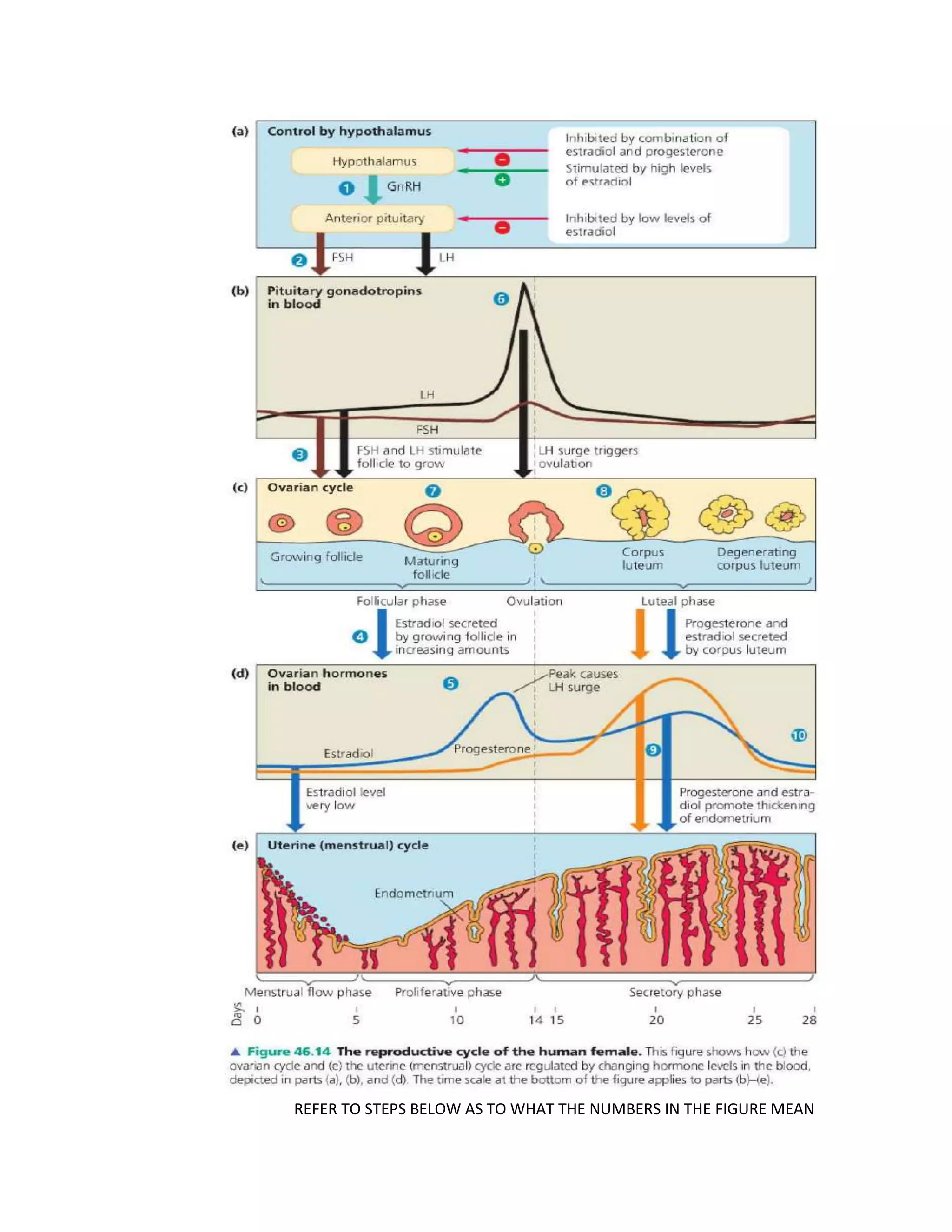
    REFER TO STEPSBELOW AS TO WHAT THE NUMBERS IN THE FIGURE MEAN
  • 34.
    Release of GnRHfrom hypothalamus
  • 35.
    GnRH stimulates anteriorpituitary to release FSH and LH
  • 36.
    FSH, aided byLH, stimulates follicle growth
  • 37.
    Estradiol secretion bygrowing follicles
  • 38.
  • 39.
  • 40.
    Maturing follicle growsvery large; follicle & adjacent wall of the ovary ruptureOVULATION – ovum is released from ovary to fallopian tube<br />Remaining follicular tissue (stimulation by LH) -> corpus luteum
  • 41.
    ↑estradiol, ↑progesterone causesnegative feedback on the release of LH and FSH (↓LH, ↓FSH)
  • 42.
    ↓gonadotropin levels causesthe corpus luteum to disintegrate
  • 43.
    ↓estradiol, ↓progesterone whichends the negative feedback (FSH and LH levels increase)
  • 44.
    Enough FSH stimulatesthe growth of new folliclesProliferative phase – coincides with follicular phase; estradiol by growing follicles -> endometrium thickens<br />Secretory phase – coincides with luteal phase; estradiol and progesterone causes development & maintenance of uterine lining, enlargement of arteries and growth of endometrial glands. (these glands secrete nutrient fluid, hence it is called the secretory phase)
  • 45.
  • 46.
    ↓ovarian hormone levels,endometrial arteries constrict
  • 47.
    ↓circulation, uterine liningdisintegrates, uterus contracts
  • 48.
    Blood vessels constrict-> blood released and shed along with endometrial tissue & fluid
  • 49.
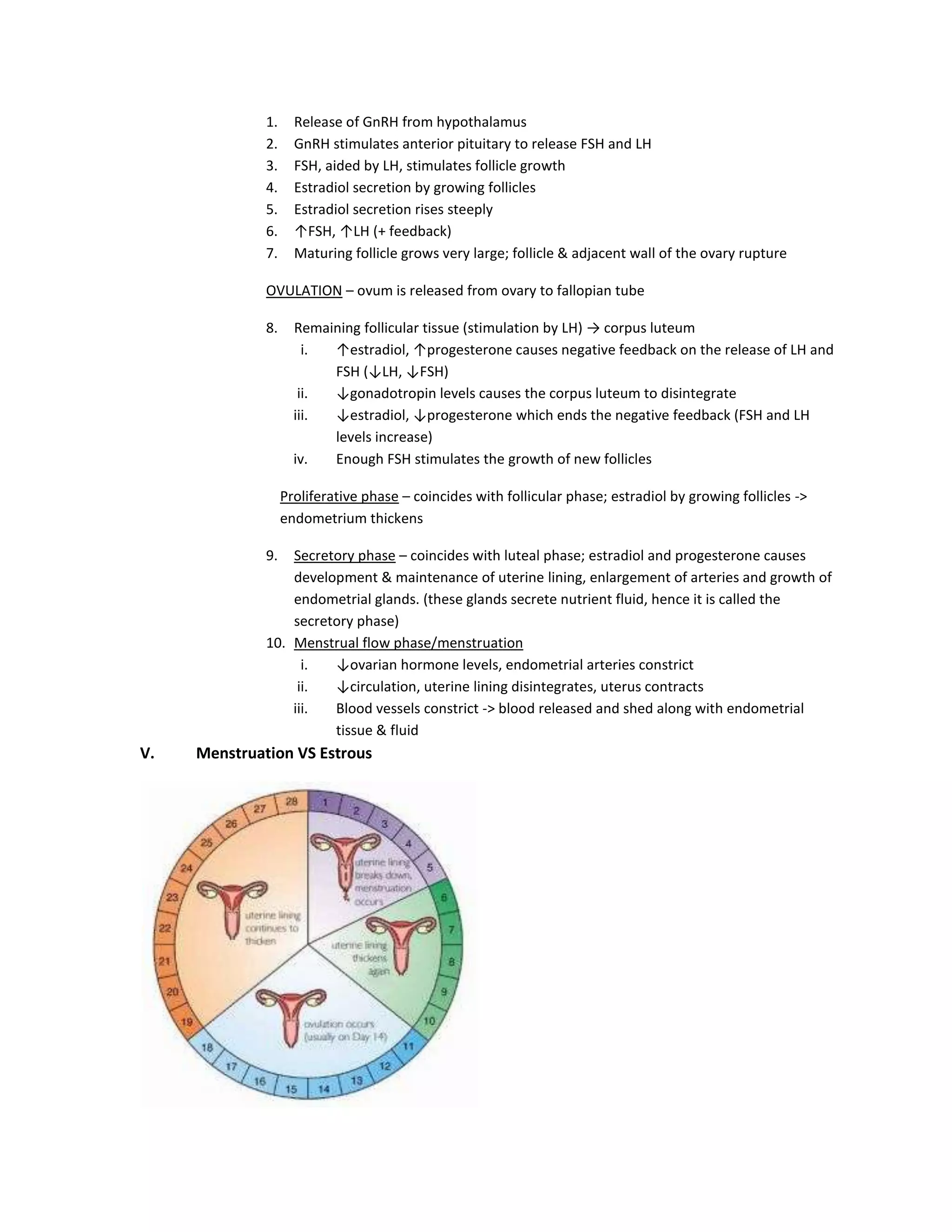
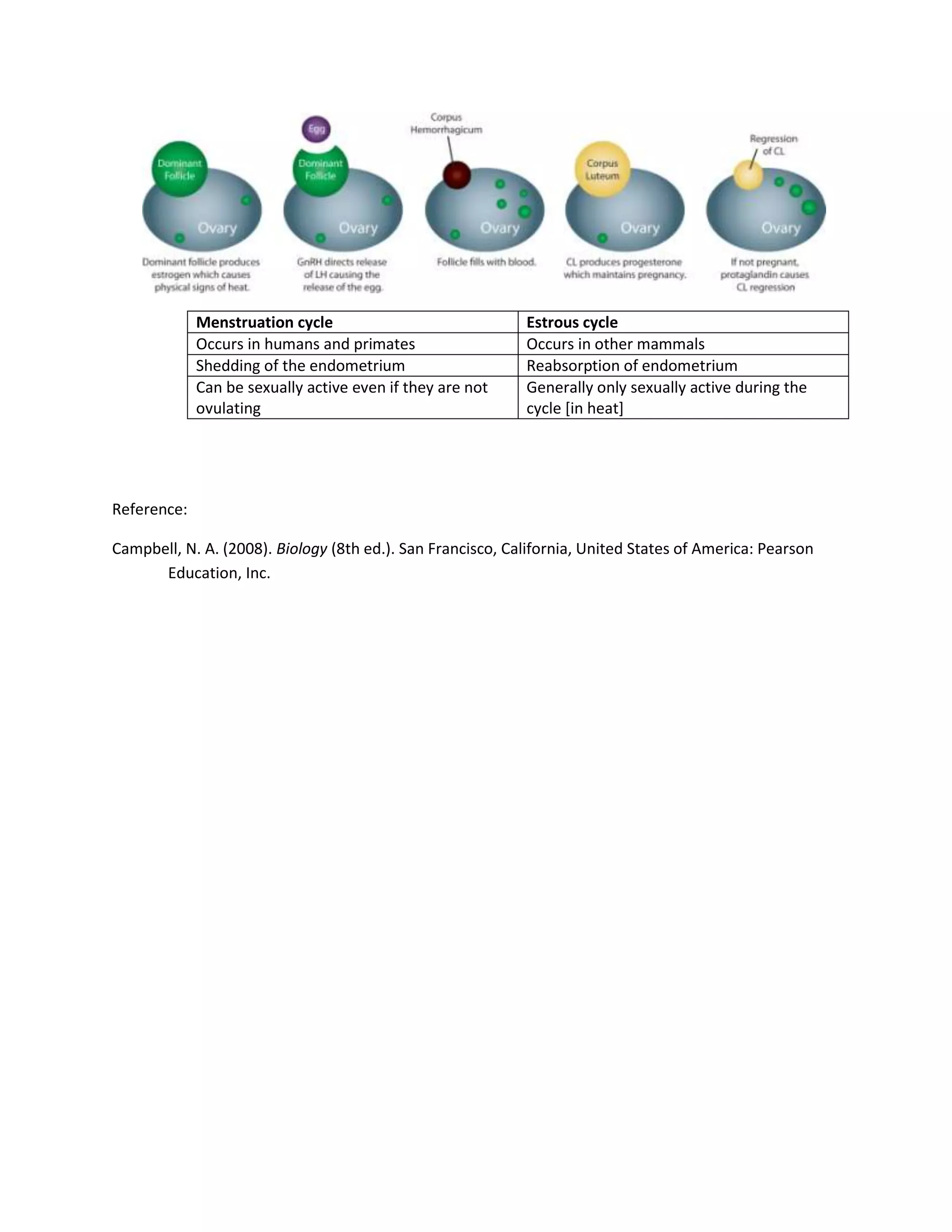
    Menstruation VS Estrous<br />Menstruation cycleEstrous cycleOccurs in humans and primatesOccurs in other mammalsShedding of the endometrium Reabsorption of endometriumCan be sexually active even if they are not ovulatingGenerally only sexually active during the cycle [in heat]Reference:<br /> BIBLIOGRAPHY \l 13321 Campbell, N. A. (2008). Biology (8th ed.). San Francisco, California, United States of America: Pearson Education, Inc.<br />