QIISS4Long Exam I ReviewerFerdinand B. Sta. Ana Jr. (IV – Electron)
Elasticity
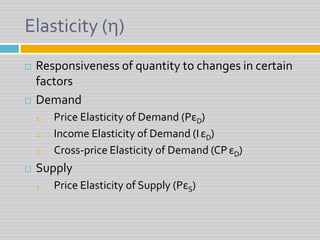
Elasticity (η)Responsiveness of quantity to changes in certain factorsDemandPrice Elasticity of Demand (PεD)Income Elasticity of Demand (IεD)Cross-price Elasticity of Demand (CPεD)SupplyPrice Elasticity of Supply (PεS)
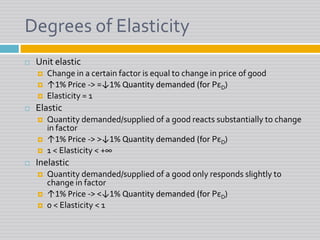
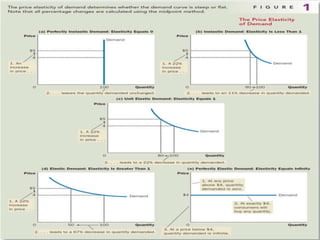
Degrees of ElasticityUnit elasticChange in a certain factor is equal to change in price of g00d↑1% Price -> =↓1% Quantity demanded (for PεD)Elasticity = 1ElasticQuantity demanded/supplied of a good reacts substantially to change in factor↑1% Price -> >↓1% Quantity demanded (for PεD)1 < Elasticity < +∞InelasticQuantity demanded/supplied of a good only responds slightly to change in factor↑1% Price -> <↓1% Quantity demanded (for PεD)0 < Elasticity < 1
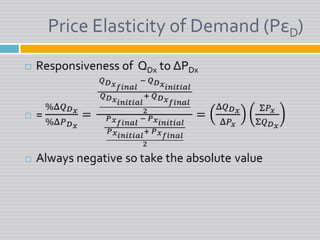
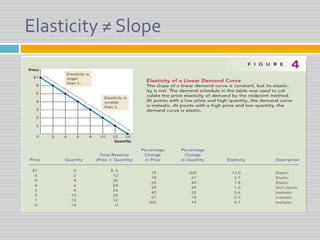
Price Elasticity of Demand (PεD)Responsiveness of  QDx to ΔPDx= %Δ𝑄𝐷𝑥%Δ𝑃𝐷𝑥= 𝑄𝐷𝑥𝑓𝑖𝑛𝑎𝑙 − 𝑄𝐷𝑥𝑖𝑛𝑖𝑡𝑖𝑎𝑙𝑄𝐷𝑥𝑖𝑛𝑖𝑡𝑖𝑎𝑙+ 𝑄𝐷𝑥𝑓𝑖𝑛𝑎𝑙2𝑃𝑥𝑓𝑖𝑛𝑎𝑙 − 𝑃𝑥𝑖𝑛𝑖𝑡𝑖𝑎𝑙𝑃𝑥𝑖𝑛𝑖𝑡𝑖𝑎𝑙+ 𝑃𝑥𝑓𝑖𝑛𝑎𝑙2=Δ𝑄𝐷𝑥Δ𝑃𝑥Σ𝑃𝑥Σ𝑄𝐷𝑥Always negative so take the absolute value 
Elasticity ≠ Slope
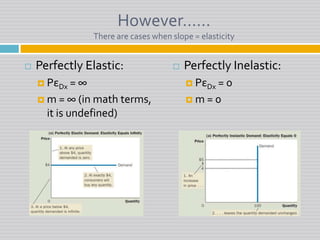
However……There are cases when slope = elasticityPerfectly Elastic:PεDx= ∞m = ∞ (in math terms, it is undefined)Perfectly Inelastic:PεDx = 0m = 0
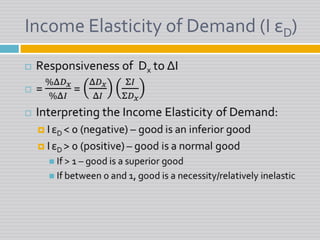
Income Elasticity of Demand (I εD)Responsiveness of  Dxto ΔI= %Δ𝐷𝑥%Δ𝐼 = Δ𝐷𝑥Δ𝐼Σ𝐼Σ𝐷𝑥Interpreting the Income Elasticity of Demand:IεD < 0 (negative) – good is an inferior goodIεD > 0 (positive) – good is a normal goodIf > 1 – good is a superior goodIf between 0 and 1, good is a necessity/relatively inelastic 
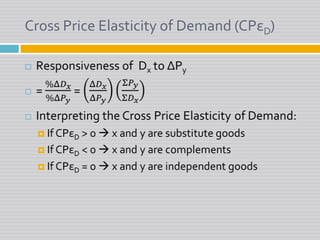
Cross Price Elasticity of Demand (CPεD)Responsiveness of  Dx to ΔPy= %Δ𝐷𝑥%Δ𝑃𝑦 = Δ𝐷𝑥Δ𝑃𝑦Σ𝑃𝑦Σ𝐷𝑥Interpreting the Cross Price Elasticity of Demand:If CPεD > 0  x and y are substitute goodsIf CPεD< 0  x and y are complementsIf CPεD= 0  x and y are independent goods 
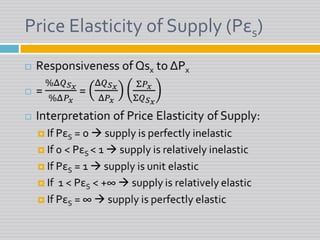
Price Elasticity of Supply (Pεs)Responsiveness of Qsx to ΔPx= %Δ𝑄𝑆𝑥%Δ𝑃𝑥 = Δ𝑄𝑆𝑥Δ𝑃𝑥Σ𝑃𝑥Σ𝑄𝑆𝑥Interpretation of Price Elasticity of Supply:If PεS = 0  supply is perfectly inelasticIf 0 < PεS < 1  supply is relatively inelasticIf PεS = 1  supply is unit elasticIf  1 < PεS < +∞  supply is relatively elasticIf PεS = ∞  supply is perfectly elastic 
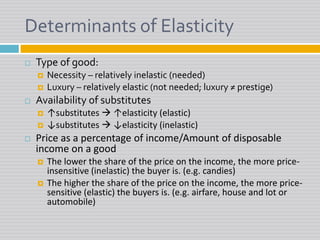
Determinants of Elasticity Type of good:Necessity – relatively inelastic (needed)Luxury – relatively elastic (not needed; luxury ≠ prestige)Availability of substitutes↑substitutes  ↑elasticity (elastic)↓substitutes  ↓elasticity (inelastic)Price as a percentage of income/Amount of disposable income on a goodThe lower the share of the price on the income, the more price-insensitive (inelastic) the buyer is. (e.g. candies)The higher the share of the price on the income, the more price-sensitive (elastic) the buyers is. (e.g. airfare, house and lot or automobile)
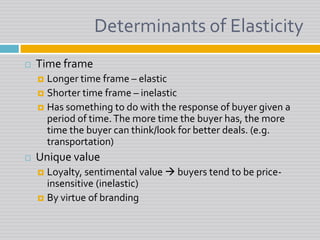
Determinants of ElasticityTime frameLonger time frame – elasticShorter time frame – inelasticHas something to do with the response of buyer given a period of time. The more time the buyer has, the more time the buyer can think/look for better deals. (e.g. transportation)Unique valueLoyalty, sentimental value  buyers tend to be price-insensitive (inelastic)By virtue of branding
Tax Incidence
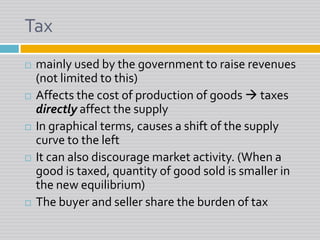
Taxmainly used by the government to raise revenues (not limited to this)Affects the cost of production of goods  taxes directly affect the supply In graphical terms, causes a shift of the supply curve to the leftIt can also discourage market activity. (When a good is taxed, quantity of good sold is smaller in the new equilibrium)The buyer and seller share the burden of tax
Who has the heavier burden?This is where elasticity comes in. Analyze the ff. graphs:Demand and Supply have equal elasticity
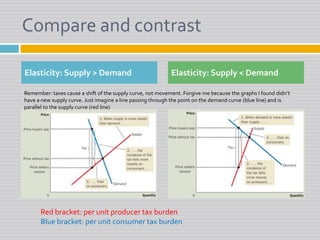
Compare and contrastElasticity: Supply > DemandElasticity: Supply < DemandRemember: taxes cause a shift of the supply curve, not movement. Forgive me because the graphs I found didn’t have a new supply curve. Just imagine a line passing through the point on the demand curve (blue line) and is parallel to the supply curve (red line)Red bracket: per unit producer tax burdenBlue bracket: per unit consumer tax burden
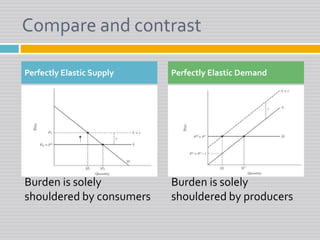
Compare and contrastBurden is solely shouldered by consumersBurden is solely shouldered by producersPerfectly Elastic SupplyPerfectly Elastic Demand
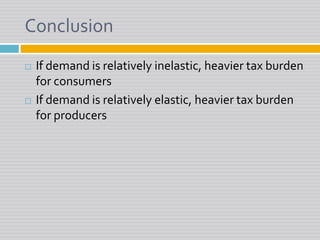
ConclusionIf demand is relatively inelastic, heavier tax burden for consumersIf demand is relatively elastic, heavier tax burden for producers
Other notesRemember that the government will profit more from taxing inelastic goodsBut, inelastic goods are usually necessities, and taxing inelastic goods will contradict the equity function of the governmentSo, the gov’t taxes the elastic goods that it wants to lower transactions of.Sin taxes – taxes on generally socially unwanted goods.Taxes on imports – taxes levied on imports to promote local products
ReferencesSamuelson, P. A. & Nordhaus, W. D. (2004). Economics, 18th ed. USA: Mc-Graw Hill, Inc.Mankiw, N. G. (2009). Principle of microeconomics, 5th ed. Mason, OH: South-Western Cengage LearningDepken, C. A. (2006). Microeconomicsdemystified. USA: Mc-Graw Hill, Inc.Notes from the lecture of Vladimir S. Lopez
End of Reviewer-fbsaj2011

QII - SS4 - LT1 reviewer

  • 1.
    QIISS4Long Exam IReviewerFerdinand B. Sta. Ana Jr. (IV – Electron)
  • 2.
  • 3.
    Elasticity (η)Responsiveness ofquantity to changes in certain factorsDemandPrice Elasticity of Demand (PεD)Income Elasticity of Demand (IεD)Cross-price Elasticity of Demand (CPεD)SupplyPrice Elasticity of Supply (PεS)
  • 4.
    Degrees of ElasticityUnitelasticChange in a certain factor is equal to change in price of g00d↑1% Price -> =↓1% Quantity demanded (for PεD)Elasticity = 1ElasticQuantity demanded/supplied of a good reacts substantially to change in factor↑1% Price -> >↓1% Quantity demanded (for PεD)1 < Elasticity < +∞InelasticQuantity demanded/supplied of a good only responds slightly to change in factor↑1% Price -> <↓1% Quantity demanded (for PεD)0 < Elasticity < 1
  • 5.
    Price Elasticity ofDemand (PεD)Responsiveness of QDx to ΔPDx= %Δ𝑄𝐷𝑥%Δ𝑃𝐷𝑥= 𝑄𝐷𝑥𝑓𝑖𝑛𝑎𝑙 − 𝑄𝐷𝑥𝑖𝑛𝑖𝑡𝑖𝑎𝑙𝑄𝐷𝑥𝑖𝑛𝑖𝑡𝑖𝑎𝑙+ 𝑄𝐷𝑥𝑓𝑖𝑛𝑎𝑙2𝑃𝑥𝑓𝑖𝑛𝑎𝑙 − 𝑃𝑥𝑖𝑛𝑖𝑡𝑖𝑎𝑙𝑃𝑥𝑖𝑛𝑖𝑡𝑖𝑎𝑙+ 𝑃𝑥𝑓𝑖𝑛𝑎𝑙2=Δ𝑄𝐷𝑥Δ𝑃𝑥Σ𝑃𝑥Σ𝑄𝐷𝑥Always negative so take the absolute value 
  • 7.
  • 8.
    However……There are caseswhen slope = elasticityPerfectly Elastic:PεDx= ∞m = ∞ (in math terms, it is undefined)Perfectly Inelastic:PεDx = 0m = 0
  • 9.
    Income Elasticity ofDemand (I εD)Responsiveness of Dxto ΔI= %Δ𝐷𝑥%Δ𝐼 = Δ𝐷𝑥Δ𝐼Σ𝐼Σ𝐷𝑥Interpreting the Income Elasticity of Demand:IεD < 0 (negative) – good is an inferior goodIεD > 0 (positive) – good is a normal goodIf > 1 – good is a superior goodIf between 0 and 1, good is a necessity/relatively inelastic 
  • 10.
    Cross Price Elasticityof Demand (CPεD)Responsiveness of Dx to ΔPy= %Δ𝐷𝑥%Δ𝑃𝑦 = Δ𝐷𝑥Δ𝑃𝑦Σ𝑃𝑦Σ𝐷𝑥Interpreting the Cross Price Elasticity of Demand:If CPεD > 0  x and y are substitute goodsIf CPεD< 0  x and y are complementsIf CPεD= 0  x and y are independent goods 
  • 11.
    Price Elasticity ofSupply (Pεs)Responsiveness of Qsx to ΔPx= %Δ𝑄𝑆𝑥%Δ𝑃𝑥 = Δ𝑄𝑆𝑥Δ𝑃𝑥Σ𝑃𝑥Σ𝑄𝑆𝑥Interpretation of Price Elasticity of Supply:If PεS = 0  supply is perfectly inelasticIf 0 < PεS < 1  supply is relatively inelasticIf PεS = 1  supply is unit elasticIf 1 < PεS < +∞  supply is relatively elasticIf PεS = ∞  supply is perfectly elastic 
  • 12.
    Determinants of ElasticityType of good:Necessity – relatively inelastic (needed)Luxury – relatively elastic (not needed; luxury ≠ prestige)Availability of substitutes↑substitutes  ↑elasticity (elastic)↓substitutes  ↓elasticity (inelastic)Price as a percentage of income/Amount of disposable income on a goodThe lower the share of the price on the income, the more price-insensitive (inelastic) the buyer is. (e.g. candies)The higher the share of the price on the income, the more price-sensitive (elastic) the buyers is. (e.g. airfare, house and lot or automobile)
  • 13.
    Determinants of ElasticityTimeframeLonger time frame – elasticShorter time frame – inelasticHas something to do with the response of buyer given a period of time. The more time the buyer has, the more time the buyer can think/look for better deals. (e.g. transportation)Unique valueLoyalty, sentimental value  buyers tend to be price-insensitive (inelastic)By virtue of branding
  • 14.
  • 15.
    Taxmainly used bythe government to raise revenues (not limited to this)Affects the cost of production of goods  taxes directly affect the supply In graphical terms, causes a shift of the supply curve to the leftIt can also discourage market activity. (When a good is taxed, quantity of good sold is smaller in the new equilibrium)The buyer and seller share the burden of tax
  • 16.
    Who has theheavier burden?This is where elasticity comes in. Analyze the ff. graphs:Demand and Supply have equal elasticity
  • 17.
    Compare and contrastElasticity:Supply > DemandElasticity: Supply < DemandRemember: taxes cause a shift of the supply curve, not movement. Forgive me because the graphs I found didn’t have a new supply curve. Just imagine a line passing through the point on the demand curve (blue line) and is parallel to the supply curve (red line)Red bracket: per unit producer tax burdenBlue bracket: per unit consumer tax burden
  • 18.
    Compare and contrastBurdenis solely shouldered by consumersBurden is solely shouldered by producersPerfectly Elastic SupplyPerfectly Elastic Demand
  • 19.
    ConclusionIf demand isrelatively inelastic, heavier tax burden for consumersIf demand is relatively elastic, heavier tax burden for producers
  • 20.
    Other notesRemember thatthe government will profit more from taxing inelastic goodsBut, inelastic goods are usually necessities, and taxing inelastic goods will contradict the equity function of the governmentSo, the gov’t taxes the elastic goods that it wants to lower transactions of.Sin taxes – taxes on generally socially unwanted goods.Taxes on imports – taxes levied on imports to promote local products
  • 21.
    ReferencesSamuelson, P. A.& Nordhaus, W. D. (2004). Economics, 18th ed. USA: Mc-Graw Hill, Inc.Mankiw, N. G. (2009). Principle of microeconomics, 5th ed. Mason, OH: South-Western Cengage LearningDepken, C. A. (2006). Microeconomicsdemystified. USA: Mc-Graw Hill, Inc.Notes from the lecture of Vladimir S. Lopez
  • 22.