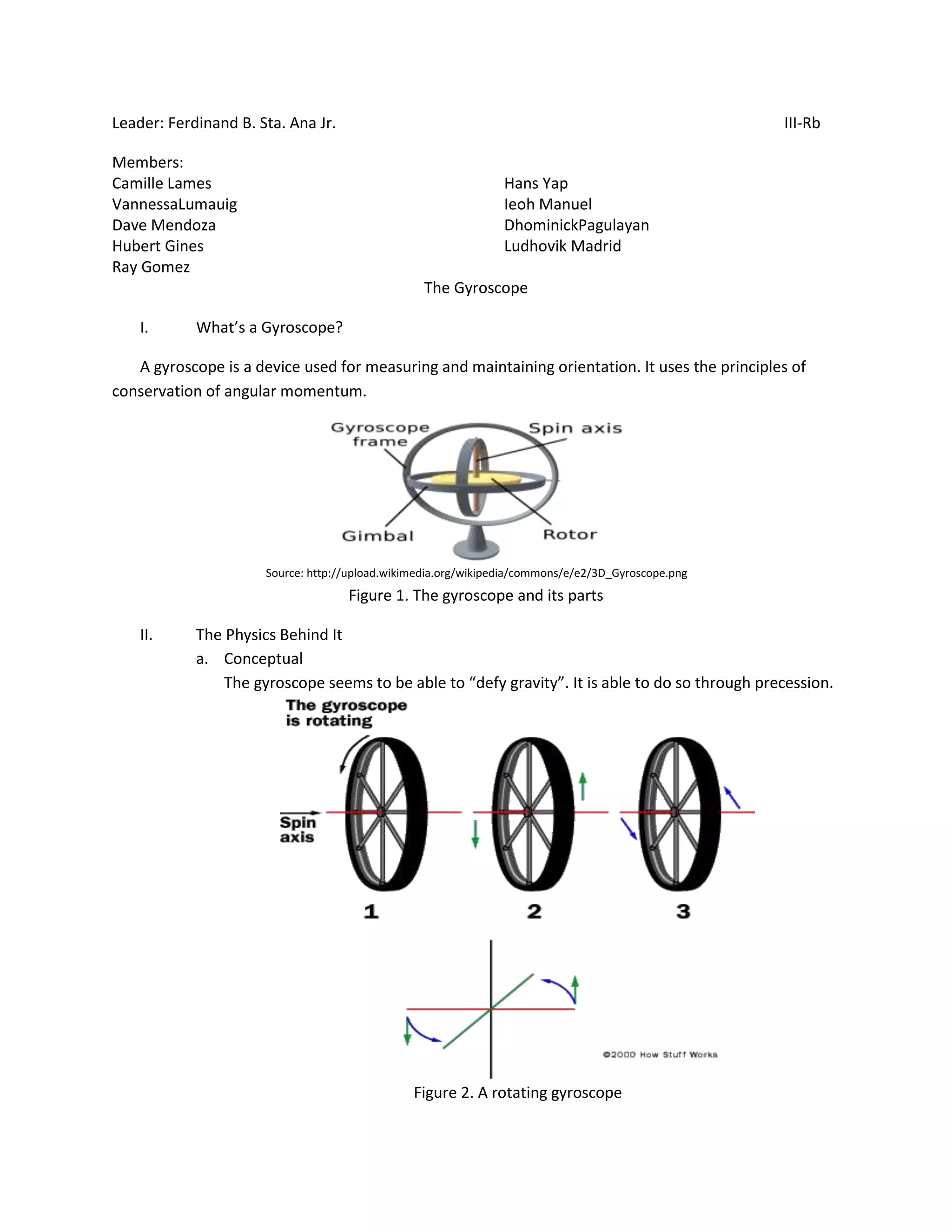
Leader: Ferdinand B. Sta. Ana Jr.      III-Rb<br />Members:<br />Camille Lames<br />Vannessa Lumauig<br />Dave Mendoza<br />Hubert Gines<br />Ray Gomez<br />Hans Yap<br />Ieoh Manuel<br />Dhominick Pagulayan<br />Ludhovik Madrid<br />The Gyroscope<br />What’s a Gyroscope?A gyroscope is a device used for measuring and maintaining orientation. It uses the principles of conservation of angular momentum. <br />10953751141095Source: http://upload.wikimedia.org/wikipedia/commons/e/e2/3D_Gyroscope.png00Source: http://upload.wikimedia.org/wikipedia/commons/e/e2/3D_Gyroscope.png<br />Figure 1. The gyroscope and its parts<br />The Physics Behind It
Conceptual
The gyroscope seems to be able to “defy gravity”. It is able to do so through precession.

Gyroscope

  • 1.
    Leader: Ferdinand B.Sta. Ana Jr. III-Rb<br />Members:<br />Camille Lames<br />Vannessa Lumauig<br />Dave Mendoza<br />Hubert Gines<br />Ray Gomez<br />Hans Yap<br />Ieoh Manuel<br />Dhominick Pagulayan<br />Ludhovik Madrid<br />The Gyroscope<br />What’s a Gyroscope?A gyroscope is a device used for measuring and maintaining orientation. It uses the principles of conservation of angular momentum. <br />10953751141095Source: http://upload.wikimedia.org/wikipedia/commons/e/e2/3D_Gyroscope.png00Source: http://upload.wikimedia.org/wikipedia/commons/e/e2/3D_Gyroscope.png<br />Figure 1. The gyroscope and its parts<br />The Physics Behind It
  • 2.
  • 3.
    The gyroscope seemsto be able to “defy gravity”. It is able to do so through precession.
  • 4.
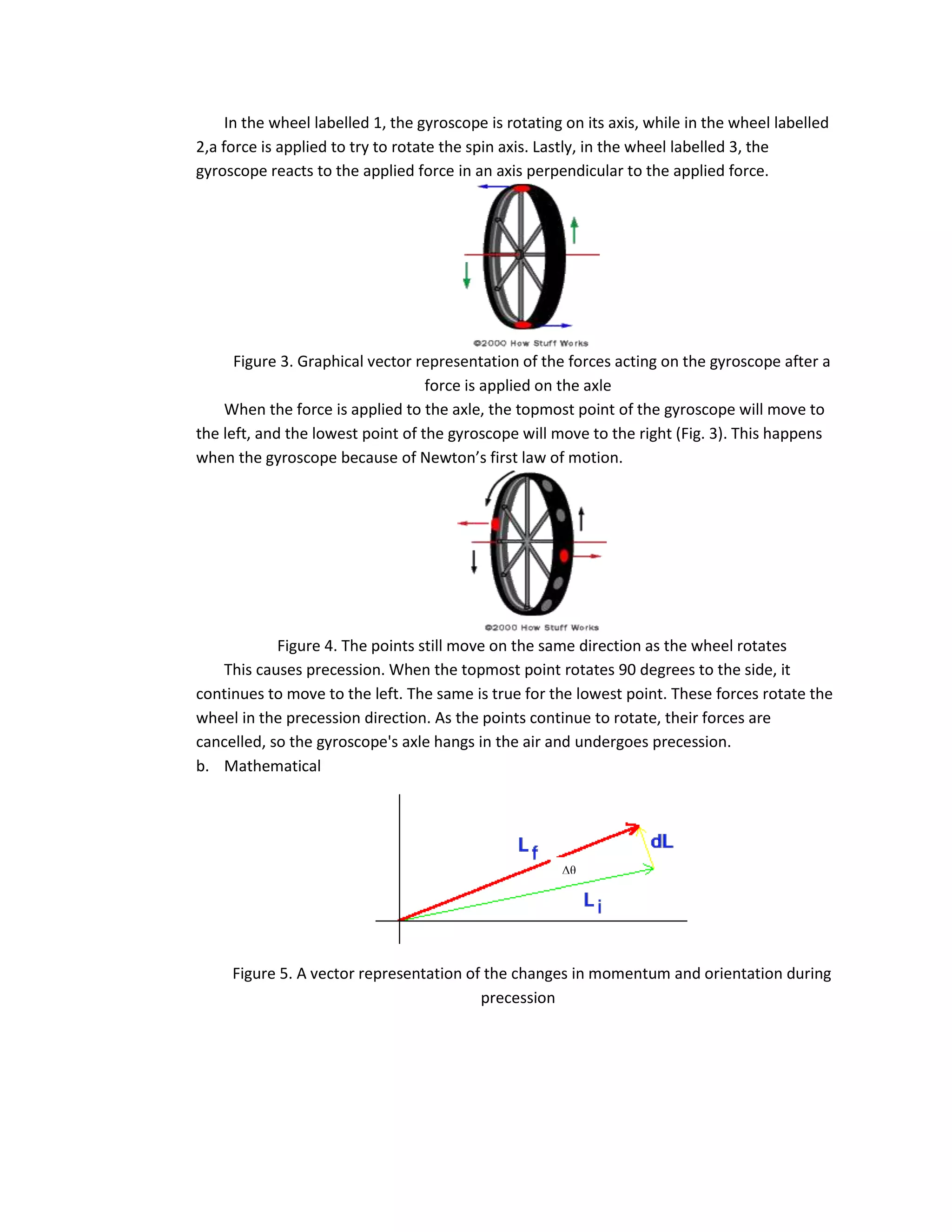
    Figure 2. Arotating gyroscope
  • 5.
    In the wheellabelled 1, the gyroscope is rotating on its axis, while in the wheel labelled 2, a force is applied to try to rotate the spin axis. Lastly, in the wheel labelled 3, the gyroscope reacts to the applied force in an axis perpendicular to the applied force.
  • 6.
    Figure 3. Graphicalvector representation of the forces acting on the gyroscope after a force is applied on the axle
  • 7.
    When the forceis applied to the axle, the topmost point of the gyroscope will move to the left, and the lowest point of the gyroscope will move to the right (Fig. 3). This happens when the gyroscope because of Newton’s first law of motion.
  • 8.
    Figure 4. Thepoints still move on the same direction as the wheel rotates
  • 9.
    This causes precession.When the topmost point rotates 90 degrees to the side, it continues to move to the left. The same is true for the lowest point. These forces rotate the wheel in the precession direction. As the points continue to rotate, their forces are cancelled, so the gyroscope's axle hangs in the air and undergoes precession.
  • 10.
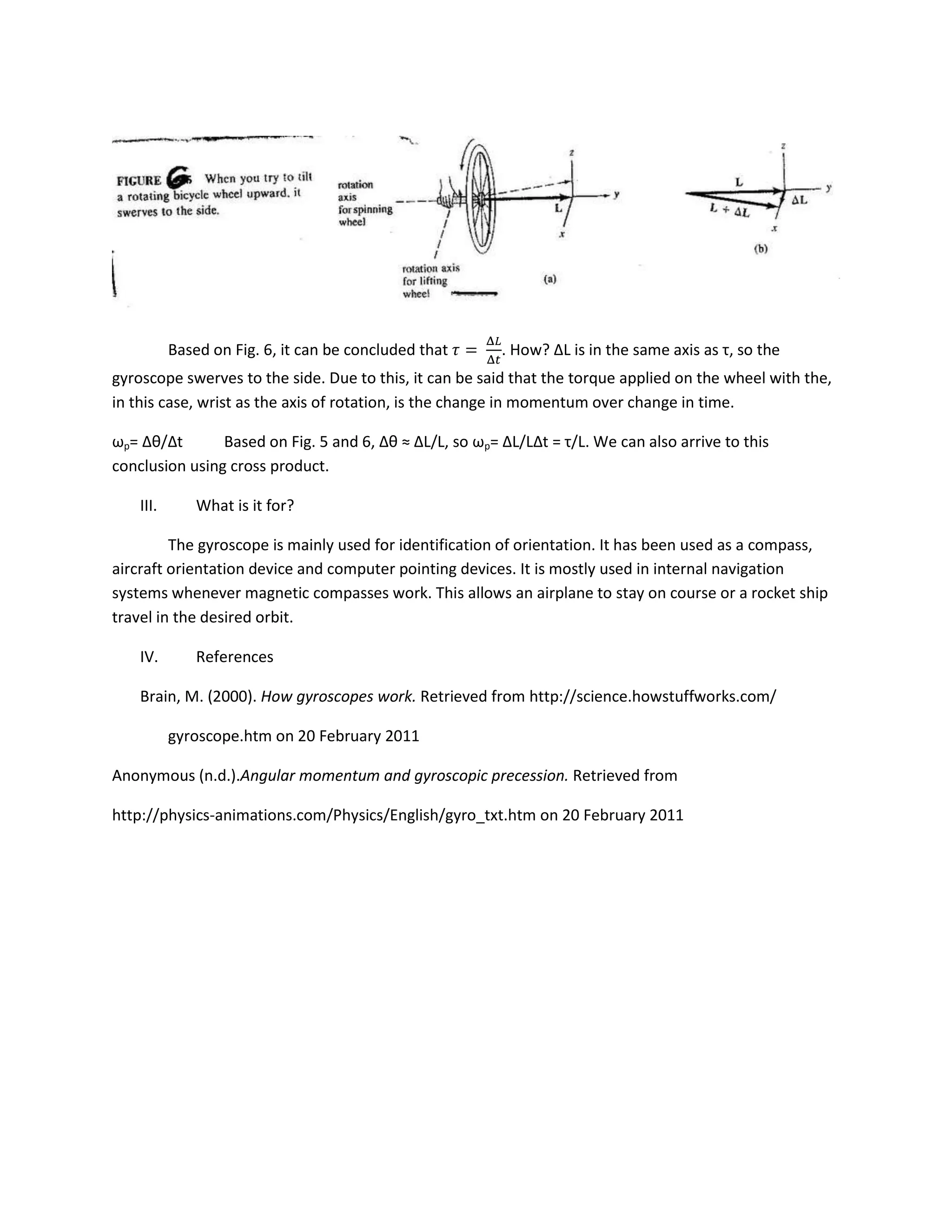
    Mathematical3581400512445Δθ00Δθ<br />Figure 5.A vector representation of the changes in momentum and orientation during precession<br />Based on Fig. 6, it can be concluded that τ= ΔLΔt. How? ΔL is in the same axis as τ, so the gyroscope swerves to the side. Due to this, it can be said that the torque applied on the wheel with the, in this case, wrist as the axis of rotation, is the change in momentum over change in time. <br />ωp = Δθ/ΔtBased on Fig. 5 and 6, Δθ ≈ ΔL/L, so ωp = ΔL/L Δt = τ/L. We can also arrive to this conclusion using cross product. <br />What is it for?The gyroscope is mainly used for identification of orientation. It has been used as a compass, aircraft orientation device and computer pointing devices. It is mostly used in internal navigation systems whenever magnetic compasses work. This allows an airplane to stay on course or a rocket ship travel in the desired orbit.<br />ReferencesBrain, M. (2000). How gyroscopes work. Retrieved from http://science.howstuffworks.com/<br />gyroscope.htm on 20 February 2011<br /> Anonymous (n.d.). Angular momentum and gyroscopic precession. Retrieved from <br /> http://physics-animations.com/Physics/English/gyro_txt.htm on 20 February 2011<br />