Placket-Burman Method For Media Optimization
Presented By
ADITYAAMRUT PAWAR
Tuesday, March 9, 2021
Contents
1. Introduction
2. Methods of optimization of media
3. Classical method
4. The Plackett-Burman Design
5. Reference
2
1. Introduction
• Process of optimization of media is done before the media
preparation to get maximum yield at industrial level
• Process of optimization of media should be target oriented
means either for biomass production or for desire production
• On small scale it is easy to devise a medium containing pure
compounds
• But in case of large scale process for satisfactory growth of
microorganisms it can be unsuitable.
3
The optimization of a medium should meet the following seven
criteria:
1. Produce maximum yield of product or biomass per gram of substrate
used
2. Produce the maximum concentration of product or biomass
3. Permit the maximum rate of product formation
4. Give the minimum yield of undesired products
5. Has consistent quality
6. Be readily available throughout the year
7. It will cause minimal problems during media making and sterilization
8. It will cause minimal problems in other aspects of the production
process particularly in aeration and agitation, extraction, purification
and waste treatment.
4
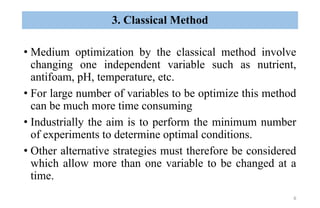
2. Methods of optimization of media
1. Classical Method
2.The Plackett-Burman Design
5
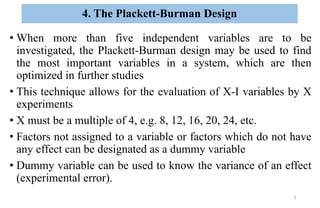
• Medium optimization by the classical method involve
changing one independent variable such as nutrient,
antifoam, pH, temperature, etc.
• For large number of variables to be optimize this method
can be much more time consuming
• Industrially the aim is to perform the minimum number
of experiments to determine optimal conditions.
• Other alternative strategies must therefore be considered
which allow more than one variable to be changed at a
time.
6
3. Classical Method
7
4. The Plackett-Burman Design
• When more than five independent variables are to be
investigated, the Plackett-Burman design may be used to find
the most important variables in a system, which are then
optimized in further studies
• This technique allows for the evaluation of X-I variables by X
experiments
• X must be a multiple of 4, e.g. 8, 12, 16, 20, 24, etc.
• Factors not assigned to a variable or factors which do not have
any effect can be designated as a dummy variable
• Dummy variable can be used to know the variance of an effect
(experimental error).
8
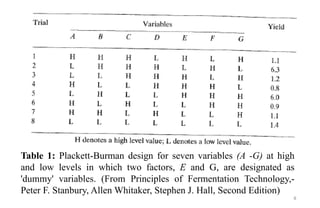
Table 1: Plackett-Burman design for seven variables (A -G) at high
and low levels in which two factors, E and G, are designated as
'dummy' variables. (From Principles of Fermentation Technology,-
Peter F. Stanbury, Allen Whitaker, Stephen J. Hall, Second Edition)
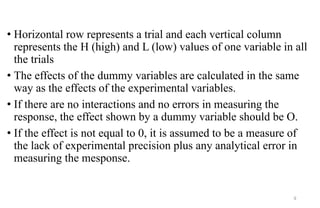
• Horizontal row represents a trial and each vertical column
represents the H (high) and L (low) values of one variable in all
the trials
• The effects of the dummy variables are calculated in the same
way as the effects of the experimental variables.
• If there are no interactions and no errors in measuring the
response, the effect shown by a dummy variable should be O.
• If the effect is not equal to 0, it is assumed to be a measure of
the lack of experimental precision plus any analytical error in
measuring the mesponse.
9
10
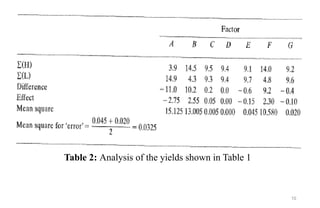
Table 2: Analysis of the yields shown in Table 1
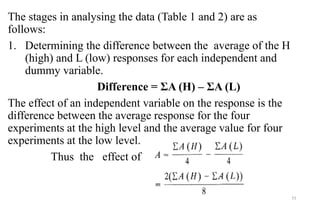
The stages in analysing the data (Table 1 and 2) are as
follows:
1. Determining the difference between the average of the H
(high) and L (low) responses for each independent and
dummy variable.
Difference = ΣA (H) – ΣA (L)
The effect of an independent variable on the response is the
difference between the average response for the four
experiments at the high level and the average value for four
experiments at the low level.
Thus the effect of
11
12
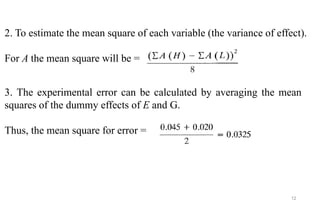
2. To estimate the mean square of each variable (the variance of effect).
For A the mean square will be =
3. The experimental error can be calculated by averaging the mean
squares of the dummy effects of E and G.
Thus, the mean square for error =
4. The final stage is to identify the factors which are showing large
effects. In the example this was done using an F-test for
Factor mean square.
Error mean square.
• When Probability Tables are examined
it is found that Factors A, B and F
show large effects which are very
significant.
• Whereas C shows a very low effect
which is not significant and D shows
no effect.
• A, B and F have been identified as the
most important factors.
• Stanbury, Peter F., Allan Whitaker, and Stephen J.
Hall. Principles of fermentation technology. Elsevier, 2013.
14
5. Reference

Plackett burman design ppt

  • 1.
    Placket-Burman Method ForMedia Optimization Presented By ADITYAAMRUT PAWAR Tuesday, March 9, 2021
  • 2.
    Contents 1. Introduction 2. Methodsof optimization of media 3. Classical method 4. The Plackett-Burman Design 5. Reference 2
  • 3.
    1. Introduction • Processof optimization of media is done before the media preparation to get maximum yield at industrial level • Process of optimization of media should be target oriented means either for biomass production or for desire production • On small scale it is easy to devise a medium containing pure compounds • But in case of large scale process for satisfactory growth of microorganisms it can be unsuitable. 3
  • 4.
    The optimization ofa medium should meet the following seven criteria: 1. Produce maximum yield of product or biomass per gram of substrate used 2. Produce the maximum concentration of product or biomass 3. Permit the maximum rate of product formation 4. Give the minimum yield of undesired products 5. Has consistent quality 6. Be readily available throughout the year 7. It will cause minimal problems during media making and sterilization 8. It will cause minimal problems in other aspects of the production process particularly in aeration and agitation, extraction, purification and waste treatment. 4
  • 5.
    2. Methods ofoptimization of media 1. Classical Method 2.The Plackett-Burman Design 5
  • 6.
    • Medium optimizationby the classical method involve changing one independent variable such as nutrient, antifoam, pH, temperature, etc. • For large number of variables to be optimize this method can be much more time consuming • Industrially the aim is to perform the minimum number of experiments to determine optimal conditions. • Other alternative strategies must therefore be considered which allow more than one variable to be changed at a time. 6 3. Classical Method
  • 7.
    7 4. The Plackett-BurmanDesign • When more than five independent variables are to be investigated, the Plackett-Burman design may be used to find the most important variables in a system, which are then optimized in further studies • This technique allows for the evaluation of X-I variables by X experiments • X must be a multiple of 4, e.g. 8, 12, 16, 20, 24, etc. • Factors not assigned to a variable or factors which do not have any effect can be designated as a dummy variable • Dummy variable can be used to know the variance of an effect (experimental error).
  • 8.
    8 Table 1: Plackett-Burmandesign for seven variables (A -G) at high and low levels in which two factors, E and G, are designated as 'dummy' variables. (From Principles of Fermentation Technology,- Peter F. Stanbury, Allen Whitaker, Stephen J. Hall, Second Edition)
  • 9.
    • Horizontal rowrepresents a trial and each vertical column represents the H (high) and L (low) values of one variable in all the trials • The effects of the dummy variables are calculated in the same way as the effects of the experimental variables. • If there are no interactions and no errors in measuring the response, the effect shown by a dummy variable should be O. • If the effect is not equal to 0, it is assumed to be a measure of the lack of experimental precision plus any analytical error in measuring the mesponse. 9
  • 10.
    10 Table 2: Analysisof the yields shown in Table 1
  • 11.
    The stages inanalysing the data (Table 1 and 2) are as follows: 1. Determining the difference between the average of the H (high) and L (low) responses for each independent and dummy variable. Difference = ΣA (H) – ΣA (L) The effect of an independent variable on the response is the difference between the average response for the four experiments at the high level and the average value for four experiments at the low level. Thus the effect of 11
  • 12.
    12 2. To estimatethe mean square of each variable (the variance of effect). For A the mean square will be = 3. The experimental error can be calculated by averaging the mean squares of the dummy effects of E and G. Thus, the mean square for error =
  • 13.
    4. The finalstage is to identify the factors which are showing large effects. In the example this was done using an F-test for Factor mean square. Error mean square. • When Probability Tables are examined it is found that Factors A, B and F show large effects which are very significant. • Whereas C shows a very low effect which is not significant and D shows no effect. • A, B and F have been identified as the most important factors.
  • 14.
    • Stanbury, PeterF., Allan Whitaker, and Stephen J. Hall. Principles of fermentation technology. Elsevier, 2013. 14 5. Reference