Principles of drug discovery :                            by kavya lakshmi.v                              (Pharmacology)           Under the guidance of :                              Dr T.Vedhavathi                                     Mpharm ;PhDCmr collage of pharmacy
Principles of drug discovery
Drug discoveryDef: The process of drug discovery involves the identification of  lead and its targets, synthesis, characterization, screening, and assays for therapeutic efficacy of lead. Once a compound  has shown its value in in these tests, it will begin the process of drug development prior to clinical trails.The  average  time  required  to bring a drug to the market range from  12–15 years at an average cost of $600–800 million
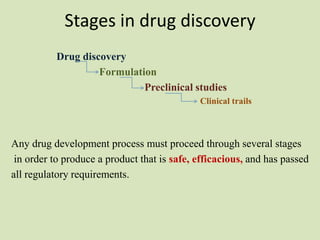
Stages in drug discovery                 Drug discovery Formulation  Preclinical studiesClinical trailsAny drug development process must proceed through several stagesin order to produce a product that is safe, efficacious, and has passed all regulatory requirements.
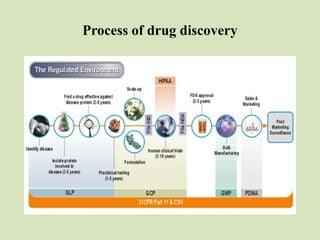
Process of drug discovery
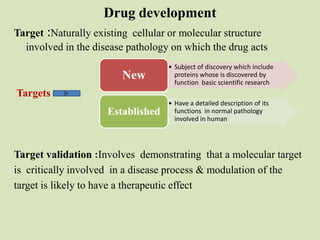
Drug developmentTarget :Naturally existing  cellular or molecular structure  involved in the disease pathology on which the drug actsTargets                                                                                               TypesTarget validation :Involves  demonstrating  that a molecular target is  critically involved  in a disease process & modulation of the target is likely to have a therapeutic effect
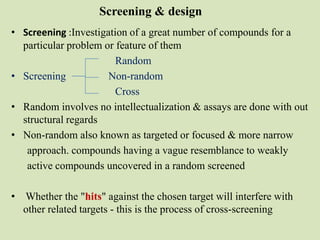
Screening & designScreening :Investigation of a great number of compounds for a particular problem or feature of them                                       RandomScreening                Non-random                                       Cross   Random involves no intellectualization & assays are done with out structural regardsNon-random also known as targeted or focused & more narrow      approach. compounds having a vague resemblance to weakly      active compounds uncovered in a random screened Whether the "hits" against the chosen target will interfere with other related targets - this is the process of cross-screening
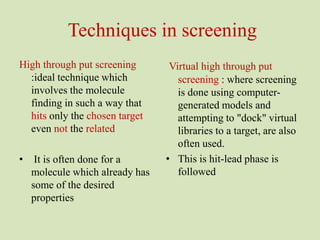
 Techniques in screeningHigh through put screening :ideal technique which involves the molecule finding in such a way that hits only the chosen target even not the related It is often done for a molecule which already has some of the desired propertiesVirtual high through put screening : where screening is done using computer-generated models and attempting to "dock" virtual libraries to a target, are also often used.This is hit-lead phase is  followed
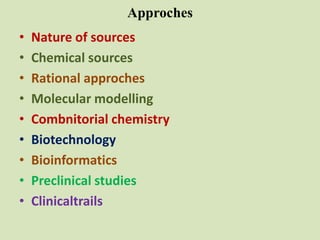
Approches Nature of sources Chemical sourcesRational approchesMolecular modelling Combnitorial chemistryBiotechnologyBioinformatics Preclinical studiesClinicaltrails
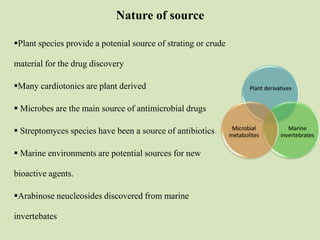
Nature of sourcePlant species provide a potenial source of strating or crude material for the drug discovery
Many cardiotonics are plant derived
 Microbes are the main source of antimicrobial drugs
 Streptomyces species have been a source of antibiotics.
 Marine environments are potential sources for new       bioactive agents.
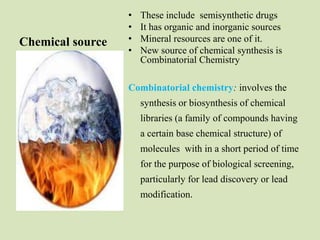
Arabinose neucleosides discovered from marine invertebatesChemical sourceThese include semisynthetic drugsIt has organic and inorganic sourcesMineral resources are one of it.New source of chemical synthesis is  Combinatorial ChemistryCombinatorial chemistry: involves the synthesis or biosynthesis of chemical libraries (a family of compounds having a certain base chemical structure) of molecules  with in a short period of time for the purpose of biological screening, particularly for lead discovery or lead modification.
MethodsThere different types of combinatorial synthesis combinatorial synthesis
 Split Synthesis: Peptide Libraries
 Encoding Combinatorial Libraries
 Nonpeptide LibrariesThe main differences among the various combinatorial approaches are the solid support used, the methods for assembling the building blocks, the state (immobilized or in solution) and numbers (a fraction of the total library or individual entities)
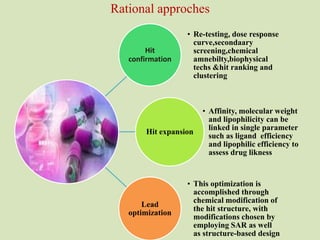
Rational approchesHit -Lead:
Molecular modelingStructure Modifications to Increase Potency and the Therapeutic Index 1 Homologation 2 Chain Branching 3 Ring-Chain Transformations 4 Bioisosterism5 SAR by NMR/SAR by MS6 CADD
Homologation : prolongation of  saturated carbon chain with groups that differ by a constant unit to increase pharmacological effect & lipophilicityChain branching :this involves the side branching of alkyl groups instead of long straight chain  alkyl groupsRing chain transformation :effective pharmacokinetic properties are obtained by transformation of alkyl substituent's into cyclic analogsBioisosterism :Bioisosterism is an important lead modification approach that has been shown to be useful to attenuate toxicity or to modify the activity of a lead
SAR/NMR :This approach, termed SAR by NMR, was initially used to discover compounds with nanomolar affinitiess by tethering two molecules with micro molar affinities (low potency). CADD :Computer-aided design (CAD), also known as computer-aided design and drafting (CADD) , is the use of computer technology for the process of design and design-documentation. Computer Aided Drafting describes the process of drafting with a computer
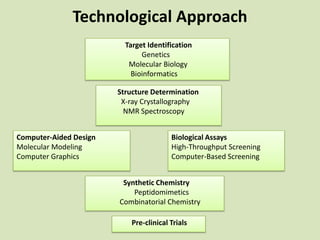
Technological Approachssss
Preclinical studiesAcute Studies :The goal is to determine toxic dose levels and observe clinical indications of toxicity. Data from acute toxic studies helps determine doses for repeated dose studies in animals and Phase I studies in humans. Repeated Dose Studies :These  are repeated dose studies may be referred to as sub acute, sub chronic, or chronic. The specific duration should anticipate the length of the clinical trial that will be conducted on the new drug. Again, two species are typically required. Genetic Toxicity Studies :These studies assess the likelihood that the drug compound is mutagenic or carcinogenic.
Reproductive Toxicity Studies : Segment I reproductive toxic studies look at the effects of the drug on fertility. Segment II and III studies detect effects on embryonic and post-natal developmentCarcinogenicity Studies :Carcinogenicity studies are usually needed only for drugs intended for chronic or recurring conditionsToxicokinetic Studies :These are typically similar in design to PK/ADME studies except that they use much higher dose levels. They examine the effects of toxic doses of the drug and help estimate the clinical margin of safety
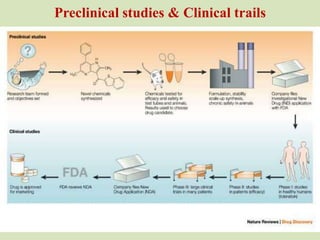
Preclinical studies & Clinical trails
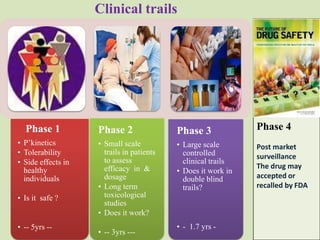
Clinical trails
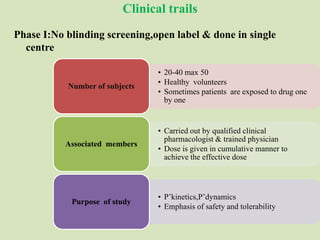
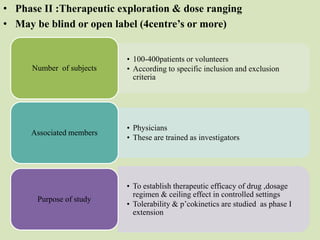
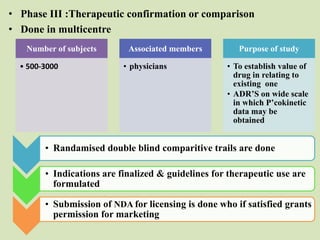
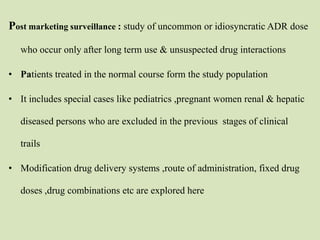
Clinical trailsPhase I:No blinding screening,open label & done in single           centre