Making a Great Lab Notebook
Oscar Mihigo Shetonde
200000169
Introduction
 There are many reasons for the value of keeping a coherent, continuous
and comprehensive record of one’s ideas, creations and actions.
1) Intellectual property for commercial purposes: the importance of
keeping records of intellectual and creative activity.
 Disputes sometimes arise over who first made an invention, and the issue
is usually decided on the written evidence kept by the parties to the
dispute.
Records of integrity are the only means of assuring one can obtain
copyrights or patent rights.
Introduction: cont’d…
2) Keeping up a nicely maintained lab notebook (LNB) pays off later
as it helps one stay out of trouble later: when you need to look
back and provide details of what you did.
!!!
!!!
!!!
!!!
Sources
Central Michigan University
Florida State University
Harvard University
National University of Ireland
National Cancer Institute (National Health Institutes, USA)
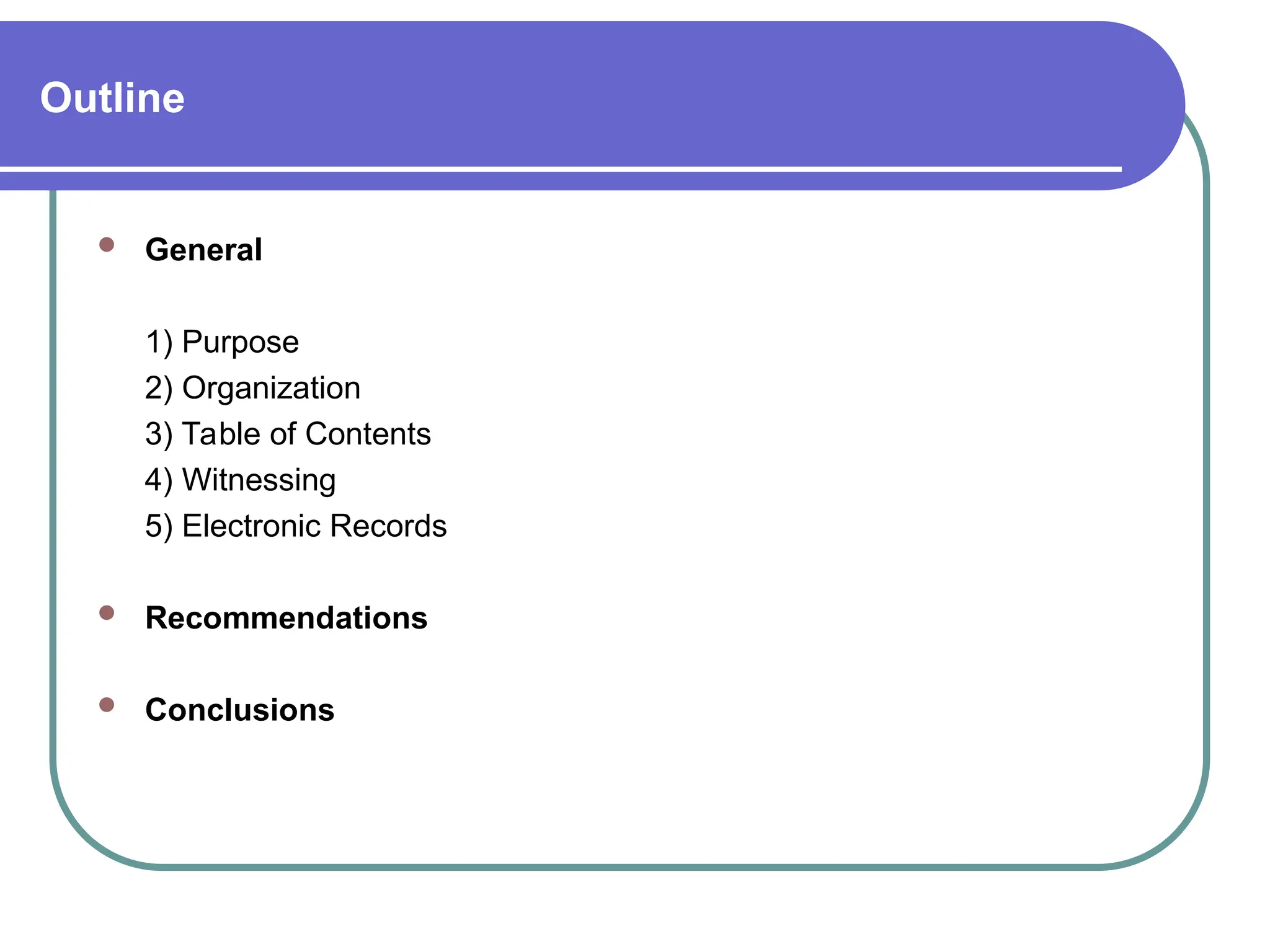
Outline
 General
1) Purpose
2) Organization
3) Table of Contents
4) Witnessing
5) Electronic Records
 Recommendations
 Conclusions
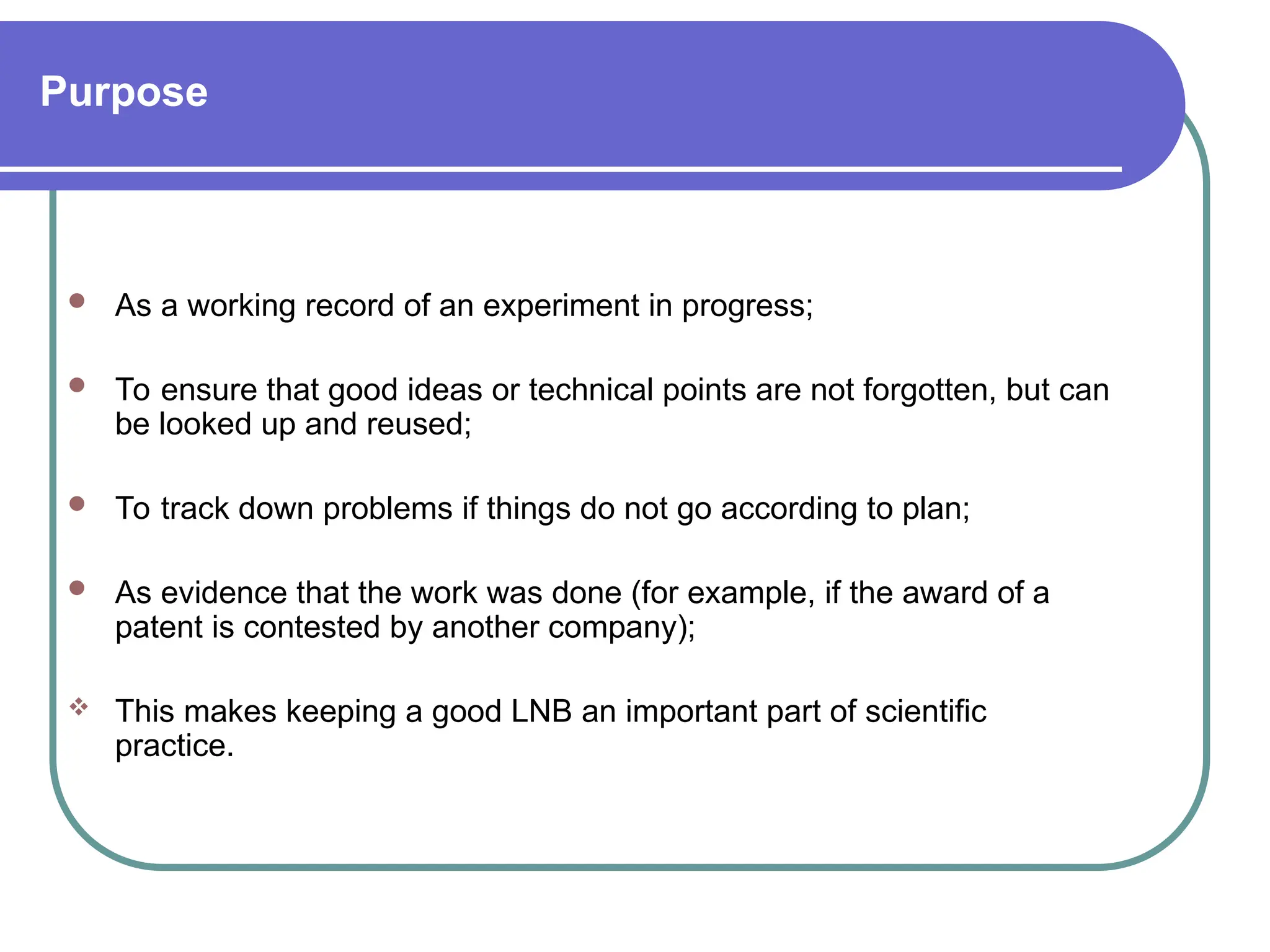
Purpose
 As a working record of an experiment in progress;
 To ensure that good ideas or technical points are not forgotten, but can
be looked up and reused;
 To track down problems if things do not go according to plan;
 As evidence that the work was done (for example, if the award of a
patent is contested by another company);
 This makes keeping a good LNB an important part of scientific
practice.
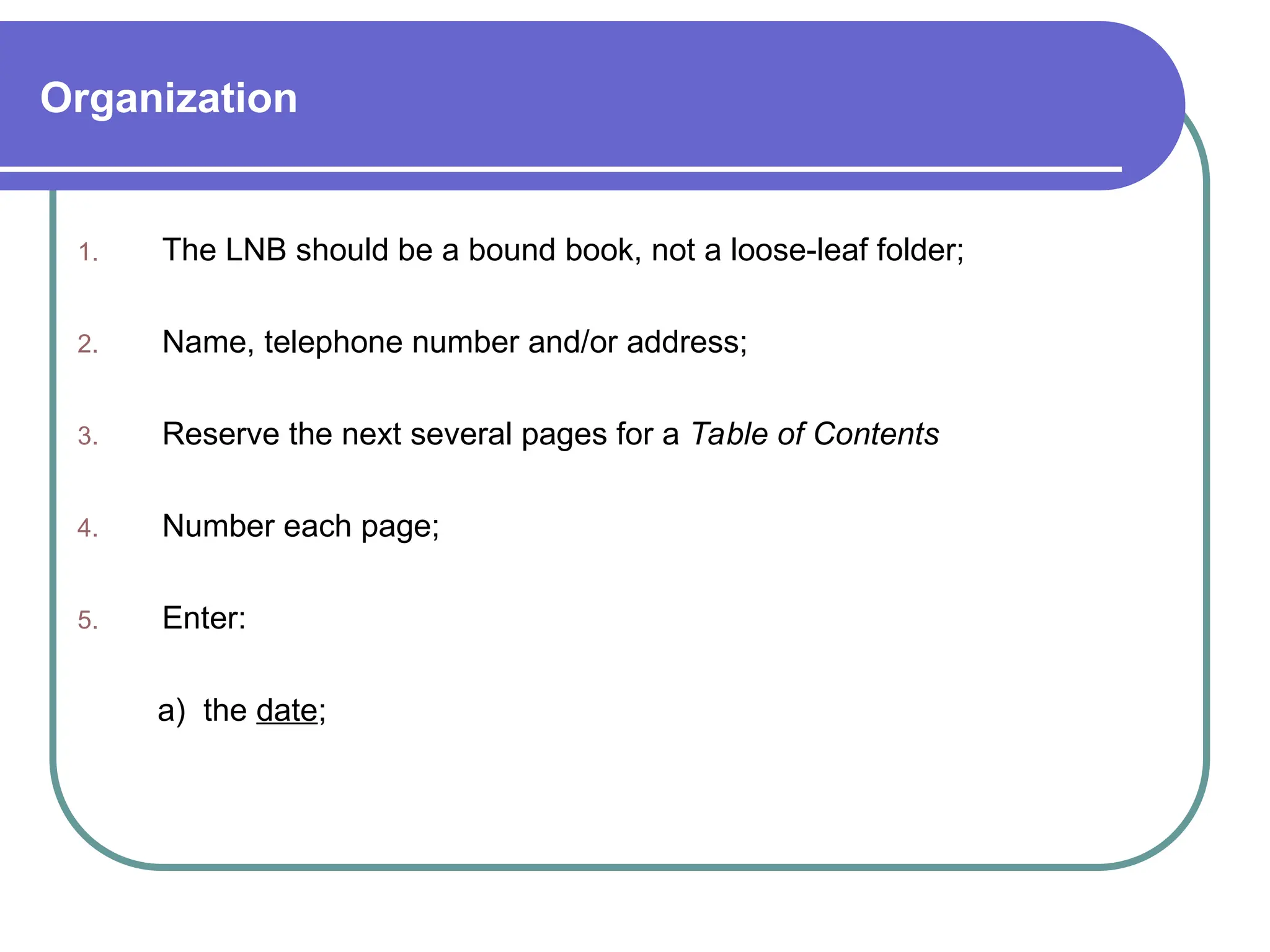
Organization
1. The LNB should be a bound book, not a loose-leaf folder;
2. Name, telephone number and/or address;
3. Reserve the next several pages for a Table of Contents
4. Number each page;
5. Enter:
a) the date;
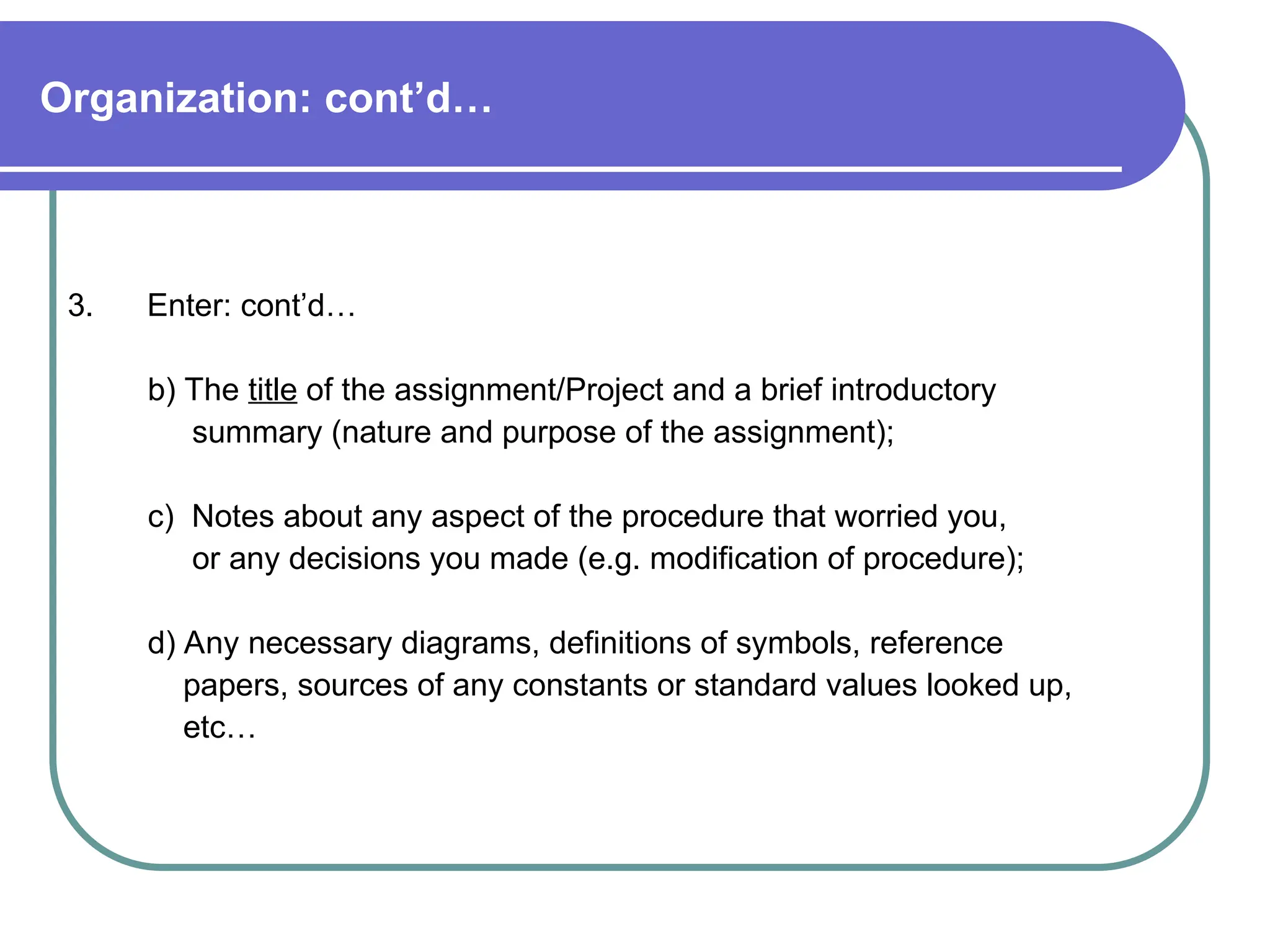
Organization: cont’d…
3. Enter: cont’d…
b) The title of the assignment/Project and a brief introductory
summary (nature and purpose of the assignment);
c) Notes about any aspect of the procedure that worried you,
or any decisions you made (e.g. modification of procedure);
d) Any necessary diagrams, definitions of symbols, reference
papers, sources of any constants or standard values looked up,
etc…
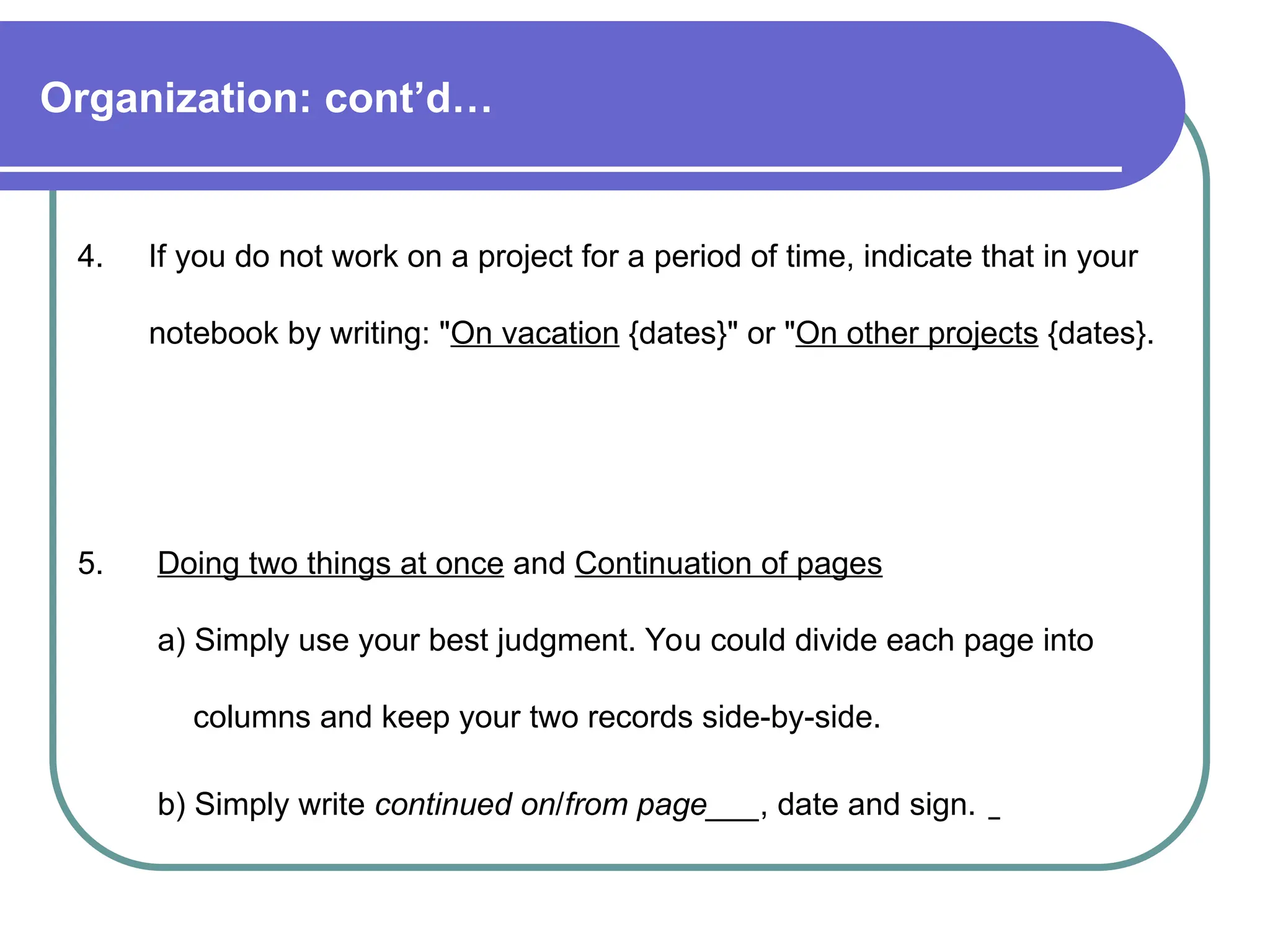
Organization: cont’d…
4. If you do not work on a project for a period of time, indicate that in your
notebook by writing: "On vacation {dates}" or "On other projects {dates}.
5. Doing two things at once and Continuation of pages
a) Simply use your best judgment. You could divide each page into
columns and keep your two records side-by-side.
b) Simply write continued on/from page___, date and sign.
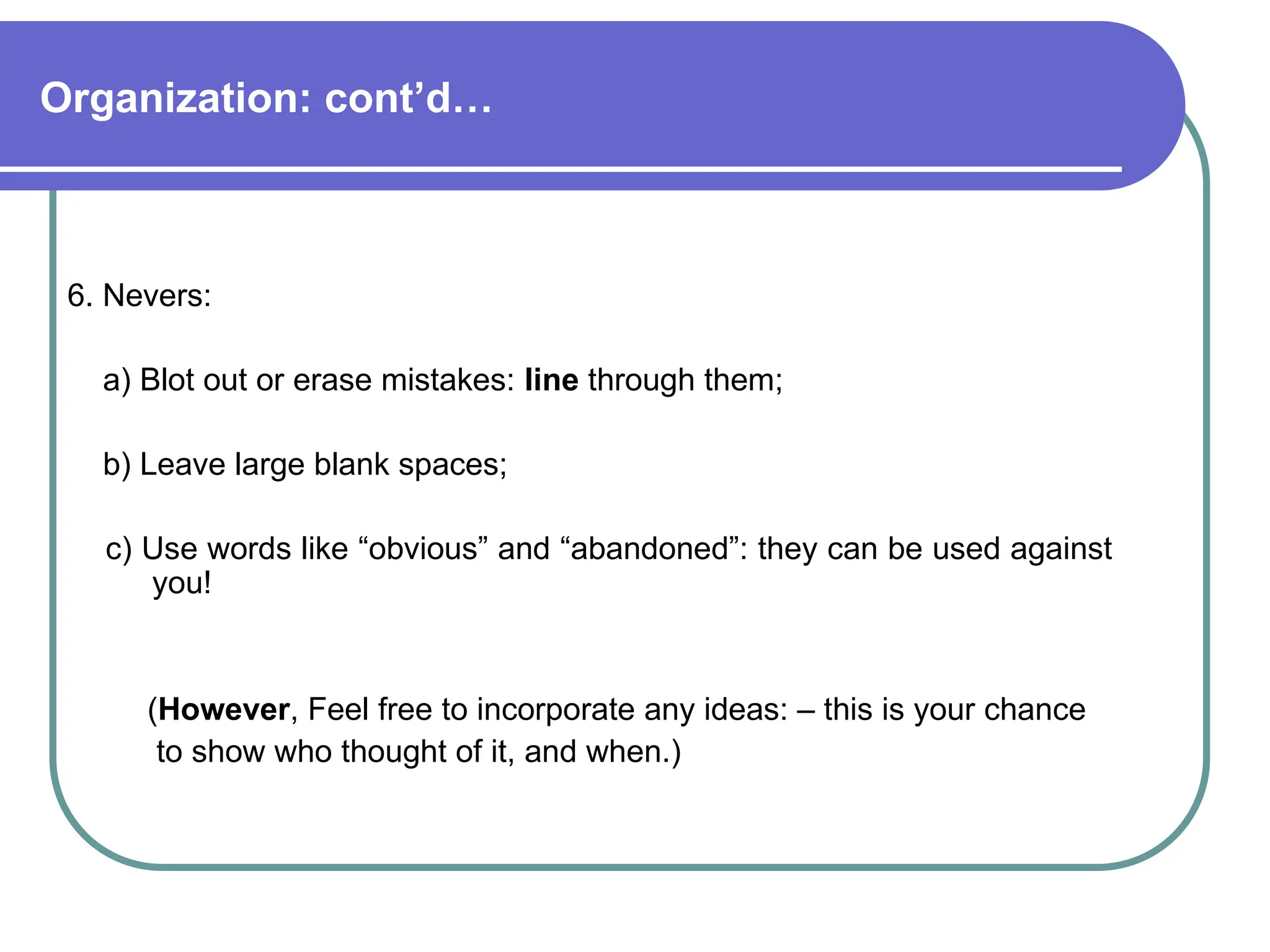
Organization: cont’d…
6. Nevers:
a) Blot out or erase mistakes: line through them;
b) Leave large blank spaces;
c) Use words like “obvious” and “abandoned”: they can be used against
you!
(However, Feel free to incorporate any ideas: – this is your chance
to show who thought of it, and when.)
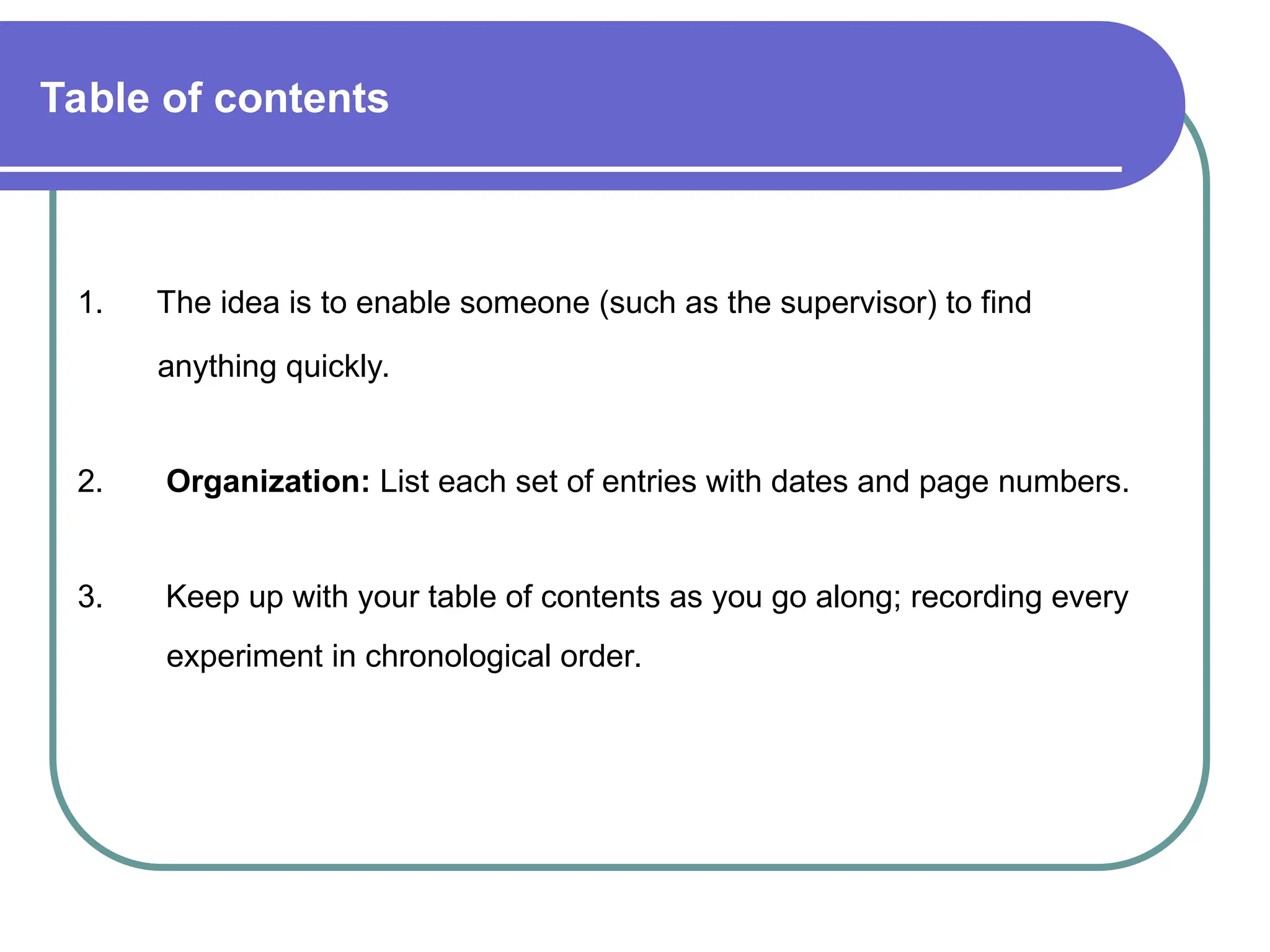
Table of contents
1. The idea is to enable someone (such as the supervisor) to find
anything quickly.
2. Organization: List each set of entries with dates and page numbers.
3. Keep up with your table of contents as you go along; recording every
experiment in chronological order.
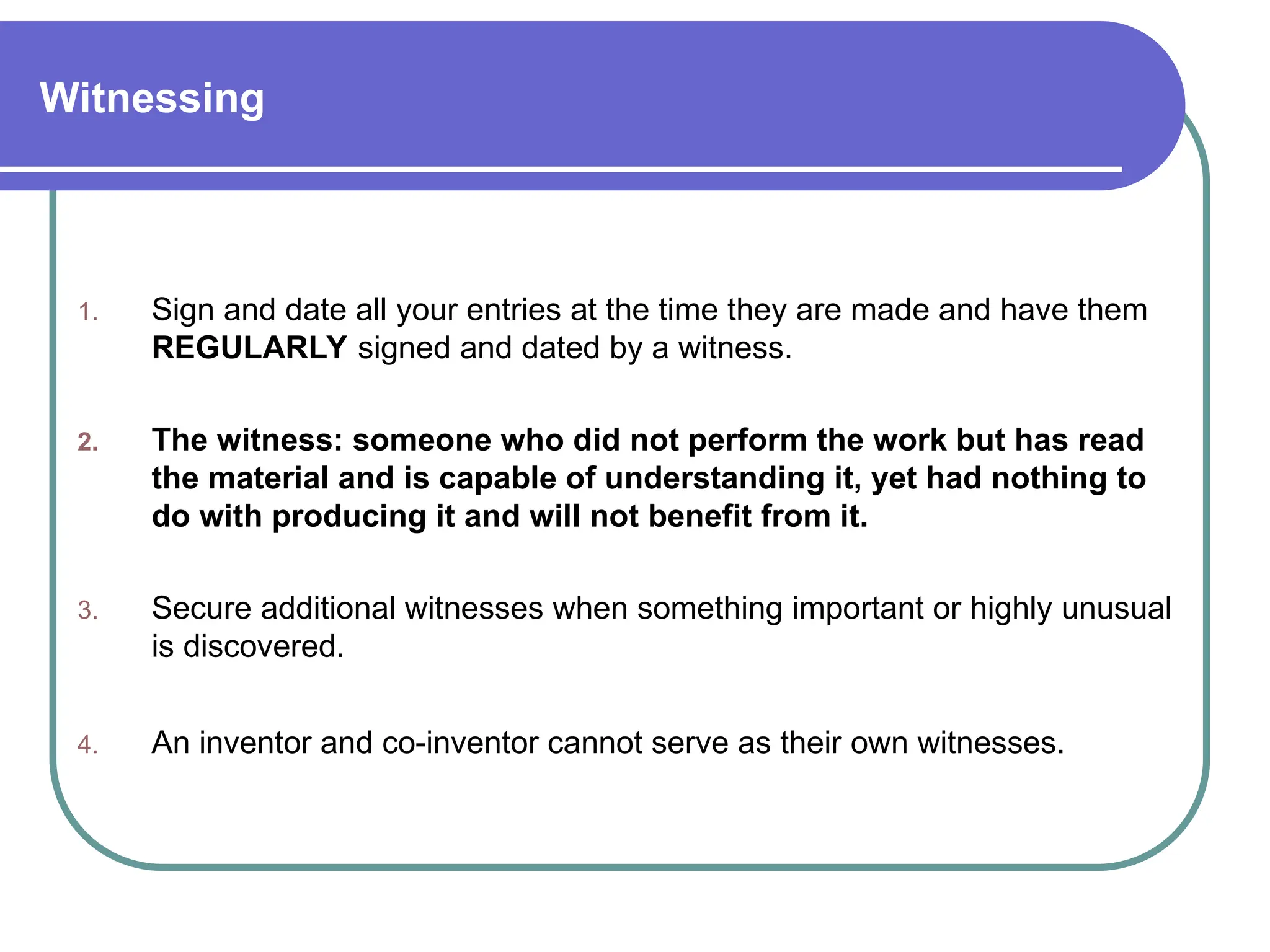
Witnessing
1. Sign and date all your entries at the time they are made and have them
REGULARLY signed and dated by a witness.
2. The witness: someone who did not perform the work but has read
the material and is capable of understanding it, yet had nothing to
do with producing it and will not benefit from it.
3. Secure additional witnesses when something important or highly unusual
is discovered.
4. An inventor and co-inventor cannot serve as their own witnesses.
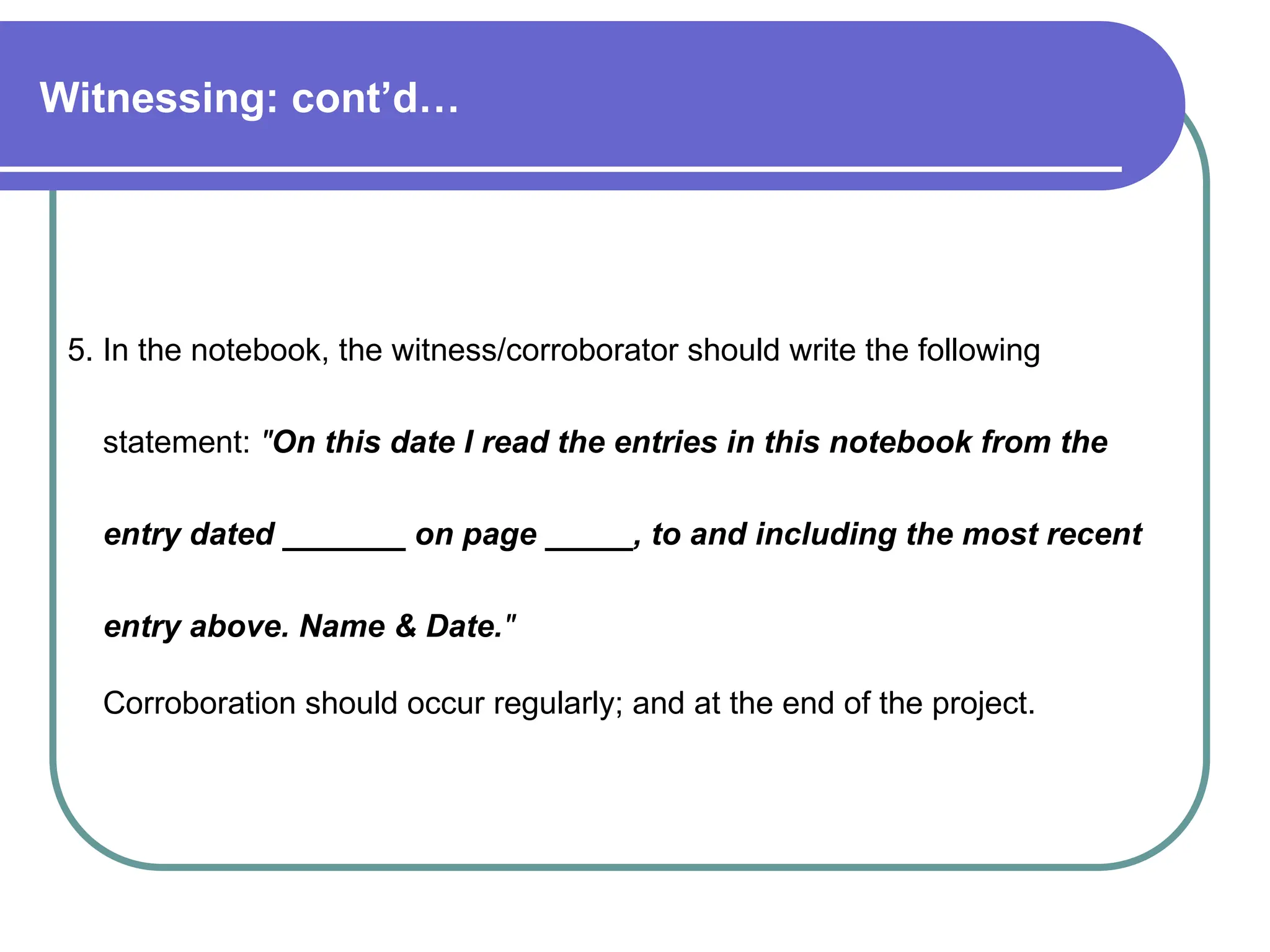
Witnessing: cont’d…
5. In the notebook, the witness/corroborator should write the following
statement: "On this date I read the entries in this notebook from the
entry dated _______ on page _____, to and including the most recent
entry above. Name & Date."
Corroboration should occur regularly; and at the end of the project.
Electronic Records
 Computer software packages: excellent research tools, but
you should not rely on electronic records for purposes of documentation;
• The difficulty with such storage systems is that many people can often
access the data.
 Thus, it is hard to prove that the data was not added to, deleted from,
or in some way tampered with.
Electronic Records: cont’d…
 In order to have computer-generated data withstand legal examination,
one has to print out the data, bind them, and sign and date each page as
described above.
 It is still believed that for now, the courts only recognize a written
printout that has been properly signed and dated and corroborated
by a witness.
Recommendations
1) Bound LNB to all (+ Instructions, ex. Uniform Coding of Cpds);
2) Introduce the a) Table of Contents and b) Computer Storage systems;
3) Get a) all exp. details (physical data, etc.) and b) files for spectra
4) Writing down one’s idea
5) Reviews:
a) Person doing the work;
b) Supervisor
6) Witnessing
Conclusions

Records Can Win or Lose Patents
 a) Proper record keeping is important for research;
b) "Notebook witnessing day" should be a routine part of the review of
the research process;
c) Also, all research lab members should be issued their own LNB, with
instructions on how to record in them.
Conclusions: cont’d…
 Rules summary
Record all lab information in a bound notebook;
Each entry must be signed and dated by the person doing the work;
Corroborate all entries by an additional, knowledgeable party who reads, co-
signs and dates all entries;
Original entries should never be erased;
Review all records (important to analyze research progress);
Data generated or stored on a computer must be printed out, permanently
bound, signed and dated, and corroborated/witnessed.
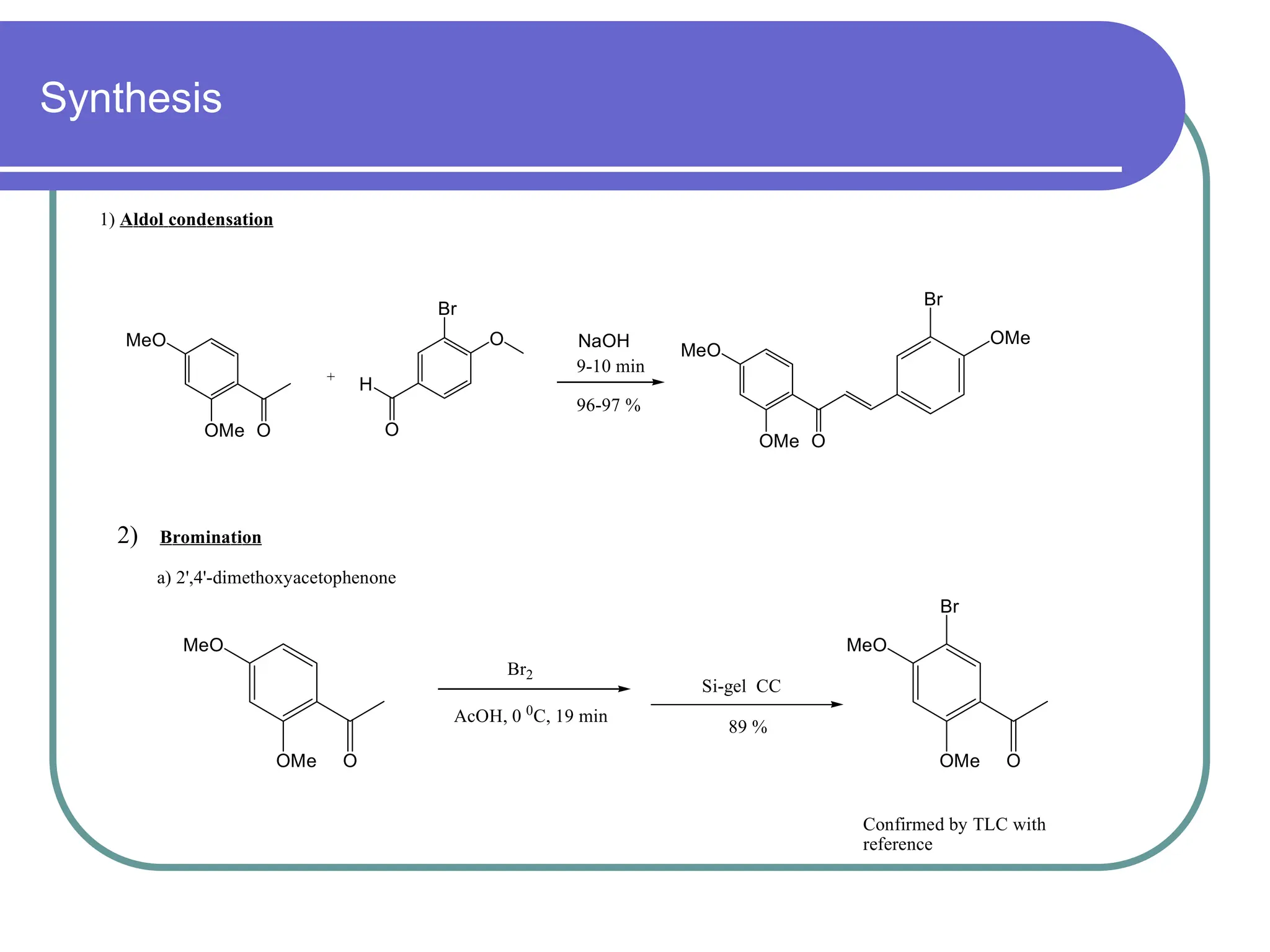
Synthesis
2)
MeO
OMe O
Bromination
a) 2',4'-dimethoxyacetophenone
Br2
AcOH, 0 0
C, 19 min
MeO
OMe O
Br
89 %
Si-gel CC
1) Aldol condensation
Confirmed by TLC with
reference
MeO
OMe O
+
H
O
O NaOH
MeO
OMe O
OMe
Br
Br
96-97 %
9-10 min

Making a Great Lab Notebook for ease of an excellent paper

  • 1.
    Making a GreatLab Notebook Oscar Mihigo Shetonde 200000169
  • 2.
    Introduction  There aremany reasons for the value of keeping a coherent, continuous and comprehensive record of one’s ideas, creations and actions. 1) Intellectual property for commercial purposes: the importance of keeping records of intellectual and creative activity.  Disputes sometimes arise over who first made an invention, and the issue is usually decided on the written evidence kept by the parties to the dispute. Records of integrity are the only means of assuring one can obtain copyrights or patent rights.
  • 3.
    Introduction: cont’d… 2) Keepingup a nicely maintained lab notebook (LNB) pays off later as it helps one stay out of trouble later: when you need to look back and provide details of what you did. !!! !!! !!! !!!
  • 4.
    Sources Central Michigan University FloridaState University Harvard University National University of Ireland National Cancer Institute (National Health Institutes, USA)
  • 5.
    Outline  General 1) Purpose 2)Organization 3) Table of Contents 4) Witnessing 5) Electronic Records  Recommendations  Conclusions
  • 6.
    Purpose  As aworking record of an experiment in progress;  To ensure that good ideas or technical points are not forgotten, but can be looked up and reused;  To track down problems if things do not go according to plan;  As evidence that the work was done (for example, if the award of a patent is contested by another company);  This makes keeping a good LNB an important part of scientific practice.
  • 7.
    Organization 1. The LNBshould be a bound book, not a loose-leaf folder; 2. Name, telephone number and/or address; 3. Reserve the next several pages for a Table of Contents 4. Number each page; 5. Enter: a) the date;
  • 8.
    Organization: cont’d… 3. Enter:cont’d… b) The title of the assignment/Project and a brief introductory summary (nature and purpose of the assignment); c) Notes about any aspect of the procedure that worried you, or any decisions you made (e.g. modification of procedure); d) Any necessary diagrams, definitions of symbols, reference papers, sources of any constants or standard values looked up, etc…
  • 9.
    Organization: cont’d… 4. Ifyou do not work on a project for a period of time, indicate that in your notebook by writing: "On vacation {dates}" or "On other projects {dates}. 5. Doing two things at once and Continuation of pages a) Simply use your best judgment. You could divide each page into columns and keep your two records side-by-side. b) Simply write continued on/from page___, date and sign.
  • 10.
    Organization: cont’d… 6. Nevers: a)Blot out or erase mistakes: line through them; b) Leave large blank spaces; c) Use words like “obvious” and “abandoned”: they can be used against you! (However, Feel free to incorporate any ideas: – this is your chance to show who thought of it, and when.)
  • 11.
    Table of contents 1.The idea is to enable someone (such as the supervisor) to find anything quickly. 2. Organization: List each set of entries with dates and page numbers. 3. Keep up with your table of contents as you go along; recording every experiment in chronological order.
  • 12.
    Witnessing 1. Sign anddate all your entries at the time they are made and have them REGULARLY signed and dated by a witness. 2. The witness: someone who did not perform the work but has read the material and is capable of understanding it, yet had nothing to do with producing it and will not benefit from it. 3. Secure additional witnesses when something important or highly unusual is discovered. 4. An inventor and co-inventor cannot serve as their own witnesses.
  • 13.
    Witnessing: cont’d… 5. Inthe notebook, the witness/corroborator should write the following statement: "On this date I read the entries in this notebook from the entry dated _______ on page _____, to and including the most recent entry above. Name & Date." Corroboration should occur regularly; and at the end of the project.
  • 14.
    Electronic Records  Computersoftware packages: excellent research tools, but you should not rely on electronic records for purposes of documentation; • The difficulty with such storage systems is that many people can often access the data.  Thus, it is hard to prove that the data was not added to, deleted from, or in some way tampered with.
  • 15.
    Electronic Records: cont’d… In order to have computer-generated data withstand legal examination, one has to print out the data, bind them, and sign and date each page as described above.  It is still believed that for now, the courts only recognize a written printout that has been properly signed and dated and corroborated by a witness.
  • 16.
    Recommendations 1) Bound LNBto all (+ Instructions, ex. Uniform Coding of Cpds); 2) Introduce the a) Table of Contents and b) Computer Storage systems; 3) Get a) all exp. details (physical data, etc.) and b) files for spectra 4) Writing down one’s idea 5) Reviews: a) Person doing the work; b) Supervisor 6) Witnessing
  • 17.
    Conclusions  Records Can Winor Lose Patents  a) Proper record keeping is important for research; b) "Notebook witnessing day" should be a routine part of the review of the research process; c) Also, all research lab members should be issued their own LNB, with instructions on how to record in them.
  • 18.
    Conclusions: cont’d…  Rulessummary Record all lab information in a bound notebook; Each entry must be signed and dated by the person doing the work; Corroborate all entries by an additional, knowledgeable party who reads, co- signs and dates all entries; Original entries should never be erased; Review all records (important to analyze research progress); Data generated or stored on a computer must be printed out, permanently bound, signed and dated, and corroborated/witnessed.
  • 19.
    Synthesis 2) MeO OMe O Bromination a) 2',4'-dimethoxyacetophenone Br2 AcOH,0 0 C, 19 min MeO OMe O Br 89 % Si-gel CC 1) Aldol condensation Confirmed by TLC with reference MeO OMe O + H O O NaOH MeO OMe O OMe Br Br 96-97 % 9-10 min