Maglev trainPresentation on. "MAGLEV TRAIN" PRESENTED BY:
1.
1
DEPARTMENT OF ELECTRICALENGINEERING
Presentation on.
‘‘MAGLEV TRAIN”
PRESENTED BY :
Mr. Rajan Naik
KARMAYOGI INSTITUTE OF TECHNOLOGY ( POLYTECHNIC) ,
SHELVE-PANDHARPUR.
What is meantby Maglev?
Maglev = Magnetic + Leviation
Any thing which may levitate(raise or
float) by means of a magnetic
power is simply called as magnetic
levitation.
4.
Motion of theMaglev train
• Purely based on magnetism and magnetic fields
•Magnetic fields produced by powerful electromagnets
•Wheels eliminated from the train allowing it to
essentially move in the air frictionlessly
5.
Basic Principle ofMaglev
Trains
Maglev trains have to perform the following
functions to operate in high speeds
1.Levitation 2.Propulsion
3.Lateral Guidance
6.
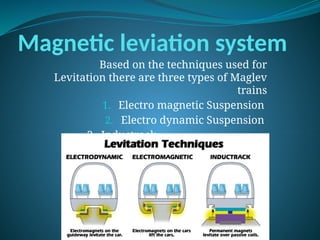
Magnetic leviation system
Basedon the techniques used for
Levitation there are three types of Maglev
trains
1. Electro magnetic Suspension
2. Electro dynamic Suspension
3. Inductrack
7.
Electromagnetic suspension
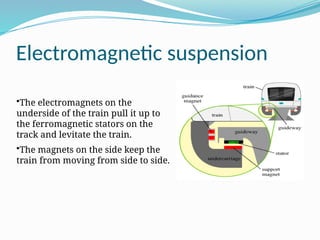
•The electromagnetson the
underside of the train pull it up to
the ferromagnetic stators on the
track and levitate the train.
•The magnets on the side keep the
train from moving from side to side.
8.
Electrodynamic Suspension
Magnetic fieldproduced by
superconducting magnets
located at the bottom of the
train
•The train is levitated by
the repulsive and
attractive force between
the magnetic fields of the
train and the guideway
9.
inductrack
The major differencebetween the
Inductrack and the Electrodymanic
System is the use of permanent magnets
rather than superconducting magnets.
10.
PROPULSION
•An alternating currentis ran through
electromagnet coils on the guide walls of the
guide way. This creates a magnetic field that
attracts and repels the superconducting magnets
on the train and propels the train forward.
•Braking is accomplished by sending an
alternating current in the reverse direction so
that it is slowed by attractive and repulsive forces.
11.
GUIDANCE
The Maglevtrain is a noncontact system that
requires a guiding force for the prevention of
lateral displacement
12.
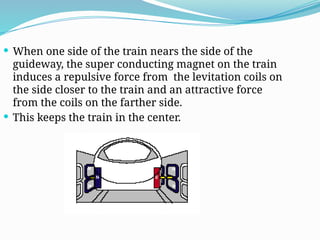
When oneside of the train nears the side of the
guideway, the super conducting magnet on the train
induces a repulsive force from the levitation coils on
the side closer to the train and an attractive force
from the coils on the farther side.
This keeps the train in the center.
13.
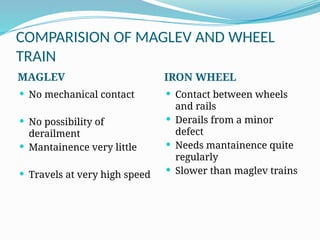
COMPARISION OF MAGLEVAND WHEEL
TRAIN
MAGLEV IRON WHEEL
No mechanical contact
No possibility of
derailment
Mantainence very little
Travels at very high speed
Contact between wheels
and rails
Derails from a minor
defect
Needs mantainence quite
regularly
Slower than maglev trains
14.
Advantages
•The maglev trackstake up a lot less land,
because they are elevated. This also reduces
the amount of collisions and accidents.
•Maglev trains use far less energy than other
types of transportation.
•Maglev trains do not pollute
•Maglev trains are much faster
• Less maintenance
15.
Disadvantages
Cost andinfrastructure
Weight of the electromagnets is also an issue
Feasible only in urban areas
Conclusion
More energy efficientand environment friendly than present
day railway system
Maglev will have a positive impact on sustainability.
Maglev trains are the future of the transportation world.








![FOOT STEP BY POWER GENERATION PPT[1].pptxnew.pptx](https://cdn.slidesharecdn.com/ss_thumbnails/footstepbypowergenerationppt1-250919021928-9d77c296-thumbnail.jpg?width=640&height=640&fit=bounds)


![[Deck] What's New in Spark-Iceberg Integration via DSV2.pptx](https://cdn.slidesharecdn.com/ss_thumbnails/deckwhatsnewinspark-icebergintegrationviadsv2-260210005337-25955b12-thumbnail.jpg?width=640&height=640&fit=bounds)


