INTRODUCTORYINTRODUCTORY
BIOCHEMISTRYBIOCHEMISTRY
BY- DR.ARMAAN SINGH
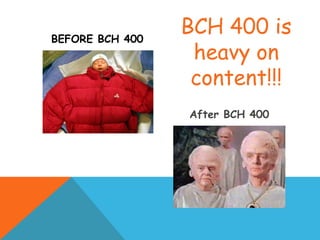
BEFORE BCH 400
After BCH 400
BCH 400 is
heavy on
content!!!
COME TO CLASS!!!!!!
TRY NOT TO FALL
BEHIND!!
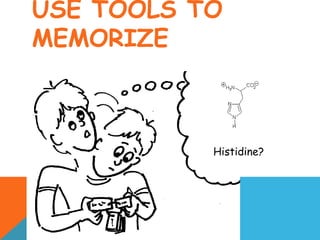
USE TOOLS TO
MEMORIZE
Histidine?
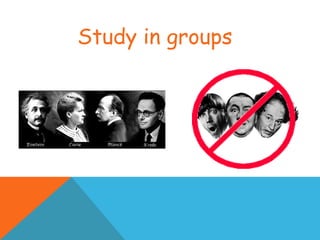
Study in groups
PARTICIPATE IN THE
CLICKER SYSTEM!!!
20 extra credit points!!
Feel Free
to see me!
My office hours
are Tuedays from
2:00 to 3:00 PM
Or e-mail me for
a private audience
WHAT IS BIOCHEMISTRY?
Biochemistry = chemistry of life.
Biochemists use physical and chemical principles to explain biology at the
molecular level.
Basic principles of biochemistry are common to all living organism
HOW DOES BIOCHEMISTRY IMPACT
YOU?
Medicine
Agriculture
Industrial applications
Environmental applications
PRINCIPLE AREAS OF BIOCHEMISTRY
Structure and function of biological
macromolecules
Metabolism – anabolic and catabolic
processes.
Molecular Genetics – How life is replicated.
Regulation of protein synthesis
LIFE BEFORE BIOCHEMISTRY
ONCE UPON A TIME, A LONG LONG
TIME AGO…..
Vitalism: idea that substances and processes
associated with living organisms did not
behave according to the known laws of
physics and chemistry
Evidence:
1) Only living things have a high degree of
complexity
2) Only living things extract, transform and
utilize energy from their environment
3) Only living things are capable of self
assembly and self replication
ORIGINS OF BIOCHEMISTRY:
A CHALLENGE TO “VITALISM.”
Famous Dead Biochemist!
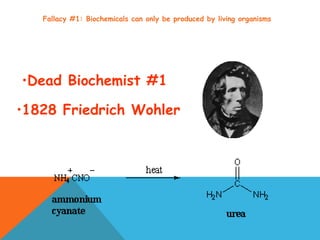
Fallacy #1: Biochemicals can only be produced by living organisms
•1828 Friedrich Wohler
•Dead Biochemist #1
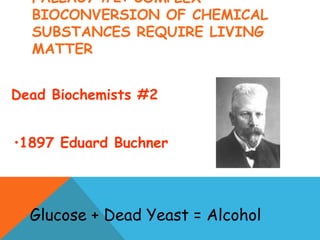
FALLACY #2: COMPLEX
BIOCONVERSION OF CHEMICAL
SUBSTANCES REQUIRE LIVING
MATTER
•1897 Eduard Buchner
Dead Biochemists #2
Glucose + Dead Yeast = Alcohol
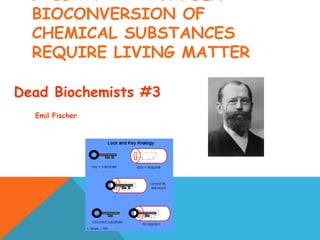
FALLACY #2: COMPLEX
BIOCONVERSION OF
CHEMICAL SUBSTANCES
REQUIRE LIVING MATTER
Emil Fischer
Dead Biochemists #3
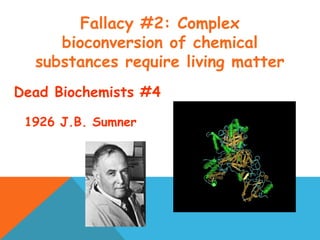
Fallacy #2: Complex
bioconversion of chemical
substances require living matter
Dead Biochemists #4
1926 J.B. Sumner
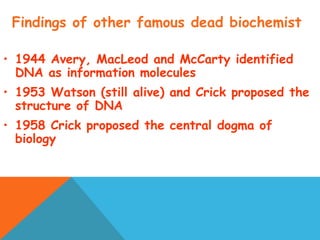
Findings of other famous dead biochemist
• 1944 Avery, MacLeod and McCarty identified
DNA as information molecules
• 1953 Watson (still alive) and Crick proposed the
structure of DNA
• 1958 Crick proposed the central dogma of
biology
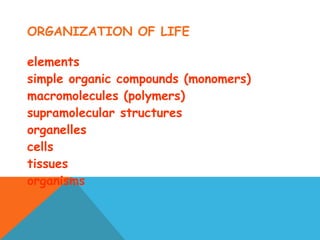
ORGANIZATION OF LIFE
elements
simple organic compounds (monomers)
macromolecules (polymers)
supramolecular structures
organelles
cells
tissues
organisms
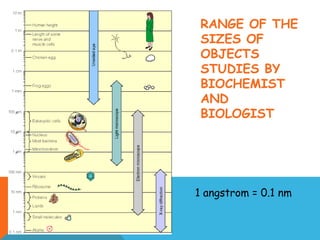
RANGE OF THE
SIZES OF
OBJECTS
STUDIES BY
BIOCHEMIST
AND
BIOLOGIST
1 angstrom = 0.1 nm
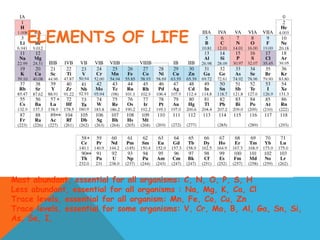
Most abundant, essential for all organisms: C, N, O, P, S, H
Less abundant, essential for all organisms : Na, Mg, K, Ca, Cl
Trace levels, essential for all organism: Mn, Fe, Co, Cu, Zn
Trace levels, essential for some organisms: V, Cr, Mo, B, Al, Ga, Sn, Si,
As, Se, I,
ELEMENTS OF LIFE
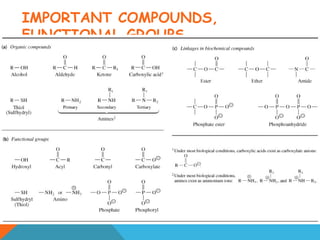
IMPORTANT COMPOUNDS,
FUNCTIONAL GROUPS
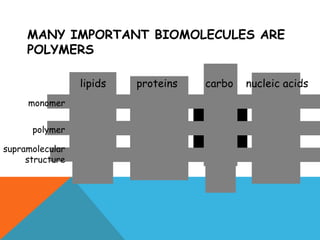
MANY IMPORTANT BIOMOLECULES ARE
POLYMERS
p r o t e i n c o m p le x
p r o t e in s u b u n it
a m i n o a c id
m e m b r a n e
p h o s p h o lip id
f a t t y a c id
c e ll w a ll
c e llu lo se
g lu co se
c h r o m o s o m e
D N A
n u c le o tid emonomer
polymer
supramolecular
structure
lipids proteins carbo nucleic acids
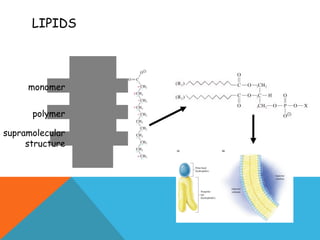
LIPIDS
m e m b r a n e
p h o s p h o lip id
f a t t y a c idmonomer
polymer
supramolecular
structure
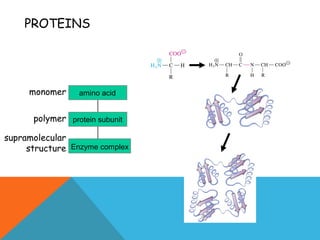
PROTEINS
monomer
polymer
supramolecular
structure Enzyme complex
protein subunit
amino acid
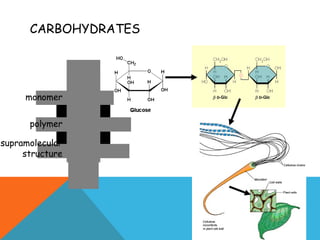
CARBOHYDRATES
c e ll w a ll
c e llu lo se
g lu co semonomer
polymer
supramolecular
structure
c h r o m a t in
D N A
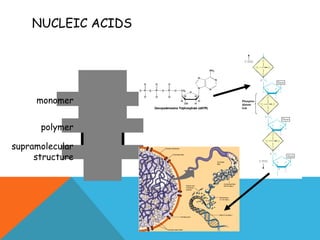
n u c le o ti d emonomer
polymer
supramolecular
structure
NUCLEIC ACIDS
 
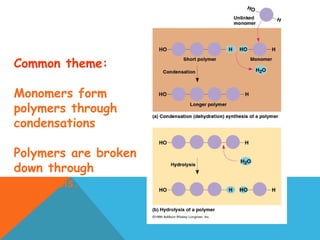
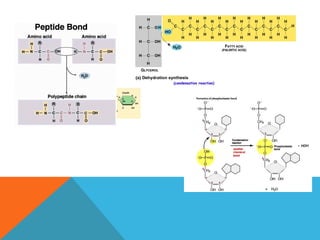
Common theme:
Monomers form
polymers through
condensations
Polymers are broken
down through
hydrolysis.
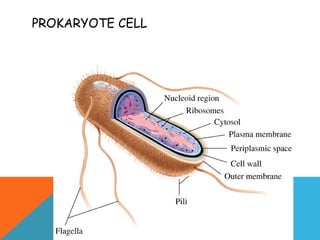
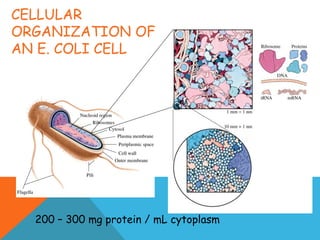
PROKARYOTE CELL
CELLULAR
ORGANIZATION OF
AN E. COLI CELL
200 – 300 mg protein / mL cytoplasm
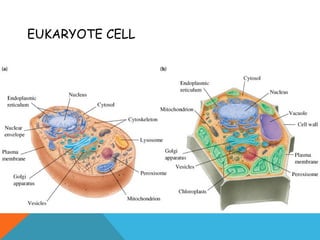
EUKARYOTE CELL
Biochemistry introduction

Biochemistry introduction

Editor's Notes

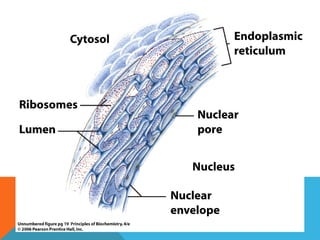
  • #35 Nuclear envelope and endoplasmic reticulum of a eukaryotic cell.
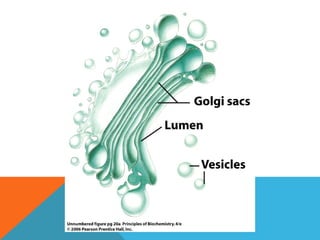
  • #36 Golgi apparatus. Often associated with the endoplasmic reticulum, the Golgi apparatus is responsible for the modification and sorting of some biomolecules. The proteins inserted into the lumen of the ER are transported to the Golgi apparatus for sorting and secretion. Vesicles carry modified material to destinations inside and outside the cell.
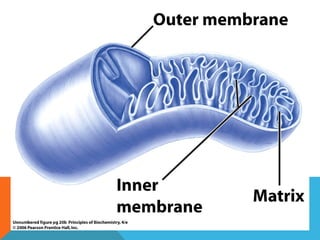
  • #37 Mitochondrion. Mitochondria are the main sites of energy transduction in aerobic eukaryotic cells. Carbohydrates, fatty acids, and amino acids are metabolized in this organelle.
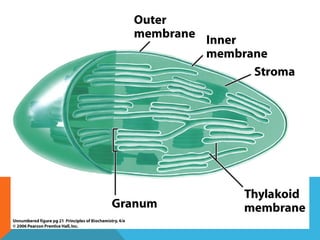
  • #38 Chloroplast. Chloroplasts are the sites of photosynthesis in plants and algae. Light energy is captured by pigments associated with the thylakoid membrane and used to convert carbon dioxide and water to carbohydrates.