Here are the names of the bonds:
1. Sugars in a polysaccharide - Glycosidic bonds
2. Amino acids in a protein - Peptide bonds
3. Nucleotides in a nucleic acid - Phosphodiester bonds
The Structure &Function ofThe Structure & Function of
MacromoleculesMacromolecules
2.
Your Goal
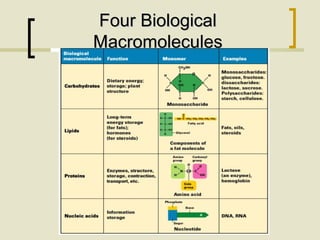
Namethe monomers of the 4
macromolecules
Explain how those monomers are
joined into polymers
Describe the uses of each
macromolecule in living things
Most Macromolecules areMostMacromolecules are
PolymersPolymers Built fromBuilt from MonomersMonomers
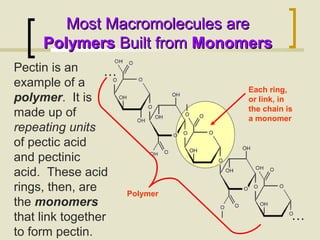
Pectin is an
example of a
polymer. It is
made up of
repeating units
of pectic acid
and pectinic
acid. These acid
rings, then, are
the monomers
that link together
to form pectin.
Polymer
Each ring,
or link, in
the chain is
a monomer
5.
The Synthesis ofPolymersThe Synthesis of Polymers
In order to covalently bond, the 2 monomers
lose –H & -OH atoms which combine to form
water as a bi-product. Thus this reaction is
known as dehydration synthesis The process
is then repeated many times to synthesize a
large polymer.
Note: Some texts may refer to this as a condensation reaction
6.
……And the BreakdownofAnd the Breakdown of
PolymersPolymers
The reverse reaction for a dehydration
synthesis is hydrolysis. A water molecule
is used to break, or lyse, the covalent bond
between two monomers. When the bonds
are broken, energy is released.
7.
When one organismeats another,
macromolecules are broken down
& their monomers can be reused
and/or rearranged to make new
polymers with different functions.
8.
Polymer DiversityPolymer Diversity
Variationsamong organisms is primarily a result of molecular
differences; namely in their DNA & protein
Although there’s a HUGE variety of polymers, but only 40-50
monomers exist!
**The variety results from the order of a sequence of
monomers. As a simple example, 4 monomers can be ordered
in several configurations to yield polymers that have different
structures and functions.
STOP
POTS
TOPS
It’s sort of like letters of the
alphabet; different
arrangements of the same
letters form different words
with very different meanings
Carbohydrates Serve asCarbohydratesServe as
Fuel & Building MaterialFuel & Building Material
Carbohydrates are sugars
& starches
There are 3 levels of
carbohydrate complexity:
Monosaccharides
Disaccharides
Polysaccharides
(Mono means 1, saccharide refers to a sugar)
(Di = 2)
(Poly = Many) Vocab. Tip: Most
sugars end in the
suffix –ose.
Glucose,Maltose,
Lactose, etc
12.
Monosaccharides-simplest of thesugars;
consist of 1 ring
Examples: Glucose & Fructose
Main fuel for cells cellular respiration; used for quick energy.
Monosaccharides that are left unused become linked by
dehydration synthesis to form disaccharides & polysaccharides.
Basic molecular formula = CH2O where there are generally twice
as many H as C or O. Example: glucose C6H12O6
Like other sugars, glucose forms rings in
water
13.
Disaccharides – Consistof two monosaccharides
joined together
Examples: Maltose, Lactose, Sucrose
2 glucose monomers bond to make
maltose, which has different chemical
characteristics than glucose
Name of bond
between C1 & C4
Glucose + Fructose = Sucrose
14.
Polysaccharides- Polymers of100s to 1,000s of
monosaccharides linked together
Storage polysaccharides:
Polymer
Name
Monomer Location Function
In Plants Starch Glucose Plastids of
cells
Store surplus
glucose
In Animals Glycogen Glucose Liver & muscle
cells
Fuel storage
used when
glucose is
unavailable
15.
Structural Polysaccharides-insoluble &hard to break down
(e.g. dietary fiber):
Example in plants = cellulose
Long, straight chains of
glucose that are H-bonded to
each other at their hydroxyl
groups = microfibrils that form
cell wall
Example in animals = chitin
Monomer is
glucose
with 1
hydroxyl
group
replaced
with an
acetylamino
group
Polysaccharides
16.
Quick Think withyour best
thing buddy
Draw a monosaccharide
Draw a polysaccharide
Give one biological use for these
molecules
17.
Lipids are aDiverseLipids are a Diverse GroupGroup
of Hydrophobic Moleculesof Hydrophobic Molecules
Lipids are macromolecules that ARE NOT polymers
Hydro = water
Phobic = fearing
Lipids are mostly hydrocarbons and, therefore, are
hydrophobic
Three biologically important lipids:
1. Fats
2. Phospholipids
3. Steroids
18.
FatsFats
Each molecule ismade
of 1 glycerol & 3 fatty
acids
Bonds form by
dehydration synthesis
Carboxyl group =
fatty “acid”
Triacylglycerol
(a.k.a.triglyceride)Saturated fat = no
double bonds between
C in fatty acid chain
Unsaturated fat =
1 or more double
bonds between C in
fatty acid chain
19.
FatsFats
Function = Energystorage
*1 gram of fat stores more than twice as much
energy as 1g of carbohydrate!
*The fat molecules in animals are stored in adipose
cells
-Adipose layers protect organs & insulate
Adipose Cells (40X)
Whale Blubber
20.
PhospholipidsPhospholipids
Made of 1glycerol & only
2 fatty acidsCharged
phosphate
group
makes the
head
hydrophilic
In water,
phospholipids
arrange into a
bilayer according
to their
hydrophobic &
hydrophilic
regions
Slightly positive H in water
attracts negative phosphate
group in phospholipids
21.
SteroidsSteroids
Steroids have this4-ringed
basic structure attached to a
functional group
This functional group makes
this molecule cholesterol.
*Cholesterol is a major component of
animal cell membranes
*Many sex hormones are made from
cholesterol
22.
Quick Think withyour super
hero buddy
Why are fats NOT polymers?
Name one biological use for lipids.
23.
Proteins Have ManyStructures,Proteins Have Many Structures,
Resulting in a Wide Range of FunctionsResulting in a Wide Range of Functions
Some protein functions:
Enzymatic proteins- catalyze rxns
Structural proteins- support
Storage Proteins- storage of amino acids
Transport proteins- transport other molecules
Hormonal proteins- regulate organism’s activities
Receptor proteins- allow cells to respond to stimuli
Contractile proteins- movement
Defensive proteins- protection against disease
Hair
Protein in seeds
Hemoglobin
Found in muscle cells
24.
PolypeptidesPolypeptides
•A protein is1 or more
polypeptides folded & coiled
into a specific shape
•A polypeptide is a
polymer of amino acids
One amino acid monomer
linked to a chain of others.
All of the amino acids
linked together form a
polypeptide chain
25.
Polypeptides:Polypeptides:
Amino Acid MonomersAminoAcid Monomers
R
group
R
group
Leucine Serine
Carboxyl groupAmino group
Variable side group
Each of the 20
different amino
acids has a
different R group
which gives it its
unique
characteristics
26.
Polypeptides:Polypeptides:
Amino Acid PolymersAminoAcid Polymers
Peptide Bond
R
group
R
group
R
group
R
group
Amino
group
Carboxyl
group
N-terminus C-
terminus
Amino Acid chains are
held together by peptide
bonds which are formed
by a dehydration
reaction
The number,
type, &
sequence of
amino acids
determine the
shape and
function of the
polypeptide
27.
Note that boththe C & N-terminus
ionize in aqueous solutions
28.
Protein ConformationProtein Conformation
&Function& Function
The function of a protein is an emergent property
resulting from its unique shape
Model of receptor protein Model of enzyme
In each example, the protein’s ability to perform its
function is dependant on the specific shape of the protein
29.
Protein Conformation &Function:Protein Conformation & Function:
Four Levels of Protein StructureFour Levels of Protein Structure
Primary Structure: a protein’s
unique, linear sequence of amino
acids which is determined by
genetic information
30.
Protein Conformation &Function:Protein Conformation & Function:
Four Levels of Protein StructureFour Levels of Protein Structure
Secondary
Structure: the result
of H-bonding
between partially
negative oxygen &
nitrogen of the
polypeptide
backbone and
hydrogen on the
backbone.
Primary
Structure
α-helix structure: coiling that
results from H-bonding
between every 4th
amino acid
β-pleated sheet:
polypeptide backbone
folds on itself, forming
H-bonds
31.
Protein Conformation &Function:Protein Conformation & Function:
Four Levels of Protein StructureFour Levels of Protein Structure
Tertiary
structure: the
overall shape
of the
polypeptide
resulting from
interactions
between R-
groups of
amino acids.
Hydrophobic
interactions
contribute to tertiary
structure:
hydrophobic R-
groups are
organized so that
they are in the
center of the
protein. Hydrophilic
amino acid R-
groups end up on
the outer surface of
the protein.
Note disulfide
bridge
reinforces
protein
conformation
32.
Protein Conformation &Function:Protein Conformation & Function:
Four Levels of Protein StructureFour Levels of Protein Structure
Quaternary
structure:
forms when
two or more
polypeptide
chains
aggregate to
make one
molecule
33.
Protein Conformation &Function:Protein Conformation & Function:
Four Levels of Protein StructureFour Levels of Protein Structure
•A protein’s shape is sensitive to
the surrounding environment
Unfavorable
temperature and pH
changes can cause
a protein to unravel
and lose its shape.
This is called
denaturation
34.
Quick Think withyour love
buddy <3
Draw and label the 4 levels of protein
structure
35.
Nucleic AcidsNucleic AcidsStore & TransmitStore & Transmit
Hereditary InformationHereditary Information
•Nucleic acids store the
instructions for building proteins
•Two types: Deoxyribonucleic
Acid (DNA) & Ribonucleic Acid
(RNA)
•The flow of genetic information:
DNA RNA protein
36.
Nucleic Acid StructureNucleicAcid Structure
Nucleic acids
are polymers
of
nucleotides.
Each
nucleotide
has 3 parts:
5-carbon
sugar,
phosphate
group, & a
nitrogenous
base
37.
Nucleic Acid Structure:NucleicAcid Structure:
Nucleotide MonomersNucleotide Monomers
Nucleotides
can have 1 of
4 different
nitrogenous
bases:
cytosine,
thymine –
uracil in RNA-
(pyrimidines)
or adenine,
guanine
(purines)
Thymine (T) Cytosine (C)
Adenine (A) Guanine (G)
p
u
r
i
n
e
s
p
y
r
i
m
i
d
i
n
e
s
38.
Nucleic Acid Structure:NucleicAcid Structure:
Nucleotide PolymersNucleotide Polymers
Bond occurs at -OH
on 3’ C of one
nucleotide and the
phosphate group
on the 5’ C of the
other nucleotide
Bond formed is
called a
phosphodiester
bond
This process
creates a sugar-
phosphate
backbone with the
nitrogenous bases
sticking out
39.
The DNA DoubleHelixThe DNA Double Helix
The two
strands of the
double helix
are
antiparallel,
running in the
5’ 3’
direction
H-Bonds
40.
DNA & Proteinsas TapeDNA & Proteins as Tape
Measures of EvolutionMeasures of Evolution
The sequence of nucleotides in DNA and the sequence of
amino acids in proteins can be used to determine
evolutionary relationships…closely related species have
fewer differences in their sequences.
Millionsofyearsago
Amino acid
differences
compared
with human
hemoglobin
41.
Quick Think
Whatare the names of the bonds between:
1. Sugars in a polysaccharide
2. Amino acids in a protein
3. Nucleotides in a nucleic acid






![Chapter 7 photosynthesis [compatibility mode]](https://cdn.slidesharecdn.com/ss_thumbnails/chapter7-photosynthesiscompatibilitymode-141214133517-conversion-gate02-thumbnail.jpg?width=640&height=640&fit=bounds)


