Institutional Ethics Committee
DR SAHIL KUMAR
INTRODUCTION
Institutional Ethics Committee - independent body constituted of medical/scientific professionals and
non-medical/non-scientific members to ensure protection of the rights and welfare of human subjects
participating in clinical trials & to provide public reassurance, inter alia, by previewing trial protocols etc.
(WHO)
Might have different names at different institutions :
Independent Ethics Committee, Institutional Review Board (IRB),
Institutional Ethics Committee (IEC)
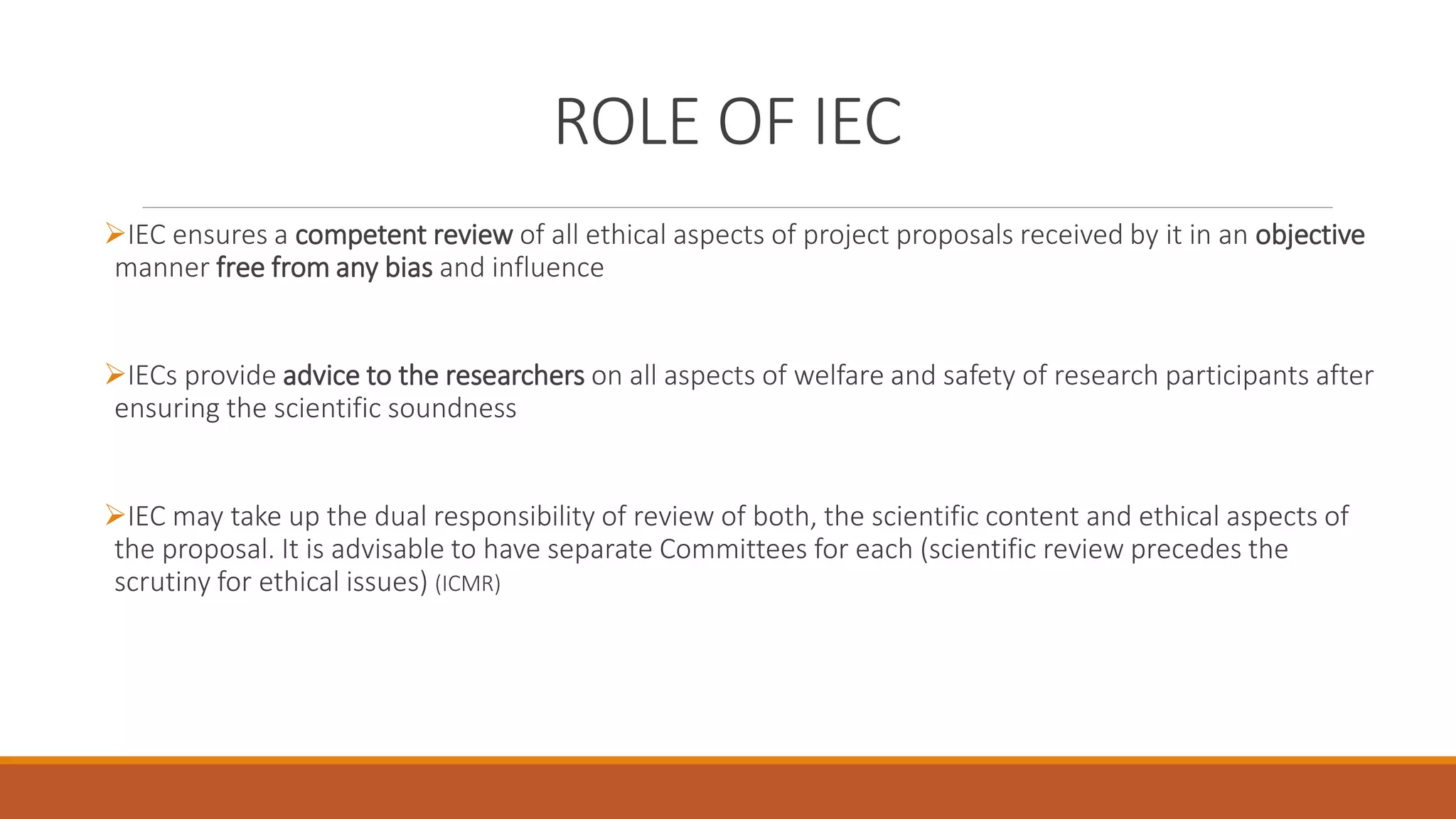
ROLE OF IEC
IEC ensures a competent review of all ethical aspects of project proposals received by it in an objective
manner free from any bias and influence
IECs provide advice to the researchers on all aspects of welfare and safety of research participants after
ensuring the scientific soundness
IEC may take up the dual responsibility of review of both, the scientific content and ethical aspects of
the proposal. It is advisable to have separate Committees for each (scientific review precedes the
scrutiny for ethical issues) (ICMR)
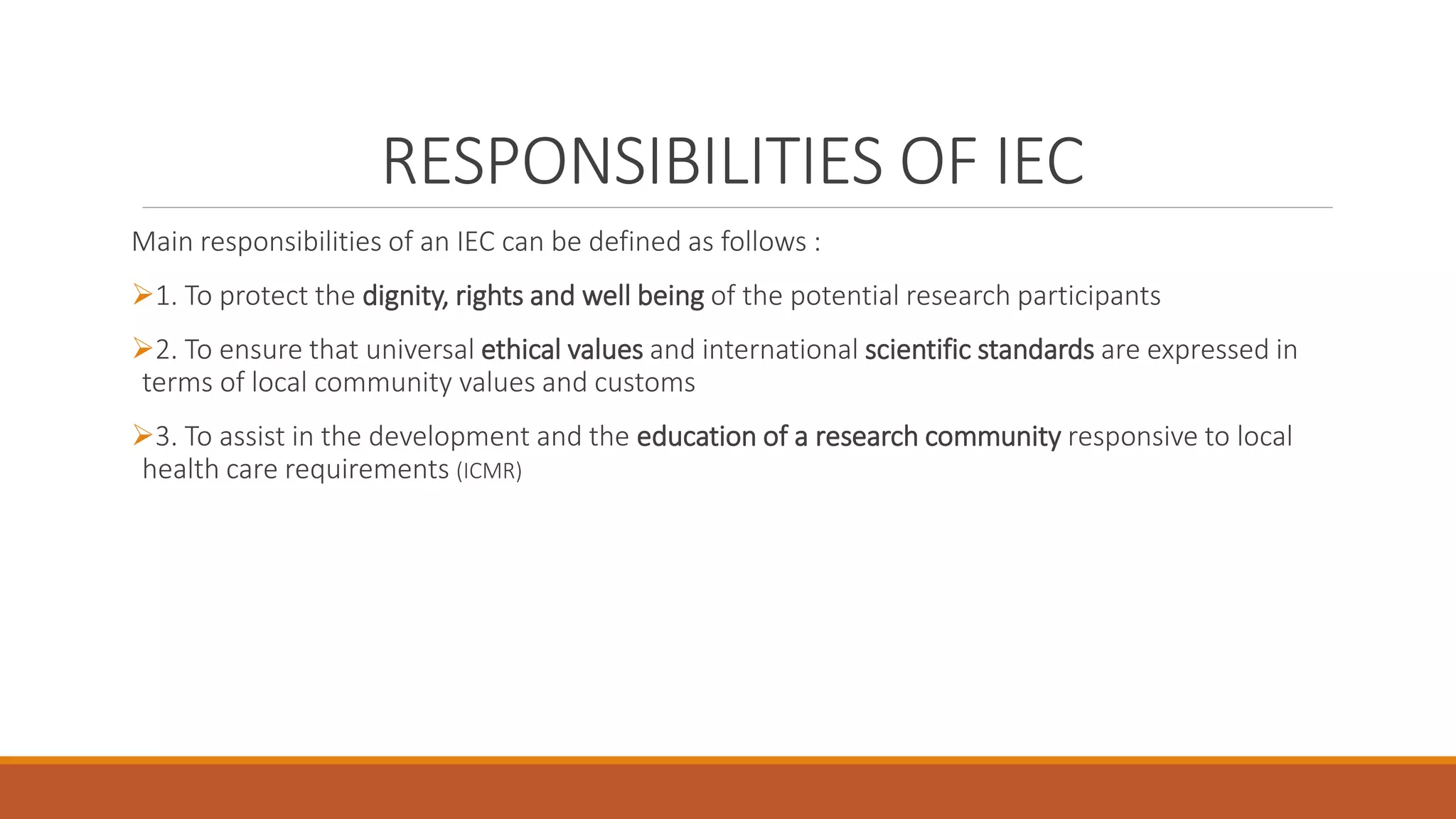
RESPONSIBILITIES OF IEC
Main responsibilities of an IEC can be defined as follows :
1. To protect the dignity, rights and well being of the potential research participants
2. To ensure that universal ethical values and international scientific standards are expressed in
terms of local community values and customs
3. To assist in the development and the education of a research community responsive to local
health care requirements (ICMR)
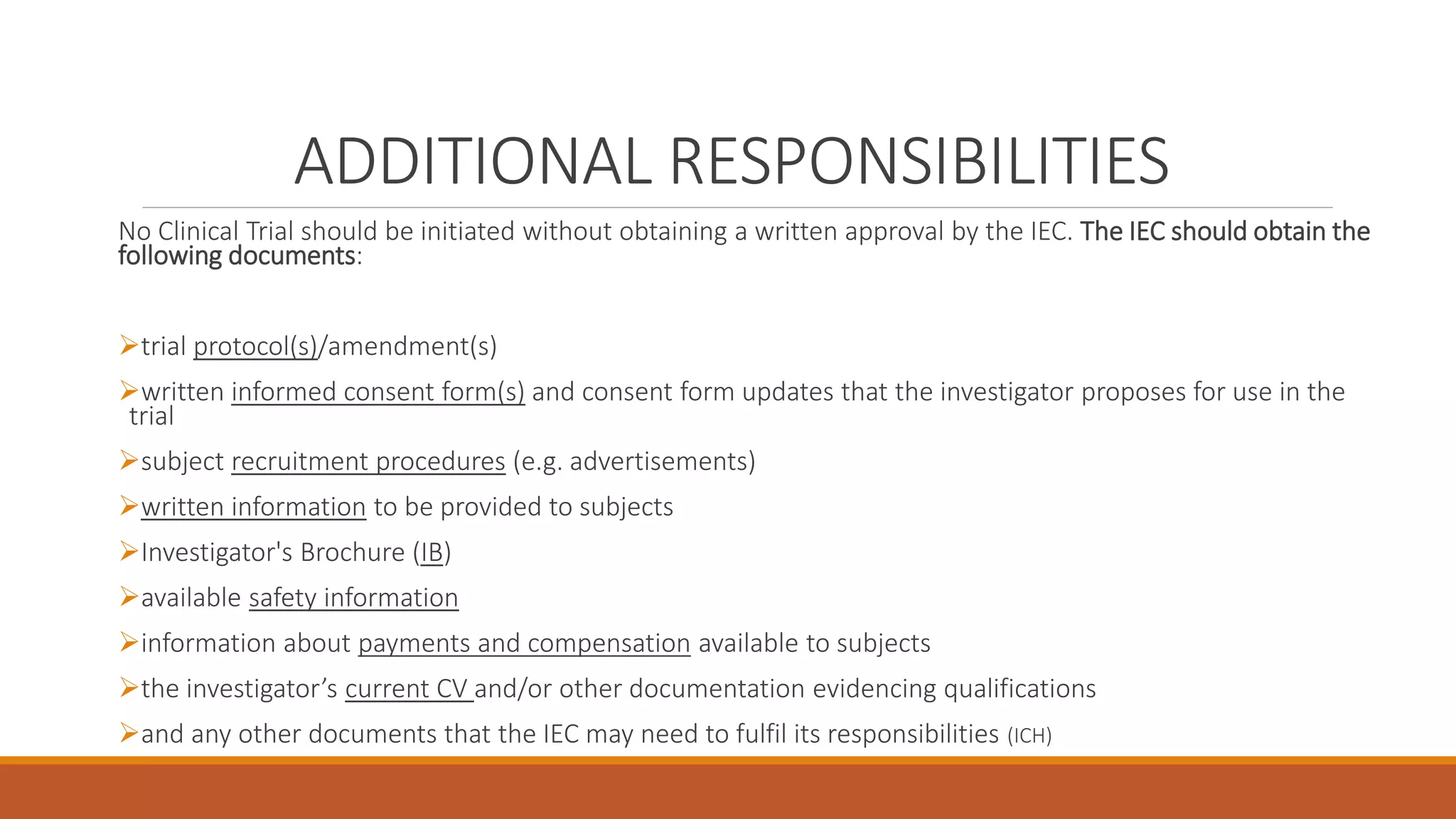
ADDITIONAL RESPONSIBILITIES
No Clinical Trial should be initiated without obtaining a written approval by the IEC. The IEC should obtain the
following documents:
trial protocol(s)/amendment(s)
written informed consent form(s) and consent form updates that the investigator proposes for use in the
trial
subject recruitment procedures (e.g. advertisements)
written information to be provided to subjects
Investigator's Brochure (IB)
available safety information
information about payments and compensation available to subjects
the investigator’s current CV and/or other documentation evidencing qualifications
and any other documents that the IEC may need to fulfil its responsibilities (ICH)
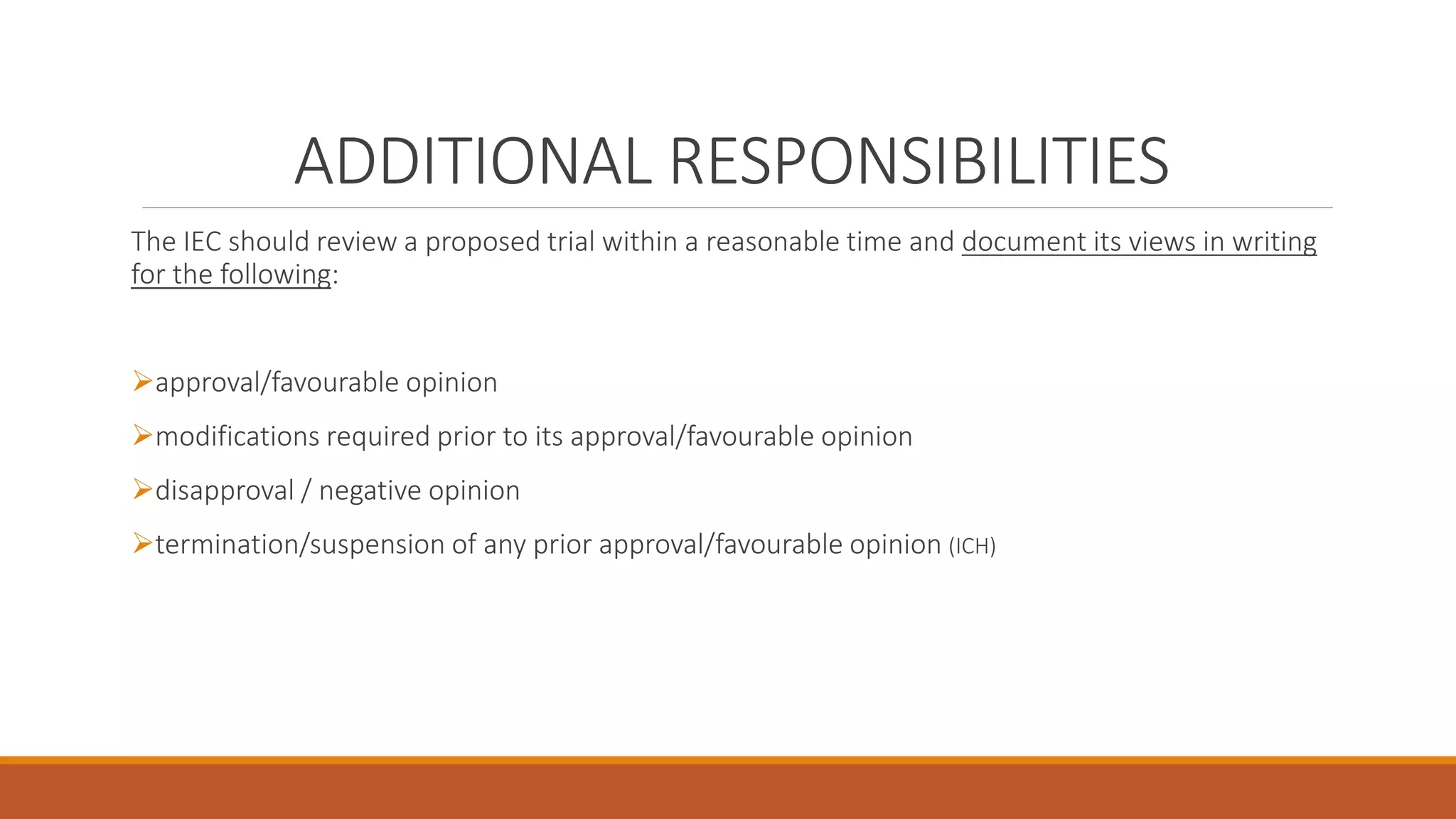
ADDITIONAL RESPONSIBILITIES
The IEC should review a proposed trial within a reasonable time and document its views in writing
for the following:
approval/favourable opinion
modifications required prior to its approval/favourable opinion
disapproval / negative opinion
termination/suspension of any prior approval/favourable opinion (ICH)
ADDITIONAL RESPONSIBILITIES
IEC should consider qualifications of investigator (by a current CV or other relevant
documentation)
IEC should conduct continuing review at intervals appropriate to degree of risk, but at
least once per year. The ethical review should be done through formal meetings and
should not resort to decisions through circulation of proposals (CDSCO)
The IEC may request more information to be given to subjects when the additional
information would add meaningfully (ICH)
ADDITIONAL RESPONSIBILITIES
When Non-therapeutic trial is to be carried out with the consent of the subject’s legally acceptable
representative, IEC should determine that relevant ethical concerns and applicable regulatory
requirements are met
Where prior consent not possible, the IEC should determine that relevant ethical concerns and
applicable regulatory requirements are met (i.e. in emergency situations)
IEC should review both amount and method of payment to subjects to assure that neither presents
problems of coercion or undue influence on trial subjects(ICH)
ADDITIONAL RESPONSIBILITIES
IEC should ensure that information regarding payment to subjects is set forth in the written
informed consent form and any other written information to be provided to subjects. The way
payment will be prorated should be specified.
RECORD KEEPING
All documentation and communication of an IEC are dated, filed and preserved according to written procedures.
Strict confidentiality maintained. Records should be maintained for the following :
i. Constitution and composition of the IEC
ii. CV of all IEC members
iii. SOPs of the IEC
iv. National and International guidelines
v. Copies of the Protocol, data collection formats, investigational brochures etc. submitted for review
vi. All correspondence with IEC members and investigators regarding application, decision and follow up
vii. Agenda of all IEC meetings
viii. Minutes of all IEC meetings with signature of the Chairperson
ix. Copies of decisions communicated to the applicants
x. Record of all notification issued for premature termination of a study with a summary of the reasons
xi. Final report of the study including microfilms, CDs and Video-recordings
Records must be safely maintained after termination of the study for at least a period of 5 years (CDSCO) (3 years –
ICMR, ICH)
COMPOSITION
 IEC should be multidisciplinary and multi-sectorial in composition
 The number of persons kept fairly small (5-7) (minimum five). No specific recommendation for
maximum number of persons too large a Committee will make it difficult in reaching consensus
opinion
The Chairperson of the Committee should preferably be from outside the Institution and not head of
the same Institution to maintain independence
The Member Secretary generally belongs to the same Institution should conduct the business of the
Committees
COMPOSITION
The composition may be as follows (CDSCO, Schedule Y Amendment 2005) :
 Chairperson
 1-2 basic medical scientists (preferably one pharmacologist)
 1-2 clinicians from various Institutes
 One legal expert or retired judge
 One social scientist / representative of non-governmental voluntary agency
 One philosopher / ethicist / theologian
 One lay person from the community
 Member Secretary
MEMBERSHIP REQUIREMENTS
Duration of appointment is initially for a period of 2-3 years
At the end of 2-3 years committee is reconstituted, and 50% of the members will be replaced by a
defined procedure
A member can be replaced in the event of death or long-term non-availability or for any action not
commensurate with the responsibilities laid down in the guidelines deemed unfit for a member
A member can tender resignation from the committee with proper reasons
All members should maintain absolute confidentiality of all discussions
REVIEW PROCESS
PERIODIC REVIEW - at regular intervals of six months to one year as may be specified in the SOP
CONTINUING REVIEW - approved projects for continuation, new information, adverse event
monitoring, follow-up
INTERIM REVIEW - can be resorted-to instead of waiting for the scheduled time of the meeting.
However, decisions taken should be brought to the notice of the main committee. Reasons:
To re-examine a proposal
research study of a minor nature such as examination of case records etc
an urgent proposal of national interest
ADMINISTRATION AND MANAGEMENT
A full time secretariat and space for keeping records is required
The members could be given a reasonable compensation for the time spared for reviewing the
proposals
A reasonable fees can be charged to cover the expenses related to review and administrative
processes (ICMR)
Thank You

Institutional ethics committee : Roles and Responsibilities

  • 1.
  • 2.
    INTRODUCTION Institutional Ethics Committee- independent body constituted of medical/scientific professionals and non-medical/non-scientific members to ensure protection of the rights and welfare of human subjects participating in clinical trials & to provide public reassurance, inter alia, by previewing trial protocols etc. (WHO) Might have different names at different institutions : Independent Ethics Committee, Institutional Review Board (IRB), Institutional Ethics Committee (IEC)
  • 3.
    ROLE OF IEC IECensures a competent review of all ethical aspects of project proposals received by it in an objective manner free from any bias and influence IECs provide advice to the researchers on all aspects of welfare and safety of research participants after ensuring the scientific soundness IEC may take up the dual responsibility of review of both, the scientific content and ethical aspects of the proposal. It is advisable to have separate Committees for each (scientific review precedes the scrutiny for ethical issues) (ICMR)
  • 4.
    RESPONSIBILITIES OF IEC Mainresponsibilities of an IEC can be defined as follows : 1. To protect the dignity, rights and well being of the potential research participants 2. To ensure that universal ethical values and international scientific standards are expressed in terms of local community values and customs 3. To assist in the development and the education of a research community responsive to local health care requirements (ICMR)
  • 5.
    ADDITIONAL RESPONSIBILITIES No ClinicalTrial should be initiated without obtaining a written approval by the IEC. The IEC should obtain the following documents: trial protocol(s)/amendment(s) written informed consent form(s) and consent form updates that the investigator proposes for use in the trial subject recruitment procedures (e.g. advertisements) written information to be provided to subjects Investigator's Brochure (IB) available safety information information about payments and compensation available to subjects the investigator’s current CV and/or other documentation evidencing qualifications and any other documents that the IEC may need to fulfil its responsibilities (ICH)
  • 6.
    ADDITIONAL RESPONSIBILITIES The IECshould review a proposed trial within a reasonable time and document its views in writing for the following: approval/favourable opinion modifications required prior to its approval/favourable opinion disapproval / negative opinion termination/suspension of any prior approval/favourable opinion (ICH)
  • 7.
    ADDITIONAL RESPONSIBILITIES IEC shouldconsider qualifications of investigator (by a current CV or other relevant documentation) IEC should conduct continuing review at intervals appropriate to degree of risk, but at least once per year. The ethical review should be done through formal meetings and should not resort to decisions through circulation of proposals (CDSCO) The IEC may request more information to be given to subjects when the additional information would add meaningfully (ICH)
  • 8.
    ADDITIONAL RESPONSIBILITIES When Non-therapeutictrial is to be carried out with the consent of the subject’s legally acceptable representative, IEC should determine that relevant ethical concerns and applicable regulatory requirements are met Where prior consent not possible, the IEC should determine that relevant ethical concerns and applicable regulatory requirements are met (i.e. in emergency situations) IEC should review both amount and method of payment to subjects to assure that neither presents problems of coercion or undue influence on trial subjects(ICH)
  • 9.
    ADDITIONAL RESPONSIBILITIES IEC shouldensure that information regarding payment to subjects is set forth in the written informed consent form and any other written information to be provided to subjects. The way payment will be prorated should be specified.
  • 10.
    RECORD KEEPING All documentationand communication of an IEC are dated, filed and preserved according to written procedures. Strict confidentiality maintained. Records should be maintained for the following : i. Constitution and composition of the IEC ii. CV of all IEC members iii. SOPs of the IEC iv. National and International guidelines v. Copies of the Protocol, data collection formats, investigational brochures etc. submitted for review vi. All correspondence with IEC members and investigators regarding application, decision and follow up vii. Agenda of all IEC meetings viii. Minutes of all IEC meetings with signature of the Chairperson ix. Copies of decisions communicated to the applicants x. Record of all notification issued for premature termination of a study with a summary of the reasons xi. Final report of the study including microfilms, CDs and Video-recordings Records must be safely maintained after termination of the study for at least a period of 5 years (CDSCO) (3 years – ICMR, ICH)
  • 11.
    COMPOSITION  IEC shouldbe multidisciplinary and multi-sectorial in composition  The number of persons kept fairly small (5-7) (minimum five). No specific recommendation for maximum number of persons too large a Committee will make it difficult in reaching consensus opinion The Chairperson of the Committee should preferably be from outside the Institution and not head of the same Institution to maintain independence The Member Secretary generally belongs to the same Institution should conduct the business of the Committees
  • 12.
    COMPOSITION The composition maybe as follows (CDSCO, Schedule Y Amendment 2005) :  Chairperson  1-2 basic medical scientists (preferably one pharmacologist)  1-2 clinicians from various Institutes  One legal expert or retired judge  One social scientist / representative of non-governmental voluntary agency  One philosopher / ethicist / theologian  One lay person from the community  Member Secretary
  • 13.
    MEMBERSHIP REQUIREMENTS Duration ofappointment is initially for a period of 2-3 years At the end of 2-3 years committee is reconstituted, and 50% of the members will be replaced by a defined procedure A member can be replaced in the event of death or long-term non-availability or for any action not commensurate with the responsibilities laid down in the guidelines deemed unfit for a member A member can tender resignation from the committee with proper reasons All members should maintain absolute confidentiality of all discussions
  • 14.
    REVIEW PROCESS PERIODIC REVIEW- at regular intervals of six months to one year as may be specified in the SOP CONTINUING REVIEW - approved projects for continuation, new information, adverse event monitoring, follow-up INTERIM REVIEW - can be resorted-to instead of waiting for the scheduled time of the meeting. However, decisions taken should be brought to the notice of the main committee. Reasons: To re-examine a proposal research study of a minor nature such as examination of case records etc an urgent proposal of national interest
  • 15.
    ADMINISTRATION AND MANAGEMENT Afull time secretariat and space for keeping records is required The members could be given a reasonable compensation for the time spared for reviewing the proposals A reasonable fees can be charged to cover the expenses related to review and administrative processes (ICMR)
  • 16.