Dose Determination
in
Preclinical & Clinical Studies
DR SAHIL KUMAR
OUTLINE
In vitro Dose Considerations
In vivo Dose Considerations
Dose Range Finding (DRF) Studies
Dose Guidance in Regulatory Toxicology
First in Human (FIH) Dose
Estimating FIH/MRSD
Conclusion
Problem Solving Exercizes
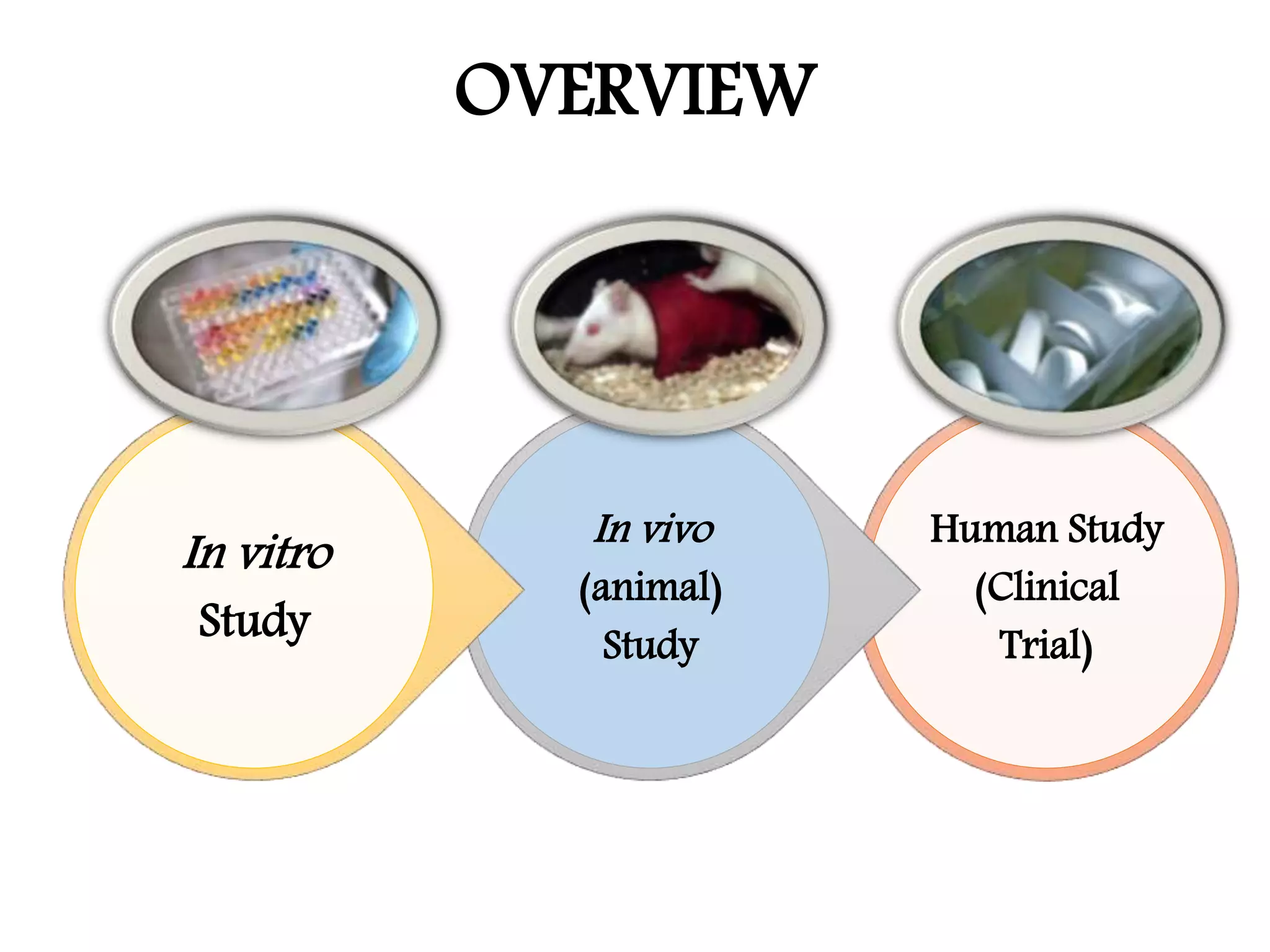
OVERVIEW
Human Study
(Clinical
Trial)
In vivo
(animal)
Study
In vitro
Study
In vitro
DOSE CONSIDERATIONS
In vitro models as close to human physiological
systems chosen.
Starting dose chosen empirically.
0.1nM to 0.1M.
Is there a way to extrapolate in vitro
dose to in vivo?...
Not accurately possible.
Transposing dose response relationship.

𝐷𝑜𝑠𝑒
τ
=
𝐶𝐿
𝐹
× ∁𝑡𝑎𝑟𝑔𝑒𝑡
Computer based models (IVISIVC).
In vivo (Animal)
DOSE
CONSIDERATIONS
Selecting the high dose
Maximum Tolerated Dose (MTD).
Limit Dose.
Toxicokinetics and Saturation of Exposure.
Maximum Feasible/ Practical Dose.
(ICH M3(R2), Guidance on Nonclinical Safety Studies for the Conduct of Human
Clinical Trials and Marketing Authorization for Pharmaceuticals.)
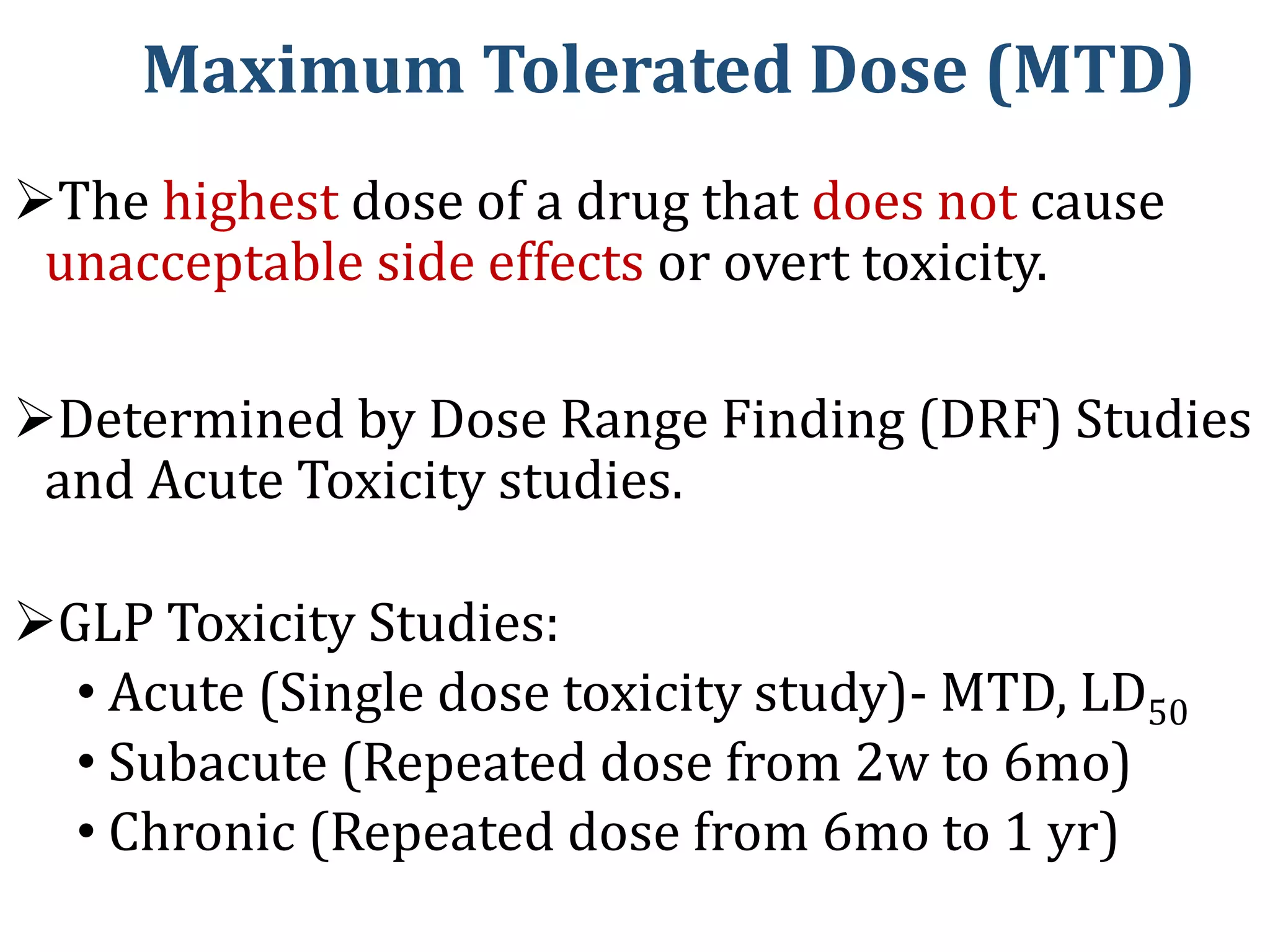
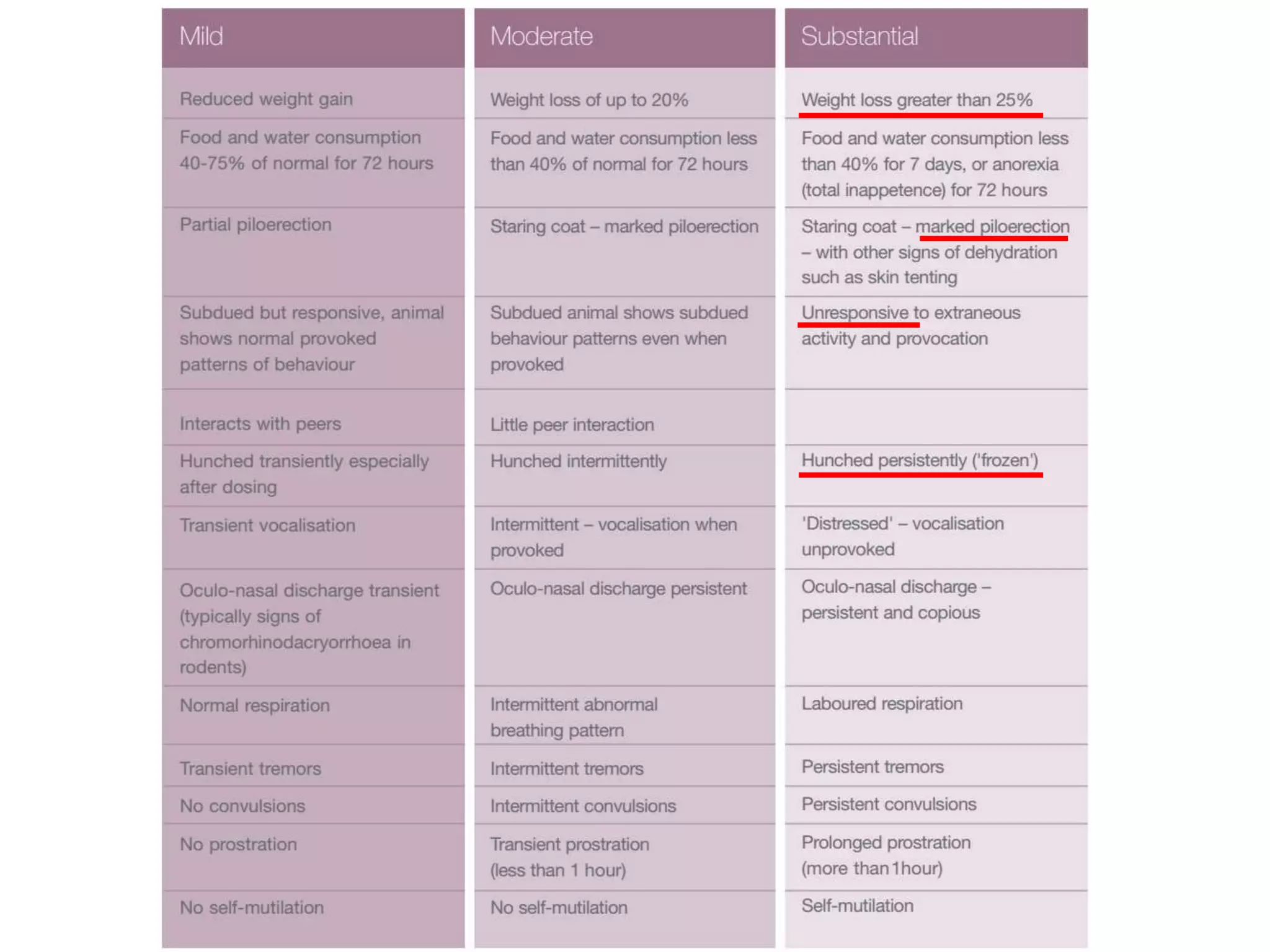
Maximum Tolerated Dose (MTD)
The highest dose of a drug that does not cause
unacceptable side effects or overt toxicity.
Determined by Dose Range Finding (DRF) Studies
and Acute Toxicity studies.
GLP Toxicity Studies:
• Acute (Single dose toxicity study)- MTD, LD50
• Subacute (Repeated dose from 2w to 6mo)
• Chronic (Repeated dose from 6mo to 1 yr)
Dose Range Finding (DRF) Studies
No regulatory guidelines for DRF studies.
Dose escalation phase and Repeat dose phase.
Starting dose? Number of dose groups?
Study design:
• One group of animals dosed at a time.
• Next dose may be higher or lower depending
upon the observations.
• Group sizes increased once dose response
established.
Half log intervals e.g. 1, 3, 10,
30, 100, 300, 1000mg/kg etc.
used.
Formulation in the DRF study
should be same as the
formulation proposed for
regulatory study.
Tolerability of the animals to
co-solvents should be
established.
Importance of good animal care
and empathetic handling by
trained animal care staff should
not be underestimated.
Clinical pathology &
histopathology.
Toxicokinetic assessment.
Dose Guidance in Regulatory Toxicology
If dose not
investigated in DRF
study – avoid it.
The high dose should
match one of the
doses already
investigated in the
DRF study.
Solubility may limit
the dose that can be
given.
Escalating dose design
recommended for test
items where tolerance to
known pharmacological
effects develops.
The low dose should
ideally demonstrate the
NOEL / NOAEL in the
animal.
The intermediate dose
is required to
demonstrate a dose
response relationship.
Sometimes a second
intermediate dose may
be required, eg: Where
the dose range from the
low dose to MTD is large.
786yam
FIRST IN HUMAN
DOSE
FIH/ MRSD/FHD/EIH/FTIM
DEFINITIONS
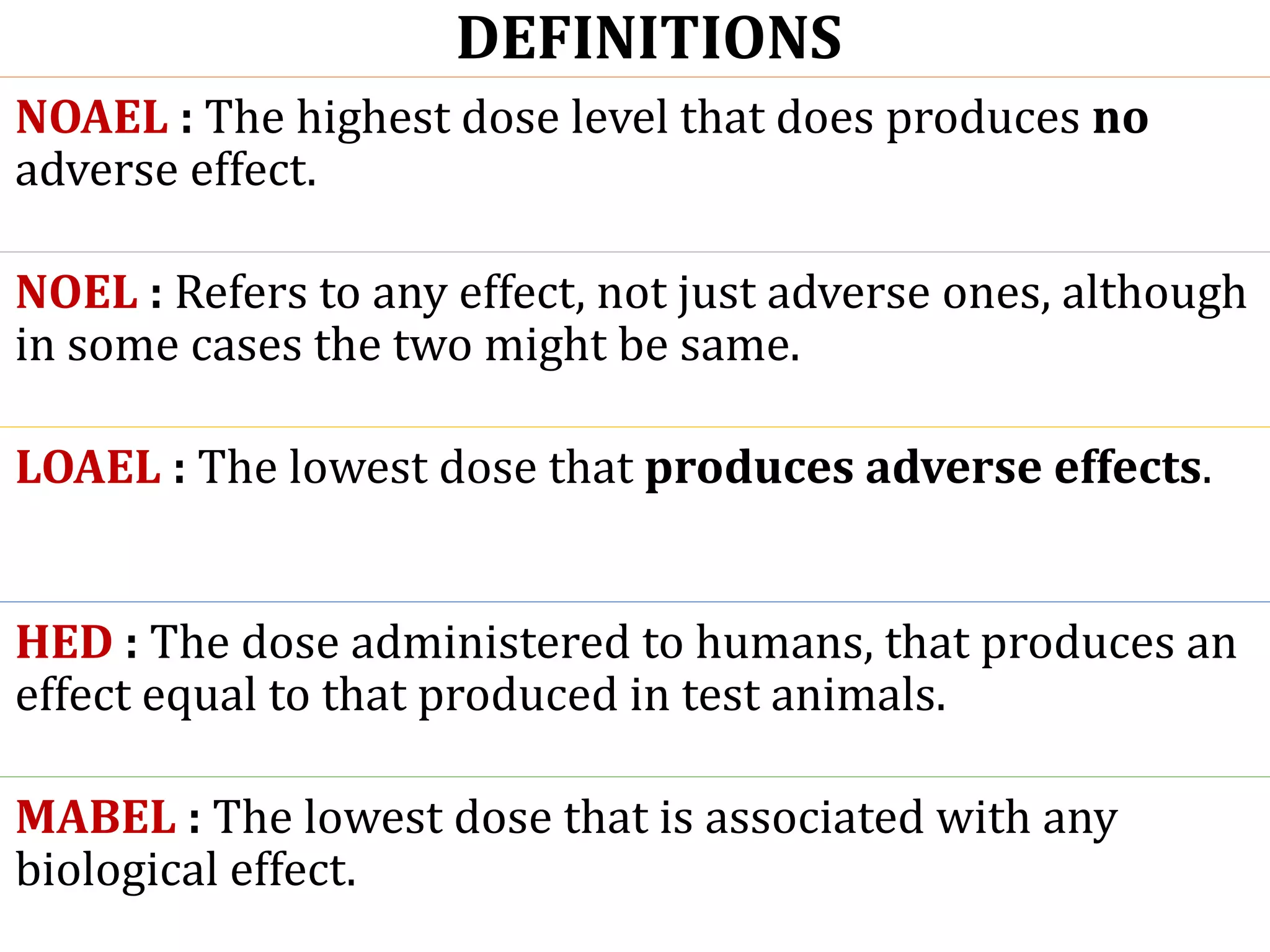
NOAEL : The highest dose level that does produces no
adverse effect.
NOEL : Refers to any effect, not just adverse ones, although
in some cases the two might be same.
LOAEL : The lowest dose that produces adverse effects.
HED : The dose administered to humans, that produces an
effect equal to that produced in test animals.
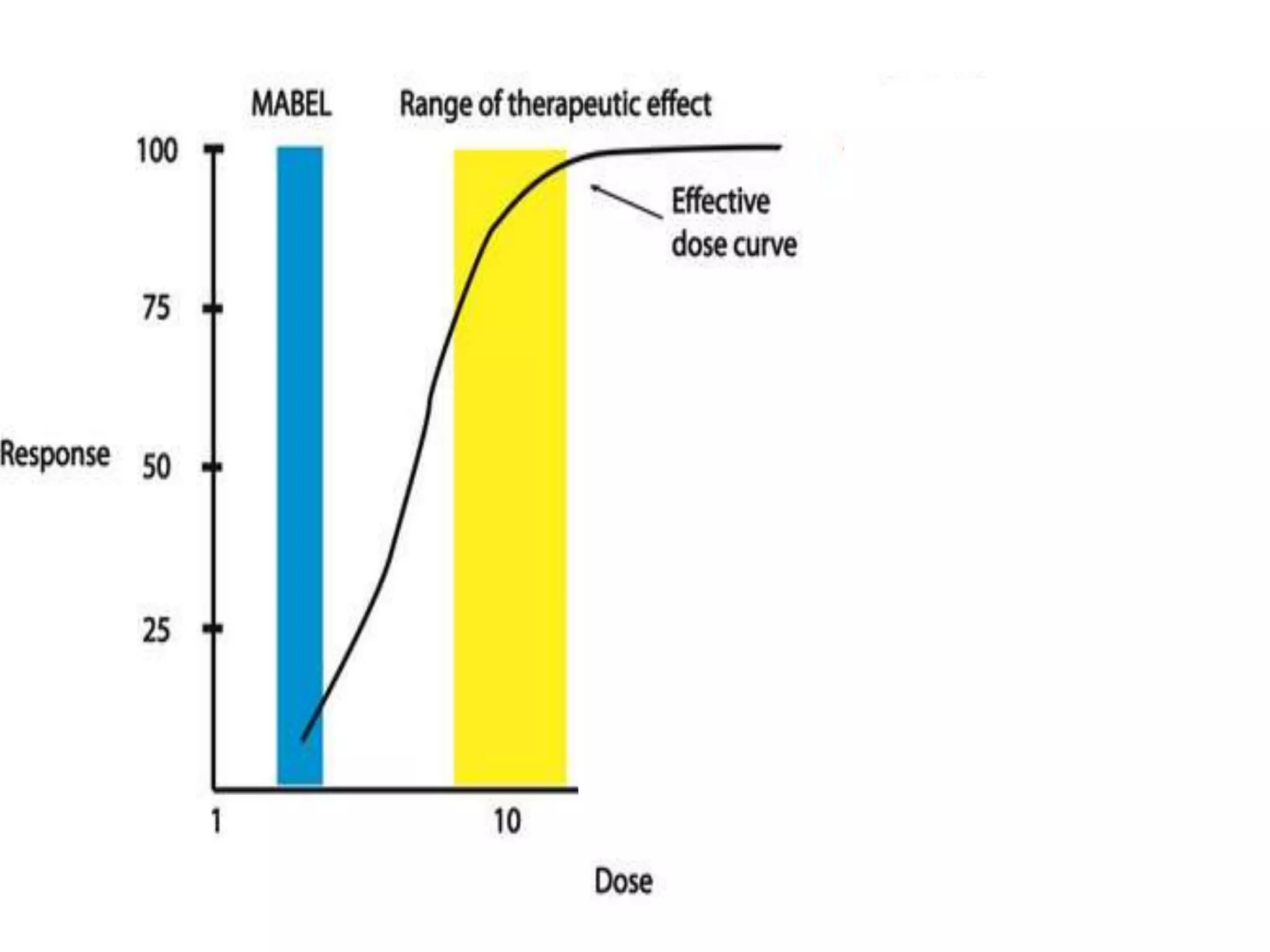
MABEL : The lowest dose that is associated with any
biological effect.
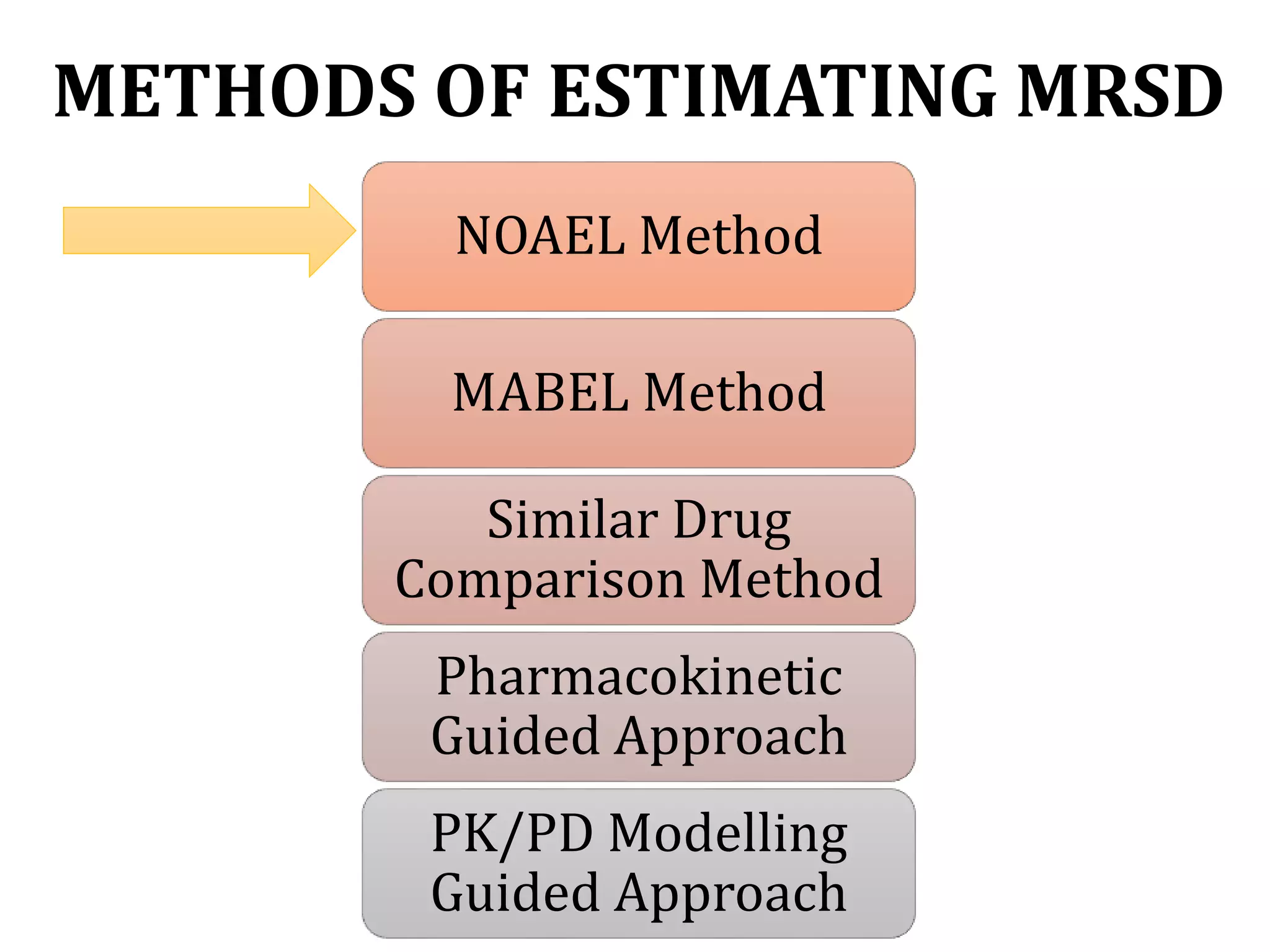
METHODS OF ESTIMATING MRSD
NOAEL Method
MABEL Method
Similar Drug
Comparison Method
Pharmacokinetic
Guided Approach
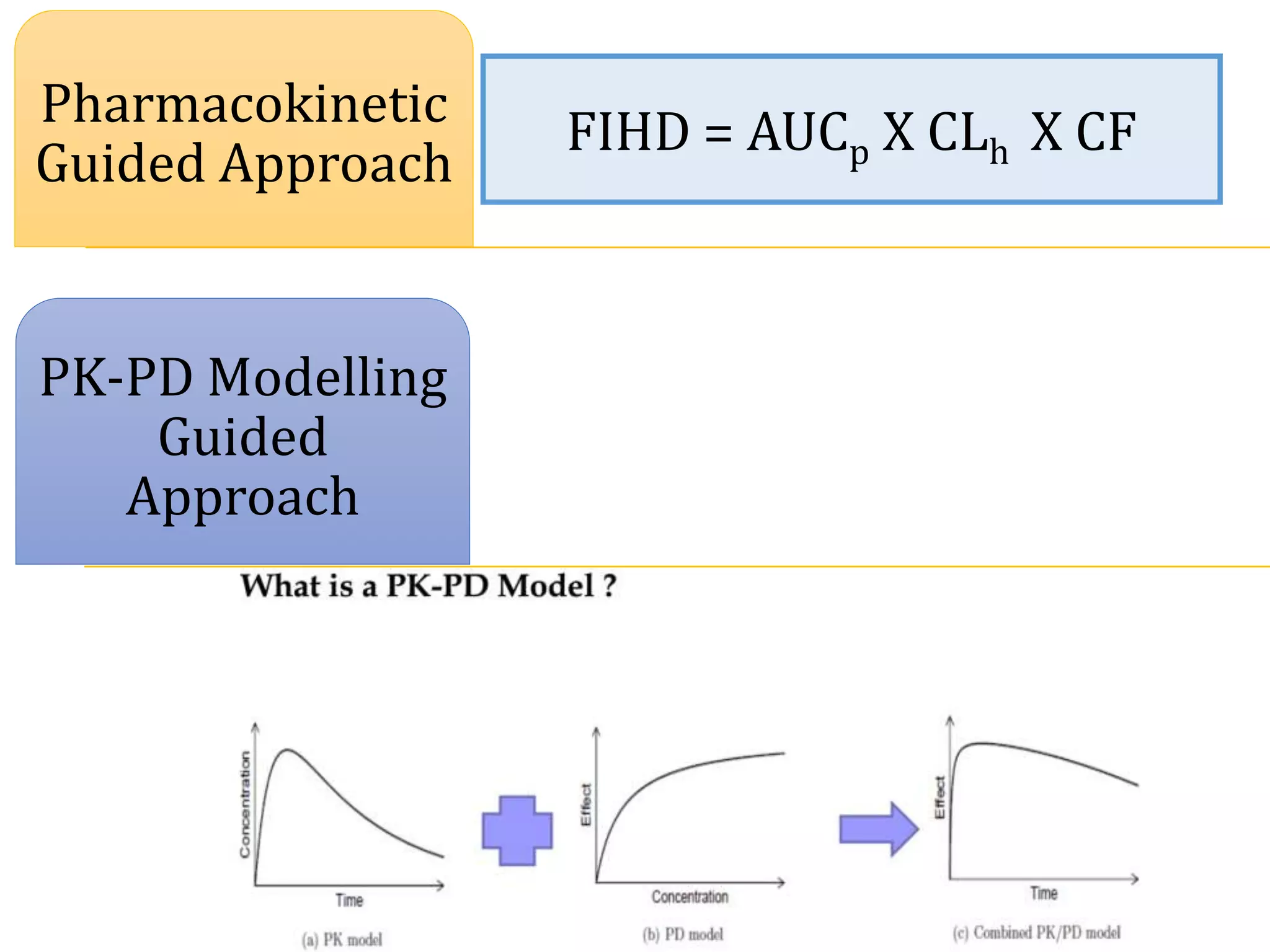
PK/PD Modelling
Guided Approach
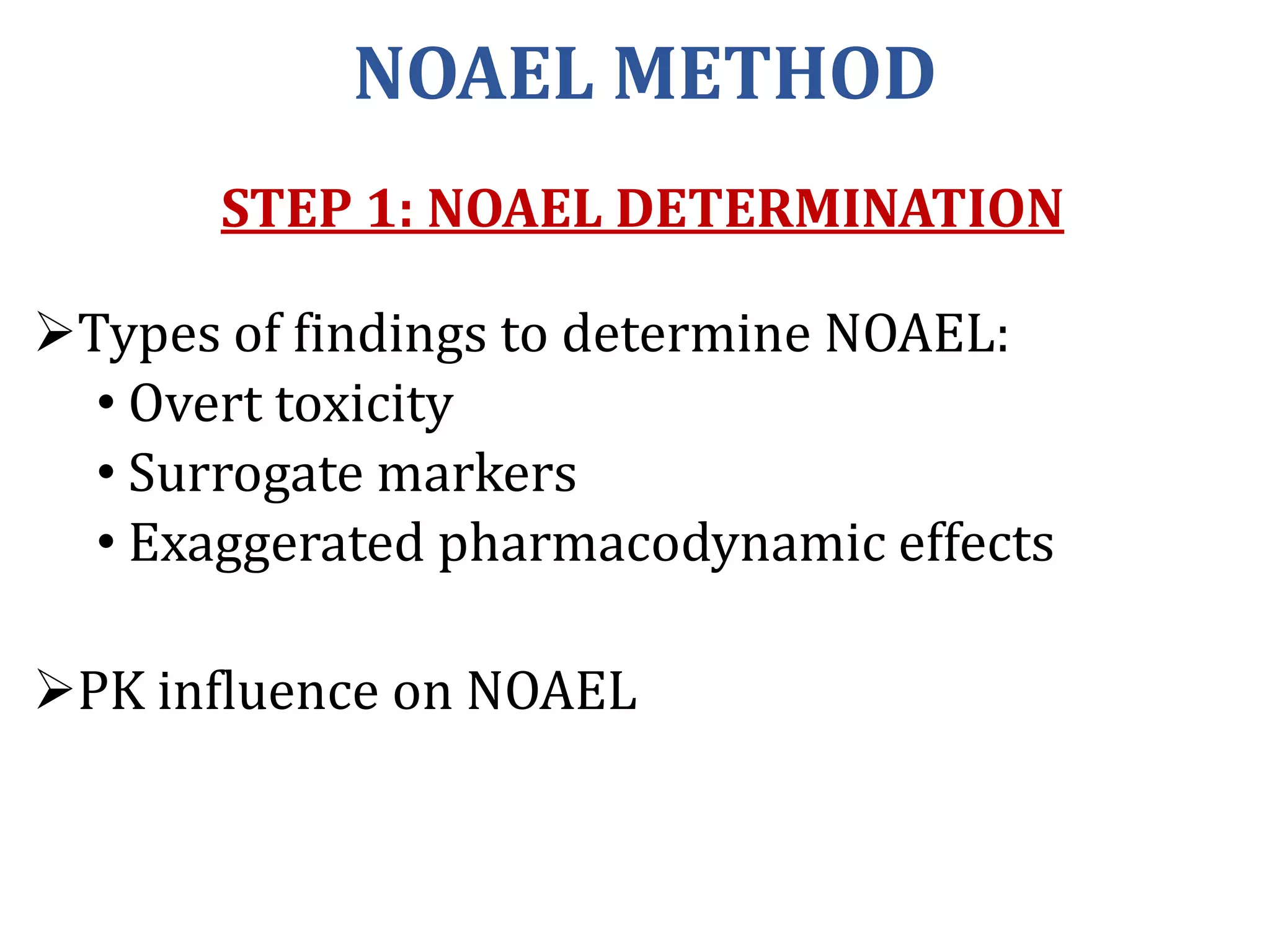
NOAEL METHOD
STEP 1: NOAEL DETERMINATION
Types of findings to determine NOAEL:
• Overt toxicity
• Surrogate markers
• Exaggerated pharmacodynamic effects
PK influence on NOAEL
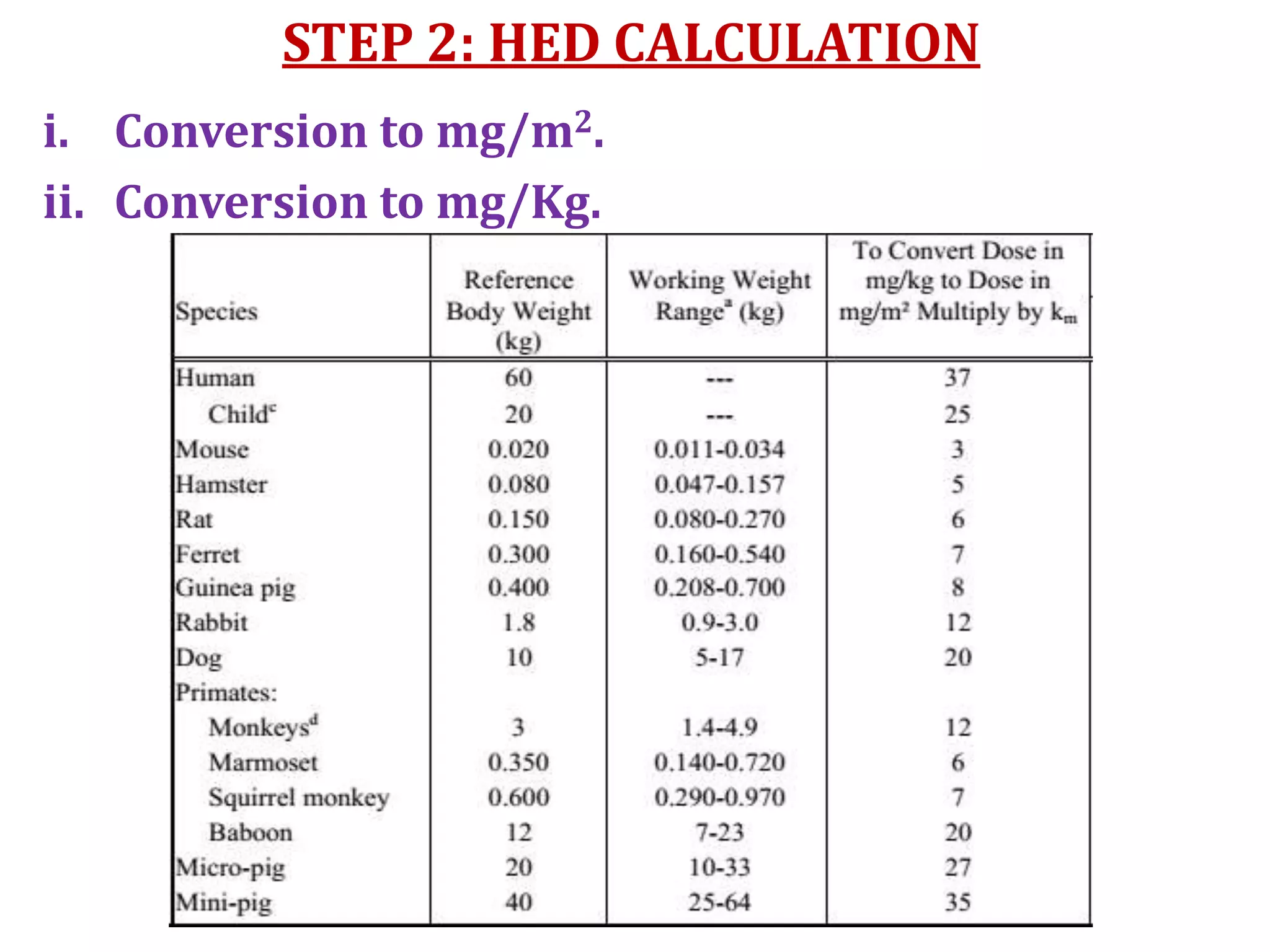
i. Conversion to mg/m2.
ii. Conversion to mg/Kg.
STEP 2: HED CALCULATION
STEP 3: MOST APPROPRIATE SPECIES SELECTION
Factors influencing this choice:
HED chosen from species with the lowest HED.
Previous studies that have demonstrated that a
particular animal model is more appropriate
for the assessment of safety for a particular class
of therapeutics.
Whether an animal species expresses relevant
receptors or epitopes.
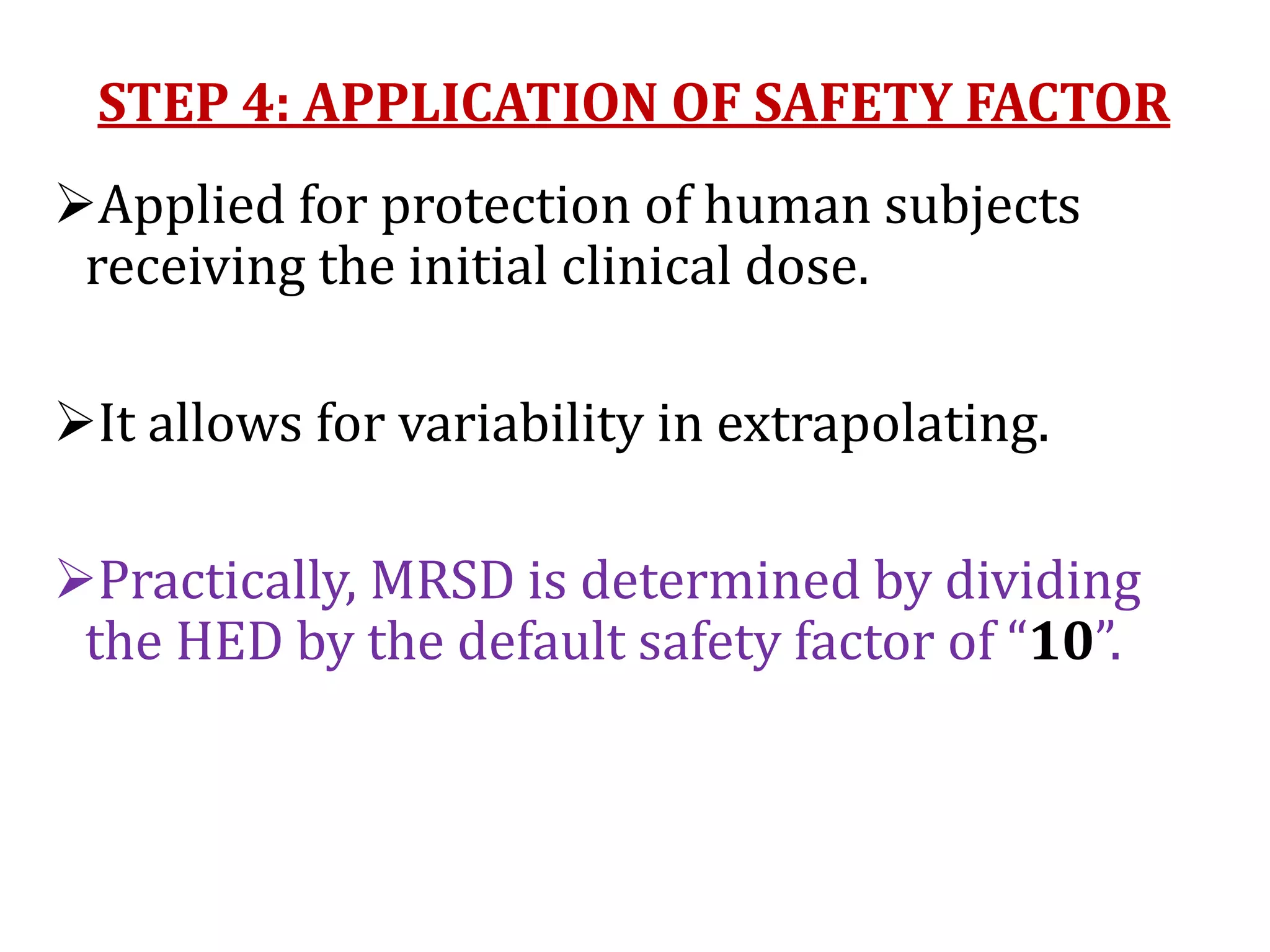
STEP 4: APPLICATION OF SAFETY FACTOR
Applied for protection of human subjects
receiving the initial clinical dose.
It allows for variability in extrapolating.
Practically, MRSD is determined by dividing
the HED by the default safety factor of “10”.
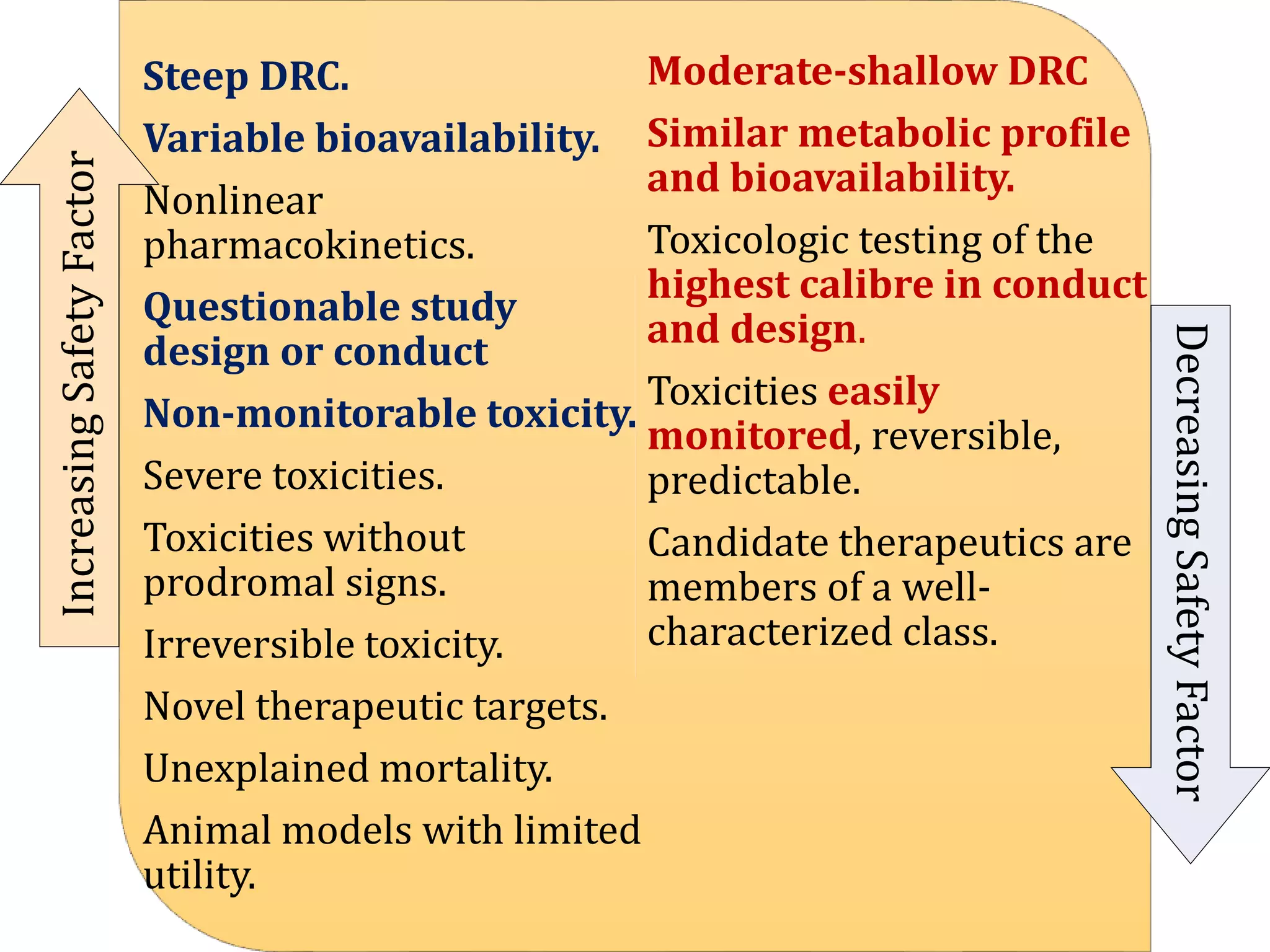
Steep DRC.
Variable bioavailability.
Nonlinear
pharmacokinetics.
Questionable study
design or conduct
Non-monitorable toxicity.
Severe toxicities.
Toxicities without
prodromal signs.
Irreversible toxicity.
Novel therapeutic targets.
Unexplained mortality.
Animal models with limited
utility.
Moderate-shallow DRC
Similar metabolic profile
and bioavailability.
Toxicologic testing of the
highest calibre in conduct
and design.
Toxicities easily
monitored, reversible,
predictable.
Candidate therapeutics are
members of a well-
characterized class.
IncreasingSafetyFactor
DecreasingSafetyFactor
STEP 5: CONSIDERING
PHARMACOLOGICALLY ACTIVE DOSE (PAD)
PAD derived from appropriate in vivo PD models.
A pharmacologic HED can be derived from PAD.
If this pharmacologic HED < MRSD, ↓ the
clinical starting dose.
Sometimes, PAD may be a more sensitive
indicator of potential toxicity than the NOAEL.
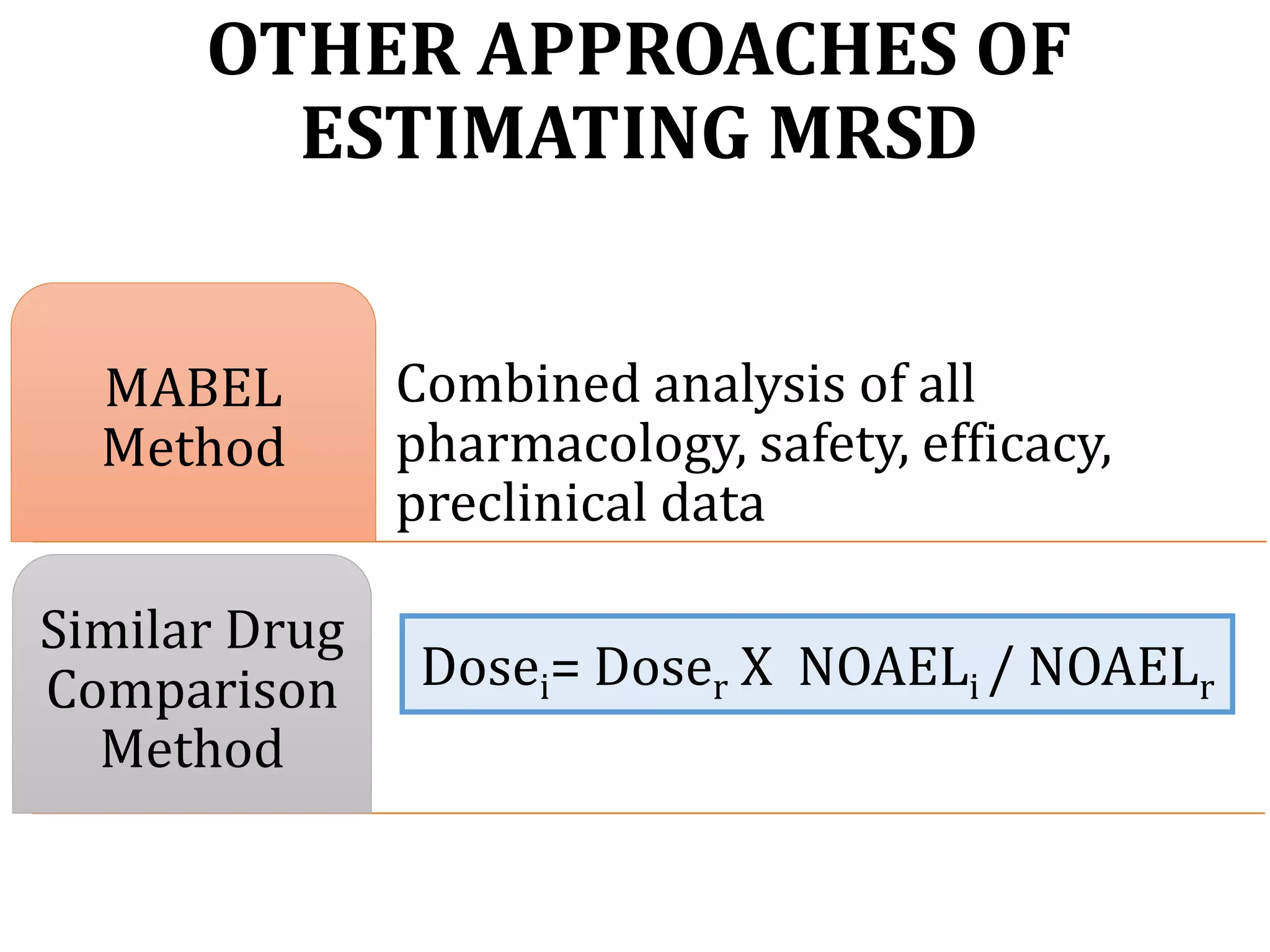
OTHER APPROACHES OF
ESTIMATING MRSD
Combined analysis of all
pharmacology, safety, efficacy,
preclinical data
MABEL
Method
Similar Drug
Comparison
Method
Dosei= Doser X NOAELi / NOAELr
Pharmacokinetic
Guided Approach
PK-PD Modelling
Guided
Approach
FIHD = AUCp X CLh X CF
CONCLUSION
• Dose determination is a long and careful
process.
• Animal toxicology studies form the core of dose
determination.
Let’s apply what we’ve
learnt…
Question: Is this information adequate to set
doses for a one month repeat dose toxicity study
of the test item?
Scenario: A seven day repeat dose DRF study.
At a daily dose of 800mg/kg/day, adverse
clinical signs including hunched posture and
piloerection are observed in the animals and
one animal was euthanized on Day 7.
A second dose of 200mg/kg/day produces no
adverse effects in any parameter.
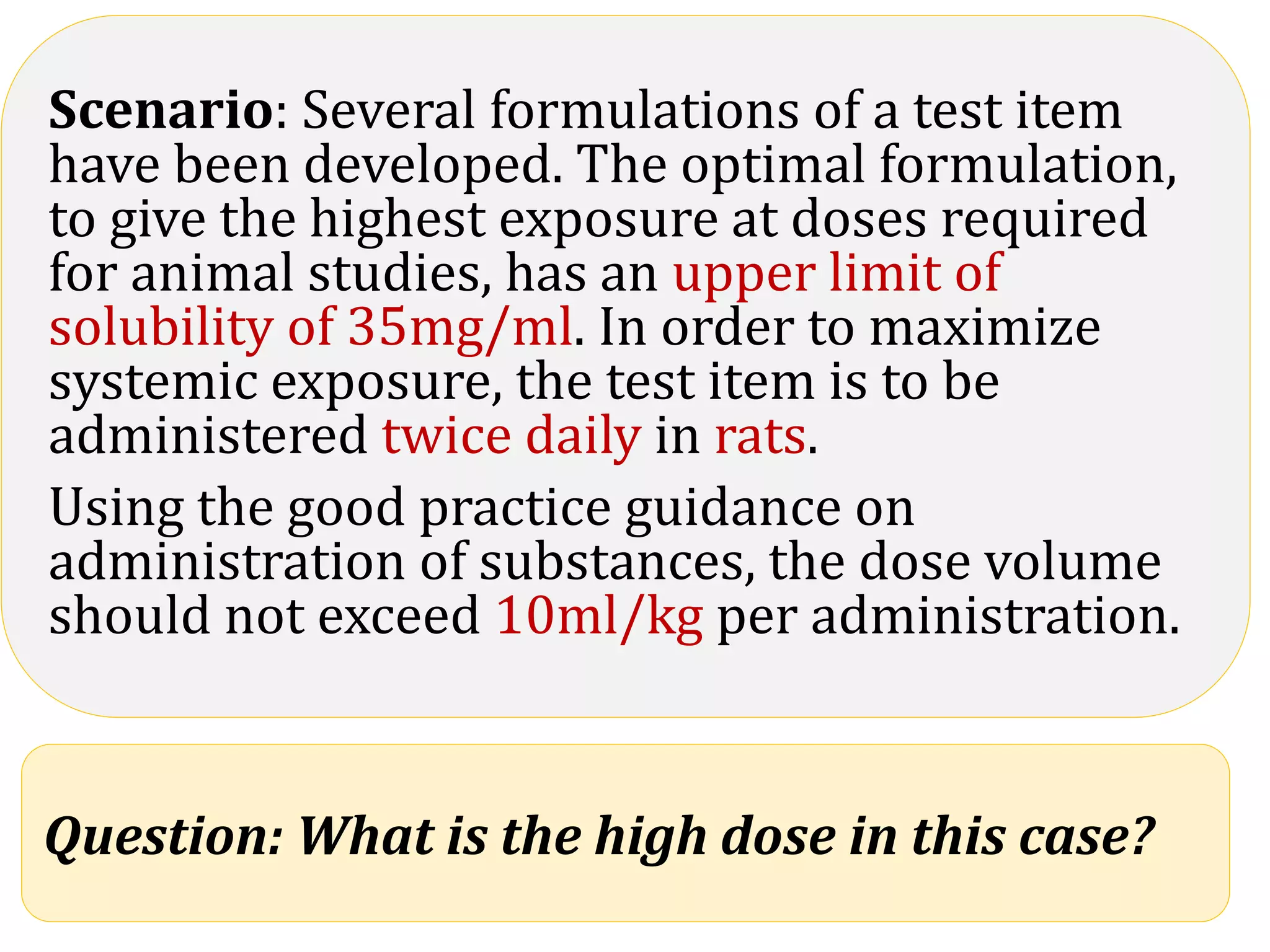
Scenario: Several formulations of a test item
have been developed. The optimal formulation,
to give the highest exposure at doses required
for animal studies, has an upper limit of
solubility of 35mg/ml. In order to maximize
systemic exposure, the test item is to be
administered twice daily in rats.
Using the good practice guidance on
administration of substances, the dose volume
should not exceed 10ml/kg per administration.
Question: What is the high dose in this case?
MTD of a test item was 1000mg/kg and the
NOAEL was 1mg/kg.
Question: How would the intermediate dose
be chosen in this case?
• JONAERYS-309 (MW = 128000) is a novel TRPV3 inhibitor in
development for the treatment of neuropathic pain.
• In vitro Pharmacology:
Rat IC50: 2 nM
Human IC50: 0.5 nM
• Pre-clinical Pharmacology:
In a chronic neuropathic pain model in rat, Emax was determined to be 10
mg/kg.
• Preclinical Toxicology:
• Pre-clinical PK:
• Absolute BA in rat, mice and dog are estimated to be 50, 75 and 60
• PPB in rat, mice, dog and human: 99.1%, 99.3%, 99.5% and 99.5%
• For a rat with mean weight 0.15 Kg oral clearance is 0.525 mL/min
Question 1: Calculate the FIH dose in
mg by –
• (a) The pharmacokinetic method
• (b) The NOAEL Method
Question 2: What will be the final
FIH and why?
THANK YOU

Dose determination in preclinical and clinical studies

  • 1.
    Dose Determination in Preclinical &Clinical Studies DR SAHIL KUMAR
  • 2.
    OUTLINE In vitro DoseConsiderations In vivo Dose Considerations Dose Range Finding (DRF) Studies Dose Guidance in Regulatory Toxicology First in Human (FIH) Dose Estimating FIH/MRSD Conclusion Problem Solving Exercizes
  • 3.
  • 4.
  • 5.
    In vitro modelsas close to human physiological systems chosen. Starting dose chosen empirically. 0.1nM to 0.1M.
  • 6.
    Is there away to extrapolate in vitro dose to in vivo?... Not accurately possible. Transposing dose response relationship.  𝐷𝑜𝑠𝑒 τ = 𝐶𝐿 𝐹 × ∁𝑡𝑎𝑟𝑔𝑒𝑡 Computer based models (IVISIVC).
  • 7.
  • 8.
    Selecting the highdose Maximum Tolerated Dose (MTD). Limit Dose. Toxicokinetics and Saturation of Exposure. Maximum Feasible/ Practical Dose. (ICH M3(R2), Guidance on Nonclinical Safety Studies for the Conduct of Human Clinical Trials and Marketing Authorization for Pharmaceuticals.)
  • 9.
    Maximum Tolerated Dose(MTD) The highest dose of a drug that does not cause unacceptable side effects or overt toxicity. Determined by Dose Range Finding (DRF) Studies and Acute Toxicity studies. GLP Toxicity Studies: • Acute (Single dose toxicity study)- MTD, LD50 • Subacute (Repeated dose from 2w to 6mo) • Chronic (Repeated dose from 6mo to 1 yr)
  • 11.
    Dose Range Finding(DRF) Studies No regulatory guidelines for DRF studies. Dose escalation phase and Repeat dose phase. Starting dose? Number of dose groups? Study design: • One group of animals dosed at a time. • Next dose may be higher or lower depending upon the observations. • Group sizes increased once dose response established.
  • 12.
    Half log intervalse.g. 1, 3, 10, 30, 100, 300, 1000mg/kg etc. used. Formulation in the DRF study should be same as the formulation proposed for regulatory study. Tolerability of the animals to co-solvents should be established.
  • 13.
    Importance of goodanimal care and empathetic handling by trained animal care staff should not be underestimated. Clinical pathology & histopathology. Toxicokinetic assessment.
  • 15.
    Dose Guidance inRegulatory Toxicology If dose not investigated in DRF study – avoid it. The high dose should match one of the doses already investigated in the DRF study. Solubility may limit the dose that can be given. Escalating dose design recommended for test items where tolerance to known pharmacological effects develops.
  • 16.
    The low doseshould ideally demonstrate the NOEL / NOAEL in the animal. The intermediate dose is required to demonstrate a dose response relationship. Sometimes a second intermediate dose may be required, eg: Where the dose range from the low dose to MTD is large.
  • 17.
  • 18.
    DEFINITIONS NOAEL : Thehighest dose level that does produces no adverse effect. NOEL : Refers to any effect, not just adverse ones, although in some cases the two might be same. LOAEL : The lowest dose that produces adverse effects. HED : The dose administered to humans, that produces an effect equal to that produced in test animals. MABEL : The lowest dose that is associated with any biological effect.
  • 20.
    METHODS OF ESTIMATINGMRSD NOAEL Method MABEL Method Similar Drug Comparison Method Pharmacokinetic Guided Approach PK/PD Modelling Guided Approach
  • 21.
    NOAEL METHOD STEP 1:NOAEL DETERMINATION Types of findings to determine NOAEL: • Overt toxicity • Surrogate markers • Exaggerated pharmacodynamic effects PK influence on NOAEL
  • 22.
    i. Conversion tomg/m2. ii. Conversion to mg/Kg. STEP 2: HED CALCULATION
  • 23.
    STEP 3: MOSTAPPROPRIATE SPECIES SELECTION Factors influencing this choice: HED chosen from species with the lowest HED. Previous studies that have demonstrated that a particular animal model is more appropriate for the assessment of safety for a particular class of therapeutics. Whether an animal species expresses relevant receptors or epitopes.
  • 24.
    STEP 4: APPLICATIONOF SAFETY FACTOR Applied for protection of human subjects receiving the initial clinical dose. It allows for variability in extrapolating. Practically, MRSD is determined by dividing the HED by the default safety factor of “10”.
  • 25.
    Steep DRC. Variable bioavailability. Nonlinear pharmacokinetics. Questionablestudy design or conduct Non-monitorable toxicity. Severe toxicities. Toxicities without prodromal signs. Irreversible toxicity. Novel therapeutic targets. Unexplained mortality. Animal models with limited utility. Moderate-shallow DRC Similar metabolic profile and bioavailability. Toxicologic testing of the highest calibre in conduct and design. Toxicities easily monitored, reversible, predictable. Candidate therapeutics are members of a well- characterized class. IncreasingSafetyFactor DecreasingSafetyFactor
  • 26.
    STEP 5: CONSIDERING PHARMACOLOGICALLYACTIVE DOSE (PAD) PAD derived from appropriate in vivo PD models. A pharmacologic HED can be derived from PAD. If this pharmacologic HED < MRSD, ↓ the clinical starting dose. Sometimes, PAD may be a more sensitive indicator of potential toxicity than the NOAEL.
  • 27.
    OTHER APPROACHES OF ESTIMATINGMRSD Combined analysis of all pharmacology, safety, efficacy, preclinical data MABEL Method Similar Drug Comparison Method Dosei= Doser X NOAELi / NOAELr
  • 28.
  • 29.
    CONCLUSION • Dose determinationis a long and careful process. • Animal toxicology studies form the core of dose determination.
  • 30.
    Let’s apply whatwe’ve learnt…
  • 31.
    Question: Is thisinformation adequate to set doses for a one month repeat dose toxicity study of the test item? Scenario: A seven day repeat dose DRF study. At a daily dose of 800mg/kg/day, adverse clinical signs including hunched posture and piloerection are observed in the animals and one animal was euthanized on Day 7. A second dose of 200mg/kg/day produces no adverse effects in any parameter.
  • 32.
    Scenario: Several formulationsof a test item have been developed. The optimal formulation, to give the highest exposure at doses required for animal studies, has an upper limit of solubility of 35mg/ml. In order to maximize systemic exposure, the test item is to be administered twice daily in rats. Using the good practice guidance on administration of substances, the dose volume should not exceed 10ml/kg per administration. Question: What is the high dose in this case?
  • 33.
    MTD of atest item was 1000mg/kg and the NOAEL was 1mg/kg. Question: How would the intermediate dose be chosen in this case?
  • 34.
    • JONAERYS-309 (MW= 128000) is a novel TRPV3 inhibitor in development for the treatment of neuropathic pain. • In vitro Pharmacology: Rat IC50: 2 nM Human IC50: 0.5 nM • Pre-clinical Pharmacology: In a chronic neuropathic pain model in rat, Emax was determined to be 10 mg/kg. • Preclinical Toxicology: • Pre-clinical PK: • Absolute BA in rat, mice and dog are estimated to be 50, 75 and 60 • PPB in rat, mice, dog and human: 99.1%, 99.3%, 99.5% and 99.5% • For a rat with mean weight 0.15 Kg oral clearance is 0.525 mL/min
  • 35.
    Question 1: Calculatethe FIH dose in mg by – • (a) The pharmacokinetic method • (b) The NOAEL Method Question 2: What will be the final FIH and why?
  • 37.

Editor's Notes

  • #9 Dose providing 50-fold margin of exposure.
  • #10 The rationale for using the MTD in long term studies is to maximize the likelihood of detecting any chronic disease effects or other hazards of a drug candidate.
  • #15 TS: Target Selection, Lead Generation and Optimization, Candidate drug prenomination
  • #16 7.1.2 Usually the same doses are administered to both sexes. On rare occasions the exposure or tolerance may be significantly different between the sexes such that different doses should be considered for males and females. If significant sex differences become apparent in the DRF study these should be fully investigated before progressing to further studies.
  • #19 NO OBSERVED ADVERSE EFFECT LEVEL NO OBSERVED EFFECT LEVEL LOWEST OBSERVED ADVERSE EFFECT LEVEL HUMAN EQUIVALENT DOSE MINIMAL ANTICIPATED BIOLOGICAL EFFECT LEVELS
  • #46 Transient Receptor Potential Cation Channels: Novel analgesic target. The TRPV3 protein belongs to a family of nonselective cation channels that function in a variety of processes, including temperature sensation, vasoregulation and nociception.