Ultrasonic Testing
Module 4
Hareesh K
Assistant Professor
Department of Mechanical Engineering
Introduction
Ultrasonic non-destructive testing, also known as ultrasonic NDT
or simply UT, is a method of characterizing the thickness or
internal structure of a test piece through the use of high
frequency sound waves. The frequencies, or pitch, used for
ultrasonic testing are many times higher than the limit of human
hearing, most commonly in the range from 500 KHz to 20 MHz.
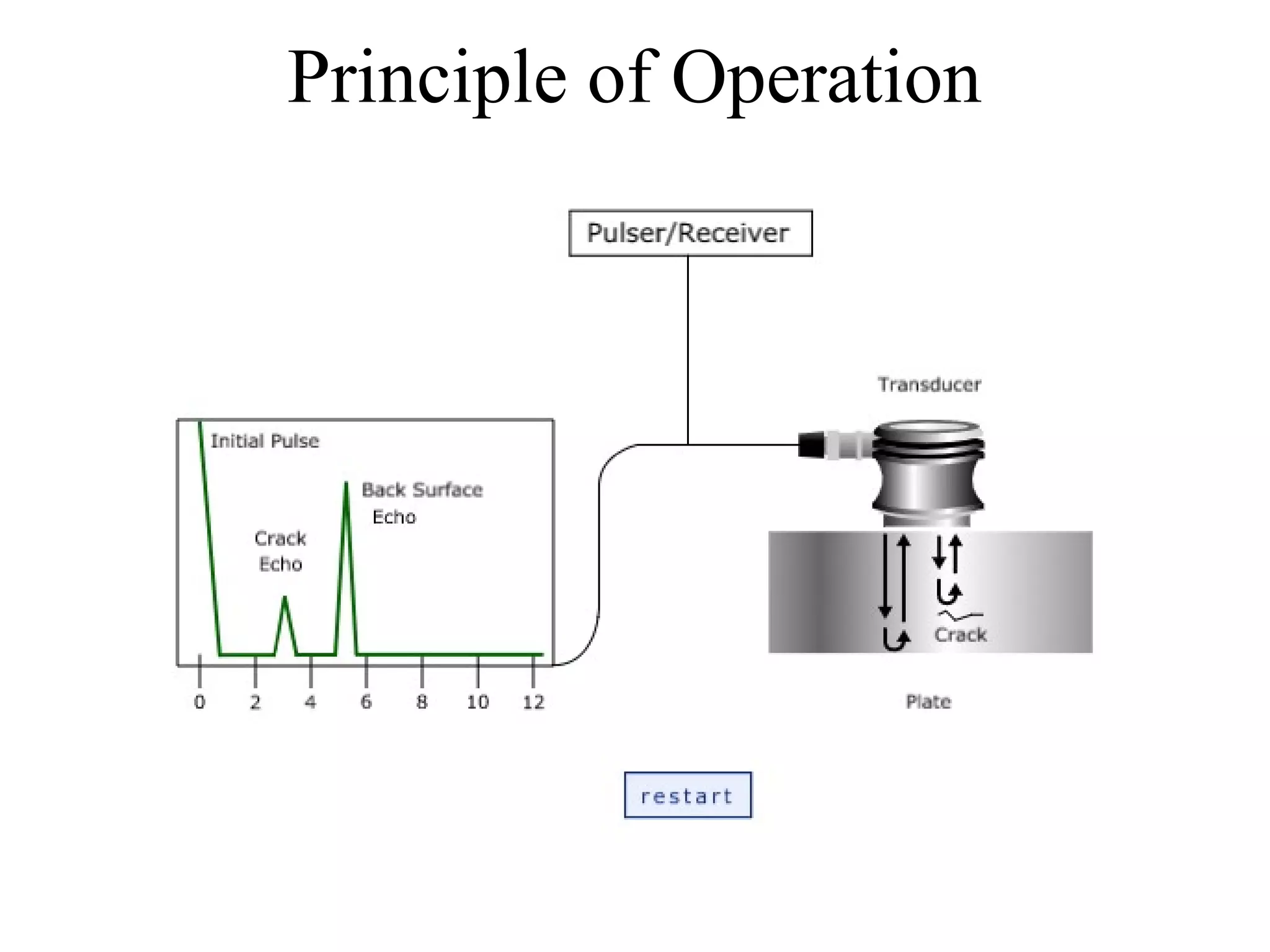
Principle of Operation
Instruments used in Ultrasonic Testing
• Pulser/Receiver
• Ultrasonic Transducer
• Couplant
• Display Screen
• Receiver/Amplifier
• A typical UT inspection system consists of several functional units, such as
the pulser /receiver, transducer, and display devices.
• A pulser /receiver is an electronic device that can produce high voltage
electrical pulses.
• Driven by the pulser, the transducer generates high frequency ultrasonic
energy. The sound energy is introduced and propagates through the
materials in the form of waves.
• When there is a discontinuity (such as a crack) in the wave path, part of the
energy will be reflected back from the flaw surface. The reflected wave
signal is transformed into an electrical signal by the transducer and is
displayed on a screen. In the applet below, the reflected signal strength is
displayed versus the time from signal generation to when a echo was
received.
• Signal travel time can be directly related to the distance that the signal
travelled. From the signal, information about the reflector location, size,
orientation and other features can sometimes be gained.
Types of Waves
• In solids, sound waves can propagate in four principle modes that are
based on the way the particles oscillate. Sound can propagate as
longitudinal waves, shear waves, surface waves, and in thin materials as
plate waves. Longitudinal and shear waves are the two modes of
propagation most widely used in ultrasonic testing.
• The particle movement responsible for the propagation of longitudinal and
shear waves is illustrated below.
Longitudinal Wave
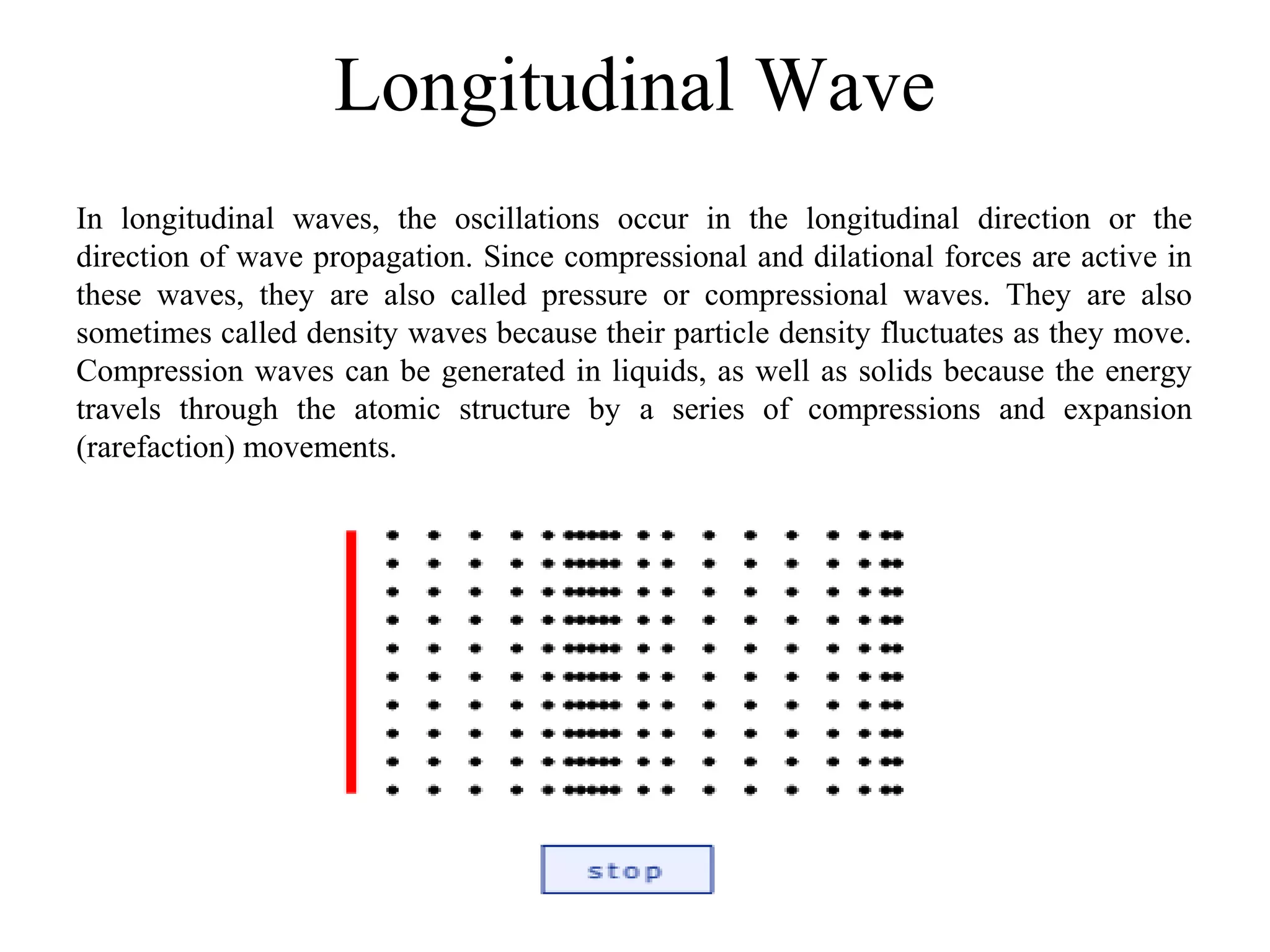
In longitudinal waves, the oscillations occur in the longitudinal direction or the
direction of wave propagation. Since compressional and dilational forces are active in
these waves, they are also called pressure or compressional waves. They are also
sometimes called density waves because their particle density fluctuates as they move.
Compression waves can be generated in liquids, as well as solids because the energy
travels through the atomic structure by a series of compressions and expansion
(rarefaction) movements.
Transverse Wave
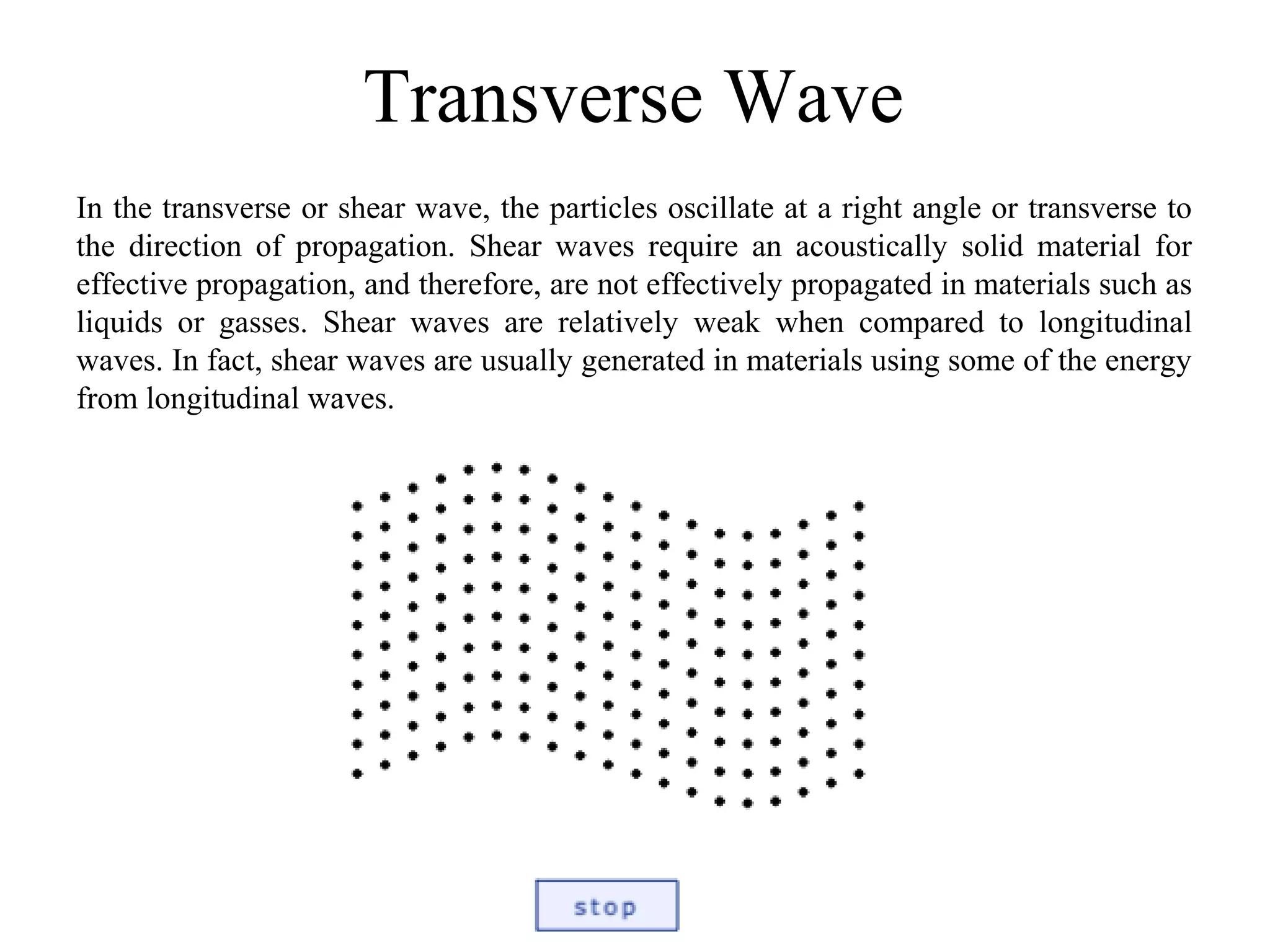
In the transverse or shear wave, the particles oscillate at a right angle or transverse to
the direction of propagation. Shear waves require an acoustically solid material for
effective propagation, and therefore, are not effectively propagated in materials such as
liquids or gasses. Shear waves are relatively weak when compared to longitudinal
waves. In fact, shear waves are usually generated in materials using some of the energy
from longitudinal waves.
Surface Wave
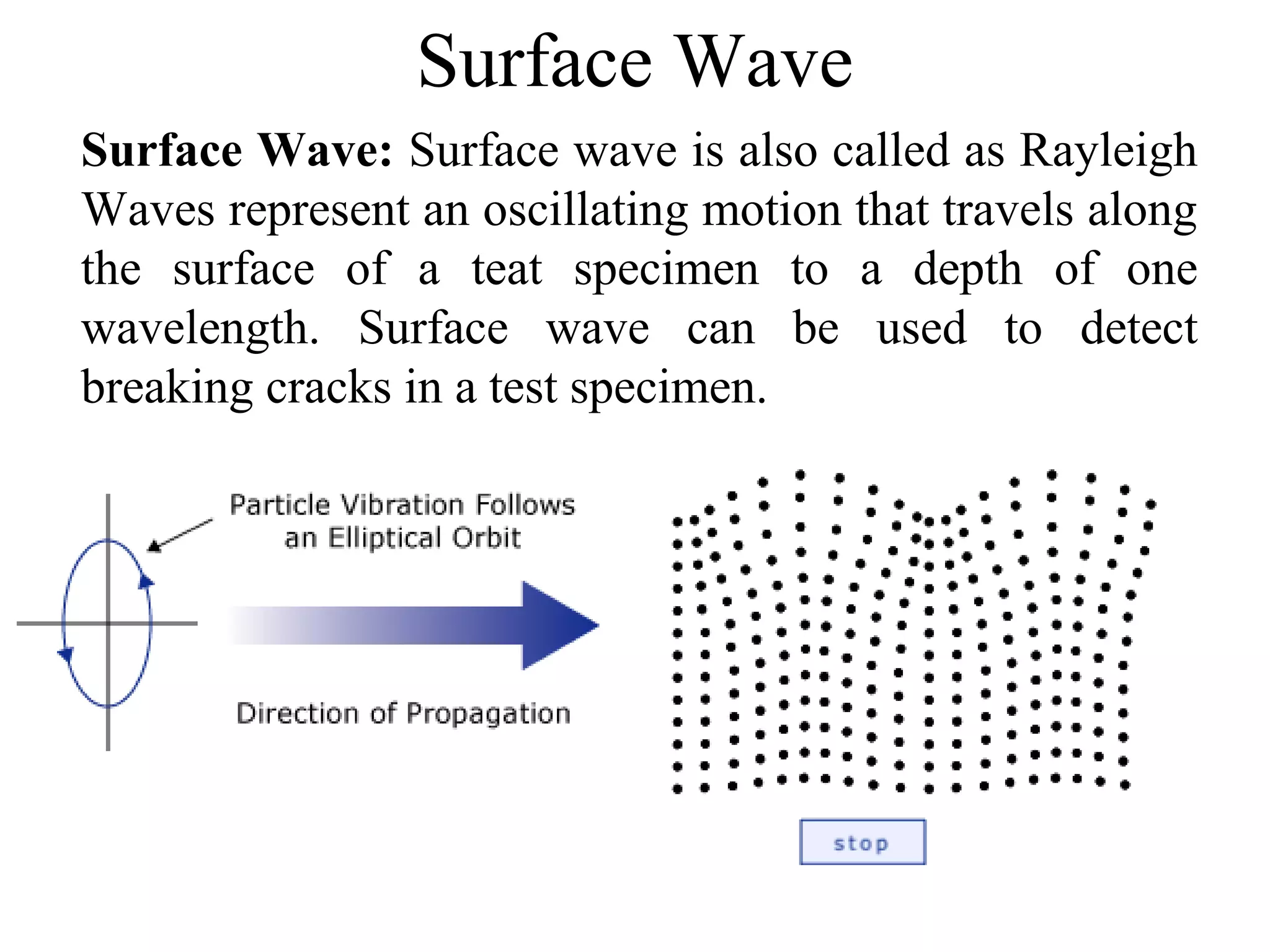
Surface Wave: Surface wave is also called as Rayleigh
Waves represent an oscillating motion that travels along
the surface of a teat specimen to a depth of one
wavelength. Surface wave can be used to detect
breaking cracks in a test specimen.
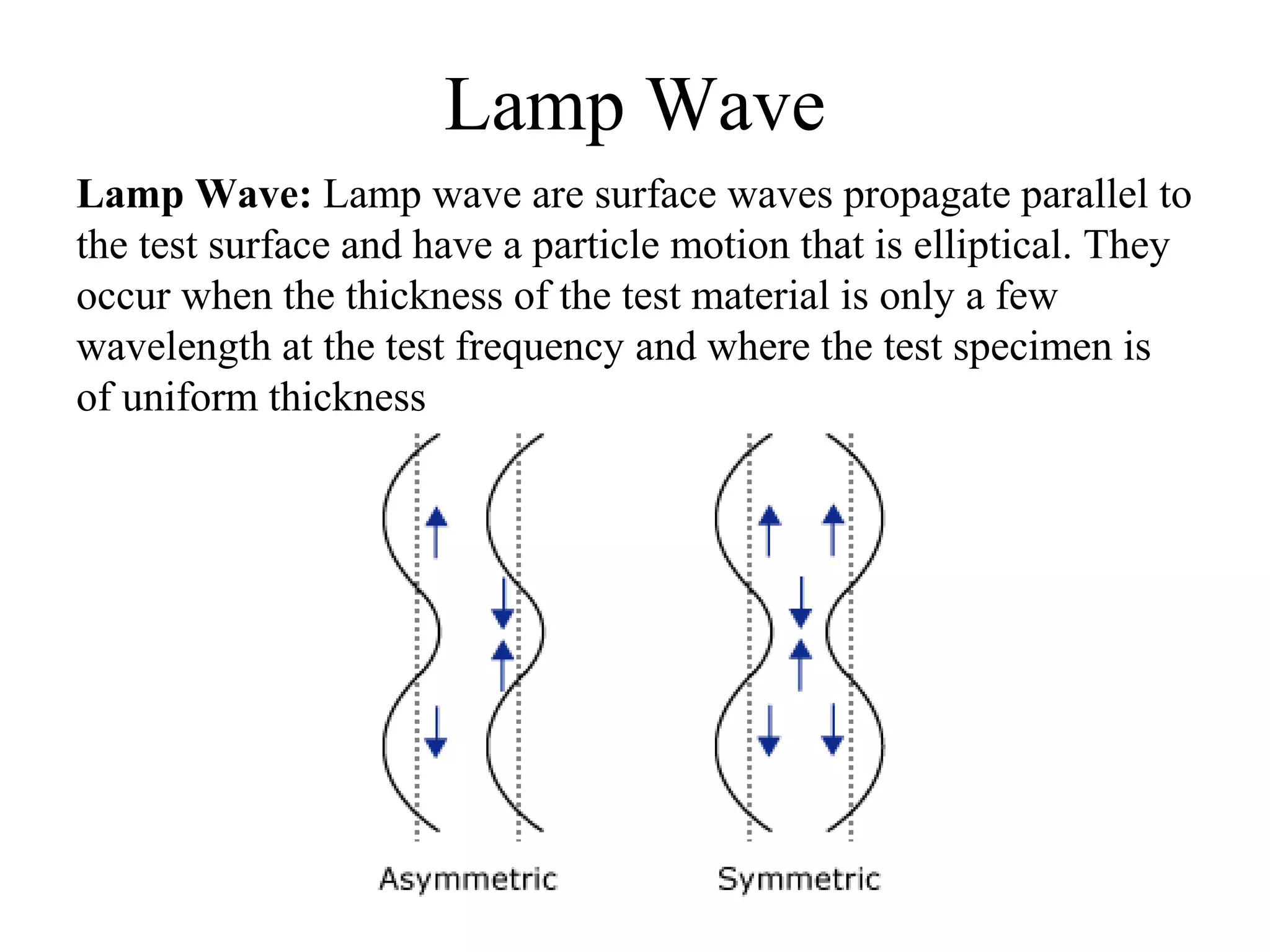
Lamp Wave
Lamp Wave: Lamp wave are surface waves propagate parallel to
the test surface and have a particle motion that is elliptical. They
occur when the thickness of the test material is only a few
wavelength at the test frequency and where the test specimen is
of uniform thickness
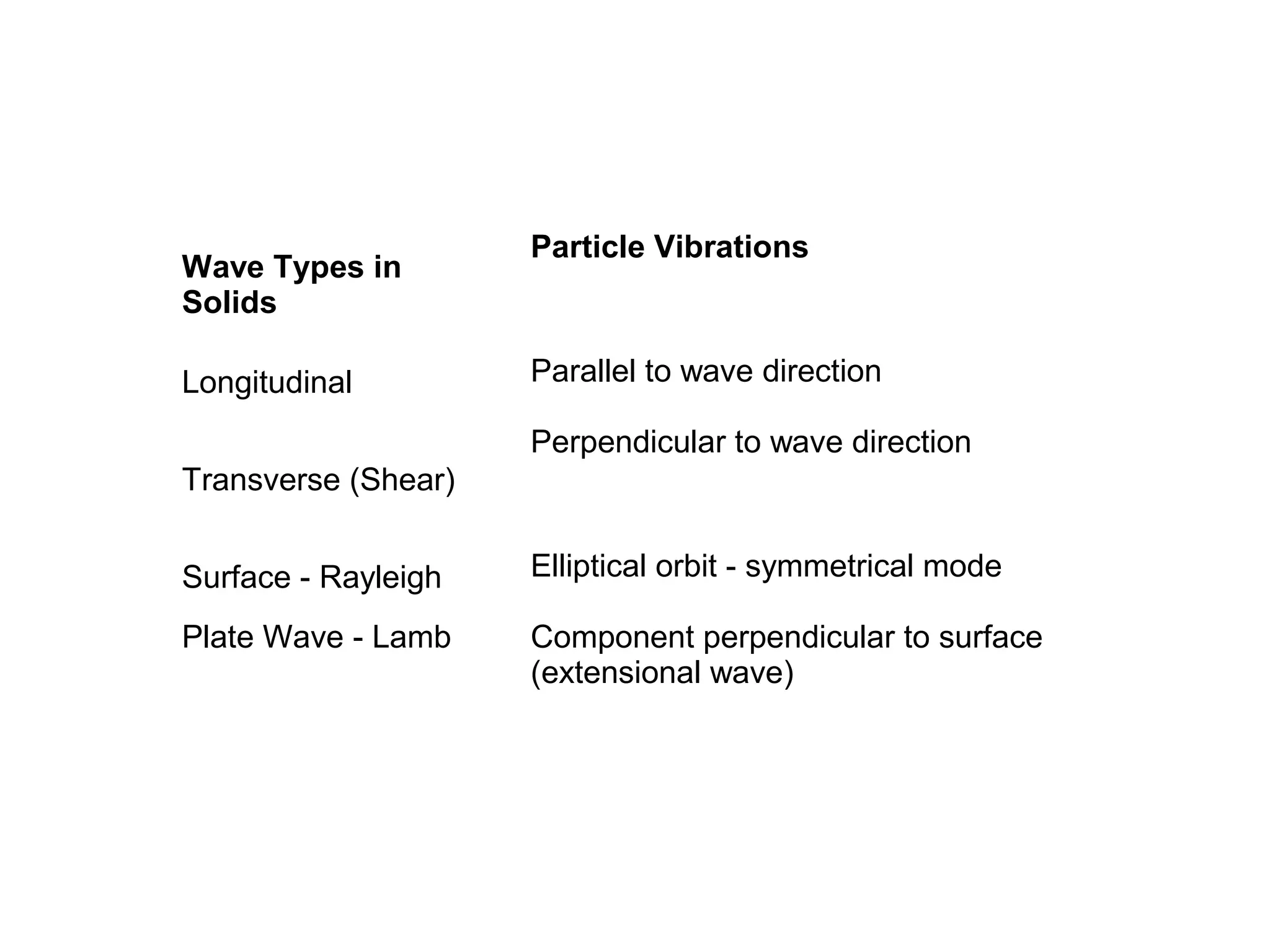
Wave Types in
Solids
Particle Vibrations
Longitudinal Parallel to wave direction
Transverse (Shear)
Perpendicular to wave direction
Surface - Rayleigh Elliptical orbit - symmetrical mode
Plate Wave - Lamb Component perpendicular to surface
(extensional wave)
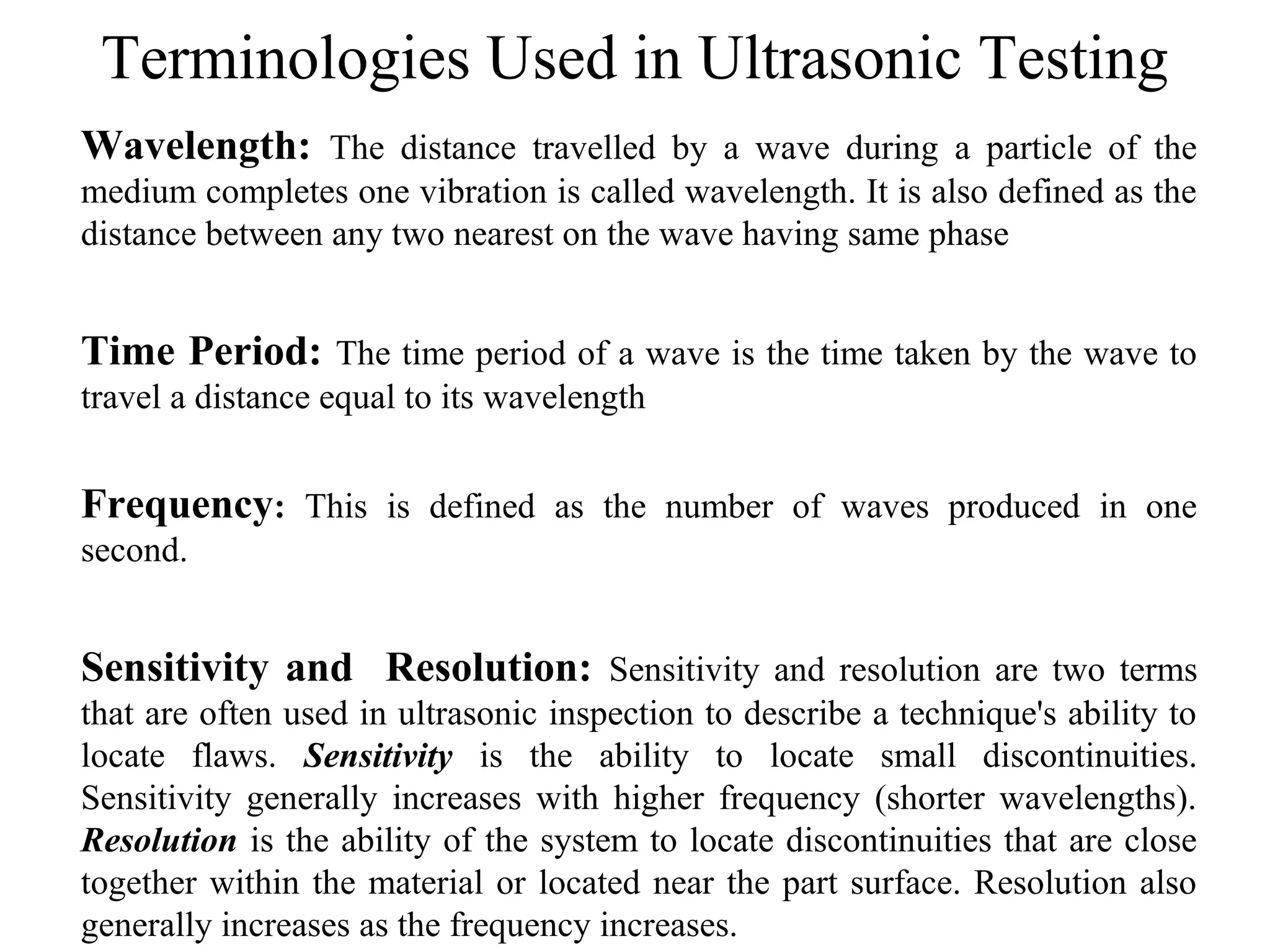
Terminologies Used in Ultrasonic Testing
Wavelength: The distance travelled by a wave during a particle of the
medium completes one vibration is called wavelength. It is also defined as the
distance between any two nearest on the wave having same phase
Time Period: The time period of a wave is the time taken by the wave to
travel a distance equal to its wavelength
Frequency: This is defined as the number of waves produced in one
second.
Sensitivity and Resolution: Sensitivity and resolution are two terms
that are often used in ultrasonic inspection to describe a technique's ability to
locate flaws. Sensitivity is the ability to locate small discontinuities.
Sensitivity generally increases with higher frequency (shorter wavelengths).
Resolution is the ability of the system to locate discontinuities that are close
together within the material or located near the part surface. Resolution also
generally increases as the frequency increases.
Scattering and Attenuation: Scattering is the reflection of the sound in
directions other than its original direction of propagation. Absorption is the
conversion of the sound energy to other forms of energy. The combined effect
of scattering and absorption is called attenuation. Ultrasonic attenuation is
the decay rate of the wave as it propagates through material.
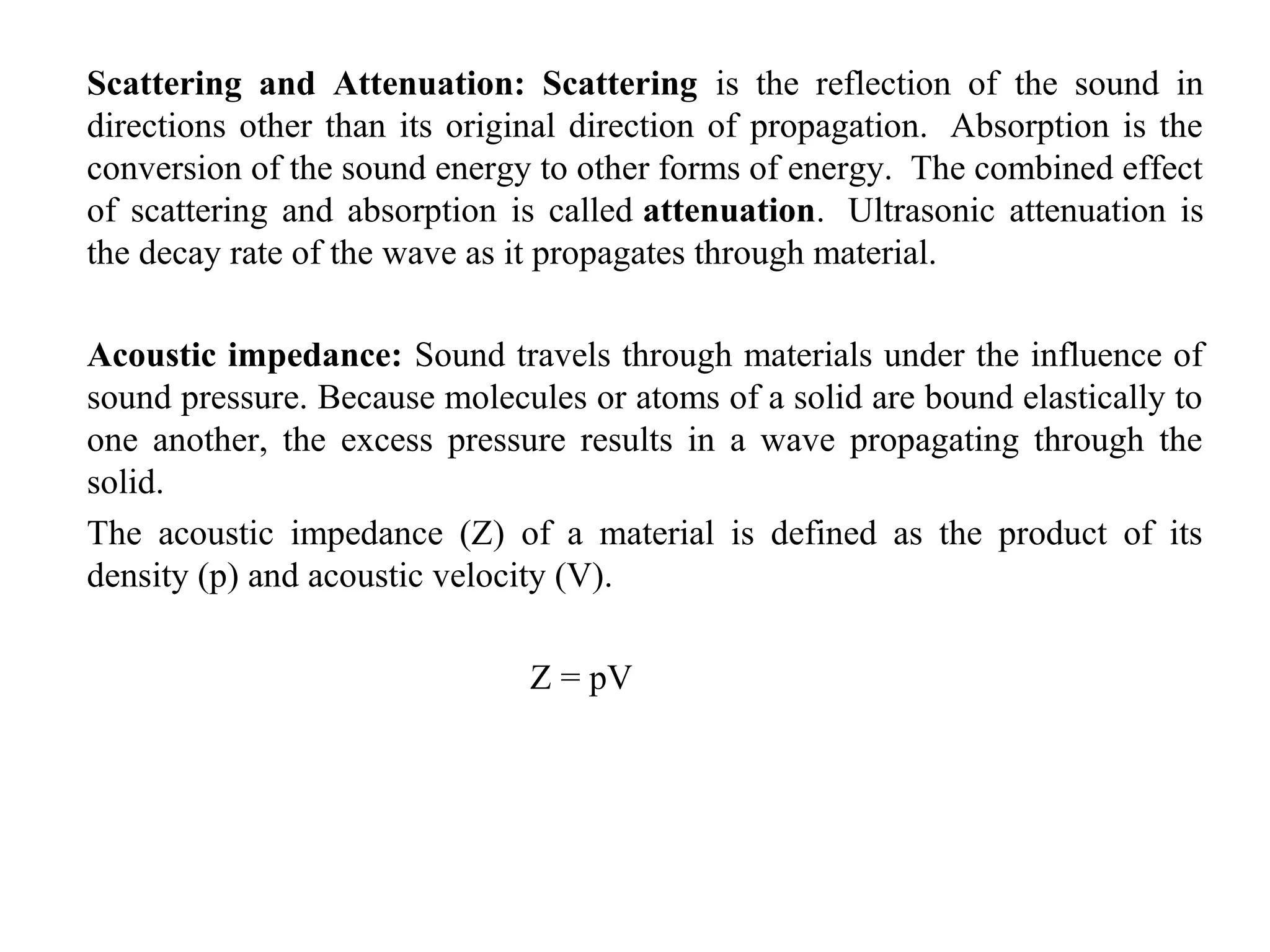
Acoustic impedance: Sound travels through materials under the influence of
sound pressure. Because molecules or atoms of a solid are bound elastically to
one another, the excess pressure results in a wave propagating through the
solid.
The acoustic impedance (Z) of a material is defined as the product of its
density (p) and acoustic velocity (V).
Z = pV
Mode Conversion in UST
When sound travels in a solid material, one form of wave energy can be
transformed into another form.
For example, when a longitudinal waves hits an interface at an angle, some of
the energy can cause particle movement in the transverse direction to start a
shear (transverse) wave. Mode conversion occurs when a wave encounters an
interface between materials of different acoustic impedances and the incident
angle is not normal to the interface.
it was pointed out that when sound waves pass through an interface between
materials having different acoustic velocities, refraction takes place at the
interface. The larger the difference in acoustic velocities between the two
materials, the more the sound is refracted. Notice that the shear wave is not
refracted as much as the longitudinal wave. This occurs because shear waves
travel slower than longitudinal waves. Therefore, the velocity difference
between the incident longitudinal wave and the shear wave is not as great as it
is between the incident and refracted longitudinal waves.
Also note that when a longitudinal wave is reflected inside the material, the
reflected shear wave is reflected at a smaller angle than the reflected
longitudinal wave. This is also due to the fact that the shear velocity is less
than the longitudinal velocity within a given material.
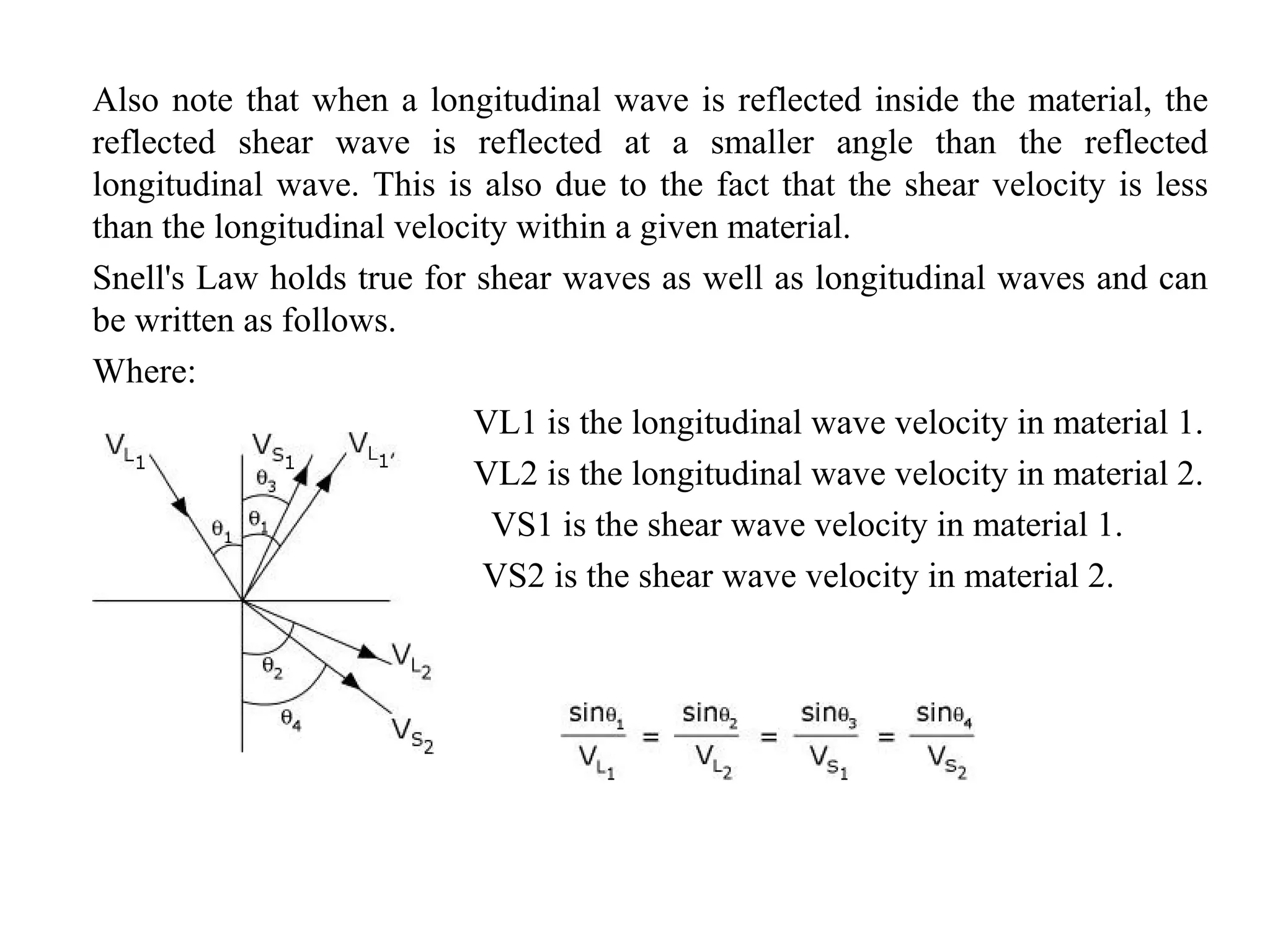
Snell's Law holds true for shear waves as well as longitudinal waves and can
be written as follows.
Where:
VL1 is the longitudinal wave velocity in material 1.
VL2 is the longitudinal wave velocity in material 2.
VS1 is the shear wave velocity in material 1.
VS2 is the shear wave velocity in material 2.
Ultrasonic Testing Methods
Ultrasonic testing is a very versatile inspection method, and inspections can be
accomplished in a number of different ways.
Ultrasonic inspection techniques are commonly divided into three primary
classifications.
–Pulse-echo and Through Transmission (Relates to whether reflected or
transmitted energy is used)
–Normal Beam and Angle Beam (Relates to the angle that the sound energy
enters the test article)
–Contact and Immersion (Relates to the method of coupling the transducer
to the test article)
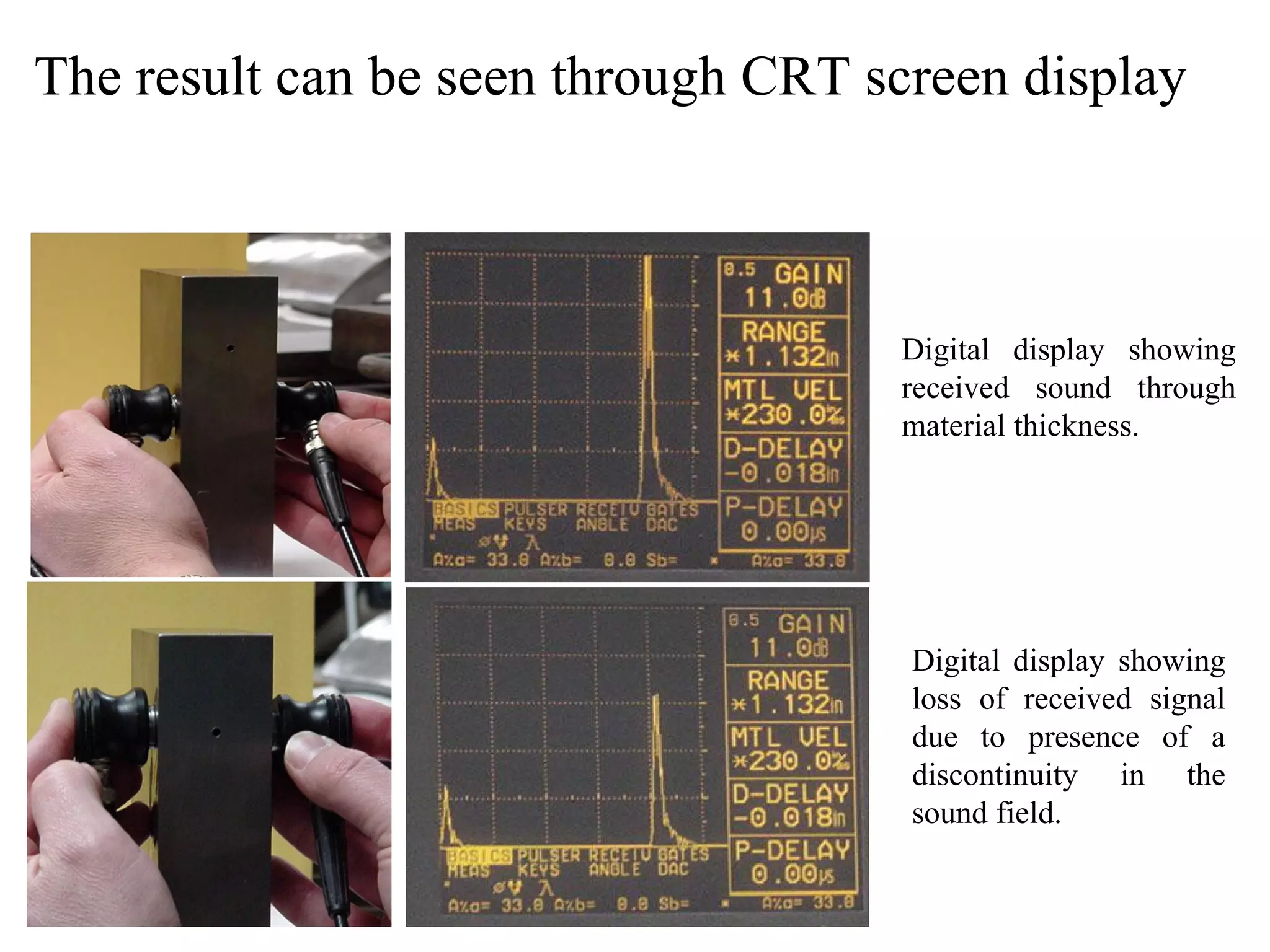
Transmission Through Method
In this method, the defect can be identified on quantifying the
received sound waves.
Test Procedure:
Two transducers located on opposing sides of the test specimen
are used. One transducer acts as a transmitter, the other as a
receiver.
Discontinuities in the sound path will result in a partial or total
loss of sound being transmitted and be indicated by a decrease in
the received signal amplitude.
Through transmission is useful in detecting discontinuities that
are not good reflectors, and when signal strength is weak. It does
not provide depth information.
The result can be seen through CRT screen display
Digital display showing
received sound through
material thickness.
Digital display showing
loss of received signal
due to presence of a
discontinuity in the
sound field.
Pulse-Echo Testing Methods
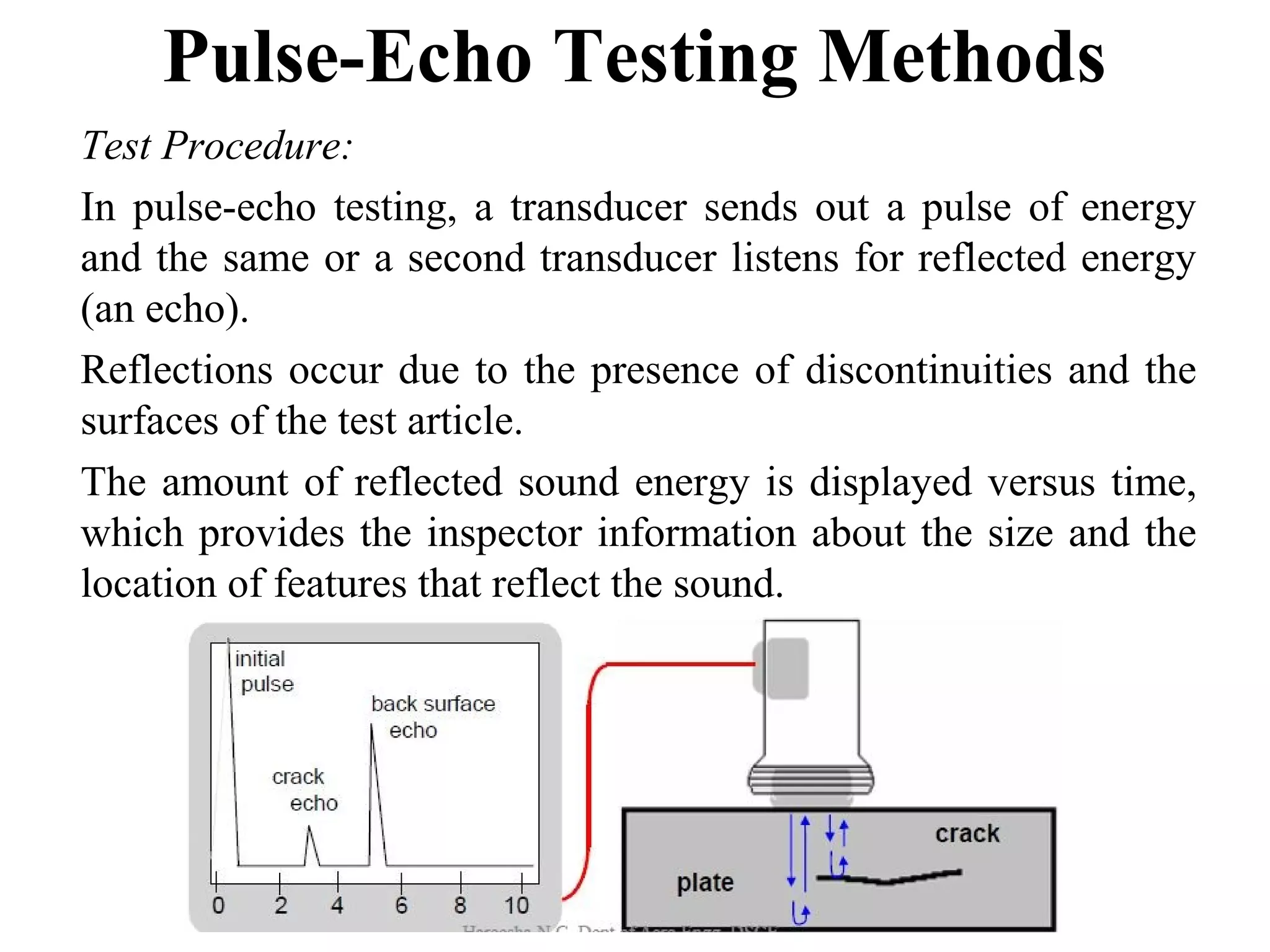
Test Procedure:
In pulse-echo testing, a transducer sends out a pulse of energy
and the same or a second transducer listens for reflected energy
(an echo).
Reflections occur due to the presence of discontinuities and the
surfaces of the test article.
The amount of reflected sound energy is displayed versus time,
which provides the inspector information about the size and the
location of features that reflect the sound.
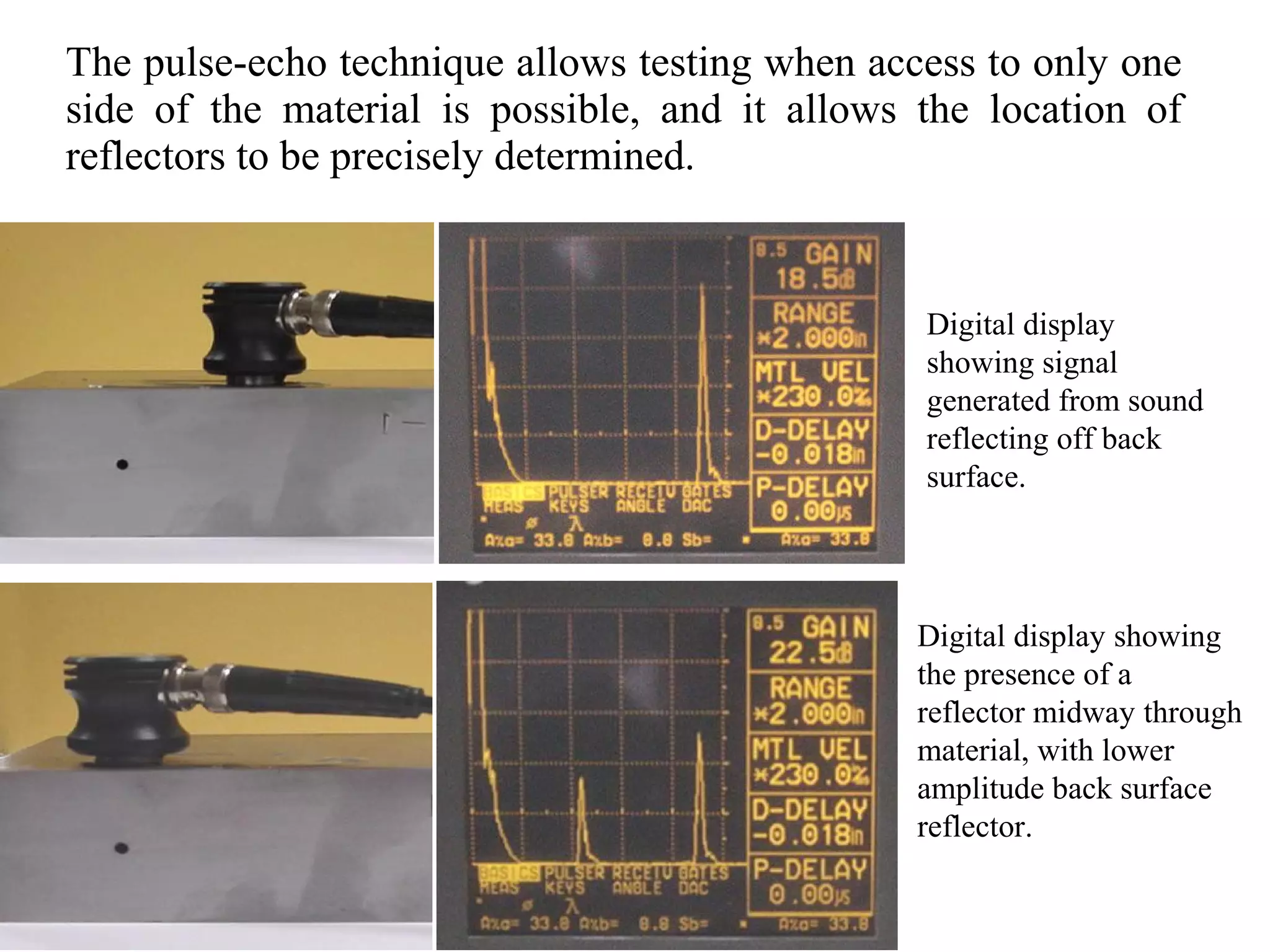
The pulse-echo technique allows testing when access to only one
side of the material is possible, and it allows the location of
reflectors to be precisely determined.
Digital display
showing signal
generated from sound
reflecting off back
surface.
Digital display showing
the presence of a
reflector midway through
material, with lower
amplitude back surface
reflector.
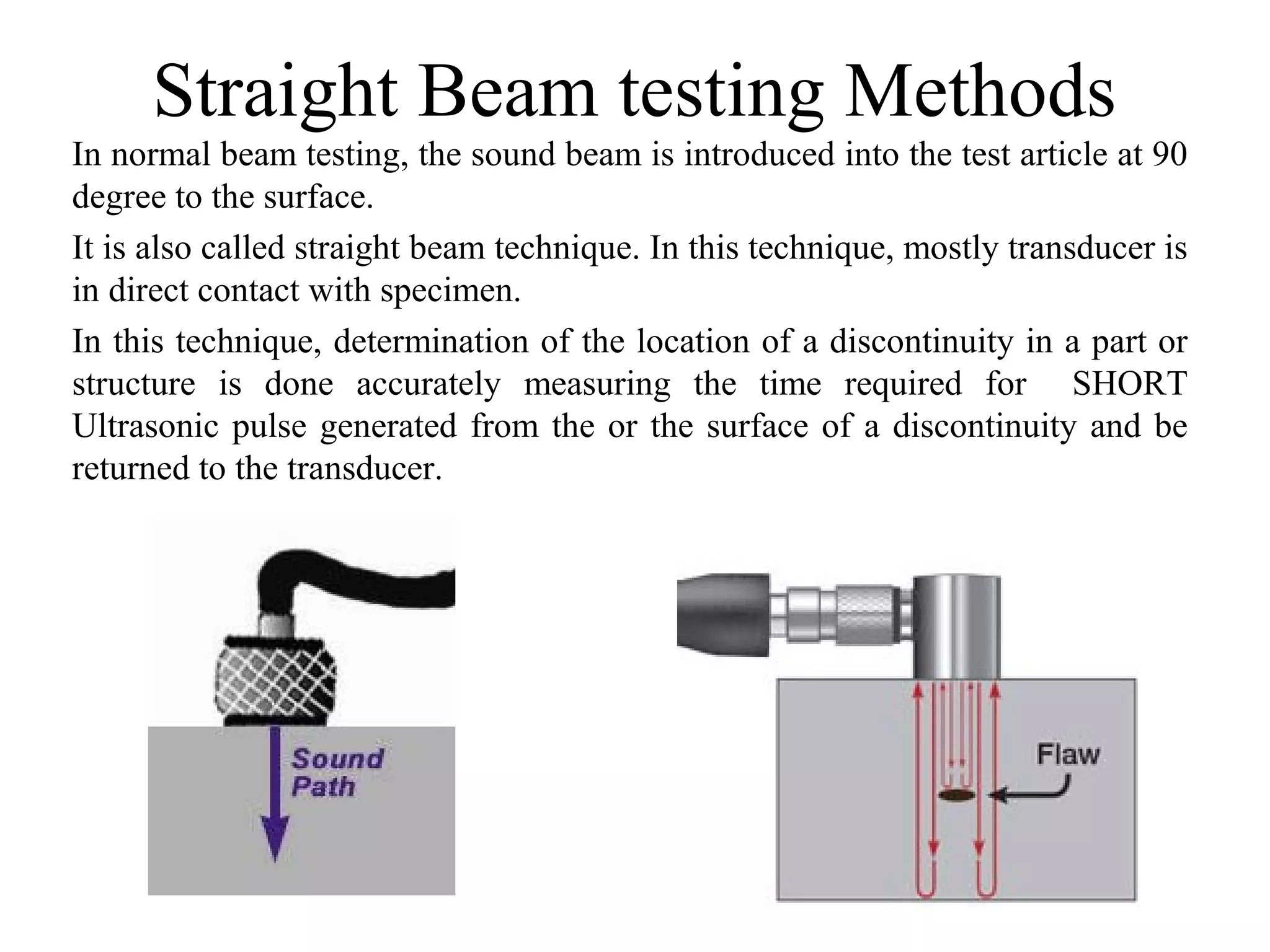
Straight Beam testing Methods
In normal beam testing, the sound beam is introduced into the test article at 90
degree to the surface.
It is also called straight beam technique. In this technique, mostly transducer is
in direct contact with specimen.
In this technique, determination of the location of a discontinuity in a part or
structure is done accurately measuring the time required for SHORT
Ultrasonic pulse generated from the or the surface of a discontinuity and be
returned to the transducer.
Angle Beam Testing
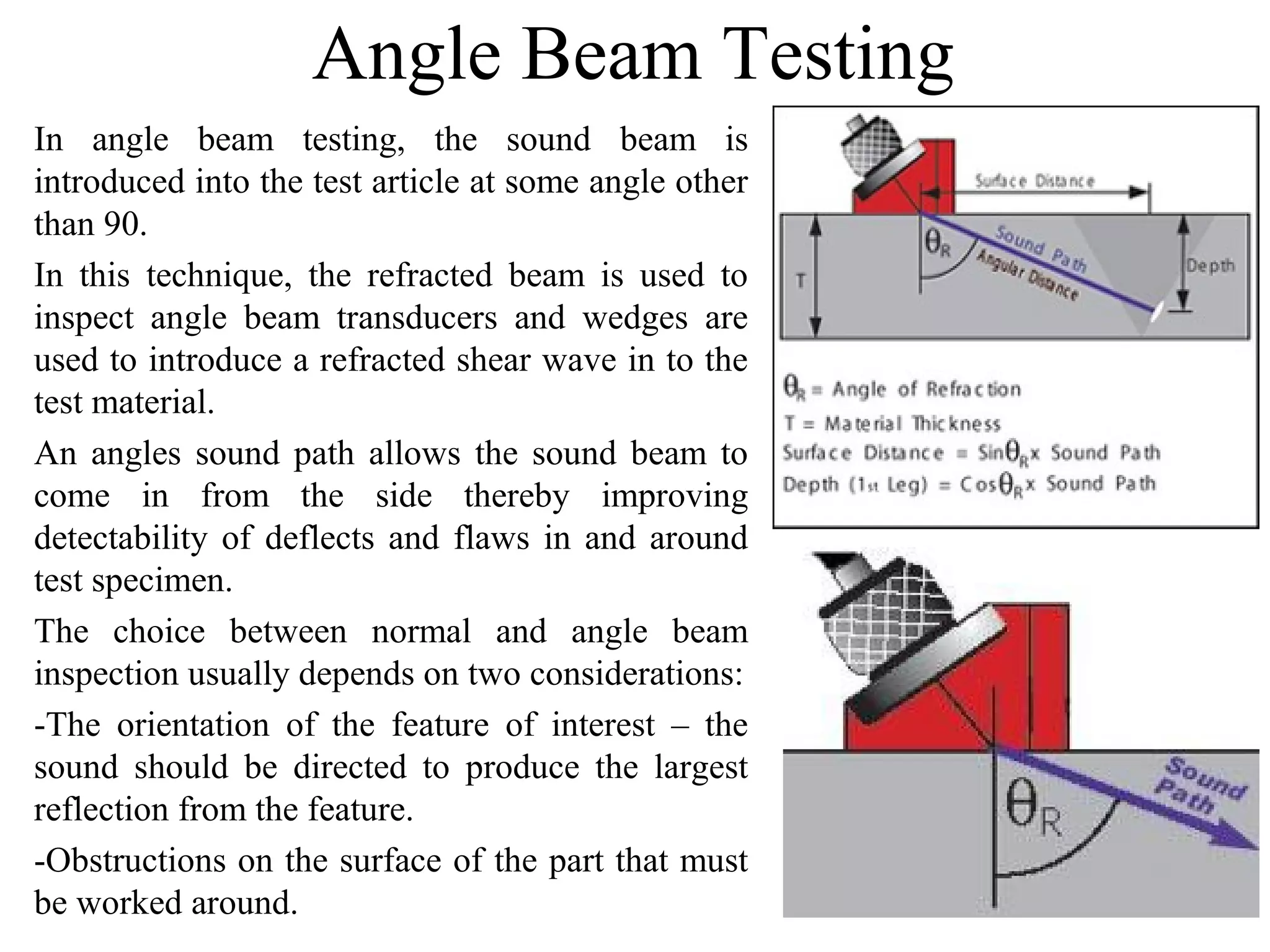
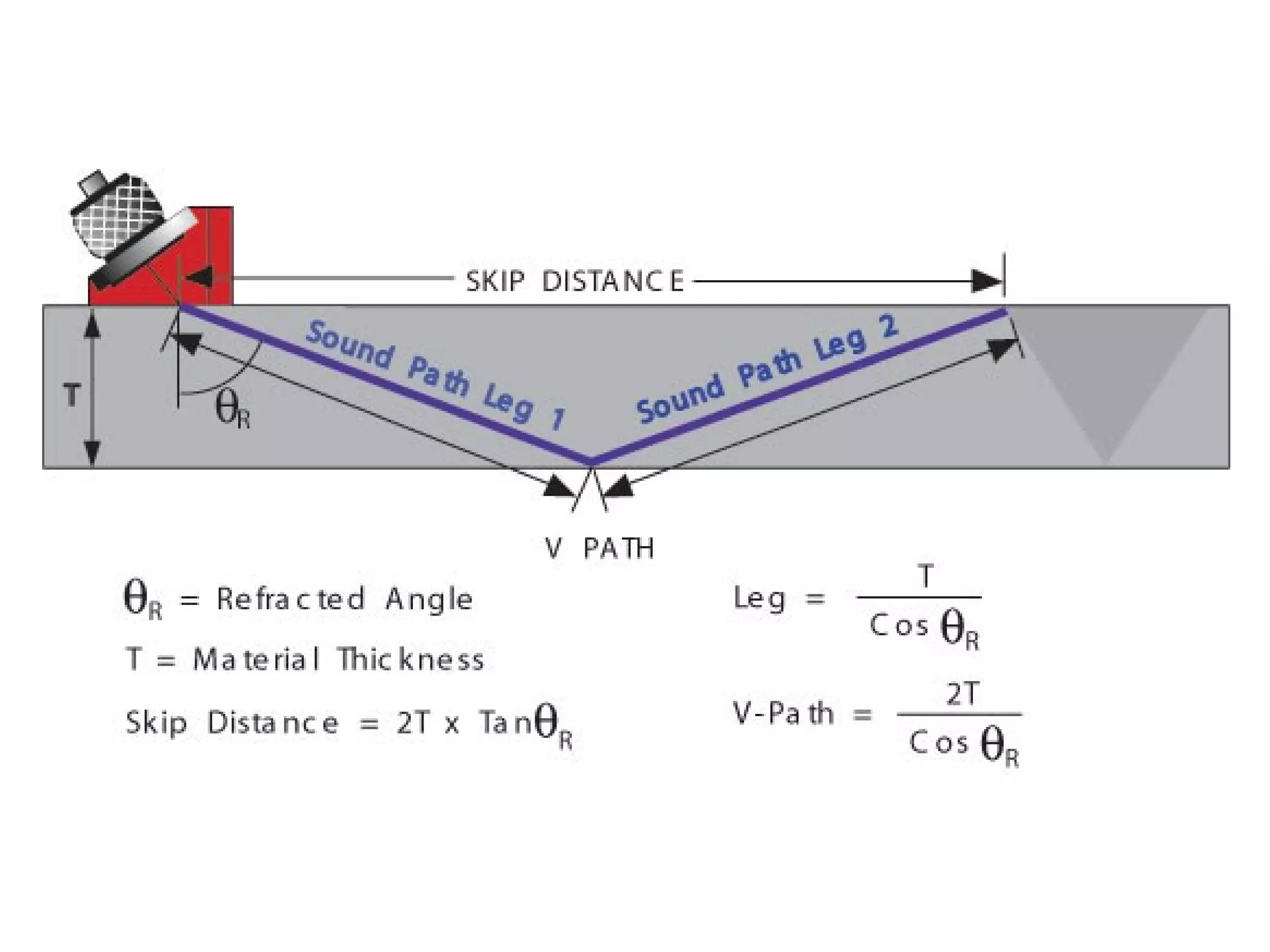
In angle beam testing, the sound beam is
introduced into the test article at some angle other
than 90.
In this technique, the refracted beam is used to
inspect angle beam transducers and wedges are
used to introduce a refracted shear wave in to the
test material.
An angles sound path allows the sound beam to
come in from the side thereby improving
detectability of deflects and flaws in and around
test specimen.
The choice between normal and angle beam
inspection usually depends on two considerations:
-The orientation of the feature of interest – the
sound should be directed to produce the largest
reflection from the feature.
-Obstructions on the surface of the part that must
be worked around.
Contact Testing Technique
Contact testing are used for direct contact inspections, and are
manipulated manually. As the name suggests , this transducer has
direct contact with this specimen.
These transducers are designed in such a manner so that it is easy
to grip and move along a surface.
To get useful levels of sound energy into a material, the air
between the transducer and the test article must be removed. This
is referred to as coupling.
In contact testing, a couplant such as water, oil or a gel is applied
between the transducer and the part.
Immersion Testing Technique
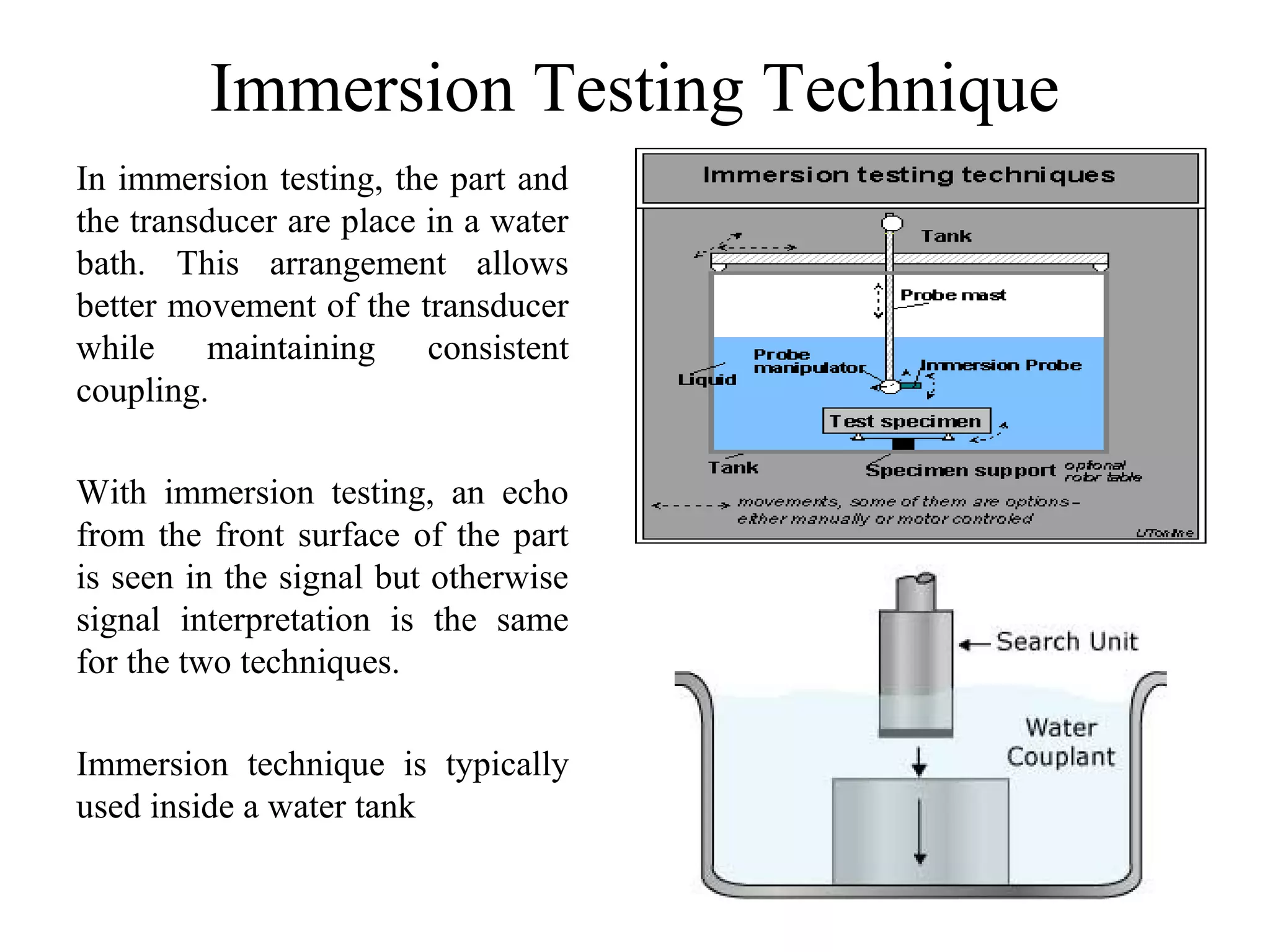
In immersion testing, the part and
the transducer are place in a water
bath. This arrangement allows
better movement of the transducer
while maintaining consistent
coupling.
With immersion testing, an echo
from the front surface of the part
is seen in the signal but otherwise
signal interpretation is the same
for the two techniques.
Immersion technique is typically
used inside a water tank
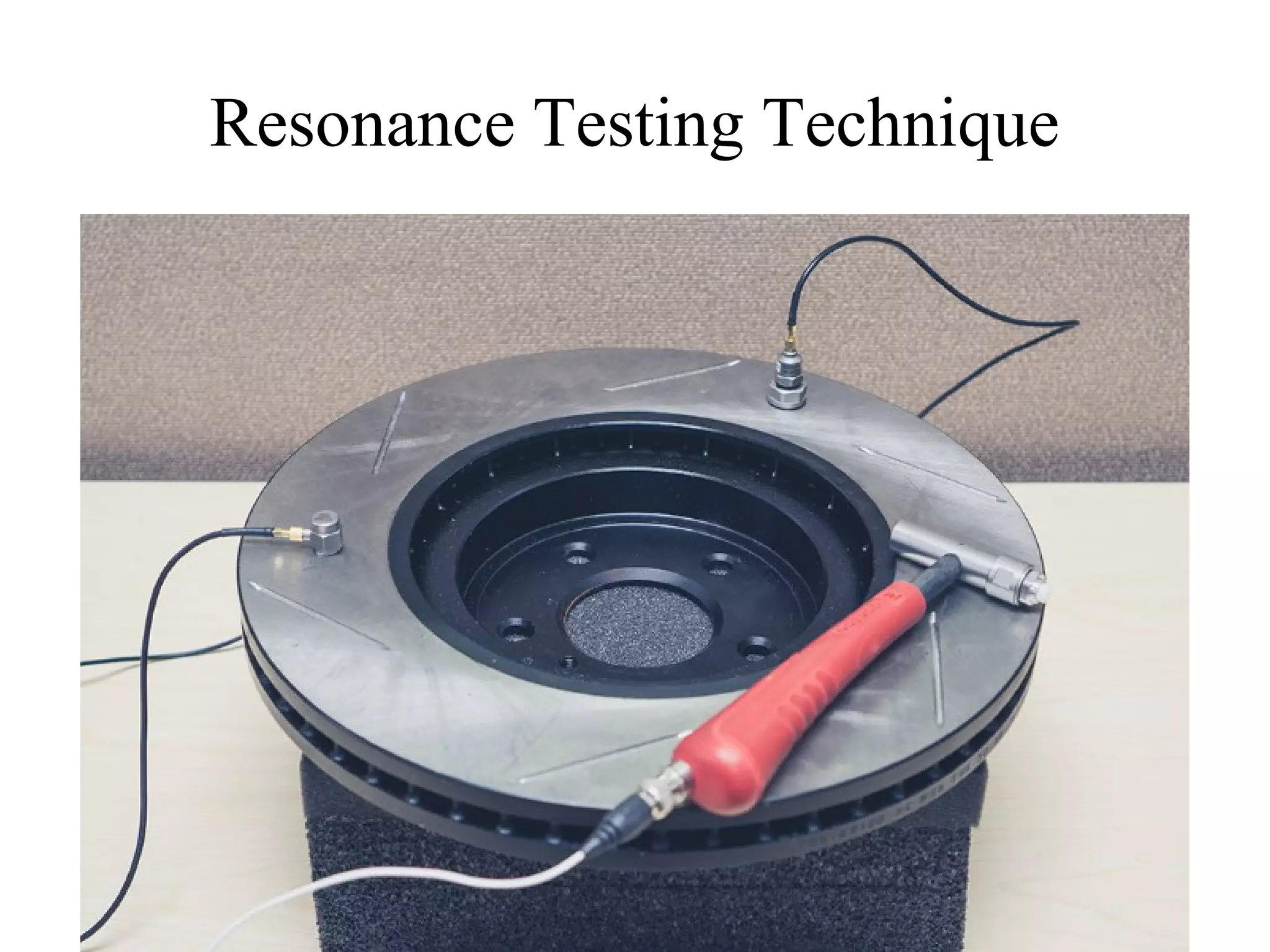
Resonance Testing Technique
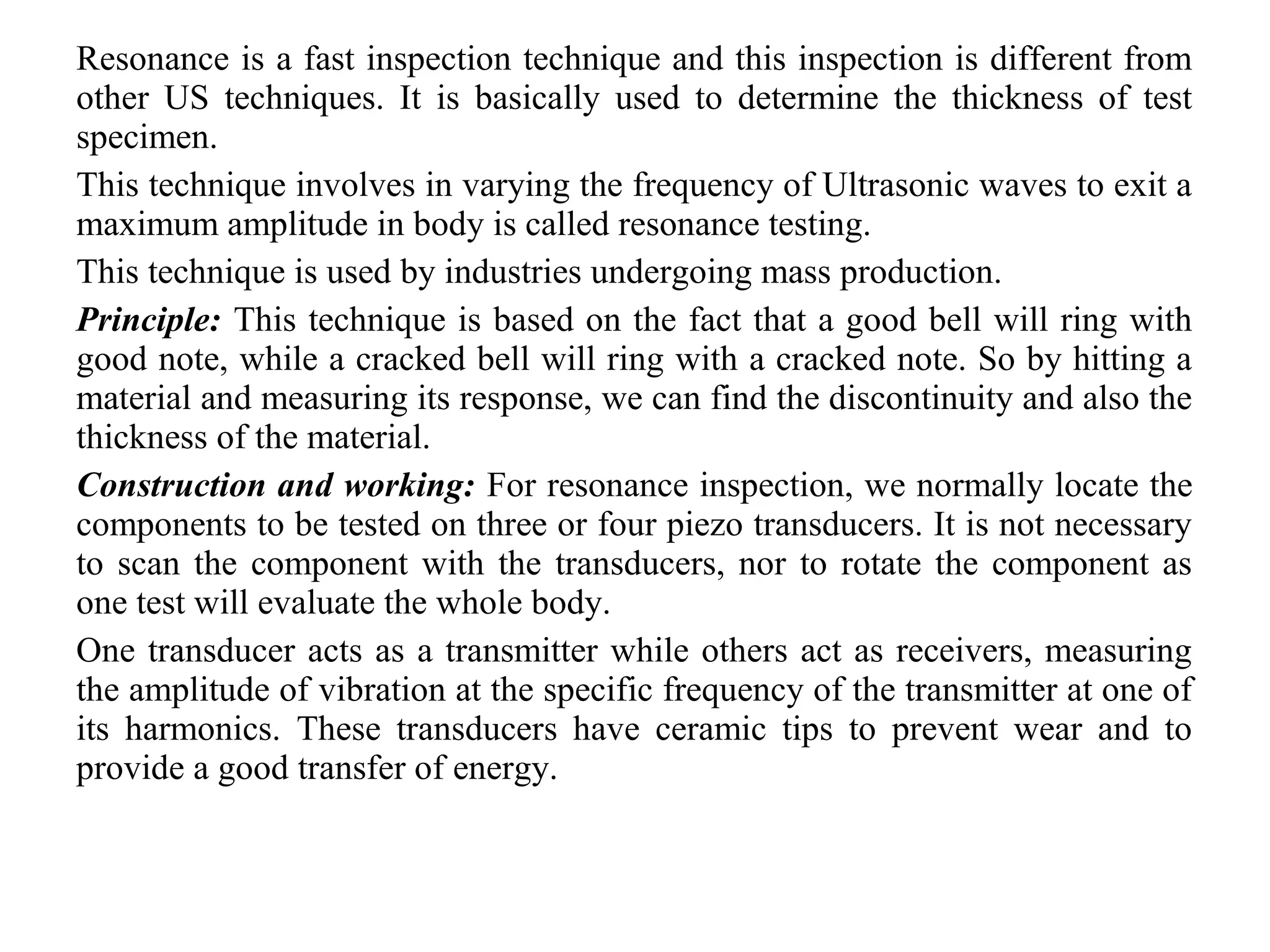
Resonance is a fast inspection technique and this inspection is different from
other US techniques. It is basically used to determine the thickness of test
specimen.
This technique involves in varying the frequency of Ultrasonic waves to exit a
maximum amplitude in body is called resonance testing.
This technique is used by industries undergoing mass production.
Principle: This technique is based on the fact that a good bell will ring with
good note, while a cracked bell will ring with a cracked note. So by hitting a
material and measuring its response, we can find the discontinuity and also the
thickness of the material.
Construction and working: For resonance inspection, we normally locate the
components to be tested on three or four piezo transducers. It is not necessary
to scan the component with the transducers, nor to rotate the component as
one test will evaluate the whole body.
One transducer acts as a transmitter while others act as receivers, measuring
the amplitude of vibration at the specific frequency of the transmitter at one of
its harmonics. These transducers have ceramic tips to prevent wear and to
provide a good transfer of energy.
Ultrasonic Transducer
Ultrasonic transducers are used to transfer electrical energy to
mechanical energy and vice-versa. It is also called as probe.
There are wide classifications of transducers. Some of the
transducers are.
1.Piezo electric transducers
2.Polyvinylidene Fluoride transducers
3.Electromagnetic Acoustic Transducers
4.Laser generator ultrasound
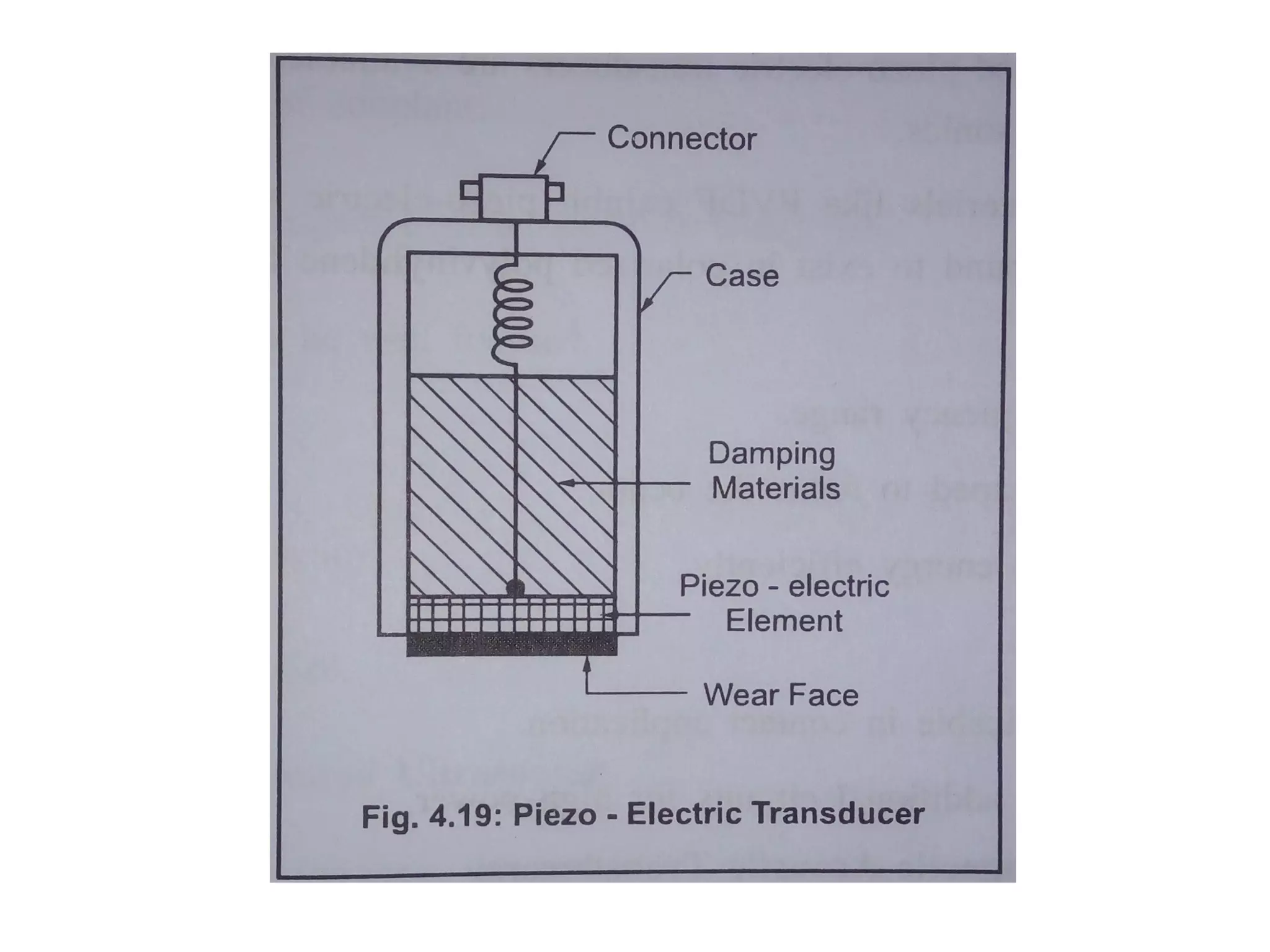
1. Piezo electric transducers
In this transducer, it consist of materials which generate electric charges when
mechanically stressed. We know that a piezo electric crystal generates
electricity when it is vibrated mechanically, thus the piezo electric material is
mounted at the front end of transducer.
When electric pulse is applied to piezo electric crystal, it produces high
frequency ultrasonic waves due to its vibration.
Advantages:
Compact, Simple,
Offers high Output,
high frequency
Disadvantages:
Difficult to get required shape of piezo electric element
Additional circuits are needed to reduce acoustic impedance.
2. Polyvinylidene Fluoride Transducer
Polymer based piezo electric transducer are available in Non
destructive testing using ultrasonics. Polymer materials like
PVDF exhibits piezo electric activity. Relatively high activity is
found to exists in polarized PVDF.
Advantages:
High frequency range,
Easily shaped to focus the beam,
Transfer energy easily
Disadvantages:
Not applicable in contact application,
Requires additional circuits for high power.
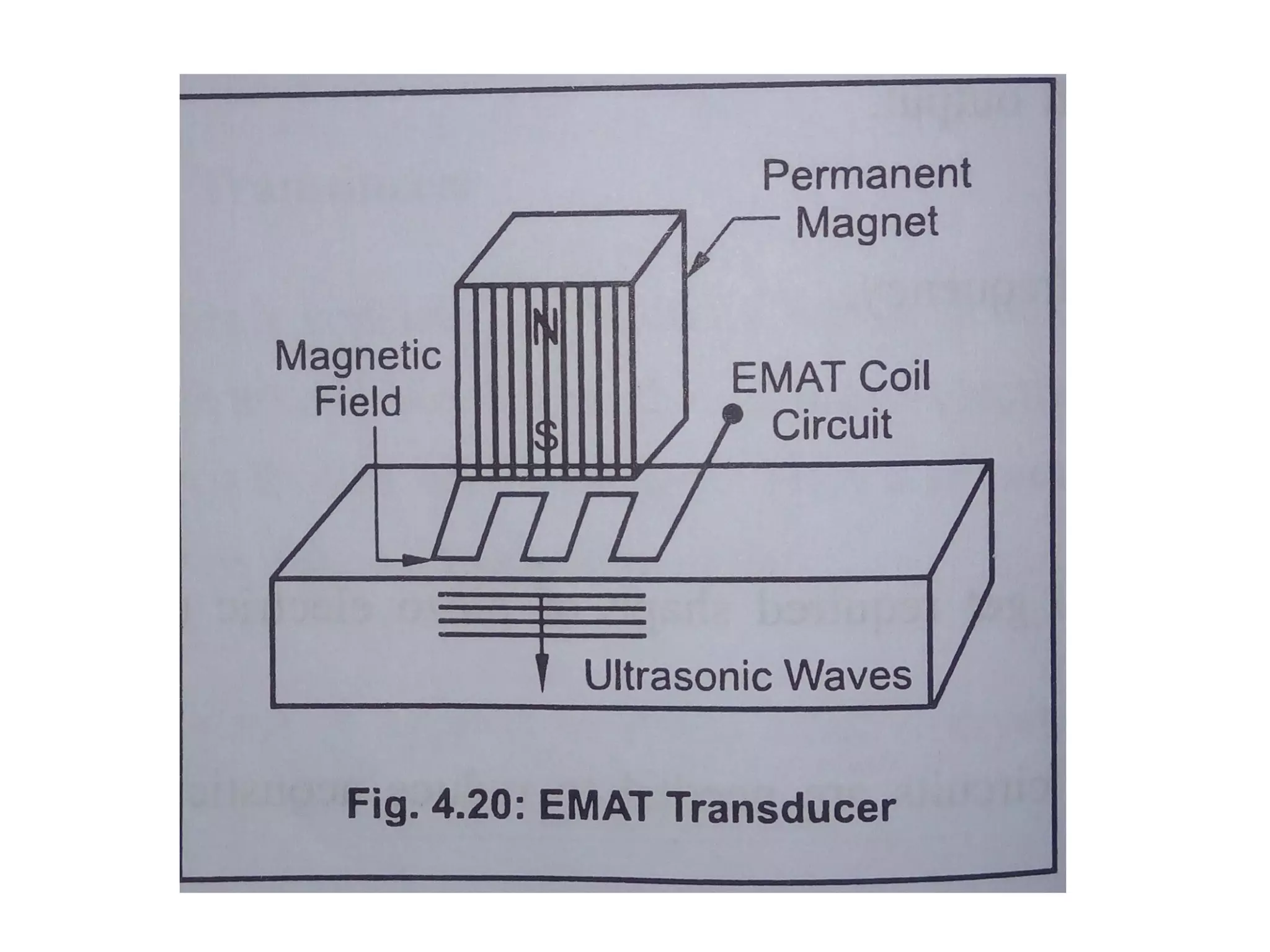
3. Electro Magnetic Acoustic Transducer
This is made up of coils, which are placed close to test pieces. So it is
basically non contact type. It actually produces a magnetic field that interacts
with metal, producing a deformation in the surface of the material which in
turn produces ultrasonic energy.
Advantages:
No Need of Couplant,
Used to inspect high temperature,
Beam can be well focused
Disadvantages:
Low efficiency,
Large in Size.
4.Laser Generated Ultrasound
There are two separate laser, one is to heat the surface and produce the wave
and a second is to detect the defects from reflected wave. Due to his surface
heating, acoustic propagation is accomplished. This heating causes thermal
expansion on the surface, which results in the formation of a wave that travels
through the material.
Advantages:
No need couplant,
Acoustic impedance is achieved easily
Disadvantages:
Relatively low cost
Reference Block With Artificially Created
Defects
For quantitative characterization of material properties and
defects, it is important to calibrate the characteristics of an
ultrasonic instrument.
A widely adopted technique is the use of ultrasonic reference
blocks specified by ASTM,AWS etc.
Blocks are made of such material as Al, steel, Titanium, plastic,
etc.
Artificial defects such as flat bottom holes, side derived holes,
notches and step wedges are usually provided in blocks.
Time of Flight Diffraction (TOFD)
Time-of-flight diffraction (TOFD) method of ultrasonic testing is a sensitive 
and accurate method for the non-destructive testing of welds for defects. 
In a TOFD system, a pair of ultrasonic probes sits on opposite sides of a weld. 
One of the probes, the transmitter, emits an ultrasonic pulse that is picked up 
by the probe on the other side, the receiver. In undamaged pipes, the signals 
picked up by the receiver probe are from two waves: one that travels along the 
surface and one that reflects off the far wall. When a crack is present, there is 
a  diffraction  of  the  ultrasonic  wave  from  the  tip(s)  of  the  crack.  Using  the 
measured time of flight of the pulse, the depth of a crack tips can be calculated 
automatically by simple trigonometry.
Modes of Display
Ultrasonic  data  can  be  collected  and  displayed  in  a  number  of 
different formats. The three most common formats are know in the 
NDT  world  as A-scan, B-scan and C-scan presentations.  Each 
presentation  mode  provides  a  different  way  of  looking  at  and 
evaluating  the  region  of  material  being  inspected.  Modern 
computerized  ultrasonic  scanning  systems  can  display  data  in  all 
three presentation forms simultaneously.
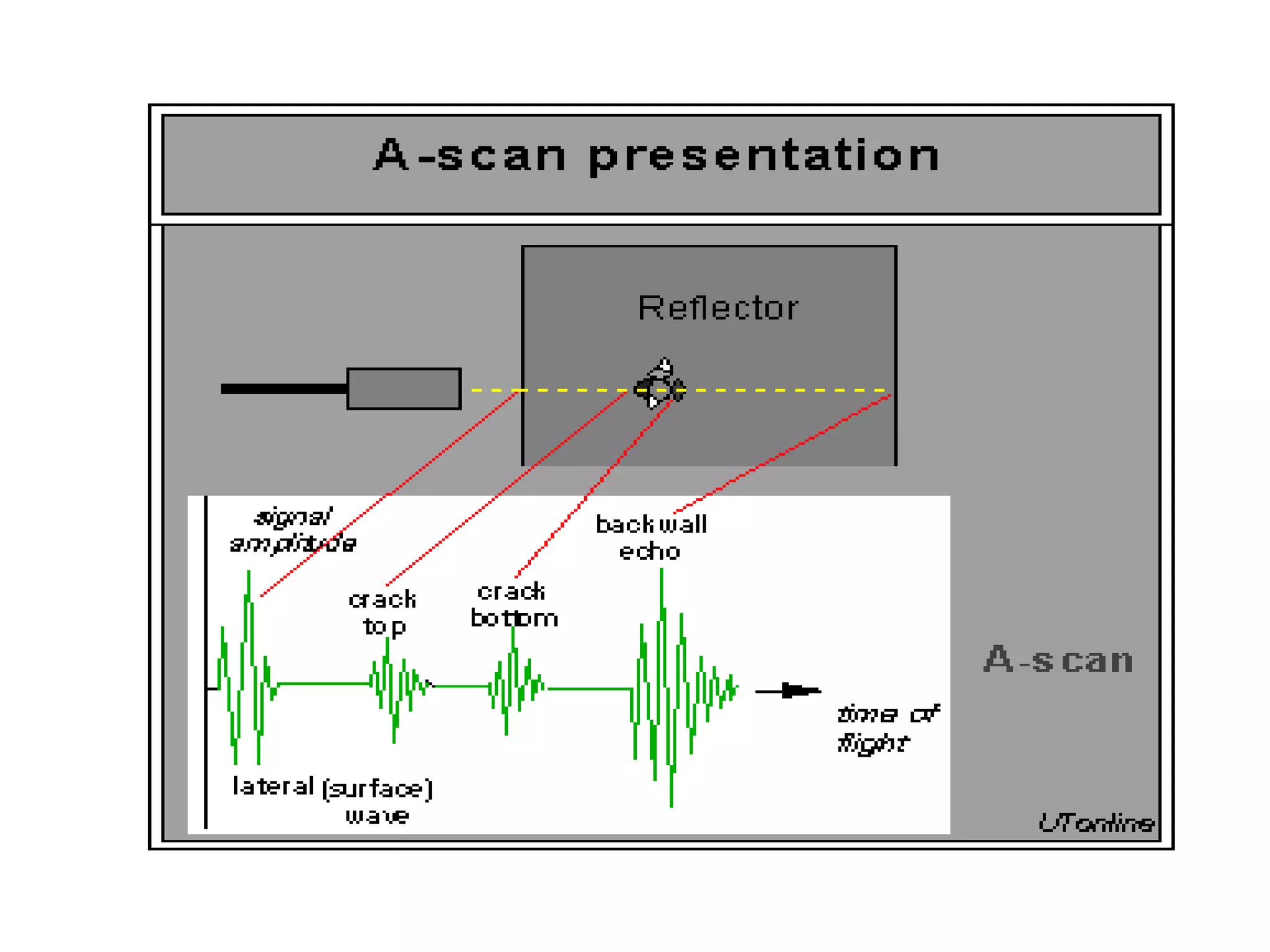
A Scan
A Scan is one of the simplest method of displaying the results of ultrasonic 
testing. Here the time of flight of the pulse is represented in X axis and the 
amplitude of the echoes are represented in Y axis.
In this, certain amount of ultrasonic energy is reflected at the top and bottom 
faces of the material. The echoes from the top and bottom faces give the initial 
and back wall peaks on the CRT.
Suppose a defect is present under the probe in the material it is indicated as 
small echoes in CRT. This corresponds to a defect peak on the surface of CRT 
screens.
The size of the defect is proportional to the height of the defect peak and depth 
of the defect from the top of the material is proportional to the position of the 
defect peak on the horizontal sweep of the CRT
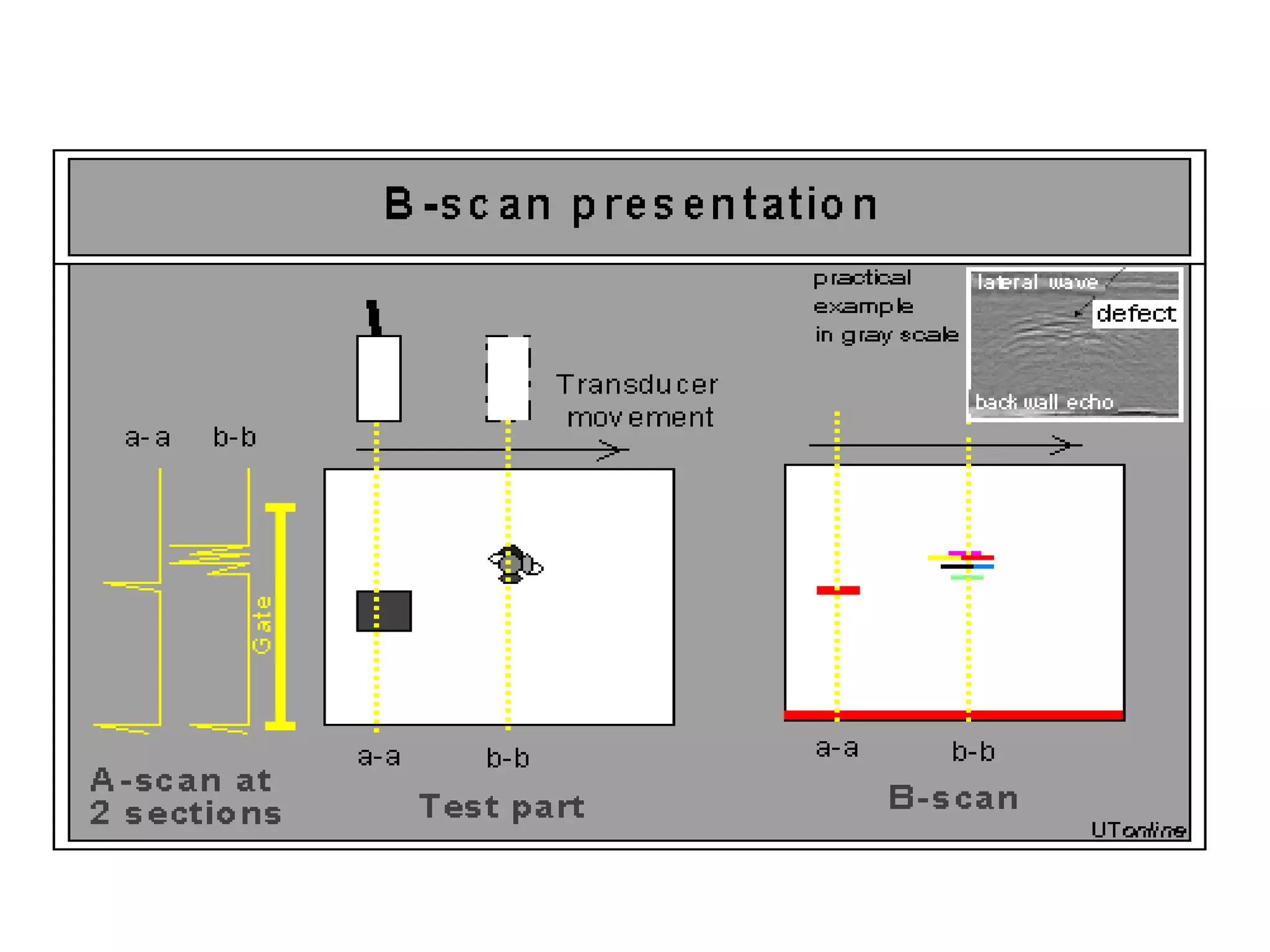
B Scan
B Scan represents a two dimensional image of a stationary specimen. Here, the 
dimension of the specimen is displayed in the X axis, while the travel of the 
ultrasonic pulse in the specimen is displayed in the Y axis.
In this scan, the ultrasonic probe is move along a line on the top face of the 
material. This scan shows the reflection of ultrasonic pulse energy from the 
top  and  bottom  faces  of  the  testing  material,  also  from  the  defects  as  the 
ultrasonic probes moves along a line of the surface of the material. 
The B Scan presents the cross sectional view of the material alone a line and  
provides a depth of flaw from the surface of the material and also length of the 
flaw along the line of movement of the probe.
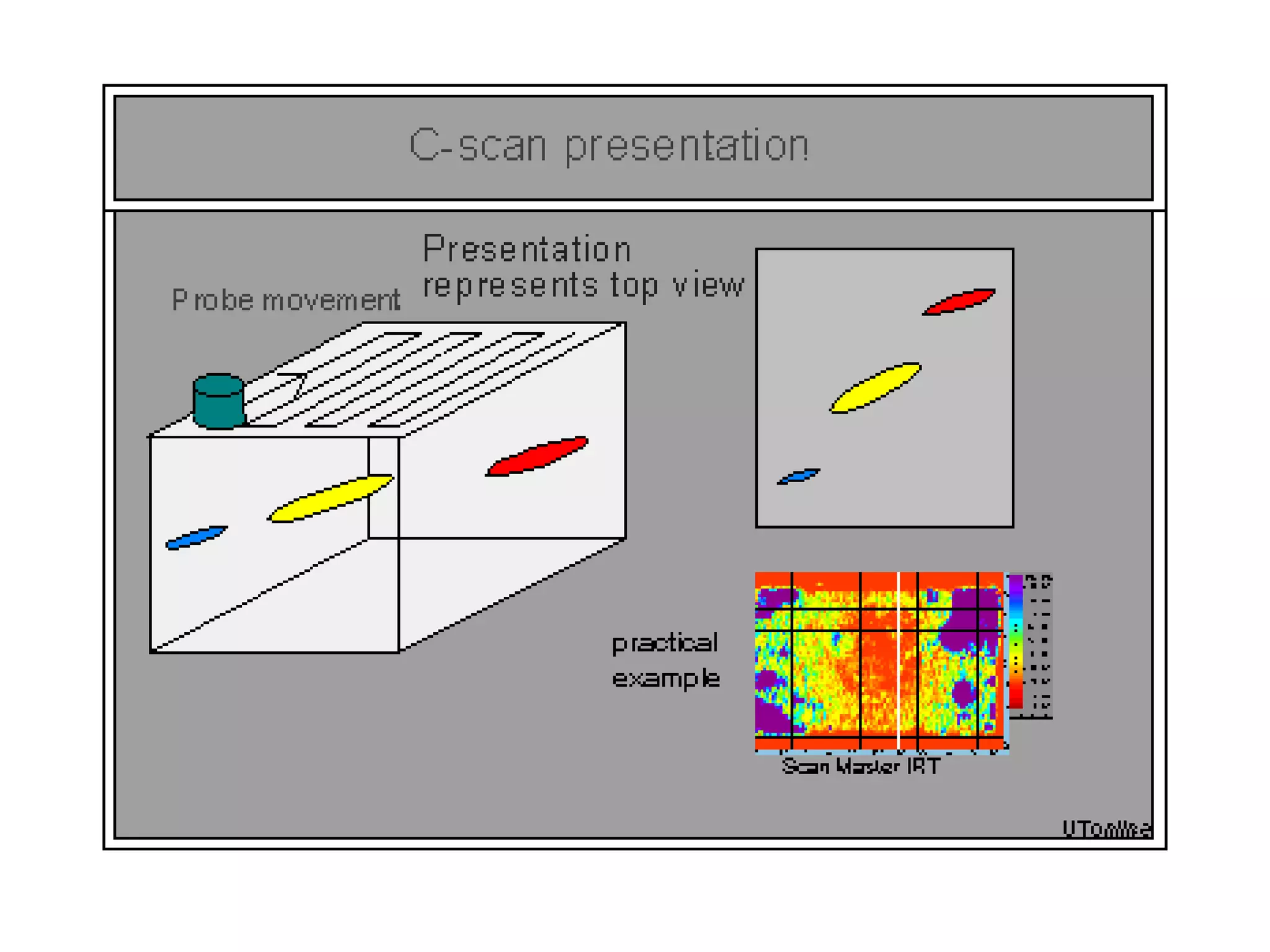
C Scan
C  Scan  display  is  the  best  method  to  display  the  flaw  depth.  In  order  to 
determine  the  accurate  depth  of  the  flaw,  the  probe  is  moved  on  the  test 
specimen. The echo of the scan output a shaded line with varying intensity 
which indicates the absence of the flaw. The echoes of the scan output without 
any shading indicates the flaw shape.
In this scan,  the ultrasonic probe is swept continuously line by line on the 
complete top face. This scan produces a plan of the material and this is similar 
to radiograph.
C Scan has been particularly used in corrosion detection in pipes and pressure 
vessels and in the detection of delamination's in composite materials
Advantages
1. It is sensitive to both surface and subsurface discontinuities.
2. The depth of penetration for flaw detection or measurement is superior to 
other NDT methods.
3. Only single-sided access is needed when the pulse-echo technique is used.
4. It is highly accurate in determining reflector position and estimating size 
and shape.
5. Minimal part preparation is required.
6. Electronic equipment provides instantaneous results.
7. Detailed images can be produced with automated systems.
8. It  has  other  uses,  such  as  thickness  measurement,  in  addition  to  flaw 
detection.
Limitations
1. Surface must be accessible to transmit ultrasound.
2. Skill and training is more extensive than with some other methods.
3. It normally requires a coupling medium to promote the transfer of sound 
energy into the test specimen.
4. Materials that are rough, irregular in shape, very small, exceptionally thin 
or not homogeneous are difficult to inspect.
5. Cast iron and other coarse grained materials are difficult to inspect due to 
low sound transmission and high signal noise.
6. Linear defects oriented parallel to the sound beam may go undetected.
7. Reference standards are required for both equipment calibration and the 
characterization of flaws.
Applications
• Testing of ferrous and non ferrous pipes
• Testing weld in pressure vessels
• Fatigue detection in welds and boilers
• Inspection of large castings
• Structural integrity of aircraft parts
M4 ndt me 367 introductiontoultrasonictesting

M4 ndt me 367 introductiontoultrasonictesting

  • 1.
    Ultrasonic Testing Module 4 HareeshK Assistant Professor Department of Mechanical Engineering
  • 2.
    Introduction Ultrasonic non-destructive testing,also known as ultrasonic NDT or simply UT, is a method of characterizing the thickness or internal structure of a test piece through the use of high frequency sound waves. The frequencies, or pitch, used for ultrasonic testing are many times higher than the limit of human hearing, most commonly in the range from 500 KHz to 20 MHz.
  • 3.
  • 4.
    Instruments used inUltrasonic Testing • Pulser/Receiver • Ultrasonic Transducer • Couplant • Display Screen • Receiver/Amplifier
  • 5.
    • A typicalUT inspection system consists of several functional units, such as the pulser /receiver, transducer, and display devices. • A pulser /receiver is an electronic device that can produce high voltage electrical pulses. • Driven by the pulser, the transducer generates high frequency ultrasonic energy. The sound energy is introduced and propagates through the materials in the form of waves. • When there is a discontinuity (such as a crack) in the wave path, part of the energy will be reflected back from the flaw surface. The reflected wave signal is transformed into an electrical signal by the transducer and is displayed on a screen. In the applet below, the reflected signal strength is displayed versus the time from signal generation to when a echo was received. • Signal travel time can be directly related to the distance that the signal travelled. From the signal, information about the reflector location, size, orientation and other features can sometimes be gained.
  • 6.
    Types of Waves •In solids, sound waves can propagate in four principle modes that are based on the way the particles oscillate. Sound can propagate as longitudinal waves, shear waves, surface waves, and in thin materials as plate waves. Longitudinal and shear waves are the two modes of propagation most widely used in ultrasonic testing. • The particle movement responsible for the propagation of longitudinal and shear waves is illustrated below.
  • 7.
    Longitudinal Wave In longitudinalwaves, the oscillations occur in the longitudinal direction or the direction of wave propagation. Since compressional and dilational forces are active in these waves, they are also called pressure or compressional waves. They are also sometimes called density waves because their particle density fluctuates as they move. Compression waves can be generated in liquids, as well as solids because the energy travels through the atomic structure by a series of compressions and expansion (rarefaction) movements.
  • 8.
    Transverse Wave In thetransverse or shear wave, the particles oscillate at a right angle or transverse to the direction of propagation. Shear waves require an acoustically solid material for effective propagation, and therefore, are not effectively propagated in materials such as liquids or gasses. Shear waves are relatively weak when compared to longitudinal waves. In fact, shear waves are usually generated in materials using some of the energy from longitudinal waves.
  • 9.
    Surface Wave Surface Wave:Surface wave is also called as Rayleigh Waves represent an oscillating motion that travels along the surface of a teat specimen to a depth of one wavelength. Surface wave can be used to detect breaking cracks in a test specimen.
  • 10.
    Lamp Wave Lamp Wave:Lamp wave are surface waves propagate parallel to the test surface and have a particle motion that is elliptical. They occur when the thickness of the test material is only a few wavelength at the test frequency and where the test specimen is of uniform thickness
  • 11.
    Wave Types in Solids ParticleVibrations Longitudinal Parallel to wave direction Transverse (Shear) Perpendicular to wave direction Surface - Rayleigh Elliptical orbit - symmetrical mode Plate Wave - Lamb Component perpendicular to surface (extensional wave)
  • 12.
    Terminologies Used inUltrasonic Testing Wavelength: The distance travelled by a wave during a particle of the medium completes one vibration is called wavelength. It is also defined as the distance between any two nearest on the wave having same phase Time Period: The time period of a wave is the time taken by the wave to travel a distance equal to its wavelength Frequency: This is defined as the number of waves produced in one second. Sensitivity and Resolution: Sensitivity and resolution are two terms that are often used in ultrasonic inspection to describe a technique's ability to locate flaws. Sensitivity is the ability to locate small discontinuities. Sensitivity generally increases with higher frequency (shorter wavelengths). Resolution is the ability of the system to locate discontinuities that are close together within the material or located near the part surface. Resolution also generally increases as the frequency increases.
  • 13.
    Scattering and Attenuation:Scattering is the reflection of the sound in directions other than its original direction of propagation. Absorption is the conversion of the sound energy to other forms of energy. The combined effect of scattering and absorption is called attenuation. Ultrasonic attenuation is the decay rate of the wave as it propagates through material. Acoustic impedance: Sound travels through materials under the influence of sound pressure. Because molecules or atoms of a solid are bound elastically to one another, the excess pressure results in a wave propagating through the solid. The acoustic impedance (Z) of a material is defined as the product of its density (p) and acoustic velocity (V). Z = pV
  • 14.
    Mode Conversion inUST When sound travels in a solid material, one form of wave energy can be transformed into another form. For example, when a longitudinal waves hits an interface at an angle, some of the energy can cause particle movement in the transverse direction to start a shear (transverse) wave. Mode conversion occurs when a wave encounters an interface between materials of different acoustic impedances and the incident angle is not normal to the interface. it was pointed out that when sound waves pass through an interface between materials having different acoustic velocities, refraction takes place at the interface. The larger the difference in acoustic velocities between the two materials, the more the sound is refracted. Notice that the shear wave is not refracted as much as the longitudinal wave. This occurs because shear waves travel slower than longitudinal waves. Therefore, the velocity difference between the incident longitudinal wave and the shear wave is not as great as it is between the incident and refracted longitudinal waves.
  • 15.
    Also note thatwhen a longitudinal wave is reflected inside the material, the reflected shear wave is reflected at a smaller angle than the reflected longitudinal wave. This is also due to the fact that the shear velocity is less than the longitudinal velocity within a given material. Snell's Law holds true for shear waves as well as longitudinal waves and can be written as follows. Where: VL1 is the longitudinal wave velocity in material 1. VL2 is the longitudinal wave velocity in material 2. VS1 is the shear wave velocity in material 1. VS2 is the shear wave velocity in material 2.
  • 16.
    Ultrasonic Testing Methods Ultrasonictesting is a very versatile inspection method, and inspections can be accomplished in a number of different ways. Ultrasonic inspection techniques are commonly divided into three primary classifications. –Pulse-echo and Through Transmission (Relates to whether reflected or transmitted energy is used) –Normal Beam and Angle Beam (Relates to the angle that the sound energy enters the test article) –Contact and Immersion (Relates to the method of coupling the transducer to the test article)
  • 17.
    Transmission Through Method Inthis method, the defect can be identified on quantifying the received sound waves. Test Procedure: Two transducers located on opposing sides of the test specimen are used. One transducer acts as a transmitter, the other as a receiver. Discontinuities in the sound path will result in a partial or total loss of sound being transmitted and be indicated by a decrease in the received signal amplitude. Through transmission is useful in detecting discontinuities that are not good reflectors, and when signal strength is weak. It does not provide depth information.
  • 18.
    The result canbe seen through CRT screen display Digital display showing received sound through material thickness. Digital display showing loss of received signal due to presence of a discontinuity in the sound field.
  • 19.
    Pulse-Echo Testing Methods TestProcedure: In pulse-echo testing, a transducer sends out a pulse of energy and the same or a second transducer listens for reflected energy (an echo). Reflections occur due to the presence of discontinuities and the surfaces of the test article. The amount of reflected sound energy is displayed versus time, which provides the inspector information about the size and the location of features that reflect the sound.
  • 20.
    The pulse-echo techniqueallows testing when access to only one side of the material is possible, and it allows the location of reflectors to be precisely determined. Digital display showing signal generated from sound reflecting off back surface. Digital display showing the presence of a reflector midway through material, with lower amplitude back surface reflector.
  • 21.
    Straight Beam testingMethods In normal beam testing, the sound beam is introduced into the test article at 90 degree to the surface. It is also called straight beam technique. In this technique, mostly transducer is in direct contact with specimen. In this technique, determination of the location of a discontinuity in a part or structure is done accurately measuring the time required for SHORT Ultrasonic pulse generated from the or the surface of a discontinuity and be returned to the transducer.
  • 22.
    Angle Beam Testing Inangle beam testing, the sound beam is introduced into the test article at some angle other than 90. In this technique, the refracted beam is used to inspect angle beam transducers and wedges are used to introduce a refracted shear wave in to the test material. An angles sound path allows the sound beam to come in from the side thereby improving detectability of deflects and flaws in and around test specimen. The choice between normal and angle beam inspection usually depends on two considerations: -The orientation of the feature of interest – the sound should be directed to produce the largest reflection from the feature. -Obstructions on the surface of the part that must be worked around.
  • 24.
    Contact Testing Technique Contacttesting are used for direct contact inspections, and are manipulated manually. As the name suggests , this transducer has direct contact with this specimen. These transducers are designed in such a manner so that it is easy to grip and move along a surface. To get useful levels of sound energy into a material, the air between the transducer and the test article must be removed. This is referred to as coupling. In contact testing, a couplant such as water, oil or a gel is applied between the transducer and the part.
  • 25.
    Immersion Testing Technique Inimmersion testing, the part and the transducer are place in a water bath. This arrangement allows better movement of the transducer while maintaining consistent coupling. With immersion testing, an echo from the front surface of the part is seen in the signal but otherwise signal interpretation is the same for the two techniques. Immersion technique is typically used inside a water tank
  • 26.
  • 27.
    Resonance is afast inspection technique and this inspection is different from other US techniques. It is basically used to determine the thickness of test specimen. This technique involves in varying the frequency of Ultrasonic waves to exit a maximum amplitude in body is called resonance testing. This technique is used by industries undergoing mass production. Principle: This technique is based on the fact that a good bell will ring with good note, while a cracked bell will ring with a cracked note. So by hitting a material and measuring its response, we can find the discontinuity and also the thickness of the material. Construction and working: For resonance inspection, we normally locate the components to be tested on three or four piezo transducers. It is not necessary to scan the component with the transducers, nor to rotate the component as one test will evaluate the whole body. One transducer acts as a transmitter while others act as receivers, measuring the amplitude of vibration at the specific frequency of the transmitter at one of its harmonics. These transducers have ceramic tips to prevent wear and to provide a good transfer of energy.
  • 28.
    Ultrasonic Transducer Ultrasonic transducersare used to transfer electrical energy to mechanical energy and vice-versa. It is also called as probe. There are wide classifications of transducers. Some of the transducers are. 1.Piezo electric transducers 2.Polyvinylidene Fluoride transducers 3.Electromagnetic Acoustic Transducers 4.Laser generator ultrasound
  • 29.
    1. Piezo electrictransducers In this transducer, it consist of materials which generate electric charges when mechanically stressed. We know that a piezo electric crystal generates electricity when it is vibrated mechanically, thus the piezo electric material is mounted at the front end of transducer. When electric pulse is applied to piezo electric crystal, it produces high frequency ultrasonic waves due to its vibration. Advantages: Compact, Simple, Offers high Output, high frequency Disadvantages: Difficult to get required shape of piezo electric element Additional circuits are needed to reduce acoustic impedance.
  • 31.
    2. Polyvinylidene FluorideTransducer Polymer based piezo electric transducer are available in Non destructive testing using ultrasonics. Polymer materials like PVDF exhibits piezo electric activity. Relatively high activity is found to exists in polarized PVDF. Advantages: High frequency range, Easily shaped to focus the beam, Transfer energy easily Disadvantages: Not applicable in contact application, Requires additional circuits for high power.
  • 32.
    3. Electro MagneticAcoustic Transducer This is made up of coils, which are placed close to test pieces. So it is basically non contact type. It actually produces a magnetic field that interacts with metal, producing a deformation in the surface of the material which in turn produces ultrasonic energy. Advantages: No Need of Couplant, Used to inspect high temperature, Beam can be well focused Disadvantages: Low efficiency, Large in Size.
  • 34.
    4.Laser Generated Ultrasound Thereare two separate laser, one is to heat the surface and produce the wave and a second is to detect the defects from reflected wave. Due to his surface heating, acoustic propagation is accomplished. This heating causes thermal expansion on the surface, which results in the formation of a wave that travels through the material. Advantages: No need couplant, Acoustic impedance is achieved easily Disadvantages: Relatively low cost
  • 35.
    Reference Block WithArtificially Created Defects For quantitative characterization of material properties and defects, it is important to calibrate the characteristics of an ultrasonic instrument. A widely adopted technique is the use of ultrasonic reference blocks specified by ASTM,AWS etc. Blocks are made of such material as Al, steel, Titanium, plastic, etc. Artificial defects such as flat bottom holes, side derived holes, notches and step wedges are usually provided in blocks.
  • 36.
    Time of FlightDiffraction (TOFD)
  • 37.
    Time-of-flight diffraction (TOFD) method of ultrasonic testing is a sensitive  and accurate method for the non-destructive testing of welds for defects.  In a TOFD system, a pair of ultrasonic probes sits on opposite sides of a weld.  One of the probes, the transmitter, emits an ultrasonic pulse that is picked up  by the probe on the other side, the receiver. In undamaged pipes, the signals  picked up by the receiver probe are from two waves: one that travels along the  surface and one that reflects off the far wall. When a crack is present, there is  a  diffraction of  the  ultrasonic  wave  from  the  tip(s)  of  the  crack.  Using  the  measured time of flight of the pulse, the depth of a crack tips can be calculated  automatically by simple trigonometry.
  • 38.
    Modes of Display Ultrasonic  data  can be  collected  and  displayed  in  a  number  of  different formats. The three most common formats are know in the  NDT  world  as A-scan, B-scan and C-scan presentations.  Each  presentation  mode  provides  a  different  way  of  looking  at  and  evaluating  the  region  of  material  being  inspected.  Modern  computerized  ultrasonic  scanning  systems  can  display  data  in  all  three presentation forms simultaneously.
  • 39.
    A Scan A Scan is one of the simplest method of displaying the results of ultrasonic  testing. Here the time of flight of the pulse is represented in X axis and the  amplitude of the echoes are represented in Y axis. In this, certain amount of ultrasonic energy is reflected at the top and bottom  faces of the material. The echoes from the top and bottom faces give the initial  and back wall peaks on the CRT. Suppose a defect is present under the probe in the material it is indicated as  small echoes in CRT. This corresponds to a defect peak on the surface of CRT  screens. The size of the defect is proportional to the height of the defect peak and depth  of the defect from the top of the material is proportional to the position of the  defect peak on the horizontal sweep of the CRT
  • 41.
    B Scan B Scan represents a two dimensional image of a stationary specimen. Here, the  dimension of the specimen is displayed in the X axis, while the travel of the  ultrasonic pulse in the specimen is displayed in the Y axis. In this scan, the ultrasonic probe is move along a line on the top face of the  material. This scan shows the reflection of ultrasonic pulse energy from the  top  and  bottom faces  of  the  testing  material,  also  from  the  defects  as  the  ultrasonic probes moves along a line of the surface of the material.  The B Scan presents the cross sectional view of the material alone a line and   provides a depth of flaw from the surface of the material and also length of the  flaw along the line of movement of the probe.
  • 43.
    C Scan C  Scan  display is  the  best  method  to  display  the  flaw  depth.  In  order  to  determine  the  accurate  depth  of  the  flaw,  the  probe  is  moved  on  the  test  specimen. The echo of the scan output a shaded line with varying intensity  which indicates the absence of the flaw. The echoes of the scan output without  any shading indicates the flaw shape. In this scan,  the ultrasonic probe is swept continuously line by line on the  complete top face. This scan produces a plan of the material and this is similar  to radiograph. C Scan has been particularly used in corrosion detection in pipes and pressure  vessels and in the detection of delamination's in composite materials
  • 45.
    Advantages 1. It is sensitive to both surface and subsurface discontinuities. 2. The depth of penetration for flaw detection or measurement is superior to  other NDT methods. 3.Only single-sided access is needed when the pulse-echo technique is used. 4. It is highly accurate in determining reflector position and estimating size  and shape. 5. Minimal part preparation is required. 6. Electronic equipment provides instantaneous results. 7. Detailed images can be produced with automated systems. 8. It  has  other  uses,  such  as  thickness  measurement,  in  addition  to  flaw  detection.
  • 46.
    Limitations 1. Surface must be accessible to transmit ultrasound. 2. Skill and training is more extensive than with some other methods. 3.It normally requires a coupling medium to promote the transfer of sound  energy into the test specimen. 4. Materials that are rough, irregular in shape, very small, exceptionally thin  or not homogeneous are difficult to inspect. 5. Cast iron and other coarse grained materials are difficult to inspect due to  low sound transmission and high signal noise. 6. Linear defects oriented parallel to the sound beam may go undetected. 7. Reference standards are required for both equipment calibration and the  characterization of flaws.
  • 47.
    Applications • Testing of ferrous and non ferrous pipes • Testing weld in pressure vessels •Fatigue detection in welds and boilers • Inspection of large castings • Structural integrity of aircraft parts