Non-Destructive Testing
Alfa institute of Technology, Udupi Page 35
4.ULTRASONIC TESTING (UT)
Introduction:
Ultrasonic testing uses high frequency sound waves to conduct examination and make
measurements. Besides its wide use in engineering applications (such as flaw detection and
evaluation, dimensional measurements, material characterization, etc ), ultrasonic are also
used in medical field. In general, ultrasonic testing is on capture and quantification of either
the reflected waves. Each of the two types are in certain applications, but generally, pulse
echo systems are more useful since they require one sided access to the object being
inspected
Basic principle:
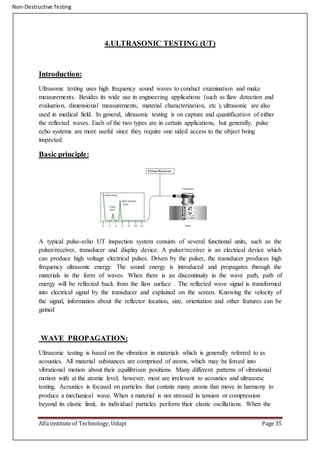
A typical pulse-echo UT inspection system consists of several functional units, such as the
pulser/receiver, transducer and display device. A pulser/receiver is an electrical device which
can produce high voltage electrical pulses. Driven by the pulser, the transducer produces high
frequency ultrasonic energy. The sound energy is introduced and propagates through the
materials in the form of waves. When there is an discontinuity in the wave path, path of
energy will be reflected back from the flaw surface . The reflected wave signal is transformed
into electrical signal by the transducer and explained on the screen. Knowing the velocity of
the signal, information about the reflector location, size, orientation and other features can be
gained
WAVE PROPAGATION:
Ultrasonic testing is based on the vibration in materials which is generally referred to as
acoustics. All material substances are comprised of atoms, which may be forced into
vibrational motion about their equilibrium positions. Many different patterns of vibrational
motion with at the atomic level; however, most are irrelevant to acoustics and ultrasonic
testing. Acoustics is focused on particles that contain many atoms that move in harmony to
produce a mechanical wave. When a material is not stressed in tension or compression
beyond its elastic limit, its individual particles perform their elastic oscillations. When the
Non-Destructive Testing
Alfa institute of Technology, Udupi Page 36
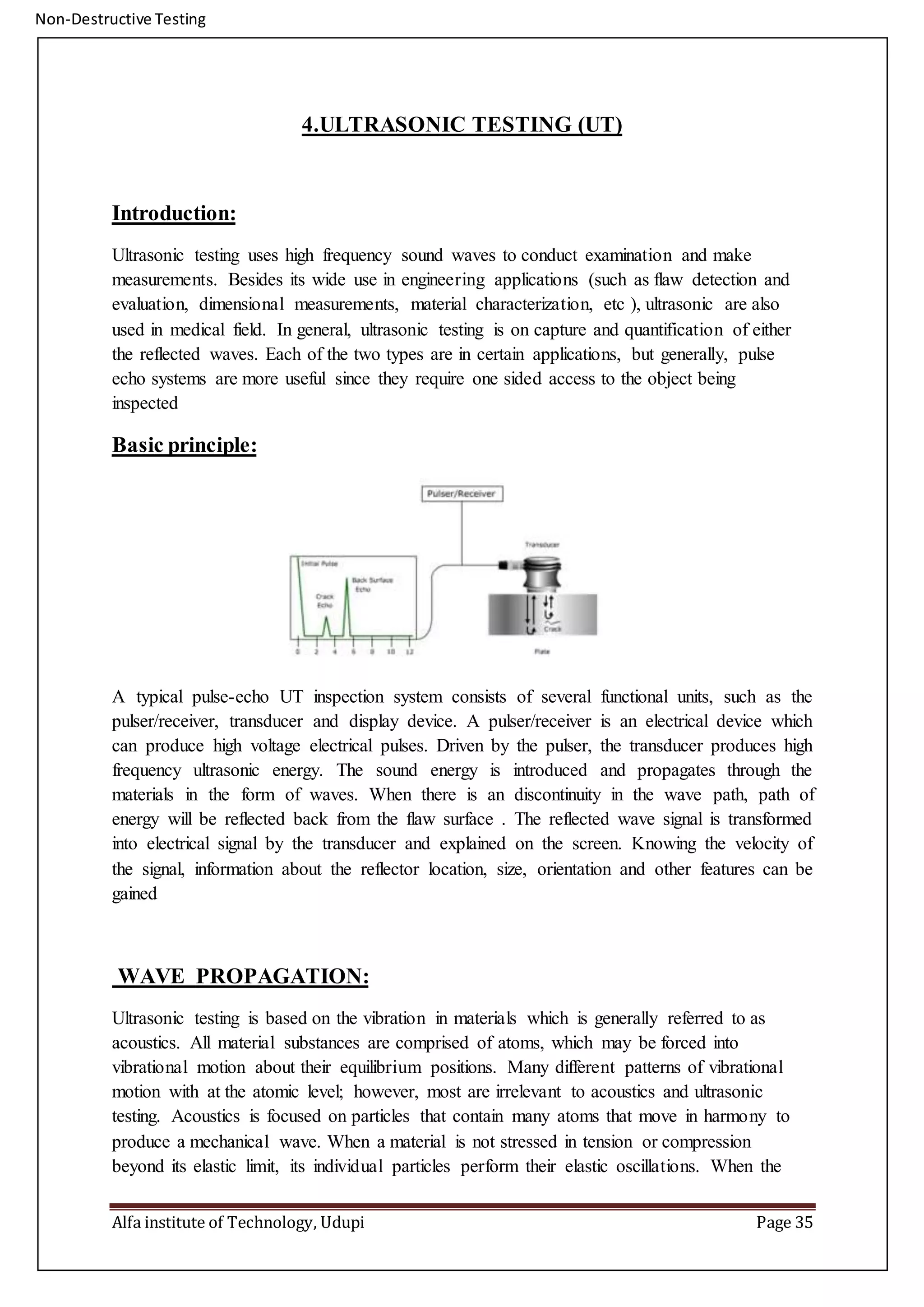
particles of a medium are displaced from their
equilibrium position, internal restoration forces arise.
These elastic restoring between particles lead to the
oscillatory motions of the medium. In solids, sound
waves can propagate in four principal modes that are
based on the way the particles oscillate. Sound can
propagate as longitudinal waves, shear waves surface
waves and in thin materials as plate waves longitudinal
and shear waves are the two modes of propagation used
in the ultrasonic testing as shown in the figure
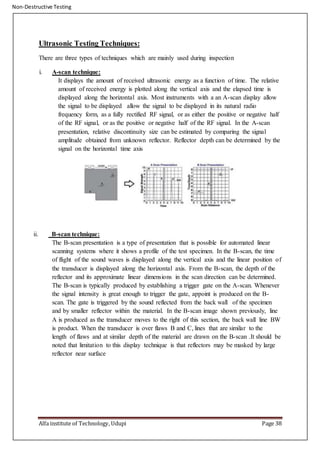
Snell’s law:
It describes the relationship between the angles and the
velocities of the waves. Snell’s law equates the ratio of
material velocities to the ratio of the sine’s of incident and
refracted angles, as shown in the following equation
Transducers:
There are two types of transducer
i. Contact type transducer
ii. Immersion transducer
Piezoelectric transducer (contact type)
The conversion of electrical pulses to mechanical vibrations and conversion of returned
mechanical vibration into electrical energy is the basis of UT .The conversion is done by the
transducer using piezoelectric material with electrodes attached to the two of the opposite
faces .When an electric field is applied across the material, the molecules will align
themselves with the electrical field causing the material to change dimensions. In addition, a
permanently polarized material such as quartz and barium titanate will produce an electric
field the material will change dimensions as a result of imposed mechanical force. The
phenomenon is known as piezoelectric effect
Non-Destructive Testing
Alfa institute of Technology, Udupi Page 37
Characteristicsofpiezoelectric transducer:
The function of transducer is to
convert electrical signal into
mechanical vibration and vice versa
A cut away of typical contact
transducer is shown in the fig. To get
as much as energy out of the
transducer .Optimal impedance
matching is achieved by sizing the
matching layer so that the thickness is ¼ of the desired wavelength. This keeps the waves that
are reflected within the matching layer in the phase when the exit the layer, for this type of
transducer is made up of material which has acoustic impedance similar to that of the active
element and steel, it also has wear plate to protect the matching layer and active element from
scratching
The backing material has greater influence on the damping characteristics of a transducer. As
the mismatch in the impedance between the active element and the backing material
increases, material penetration increases but transducer sensitivity is reduced. The bandwidth
refers to the range of frequencies associated with the transducer. The frequency noted on the
transducer s the central frequency and depends primarily on the backing material. The central
frequency will also define the capabilities of the transducer
Immersion type:
These transducers are designed to operate in the liquid environment and all the connections
are water tight. Immersion transducers usually have an impedance matching layer helps to get
more sound energy into water and in into components being inspected. Immersion
transducers can be purchased with a planer focused or spherically focused lens. A focused
transducer can improve the sensitivity and axial resolution by concentrating the sound energy
to a smaller area. It is used inside a water tank or as part of a squitter or bubbler system in
scanning application
Non-Destructive Testing
Alfa institute of Technology, Udupi Page 38
Ultrasonic Testing Techniques:
There are three types of techniques which are mainly used during inspection
i. A-scan technique:
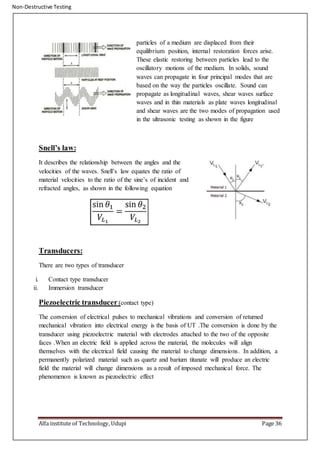
It displays the amount of received ultrasonic energy as a function of time. The relative
amount of received energy is plotted along the vertical axis and the elapsed time is
displayed along the horizontal axis. Most instruments with a an A-scan display allow
the signal to be displayed allow the signal to be displayed in its natural radio
frequency form, as a fully rectified RF signal, or as either the positive or negative half
of the RF signal, or as the positive or negative half of the RF signal. In the A-scan
presentation, relative discontinuity size can be estimated by comparing the signal
amplitude obtained from unknown reflector. Reflector depth can be determined by the
signal on the horizontal time axis
ii. B-scan technique:
The B-scan presentation is a type of presentation that is possible for automated linear
scanning systems where it shows a profile of the test specimen. In the B-scan, the time
of flight of the sound waves is displayed along the vertical axis and the linear position of
the transducer is displayed along the horizontal axis. From the B-scan, the depth of the
reflector and its approximate linear dimensions in the scan direction can be determined.
The B-scan is typically produced by establishing a trigger gate on the A-scan. Whenever
the signal intensity is great enough to trigger the gate, appoint is produced on the B-
scan. The gate is triggered by the sound reflected from the back wall of the specimen
and by smaller reflector within the material. In the B-scan image shown previously, line
A is produced as the transducer moves to the right of this section, the back wall line BW
is product. When the transducer is over flaws B and C, lines that are similar to the
length of flaws and at similar depth of the material are drawn on the B-scan .It should be
noted that limitation to this display technique is that reflectors may be masked by large
reflector near surface
Non-Destructive Testing
Alfa institute of Technology, Udupi Page 39
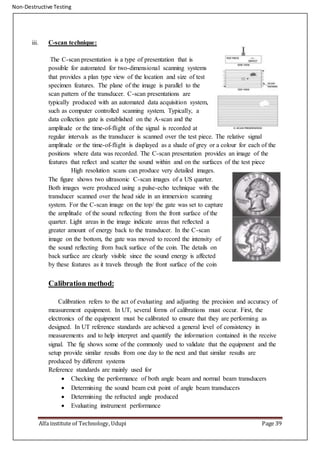
iii. C-scan technique:
The C-scan presentation is a type of presentation that is
possible for automated for two-dimensional scanning systems
that provides a plan type view of the location and size of test
specimen features. The plane of the image is parallel to the
scan pattern of the transducer. C-scan presentations are
typically produced with an automated data acquisition system,
such as computer controlled scanning system. Typically, a
data collection gate is established on the A-scan and the
amplitude or the time-of-flight of the signal is recorded at
regular intervals as the transducer is scanned over the test piece. The relative signal
amplitude or the time-of-flight is displayed as a shade of grey or a colour for each of the
positions where data was recorded. The C-scan presentation provides an image of the
features that reflect and scatter the sound within and on the surfaces of the test piece
High resolution scans can produce very detailed images.
The figure shows two ultrasonic C-scan images of a US quarter.
Both images were produced using a pulse-echo technique with the
transducer scanned over the head side in an immersion scanning
system. For the C-scan image on the top/ the gate was set to capture
the amplitude of the sound reflecting from the front surface of the
quarter. Light areas in the image indicate areas that reflected a
greater amount of energy back to the transducer. In the C-scan
image on the bottom, the gate was moved to record the intensity of
the sound reflecting from back surface of the coin. The details on
back surface are clearly visible since the sound energy is affected
by these features as it travels through the front surface of the coin
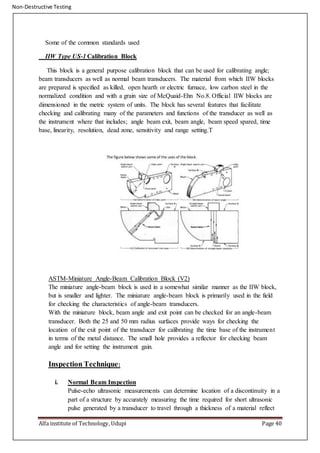
Calibration method:
Calibration refers to the act of evaluating and adjusting the precision and accuracy of
measurement equipment. In UT, several forms of calibrations must occur. First, the
electronics of the equipment must be calibrated to ensure that they are performing as
designed. In UT reference standards are achieved a general level of consistency in
measurements and to help interpret and quantify the information contained in the receive
signal. The fig shows some of the commonly used to validate that the equipment and the
setup provide similar results from one day to the next and that similar results are
produced by different systems
Reference standards are mainly used for
 Checking the performance of both angle beam and normal beam transducers
 Determining the sound beam exit point of angle beam transducers
 Determining the refracted angle produced
 Evaluating instrument performance
Non-Destructive Testing
Alfa institute of Technology, Udupi Page 40
Some of the common standards used
IIW Type US-1 Calibration Block
This block is a general purpose calibration block that can be used for calibrating angle;
beam transducers as well as normal beam transducers. The material from which IIW blocks
are prepared is specified as killed, open hearth or electric furnace, low carbon steel in the
normalized condition and with a grain size of McQuaid-Ehn No.8. Official IIW blocks are
dimensioned in the metric system of units. The block has several features that facilitate
checking and calibrating many of the parameters and functions of the transducer as well as
the instrument where that includes; angle beam exit, beam angle, beam speed spared, time
base, linearity, resolution, dead zone, sensitivity and range setting.T
ASTM-Miniature Angle-Beam Calibration Block (V2)
The miniature angle-beam block is used in a somewhat similar manner as the IIW block,
but is smaller and lighter. The miniature angle-beam block is primarily used in the field
for checking the characteristics of angle-beam transducers.
With the miniature block, beam angle and exit point can be checked for an angle-beam
transducer. Both the 25 and 50 mm radius surfaces provide ways for checking the
location of the exit point of the transducer for calibrating the time base of the instrument
in terms of the metal distance. The small hole provides a reflector for checking beam
angle and for setting the instrument gain.
Inspection Technique:
i. Normal Beam Inspection
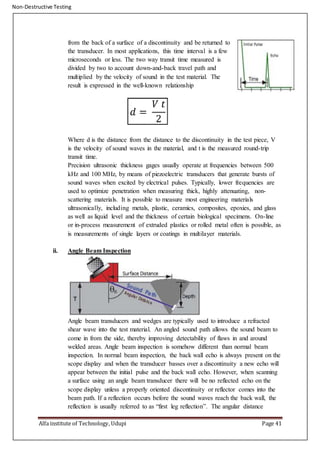
Pulse-echo ultrasonic measurements can determine location of a discontinuity in a
part of a structure by accurately measuring the time required for short ultrasonic
pulse generated by a transducer to travel through a thickness of a material reflect
Non-Destructive Testing
Alfa institute of Technology, Udupi Page 41
from the back of a surface of a discontinuity and be returned to
the transducer. In most applications, this time interval is a few
microseconds or less. The two way transit time measured is
divided by two to account down-and-back travel path and
multiplied by the velocity of sound in the test material. The
result is expressed in the well-known relationship
Where d is the distance from the distance to the discontinuity in the test piece, V
is the velocity of sound waves in the material, and t is the measured round-trip
transit time.
Precision ultrasonic thickness gages usually operate at frequencies between 500
kHz and 100 MHz, by means of piezoelectric transducers that generate bursts of
sound waves when excited by electrical pulses. Typically, lower frequencies are
used to optimize penetration when measuring thick, highly attenuating, non-
scattering materials. It is possible to measure most engineering materials
ultrasonically, including metals, plastic, ceramics, composites, epoxies, and glass
as well as liquid level and the thickness of certain biological specimens. On-line
or in-process measurement of extruded plastics or rolled metal often is possible, as
is measurements of single layers or coatings in multilayer materials.
ii. Angle Beam Inspection
Angle beam transducers and wedges are typically used to introduce a refracted
shear wave into the test material. An angled sound path allows the sound beam to
come in from the side, thereby improving detectability of flaws in and around
welded areas. Angle beam inspection is somehow different than normal beam
inspection. In normal beam inspection, the back wall echo is always present on the
scope display and when the transducer basses over a discontinuity a new echo will
appear between the initial pulse and the back wall echo. However, when scanning
a surface using an angle beam transducer there will be no reflected echo on the
scope display unless a properly oriented discontinuity or reflector comes into the
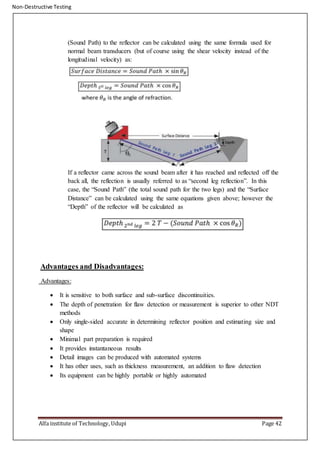
beam path. If a reflection occurs before the sound waves reach the back wall, the
reflection is usually referred to as “first leg reflection”. The angular distance
Non-Destructive Testing
Alfa institute of Technology, Udupi Page 42
(Sound Path) to the reflector can be calculated using the same formula used for
normal beam transducers (but of course using the shear velocity instead of the
longitudinal velocity) as:
If a reflector came across the sound beam after it has reached and reflected off the
back all, the reflection is usually referred to as “second leg reflection”. In this
case, the “Sound Path” (the total sound path for the two legs) and the “Surface
Distance” can be calculated using the same equations given above; however the
“Depth” of the reflector will be calculated as
Advantages and Disadvantages:
Advantages:
 It is sensitive to both surface and sub-surface discontinuities.
 The depth of penetration for flaw detection or measurement is superior to other NDT
methods
 Only single-sided accurate in determining reflector position and estimating size and
shape
 Minimal part preparation is required
 It provides instantaneous results
 Detail images can be produced with automated systems
 It has other uses, such as thickness measurement, an addition to flaw detection
 Its equipment can be highly portable or highly automated
Non-Destructive Testing
Alfa institute of Technology, Udupi Page 43
Disadvantages:
 Surface must be accessible to transmit ultrasound
 Skill and training is more extensive than with some other method
 It normally requires a coupling medium to promote the transfer of sound energy into
the test specimen
 Cast iron and other coarse grains are difficult is difficult due to low sound
transmission and high signal noise
 Linear defects oriented parallel to the sound beam may go undetected
 Reference standards are required to both equipment calibration and the
characterization of flaws

5.ULTRASONIC TESTING

  • 1.
    Non-Destructive Testing Alfa instituteof Technology, Udupi Page 35 4.ULTRASONIC TESTING (UT) Introduction: Ultrasonic testing uses high frequency sound waves to conduct examination and make measurements. Besides its wide use in engineering applications (such as flaw detection and evaluation, dimensional measurements, material characterization, etc ), ultrasonic are also used in medical field. In general, ultrasonic testing is on capture and quantification of either the reflected waves. Each of the two types are in certain applications, but generally, pulse echo systems are more useful since they require one sided access to the object being inspected Basic principle: A typical pulse-echo UT inspection system consists of several functional units, such as the pulser/receiver, transducer and display device. A pulser/receiver is an electrical device which can produce high voltage electrical pulses. Driven by the pulser, the transducer produces high frequency ultrasonic energy. The sound energy is introduced and propagates through the materials in the form of waves. When there is an discontinuity in the wave path, path of energy will be reflected back from the flaw surface . The reflected wave signal is transformed into electrical signal by the transducer and explained on the screen. Knowing the velocity of the signal, information about the reflector location, size, orientation and other features can be gained WAVE PROPAGATION: Ultrasonic testing is based on the vibration in materials which is generally referred to as acoustics. All material substances are comprised of atoms, which may be forced into vibrational motion about their equilibrium positions. Many different patterns of vibrational motion with at the atomic level; however, most are irrelevant to acoustics and ultrasonic testing. Acoustics is focused on particles that contain many atoms that move in harmony to produce a mechanical wave. When a material is not stressed in tension or compression beyond its elastic limit, its individual particles perform their elastic oscillations. When the
  • 2.
    Non-Destructive Testing Alfa instituteof Technology, Udupi Page 36 particles of a medium are displaced from their equilibrium position, internal restoration forces arise. These elastic restoring between particles lead to the oscillatory motions of the medium. In solids, sound waves can propagate in four principal modes that are based on the way the particles oscillate. Sound can propagate as longitudinal waves, shear waves surface waves and in thin materials as plate waves longitudinal and shear waves are the two modes of propagation used in the ultrasonic testing as shown in the figure Snell’s law: It describes the relationship between the angles and the velocities of the waves. Snell’s law equates the ratio of material velocities to the ratio of the sine’s of incident and refracted angles, as shown in the following equation Transducers: There are two types of transducer i. Contact type transducer ii. Immersion transducer Piezoelectric transducer (contact type) The conversion of electrical pulses to mechanical vibrations and conversion of returned mechanical vibration into electrical energy is the basis of UT .The conversion is done by the transducer using piezoelectric material with electrodes attached to the two of the opposite faces .When an electric field is applied across the material, the molecules will align themselves with the electrical field causing the material to change dimensions. In addition, a permanently polarized material such as quartz and barium titanate will produce an electric field the material will change dimensions as a result of imposed mechanical force. The phenomenon is known as piezoelectric effect
  • 3.
    Non-Destructive Testing Alfa instituteof Technology, Udupi Page 37 Characteristicsofpiezoelectric transducer: The function of transducer is to convert electrical signal into mechanical vibration and vice versa A cut away of typical contact transducer is shown in the fig. To get as much as energy out of the transducer .Optimal impedance matching is achieved by sizing the matching layer so that the thickness is ¼ of the desired wavelength. This keeps the waves that are reflected within the matching layer in the phase when the exit the layer, for this type of transducer is made up of material which has acoustic impedance similar to that of the active element and steel, it also has wear plate to protect the matching layer and active element from scratching The backing material has greater influence on the damping characteristics of a transducer. As the mismatch in the impedance between the active element and the backing material increases, material penetration increases but transducer sensitivity is reduced. The bandwidth refers to the range of frequencies associated with the transducer. The frequency noted on the transducer s the central frequency and depends primarily on the backing material. The central frequency will also define the capabilities of the transducer Immersion type: These transducers are designed to operate in the liquid environment and all the connections are water tight. Immersion transducers usually have an impedance matching layer helps to get more sound energy into water and in into components being inspected. Immersion transducers can be purchased with a planer focused or spherically focused lens. A focused transducer can improve the sensitivity and axial resolution by concentrating the sound energy to a smaller area. It is used inside a water tank or as part of a squitter or bubbler system in scanning application
  • 4.
    Non-Destructive Testing Alfa instituteof Technology, Udupi Page 38 Ultrasonic Testing Techniques: There are three types of techniques which are mainly used during inspection i. A-scan technique: It displays the amount of received ultrasonic energy as a function of time. The relative amount of received energy is plotted along the vertical axis and the elapsed time is displayed along the horizontal axis. Most instruments with a an A-scan display allow the signal to be displayed allow the signal to be displayed in its natural radio frequency form, as a fully rectified RF signal, or as either the positive or negative half of the RF signal, or as the positive or negative half of the RF signal. In the A-scan presentation, relative discontinuity size can be estimated by comparing the signal amplitude obtained from unknown reflector. Reflector depth can be determined by the signal on the horizontal time axis ii. B-scan technique: The B-scan presentation is a type of presentation that is possible for automated linear scanning systems where it shows a profile of the test specimen. In the B-scan, the time of flight of the sound waves is displayed along the vertical axis and the linear position of the transducer is displayed along the horizontal axis. From the B-scan, the depth of the reflector and its approximate linear dimensions in the scan direction can be determined. The B-scan is typically produced by establishing a trigger gate on the A-scan. Whenever the signal intensity is great enough to trigger the gate, appoint is produced on the B- scan. The gate is triggered by the sound reflected from the back wall of the specimen and by smaller reflector within the material. In the B-scan image shown previously, line A is produced as the transducer moves to the right of this section, the back wall line BW is product. When the transducer is over flaws B and C, lines that are similar to the length of flaws and at similar depth of the material are drawn on the B-scan .It should be noted that limitation to this display technique is that reflectors may be masked by large reflector near surface
  • 5.
    Non-Destructive Testing Alfa instituteof Technology, Udupi Page 39 iii. C-scan technique: The C-scan presentation is a type of presentation that is possible for automated for two-dimensional scanning systems that provides a plan type view of the location and size of test specimen features. The plane of the image is parallel to the scan pattern of the transducer. C-scan presentations are typically produced with an automated data acquisition system, such as computer controlled scanning system. Typically, a data collection gate is established on the A-scan and the amplitude or the time-of-flight of the signal is recorded at regular intervals as the transducer is scanned over the test piece. The relative signal amplitude or the time-of-flight is displayed as a shade of grey or a colour for each of the positions where data was recorded. The C-scan presentation provides an image of the features that reflect and scatter the sound within and on the surfaces of the test piece High resolution scans can produce very detailed images. The figure shows two ultrasonic C-scan images of a US quarter. Both images were produced using a pulse-echo technique with the transducer scanned over the head side in an immersion scanning system. For the C-scan image on the top/ the gate was set to capture the amplitude of the sound reflecting from the front surface of the quarter. Light areas in the image indicate areas that reflected a greater amount of energy back to the transducer. In the C-scan image on the bottom, the gate was moved to record the intensity of the sound reflecting from back surface of the coin. The details on back surface are clearly visible since the sound energy is affected by these features as it travels through the front surface of the coin Calibration method: Calibration refers to the act of evaluating and adjusting the precision and accuracy of measurement equipment. In UT, several forms of calibrations must occur. First, the electronics of the equipment must be calibrated to ensure that they are performing as designed. In UT reference standards are achieved a general level of consistency in measurements and to help interpret and quantify the information contained in the receive signal. The fig shows some of the commonly used to validate that the equipment and the setup provide similar results from one day to the next and that similar results are produced by different systems Reference standards are mainly used for  Checking the performance of both angle beam and normal beam transducers  Determining the sound beam exit point of angle beam transducers  Determining the refracted angle produced  Evaluating instrument performance
  • 6.
    Non-Destructive Testing Alfa instituteof Technology, Udupi Page 40 Some of the common standards used IIW Type US-1 Calibration Block This block is a general purpose calibration block that can be used for calibrating angle; beam transducers as well as normal beam transducers. The material from which IIW blocks are prepared is specified as killed, open hearth or electric furnace, low carbon steel in the normalized condition and with a grain size of McQuaid-Ehn No.8. Official IIW blocks are dimensioned in the metric system of units. The block has several features that facilitate checking and calibrating many of the parameters and functions of the transducer as well as the instrument where that includes; angle beam exit, beam angle, beam speed spared, time base, linearity, resolution, dead zone, sensitivity and range setting.T ASTM-Miniature Angle-Beam Calibration Block (V2) The miniature angle-beam block is used in a somewhat similar manner as the IIW block, but is smaller and lighter. The miniature angle-beam block is primarily used in the field for checking the characteristics of angle-beam transducers. With the miniature block, beam angle and exit point can be checked for an angle-beam transducer. Both the 25 and 50 mm radius surfaces provide ways for checking the location of the exit point of the transducer for calibrating the time base of the instrument in terms of the metal distance. The small hole provides a reflector for checking beam angle and for setting the instrument gain. Inspection Technique: i. Normal Beam Inspection Pulse-echo ultrasonic measurements can determine location of a discontinuity in a part of a structure by accurately measuring the time required for short ultrasonic pulse generated by a transducer to travel through a thickness of a material reflect
  • 7.
    Non-Destructive Testing Alfa instituteof Technology, Udupi Page 41 from the back of a surface of a discontinuity and be returned to the transducer. In most applications, this time interval is a few microseconds or less. The two way transit time measured is divided by two to account down-and-back travel path and multiplied by the velocity of sound in the test material. The result is expressed in the well-known relationship Where d is the distance from the distance to the discontinuity in the test piece, V is the velocity of sound waves in the material, and t is the measured round-trip transit time. Precision ultrasonic thickness gages usually operate at frequencies between 500 kHz and 100 MHz, by means of piezoelectric transducers that generate bursts of sound waves when excited by electrical pulses. Typically, lower frequencies are used to optimize penetration when measuring thick, highly attenuating, non- scattering materials. It is possible to measure most engineering materials ultrasonically, including metals, plastic, ceramics, composites, epoxies, and glass as well as liquid level and the thickness of certain biological specimens. On-line or in-process measurement of extruded plastics or rolled metal often is possible, as is measurements of single layers or coatings in multilayer materials. ii. Angle Beam Inspection Angle beam transducers and wedges are typically used to introduce a refracted shear wave into the test material. An angled sound path allows the sound beam to come in from the side, thereby improving detectability of flaws in and around welded areas. Angle beam inspection is somehow different than normal beam inspection. In normal beam inspection, the back wall echo is always present on the scope display and when the transducer basses over a discontinuity a new echo will appear between the initial pulse and the back wall echo. However, when scanning a surface using an angle beam transducer there will be no reflected echo on the scope display unless a properly oriented discontinuity or reflector comes into the beam path. If a reflection occurs before the sound waves reach the back wall, the reflection is usually referred to as “first leg reflection”. The angular distance
  • 8.
    Non-Destructive Testing Alfa instituteof Technology, Udupi Page 42 (Sound Path) to the reflector can be calculated using the same formula used for normal beam transducers (but of course using the shear velocity instead of the longitudinal velocity) as: If a reflector came across the sound beam after it has reached and reflected off the back all, the reflection is usually referred to as “second leg reflection”. In this case, the “Sound Path” (the total sound path for the two legs) and the “Surface Distance” can be calculated using the same equations given above; however the “Depth” of the reflector will be calculated as Advantages and Disadvantages: Advantages:  It is sensitive to both surface and sub-surface discontinuities.  The depth of penetration for flaw detection or measurement is superior to other NDT methods  Only single-sided accurate in determining reflector position and estimating size and shape  Minimal part preparation is required  It provides instantaneous results  Detail images can be produced with automated systems  It has other uses, such as thickness measurement, an addition to flaw detection  Its equipment can be highly portable or highly automated
  • 9.
    Non-Destructive Testing Alfa instituteof Technology, Udupi Page 43 Disadvantages:  Surface must be accessible to transmit ultrasound  Skill and training is more extensive than with some other method  It normally requires a coupling medium to promote the transfer of sound energy into the test specimen  Cast iron and other coarse grains are difficult is difficult due to low sound transmission and high signal noise  Linear defects oriented parallel to the sound beam may go undetected  Reference standards are required to both equipment calibration and the characterization of flaws