KONSEP YANG BEREVOLUSI
by: AGB
Konsep dan Lingkup
Technopreneurship
Kewirausahaan….
• Keahlian memulai atau menguatkan sebuah bisnis
dalam mengidentifikasi peluang.
• Mencegah kegagalan pada bisnis baru.
• Keberanian menciptakan dan mengambil berbagai
peluang bisnis.
• Orang yang mampu secara kreatif menembus
pasar dan industri yang secara terus-menerus
menghasilkan produk baru dan model-model
bisnis.
• orang yang mampu dan dapat merubah ide baru
atau invensi menjadi inovasi yang berhasil.
• Orang yang berani mengambil resiko dalam
ketidakpastian.
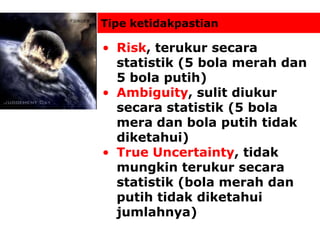
• Risk, terukur secara
statistik (5 bola merah dan
5 bola putih)
• Ambiguity, sulit diukur
secara statistik (5 bola
mera dan bola putih tidak
diketahui)
• True Uncertainty, tidak
mungkin terukur secara
statistik (bola merah dan
putih tidak diketahui
jumlahnya)
Tipe ketidakpastian
wirausaha True uncertainty
Sebelum ada internet, tidak ada orang yang
tahu kalo web seperti Amazon, Google,
YouTube, Yahoo dan lain-lain merupakan
peluang pasar yang luar biasa
Kalaupun pasar sudah eksis, tapi tidak ada
orang yang menjamin bahwa Coca Cola
berkembang dengan pesat
The question is: whether a market exists and if
it exists for you.
Entrepreneurship is widely regarded as an integral player in the
business culture of American life, and particularly as an engine for
job creation and economic growth.
(Robert Sobel published The Entrepreneurs: Explorations Within the American Business Tradition)
DEFINISI Wirausaha
Wirausaha adalah ahlinya
mengambil resiko (Cantillon, 1697)
Wirausaha adalah individu
yang berorientasi pada
tindakan dan bermotivasi
tinggi, serta berani mengambil
resiko dalam mengejar
tujuannya (Meredith, 1996)
DEFINISI Wirausaha
“Someone who runs a business at his
own financial Risk” (Webster Dictionary)
“One who organizes, manages, and
assumes the risks of a business or
enterprise” (Merriem Webster Dictionary)
“Orang yang mengawinkan ide-ide
kreatif dengan tindakan yang
bertujuan dan berstruktur dari bisnis”
(Zimmerer and Scarborough)
EVOLUSI
“KEWIRAUSAHAAN”
• Saat ini, ENTREPRENUER diartikan juga
sebagai seorang INOVATOR, PENGGERAK
PEMBANGUNAN, yang akan merubah
PELUANG menjadi IDE yang dapat dijual, dan
PENINGKATAN NILAI TAMBAH melalui
efisiensi waktu, tenaga kerja, uang dan
peningkatan keterampilan.
• Seorang “ENTREPRENEUR” merupakan
“KATALIS” yang agresif untuk perubahan
bisnis dan pertumbuhan ekonomi dunia
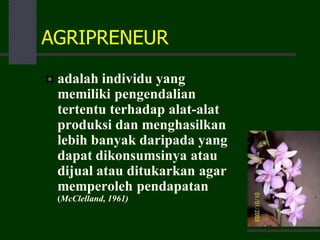
AGRIPRENEUR
adalah individu yang
memiliki pengendalian
tertentu terhadap alat-alat
produksi dan menghasilkan
lebih banyak daripada yang
dapat dikonsumsinya atau
dijual atau ditukarkan agar
memperoleh pendapatan
(McClelland, 1961)
TECHNOPRENEUR
adalah pencipta kekayaan
melalui inovasi, teknologi,
pertumbuhan pekerjaan
dan ekonomi, dan
pembagian kekayaan yang
bergantung pada kerja
keras dan pengambilan
resiko (Bygrave, 1987)
 ENTREPRENEURSHIP TIDAK HANYA SEKEDAR ORANG YANG
MENGELOLA BISNIS SAJA SECARA RUTIN AKAN TETAPI
BERKAITAN JUGA DENGAN KEPEMIMPINAN (JOSEPH
SCHUMPETER, 1951)
 ENTREPERNEURSHIP DIDALAMNYA TERDAPAT PRILAKU: (1)
MENGAMBIL INISIATIF, (2) MENGORGANISASI SUMBERDAYA
MELALUI MEKANISME SISTEM EKONOMI DAN SOSIAL, DAN
(3) KEINGINAN UNTUK MENGAMBIL RESIKO DAN MENERIMA
KEGAGALAN (ALBERT SHAPERO, 1975)
DEFINISI
ENTREPRENEURSHIP
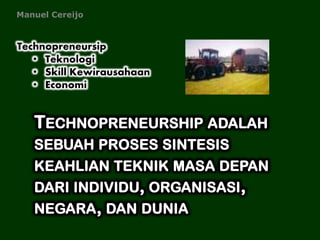
TECHNOPRENEURSHIP ADALAH
SEBUAH PROSES SINTESIS
KEAHLIAN TEKNIK MASA DEPAN
DARI INDIVIDU, ORGANISASI,
NEGARA, DAN DUNIA
Technopreneursip
• Teknologi
• Skill Kewirausahaan
• Economi
Manuel Cereijo
• proses dinamis untuk
menciptakan kekayaan secara
bertahap. Kekayaan diciptakan
oleh orang yang mengasumsikan
bahwa resiko, waktu, dan karir
merupakan komitmen dari nilai
barang atau jasa. Bisa jadi
barang atau jasa itu tidak baru
atau tidak unik, yang pasti nilai
yang didapat berasal dari
kemampuan dalam mengalokasi
sumberdaya dan tingkat skill
orang tersebut (Robert C. Ronstadt )
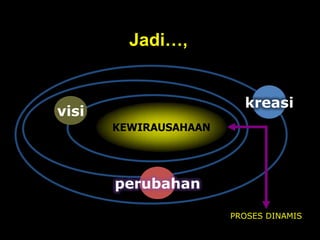
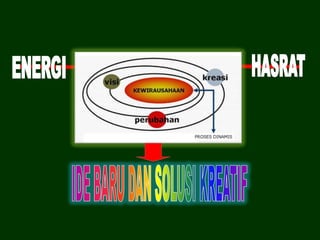
Jadi…,
visi
perubahan
kreasi
KEWIRAUSAHAAN
PROSES DINAMIS
• KEMAUAN UNTUK
MENGAMBIL RESIKO YANG
DIPERHITUNGKAN, DALAM
ARTI WAKTU, EKUITAS ATAU
KARIR;
• KEMAMPUAN MERUMUSKAN
KERJASAMA TIM YANG
EFEKTIF;
• KREATIVITAS MENGELOLA
SUMBERDAYA YANG
DIBUTUHKAN;
• KETERAMPILAN DASAR
MEMBANGUN “A SOLID
BUSINESS PLAN”;
• VISI MENGENALI PELUANG
PADA SAAT SITUASI DAN
KONDISI TIDAK NORMAL.
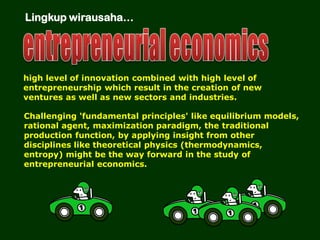
Lingkup wirausaha…
high level of innovation combined with high level of
entrepreneurship which result in the creation of new
ventures as well as new sectors and industries.
Challenging 'fundamental principles' like equilibrium models,
rational agent, maximization paradigm, the traditional
production function, by applying insight from other
disciplines like theoretical physics (thermodynamics,
entropy) might be the way forward in the study of
entrepreneurial economics.
A political entrepreneur refers to a political player who seeks to gain certain political
and social benefits in return for providing the common goods that can be shared by
an unorganized general public. These common goods that political entrepreneurs
attempt to provide to the populace generally include foreign-and domestic-related
public policy, while the benefits they hope to gain involve voter support, public
recognition, and personal popularity.
The term Political entrepreneur may refer to any of the following:
• someone (usually active in the fields of either politics or business) who
founds a new political project, group, or political party
• a businessman who seeks to gain profit through subsidies, protectionism,
government contracts, or other such favorable arrangements with
government(s) through political influence.
• a political actor (not necessarily a politician) who seeks to further his or
her own political career and popularity by pursuing the creation of policy
that pleases the populace.
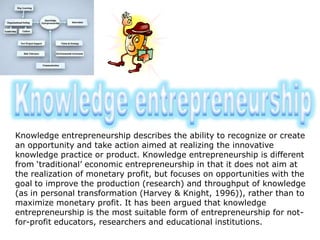
Knowledge entrepreneurship describes the ability to recognize or create
an opportunity and take action aimed at realizing the innovative
knowledge practice or product. Knowledge entrepreneurship is different
from ‘traditional’ economic entrepreneurship in that it does not aim at
the realization of monetary profit, but focuses on opportunities with the
goal to improve the production (research) and throughput of knowledge
(as in personal transformation (Harvey & Knight, 1996)), rather than to
maximize monetary profit. It has been argued that knowledge
entrepreneurship is the most suitable form of entrepreneurship for not-
for-profit educators, researchers and educational institutions.
Social entrepreneurship is the work of a social entrepreneur. A
social entrepreneur is someone who recognizes a social problem
and uses entrepreneurial principles to organize, create, and manage
a venture to make social change. Whereas a business entrepreneur
typically measures performance in profit and return, a social
entrepreneur assesses success in terms of the impact s/he has on
society. While social entrepreneurs often work through nonprofits
and citizen groups, many work in the private and governmental
sectors.
Nonprofits and non-governmental organizations, foundations,
governments and individuals promote, fund, and advise social
entrepreneurs around the planet. A growing number of colleges and
universities are establishing programs focused on educating and
training social entrepreneurs.
Entrepreneurship education seeks to provide
students with the knowledge, skills and motivation
to encourage entrepreneurial success in a variety
of settings. Variations of entrepreneurship
education are offered at all levels of schooling
from senior schools through graduate university
programs.
Digital Entrepreneurship represents a
category of Entrepreneurship that leverages
new technologies in novel ways such as the
Internet Communications Technology. A digital
entrepreneur is an individual who uses the
Internet as a tool to create commercial
opportunities, disseminate information, and
collaborate with clients and partners.
Intrapreneurship is the practice of using entrepreneurial
skills without taking on the risks or accountability associated
with entrepreneurial activities. It is practiced by employees
within an established organization using a systemised business
model. Employees, perhaps engaged in a special project within
a larger firm are supposed to behave as entrepreneurs, even
though they have the resources and capabilities of the larger
firm to draw upon. Capturing the dynamic nature of
entrepreneurial management (trying things until successful,
learning from failures, attempting to conserve resources, etc.)
adds to the potential of an otherwise static organizations
without exposing those employees or self employed people to
the risks or accountability normally associated with
entrepreneurial failure.
terimakasih

konsep

  • 1.
    KONSEP YANG BEREVOLUSI by:AGB Konsep dan Lingkup Technopreneurship
  • 2.
    Kewirausahaan…. • Keahlian memulaiatau menguatkan sebuah bisnis dalam mengidentifikasi peluang. • Mencegah kegagalan pada bisnis baru. • Keberanian menciptakan dan mengambil berbagai peluang bisnis. • Orang yang mampu secara kreatif menembus pasar dan industri yang secara terus-menerus menghasilkan produk baru dan model-model bisnis. • orang yang mampu dan dapat merubah ide baru atau invensi menjadi inovasi yang berhasil. • Orang yang berani mengambil resiko dalam ketidakpastian.
  • 3.
    • Risk, terukursecara statistik (5 bola merah dan 5 bola putih) • Ambiguity, sulit diukur secara statistik (5 bola mera dan bola putih tidak diketahui) • True Uncertainty, tidak mungkin terukur secara statistik (bola merah dan putih tidak diketahui jumlahnya) Tipe ketidakpastian
  • 4.
    wirausaha True uncertainty Sebelumada internet, tidak ada orang yang tahu kalo web seperti Amazon, Google, YouTube, Yahoo dan lain-lain merupakan peluang pasar yang luar biasa Kalaupun pasar sudah eksis, tapi tidak ada orang yang menjamin bahwa Coca Cola berkembang dengan pesat The question is: whether a market exists and if it exists for you. Entrepreneurship is widely regarded as an integral player in the business culture of American life, and particularly as an engine for job creation and economic growth. (Robert Sobel published The Entrepreneurs: Explorations Within the American Business Tradition)
  • 5.
    DEFINISI Wirausaha Wirausaha adalahahlinya mengambil resiko (Cantillon, 1697) Wirausaha adalah individu yang berorientasi pada tindakan dan bermotivasi tinggi, serta berani mengambil resiko dalam mengejar tujuannya (Meredith, 1996)
  • 6.
    DEFINISI Wirausaha “Someone whoruns a business at his own financial Risk” (Webster Dictionary) “One who organizes, manages, and assumes the risks of a business or enterprise” (Merriem Webster Dictionary) “Orang yang mengawinkan ide-ide kreatif dengan tindakan yang bertujuan dan berstruktur dari bisnis” (Zimmerer and Scarborough)
  • 7.
    EVOLUSI “KEWIRAUSAHAAN” • Saat ini,ENTREPRENUER diartikan juga sebagai seorang INOVATOR, PENGGERAK PEMBANGUNAN, yang akan merubah PELUANG menjadi IDE yang dapat dijual, dan PENINGKATAN NILAI TAMBAH melalui efisiensi waktu, tenaga kerja, uang dan peningkatan keterampilan. • Seorang “ENTREPRENEUR” merupakan “KATALIS” yang agresif untuk perubahan bisnis dan pertumbuhan ekonomi dunia
  • 8.
    AGRIPRENEUR adalah individu yang memilikipengendalian tertentu terhadap alat-alat produksi dan menghasilkan lebih banyak daripada yang dapat dikonsumsinya atau dijual atau ditukarkan agar memperoleh pendapatan (McClelland, 1961)
  • 9.
    TECHNOPRENEUR adalah pencipta kekayaan melaluiinovasi, teknologi, pertumbuhan pekerjaan dan ekonomi, dan pembagian kekayaan yang bergantung pada kerja keras dan pengambilan resiko (Bygrave, 1987)
  • 10.
     ENTREPRENEURSHIP TIDAKHANYA SEKEDAR ORANG YANG MENGELOLA BISNIS SAJA SECARA RUTIN AKAN TETAPI BERKAITAN JUGA DENGAN KEPEMIMPINAN (JOSEPH SCHUMPETER, 1951)  ENTREPERNEURSHIP DIDALAMNYA TERDAPAT PRILAKU: (1) MENGAMBIL INISIATIF, (2) MENGORGANISASI SUMBERDAYA MELALUI MEKANISME SISTEM EKONOMI DAN SOSIAL, DAN (3) KEINGINAN UNTUK MENGAMBIL RESIKO DAN MENERIMA KEGAGALAN (ALBERT SHAPERO, 1975) DEFINISI ENTREPRENEURSHIP
  • 11.
    TECHNOPRENEURSHIP ADALAH SEBUAH PROSESSINTESIS KEAHLIAN TEKNIK MASA DEPAN DARI INDIVIDU, ORGANISASI, NEGARA, DAN DUNIA Technopreneursip • Teknologi • Skill Kewirausahaan • Economi Manuel Cereijo
  • 12.
    • proses dinamisuntuk menciptakan kekayaan secara bertahap. Kekayaan diciptakan oleh orang yang mengasumsikan bahwa resiko, waktu, dan karir merupakan komitmen dari nilai barang atau jasa. Bisa jadi barang atau jasa itu tidak baru atau tidak unik, yang pasti nilai yang didapat berasal dari kemampuan dalam mengalokasi sumberdaya dan tingkat skill orang tersebut (Robert C. Ronstadt )
  • 13.
  • 15.
    • KEMAUAN UNTUK MENGAMBILRESIKO YANG DIPERHITUNGKAN, DALAM ARTI WAKTU, EKUITAS ATAU KARIR; • KEMAMPUAN MERUMUSKAN KERJASAMA TIM YANG EFEKTIF; • KREATIVITAS MENGELOLA SUMBERDAYA YANG DIBUTUHKAN; • KETERAMPILAN DASAR MEMBANGUN “A SOLID BUSINESS PLAN”; • VISI MENGENALI PELUANG PADA SAAT SITUASI DAN KONDISI TIDAK NORMAL.
  • 16.
    Lingkup wirausaha… high levelof innovation combined with high level of entrepreneurship which result in the creation of new ventures as well as new sectors and industries. Challenging 'fundamental principles' like equilibrium models, rational agent, maximization paradigm, the traditional production function, by applying insight from other disciplines like theoretical physics (thermodynamics, entropy) might be the way forward in the study of entrepreneurial economics.
  • 17.
    A political entrepreneurrefers to a political player who seeks to gain certain political and social benefits in return for providing the common goods that can be shared by an unorganized general public. These common goods that political entrepreneurs attempt to provide to the populace generally include foreign-and domestic-related public policy, while the benefits they hope to gain involve voter support, public recognition, and personal popularity. The term Political entrepreneur may refer to any of the following: • someone (usually active in the fields of either politics or business) who founds a new political project, group, or political party • a businessman who seeks to gain profit through subsidies, protectionism, government contracts, or other such favorable arrangements with government(s) through political influence. • a political actor (not necessarily a politician) who seeks to further his or her own political career and popularity by pursuing the creation of policy that pleases the populace.
  • 18.
    Knowledge entrepreneurship describesthe ability to recognize or create an opportunity and take action aimed at realizing the innovative knowledge practice or product. Knowledge entrepreneurship is different from ‘traditional’ economic entrepreneurship in that it does not aim at the realization of monetary profit, but focuses on opportunities with the goal to improve the production (research) and throughput of knowledge (as in personal transformation (Harvey & Knight, 1996)), rather than to maximize monetary profit. It has been argued that knowledge entrepreneurship is the most suitable form of entrepreneurship for not- for-profit educators, researchers and educational institutions.
  • 19.
    Social entrepreneurship isthe work of a social entrepreneur. A social entrepreneur is someone who recognizes a social problem and uses entrepreneurial principles to organize, create, and manage a venture to make social change. Whereas a business entrepreneur typically measures performance in profit and return, a social entrepreneur assesses success in terms of the impact s/he has on society. While social entrepreneurs often work through nonprofits and citizen groups, many work in the private and governmental sectors. Nonprofits and non-governmental organizations, foundations, governments and individuals promote, fund, and advise social entrepreneurs around the planet. A growing number of colleges and universities are establishing programs focused on educating and training social entrepreneurs.
  • 20.
    Entrepreneurship education seeksto provide students with the knowledge, skills and motivation to encourage entrepreneurial success in a variety of settings. Variations of entrepreneurship education are offered at all levels of schooling from senior schools through graduate university programs.
  • 21.
    Digital Entrepreneurship representsa category of Entrepreneurship that leverages new technologies in novel ways such as the Internet Communications Technology. A digital entrepreneur is an individual who uses the Internet as a tool to create commercial opportunities, disseminate information, and collaborate with clients and partners.
  • 22.
    Intrapreneurship is thepractice of using entrepreneurial skills without taking on the risks or accountability associated with entrepreneurial activities. It is practiced by employees within an established organization using a systemised business model. Employees, perhaps engaged in a special project within a larger firm are supposed to behave as entrepreneurs, even though they have the resources and capabilities of the larger firm to draw upon. Capturing the dynamic nature of entrepreneurial management (trying things until successful, learning from failures, attempting to conserve resources, etc.) adds to the potential of an otherwise static organizations without exposing those employees or self employed people to the risks or accountability normally associated with entrepreneurial failure.
  • 23.