






Entrpreneurship
Development
Presented to
Prof. Dr. Kazi Ahmed Nabi
Dean, FBA, USTC
Todays Topics
 Characteristics Attributed to Entrpreneurs
 Types of Entrepreneurship
 Entrepreneur versus Management
 National Benefits of Entrepreneurship
Definition
'Entrepreneur'
An individual who, rather than working as
an employee, runs a small business and
assumes all the risk and reward of a given
business venture, idea, or good or service
offered for sale.
‘Entrepreneurship’
The ability of a person to see a business
opportunity, to get together the capital
needed to take advantage of the opportunity
and to start a business taking the risk of
failure in the hope of reaping the rewards of
success.
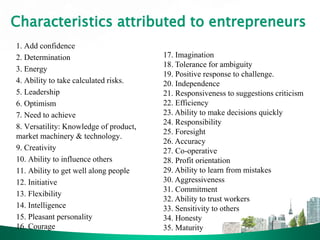
Characteristics attributed to entrepreneurs
1. Add confidence
2. Determination
3. Energy
4. Ability to take calculated risks.
5. Leadership
6. Optimism
7. Need to achieve
8. Versatility: Knowledge of product,
market machinery & technology.
9. Creativity
10. Ability to influence others
11. Ability to get well along people
12. Initiative
13. Flexibility
14. Intelligence
15. Pleasant personality
16. Courage
17. Imagination
18. Tolerance for ambiguity
19. Positive response to challenge.
20. Independence
21. Responsiveness to suggestions criticism
22. Efficiency
23. Ability to make decisions quickly
24. Responsibility
25. Foresight
26. Accuracy
27. Co-operative
28. Profit orientation
29. Ability to learn from mistakes
30. Aggressiveness
31. Commitment
32. Ability to trust workers
33. Sensitivity to others
34. Honesty
35. Maturity
Attributes that successful entrepreneurs tend to possess
 Being an entrepreneur requires much more than just big ideas. A true
entrepreneur is a rare breed; it’s someone who possesses a unique cocktail of
traits, skills and characteristics that enable them to beat the odds and go after
their dreams full throttle. But what are those attributes? What does an
entrepreneur need to succeed?
 They’re goal-orientated:
Entrepreneurs are all about setting goals and
putting their all into achieving them; they’re
determined to make their business succeed
and will remove any encumbrances that may
stand in their way.
 They’re committed to their business:
Entrepreneurs are not easily defeated; they
view failure as an opportunity for future
success.
Attributes that successful entrepreneurs tend to possess (cont...)
 They’re hands-on:
Entrepreneurs are inherently proactive,
and know that if something really needs to
get done, they should do it themselves.
They’re ‘doers’, not thinkers, and tend to
have very exacting standards.
They thrive on uncertainty:
Not only do they thrive on it—they
also remain calm throughout it.
Attributes that successful entrepreneurs tend to possess
(cont...)
 They continuously look for
opportunities to improve:
They have the ability to look at everything
around them and focus it toward their goals
in an effort to improve their business.
 They’re willing to take risks:
A true entrepreneur doesn’t ask questions
about whether or not they’ll succeed—they
truly believe they will.
 They’re inherently creative:
They’re able to not only come up with
ingenious ideas, but also turn those ideas
into profits.
Types of Entrepreneurship
Five types of entrepreneurs
1. Administrative entrepreneurship
It is the joint efforts of both the general management
and scientific technical personnel to identify areas for
R & D and the development of new products,
techniques or the improvement of existing ones.
2. Opportunistic Entrepreneurship
Ability to catch at the right time the fruits of the
internal as well as external technological
developments.
3. Incubative Entrepreneurship
This is nothing but the ability to initiate and nurture
new venture developments within the original
company with special care.
Types of Entrepreneurship (cont...)
4. Imitative technical Entrepreneurship
This stresses the replication or creative imitation
of innovative technical achievements made by
another firm ---done with appropriate
modifications and refinements in case protected
property right are involved.
5. Acquisitive Entrepreneurship
This is the ability of the internal management/
entrepreneurs to acquire competitors technical
capabilities.
Entrepreneur Versus Management
In 1980, Thomas Beglay and David P Boyd identified five dimensions
of distinctions between Entrepreneurs and Managers. These are:
1. Need – Achievement: High in case of entrepreneurs while
managers are with moderate scale.
2. Locus of Control: Both of them feel that not luck or fate but
themselves control their own lives.
3. Tolerance for Ambiguity: Every manager faces some amount of
ambiguity but entrepreneurs face more as they take more risk.
4. Tolerance for Risk: Entrepreneurs bear moderate risk and in case
of others it is limited only with reference to their jobs.
Entrepreneur versus Management (cont...)
5. Type “A” behavior: This refers to the
drive to get more in less time. Both the groups
have this type of behavior.
• Entrpreneur tend to value self respect, freedom, a
sense of acomplishment and exciting life style.
• Manager tend value true friendship, wisedom,
salvation and pleasure.
• Entrepreneurship are individual who
i. concieve the idea for a new business venture;
ii. gather the necessary inputs to the venture;
iii. start the operation and grow it; and
iv. bear the rik of starting and operating the venture.
• Professional managers on the other hand, are hired to
perform the basic management functions of the ongoing
and the growing organization.
National Benefits of
Entrepreneurship
Entrepreneurship has at least four national benefits: These are under:
1. Fosters economic growth: In the USA ¾ ths and in our country
most of the new jobs are provided by the entrepreneurs.
2. Creates new technologies, products & services: Entrepreneurship
play a very vital role in promoting innovative technologies, products,
and services. Sometimes one entrepreneurial invention gives rise to
many others.
3. Changes and rejuvenates market competition: Entrepreneurs stir
up the waters of competition in the marketplace. The international
market also provides entrepreneurial opportunities for companies.
4. Increases productivity: Entrepreneurship has been recognized for
its dynamic role in raising productivity. Higher productivity is simply
a matter of improving production techniques.
Presented by
MEHEDI HASAN
Class ID: 1114
7th Semester

Entrepreneurship Development

  • 1.
  • 2.
    Todays Topics  CharacteristicsAttributed to Entrpreneurs  Types of Entrepreneurship  Entrepreneur versus Management  National Benefits of Entrepreneurship
  • 3.
    Definition 'Entrepreneur' An individual who,rather than working as an employee, runs a small business and assumes all the risk and reward of a given business venture, idea, or good or service offered for sale. ‘Entrepreneurship’ The ability of a person to see a business opportunity, to get together the capital needed to take advantage of the opportunity and to start a business taking the risk of failure in the hope of reaping the rewards of success.
  • 4.
    Characteristics attributed toentrepreneurs 1. Add confidence 2. Determination 3. Energy 4. Ability to take calculated risks. 5. Leadership 6. Optimism 7. Need to achieve 8. Versatility: Knowledge of product, market machinery & technology. 9. Creativity 10. Ability to influence others 11. Ability to get well along people 12. Initiative 13. Flexibility 14. Intelligence 15. Pleasant personality 16. Courage 17. Imagination 18. Tolerance for ambiguity 19. Positive response to challenge. 20. Independence 21. Responsiveness to suggestions criticism 22. Efficiency 23. Ability to make decisions quickly 24. Responsibility 25. Foresight 26. Accuracy 27. Co-operative 28. Profit orientation 29. Ability to learn from mistakes 30. Aggressiveness 31. Commitment 32. Ability to trust workers 33. Sensitivity to others 34. Honesty 35. Maturity
  • 5.
    Attributes that successfulentrepreneurs tend to possess  Being an entrepreneur requires much more than just big ideas. A true entrepreneur is a rare breed; it’s someone who possesses a unique cocktail of traits, skills and characteristics that enable them to beat the odds and go after their dreams full throttle. But what are those attributes? What does an entrepreneur need to succeed?  They’re goal-orientated: Entrepreneurs are all about setting goals and putting their all into achieving them; they’re determined to make their business succeed and will remove any encumbrances that may stand in their way.  They’re committed to their business: Entrepreneurs are not easily defeated; they view failure as an opportunity for future success.
  • 6.
    Attributes that successfulentrepreneurs tend to possess (cont...)  They’re hands-on: Entrepreneurs are inherently proactive, and know that if something really needs to get done, they should do it themselves. They’re ‘doers’, not thinkers, and tend to have very exacting standards. They thrive on uncertainty: Not only do they thrive on it—they also remain calm throughout it.
  • 7.
    Attributes that successfulentrepreneurs tend to possess (cont...)  They continuously look for opportunities to improve: They have the ability to look at everything around them and focus it toward their goals in an effort to improve their business.  They’re willing to take risks: A true entrepreneur doesn’t ask questions about whether or not they’ll succeed—they truly believe they will.  They’re inherently creative: They’re able to not only come up with ingenious ideas, but also turn those ideas into profits.
  • 8.
    Types of Entrepreneurship Fivetypes of entrepreneurs 1. Administrative entrepreneurship It is the joint efforts of both the general management and scientific technical personnel to identify areas for R & D and the development of new products, techniques or the improvement of existing ones. 2. Opportunistic Entrepreneurship Ability to catch at the right time the fruits of the internal as well as external technological developments. 3. Incubative Entrepreneurship This is nothing but the ability to initiate and nurture new venture developments within the original company with special care.
  • 9.
    Types of Entrepreneurship(cont...) 4. Imitative technical Entrepreneurship This stresses the replication or creative imitation of innovative technical achievements made by another firm ---done with appropriate modifications and refinements in case protected property right are involved. 5. Acquisitive Entrepreneurship This is the ability of the internal management/ entrepreneurs to acquire competitors technical capabilities.
  • 10.
    Entrepreneur Versus Management In1980, Thomas Beglay and David P Boyd identified five dimensions of distinctions between Entrepreneurs and Managers. These are: 1. Need – Achievement: High in case of entrepreneurs while managers are with moderate scale. 2. Locus of Control: Both of them feel that not luck or fate but themselves control their own lives. 3. Tolerance for Ambiguity: Every manager faces some amount of ambiguity but entrepreneurs face more as they take more risk. 4. Tolerance for Risk: Entrepreneurs bear moderate risk and in case of others it is limited only with reference to their jobs.
  • 11.
    Entrepreneur versus Management(cont...) 5. Type “A” behavior: This refers to the drive to get more in less time. Both the groups have this type of behavior. • Entrpreneur tend to value self respect, freedom, a sense of acomplishment and exciting life style. • Manager tend value true friendship, wisedom, salvation and pleasure. • Entrepreneurship are individual who i. concieve the idea for a new business venture; ii. gather the necessary inputs to the venture; iii. start the operation and grow it; and iv. bear the rik of starting and operating the venture. • Professional managers on the other hand, are hired to perform the basic management functions of the ongoing and the growing organization.
  • 12.
    National Benefits of Entrepreneurship Entrepreneurshiphas at least four national benefits: These are under: 1. Fosters economic growth: In the USA ¾ ths and in our country most of the new jobs are provided by the entrepreneurs. 2. Creates new technologies, products & services: Entrepreneurship play a very vital role in promoting innovative technologies, products, and services. Sometimes one entrepreneurial invention gives rise to many others. 3. Changes and rejuvenates market competition: Entrepreneurs stir up the waters of competition in the marketplace. The international market also provides entrepreneurial opportunities for companies. 4. Increases productivity: Entrepreneurship has been recognized for its dynamic role in raising productivity. Higher productivity is simply a matter of improving production techniques.
  • 14.
    Presented by MEHEDI HASAN ClassID: 1114 7th Semester