
Problem Solving
Techniques
Mind Maps
Excellent method for those interested in
generating alternatives (brain storming)
without judgment, capturing many ideas.
• Go for quantity of ideas
• Can see one idea amplified
• Generates answers to: What about that
idea?
Critical Path Analysis
• Calculate length of time to complete projects
• List all activities in the plan by: start date,
duration, and if they are parallel or sequential
• Arrange all data on a graph
• Schedule each activity
• Determine critical path –longest sequence of
dependent activities
PMI
On a large sheet of paper – create 3 columns:
• Plus (all positive points for taking any of the
actions)
• Negative (all negative effects)
• Interesting ( extenuating issues impacting each
decision)
Assign positive and negative score to weight issues.
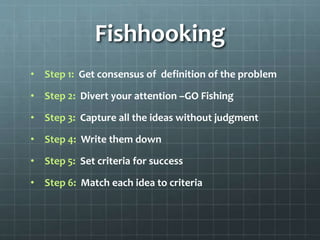
Fishhooking
• Step 1: Get consensus of definition of the problem
• Step 2: Divert your attention –GO Fishing
• Step 3: Capture all the ideas without judgment
• Step 4: Write them down
• Step 5: Set criteria for success
• Step 6: Match each idea to criteria
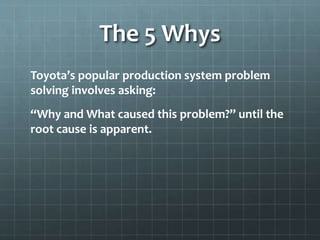
The 5 Whys
Toyota’s popular production system problem
solving involves asking:
“Why and What caused this problem?” until the
root cause is apparent.
http://www.isixsigma.com/tools-
templates/cause-effect/determine-root-cause-5-
whys/
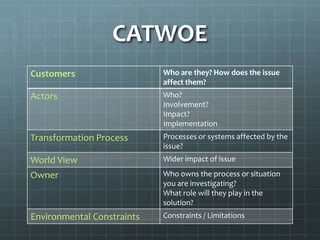
CATWOE
Customers Who are they? How does the issue affect
them?
Actors Who?
Involvement?
Impact?
Implementation
Transformation Process Processes or systems affected by the
issue?
World View Wider impact of issue
Owner Who owns the process or situation you
are investigating?
What role will they play in the solution?
Environmental Constraints Constraints / Limitations

M1 Problem Solving Techniques

  • 1.
  • 2.
    Mind Maps Excellent methodfor those interested in generating alternatives (brain storming) without judgment, capturing many ideas. • Go for quantity of ideas • Can see one idea amplified • Generates answers to: What about that idea?
  • 3.
    Critical Path Analysis •Calculate length of time to complete projects • List all activities in the plan by: start date, duration, and if they are parallel or sequential • Arrange all data on a graph • Schedule each activity • Determine critical path –longest sequence of dependent activities
  • 4.
    PMI On a largesheet of paper – create 3 columns: • Plus (all positive points for taking any of the actions) • Negative (all negative effects) • Interesting ( extenuating issues impacting each decision) Assign positive and negative score to weight issues.
  • 5.
    Fishhooking • Step 1:Get consensus of definition of the problem • Step 2: Divert your attention –GO Fishing • Step 3: Capture all the ideas without judgment • Step 4: Write them down • Step 5: Set criteria for success • Step 6: Match each idea to criteria
  • 6.
    The 5 Whys Toyota’spopular production system problem solving involves asking: “Why and What caused this problem?” until the root cause is apparent. http://www.isixsigma.com/tools- templates/cause-effect/determine-root-cause-5- whys/
  • 7.
    CATWOE Customers Who arethey? How does the issue affect them? Actors Who? Involvement? Impact? Implementation Transformation Process Processes or systems affected by the issue? World View Wider impact of issue Owner Who owns the process or situation you are investigating? What role will they play in the solution? Environmental Constraints Constraints / Limitations