Problem-Solving Techniques
Problem-Solving Techniques: The following problem-solving techniques focus more on creative, lateral, or divergent thinking (e.g., de Bono, 1983; Prince, 1970; Wonder & Donovan, 1984): (William , 1992)
Problem-Solving Techniques: Brainstorming--attempting to spontaneously generate as many ideas on a subject as possible; ideas are not critiqued during the brainstorming process; participants are encouraged to form new ideas from ideas already stated (Brookfield, 1987; Osborn, 1963);
Problem-Solving TechniquesImaging/visualization--producing mental pictures of the total problem or specific parts of the problem (Lazarus, 1978; McKim, 1980; Wonder & Donovan, 1984);
Problem-Solving TechniquesIncubation--putting aside the problem and doing something else to allow the mind to unconsciously consider the problem (Frederiksen, 1984; Osborn, 1963)
Problem-Solving Techniques)Outcome psychodrama--enacting a scenario of alternatives or solutions through role playing (Janis & Mann, 1977); (Fraenkel, 1977; Johnson & Johnson, 1988; Kirschenbaum, 1977).
Problem-Solving TechniquesOutrageous provocation--making a statement that is known to be absolutely incorrect (e.g., the brain is made of charcoal) and then considering it; used as a bridge to a new idea (Beinstock, 1984); also called "insideouts" by Wonder and Donovan (1984);
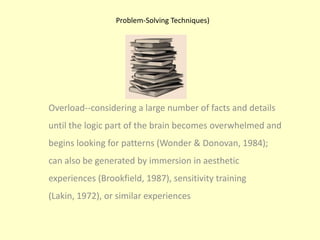
Problem-Solving Techniques)Overload--considering a large number of facts and details until the logic part of the brain becomes overwhelmed and begins looking for patterns (Wonder & Donovan, 1984); can also be generated by immersion in aesthetic experiences (Brookfield, 1987), sensitivity training (Lakin, 1972), or similar experiences
Problem-Solving TechniquesRandom word technique--selecting a word randomly from the dictionary and juxtaposing it with problem statement, then brainstorming about possible relationships (Beinstock, 1984)
Problem-Solving TechniquesRelaxation--systematically relaxing all muscles while repeating a personally meaningful focus word or phrase (Benson, 1987); a specific example of the more general technique called "suspenders" by Wonder and Donovan (1984);
Problem-Solving TechniquesSynthesizing--combining parts or elements into a new and original pattern Bloom et al., 1956; Sternberg, 1988);
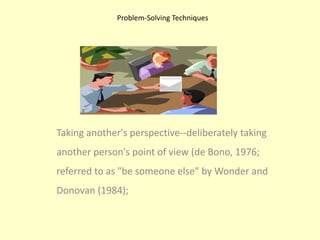
Problem-Solving TechniquesTaking another's perspective--deliberately taking another person's point of view (de Bono, 1976; referred to as "be someone else" by Wonder and Donovan (1984);
Problem-Solving TechniquesValues clarification--using techniques such as role-playing, simulations, self-analysis exercises, and structured controversy to gain a greater understanding of attitudes and beliefs that individuals hold important (Fraenkel, 1977; Johnson & Johnson, 1988; Kirschenbaum, 1977).

Problem solving techniques