Chapter 7
Problem Solving
1
7.1 Introduction
 Having the right tools and knowing how to use them are critical components
for success.
 Engineers need to be good at solving problems and creating things. In order to
be able to become a successful engineer you will need to expand your toolbox
set and understand how to apply it to different problems.
7.2 Analytic and Creative Problem Solving
 Two basic types of problem solving involved in design process:
 Analytic
 More students familiar with analytic, where there is one right answer the common tools
and the common ways to use them.
 Creative
 Creative problem solving has no right answers. This is where you use the tools that you
already have and utilize them in a new way.
 Creative skills will help solve a problem on the best way. The best way to solve a
problem will take into consideration “The Big Picture”; Will it bring long-term
success? How soon will it be outdated? Will it be safe? Will it be cost-effective?
7.2 Analytic and Creative Problem Solving
 Creative skills will help solve a problem on the best way. The best way to solve a
problem will take into consideration “The Big Picture”; Will it bring long-term
success? How soon will it be outdated? Will it be safe? Will it be cost-effective?
 For example, there are many examples in history of great developments that turn
in tools of destruction, like nuclear energy and fertilizers. As an engineer one thing
you should use your creativity is to think if this may happen with a new technology
and prevent it from happening.
 Most people will try up to three ways to solve a problem and then give up. In order
to find the optimum solution to a problem you will need to use multiple ways to
solve it.
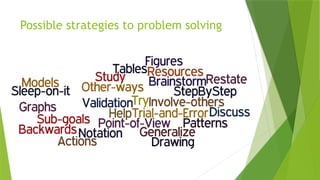
Possible strategies to problem solving
7.3 Analytic Problem Solving
 The Scientific Method
1. Define the problem
2. Gather the facts
3. Develop a hypothesis
4. Perform a test
5. Evaluate the Results
 Estimation
 The Analytic Method
1. Problem statement
2. Description
3. Theory
4. Simplifying assumptions
5. Problem solution
6. Accuracy verification
7.4 Creative Problem Solving
 Use divergence and convergence to gather and analyze ideas. Divergence is
brainstorming. Convergence is analyzing and evaluating the ideas, seeking
out the best possible solutions.
 What is wrong?
 What do we know?
 What is the real problem?
 What is the best solution?
 How do we implement the solution?
 Implement and Evaluate the solution
7.5 Personal Problem Problem Solving Style
 Isaksen and Treffinger
 Mess finding
 Data finding
 Problem finding
 Idea finding
 Solution finding
 Acceptance finding
7.5 Personal Problem Problem Solving Style
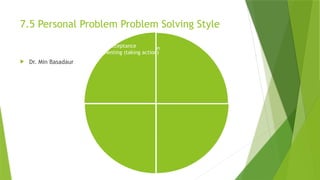
 Dr. Min Basadaur
Generator
• Problem finding
• Fact finding
Conceptualizer
• Problem defining
• Idea finding
Optimizer
• Idea evaluation and selection
• Action planning
Implementor
• Gaining acceptance
• Implementing (taking action)
7.6 Brainstorming Strategies
 SCAMPER
 Individual
 Group
7.7 Critical Thinking
 When solving a problem at each step ask yourself;
 Why?
 What?
 How?

Chapter 7 Problem Solving Presentation for Engineering

  • 1.
  • 2.
    7.1 Introduction  Havingthe right tools and knowing how to use them are critical components for success.  Engineers need to be good at solving problems and creating things. In order to be able to become a successful engineer you will need to expand your toolbox set and understand how to apply it to different problems.
  • 3.
    7.2 Analytic andCreative Problem Solving  Two basic types of problem solving involved in design process:  Analytic  More students familiar with analytic, where there is one right answer the common tools and the common ways to use them.  Creative  Creative problem solving has no right answers. This is where you use the tools that you already have and utilize them in a new way.  Creative skills will help solve a problem on the best way. The best way to solve a problem will take into consideration “The Big Picture”; Will it bring long-term success? How soon will it be outdated? Will it be safe? Will it be cost-effective?
  • 4.
    7.2 Analytic andCreative Problem Solving  Creative skills will help solve a problem on the best way. The best way to solve a problem will take into consideration “The Big Picture”; Will it bring long-term success? How soon will it be outdated? Will it be safe? Will it be cost-effective?  For example, there are many examples in history of great developments that turn in tools of destruction, like nuclear energy and fertilizers. As an engineer one thing you should use your creativity is to think if this may happen with a new technology and prevent it from happening.  Most people will try up to three ways to solve a problem and then give up. In order to find the optimum solution to a problem you will need to use multiple ways to solve it.
  • 5.
    Possible strategies toproblem solving
  • 6.
    7.3 Analytic ProblemSolving  The Scientific Method 1. Define the problem 2. Gather the facts 3. Develop a hypothesis 4. Perform a test 5. Evaluate the Results  Estimation  The Analytic Method 1. Problem statement 2. Description 3. Theory 4. Simplifying assumptions 5. Problem solution 6. Accuracy verification
  • 7.
    7.4 Creative ProblemSolving  Use divergence and convergence to gather and analyze ideas. Divergence is brainstorming. Convergence is analyzing and evaluating the ideas, seeking out the best possible solutions.  What is wrong?  What do we know?  What is the real problem?  What is the best solution?  How do we implement the solution?  Implement and Evaluate the solution
  • 8.
    7.5 Personal ProblemProblem Solving Style  Isaksen and Treffinger  Mess finding  Data finding  Problem finding  Idea finding  Solution finding  Acceptance finding
  • 9.
    7.5 Personal ProblemProblem Solving Style  Dr. Min Basadaur Generator • Problem finding • Fact finding Conceptualizer • Problem defining • Idea finding Optimizer • Idea evaluation and selection • Action planning Implementor • Gaining acceptance • Implementing (taking action)
  • 10.
    7.6 Brainstorming Strategies SCAMPER  Individual  Group
  • 11.
    7.7 Critical Thinking When solving a problem at each step ask yourself;  Why?  What?  How?

Editor's Notes

  • #7 Look at Figure 7.2 page 207