Learn these well
Creative thinking
and Problem-
solving
Business enterprises are under constant pressure to outperform their competitors
and meet their shareholders’ expectations. In order to maintain their market
position, business enterprises need to find effective and creative solutions to
problems. Entrepreneurs have to use advanced tools and techniques to help them
to be creative.
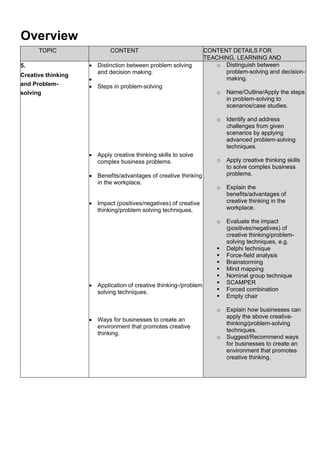
Overview
TOPIC CONTENT CONTENT DETAILS FOR
TEACHING, LEARNING AND
5.
Creative thinking
and Problem-
solving
 Distinction between problem solving
and decision making.

 Steps in problem-solving
 Apply creative thinking skills to solve
complex business problems.
 Benefits/advantages of creative thinking
in the workplace.
 Impact (positives/negatives) of creative
thinking/problem solving techniques.
 Application of creative thinking-/problem
solving techniques.
 Ways for businesses to create an
environment that promotes creative
thinking.
o Distinguish between
problem-solving and decision-
making.
o Name/Outline/Apply the steps
in problem-solving to
scenarios/case studies.
o Identify and address
challenges from given
scenarios by applying
advanced problem-solving
techniques.
o Apply creative thinking skills
to solve complex business
problems.
o Explain the
benefits/advantages of
creative thinking in the
workplace.
o Evaluate the impact
(positives/negatives) of
creative thinking/problem-
solving techniques, e.g.
 Delphi technique
 Force-field analysis
 Brainstorming
 Mind mapping
 Nominal group technique
 SCAMPER
 Forced combination
 Empty chair
o Explain how businesses can
apply the above creative-
thinking/problem-solving
techniques.
o Suggest/Recommend ways
for businesses to create an
environment that promotes
creative thinking.
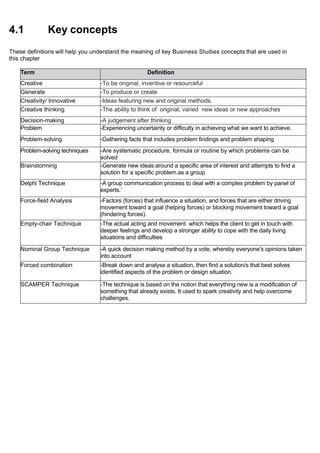
4.1 Key concepts
These definitions will help you understand the meaning of key Business Studies concepts that are used in
this chapter
Term Definition
Creative -To be original, inventive or resourceful
Generate -To produce or create
Creativity/ Innovative -Ideas featuring new and original methods.
Creative thinking -The ability to think of original, varied new ideas or new approaches
Decision-making -A judgement after thinking
Problem -Experiencing uncertainty or difficulty in achieving what we want to achieve.
Problem-solving -Gathering facts that includes problem findings and problem shaping
Problem-solving techniques -Are systematic procedure, formula or routine by which problems can be
solved
Brainstorming -Generate new ideas around a specific area of interest and attempts to find a
solution for a specific problem.as a group
Delphi Technique -A group communication process to deal with a complex problem by panel of
experts.’
Force-field Analysis -Factors (forces) that influence a situation, and forces that are either driving
movement toward a goal (helping forces) or blocking movement toward a goal
(hindering forces).
Empty-chair Technique -The actual acting and movement which helps the client to get in touch with
deeper feelings and develop a stronger ability to cope with the daily living
situations and difficulties
Nominal Group Technique -A quick decision making method by a vote, whereby everyone's opinions taken
into account
Forced combination -Break down and analyse a situation, then find a solution/s that best solves
identified aspects of the problem or design situation.
SCAMPER Technique -The technique is based on the notion that everything new is a modification of
something that already exists. It used to spark creativity and help overcome
challenges.
Do you know the
distinction between
problem-solving and
decision-making?
Activity
4.2 Problem-solving and Decision-making
4.2.1 Description between problem-solving and decision-making
Distinguish between problem solving and decision making. (4)
Answer to activity 1
Problem-Solving Decision-Making
Problems can be solved by a group/team 
or an individual team member 
Decision making often done by member of
management –  becomes authoritarian 
Alternative solutions are generated, 
identified and critically evaluated 
Various alternatives are considered  before
deciding on the best one 
Process of analysing a situation to identify
strategies to bring about change 
It is part of the problem solving cycle as
decisions need to be taken in each step 
Sub max (2) Sub max (2)
[4]
4.2.2 Steps in problem-solving
 Identify the problem.
 Define the problem.
 Identify alternative possible solutions
 Evaluate alternative solutions.
 Select/choose the best alternative.
 Develop/formulate an action plan/strategy.
 Implement the suggested solution/action plan.
 Monitor the implementation of the action plan.
 Evaluate the chosen solution to the problem.
 Take corrective measures.
Decision-making Problem-solving
Making a choice between
alternatives which are usually
obvious
Finding solutions to problems and
which are usually not obvious
Activity
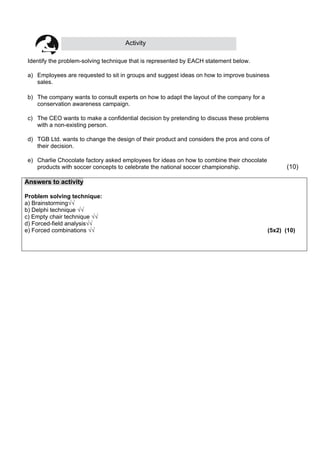
Identify the problem-solving technique that is represented by EACH statement below.
a) Employees are requested to sit in groups and suggest ideas on how to improve business
sales.
b) The company wants to consult experts on how to adapt the layout of the company for a
conservation awareness campaign.
c) The CEO wants to make a confidential decision by pretending to discuss these problems
with a non-existing person.
d) TGB Ltd. wants to change the design of their product and considers the pros and cons of
their decision.
e) Charlie Chocolate factory asked employees for ideas on how to combine their chocolate
products with soccer concepts to celebrate the national soccer championship. (10)
Answers to activity
Problem solving technique:
a) Brainstorming√√
b) Delphi technique √√
c) Empty chair technique √√
d) Forced-field analysis√√
e) Forced combinations √√ (5x2) (10)
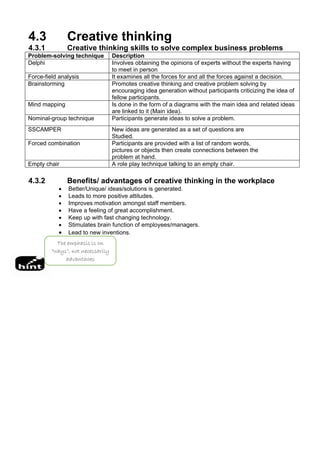
4.3 Creative thinking
4.3.1 Creative thinking skills to solve complex business problems
Problem-solving technique Description
Delphi Involves obtaining the opinions of experts without the experts having
to meet in person
Force-field analysis It examines all the forces for and all the forces against a decision.
Brainstorming Promotes creative thinking and creative problem solving by
encouraging idea generation without participants criticizing the idea of
fellow participants.
Mind mapping Is done in the form of a diagrams with the main idea and related ideas
are linked to it (Main idea).
Nominal-group technique Participants generate ideas to solve a problem.
SSCAMPER New ideas are generated as a set of questions are
Studied.
Forced combination Participants are provided with a list of random words,
pictures or objects then create connections between the
problem at hand.
Empty chair A role play technique talking to an empty chair.
4.3.2 Benefits/ advantages of creative thinking in the workplace
 Better/Unique/ ideas/solutions is generated.
 Leads to more positive attitudes.
 Improves motivation amongst staff members.
 Have a feeling of great accomplishment.
 Keep up with fast changing technology.
 Stimulates brain function of employees/managers.
 Lead to new inventions.
The emphasis is on
“ways”, not necessarily
advantages
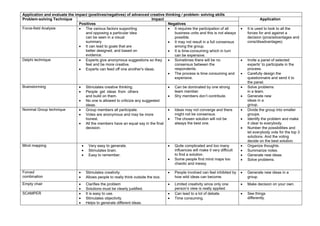
Application and evaluate the impact (positives/negatives) of advanced creative thinking / problem- solving skills
Problem-solving Technique Impact Application
Positives Negatives
Force-field Analysis  The various factors supporting
and opposing a particular idea
can be seen in a visual
summary.
 It can lead to goals that are
better designed, and based on
evidence.
 It requires the participation of all
business units and this is not always
possible.
 It may not result in a full consensus
among the group.
 It is time-consuming which in turn
can be expensive.
 It is used to look to all the
forces for and against a
decision (pros/advantages and
cons/disadvantages)
Delphi technique  Experts give anonymous suggestions so they
feel and be more creative.
 Experts can feed off one another's ideas.
 Sometimes there will be no
consensus between the
respondents.
 The process is time consuming and
expensive.
 Invite a panel of selected
experts’ to participate in the
process.
 Carefully design the
questionnaire and send it to
the panel.
Brainstorming  Stimulates creative thinking.
 People get ideas from others
and build on them.
 No one is allowed to criticize any suggested
ideas.
 Can be dominated by one strong
team member.
 Shy members don’t contribute.
 Solve problems
in a team.
 Generate new
ideas in a
group.
Nominal Group technique  Group members all participate.
 Votes are anonymous and may be more
honest.
 All the members have an equal say in the final
decision.
 Ideas may not converge and there
might not be consensus.
 The chosen solution will not be
always the best one.
 Divide the group into smaller
groups.
 Identify the problem and make
it clear to everybody.
 Number the possibilities and
let everybody vote for the top 3
solutions. And the voting
decide on the best solution.
Mind mapping  Very easy to generate.
 Stimulates brain.
 Easy to remember.
 Quite complicated and too many
influences will make it very difficult
to find a solution.
 Some people find mind maps too
chaotic and messy.
 Organize thoughts.
 Summarize notes.
 Generate new ideas.
 Solve problems.
Forced
combination
 Stimulates creativity.
 Allows people to really think outside the box.
 People involved can feel inhibited by
how wild ideas can become.
 Generate new ideas in a
group.
Empty chair  Clarifies the problem
 Solutions must be clearly justified.
 Limited creativity since only one
person’s view is really applied.
 Make decision on your own.
SCAMPER  It is easy to use.
 Stimulates objectivity.
 Helps to generate different ideas.
 Can lead to a lot of debate.
 Time consuming.
 See things
differently.
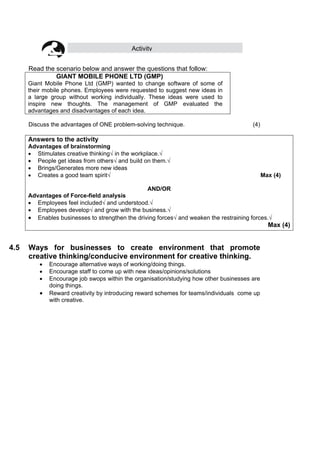
Activity
Read the scenario below and answer the questions that follow:
GIANT MOBILE PHONE LTD (GMP)
Giant Mobile Phone Ltd (GMP) wanted to change software of some of
their mobile phones. Employees were requested to suggest new ideas in
a large group without working individually. These ideas were used to
inspire new thoughts. The management of GMP evaluated the
advantages and disadvantages of each idea.
Discuss the advantages of ONE problem-solving technique. (4)
Answers to the activity
Advantages of brainstorming
 Stimulates creative thinking√ in the workplace.√
 People get ideas from others√ and build on them.√
 Brings/Generates more new ideas
 Creates a good team spirit√ Max (4)
AND/OR
Advantages of Force-field analysis
 Employees feel included√ and understood.√
 Employees develop√ and grow with the business.√
 Enables businesses to strengthen the driving forces√ and weaken the restraining forces.√
Max (4)
4.5 Ways for businesses to create environment that promote
creative thinking/conducive environment for creative thinking.
 Encourage alternative ways of working/doing things.
 Encourage staff to come up with new ideas/opinions/solutions
 Encourage job swops within the organisation/studying how other businesses are
doing things.
 Reward creativity by introducing reward schemes for teams/individuals come up
with creative.

Creative-thinking-and-Problem-solving-workbook (1).pdf

  • 1.
    Learn these well Creativethinking and Problem- solving Business enterprises are under constant pressure to outperform their competitors and meet their shareholders’ expectations. In order to maintain their market position, business enterprises need to find effective and creative solutions to problems. Entrepreneurs have to use advanced tools and techniques to help them to be creative.
  • 2.
    Overview TOPIC CONTENT CONTENTDETAILS FOR TEACHING, LEARNING AND 5. Creative thinking and Problem- solving  Distinction between problem solving and decision making.   Steps in problem-solving  Apply creative thinking skills to solve complex business problems.  Benefits/advantages of creative thinking in the workplace.  Impact (positives/negatives) of creative thinking/problem solving techniques.  Application of creative thinking-/problem solving techniques.  Ways for businesses to create an environment that promotes creative thinking. o Distinguish between problem-solving and decision- making. o Name/Outline/Apply the steps in problem-solving to scenarios/case studies. o Identify and address challenges from given scenarios by applying advanced problem-solving techniques. o Apply creative thinking skills to solve complex business problems. o Explain the benefits/advantages of creative thinking in the workplace. o Evaluate the impact (positives/negatives) of creative thinking/problem- solving techniques, e.g.  Delphi technique  Force-field analysis  Brainstorming  Mind mapping  Nominal group technique  SCAMPER  Forced combination  Empty chair o Explain how businesses can apply the above creative- thinking/problem-solving techniques. o Suggest/Recommend ways for businesses to create an environment that promotes creative thinking.
  • 3.
    4.1 Key concepts Thesedefinitions will help you understand the meaning of key Business Studies concepts that are used in this chapter Term Definition Creative -To be original, inventive or resourceful Generate -To produce or create Creativity/ Innovative -Ideas featuring new and original methods. Creative thinking -The ability to think of original, varied new ideas or new approaches Decision-making -A judgement after thinking Problem -Experiencing uncertainty or difficulty in achieving what we want to achieve. Problem-solving -Gathering facts that includes problem findings and problem shaping Problem-solving techniques -Are systematic procedure, formula or routine by which problems can be solved Brainstorming -Generate new ideas around a specific area of interest and attempts to find a solution for a specific problem.as a group Delphi Technique -A group communication process to deal with a complex problem by panel of experts.’ Force-field Analysis -Factors (forces) that influence a situation, and forces that are either driving movement toward a goal (helping forces) or blocking movement toward a goal (hindering forces). Empty-chair Technique -The actual acting and movement which helps the client to get in touch with deeper feelings and develop a stronger ability to cope with the daily living situations and difficulties Nominal Group Technique -A quick decision making method by a vote, whereby everyone's opinions taken into account Forced combination -Break down and analyse a situation, then find a solution/s that best solves identified aspects of the problem or design situation. SCAMPER Technique -The technique is based on the notion that everything new is a modification of something that already exists. It used to spark creativity and help overcome challenges.
  • 4.
    Do you knowthe distinction between problem-solving and decision-making? Activity 4.2 Problem-solving and Decision-making 4.2.1 Description between problem-solving and decision-making Distinguish between problem solving and decision making. (4) Answer to activity 1 Problem-Solving Decision-Making Problems can be solved by a group/team  or an individual team member  Decision making often done by member of management –  becomes authoritarian  Alternative solutions are generated,  identified and critically evaluated  Various alternatives are considered  before deciding on the best one  Process of analysing a situation to identify strategies to bring about change  It is part of the problem solving cycle as decisions need to be taken in each step  Sub max (2) Sub max (2) [4] 4.2.2 Steps in problem-solving  Identify the problem.  Define the problem.  Identify alternative possible solutions  Evaluate alternative solutions.  Select/choose the best alternative.  Develop/formulate an action plan/strategy.  Implement the suggested solution/action plan.  Monitor the implementation of the action plan.  Evaluate the chosen solution to the problem.  Take corrective measures. Decision-making Problem-solving Making a choice between alternatives which are usually obvious Finding solutions to problems and which are usually not obvious
  • 5.
    Activity Identify the problem-solvingtechnique that is represented by EACH statement below. a) Employees are requested to sit in groups and suggest ideas on how to improve business sales. b) The company wants to consult experts on how to adapt the layout of the company for a conservation awareness campaign. c) The CEO wants to make a confidential decision by pretending to discuss these problems with a non-existing person. d) TGB Ltd. wants to change the design of their product and considers the pros and cons of their decision. e) Charlie Chocolate factory asked employees for ideas on how to combine their chocolate products with soccer concepts to celebrate the national soccer championship. (10) Answers to activity Problem solving technique: a) Brainstorming√√ b) Delphi technique √√ c) Empty chair technique √√ d) Forced-field analysis√√ e) Forced combinations √√ (5x2) (10)
  • 6.
    4.3 Creative thinking 4.3.1Creative thinking skills to solve complex business problems Problem-solving technique Description Delphi Involves obtaining the opinions of experts without the experts having to meet in person Force-field analysis It examines all the forces for and all the forces against a decision. Brainstorming Promotes creative thinking and creative problem solving by encouraging idea generation without participants criticizing the idea of fellow participants. Mind mapping Is done in the form of a diagrams with the main idea and related ideas are linked to it (Main idea). Nominal-group technique Participants generate ideas to solve a problem. SSCAMPER New ideas are generated as a set of questions are Studied. Forced combination Participants are provided with a list of random words, pictures or objects then create connections between the problem at hand. Empty chair A role play technique talking to an empty chair. 4.3.2 Benefits/ advantages of creative thinking in the workplace  Better/Unique/ ideas/solutions is generated.  Leads to more positive attitudes.  Improves motivation amongst staff members.  Have a feeling of great accomplishment.  Keep up with fast changing technology.  Stimulates brain function of employees/managers.  Lead to new inventions. The emphasis is on “ways”, not necessarily advantages
  • 7.
    Application and evaluatethe impact (positives/negatives) of advanced creative thinking / problem- solving skills Problem-solving Technique Impact Application Positives Negatives Force-field Analysis  The various factors supporting and opposing a particular idea can be seen in a visual summary.  It can lead to goals that are better designed, and based on evidence.  It requires the participation of all business units and this is not always possible.  It may not result in a full consensus among the group.  It is time-consuming which in turn can be expensive.  It is used to look to all the forces for and against a decision (pros/advantages and cons/disadvantages) Delphi technique  Experts give anonymous suggestions so they feel and be more creative.  Experts can feed off one another's ideas.  Sometimes there will be no consensus between the respondents.  The process is time consuming and expensive.  Invite a panel of selected experts’ to participate in the process.  Carefully design the questionnaire and send it to the panel. Brainstorming  Stimulates creative thinking.  People get ideas from others and build on them.  No one is allowed to criticize any suggested ideas.  Can be dominated by one strong team member.  Shy members don’t contribute.  Solve problems in a team.  Generate new ideas in a group. Nominal Group technique  Group members all participate.  Votes are anonymous and may be more honest.  All the members have an equal say in the final decision.  Ideas may not converge and there might not be consensus.  The chosen solution will not be always the best one.  Divide the group into smaller groups.  Identify the problem and make it clear to everybody.  Number the possibilities and let everybody vote for the top 3 solutions. And the voting decide on the best solution. Mind mapping  Very easy to generate.  Stimulates brain.  Easy to remember.  Quite complicated and too many influences will make it very difficult to find a solution.  Some people find mind maps too chaotic and messy.  Organize thoughts.  Summarize notes.  Generate new ideas.  Solve problems. Forced combination  Stimulates creativity.  Allows people to really think outside the box.  People involved can feel inhibited by how wild ideas can become.  Generate new ideas in a group. Empty chair  Clarifies the problem  Solutions must be clearly justified.  Limited creativity since only one person’s view is really applied.  Make decision on your own. SCAMPER  It is easy to use.  Stimulates objectivity.  Helps to generate different ideas.  Can lead to a lot of debate.  Time consuming.  See things differently.
  • 8.
    Activity Read the scenariobelow and answer the questions that follow: GIANT MOBILE PHONE LTD (GMP) Giant Mobile Phone Ltd (GMP) wanted to change software of some of their mobile phones. Employees were requested to suggest new ideas in a large group without working individually. These ideas were used to inspire new thoughts. The management of GMP evaluated the advantages and disadvantages of each idea. Discuss the advantages of ONE problem-solving technique. (4) Answers to the activity Advantages of brainstorming  Stimulates creative thinking√ in the workplace.√  People get ideas from others√ and build on them.√  Brings/Generates more new ideas  Creates a good team spirit√ Max (4) AND/OR Advantages of Force-field analysis  Employees feel included√ and understood.√  Employees develop√ and grow with the business.√  Enables businesses to strengthen the driving forces√ and weaken the restraining forces.√ Max (4) 4.5 Ways for businesses to create environment that promote creative thinking/conducive environment for creative thinking.  Encourage alternative ways of working/doing things.  Encourage staff to come up with new ideas/opinions/solutions  Encourage job swops within the organisation/studying how other businesses are doing things.  Reward creativity by introducing reward schemes for teams/individuals come up with creative.