Introduction to
Software Defined
Networking (SDN)
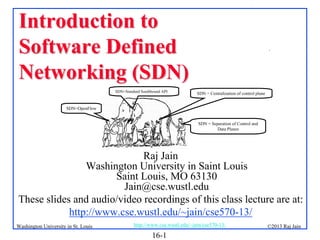
SDN=Standard Southbound API

.

SDN = Centralization of control plane

SDN=OpenFlow
SDN = Separation of Control and
Data Planes

Raj Jain
Washington University in Saint Louis
Saint Louis, MO 63130
Jain@cse.wustl.edu
These slides and audio/video recordings of this class lecture are at:
http://www.cse.wustl.edu/~jain/cse570-13/
Washington University in St. Louis

http://www.cse.wustl.edu/~jain/cse570-13/

16-1

©2013 Raj Jain
Overview
1.
2.
3.
4.

What is SDN?
Alternative APIs: XMPP, PCE, ForCES, ALTO
RESTful APIs and OSGi Framework
OpenDaylight SDN Controller Platform and Tools

Note: This is the third module of four modules on OpenFlow,
OpenFlow Controllers, SDN and NFV in this course.
Washington University in St. Louis

http://www.cse.wustl.edu/~jain/cse570-13/

16-2

©2013 Raj Jain
Origins of SDN







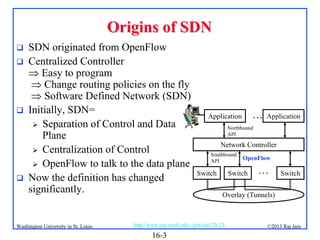
SDN originated from OpenFlow
Centralized Controller
 Easy to program
 Change routing policies on the fly
 Software Defined Network (SDN)
Initially, SDN=
 Separation of Control and Data
Plane
 Centralization of Control
 OpenFlow to talk to the data plane
Now the definition has changed
significantly.

Washington University in St. Louis

Application

Northbound
API

Network Controller
Southbound
API

Switch

OpenFlow

Switch

…

Switch

Overlay (Tunnels)

http://www.cse.wustl.edu/~jain/cse570-13/

16-3

…

Application

©2013 Raj Jain
What is SDN?
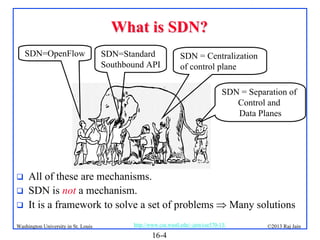
SDN=OpenFlow

SDN=Standard
Southbound API

SDN = Centralization
of control plane
SDN = Separation of
Control and
Data Planes





All of these are mechanisms.
SDN is not a mechanism.
It is a framework to solve a set of problems  Many solutions

Washington University in St. Louis

http://www.cse.wustl.edu/~jain/cse570-13/

16-4

©2013 Raj Jain
Original Definition of SDN
“What is SDN?
The physical separation of the network control plane from the
forwarding plane, and where a control plane controls several
devices.”
1. Directly programmable
2. Agile: Abstracting control from forwarding
3. Centrally managed
4. Programmatically configured
5. Open standards-based vendor neutral
The above definition includes How.
Now many different opinions about How.
SDN has become more general. Need to define by What?
Ref: https://www.opennetworking.org/index.php?option=com_content&view=article&id=686&Itemid=272&lang=en
Washington University in St. Louis

http://www.cse.wustl.edu/~jain/cse570-13/

16-5

©2013 Raj Jain
What = Why We need SDN?
1. Virtualization: Use network resource without worrying about
where it is physically located, how much it is, how it is
organized, etc.
2. Orchestration: Should be able to control and manage
thousands of devices with one command.
3. Programmable: Should be able to change behavior on the fly.
4. Dynamic Scaling: Should be able to change size, quantity
5. Automation: To lower OpEx minimize manual involvement
 Troubleshooting
 Reduce downtime
 Policy enforcement
 Provisioning/Re-provisioning/Segmentation of resources
 Add new workloads, sites, devices, and resources
Washington University in St. Louis

http://www.cse.wustl.edu/~jain/cse570-13/

16-6

©2013 Raj Jain
Why We need SDN? (Cont)
6. Visibility: Monitor resources, connectivity
7. Performance: Optimize network device utilization
 Traffic engineering/Bandwidth management
 Capacity optimization
 Load balancing
 High utilization
 Fast failure handling
8. Multi-tenancy: Tenants need complete control over their
addresses, topology, and routing, security
9. Service Integration: Load balancers, firewalls, Intrusion
Detection Systems (IDS), provisioned on demand and placed
appropriately on the traffic path
Washington University in St. Louis

http://www.cse.wustl.edu/~jain/cse570-13/

16-7

©2013 Raj Jain
Why We need SDN? (Cont)
10. Openness: Full choice of “How” mechanisms
 Modular plug-ins
 Abstraction:
 Abstract = Summary = Essence = General Idea
 Hide the details.
 Also, abstract is opposite of concrete
 Define tasks by APIs and not by how it should be done.
E.g., send from A to B. Not OSPF.

Ref: http://www.networkworld.com/news/2013/110813-onug-sdn-275784.html
Ref: Open Data Center Alliance Usage Model: Software Defined Networking Rev 1.0,”
http://www.opendatacenteralliance.org/docs/Software_Defined_Networking_Master_Usage_Model_Rev1.0.pdf
Washington University in St. Louis

http://www.cse.wustl.edu/~jain/cse570-13/

16-8

©2013 Raj Jain
SDN Definition
SDN is a framework to allow network administrators
to automatically and dynamically manage and control
a large number of network devices, services,
topology, traffic paths, and packet handling (quality of
service) policies using high-level languages and APIs.
Management includes provisioning, operating,
monitoring, optimizing, and managing FCAPS (faults,
configuration, accounting, performance, and security)
in a multi-tenant environment.
 Key: Dynamic  Quick
Legacy approaches such as CLI were not quick
particularly for large networks


Washington University in St. Louis

http://www.cse.wustl.edu/~jain/cse570-13/

16-9

©2013 Raj Jain
Examples Alternative APIs
Southbound APIs: XMPP (Juniper), OnePK (Cisco)
 Northbound APIs: I2RS, I2AEX, ALTO,
 Overlay: VxLAN, TRILL, LISP, STT, NVO3, PWE3,
L2VPN, L3VPN
 Configuration API: NETCONF
 Controller: PCE, ForCES


Ref: T. Nadeau and K. Gray, “SDN,” O’Reilly, 2013, 384 pp, ISBN:978-1-449-34230-2 (Safari Book)
http://www.cse.wustl.edu/~jain/cse570-13/
Washington University in St. Louis

16-10

©2013 Raj Jain
XMPP









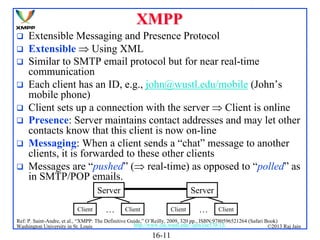
Extensible Messaging and Presence Protocol
Extensible  Using XML
Similar to SMTP email protocol but for near real-time
communication
Each client has an ID, e.g., john@wustl.edu/mobile (John’s
mobile phone)
Client sets up a connection with the server  Client is online
Presence: Server maintains contact addresses and may let other
contacts know that this client is now on-line
Messaging: When a client sends a “chat” message to another
clients, it is forwarded to these other clients
Messages are “pushed” ( real-time) as opposed to “polled” as
in SMTP/POP emails.
Server
Client

…

Server
Client

Client

…

Client

Ref: P. Saint-Andre, et al., “XMPP: The Definitive Guide,” O’Reilly, 2009, 320 pp., ISBN:9780596521264 (Safari Book)
http://www.cse.wustl.edu/~jain/cse570-13/
Washington University in St. Louis
©2013 Raj Jain

16-11
XMPP (Cont)










XMPP is IETF standardization of Jabber protocol
RFC 6121 defines XMPP using TCP connections.
But HTTP is often used as transport to navigate firewalls
All messages are XML encoded
 Not efficient for binary file transfers
 Out-of-band binary channels are often used with XMPP.
A number of open-source implementations are available
Variations of it are widely used in most instant messaging
programs including Google, Skype, Facebook, …, many games
Used in IoT and data centers for management. Network devices
have XMPP clients that respond to XMPP messages containing
CLI management requests  You can manage your network
using any other XMPP client, e.g., your mobile phone
Arista switches can be managed by XMPP, Juniper uses XMPP
as a southbound protocol for SDN

Ref: http://en.wikipedia.org/wiki/XMPP
Washington University in St. Louis

http://www.cse.wustl.edu/~jain/cse570-13/

16-12

©2013 Raj Jain
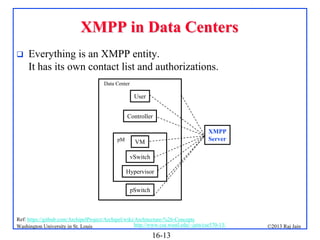
XMPP in Data Centers


Everything is an XMPP entity.
It has its own contact list and authorizations.
Data Center

User
Controller

pM

XMPP
Server

VM
vSwitch
Hypervisor
pSwitch

Ref: https://github.com/ArchipelProject/Archipel/wiki/Architecture-%26-Concepts
http://www.cse.wustl.edu/~jain/cse570-13/
Washington University in St. Louis

16-13

©2013 Raj Jain
Path Computation Element (PCE)







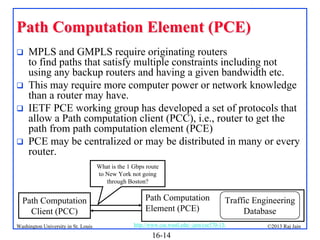
MPLS and GMPLS require originating routers
to find paths that satisfy multiple constraints including not
using any backup routers and having a given bandwidth etc.
This may require more computer power or network knowledge
than a router may have.
IETF PCE working group has developed a set of protocols that
allow a Path computation client (PCC), i.e., router to get the
path from path computation element (PCE)
PCE may be centralized or may be distributed in many or every
router.
What is the 1 Gbps route
to New York not going
through Boston?

Path Computation
Client (PCC)
Washington University in St. Louis

Path Computation
Element (PCE)

Traffic Engineering
Database

http://www.cse.wustl.edu/~jain/cse570-13/

16-14

©2013 Raj Jain
PCE (Cont)




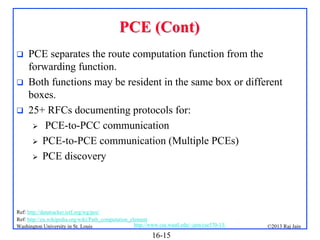
PCE separates the route computation function from the
forwarding function.
Both functions may be resident in the same box or different
boxes.
25+ RFCs documenting protocols for:
 PCE-to-PCC communication
 PCE-to-PCE communication (Multiple PCEs)
 PCE discovery

Ref: http://datatracker.ietf.org/wg/pce/
Ref: http://en.wikipedia.org/wiki/Path_computation_element
http://www.cse.wustl.edu/~jain/cse570-13/
Washington University in St. Louis

16-15

©2013 Raj Jain
Forwarding and Control Element
Separation (ForCES)





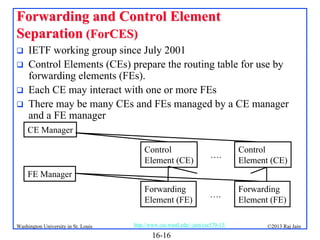
IETF working group since July 2001
Control Elements (CEs) prepare the routing table for use by
forwarding elements (FEs).
Each CE may interact with one or more FEs
There may be many CEs and FEs managed by a CE manager
and a FE manager
CE Manager
Control
Element (CE)

….

Control
Element (CE)

Forwarding
Element (FE)

….

Forwarding
Element (FE)

FE Manager

Washington University in St. Louis

http://www.cse.wustl.edu/~jain/cse570-13/

16-16

©2013 Raj Jain
ForCES (Cont)




Idea of control and data plane separation was used in BSD 4.4
routing sockets in early 1990s. It allowed routing tables to be
controlled by a simple command line or by a route daemon.
ForCES protocol supports exchange of:
 Port type, link speed, IP address
 IPv4/IPv6 unicast/multicast forwarding
 QoS including metering, policing, shaping, and queueing
 Packet classification
 High-touch functions, e.g., Network Address Translation
(NAT), Application-level Gateways (ALG)
 Encryptions to be applied to packets
 Measurement and reporting of per-flow traffic information

Ref: http://datatracker.ietf.org/doc/rfc3654/?include_text=1
http://www.cse.wustl.edu/~jain/cse570-13/
Washington University in St. Louis

16-17

©2013 Raj Jain
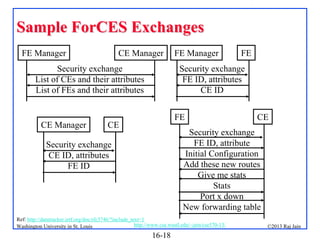
Sample ForCES Exchanges
FE Manager

CE Manager

Security exchange
List of CEs and their attributes
List of FEs and their attributes

CE Manager

FE Manager

FE

Security exchange
FE ID, attributes
CE ID
FE

CE

CE

Security exchange
FE ID, attribute
Initial Configuration
Add these new routes
Give me stats
Stats
Port x down
New forwarding table

Security exchange
CE ID, attributes
FE ID

Ref: http://datatracker.ietf.org/doc/rfc3746/?include_text=1
http://www.cse.wustl.edu/~jain/cse570-13/
Washington University in St. Louis

16-18

©2013 Raj Jain
Application Layer Traffic Optimization
(ALTO)










Peers
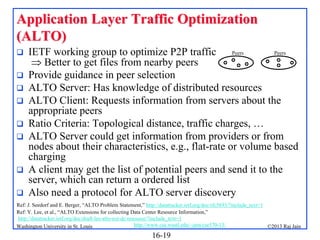
IETF working group to optimize P2P traffic Peers
 Better to get files from nearby peers
Provide guidance in peer selection
ALTO Server: Has knowledge of distributed resources
ALTO Client: Requests information from servers about the
appropriate peers
Ratio Criteria: Topological distance, traffic charges, …
ALTO Server could get information from providers or from
nodes about their characteristics, e.g., flat-rate or volume based
charging
A client may get the list of potential peers and send it to the
server, which can return a ordered list
Also need a protocol for ALTO server discovery

Ref: J. Seedorf and E. Berger, “ALTO Problem Statement,” http://datatracker.ietf.org/doc/rfc5693/?include_text=1
Ref: Y. Lee, et al., “ALTO Extensions for collecting Data Center Resource Information,”
http://datatracker.ietf.org/doc/draft-lee-alto-ext-dc-resource/?include_text=1
http://www.cse.wustl.edu/~jain/cse570-13/
Washington University in St. Louis
©2013 Raj Jain

16-19
ALTO Extension






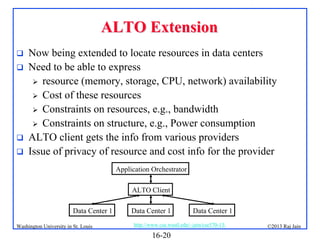
Now being extended to locate resources in data centers
Need to be able to express
 resource (memory, storage, CPU, network) availability
 Cost of these resources
 Constraints on resources, e.g., bandwidth
 Constraints on structure, e.g., Power consumption
ALTO client gets the info from various providers
Issue of privacy of resource and cost info for the provider
Application Orchestrator
ALTO Client
Data Center 1

Washington University in St. Louis

Data Center 1

Data Center 1

http://www.cse.wustl.edu/~jain/cse570-13/

16-20

©2013 Raj Jain
Current SDN Debate: What vs. How?








SDN is easy if control plane is centralized but not necessary.
Distributed solutions may be required for legacy equipment and
for fail-safe operation.
Complete removal of control plane may be harmful.
Exact division of control plane between centralized controller
and distributed forwarders is yet to be worked out
SDN is easy with a standard southbound protocol like
OpenFlow but one protocol may not work in all cases
 Diversity of protocols is a fact of life.
 There are no standard operating systems, processors,
routers, or Ethernet switches.
If industry finds an easier way to solve the same problems by
another method, that method may win. E.g., ATM vs. MPLS.

Washington University in St. Louis

http://www.cse.wustl.edu/~jain/cse570-13/

16-21

©2013 Raj Jain
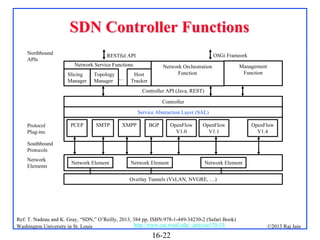
SDN Controller Functions
Northbound
APIs

OSGi Frameork

RESTful API
Network Service Functions
Slicing
Manager

Topology
Manager …

Network Orchestration
Function

Host
Tracker

Management
Function

Controller API (Java, REST)
Controller
Service Abstraction Layer (SAL)
Protocol
Plug-ins

PCEP

SMTP

XMPP

BGP

OpenFlow
V1.0

OpenFlow
V1.1

OpenFlow
V1.4

Southbound
Protocols
Network
Elements

Network Element

Network Element

Network Element

Overlay Tunnels (VxLAN, NVGRE, …)

Ref: T. Nadeau and K. Gray, “SDN,” O’Reilly, 2013, 384 pp, ISBN:978-1-449-34230-2 (Safari Book)
http://www.cse.wustl.edu/~jain/cse570-13/
Washington University in St. Louis

16-22

©2013 Raj Jain
RESTful APIs









Software architecture style developed by W3C.
Introduced by Roy Fielding in his PhD thesis.
WWW uses this sytle. Very popular in other applications.
Goals: Scalability, Generality, Independence, and allow
intermediate components
Client-Server Model: Clients and servers can be developed
undependably.
Server is stateless
Responses can be cached for the specified time
Intermediate Servers (Proxies) can respond. End point is not
critical.

Washington University in St. Louis

http://www.cse.wustl.edu/~jain/cse570-13/

16-23

©2013 Raj Jain
REST (Cont)










Create, Read, Update, Delete (CRUD) Operations
Uniform Interface: GET (Read), POST (Insert), PUT (write),
DELETE
Resources identified by global identifiers, e.g., URI in Web.
Get http://<fqdn-or-ip-address>/rest/v1/model/<datatype>/<optional-id>?<optional-query-params>
E.g., GET http://odcp.org/rest/v1/model/controller-node
Data Types: Controller node, Firewall rule, Topology
configuration, Switch, Port, link, flow entry, VLAN, …
Data types can include commercial entities, such as, Big
Virtual Switch from Big Switch Networks, vCenter from
VMware, …
If optional-id and query parameters are omitted, the returned
text includes all of the items of the given data type.

Ref: http://en.wikipedia.org/wiki/Representational_state_transfer
http://www.cse.wustl.edu/~jain/cse570-13/
Washington University in St. Louis

16-24

©2013 Raj Jain
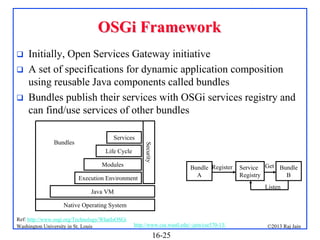
OSGi Framework




Initially, Open Services Gateway initiative
A set of specifications for dynamic application composition
using reusable Java components called bundles
Bundles publish their services with OSGi services registry and
can find/use services of other bundles
Services
Security

Bundles

Life Cycle
Modules

Bundle Register
A

Execution Environment

Service Get Bundle
Registry
B
Listen

Java VM
Native Operating System
Ref: http://www.osgi.org/Technology/WhatIsOSGi
Washington University in St. Louis

http://www.cse.wustl.edu/~jain/cse570-13/

16-25

©2013 Raj Jain
OSGi (Cont)








Bundles can be installed, started, stopped, updated or
uninstalled using a lifecycle API
Modules defines how a bundle can import/export code
Security layer handles security
Execution environment defines what methods and classes are
available in a specific platform
A bundle can get a service or it can listen for a service to
appear or disappear.
Each service has properties that allow others to select among
multiple bundles offering the same service
Services are dynamic. A bundle can decide to withdraw its
service. Other bundles should stop using it
 Bundles can be installed and uninstalled on the fly.

Washington University in St. Louis

http://www.cse.wustl.edu/~jain/cse570-13/

16-26

©2013 Raj Jain
OpenDaylight SDN Controller
Platform (OSCP)








Multi-company collaboration under Linux foundation
Many projects including OpenDaylight Controller
NO-OpenFlow (Not Only OpenFlow): Supports multiple
southbound protocols via plug-ins including OpenFlow
Dynamically linked in to a Service Abstraction Layer (SAL)
Abstraction  SAL figures out how to fulfill the service
requested by higher layers irrespective of the southbound
protocol
Modular design using OSGI framework
A rich set of North-bound APIs via RESTful services for
loosely coupled applications and OSGI services for co-located
applications using the same address space

Ref: https://wiki.opendaylight.org/view/Main_Page
Washington University in St. Louis

http://www.cse.wustl.edu/~jain/cse570-13/

16-27

©2013 Raj Jain
OpenDaylight Tools
1.

2.
3.

Applications: Provides Virtual Network Segments (VNS) for
each tenant
1. OpenDaylight Network Virtualization (ONV):
2. OpenDaylight Virtual Tenant Network (VTN)
Services:
1. Defense4All: Security
Northbound APIs:
1. REST
2. Dlux: Northbound API using AngularJS, an extension of
HTML by Google for dynamic views

Washington University in St. Louis

http://www.cse.wustl.edu/~jain/cse570-13/

16-28

©2013 Raj Jain
OpenDaylight Tools (Cont)
4.

5.

6.

Southbound APIs:
1. OpenFlow Plug-in + Protocol Library (V1.0, V1.1,…)
2. Locator ID Separation Protocol (LISP) Mapping Service
3. SNMP4SDN
4. BGP Link State Path Control Element Protocol
Overlay:
1. Open Distributed Overlay Virtual Ethernet (DOVE):
Like VxLAN but does not use IP Multicast
Configuration:
1. OpenDaylight YANG Tools: NETCONF
2. Open vSwitch Database (OVSDB) Integration
3. Affinity Metadata Service

Washington University in St. Louis

http://www.cse.wustl.edu/~jain/cse570-13/

16-29

©2013 Raj Jain
Affinity Metadata Service







API to create an abstract topology and implementation
independent description of infrastructure needs and behaviors
of network workloads
Allows intent to be specified in application and service terms
independent of where and how the workloads attach to the
network.
SDN controllers and application can use “affinity” information
to automatically provision the VMs and network for the user
Users don’t need to know about bridges, routers, VLANs, and
tunnels

Ref: https://wiki.opendaylight.org/view/Project_Proposals:Affinity_Metadata_Service
http://www.cse.wustl.edu/~jain/cse570-13/
Washington University in St. Louis

16-30

©2013 Raj Jain
Summary

1.

2.

3.
4.

SDN is the framework to automatically manage and control a
large number of network devices and services in a multi-tenant
environment
OpenFlow originated SDN but now many different
southbound and northbound APIs, intermediate services and
tools are being discussed and implemented by the industry,
e.g., XMPP, ForCES, PCE, ALTO
OpenDaylight SDN Controller platform is the leading open
source SDN controller project under Linux Foundation
It uses REST APIs and OSGI framework for modularity

Washington University in St. Louis

http://www.cse.wustl.edu/~jain/cse570-13/

16-31

©2013 Raj Jain
Reading List











T. Nadeau and K. Gray, “SDN,” O’Reilly, 2013, 384 pp, ISBN:978-1-449-34230-2
(Safari book)
V. Josyula, M. Orr, and G. Page, “Cloud Computing: Automating the Virtualized
Data Center,” Cisco Press, 2012, 392 pp., ISBN: 1587204347 (Safari Book).
J. Seedorf and E. Berger, “ALTO Problem Statement,”
http://datatracker.ietf.org/doc/rfc5693/?include_text=1
Y. Lee, et al., “ALTO Extensions for collecting Data Center Resource Information,”
http://datatracker.ietf.org/doc/draft-lee-alto-ext-dc-resource/?include_text=1
B. Martinussen (Cisco), “Introduction to Software Defined Networks (SDN),” April
2013, http://www.cisco.com/web/europe/ciscoconnect2013/pdf/DC_3_SDN.pdf
http://www.osgi.org/Technology/WhatIsOSGi
http://www.sdncentral.com/sdn-use-cases /
https://wiki.opendaylight.org/view/OpenDaylight_SDN_Controller_Platform_%28O
SCP%29:Proposal
http://datatracker.ietf.org/wg/pce/
https://wiki.opendaylight.org/view/Main_Page

Washington University in St. Louis

http://www.cse.wustl.edu/~jain/cse570-13/

16-32

©2013 Raj Jain
Wikipedia Links






http://en.wikipedia.org/wiki/Software-defined_networking
http://en.wikipedia.org/wiki/Representational_state_transfer
http://en.wikipedia.org/wiki/OSGI
http://en.wikipedia.org/wiki/XMPP
http://en.wikipedia.org/wiki/Path_computation_element

Washington University in St. Louis

http://www.cse.wustl.edu/~jain/cse570-13/

16-33

©2013 Raj Jain
References



P. Saint-Andre, et al., “XMPP: The Definitive Guide,” O’Reilly, 2009, 320
pp., ISBN:9780596521264 (Safari Book)
OpenDaylight Components and Tools:
 https://wiki.opendaylight.org/view/Open_DOVE:Proposal
 https://wiki.opendaylight.org/view/OpenDaylight_Network_Virtualizati
on_%28ONV%29:Main
 https://wiki.opendaylight.org/view/OpenDaylight_OpenFlow_Plugin:Ov
erview
 https://wiki.opendaylight.org/view/OpenDaylight_Virtual_Tenant_Netw
ork_%28VTN%29:Overview
 https://wiki.opendaylight.org/view/Openflow_Protocol_Library:Main
 https://wiki.opendaylight.org/view/OVSDB_Integration:Design
 https://wiki.opendaylight.org/view/Project_Proposals:Affinity_Metadata
_Service
 https://wiki.opendaylight.org/view/Project_Proposals:BGP_and_PCEP
 https://wiki.opendaylight.org/view/Project_Proposals:Defense4All
 https://wiki.opendaylight.org/view/Project_Proposals:Dlux

Washington University in St. Louis

http://www.cse.wustl.edu/~jain/cse570-13/

16-34

©2013 Raj Jain
References (Cont)
https://wiki.opendaylight.org/view/Project_Proposals:LispMappingServi
ce
 https://wiki.opendaylight.org/view/Project_Proposals:SNMP4SDN
 https://wiki.opendaylight.org/view/YANG_Tools:Main
https://www.opennetworking.org/index.php?option=com_content&view=art
icle&id=686&Itemid=272&lang=en
Open Data Center Alliance Usage Model: Software Defined Networking
Rev 1.0,”
http://www.opendatacenteralliance.org/docs/Software_Defined_Networking
_Master_Usage_Model_Rev1.0.pdf





Washington University in St. Louis

http://www.cse.wustl.edu/~jain/cse570-13/

16-35

©2013 Raj Jain
Acronyms

















ACI
ACL
AEX
ALG
ALTO
ANDSF
API
APIC
ARP
ATIS
ATM
AVNP
BGP
BNC
BSD
BUM

Application Policy Infrastructure
Access Control List
Application Information Exposure
Application Level Gateway
Application Layer Traffic Optimization
Access Network Discovery and Selection Function
Application Programming Interface
Application Policy Infrastructure Controller
Address REsolution Protocol
Association for Telecom Industry Solutions
Asynchronous Transfer Mode
Active Virtual Network Management Protocol
Border Gateway Protocol
Big Switch Network Controller
Berkeley Software Distribution
Broadcast, Unknown, and Multicast

Washington University in St. Louis

http://www.cse.wustl.edu/~jain/cse570-13/

16-36

©2013 Raj Jain
Acronyms (Cont)

















CDN
CDNI
CE
CLI
CMS
CPU
CRUD
CSP
DHCP
DNS
DOVE
DVS
EID
ETSI
FCAPS
FE

Content Distribution Network
Content Distribution Network Interconnection
Control Element
Command Line Interface
Content Management System
Central Processing Unit
Create, Read, Update, Delete
Cloud Service Provider
Dynamic Host Control Protocol
Domain Name System
Distributed Overlay Virtual Ethernet
Distributed Virtual Switch
Endpoint Identifier
European Telecommunications Standards Institute
Faults, configuration, accounting, performance , and security
Forwarding Element

Washington University in St. Louis

http://www.cse.wustl.edu/~jain/cse570-13/

16-37

©2013 Raj Jain
Acronyms (Cont)

















FE
ForCES
GMPLS
GUI
HTML
HTTP
I2AEX
IaaS
ID
IDS
IEEE
IETF
IGP
IoT
IP
IPv4

Forwarding Element
Forwarding and Control Element Separation
Generalized Multi-Protocol Label Switching
Graphical User Interface
Hypertext Markup Language
Hypertext Tranfer Protocol
Infrastructure to Application Information Exposure
Infrastructure as a Service
Identifier
Intrusion Detection System
Institution of Electrical and Electronic Engineers
Internet Engineering Task Force
Interior Gateway Protocol
Internet of Things
Internet Protocol
Internet Protcol version 4

Washington University in St. Louis

http://www.cse.wustl.edu/~jain/cse570-13/

16-38

©2013 Raj Jain
Acronyms (Cont)
















IPv6
IRTF
IS-IS
ISO
LAN
LISP
LS
MAC
MPLS
NAT
NFV
NTP
NVGRE
NVO3
NVP

Internet Protcol version 6
Internet Research Taskforce
Intermediate System to Intermediate System
International Standards Organization
Local Area Network
Locator-ID Separation Protocol
Link State
Media Access Control
Multi-protocol Label Switching
Network Address Translation
Network Function Virtualization
Network Time Protocol
Network Virtualization using Generic Routing Encapsulation
Network Virtualization over L3
Network Virtualization Platform

Washington University in St. Louis

http://www.cse.wustl.edu/~jain/cse570-13/

16-39

©2013 Raj Jain
Acronyms (Cont)

















OF
OnePK
ONF
ONV
OpEx
OS
OSCP
OSGi
OSPF
OVS
OVSDB
PCC
PCE
PCEP
POP
PWE3

OpenFlow
Open Network Environment Platform Kit
Open Networking Forum
OpenDaylight Network Virtualization
Operational Expences
Operating System
OpenDaylight SDN Controller Platform
Open Services Gateway Initiative
Open Shortest Path First
Open Virtual Switch
Open Virtual Switch Database
Path Computation Client
Path Computation Element
Path Computation Element Protocol
Post Office Protocol
Pseudowire Emulation Edge to Edge

Washington University in St. Louis

http://www.cse.wustl.edu/~jain/cse570-13/

16-40

©2013 Raj Jain
Acronyms (Cont)

















QoS
REST
RFC
RLOC
RLOC
RS
SAL
SDN
SMTP
SNMP
SSH
STT
TCP
TE
TIA
TRILL

Quality of Service
Representational State Transfer
Request for Comments
Routing Locator
Routing Locator
Routing System
Service Abstraction Layer
Software Defined Networking
Simple Mail Transfer Protocol
Simple Network Management Protocol
Secure Socket Host
Stateless TCP-like Transport
Transmission Control Protocol
Traffic Engineering
Telecom Industry Association
Transparent Interconnection of Lots of Links

Washington University in St. Louis

http://www.cse.wustl.edu/~jain/cse570-13/

16-41

©2013 Raj Jain
Acronyms (Cont)














URI
vBridge
VIRL
VLAN
VM
VNS
VPN
vTep
VTN
VxLAN
WAN
XML
XMPP

Uniform Resource Identifier
Virtual Bridge
Virtual Internet Routing Lab
Virtual Local Area Network
Virtual Machine
Virtual Network Segement
Virtual Private Network
Virtual Tunnel End Point
Virtual Tenant Network
Virtual Extensible Local Area Network
Wide Area Network
Extensible Markup Language
Extensible Messaging and Presence Protocol

Washington University in St. Louis

http://www.cse.wustl.edu/~jain/cse570-13/

16-42

©2013 Raj Jain
SDN Related Organizations and Projects









Open Networking Foundation (ONF):
www.opennetworking.org
Telecom Industry Association (TIA): www.tiaonline.org
European Telecommunications Standards Institute (ETSI):
www.etsi.org/
Association for Telecom Industry Solutions (ATIS):
www.atis.org/topsc/sdn.asp
Internet Engineering Task Force (IETF): www.ietf.org
Open Data Center Alliance,
http://www.opendatacenteralliance.org
OpenStack Quantum: https://wiki.openstack.org/wiki/Quantum
OpenDaylight: www.opendaylight.org

Washington University in St. Louis

http://www.cse.wustl.edu/~jain/cse570-13/

16-43

©2013 Raj Jain
SDN Web Sites








SDN Central, http://www.sdncentral.com
SDN Open Source Projects,
http://www.sdncentral.com/comprehensive-list-of-open-sourcesdn-projects/
SDN Products and Services,
http://www.sdncentral.com/announced-sdn-products/
SDN Reading List, http://www.nec-labs.com/~lume/sdnreading-list.html
HotSDN 2012, http://yuba.stanford.edu/~casado/of-sw.html
(Papers downloadable)
European Workshop on SDN, http://ewsdn.eu/ewsdn12.html
(Papers downloadable)

Washington University in St. Louis

http://www.cse.wustl.edu/~jain/cse570-13/

16-44

©2013 Raj Jain

Introduction to Software Defined Networking (SDN)

  • 1.
    Introduction to Software Defined Networking(SDN) SDN=Standard Southbound API . SDN = Centralization of control plane SDN=OpenFlow SDN = Separation of Control and Data Planes Raj Jain Washington University in Saint Louis Saint Louis, MO 63130 Jain@cse.wustl.edu These slides and audio/video recordings of this class lecture are at: http://www.cse.wustl.edu/~jain/cse570-13/ Washington University in St. Louis http://www.cse.wustl.edu/~jain/cse570-13/ 16-1 ©2013 Raj Jain
  • 2.
    Overview 1. 2. 3. 4. What is SDN? AlternativeAPIs: XMPP, PCE, ForCES, ALTO RESTful APIs and OSGi Framework OpenDaylight SDN Controller Platform and Tools Note: This is the third module of four modules on OpenFlow, OpenFlow Controllers, SDN and NFV in this course. Washington University in St. Louis http://www.cse.wustl.edu/~jain/cse570-13/ 16-2 ©2013 Raj Jain
  • 3.
    Origins of SDN     SDNoriginated from OpenFlow Centralized Controller  Easy to program  Change routing policies on the fly  Software Defined Network (SDN) Initially, SDN=  Separation of Control and Data Plane  Centralization of Control  OpenFlow to talk to the data plane Now the definition has changed significantly. Washington University in St. Louis Application Northbound API Network Controller Southbound API Switch OpenFlow Switch … Switch Overlay (Tunnels) http://www.cse.wustl.edu/~jain/cse570-13/ 16-3 … Application ©2013 Raj Jain
  • 4.
    What is SDN? SDN=OpenFlow SDN=Standard SouthboundAPI SDN = Centralization of control plane SDN = Separation of Control and Data Planes    All of these are mechanisms. SDN is not a mechanism. It is a framework to solve a set of problems  Many solutions Washington University in St. Louis http://www.cse.wustl.edu/~jain/cse570-13/ 16-4 ©2013 Raj Jain
  • 5.
    Original Definition ofSDN “What is SDN? The physical separation of the network control plane from the forwarding plane, and where a control plane controls several devices.” 1. Directly programmable 2. Agile: Abstracting control from forwarding 3. Centrally managed 4. Programmatically configured 5. Open standards-based vendor neutral The above definition includes How. Now many different opinions about How. SDN has become more general. Need to define by What? Ref: https://www.opennetworking.org/index.php?option=com_content&view=article&id=686&Itemid=272&lang=en Washington University in St. Louis http://www.cse.wustl.edu/~jain/cse570-13/ 16-5 ©2013 Raj Jain
  • 6.
    What = WhyWe need SDN? 1. Virtualization: Use network resource without worrying about where it is physically located, how much it is, how it is organized, etc. 2. Orchestration: Should be able to control and manage thousands of devices with one command. 3. Programmable: Should be able to change behavior on the fly. 4. Dynamic Scaling: Should be able to change size, quantity 5. Automation: To lower OpEx minimize manual involvement  Troubleshooting  Reduce downtime  Policy enforcement  Provisioning/Re-provisioning/Segmentation of resources  Add new workloads, sites, devices, and resources Washington University in St. Louis http://www.cse.wustl.edu/~jain/cse570-13/ 16-6 ©2013 Raj Jain
  • 7.
    Why We needSDN? (Cont) 6. Visibility: Monitor resources, connectivity 7. Performance: Optimize network device utilization  Traffic engineering/Bandwidth management  Capacity optimization  Load balancing  High utilization  Fast failure handling 8. Multi-tenancy: Tenants need complete control over their addresses, topology, and routing, security 9. Service Integration: Load balancers, firewalls, Intrusion Detection Systems (IDS), provisioned on demand and placed appropriately on the traffic path Washington University in St. Louis http://www.cse.wustl.edu/~jain/cse570-13/ 16-7 ©2013 Raj Jain
  • 8.
    Why We needSDN? (Cont) 10. Openness: Full choice of “How” mechanisms  Modular plug-ins  Abstraction:  Abstract = Summary = Essence = General Idea  Hide the details.  Also, abstract is opposite of concrete  Define tasks by APIs and not by how it should be done. E.g., send from A to B. Not OSPF. Ref: http://www.networkworld.com/news/2013/110813-onug-sdn-275784.html Ref: Open Data Center Alliance Usage Model: Software Defined Networking Rev 1.0,” http://www.opendatacenteralliance.org/docs/Software_Defined_Networking_Master_Usage_Model_Rev1.0.pdf Washington University in St. Louis http://www.cse.wustl.edu/~jain/cse570-13/ 16-8 ©2013 Raj Jain
  • 9.
    SDN Definition SDN isa framework to allow network administrators to automatically and dynamically manage and control a large number of network devices, services, topology, traffic paths, and packet handling (quality of service) policies using high-level languages and APIs. Management includes provisioning, operating, monitoring, optimizing, and managing FCAPS (faults, configuration, accounting, performance, and security) in a multi-tenant environment.  Key: Dynamic  Quick Legacy approaches such as CLI were not quick particularly for large networks  Washington University in St. Louis http://www.cse.wustl.edu/~jain/cse570-13/ 16-9 ©2013 Raj Jain
  • 10.
    Examples Alternative APIs SouthboundAPIs: XMPP (Juniper), OnePK (Cisco)  Northbound APIs: I2RS, I2AEX, ALTO,  Overlay: VxLAN, TRILL, LISP, STT, NVO3, PWE3, L2VPN, L3VPN  Configuration API: NETCONF  Controller: PCE, ForCES  Ref: T. Nadeau and K. Gray, “SDN,” O’Reilly, 2013, 384 pp, ISBN:978-1-449-34230-2 (Safari Book) http://www.cse.wustl.edu/~jain/cse570-13/ Washington University in St. Louis 16-10 ©2013 Raj Jain
  • 11.
    XMPP         Extensible Messaging andPresence Protocol Extensible  Using XML Similar to SMTP email protocol but for near real-time communication Each client has an ID, e.g., john@wustl.edu/mobile (John’s mobile phone) Client sets up a connection with the server  Client is online Presence: Server maintains contact addresses and may let other contacts know that this client is now on-line Messaging: When a client sends a “chat” message to another clients, it is forwarded to these other clients Messages are “pushed” ( real-time) as opposed to “polled” as in SMTP/POP emails. Server Client … Server Client Client … Client Ref: P. Saint-Andre, et al., “XMPP: The Definitive Guide,” O’Reilly, 2009, 320 pp., ISBN:9780596521264 (Safari Book) http://www.cse.wustl.edu/~jain/cse570-13/ Washington University in St. Louis ©2013 Raj Jain 16-11
  • 12.
    XMPP (Cont)        XMPP isIETF standardization of Jabber protocol RFC 6121 defines XMPP using TCP connections. But HTTP is often used as transport to navigate firewalls All messages are XML encoded  Not efficient for binary file transfers  Out-of-band binary channels are often used with XMPP. A number of open-source implementations are available Variations of it are widely used in most instant messaging programs including Google, Skype, Facebook, …, many games Used in IoT and data centers for management. Network devices have XMPP clients that respond to XMPP messages containing CLI management requests  You can manage your network using any other XMPP client, e.g., your mobile phone Arista switches can be managed by XMPP, Juniper uses XMPP as a southbound protocol for SDN Ref: http://en.wikipedia.org/wiki/XMPP Washington University in St. Louis http://www.cse.wustl.edu/~jain/cse570-13/ 16-12 ©2013 Raj Jain
  • 13.
    XMPP in DataCenters  Everything is an XMPP entity. It has its own contact list and authorizations. Data Center User Controller pM XMPP Server VM vSwitch Hypervisor pSwitch Ref: https://github.com/ArchipelProject/Archipel/wiki/Architecture-%26-Concepts http://www.cse.wustl.edu/~jain/cse570-13/ Washington University in St. Louis 16-13 ©2013 Raj Jain
  • 14.
    Path Computation Element(PCE)     MPLS and GMPLS require originating routers to find paths that satisfy multiple constraints including not using any backup routers and having a given bandwidth etc. This may require more computer power or network knowledge than a router may have. IETF PCE working group has developed a set of protocols that allow a Path computation client (PCC), i.e., router to get the path from path computation element (PCE) PCE may be centralized or may be distributed in many or every router. What is the 1 Gbps route to New York not going through Boston? Path Computation Client (PCC) Washington University in St. Louis Path Computation Element (PCE) Traffic Engineering Database http://www.cse.wustl.edu/~jain/cse570-13/ 16-14 ©2013 Raj Jain
  • 15.
    PCE (Cont)    PCE separatesthe route computation function from the forwarding function. Both functions may be resident in the same box or different boxes. 25+ RFCs documenting protocols for:  PCE-to-PCC communication  PCE-to-PCE communication (Multiple PCEs)  PCE discovery Ref: http://datatracker.ietf.org/wg/pce/ Ref: http://en.wikipedia.org/wiki/Path_computation_element http://www.cse.wustl.edu/~jain/cse570-13/ Washington University in St. Louis 16-15 ©2013 Raj Jain
  • 16.
    Forwarding and ControlElement Separation (ForCES)     IETF working group since July 2001 Control Elements (CEs) prepare the routing table for use by forwarding elements (FEs). Each CE may interact with one or more FEs There may be many CEs and FEs managed by a CE manager and a FE manager CE Manager Control Element (CE) …. Control Element (CE) Forwarding Element (FE) …. Forwarding Element (FE) FE Manager Washington University in St. Louis http://www.cse.wustl.edu/~jain/cse570-13/ 16-16 ©2013 Raj Jain
  • 17.
    ForCES (Cont)   Idea ofcontrol and data plane separation was used in BSD 4.4 routing sockets in early 1990s. It allowed routing tables to be controlled by a simple command line or by a route daemon. ForCES protocol supports exchange of:  Port type, link speed, IP address  IPv4/IPv6 unicast/multicast forwarding  QoS including metering, policing, shaping, and queueing  Packet classification  High-touch functions, e.g., Network Address Translation (NAT), Application-level Gateways (ALG)  Encryptions to be applied to packets  Measurement and reporting of per-flow traffic information Ref: http://datatracker.ietf.org/doc/rfc3654/?include_text=1 http://www.cse.wustl.edu/~jain/cse570-13/ Washington University in St. Louis 16-17 ©2013 Raj Jain
  • 18.
    Sample ForCES Exchanges FEManager CE Manager Security exchange List of CEs and their attributes List of FEs and their attributes CE Manager FE Manager FE Security exchange FE ID, attributes CE ID FE CE CE Security exchange FE ID, attribute Initial Configuration Add these new routes Give me stats Stats Port x down New forwarding table Security exchange CE ID, attributes FE ID Ref: http://datatracker.ietf.org/doc/rfc3746/?include_text=1 http://www.cse.wustl.edu/~jain/cse570-13/ Washington University in St. Louis 16-18 ©2013 Raj Jain
  • 19.
    Application Layer TrafficOptimization (ALTO)         Peers IETF working group to optimize P2P traffic Peers  Better to get files from nearby peers Provide guidance in peer selection ALTO Server: Has knowledge of distributed resources ALTO Client: Requests information from servers about the appropriate peers Ratio Criteria: Topological distance, traffic charges, … ALTO Server could get information from providers or from nodes about their characteristics, e.g., flat-rate or volume based charging A client may get the list of potential peers and send it to the server, which can return a ordered list Also need a protocol for ALTO server discovery Ref: J. Seedorf and E. Berger, “ALTO Problem Statement,” http://datatracker.ietf.org/doc/rfc5693/?include_text=1 Ref: Y. Lee, et al., “ALTO Extensions for collecting Data Center Resource Information,” http://datatracker.ietf.org/doc/draft-lee-alto-ext-dc-resource/?include_text=1 http://www.cse.wustl.edu/~jain/cse570-13/ Washington University in St. Louis ©2013 Raj Jain 16-19
  • 20.
    ALTO Extension     Now beingextended to locate resources in data centers Need to be able to express  resource (memory, storage, CPU, network) availability  Cost of these resources  Constraints on resources, e.g., bandwidth  Constraints on structure, e.g., Power consumption ALTO client gets the info from various providers Issue of privacy of resource and cost info for the provider Application Orchestrator ALTO Client Data Center 1 Washington University in St. Louis Data Center 1 Data Center 1 http://www.cse.wustl.edu/~jain/cse570-13/ 16-20 ©2013 Raj Jain
  • 21.
    Current SDN Debate:What vs. How?     SDN is easy if control plane is centralized but not necessary. Distributed solutions may be required for legacy equipment and for fail-safe operation. Complete removal of control plane may be harmful. Exact division of control plane between centralized controller and distributed forwarders is yet to be worked out SDN is easy with a standard southbound protocol like OpenFlow but one protocol may not work in all cases  Diversity of protocols is a fact of life.  There are no standard operating systems, processors, routers, or Ethernet switches. If industry finds an easier way to solve the same problems by another method, that method may win. E.g., ATM vs. MPLS. Washington University in St. Louis http://www.cse.wustl.edu/~jain/cse570-13/ 16-21 ©2013 Raj Jain
  • 22.
    SDN Controller Functions Northbound APIs OSGiFrameork RESTful API Network Service Functions Slicing Manager Topology Manager … Network Orchestration Function Host Tracker Management Function Controller API (Java, REST) Controller Service Abstraction Layer (SAL) Protocol Plug-ins PCEP SMTP XMPP BGP OpenFlow V1.0 OpenFlow V1.1 OpenFlow V1.4 Southbound Protocols Network Elements Network Element Network Element Network Element Overlay Tunnels (VxLAN, NVGRE, …) Ref: T. Nadeau and K. Gray, “SDN,” O’Reilly, 2013, 384 pp, ISBN:978-1-449-34230-2 (Safari Book) http://www.cse.wustl.edu/~jain/cse570-13/ Washington University in St. Louis 16-22 ©2013 Raj Jain
  • 23.
    RESTful APIs         Software architecturestyle developed by W3C. Introduced by Roy Fielding in his PhD thesis. WWW uses this sytle. Very popular in other applications. Goals: Scalability, Generality, Independence, and allow intermediate components Client-Server Model: Clients and servers can be developed undependably. Server is stateless Responses can be cached for the specified time Intermediate Servers (Proxies) can respond. End point is not critical. Washington University in St. Louis http://www.cse.wustl.edu/~jain/cse570-13/ 16-23 ©2013 Raj Jain
  • 24.
    REST (Cont)        Create, Read,Update, Delete (CRUD) Operations Uniform Interface: GET (Read), POST (Insert), PUT (write), DELETE Resources identified by global identifiers, e.g., URI in Web. Get http://<fqdn-or-ip-address>/rest/v1/model/<datatype>/<optional-id>?<optional-query-params> E.g., GET http://odcp.org/rest/v1/model/controller-node Data Types: Controller node, Firewall rule, Topology configuration, Switch, Port, link, flow entry, VLAN, … Data types can include commercial entities, such as, Big Virtual Switch from Big Switch Networks, vCenter from VMware, … If optional-id and query parameters are omitted, the returned text includes all of the items of the given data type. Ref: http://en.wikipedia.org/wiki/Representational_state_transfer http://www.cse.wustl.edu/~jain/cse570-13/ Washington University in St. Louis 16-24 ©2013 Raj Jain
  • 25.
    OSGi Framework    Initially, OpenServices Gateway initiative A set of specifications for dynamic application composition using reusable Java components called bundles Bundles publish their services with OSGi services registry and can find/use services of other bundles Services Security Bundles Life Cycle Modules Bundle Register A Execution Environment Service Get Bundle Registry B Listen Java VM Native Operating System Ref: http://www.osgi.org/Technology/WhatIsOSGi Washington University in St. Louis http://www.cse.wustl.edu/~jain/cse570-13/ 16-25 ©2013 Raj Jain
  • 26.
    OSGi (Cont)        Bundles canbe installed, started, stopped, updated or uninstalled using a lifecycle API Modules defines how a bundle can import/export code Security layer handles security Execution environment defines what methods and classes are available in a specific platform A bundle can get a service or it can listen for a service to appear or disappear. Each service has properties that allow others to select among multiple bundles offering the same service Services are dynamic. A bundle can decide to withdraw its service. Other bundles should stop using it  Bundles can be installed and uninstalled on the fly. Washington University in St. Louis http://www.cse.wustl.edu/~jain/cse570-13/ 16-26 ©2013 Raj Jain
  • 27.
    OpenDaylight SDN Controller Platform(OSCP)       Multi-company collaboration under Linux foundation Many projects including OpenDaylight Controller NO-OpenFlow (Not Only OpenFlow): Supports multiple southbound protocols via plug-ins including OpenFlow Dynamically linked in to a Service Abstraction Layer (SAL) Abstraction  SAL figures out how to fulfill the service requested by higher layers irrespective of the southbound protocol Modular design using OSGI framework A rich set of North-bound APIs via RESTful services for loosely coupled applications and OSGI services for co-located applications using the same address space Ref: https://wiki.opendaylight.org/view/Main_Page Washington University in St. Louis http://www.cse.wustl.edu/~jain/cse570-13/ 16-27 ©2013 Raj Jain
  • 28.
    OpenDaylight Tools 1. 2. 3. Applications: ProvidesVirtual Network Segments (VNS) for each tenant 1. OpenDaylight Network Virtualization (ONV): 2. OpenDaylight Virtual Tenant Network (VTN) Services: 1. Defense4All: Security Northbound APIs: 1. REST 2. Dlux: Northbound API using AngularJS, an extension of HTML by Google for dynamic views Washington University in St. Louis http://www.cse.wustl.edu/~jain/cse570-13/ 16-28 ©2013 Raj Jain
  • 29.
    OpenDaylight Tools (Cont) 4. 5. 6. SouthboundAPIs: 1. OpenFlow Plug-in + Protocol Library (V1.0, V1.1,…) 2. Locator ID Separation Protocol (LISP) Mapping Service 3. SNMP4SDN 4. BGP Link State Path Control Element Protocol Overlay: 1. Open Distributed Overlay Virtual Ethernet (DOVE): Like VxLAN but does not use IP Multicast Configuration: 1. OpenDaylight YANG Tools: NETCONF 2. Open vSwitch Database (OVSDB) Integration 3. Affinity Metadata Service Washington University in St. Louis http://www.cse.wustl.edu/~jain/cse570-13/ 16-29 ©2013 Raj Jain
  • 30.
    Affinity Metadata Service     APIto create an abstract topology and implementation independent description of infrastructure needs and behaviors of network workloads Allows intent to be specified in application and service terms independent of where and how the workloads attach to the network. SDN controllers and application can use “affinity” information to automatically provision the VMs and network for the user Users don’t need to know about bridges, routers, VLANs, and tunnels Ref: https://wiki.opendaylight.org/view/Project_Proposals:Affinity_Metadata_Service http://www.cse.wustl.edu/~jain/cse570-13/ Washington University in St. Louis 16-30 ©2013 Raj Jain
  • 31.
    Summary 1. 2. 3. 4. SDN is theframework to automatically manage and control a large number of network devices and services in a multi-tenant environment OpenFlow originated SDN but now many different southbound and northbound APIs, intermediate services and tools are being discussed and implemented by the industry, e.g., XMPP, ForCES, PCE, ALTO OpenDaylight SDN Controller platform is the leading open source SDN controller project under Linux Foundation It uses REST APIs and OSGI framework for modularity Washington University in St. Louis http://www.cse.wustl.edu/~jain/cse570-13/ 16-31 ©2013 Raj Jain
  • 32.
    Reading List           T. Nadeauand K. Gray, “SDN,” O’Reilly, 2013, 384 pp, ISBN:978-1-449-34230-2 (Safari book) V. Josyula, M. Orr, and G. Page, “Cloud Computing: Automating the Virtualized Data Center,” Cisco Press, 2012, 392 pp., ISBN: 1587204347 (Safari Book). J. Seedorf and E. Berger, “ALTO Problem Statement,” http://datatracker.ietf.org/doc/rfc5693/?include_text=1 Y. Lee, et al., “ALTO Extensions for collecting Data Center Resource Information,” http://datatracker.ietf.org/doc/draft-lee-alto-ext-dc-resource/?include_text=1 B. Martinussen (Cisco), “Introduction to Software Defined Networks (SDN),” April 2013, http://www.cisco.com/web/europe/ciscoconnect2013/pdf/DC_3_SDN.pdf http://www.osgi.org/Technology/WhatIsOSGi http://www.sdncentral.com/sdn-use-cases / https://wiki.opendaylight.org/view/OpenDaylight_SDN_Controller_Platform_%28O SCP%29:Proposal http://datatracker.ietf.org/wg/pce/ https://wiki.opendaylight.org/view/Main_Page Washington University in St. Louis http://www.cse.wustl.edu/~jain/cse570-13/ 16-32 ©2013 Raj Jain
  • 33.
  • 34.
    References   P. Saint-Andre, etal., “XMPP: The Definitive Guide,” O’Reilly, 2009, 320 pp., ISBN:9780596521264 (Safari Book) OpenDaylight Components and Tools:  https://wiki.opendaylight.org/view/Open_DOVE:Proposal  https://wiki.opendaylight.org/view/OpenDaylight_Network_Virtualizati on_%28ONV%29:Main  https://wiki.opendaylight.org/view/OpenDaylight_OpenFlow_Plugin:Ov erview  https://wiki.opendaylight.org/view/OpenDaylight_Virtual_Tenant_Netw ork_%28VTN%29:Overview  https://wiki.opendaylight.org/view/Openflow_Protocol_Library:Main  https://wiki.opendaylight.org/view/OVSDB_Integration:Design  https://wiki.opendaylight.org/view/Project_Proposals:Affinity_Metadata _Service  https://wiki.opendaylight.org/view/Project_Proposals:BGP_and_PCEP  https://wiki.opendaylight.org/view/Project_Proposals:Defense4All  https://wiki.opendaylight.org/view/Project_Proposals:Dlux Washington University in St. Louis http://www.cse.wustl.edu/~jain/cse570-13/ 16-34 ©2013 Raj Jain
  • 35.
    References (Cont) https://wiki.opendaylight.org/view/Project_Proposals:LispMappingServi ce  https://wiki.opendaylight.org/view/Project_Proposals:SNMP4SDN https://wiki.opendaylight.org/view/YANG_Tools:Main https://www.opennetworking.org/index.php?option=com_content&view=art icle&id=686&Itemid=272&lang=en Open Data Center Alliance Usage Model: Software Defined Networking Rev 1.0,” http://www.opendatacenteralliance.org/docs/Software_Defined_Networking _Master_Usage_Model_Rev1.0.pdf    Washington University in St. Louis http://www.cse.wustl.edu/~jain/cse570-13/ 16-35 ©2013 Raj Jain
  • 36.
    Acronyms                 ACI ACL AEX ALG ALTO ANDSF API APIC ARP ATIS ATM AVNP BGP BNC BSD BUM Application Policy Infrastructure AccessControl List Application Information Exposure Application Level Gateway Application Layer Traffic Optimization Access Network Discovery and Selection Function Application Programming Interface Application Policy Infrastructure Controller Address REsolution Protocol Association for Telecom Industry Solutions Asynchronous Transfer Mode Active Virtual Network Management Protocol Border Gateway Protocol Big Switch Network Controller Berkeley Software Distribution Broadcast, Unknown, and Multicast Washington University in St. Louis http://www.cse.wustl.edu/~jain/cse570-13/ 16-36 ©2013 Raj Jain
  • 37.
    Acronyms (Cont)                 CDN CDNI CE CLI CMS CPU CRUD CSP DHCP DNS DOVE DVS EID ETSI FCAPS FE Content DistributionNetwork Content Distribution Network Interconnection Control Element Command Line Interface Content Management System Central Processing Unit Create, Read, Update, Delete Cloud Service Provider Dynamic Host Control Protocol Domain Name System Distributed Overlay Virtual Ethernet Distributed Virtual Switch Endpoint Identifier European Telecommunications Standards Institute Faults, configuration, accounting, performance , and security Forwarding Element Washington University in St. Louis http://www.cse.wustl.edu/~jain/cse570-13/ 16-37 ©2013 Raj Jain
  • 38.
    Acronyms (Cont)                 FE ForCES GMPLS GUI HTML HTTP I2AEX IaaS ID IDS IEEE IETF IGP IoT IP IPv4 Forwarding Element Forwardingand Control Element Separation Generalized Multi-Protocol Label Switching Graphical User Interface Hypertext Markup Language Hypertext Tranfer Protocol Infrastructure to Application Information Exposure Infrastructure as a Service Identifier Intrusion Detection System Institution of Electrical and Electronic Engineers Internet Engineering Task Force Interior Gateway Protocol Internet of Things Internet Protocol Internet Protcol version 4 Washington University in St. Louis http://www.cse.wustl.edu/~jain/cse570-13/ 16-38 ©2013 Raj Jain
  • 39.
    Acronyms (Cont)                IPv6 IRTF IS-IS ISO LAN LISP LS MAC MPLS NAT NFV NTP NVGRE NVO3 NVP Internet Protcolversion 6 Internet Research Taskforce Intermediate System to Intermediate System International Standards Organization Local Area Network Locator-ID Separation Protocol Link State Media Access Control Multi-protocol Label Switching Network Address Translation Network Function Virtualization Network Time Protocol Network Virtualization using Generic Routing Encapsulation Network Virtualization over L3 Network Virtualization Platform Washington University in St. Louis http://www.cse.wustl.edu/~jain/cse570-13/ 16-39 ©2013 Raj Jain
  • 40.
    Acronyms (Cont)                 OF OnePK ONF ONV OpEx OS OSCP OSGi OSPF OVS OVSDB PCC PCE PCEP POP PWE3 OpenFlow Open NetworkEnvironment Platform Kit Open Networking Forum OpenDaylight Network Virtualization Operational Expences Operating System OpenDaylight SDN Controller Platform Open Services Gateway Initiative Open Shortest Path First Open Virtual Switch Open Virtual Switch Database Path Computation Client Path Computation Element Path Computation Element Protocol Post Office Protocol Pseudowire Emulation Edge to Edge Washington University in St. Louis http://www.cse.wustl.edu/~jain/cse570-13/ 16-40 ©2013 Raj Jain
  • 41.
    Acronyms (Cont)                 QoS REST RFC RLOC RLOC RS SAL SDN SMTP SNMP SSH STT TCP TE TIA TRILL Quality ofService Representational State Transfer Request for Comments Routing Locator Routing Locator Routing System Service Abstraction Layer Software Defined Networking Simple Mail Transfer Protocol Simple Network Management Protocol Secure Socket Host Stateless TCP-like Transport Transmission Control Protocol Traffic Engineering Telecom Industry Association Transparent Interconnection of Lots of Links Washington University in St. Louis http://www.cse.wustl.edu/~jain/cse570-13/ 16-41 ©2013 Raj Jain
  • 42.
    Acronyms (Cont)              URI vBridge VIRL VLAN VM VNS VPN vTep VTN VxLAN WAN XML XMPP Uniform ResourceIdentifier Virtual Bridge Virtual Internet Routing Lab Virtual Local Area Network Virtual Machine Virtual Network Segement Virtual Private Network Virtual Tunnel End Point Virtual Tenant Network Virtual Extensible Local Area Network Wide Area Network Extensible Markup Language Extensible Messaging and Presence Protocol Washington University in St. Louis http://www.cse.wustl.edu/~jain/cse570-13/ 16-42 ©2013 Raj Jain
  • 43.
    SDN Related Organizationsand Projects         Open Networking Foundation (ONF): www.opennetworking.org Telecom Industry Association (TIA): www.tiaonline.org European Telecommunications Standards Institute (ETSI): www.etsi.org/ Association for Telecom Industry Solutions (ATIS): www.atis.org/topsc/sdn.asp Internet Engineering Task Force (IETF): www.ietf.org Open Data Center Alliance, http://www.opendatacenteralliance.org OpenStack Quantum: https://wiki.openstack.org/wiki/Quantum OpenDaylight: www.opendaylight.org Washington University in St. Louis http://www.cse.wustl.edu/~jain/cse570-13/ 16-43 ©2013 Raj Jain
  • 44.
    SDN Web Sites       SDNCentral, http://www.sdncentral.com SDN Open Source Projects, http://www.sdncentral.com/comprehensive-list-of-open-sourcesdn-projects/ SDN Products and Services, http://www.sdncentral.com/announced-sdn-products/ SDN Reading List, http://www.nec-labs.com/~lume/sdnreading-list.html HotSDN 2012, http://yuba.stanford.edu/~casado/of-sw.html (Papers downloadable) European Workshop on SDN, http://ewsdn.eu/ewsdn12.html (Papers downloadable) Washington University in St. Louis http://www.cse.wustl.edu/~jain/cse570-13/ 16-44 ©2013 Raj Jain