VS
Saqib Chughtai
Haris Chughtai
Jun 2020
MPLS
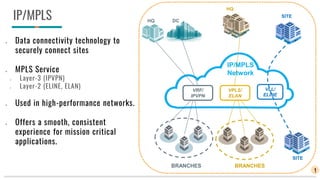
IP/MPLS
 Data connectivity technology to
securely connect sites
 MPLS Service
 Layer-3 (IPVPN)
 Layer-2 (ELINE, ELAN)
 Used in high-performance networks.
 Offers a smooth, consistent
experience for mission critical
applications.
1
IP/MPLS
Network
VRF/
IPVPN
VPLS/
ELAN
VLL/
ELINE
HQ DC
SITE
SITE
BRANCHES
HQ
BRANCHES
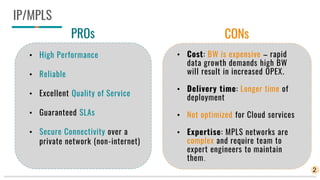
IP/MPLS
PROs
• High Performance
• Reliable
• Excellent Quality of Service
• Guaranteed SLAs
• Secure Connectivity over a
private network (non-internet)
CONs
• Cost: BW is expensive – rapid
data growth demands high BW
will result in increased OPEX.
• Delivery time: Longer time of
deployment
• Not optimized for Cloud services
• Expertise: MPLS networks are
complex and require team to
expert engineers to maintain
them.
2
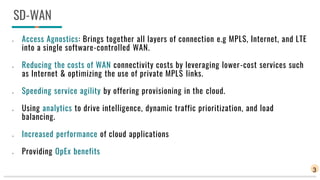
SD-WAN
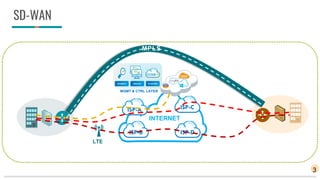
 Access Agnostics: Brings together all layers of connection e.g MPLS, Internet, and LTE
into a single software-controlled WAN.
 Reducing the costs of WAN connectivity costs by leveraging lower-cost services such
as Internet & optimizing the use of private MPLS links.
 Speeding service agility by offering provisioning in the cloud.
 Using analytics to drive intelligence, dynamic traffic prioritization, and load
balancing.
 Increased performance of cloud applications
 Providing OpEx benefits
3
SD-WAN
INTERNET
LTE
MPLS
MGMT & CTRL LAYER
3
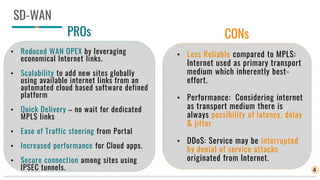
SD-WAN
PROs
• Reduced WAN OPEX by leveraging
economical Internet links.
• Scalability to add new sites globally
using available internet links from an
automated cloud based software defined
platform
• Quick Delivery – no wait for dedicated
MPLS links
• Ease of Traffic steering from Portal
• Increased performance for Cloud apps.
• Secure connection among sites using
IPSEC tunnels.
CONs
• Less Reliable compared to MPLS:
Internet used as primary transport
medium which inherently best-
effort.
• Performance: Considering internet
as transport medium there is
always possibility of latency, delay
& jitter
• DDoS: Service may be interrupted
by denial of service attacks
originated from Internet.
4
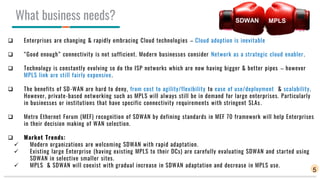
What business needs?
5
SDWAN MPLS
 Enterprises are changing & rapidly embracing Cloud technologies – Cloud adoption is inevitable
 “Good enough” connectivity is not sufficient. Modern businesses consider Network as a strategic cloud enabler.
 Technology is constantly evolving so do the ISP networks which are now having bigger & better pipes – however
MPLS link are still fairly expensive.
 The benefits of SD-WAN are hard to deny, from cost to agility/flexibility to ease of use/deployment & scalability.
However, private-based networking such as MPLS will always still be in demand for large enterprises. Particularly
in businesses or institutions that have specific connectivity requirements with stringent SLAs .
 Metro Ethernet Forum (MEF) recognition of SDWAN by defining standards in MEF 70 framework will help Enterprises
in their decision making of WAN selection.
 Market Trends:
 Modern organizations are welcoming SDWAN with rapid adaptation.
 Existing large Enterprise (having existing MPLS to their DCs) are carefully evaluating SDWAN and started using
SDWAN in selective smaller sites.
 MPLS & SDWAN will coexist with gradual increase in SDWAN adaptation and decrease in MPLS use.

SDWAN vs MPLS: What Enterprises need?

  • 1.
  • 2.
    IP/MPLS  Data connectivitytechnology to securely connect sites  MPLS Service  Layer-3 (IPVPN)  Layer-2 (ELINE, ELAN)  Used in high-performance networks.  Offers a smooth, consistent experience for mission critical applications. 1 IP/MPLS Network VRF/ IPVPN VPLS/ ELAN VLL/ ELINE HQ DC SITE SITE BRANCHES HQ BRANCHES
  • 3.
    IP/MPLS PROs • High Performance •Reliable • Excellent Quality of Service • Guaranteed SLAs • Secure Connectivity over a private network (non-internet) CONs • Cost: BW is expensive – rapid data growth demands high BW will result in increased OPEX. • Delivery time: Longer time of deployment • Not optimized for Cloud services • Expertise: MPLS networks are complex and require team to expert engineers to maintain them. 2
  • 4.
    SD-WAN  Access Agnostics:Brings together all layers of connection e.g MPLS, Internet, and LTE into a single software-controlled WAN.  Reducing the costs of WAN connectivity costs by leveraging lower-cost services such as Internet & optimizing the use of private MPLS links.  Speeding service agility by offering provisioning in the cloud.  Using analytics to drive intelligence, dynamic traffic prioritization, and load balancing.  Increased performance of cloud applications  Providing OpEx benefits 3
  • 5.
  • 6.
    SD-WAN PROs • Reduced WANOPEX by leveraging economical Internet links. • Scalability to add new sites globally using available internet links from an automated cloud based software defined platform • Quick Delivery – no wait for dedicated MPLS links • Ease of Traffic steering from Portal • Increased performance for Cloud apps. • Secure connection among sites using IPSEC tunnels. CONs • Less Reliable compared to MPLS: Internet used as primary transport medium which inherently best- effort. • Performance: Considering internet as transport medium there is always possibility of latency, delay & jitter • DDoS: Service may be interrupted by denial of service attacks originated from Internet. 4
  • 7.
    What business needs? 5 SDWANMPLS  Enterprises are changing & rapidly embracing Cloud technologies – Cloud adoption is inevitable  “Good enough” connectivity is not sufficient. Modern businesses consider Network as a strategic cloud enabler.  Technology is constantly evolving so do the ISP networks which are now having bigger & better pipes – however MPLS link are still fairly expensive.  The benefits of SD-WAN are hard to deny, from cost to agility/flexibility to ease of use/deployment & scalability. However, private-based networking such as MPLS will always still be in demand for large enterprises. Particularly in businesses or institutions that have specific connectivity requirements with stringent SLAs .  Metro Ethernet Forum (MEF) recognition of SDWAN by defining standards in MEF 70 framework will help Enterprises in their decision making of WAN selection.  Market Trends:  Modern organizations are welcoming SDWAN with rapid adaptation.  Existing large Enterprise (having existing MPLS to their DCs) are carefully evaluating SDWAN and started using SDWAN in selective smaller sites.  MPLS & SDWAN will coexist with gradual increase in SDWAN adaptation and decrease in MPLS use.