Why Software DefinedWhy Software Defined
Networking (SDN)?Networking (SDN)?
Boyan SotirovBoyan Sotirov
2
Agenda
Current State of Networking
Why
What
How
When
3
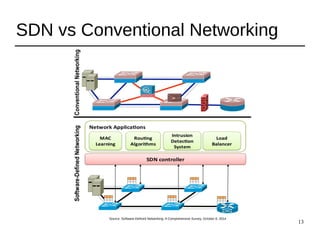
Conventional Networking
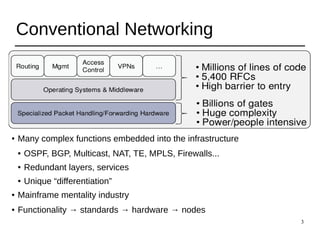
● Many complex functions embedded into the infrastructure
● OSPF, BGP, Multicast, NAT, TE, MPLS, Firewalls...
● Redundant layers, services
● Unique “differentiation”
● Mainframe mentality industry
● Functionality → standards → hardware → nodes
4
Conventional Networking
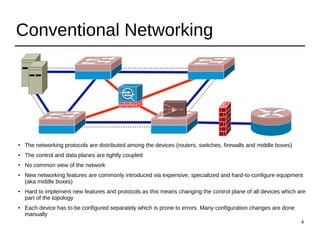
● The networking protocols are distributed among the devices (routers, switches, firewalls and middle boxes)
● The control and data planes are tightly coupled
● No common view of the network
● New networking features are commonly introduced via expensive, specialized and hard-to-configure equipment
(aka middle boxes)
●
Hard to implement new features and protocols as this means changing the control plane of all devices which are
part of the topology
●
Each device has to be configured separately which is prone to errors. Many configuration changes are done
manually
5
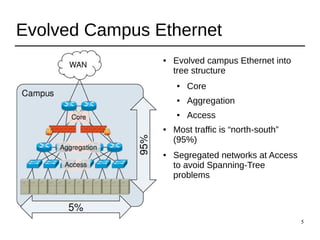
Evolved Campus Ethernet
● Evolved campus Ethernet into
tree structure
● Core
● Aggregation
● Access
● Most traffic is “north-south”
(95%)
● Segregated networks at Access
to avoid Spanning-Tree
problems
6
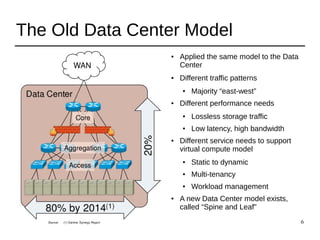
The Old Data Center Model
● Applied the same model to the Data
Center
● Different traffic patterns
● Majority “east-west”
● Different performance needs
● Lossless storage traffic
● Low latency, high bandwidth
● Different service needs to support
virtual compute model
● Static to dynamic
● Multi-tenancy
● Workload management
● A new Data Center model exists,
called “Spine and Leaf”
7
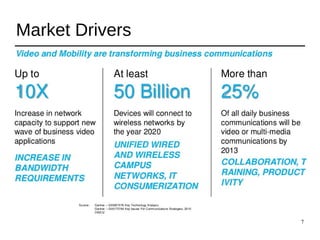
Market Drivers
8
Market Drivers Summarized
● Changing Traffic Patterns
● The “consumerization of IT”
● The rise of cloud services
● “Big Data” means more bandwidth
Source: ONF White Paper Software-Defined Networking: The New Norm for Networks, April 13, 2012
9
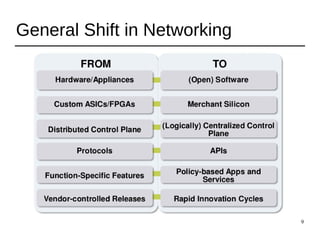
General Shift in Networking
10
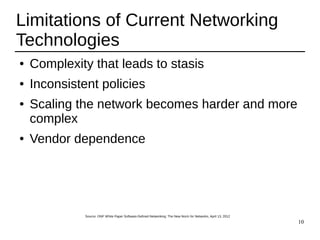
Limitations of Current Networking
Technologies
● Complexity that leads to stasis
● Inconsistent policies
● Scaling the network becomes harder and more
complex
● Vendor dependence
Source: ONF White Paper Software-Defined Networking: The New Norm for Networks, April 13, 2012
11
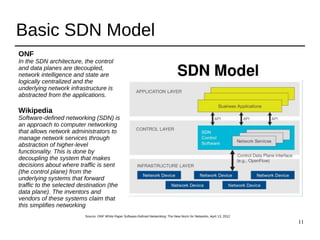
Basic SDN Model
ONF
In the SDN architecture, the control
and data planes are decoupled,
network intelligence and state are
logically centralized and the
underlying network infrastructure is
abstracted from the applications.
Wikipedia
Software-defined networking (SDN) is
an approach to computer networking
that allows network administrators to
manage network services through
abstraction of higher-level
functionality. This is done by
decoupling the system that makes
decisions about where traffic is sent
(the control plane) from the
underlying systems that forward
traffic to the selected destination (the
data plane). The inventors and
vendors of these systems claim that
this simplifies networking
Source: ONF White Paper Software-Defined Networking: The New Norm for Networks, April 13, 2012
12
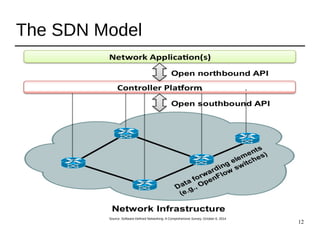
The SDN Model
Source: Software-Defined Networking: A Comprehensive Survey, October 8, 2014
13
SDN vs Conventional Networking
Source: Software-Defined Networking: A Comprehensive Survey, October 8, 2014
14
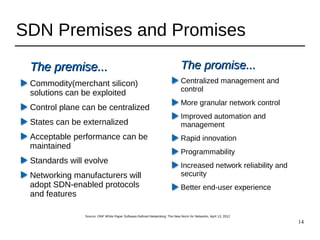
SDN Premises and Promises
The premise...The premise...
Commodity(merchant silicon)
solutions can be exploited
Control plane can be centralized
States can be externalized
Acceptable performance can be
maintained
Standards will evolve
Networking manufacturers will
adopt SDN-enabled protocols
and features
The promise...The promise...
Centralized management and
control
More granular network control
Improved automation and
management
Rapid innovation
Programmability
Increased network reliability and
security
Better end-user experience
Source: ONF White Paper Software-Defined Networking: The New Norm for Networks, April 13, 2012
15
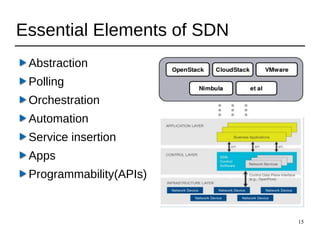
Essential Elements of SDN
Abstraction
Polling
Orchestration
Automation
Service insertion
Apps
Programmability(APIs)
16
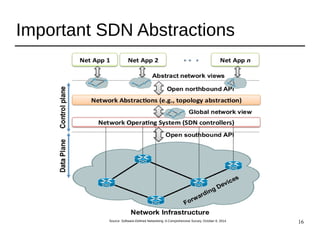
Important SDN Abstractions
Source: Software-Defined Networking: A Comprehensive Survey, October 8, 2014
17
And before we move on...
Let us consider another well known abstraction model as an analogy to
better understand SDN abstractions
Operating System
Model
18
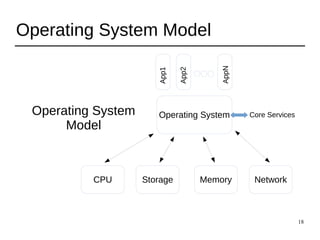
Operating System Model
Operating System
Model
Operating System Core Services
CPU Storage Memory Network
App1
App2
AppN
19
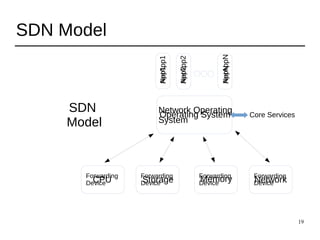
SDN Model
App1
App2
AppN
SDN
Model
Operating System
CPU Storage Memory Network
Network Operating
System
Core Services
Forwarding
Device
Forwarding
Device
Forwarding
Device
Forwarding
Device
NetApp1
NetApp2
NetAppN
21
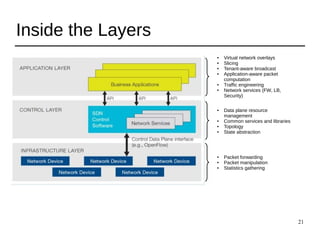
Inside the Layers
● Virtual network overlays
● Slicing
● Tenant-aware broadcast
● Application-aware packet
computation
● Traffic engineering
● Network services (FW, LB,
Security)
● Data plane resource
management
● Common services and libraries
● Topology
● State abstraction
● Packet forwarding
● Packet manipulation
● Statistics gathering
22
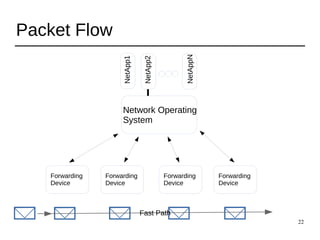
Packet Flow
Network Operating
System
Forwarding
Device
NetApp1
NetApp2
NetAppN
Forwarding
Device
Forwarding
Device
Forwarding
Device
Fast Path
24
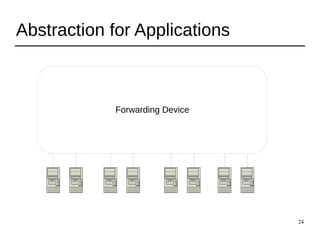
Abstraction for Applications
Forwarding
Device
Forwarding
Device
Forwarding
Device
Forwarding
Device
Forwarding
Device
Forwarding
Device
Forwarding Device
25
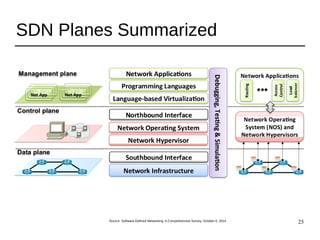
SDN Planes Summarized
Source: Software-Defined Networking: A Comprehensive Survey, October 8, 2014
26
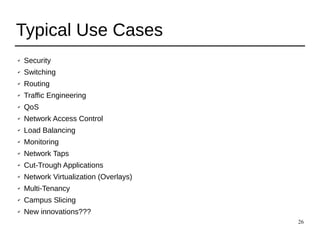
Typical Use Cases
✔ Security
✔ Switching
✔ Routing
✔ Traffic Engineering
✔ QoS
✔ Network Access Control
✔ Load Balancing
✔ Monitoring
✔ Network Taps
✔ Cut-Trough Applications
✔ Network Virtualization (Overlays)
✔ Multi-Tenancy
✔ Campus Slicing
✔ New innovations???
27
OpenFlow
OpenFlow = SDN
(by itself)
28
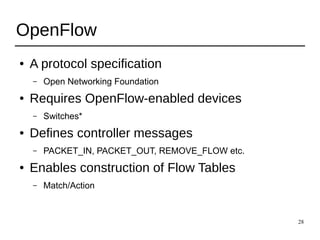
OpenFlow
● A protocol specification
– Open Networking Foundation
● Requires OpenFlow-enabled devices
– Switches*
● Defines controller messages
– PACKET_IN, PACKET_OUT, REMOVE_FLOW etc.
● Enables construction of Flow Tables
– Match/Action
29
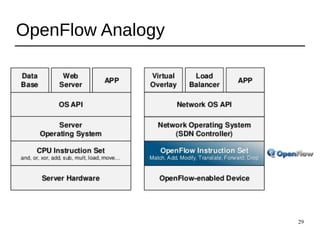
OpenFlow Analogy
30
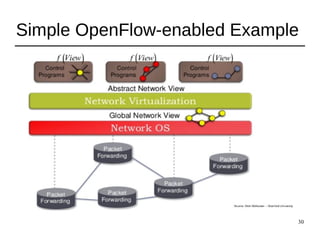
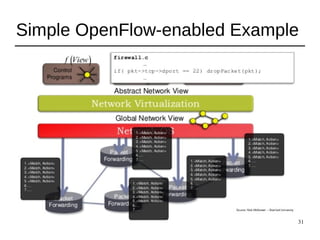
Simple OpenFlow-enabled Example
31
Simple OpenFlow-enabled Example
32
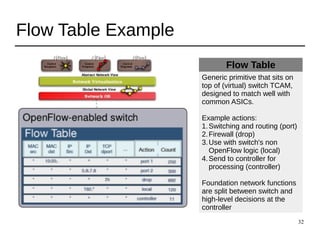
Flow Table Example
Flow Table
Generic primitive that sits on
top of (virtual) switch TCAM,
designed to match well with
common ASICs.
Example actions:
1.Switching and routing (port)
2.Firewall (drop)
3.Use with switch's non
OpenFlow logic (local)
4.Send to controller for
processing (controller)
Foundation network functions
are split between switch and
high-level decisions at the
controller
33
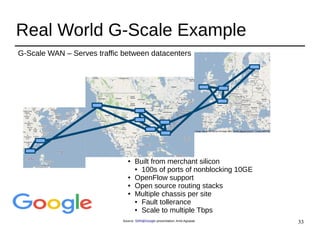
Real World G-Scale Example
● Built from merchant silicon
● 100s of ports of nonblocking 10GE
● OpenFlow support
● Open source routing stacks
● Multiple chassis per site
● Fault tollerance
● Scale to multiple Tbps
G-Scale WAN – Serves traffic between datacenters
Source: SDN@Google presentation, Amit Agrawal
34
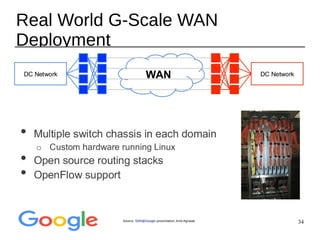
Real World G-Scale WAN
Deployment
Source: SDN@Google presentation, Amit Agrawal
35
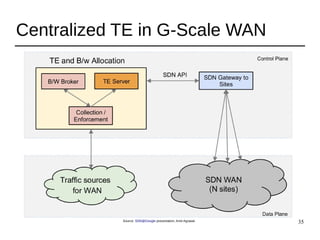
Centralized TE in G-Scale WAN
Source: SDN@Google presentation, Amit Agrawal
36
Benefits of SDN for G-Scale WAN
● Unified view of the network fabric
– Simplifies configuration, management and provisioning
● High utilization – up to 95% utilization of the network
● Faster failure handling
– Systems converge faster to target optimum and behavior is
predictable
● Faster time to market/deployment
– Only features needed are developed and rigorous testing helps
accelerate deployment
● Hitless upgrade
Source: SDN@Google presentation, Amit Agrawal
37
Data Center/Cloud Networking
Issues
● VLAN limits (4094)
● Spanning Tree Protocol disabled links
● Reconfiguration to extend VLANs
● MAC address contention
● MAC address table size in ToR switches
● Layer 3 address contention
● Security “choke points”
● ...
38
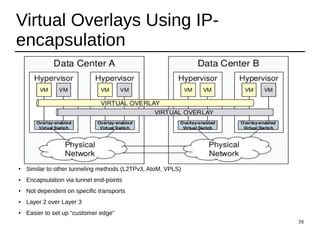
Virtual Overlays Using IP-
encapsulation
● Similar to other tunneling methods (L2TPv3, AtoM, VPLS)
● Encapsulation via tunnel end-points
● Not dependent on specific transports
● Layer 2 over Layer 3
● Easier to set up “customer edge”
39
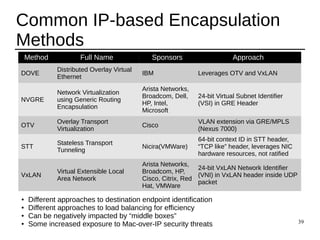
Common IP-based Encapsulation
Methods
Method Full Name Sponsors Approach
DOVE
Distributed Overlay Virtual
Ethernet
IBM Leverages OTV and VxLAN
NVGRE
Network Virtualization
using Generic Routing
Encapsulation
Arista Networks,
Broadcom, Dell,
HP, Intel,
Microsoft
24-bit Virtual Subnet Identifier
(VSI) in GRE Header
OTV
Overlay Transport
Virtualization
Cisco
VLAN extension via GRE/MPLS
(Nexus 7000)
STT
Stateless Transport
Tunneling
Nicira(VMWare)
64-bit context ID in STT header,
“TCP like” header, leverages NIC
hardware resources, not ratified
VxLAN
Virtual Extensible Local
Area Network
Arista Networks,
Broadcom, HP,
Cisco, Citrix, Red
Hat, VMWare
24-bit VxLAN Network Identifier
(VNI) in VxLAN header inside UDP
packet
● Different approaches to destination endpoint identification
● Different approaches to load balancing for efficiency
● Can be negatively impacted by “middle boxes”
● Some increased exposure to Mac-over-IP security threats
40
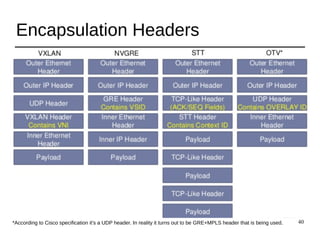
Encapsulation Headers
*According to Cisco specification it's a UDP header. In reality it turns out to be GRE+MPLS header that is being used.
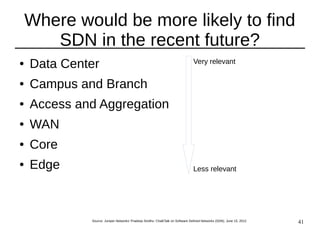
41
Where would be more likely to find
SDN in the recent future?
● Data Center
● Campus and Branch
● Access and Aggregation
● WAN
● Core
● Edge
Very relevant
Less relevant
Source: Juniper Networks' Pradeep Sindhu: ChalkTalk on Software Defined Networks (SDN), June 15, 2012
42
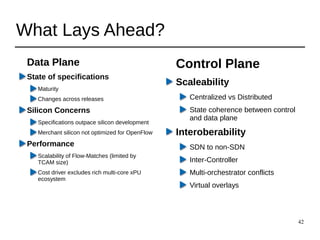
What Lays Ahead?
Data Plane
State of specifications
Maturity
Changes across releases
Silicon Concerns
Specifications outpace silicon development
Merchant silicon not optimized for OpenFlow
Performance
Scalability of Flow-Matches (limited by
TCAM size)
Cost driver excludes rich multi-core xPU
ecosystem
Control Plane
Scaleability
Centralized vs Distributed
State coherence between control
and data plane
Interoberability
SDN to non-SDN
Inter-Controller
Multi-orchestrator conflicts
Virtual overlays
43
Credits
● Software-Defined Networking: A Comprehensive Survey, October 8, 2014
● ONF White Paper Software-Defined Networking: The New Norm for Networks, April 13, 2012
● Software-Defined Networking (SDN): Unleashing the Power of the Network, presentation by Robert Keahey
● Introduction to SDN (Software-defined Networking), David Mahler, November 3, 2014
● SDN@Google presentation, Amit Agrawal

Why sdn

  • 1.
    Why Software DefinedWhySoftware Defined Networking (SDN)?Networking (SDN)? Boyan SotirovBoyan Sotirov
  • 2.
    2 Agenda Current State ofNetworking Why What How When
  • 3.
    3 Conventional Networking ● Manycomplex functions embedded into the infrastructure ● OSPF, BGP, Multicast, NAT, TE, MPLS, Firewalls... ● Redundant layers, services ● Unique “differentiation” ● Mainframe mentality industry ● Functionality → standards → hardware → nodes
  • 4.
    4 Conventional Networking ● Thenetworking protocols are distributed among the devices (routers, switches, firewalls and middle boxes) ● The control and data planes are tightly coupled ● No common view of the network ● New networking features are commonly introduced via expensive, specialized and hard-to-configure equipment (aka middle boxes) ● Hard to implement new features and protocols as this means changing the control plane of all devices which are part of the topology ● Each device has to be configured separately which is prone to errors. Many configuration changes are done manually
  • 5.
    5 Evolved Campus Ethernet ●Evolved campus Ethernet into tree structure ● Core ● Aggregation ● Access ● Most traffic is “north-south” (95%) ● Segregated networks at Access to avoid Spanning-Tree problems
  • 6.
    6 The Old DataCenter Model ● Applied the same model to the Data Center ● Different traffic patterns ● Majority “east-west” ● Different performance needs ● Lossless storage traffic ● Low latency, high bandwidth ● Different service needs to support virtual compute model ● Static to dynamic ● Multi-tenancy ● Workload management ● A new Data Center model exists, called “Spine and Leaf”
  • 7.
  • 8.
    8 Market Drivers Summarized ●Changing Traffic Patterns ● The “consumerization of IT” ● The rise of cloud services ● “Big Data” means more bandwidth Source: ONF White Paper Software-Defined Networking: The New Norm for Networks, April 13, 2012
  • 9.
  • 10.
    10 Limitations of CurrentNetworking Technologies ● Complexity that leads to stasis ● Inconsistent policies ● Scaling the network becomes harder and more complex ● Vendor dependence Source: ONF White Paper Software-Defined Networking: The New Norm for Networks, April 13, 2012
  • 11.
    11 Basic SDN Model ONF Inthe SDN architecture, the control and data planes are decoupled, network intelligence and state are logically centralized and the underlying network infrastructure is abstracted from the applications. Wikipedia Software-defined networking (SDN) is an approach to computer networking that allows network administrators to manage network services through abstraction of higher-level functionality. This is done by decoupling the system that makes decisions about where traffic is sent (the control plane) from the underlying systems that forward traffic to the selected destination (the data plane). The inventors and vendors of these systems claim that this simplifies networking Source: ONF White Paper Software-Defined Networking: The New Norm for Networks, April 13, 2012
  • 12.
    12 The SDN Model Source:Software-Defined Networking: A Comprehensive Survey, October 8, 2014
  • 13.
    13 SDN vs ConventionalNetworking Source: Software-Defined Networking: A Comprehensive Survey, October 8, 2014
  • 14.
    14 SDN Premises andPromises The premise...The premise... Commodity(merchant silicon) solutions can be exploited Control plane can be centralized States can be externalized Acceptable performance can be maintained Standards will evolve Networking manufacturers will adopt SDN-enabled protocols and features The promise...The promise... Centralized management and control More granular network control Improved automation and management Rapid innovation Programmability Increased network reliability and security Better end-user experience Source: ONF White Paper Software-Defined Networking: The New Norm for Networks, April 13, 2012
  • 15.
    15 Essential Elements ofSDN Abstraction Polling Orchestration Automation Service insertion Apps Programmability(APIs)
  • 16.
    16 Important SDN Abstractions Source:Software-Defined Networking: A Comprehensive Survey, October 8, 2014
  • 17.
    17 And before wemove on... Let us consider another well known abstraction model as an analogy to better understand SDN abstractions Operating System Model
  • 18.
    18 Operating System Model OperatingSystem Model Operating System Core Services CPU Storage Memory Network App1 App2 AppN
  • 19.
    19 SDN Model App1 App2 AppN SDN Model Operating System CPUStorage Memory Network Network Operating System Core Services Forwarding Device Forwarding Device Forwarding Device Forwarding Device NetApp1 NetApp2 NetAppN
  • 20.
    21 Inside the Layers ●Virtual network overlays ● Slicing ● Tenant-aware broadcast ● Application-aware packet computation ● Traffic engineering ● Network services (FW, LB, Security) ● Data plane resource management ● Common services and libraries ● Topology ● State abstraction ● Packet forwarding ● Packet manipulation ● Statistics gathering
  • 21.
  • 22.
  • 23.
    25 SDN Planes Summarized Source:Software-Defined Networking: A Comprehensive Survey, October 8, 2014
  • 24.
    26 Typical Use Cases ✔Security ✔ Switching ✔ Routing ✔ Traffic Engineering ✔ QoS ✔ Network Access Control ✔ Load Balancing ✔ Monitoring ✔ Network Taps ✔ Cut-Trough Applications ✔ Network Virtualization (Overlays) ✔ Multi-Tenancy ✔ Campus Slicing ✔ New innovations???
  • 25.
  • 26.
    28 OpenFlow ● A protocolspecification – Open Networking Foundation ● Requires OpenFlow-enabled devices – Switches* ● Defines controller messages – PACKET_IN, PACKET_OUT, REMOVE_FLOW etc. ● Enables construction of Flow Tables – Match/Action
  • 27.
  • 28.
  • 29.
  • 30.
    32 Flow Table Example FlowTable Generic primitive that sits on top of (virtual) switch TCAM, designed to match well with common ASICs. Example actions: 1.Switching and routing (port) 2.Firewall (drop) 3.Use with switch's non OpenFlow logic (local) 4.Send to controller for processing (controller) Foundation network functions are split between switch and high-level decisions at the controller
  • 31.
    33 Real World G-ScaleExample ● Built from merchant silicon ● 100s of ports of nonblocking 10GE ● OpenFlow support ● Open source routing stacks ● Multiple chassis per site ● Fault tollerance ● Scale to multiple Tbps G-Scale WAN – Serves traffic between datacenters Source: SDN@Google presentation, Amit Agrawal
  • 32.
    34 Real World G-ScaleWAN Deployment Source: SDN@Google presentation, Amit Agrawal
  • 33.
    35 Centralized TE inG-Scale WAN Source: SDN@Google presentation, Amit Agrawal
  • 34.
    36 Benefits of SDNfor G-Scale WAN ● Unified view of the network fabric – Simplifies configuration, management and provisioning ● High utilization – up to 95% utilization of the network ● Faster failure handling – Systems converge faster to target optimum and behavior is predictable ● Faster time to market/deployment – Only features needed are developed and rigorous testing helps accelerate deployment ● Hitless upgrade Source: SDN@Google presentation, Amit Agrawal
  • 35.
    37 Data Center/Cloud Networking Issues ●VLAN limits (4094) ● Spanning Tree Protocol disabled links ● Reconfiguration to extend VLANs ● MAC address contention ● MAC address table size in ToR switches ● Layer 3 address contention ● Security “choke points” ● ...
  • 36.
    38 Virtual Overlays UsingIP- encapsulation ● Similar to other tunneling methods (L2TPv3, AtoM, VPLS) ● Encapsulation via tunnel end-points ● Not dependent on specific transports ● Layer 2 over Layer 3 ● Easier to set up “customer edge”
  • 37.
    39 Common IP-based Encapsulation Methods MethodFull Name Sponsors Approach DOVE Distributed Overlay Virtual Ethernet IBM Leverages OTV and VxLAN NVGRE Network Virtualization using Generic Routing Encapsulation Arista Networks, Broadcom, Dell, HP, Intel, Microsoft 24-bit Virtual Subnet Identifier (VSI) in GRE Header OTV Overlay Transport Virtualization Cisco VLAN extension via GRE/MPLS (Nexus 7000) STT Stateless Transport Tunneling Nicira(VMWare) 64-bit context ID in STT header, “TCP like” header, leverages NIC hardware resources, not ratified VxLAN Virtual Extensible Local Area Network Arista Networks, Broadcom, HP, Cisco, Citrix, Red Hat, VMWare 24-bit VxLAN Network Identifier (VNI) in VxLAN header inside UDP packet ● Different approaches to destination endpoint identification ● Different approaches to load balancing for efficiency ● Can be negatively impacted by “middle boxes” ● Some increased exposure to Mac-over-IP security threats
  • 38.
    40 Encapsulation Headers *According toCisco specification it's a UDP header. In reality it turns out to be GRE+MPLS header that is being used.
  • 39.
    41 Where would bemore likely to find SDN in the recent future? ● Data Center ● Campus and Branch ● Access and Aggregation ● WAN ● Core ● Edge Very relevant Less relevant Source: Juniper Networks' Pradeep Sindhu: ChalkTalk on Software Defined Networks (SDN), June 15, 2012
  • 40.
    42 What Lays Ahead? DataPlane State of specifications Maturity Changes across releases Silicon Concerns Specifications outpace silicon development Merchant silicon not optimized for OpenFlow Performance Scalability of Flow-Matches (limited by TCAM size) Cost driver excludes rich multi-core xPU ecosystem Control Plane Scaleability Centralized vs Distributed State coherence between control and data plane Interoberability SDN to non-SDN Inter-Controller Multi-orchestrator conflicts Virtual overlays
  • 41.
    43 Credits ● Software-Defined Networking:A Comprehensive Survey, October 8, 2014 ● ONF White Paper Software-Defined Networking: The New Norm for Networks, April 13, 2012 ● Software-Defined Networking (SDN): Unleashing the Power of the Network, presentation by Robert Keahey ● Introduction to SDN (Software-defined Networking), David Mahler, November 3, 2014 ● SDN@Google presentation, Amit Agrawal